
Marketing Management Unit II Consumer Behaviour and Market
Marketing Management (Unit II) Consumer Behaviour and Market Segmentation
Consumer Behaviour “Consumer behaviour is the study of how individual customers, groups or organizations select, buy, use, and dispose ideas, goods, and services to satisfy their needs and wants. “ It refers to the actions of the consumers in the marketplace and the underlying motives for those actions.

Stages in Buying Process Need Recognition Information Search Evaluation of Alternatives Purchase Decision Postpurchase Behaviour
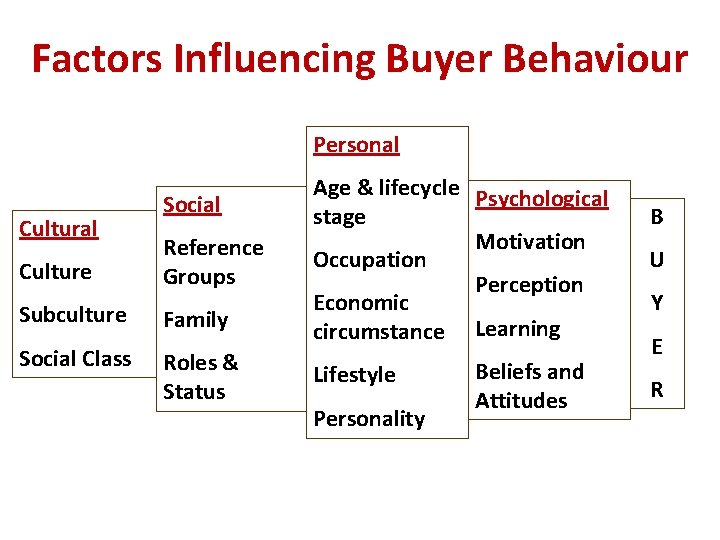
Factors Influencing Buyer Behaviour Personal Culture Subculture Social Class Social Reference Groups Family Roles & Status Age & lifecycle Psychological stage Motivation Occupation Perception Economic circumstance Learning Lifestyle Personality Beliefs and Attitudes B U Y E R
Buying Motive “A motive is the inner state that moves, or prompts a person to action” W. J. Stanton “A motive may be defined as a drive or an urge for which can individual seeks satisfaction. It becomes a buying motive when the individual seeks satisfaction through the purchase of something. ”
Classification / Types of Buying Motives 1. Physical, Psychological and Sociological Buying Motives 2. Acquired and Inherent Buying Motives 3. Primary and Selective Buying Motives 4. Conscious and Dormant Buying Motives 5. Rational and Emotional Buying Motives
Market Segmentation Market Group of individuals or organisations that may want the good or service being offered for sale based on following criteria: • They have the ability or purchasing power to buy the product being offered • They have the willingness to spend money or exchange other resources to obtain the product • They have the authority to make such expenditures
Market Segmentation “It is dividing a heterogeneous market into a number of smaller, more homogeneous submarkets. ” “Markets consist of of buyers, and buyers differ in one or more respects. They may differ in their wants, purchasing power, geographical locations, buying attitudes, and buying practices. Any of these variables can be used to segment a market. ” - Philip Kotler “It is grouping of consumers on common characteristics. ”
Bases for Segmenting Consumer Markets • Geographic • Demographic • Psychographic • Behavioural
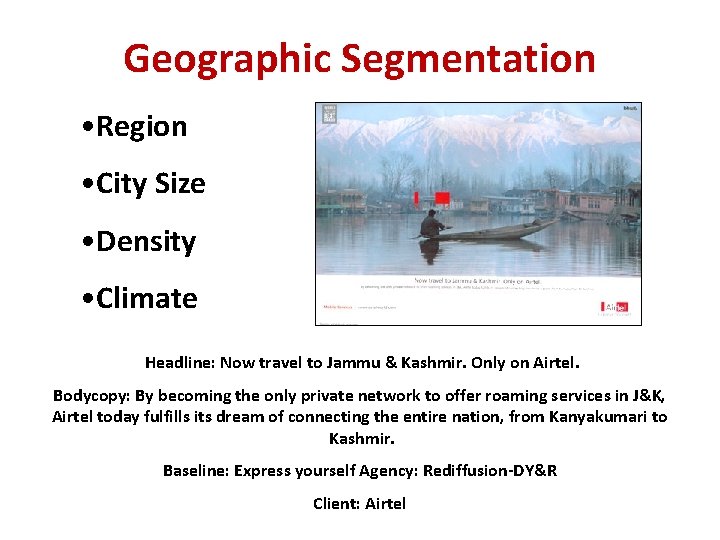
Geographic Segmentation • Region • City Size • Density • Climate Headline: Now travel to Jammu & Kashmir. Only on Airtel. Bodycopy: By becoming the only private network to offer roaming services in J&K, Airtel today fulfills its dream of connecting the entire nation, from Kanyakumari to Kashmir. Baseline: Express yourself Agency: Rediffusion-DY&R Client: Airtel
Demographic Segmentation • Age • Gender • Family Size • Family Type • Family Life Cycle • Household Income • Occupation • Education • Religion
Psychographic Segmentation • Social Class • Lifestyle • Personality
Behavioural Segmentation • Occassions • Benefits • User Status • Usage Rate • Loyalty Status • Readiness Stage • Attitude toward product
Criteria for Effective Segmentation/ Requirements for Successful Segmentation 1. Substantiability: Largest Possible Homogeneous group. 2. Accessibility: Effectively Reached and Served 3. Measurable: Size, Potential and other relevant characteristics of the segment. 4. Nature of Demand: Have demand for the product/ service. 5. Appropriate: to the organisation’s objectives 6. Stable: in consumer behaviour 7. Actionable/ Feasible: with a particular marketing programme.
Benefits or Importance of Segmentation 1. Provides various types of information that are useful in product development, Marketing Research, etc. 2. Channelises money and effort to the potential (profitable) segments of the market. 3. Designs the products, which truly parallel the demands of the market. 4. Facilitates the preparation of sound marketing programme. 5. Gives chance to prepare for changing trends prevailing in the market
Benefits or Importance of Segmentation (Cont. ) 6. Determines the most effective promotional appeals 7. Chooses advertising media more wisely 8. Corrects the timing of the advertising efforts 9. Helps manufacturer to face the competition effectively 10. Helps the producer to understand the demographic market information
- Slides: 16