
MARKETING MANAGEMENT MBA 4051 Chapter Three Analysing Marketing
MARKETING MANAGEMENT (MBA 4051) Chapter: Three Analysing Marketing Opportunities By: K. E (Ph. D)
Marketing Information System
Marketing Information System (MIS) A marketing information system (MIS) consists of people, equipment, and procedures to gather, sort, analyze, evaluate, and distribute needed, timely, and accurate information to marketing decision makers. (Philip Kotler) • Assess the information needs • Develop and analyze needed information • Distribute and using information
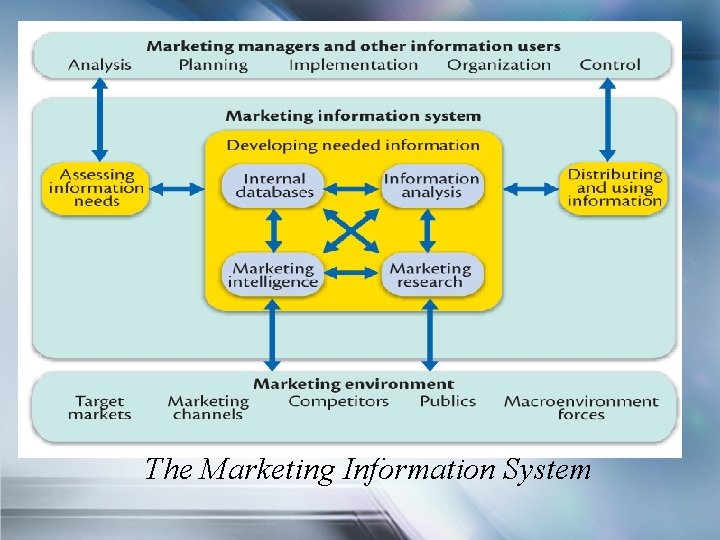
The Marketing Information System
Cont… • MIS provides information to the company’s marketing and other managers and external partners such as suppliers, resellers, and marketing service agencies Marketers can obtain information from: • Internal data • Marketing intelligence • Marketing research
Internal Data • Internal databases are electronic collections of consumer and market information obtained from data sources within the company network, including accounting, marketing, customer service, and sales departments.
Advantages and Disadvantage of Internal Databases Advantages: • Can be accessed more quickly • Less expensive Disadvantages: • Incomplete information • Wrong form for decision making • Timeliness of information • Amount of information • Need for sophisticated equipment and techniques
Marketing Intelligence • Marketing intelligence is the systematic collection and analysis of publicly available information about competitors and developments in the marketplace. • The goal of marketing intelligence is to: • Improve strategic decision making, • Assess and track competitors’ actions, and • Provide early warning of opportunities and threats.
Marketing research is the systematic design, collection, analysis, and reporting of data relevant to a specific marketing situation facing an organization.
FEATURES OF MARKETING RESEARCH o It is a systematic process carried out in a stepwise process o It should be objective and the research should not be carried out to establish an opinion o It is multi-disciplinary in the sense that it is related to Statistics, Economics, Psychology and Sociology.
Objective Of Marketing Research • To understand why consumers buy a product • To forecast future sales and market share • To assess competitive strengths and strategies • To evaluate the effectiveness of marketing actions already undertaken • To asses customer satisfaction.
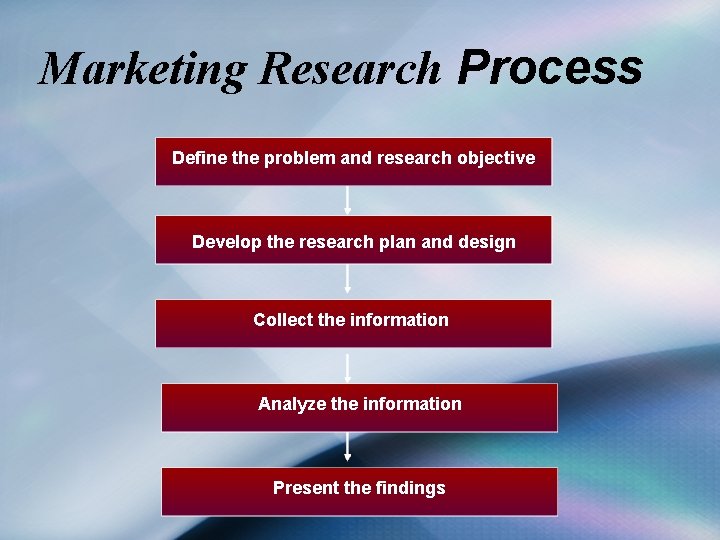
Marketing Research Process Define the problem and research objective Develop the research plan and design Collect the information Analyze the information Present the findings
STEP I : Define The Problem & Research Objective • Proper definition of the marketing problem will lead to useful and relevant results which can solve the marketing problem. • Usually research is conducted with one or more objectives and this forms the broad frame within which the research has to be conducted.
STEP 2: DEVELOP ESEARCH PLAN • A research plan is a framework within which collection and analysis of data is undertaken • This involves decisions on the following a. Data sources b. Research Approaches c. Research Instruments d. Sampling Plan
a. Data Sources • The researcher has to decided which source of data to use – Primary data or secondary data • Primary data are freshly gathered for a specific purpose or a specific research project • Secondary data are data which collected for some other purpose or for commercial purpose of selling
C. Research Instruments • The instruments used in research can 1. Questionnaire • This is the most commonly used to instrument which is highly flexible 2. Mechanical Device • Mechanical devices such as galvanometers, eye cameras, audiometers etc are used as research instruments
3. Observational Research • Fresh data is collected by observing people and situation 4. Focus Group Research • This is a group discussion method in which eight to twelve people are involved in the presence of a skilled moderator to discuss a product, service, a firm or any marketing related activity
5. Survey Research • Survey is undertaken with the help of questionnaires 6. Behavioral Research • Customers’ actual behavior in terms of actual purchases are obtained 7. Experimental Research • This is the most scientific method of research which tries to capture cause and effect relationship
d. Sampling Plan • The researcher has to prepare a sampling plan that should outline the following: o Who should be surveyed (Sampling Unit) o How many should be surveyed (Sample Size) o How should they be selected for the survey (Sampling Procedure)
Cont… – 1. Sampling Unit • Researcher must define the element of the target population in which the information shall be collected. – 2. Sample Size • Sample size is decided based on the nature of the study and variance in the population, level of accuracy desired and the budget available for research.
Sampling Procedure Two types of methods are available for selecting samples • Probability Sampling • Non-Probability Sampling
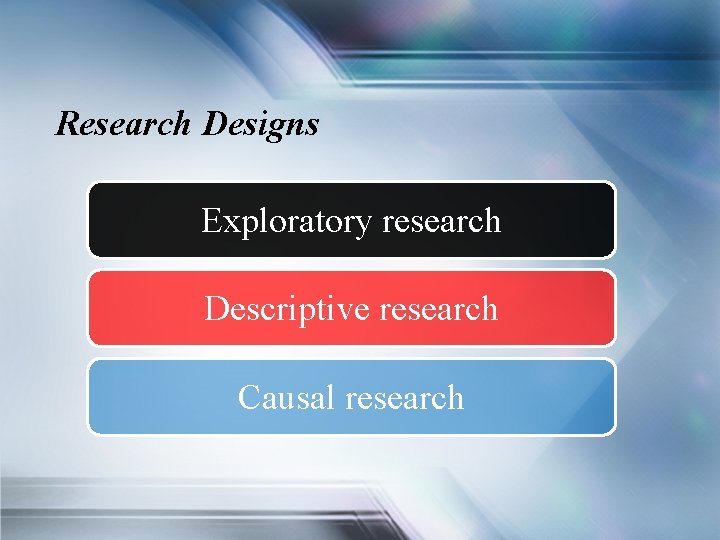
Research Designs Exploratory research Descriptive research Causal research
Step III – Collect the Information • After designing the research instrument, the researcher should now actually contact the respondent and collect the information • At this stage, it is very important to keep the quality of the data under control by ensuring accurate unbiased answers and by seeking the entire respondent’s cooperation. • The data collectors should be well trained.
Step IV: Analyze the information • In this stage researcher collects the data and codify it • Nowadays, many questionnaires are precoded • The coded data is then tabulated • Then the data is analyzed with the help of several statistical tools • Here the data is converted into information
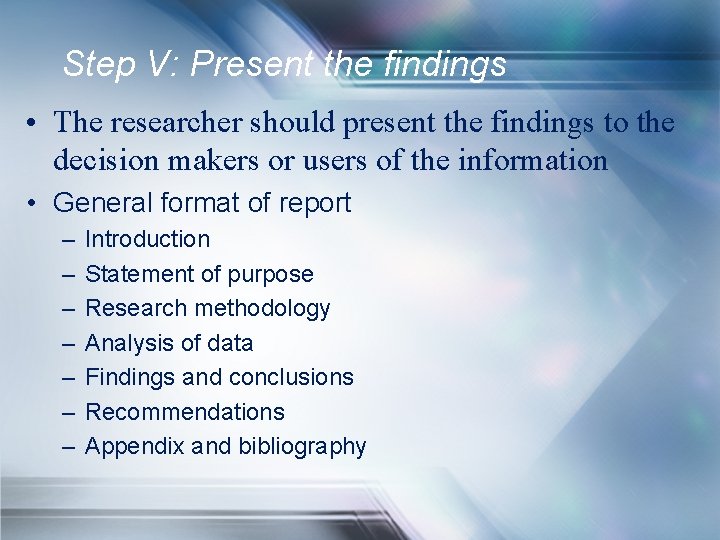
Step V: Present the findings • The researcher should present the findings to the decision makers or users of the information • General format of report – – – – Introduction Statement of purpose Research methodology Analysis of data Findings and conclusions Recommendations Appendix and bibliography
What is a Business Market ? The Business Market - all the organizations that buy goods and services to use in the production of other products and services that are sold, rented, or supplied to others. It also includes the behavior of retailing and wholesaling firms.
Similarity and difference between Business Market and individual Market Similarity Both involve people who assume buying roles and make purchase decisions to satisfy needs. Difference Business markets involve many more dollars and items do consumer markets.
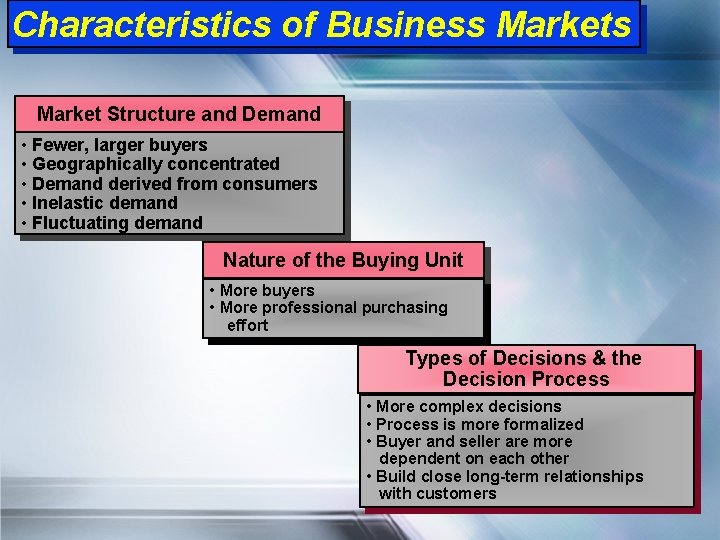
Characteristics of Business Market Structure and Demand • Fewer, larger buyers • Geographically concentrated • Demand derived from consumers • Inelastic demand • Fluctuating demand Nature of the Buying Unit • More buyers • More professional purchasing effort Types of Decisions & the Decision Process • More complex decisions • Process is more formalized • Buyer and seller are more dependent on each other • Build close long-term relationships with customers
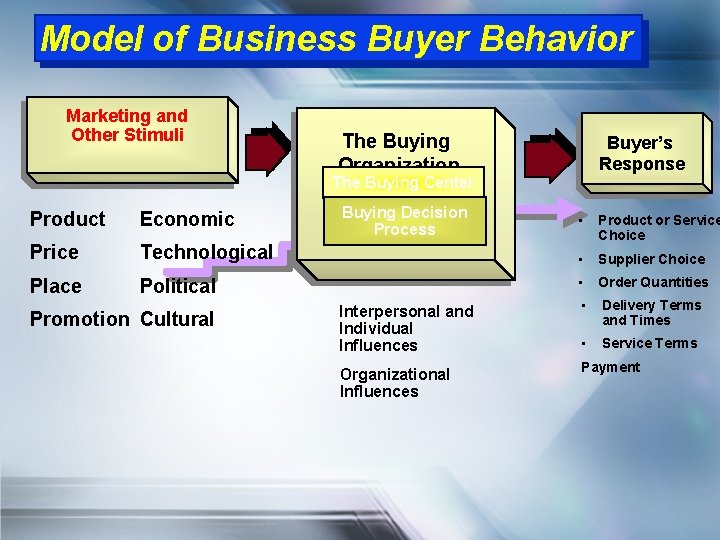
Model of Business Buyer Behavior Marketing and Other Stimuli The Buying Organization Buyer’s Response The Buying Center Product Economic Price Place Buying Decision Process • Technological Product or Service Choice • Supplier Choice Political • Order Quantities Interpersonal and Individual Influences • Delivery Terms and Times • Service Terms Organizational Influences Payment Promotion Cultural
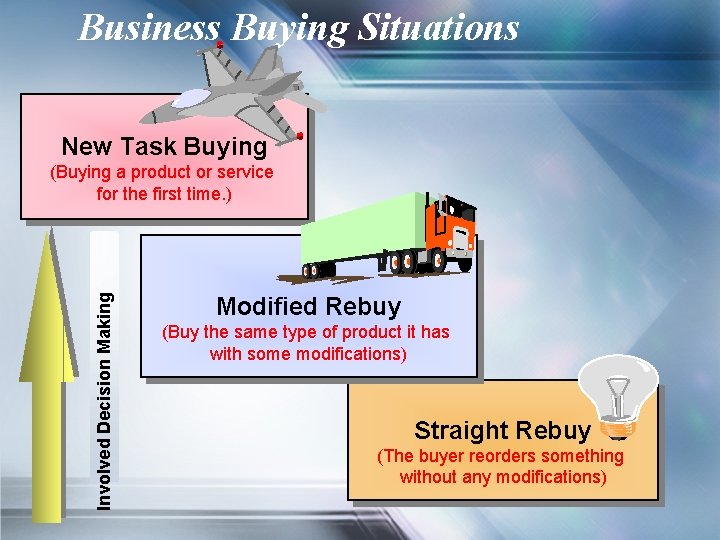
Business Buying Situations New Task Buying Involved Decision Making (Buying a product or service for the first time. ) Modified Rebuy (Buy the same type of product it has with some modifications) Straight Rebuy (The buyer reorders something without any modifications)
e s i rc E e x Discussion on the purchasing practice 1. What are the participants of gov’t office Purchases? 2. What are the steps of gov’t office Purchases? 3. Is consumer or Business buying more complex?
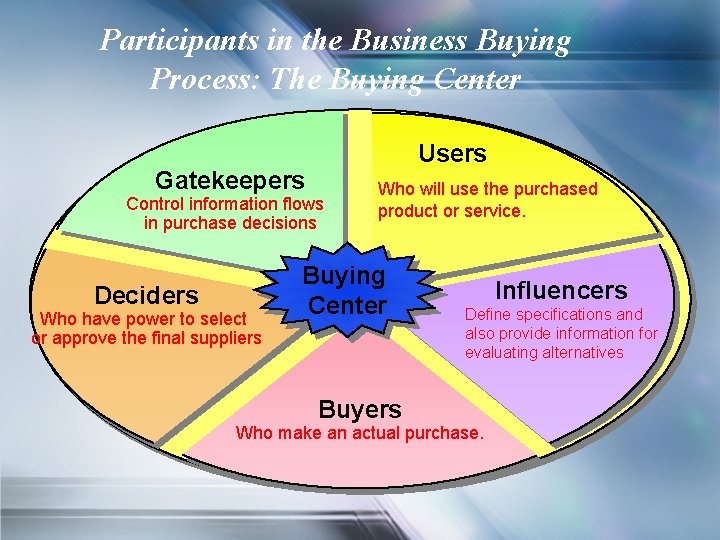
Participants in the Business Buying Process: The Buying Center Gatekeepers Users Control information flows in purchase decisions Deciders Who have power to select or approve the final suppliers Who will use the purchased product or service. Buying Center Buyers Influencers Define specifications and also provide information for evaluating alternatives Who make an actual purchase.
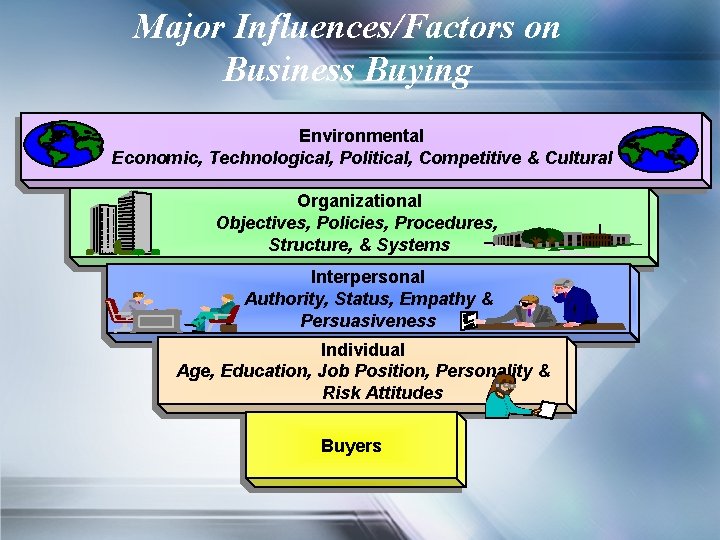
Major Influences/Factors on Business Buying Environmental Economic, Technological, Political, Competitive & Cultural Organizational Objectives, Policies, Procedures, Structure, & Systems Interpersonal Authority, Status, Empathy & Persuasiveness Individual Age, Education, Job Position, Personality & Risk Attitudes Buyers
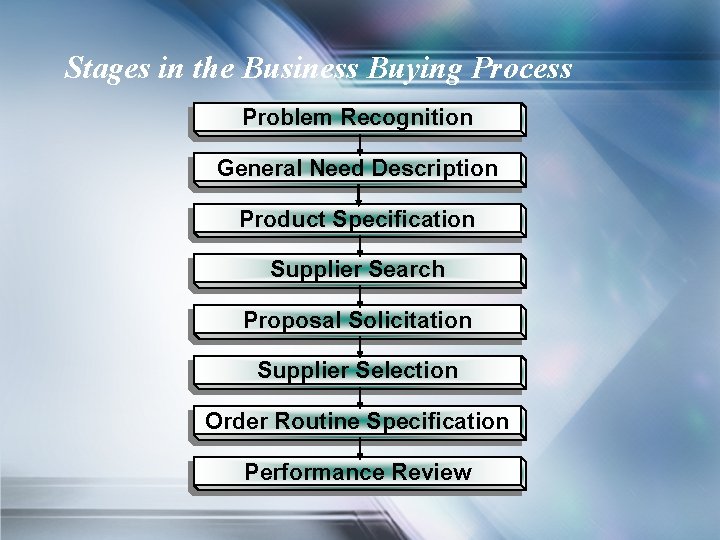
Stages in the Business Buying Process Problem Recognition General Need Description Product Specification Supplier Search Proposal Solicitation Supplier Selection Order Routine Specification Performance Review
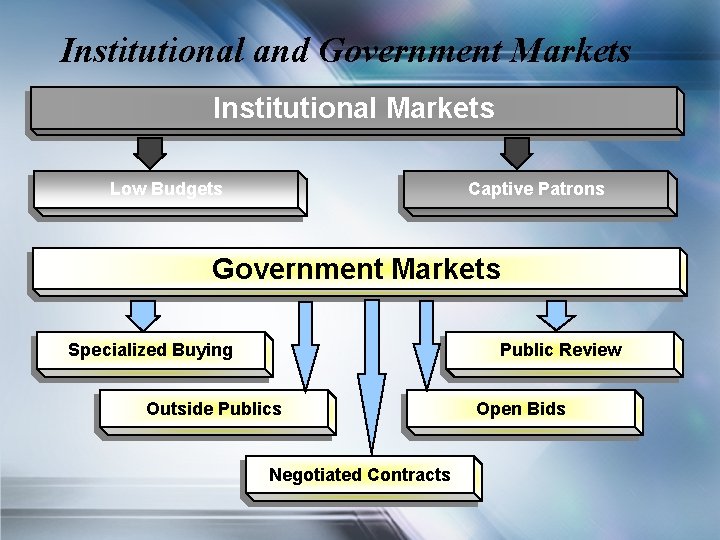
Institutional and Government Markets Institutional Markets Low Budgets Captive Patrons Government Markets Specialized Buying Public Review Outside Publics Negotiated Contracts Open Bids

I thank you !
- Slides: 36