
MARKETING MANAGEMENT LECTURER Ph D As Prof Shcherbak
MARKETING MANAGEMENT LECTURER – Ph. D, As. Prof. Shcherbak A. M.
TOPIC 4 MARKETING-MIX
AGENDA: The marketing mix 2. The extended marketing mix 1.
1. THE MARKETING MIX o o o History The term marketing mix was coined in an article written by Neil Borden called “The Concept of the Marketing Mix” The marketer, E. Jerome Mc. Carthy, proposed a four P’s classification in 1960 Robert F. Lauterborn proposed a four C’s classification in 1993
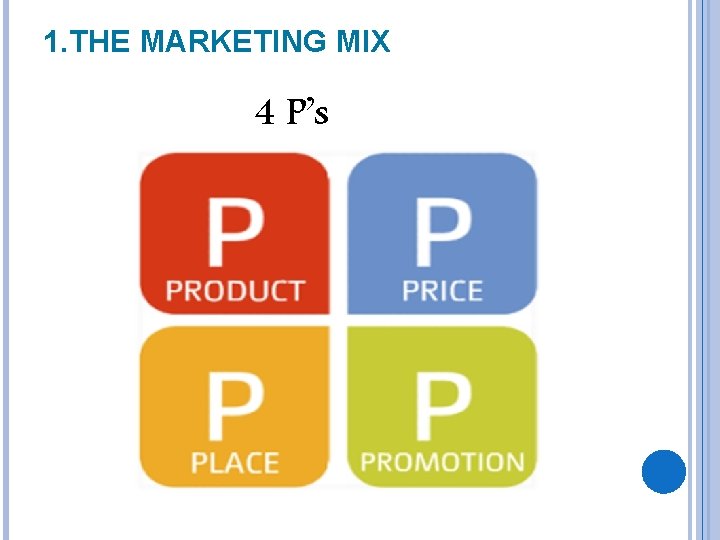
1. THE MARKETING MIX 4 P’s
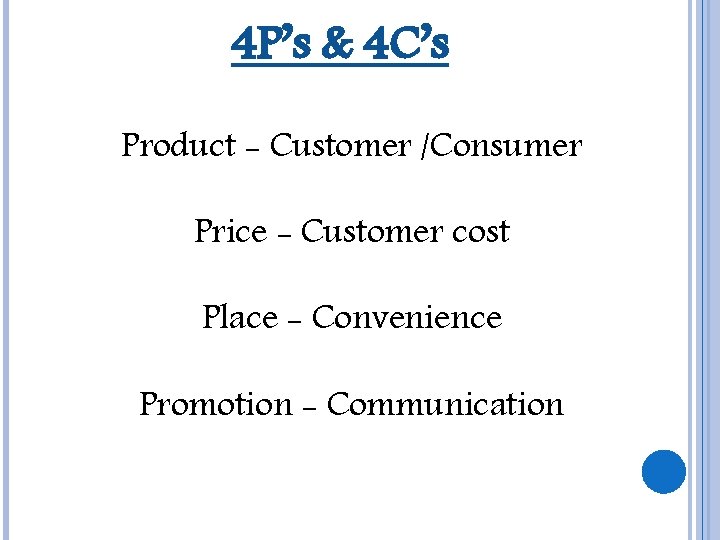
4 P’s & 4 C’s Product - Customer /Consumer Price - Customer cost Place - Convenience Promotion - Communication
1. THE MARKETING MIX The marketing mix is the combination of variables that a business uses to carry out its marketing strategy and meet customer needs. The marketing mix is often called the 4 Ps: Product Price Place Promotion
1. THE MARKETING MIX PRODUCT ‘Product’ refers to the functions and features of a good or service Should satisfy the needs of the customer May have a Unique Selling Proposition (USP) ‘Product’ also includes a range of factors such as packaging, quality, warranties, after-sales service and branding
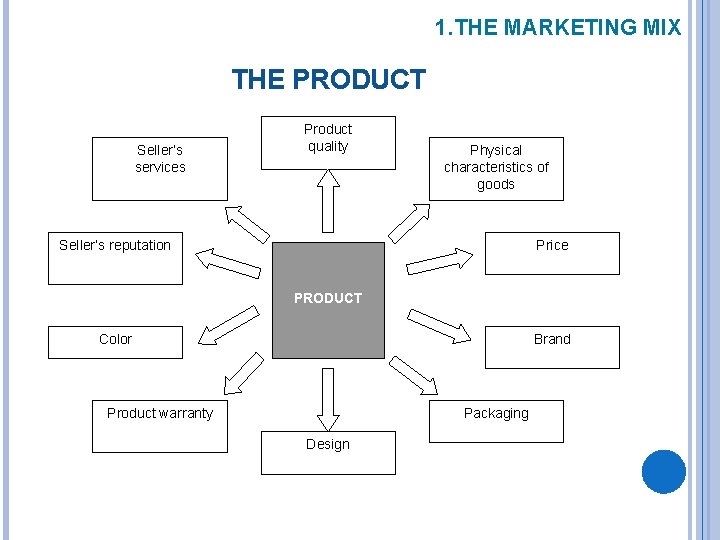
1. THE MARKETING MIX THE PRODUCT Seller’s services Product quality Physical characteristics of goods Price Seller’s reputation PRODUCT Color Brand Packaging Product warranty Design
1. THE MARKETING MIX CLASSIFICATIONS OF PRODUCTS consumer products are intended for personal consumption by households. business products are intended for resale, for use in producing other products, or providing services in an organization.
1. THE MARKETING MIX CLASSIFICATION OF CONSUMER GOODS: 1. Convenience Goods are a tangible product that the consumer feels comfortable purchasing without gathering additional information and then actually buys with a minimum of effort. 2. Shopping Goods are a tangible product for which a consumer wants to compare quality, price, and perhaps style in several stores before making a purchase.
1. THE MARKETING MIX 3. Specialty goods are a tangible product for which a consumer has a strong brand preference and is willing to expend substantial time and effort in locating the desired brand is called a specialty good. The consumer is willing to forgo more accessible substitutes to search for and purchase the desired brand. 4. Unsought good is a new product that the consumer is not yet aware of or a product that the consumer is aware of but does not want right now.
1. THE MARKETING MIX CLASSIFICATION OF BUSINESS GOODS: 1. Raw Materials are the business goods that become part of another tangible product prior to being processed in any way. Raw materials include: Goods found in their natural state, such as minerals, land, and products of the forests and the seas. Agricultural products, such as cotton, fruits, livestock, and animal products including eggs and raw milk.
1. THE MARKETING MIX 2. Fabricating Materials and Parts are the business goods that become part of the finished product after having been processed to some extent fit into the category of fabricating materials and parts. Fabricating materials undergo further processing; examples include pig iron going into steel, yarn being woven into cloth, and flour becoming part of bread. Fabricating parts are assembled with no further change in form; they include such products as zippers in clothing and semiconductor chips in computers. 3. Installations are manufactured products that are an organization's major, expensive, and long-lived equipment.
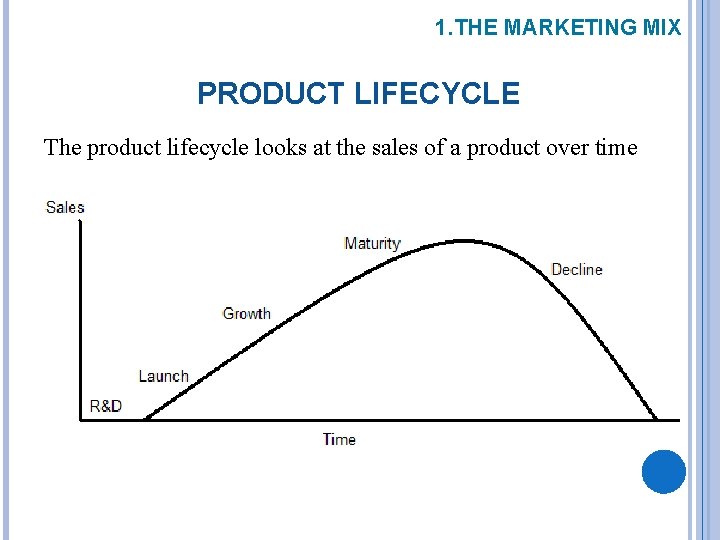
1. THE MARKETING MIX PRODUCT LIFECYCLE The product lifecycle looks at the sales of a product over time
1. THE MARKETING MIX STAGES OF PRODUCT LIFECYCLE Development – high costs but no sales Launch – high expenditure on promotion and product development, low sales Growth – sales increase and product should break-even Maturity – sales stabilise, less expenditure on promotion needed, revenue & profit should be high Decline – sales decline, extension strategies can be adopted or the product withdrawn
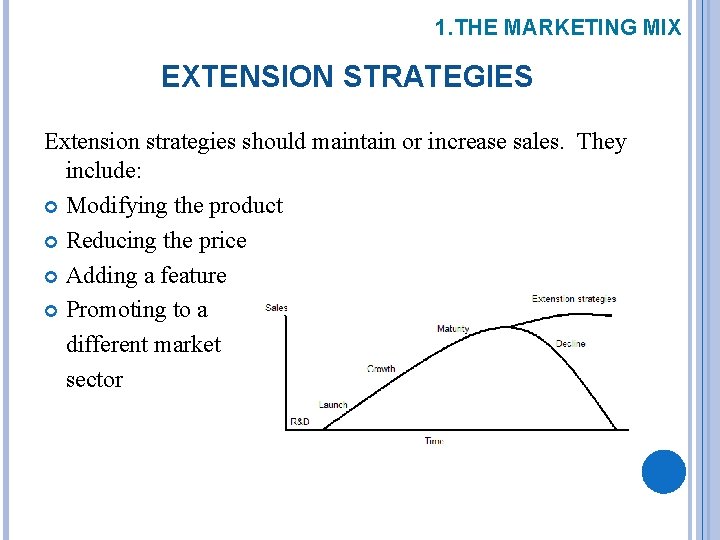
1. THE MARKETING MIX EXTENSION STRATEGIES Extension strategies should maintain or increase sales. They include: Modifying the product Reducing the price Adding a feature Promoting to a different market sector
1. THE MARKETING MIX THREE DISTINCT CATEGORIES OF NEW PRODUCTS: 1. Products that are really innovative – truly unique. 2. Replacements that are significantly different from existing products in terms of form, function, and – most important – benefits provided. 3. Imitative products that are new to a particular company but not new to the market.
1. THE MARKETING MIX A NEW-PRODUCT STRATEGY is a statement identifying the role a new product is expected to play in achieving corporate and marketing goals. Company Goal To defend market share. To strengthen a reputation as an innovator Product Strategy Introduce an addition to an existing product line or revise an existing product. Introduce a really new product – not just an extension of an existing one
1. THE MARKETING MIX PRICE The price of a product will depend on: The cost to make it The amount of profit desired Other objectives of the business The price competitors charge The price customers are willing to pay Is there a high demand? Is demand sensitive to changes in price?
1. THE MARKETING MIX PRICE LEADERS AND TAKERS Price leader – businesses that dominate the market can often dictate the price charged for a product. Other businesses follow this lead. Price taker – businesses have to charge the market price. This is often the case where there are many small firms competing against each other.
1. THE MARKETING MIX PRICING STRATEGIES & TACTICS Skimming Launching with a high price when there is little competition, then reducing the price later. Often used with technology. Penetration Low price charged initially to penetrate the market and build brand loyalty; price is then increased e. g. introductory offers on magazines. Competitive A similar price is charged to that of competitors’ products. Loss leader Products may be sold at a price lower than the cost to produce it. Often used by supermarkets to encourage people into the store where it is hoped they will buy other products. Psychological A price is set which customers perceive as lower than it is e. g. £ 39. 99 instead of £ 40.
1. THE MARKETING MIX MAKES A DISTINCTION BETWEEN THE FIRM'S BASIC PRICE MIX AND THE PRICE PROMOTION MIX. The basic price mix includes those components that define the size and means of payment exchanged for goods or services. The price promotion mix includes supplemental components of price, which aim at encouraging purchase behavior by strengthening the basic price mix during relatively short periods of time.
1. THE MARKETING MIX PRICE IS ONLY ONE DETERMINANT OF DEMAND Price elasticity of demand is a basic business concept. The relationship between price and quantity varies; as one increases, the other decreases. Elastic demand exists when small price changes result in large changes in the quantity demanded. When demand is elastic, a small decrease in price increases total revenues. Inelastic demand exists when price changes do not result in significant changes in the quantity demanded.
1. THE MARKETING MIX DEMAND IS LIKELY TO BE INELASTIC TO PRICE CHANGES: § § when there are few or no product substitutes; when buyers do not readily notice the higher price and are slow to change their buying habits or to search for lower prices, when they think higher prices are justified by product improvements or inflation, when the product or service represents a small portion of the household income.
1. THE MARKETING MIX Cross elasticity of demand relates the percentage change in quantity demanded for one product to percentage price changes for other products. When products are close substitutes, such as cola beverages, a rise in the price of one will increase the demand for the other. Alternatively, when products are complements, a price increase of one may decrease the demand for the other.
1. THE MARKETING MIX PLACE Products should be conveniently available for customers to buy ‘Places’ include: Stores Mail order Telesales Internet The use of e-commerce (promoting and selling on the internet) has grown massively over the last few years
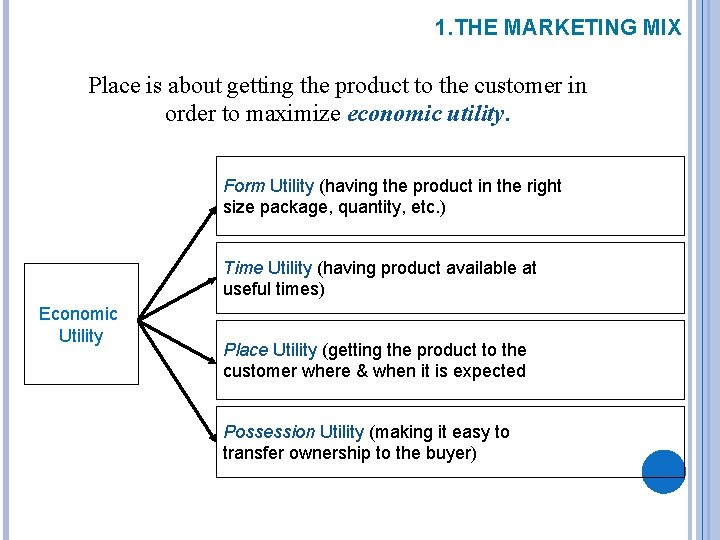
1. THE MARKETING MIX Place is about getting the product to the customer in order to maximize economic utility. Form Utility (having the product in the right size package, quantity, etc. ) Time Utility (having product available at useful times) Economic Utility Place Utility (getting the product to the customer where & when it is expected) Possession Utility (making it easy to transfer ownership to the buyer)
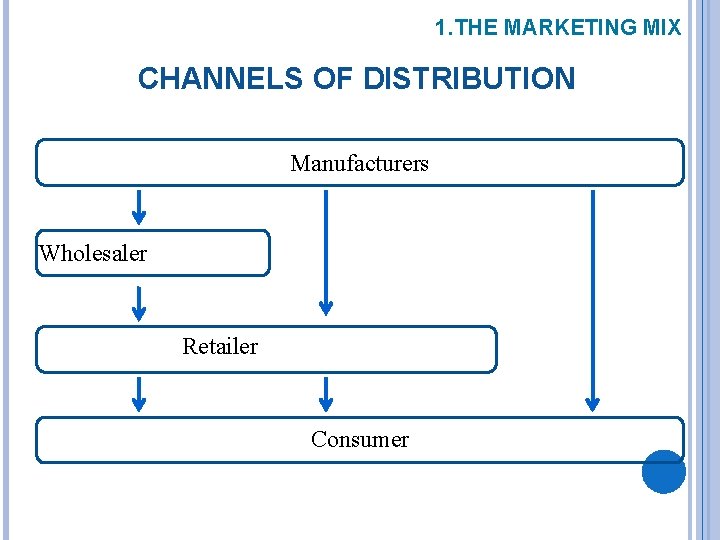
1. THE MARKETING MIX CHANNELS OF DISTRIBUTION Manufacturers Wholesaler Retailer Consumer
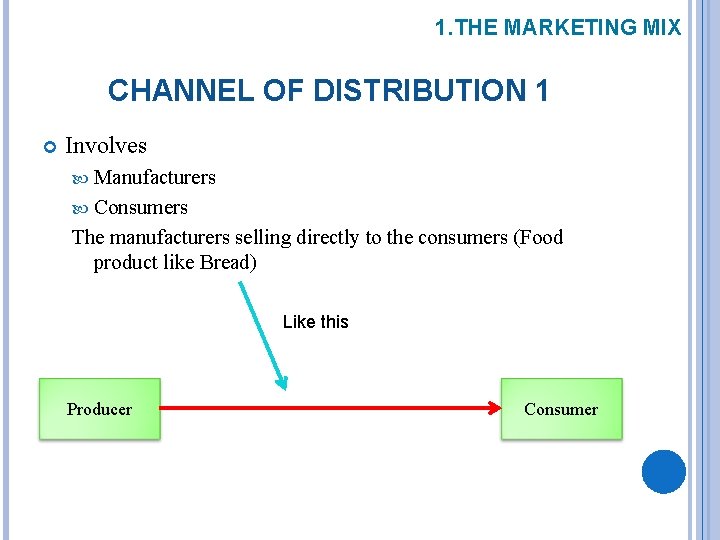
1. THE MARKETING MIX CHANNEL OF DISTRIBUTION 1 Involves Manufacturers Consumers The manufacturers selling directly to the consumers (Food product like Bread) Like this Producer Consumer
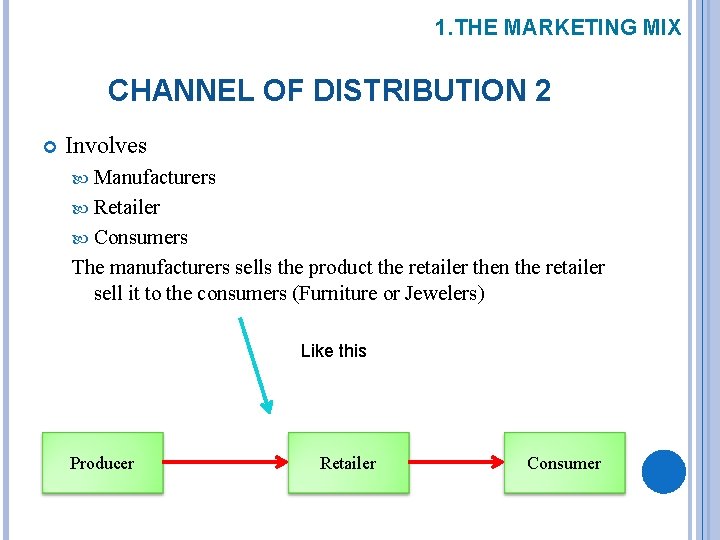
1. THE MARKETING MIX CHANNEL OF DISTRIBUTION 2 Involves Manufacturers Retailer Consumers The manufacturers sells the product the retailer then the retailer sell it to the consumers (Furniture or Jewelers) Like this Producer Retailer Consumer
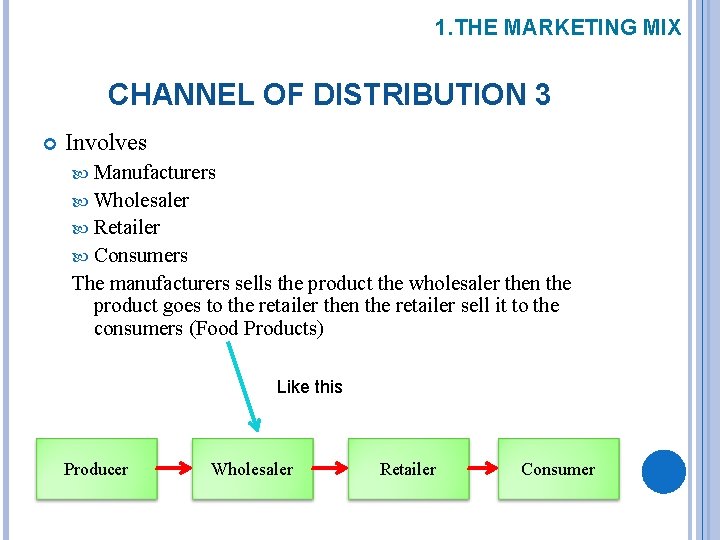
1. THE MARKETING MIX CHANNEL OF DISTRIBUTION 3 Involves Manufacturers Wholesaler Retailer Consumers The manufacturers sells the product the wholesaler then the product goes to the retailer then the retailer sell it to the consumers (Food Products) Like this Producer Wholesaler Retailer Consumer
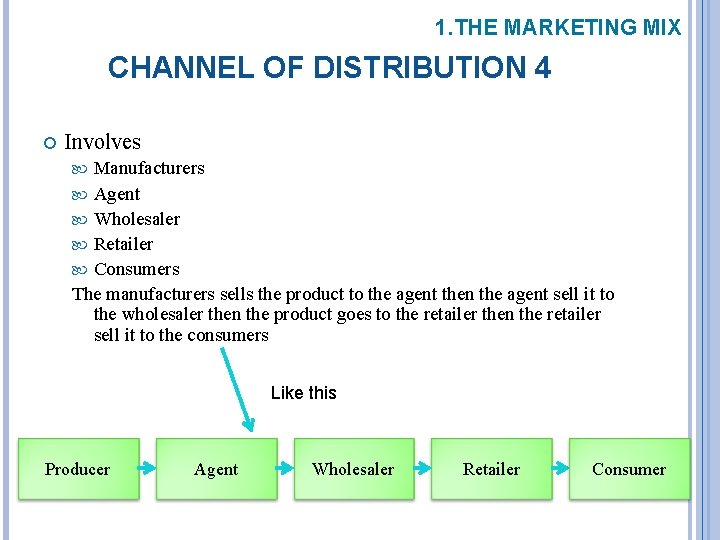
1. THE MARKETING MIX CHANNEL OF DISTRIBUTION 4 Involves Manufacturers Agent Wholesaler Retailer Consumers The manufacturers sells the product to the agent then the agent sell it to the wholesaler then the product goes to the retailer then the retailer sell it to the consumers Like this Producer Agent Wholesaler Retailer Consumer
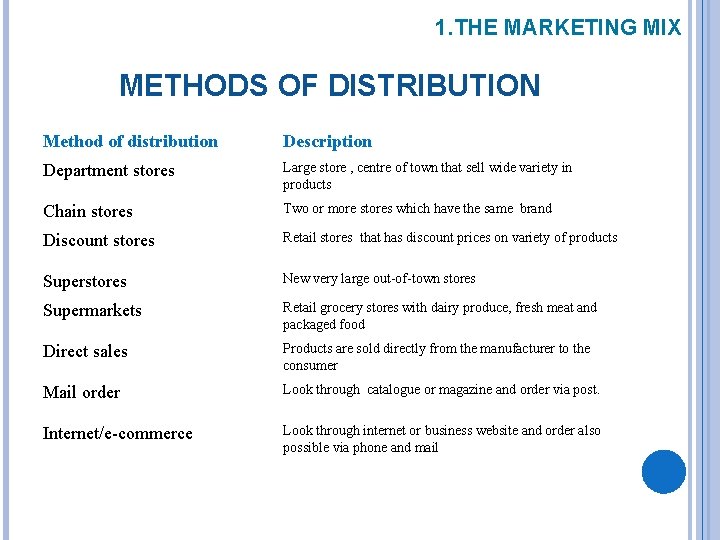
1. THE MARKETING MIX METHODS OF DISTRIBUTION Method of distribution Description Department stores Large store , centre of town that sell wide variety in products Chain stores Two or more stores which have the same brand Discount stores Retail stores that has discount prices on variety of products Superstores New very large out-of-town stores Supermarkets Retail grocery stores with dairy produce, fresh meat and packaged food Direct sales Products are sold directly from the manufacturer to the consumer Mail order Look through catalogue or magazine and order via post. Internet/e-commerce Look through internet or business website and order also possible via phone and mail
1. THE MARKETING MIX E-COMMERCE This is selling products online. Such as E-bay and yahoo.
1. THE MARKETING MIX WHAT DOES A WHOLESALER DO? A wholesaler (distributor) Important stop in the deliver chain Gets products from manufacturers to consumers. He takes charge of goods from a manufacturer Usually in very large amounts Sells them to retail at a marked up price Wholesaler sometimes establishes itself directly as a put on the market offering discounts
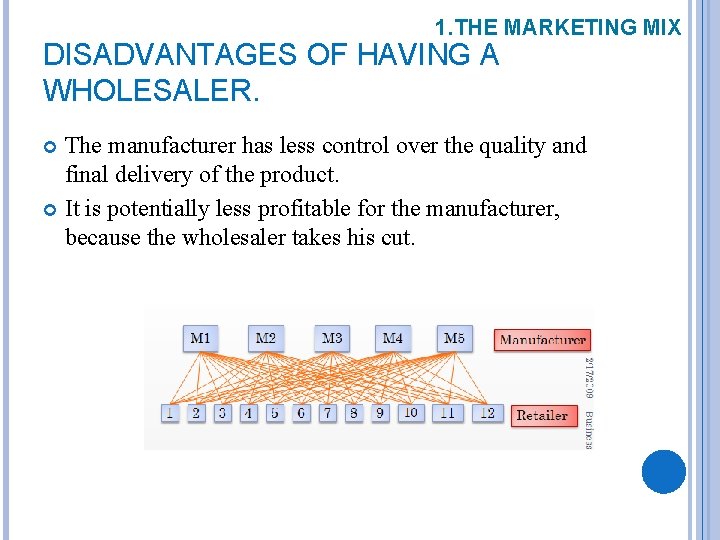
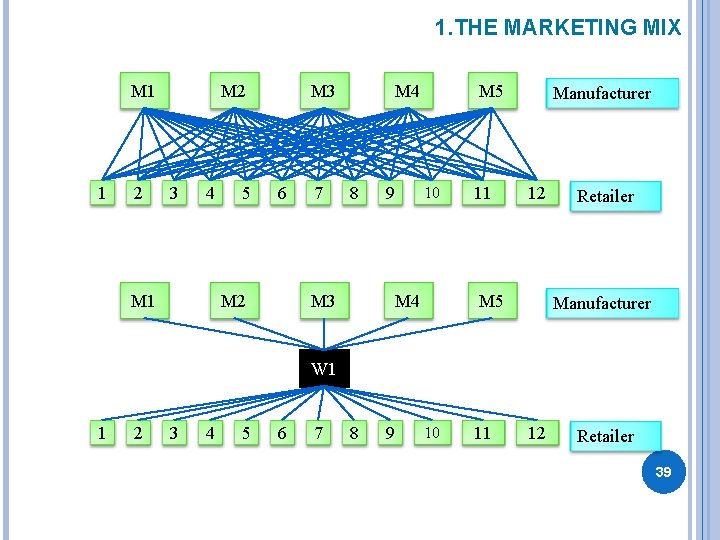
1. THE MARKETING MIX DISADVANTAGES OF HAVING A WHOLESALER. The manufacturer has less control over the quality and final delivery of the product. It is potentially less profitable for the manufacturer, because the wholesaler takes his cut.
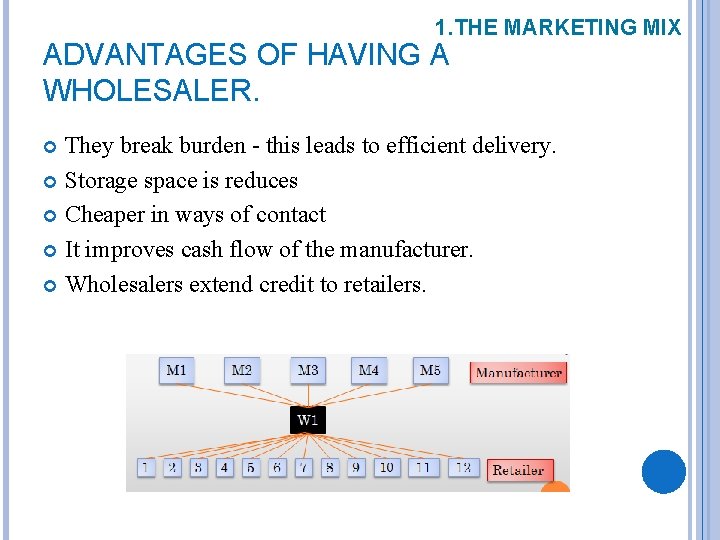
1. THE MARKETING MIX ADVANTAGES OF HAVING A WHOLESALER. They break burden - this leads to efficient delivery. Storage space is reduces Cheaper in ways of contact It improves cash flow of the manufacturer. Wholesalers extend credit to retailers.
1. THE MARKETING MIX M 1 1 2 M 2 3 4 M 1 5 M 3 6 M 2 7 M 4 8 9 M 3 M 5 10 M 4 11 Manufacturer 12 M 5 Retailer Manufacturer W 1 1 2 3 4 5 6 7 8 9 10 11 12 Retailer 39
1. THE MARKETING MIX HOW TO SELECT THE RIGHT CHANNEL OF DISTRIBUTION? You have to look at the following: What type of product is it? Is the product very technical? How often is the product bought? How expensive is the product? How fresh is the product? Where are the customers located? Where do the competitors sell their product? 40
1. THE MARKETING MIX CHANNEL MARKETING STRATEGY A push strategy involves the manufacturer using sales force and trade promotion to induce intermediaries to carry, promote, and sell the product to end users. A pull strategy involves the manufacturer using advertising and consumer promotion to induce consumers to ask intermediaries for the product, thus inducing the intermediaries to order it.
1. THE MARKETING MIX
1. THE MARKETING MIX PROMOTION The aims of promotion are to: Raise awareness Encourage sales Create or change a brand image Maintain market share
1. THE MARKETING MIX PROMOTION Above-the-line promotion This uses advertising media over which a firm has no direct control e. g. television, radio and newspapers Below-the-line promotion This uses promotional media which the firm can control e. g. direct mail, sales promotions and sponsorship
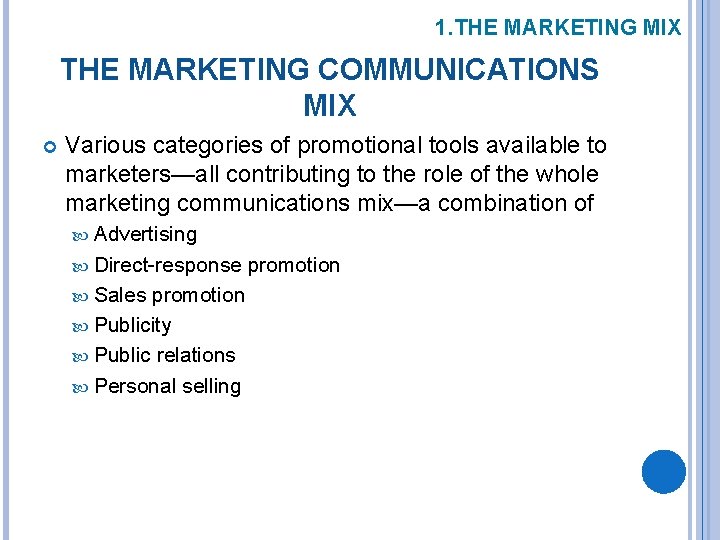
1. THE MARKETING MIX THE MARKETING COMMUNICATIONS MIX Various categories of promotional tools available to marketers—all contributing to the role of the whole marketing communications mix—a combination of Advertising Direct-response Sales promotion Publicity Public relations Personal selling promotion
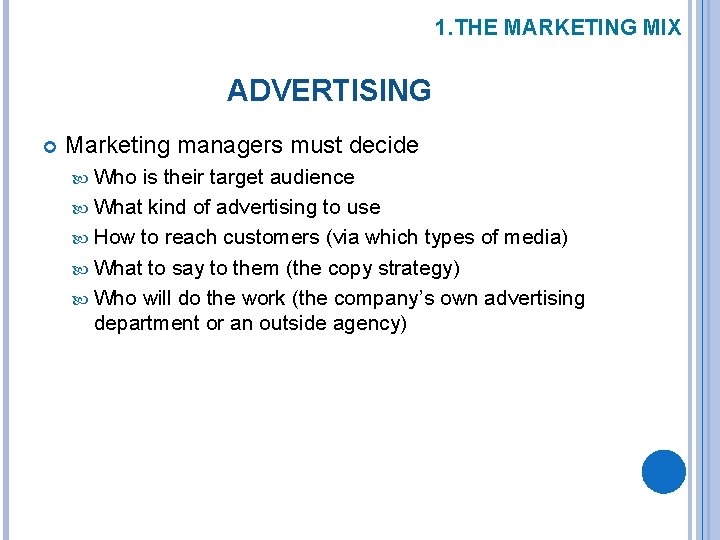
1. THE MARKETING MIX ADVERTISING Marketing managers must decide Who is their target audience What kind of advertising to use How to reach customers (via which types of media) What to say to them (the copy strategy) Who will do the work (the company’s own advertising department or an outside agency)
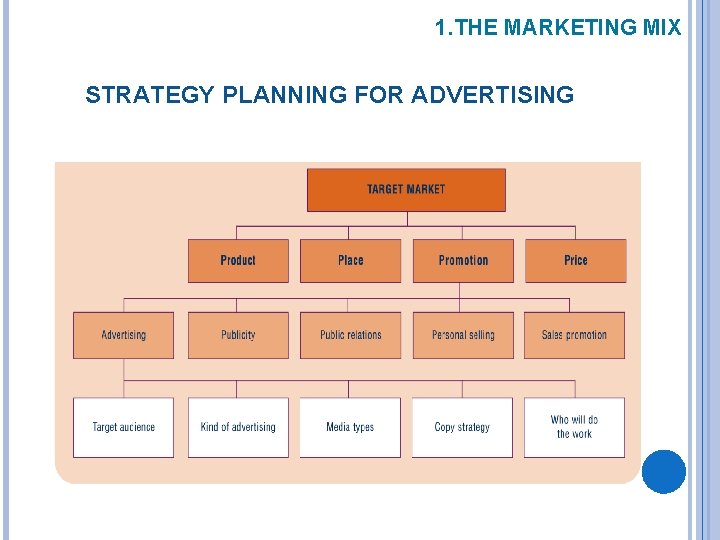
1. THE MARKETING MIX STRATEGY PLANNING FOR ADVERTISING
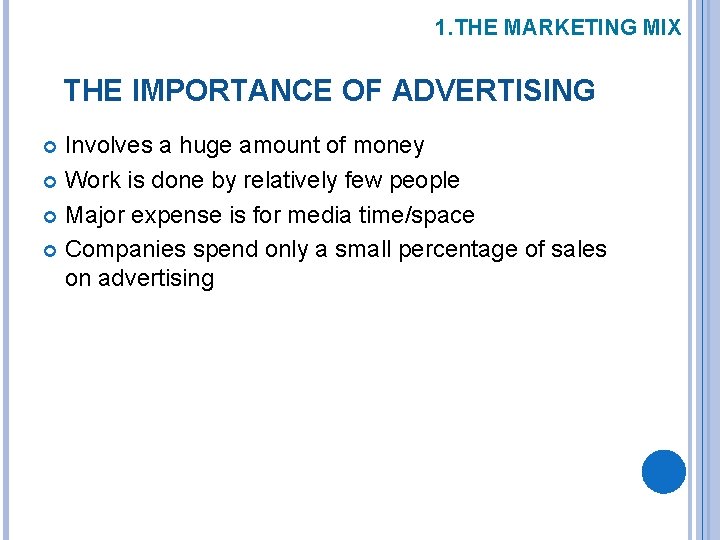
1. THE MARKETING MIX THE IMPORTANCE OF ADVERTISING Involves a huge amount of money Work is done by relatively few people Major expense is for media time/space Companies spend only a small percentage of sales on advertising
1. THE MARKETING MIX SETTING ADVERTISING OBJECTIVES Help introduce new products to specific target markets Help position the firm's brand or marketing mix by informing and persuading target customers or intermediaries about its benefits Help obtain desirable outlets (distribution) Provide ongoing contact with target customers Prepare the way for the personal selling effort Get immediate buying action Help buyers confirm purchasing decisions
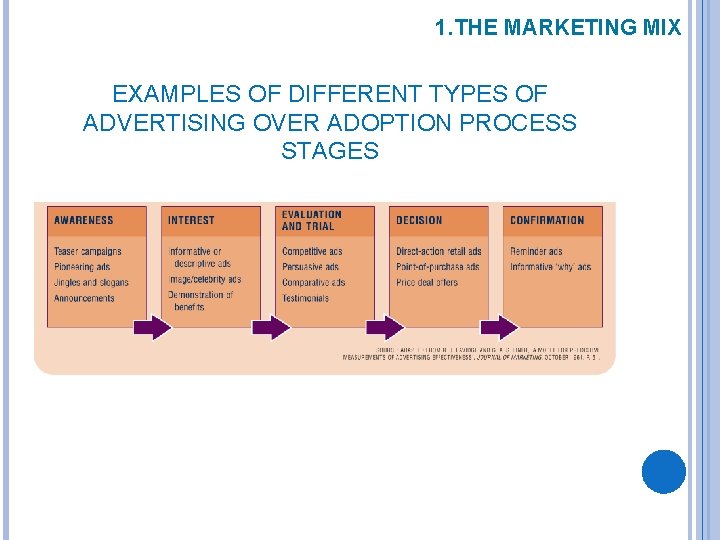
1. THE MARKETING MIX EXAMPLES OF DIFFERENT TYPES OF ADVERTISING OVER ADOPTION PROCESS STAGES
1. THE MARKETING MIX TYPES OF ADVERTISING Product advertising—Tries to sell a specific product to final users or channel members Pioneering advertising builds primary demand Competitive advertising builds selective demand Corporate/institutional advertising—Tries to promote an organisation's image, reputation or ideas—rather than a specific product
1. THE MARKETING MIX COORDINATING ADVERTISING EFFORTS Vertical cooperation Involves the cooperation of members from different levels of a distribution channel Is common in relation to advertising decisions Advertising allowances Price reductions given to organisations in the channel to encourage them to advertise or otherwise promote the supplier’s products locally Horizontal cooperation Involves cooperation between several members at the same level of a distribution channel Often occurs in relation to advertising
1. THE MARKETING MIX MAJOR ADVERTISING MEDIA Magazine Television Newspaper Yellow Pages Radio Outdoors Cinema Internet
1. THE MARKETING MIX CHOOSING THE ‘BEST’ ADVERTISING MEDIUM Promotional objectives Target market you need to reach Funds available Nature of the media Who it reaches With what frequency At what impact At what cost Overall fit with the rest of the marketing mix
1. THE MARKETING MIX DIRECT-RESPONSE PROMOTION Special considerations with ‘direct marketing’ Direct communication between a seller and the individual customer using a promotion method other than face-to-face personal selling Started with mail advertising, but has evolved to include other media Distinctive feature—It attempts to evoke a direct response from the customer Closely tied to the use of a database to target customers
1. THE MARKETING MIX DIRECT-RESPONSE ONLINE Many promotional mixes now include an advertiser’s Web site and a viewer can respond by clicking to obtain more detailed information Information might include pictures, videos, sound, text, order entry and so on A small subset of the total number of Web sites account for a large percentage of the potential audience Portals are Web sites that act as a gateway to the Internet
1. THE MARKETING MIX SALES PROMOTION Promotion activities (other than advertising, publicity and personal selling) that stimulate interest, trial or purchase May be focused at channel members, final customers or users, or employees Skill may be difficult to develop inside the company, since a promotion activity is often designed and used only once Sales promotion spending is increasing and exceeds advertising spending
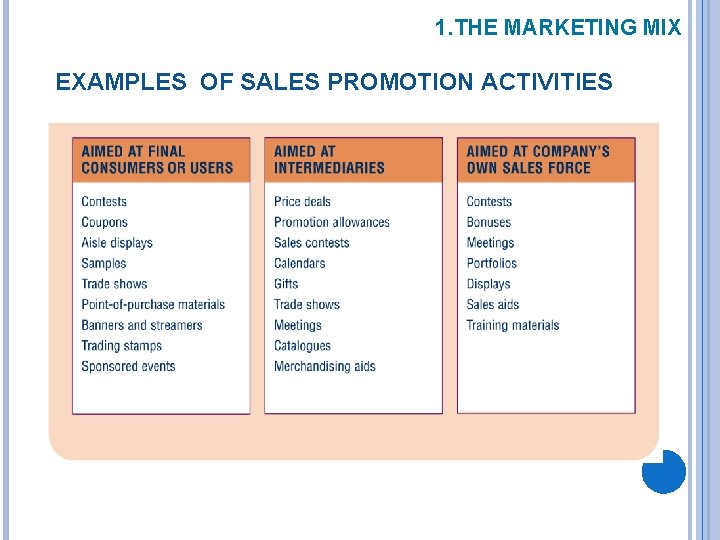
1. THE MARKETING MIX EXAMPLES OF SALES PROMOTION ACTIVITIES
1. THE MARKETING MIX SPONSORSHIP An investment in cash or kind, in an event, sport, art, person or idea, in exchange for access to the commercial potential of that event, sport, art, person or idea Not a new concept (traced back to Ancient Rome and Gladiatorial Games) Sport sponsorship is by far the most intensive form of sponsorship A wide range of possible objectives A general lack of rigorous evaluation by sponsors
1. THE MARKETING MIX PUBLIC RELATIONS AND PUBLICITY Public relations (PR) involves communicating with several interest groups—Employees, shareholders, governments and political parties as well as customers and the general public It is aimed at fostering positive publicity and may be used to counter negative publicity Publicity comprises all word-of-mouth (negative or positive) and media coverage There is such a thing as negative publicity (including rumours and myths)
1. THE MARKETING MIX PROMOTIONAL MIX Most businesses use a combination of different promotional activities. The chosen promotional mix will depend on: Cost Target market Product Competitors
1. THE MARKETING MIX AIDA Promotional campaigns often take into account the AIDA model: Awareness - raising awareness of a product Interest – exciting interest in the product Desire – creating desire for the product Action – encouraging a purchase
1. THE MARKETING MIX HOW THE MARKETING MIX EVOLVES OVER TIME The marketing mix will evolve over time. For example: The product portfolio may grow as a business becomes more established More expensive promotional activities may be adopted as a firm’s revenue increases More outlets may be opened, or products sold via the internet Price may increase as demand grows
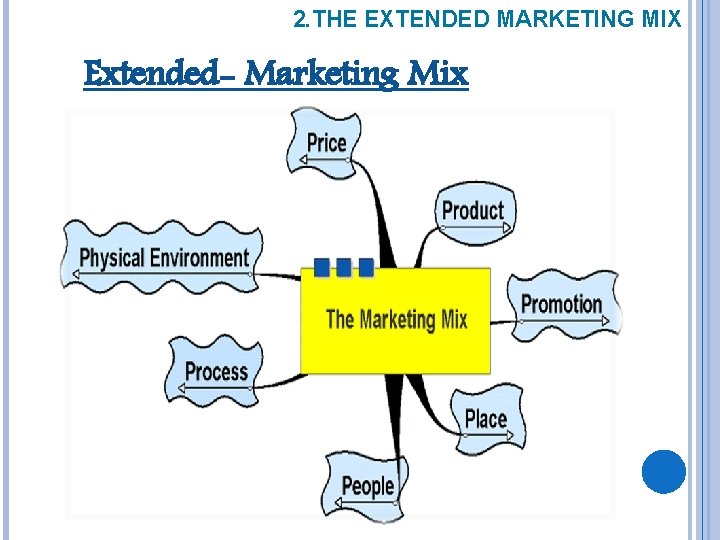
2. THE EXTENDED MARKETING MIX Extended- Marketing Mix
2. THE EXTENDED MARKETING MIX Booms and Bitner included three additional 'Ps' to accommodate trends towards a service or knowledge based economy: People Process Physical Evidence
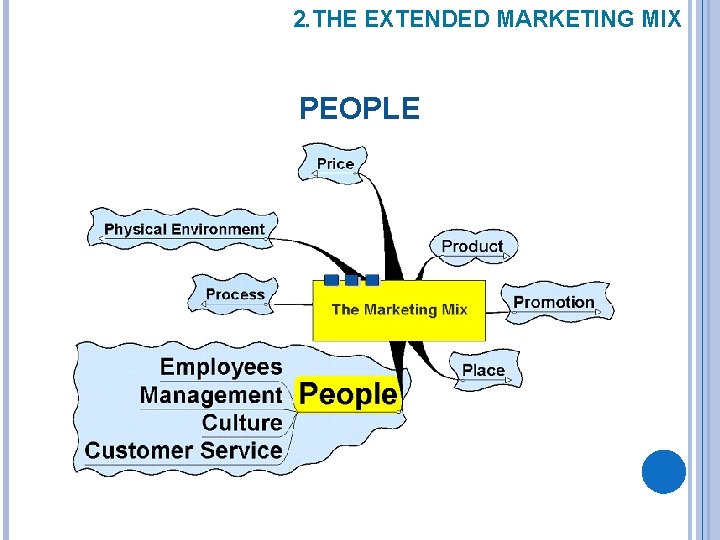
2. THE EXTENDED MARKETING MIX PEOPLE
2. THE EXTENDED MARKETING MIX PEOPLE People represent the business The image they present can be important First contact often human – what is the lasting image they provide to the customer? Extent of training and knowledge of the product/service concerned Mission statement – how relevant? Do staff represent the desired culture of the business? People – all people who directly or indirectly influence the perceived value of the product or service, including knowledge workers, employees, management and consumers.
2. THE EXTENDED MARKETING MIX PROCESS
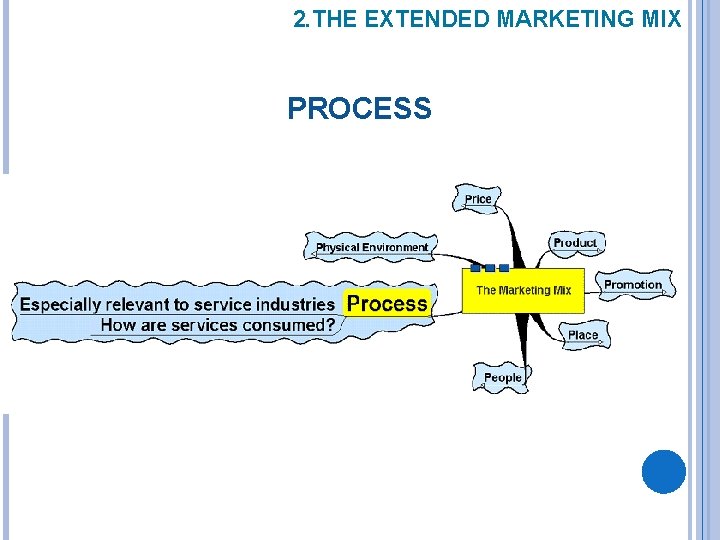
2. THE EXTENDED MARKETING MIX PROCESS How do people consume services? What processes do they have to go through to acquire the services? Where do they find the availability of the service? Contact Reminders Registration Subscription Form filling Degree of technology Process – procedures, mechanisms and flow of activities which lead to an exchange of value.
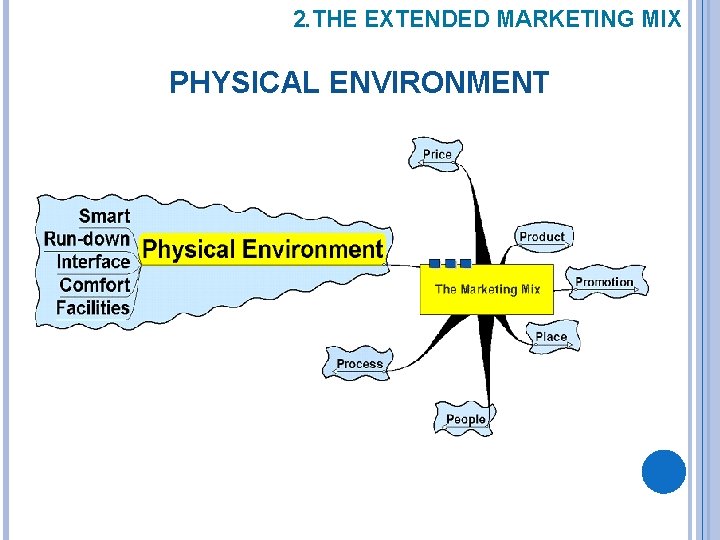
2. THE EXTENDED MARKETING MIX PHYSICAL ENVIRONMENT
2. THE EXTENDED MARKETING MIX PHYSICAL ENVIRONMENT The ambience, mood or physical presentation of the environment Smart/shabby? Trendy/retro/modern/old fashioned? Light/dark/bright/subdued? Romantic/chic/loud? Clean/dirty/unkempt/neat? Music? Smell?
2. THE EXTENDED MARKETING MIX PHYSICAL EVIDENCE The direct sensory experience of a product or service that allows a customer to measure whether he has received value. Examples might include the way a customer is treated by a staff member, or the length of time a customer has to wait, or a cover letter from an insurance company, or the environment in which a product or service is delivered.
2. THE EXTENDED MARKETING MIX PHYSICAL EVIDENCE Physical evidence is the material part of a service. Strictly speaking there are no physical attributes to a service, so a consumer tends to rely on material cues. There are many examples of physical evidence, including some of the following: Packaging. Internet/web pages. Paperwork (such as invoices, tickets and despatch notes). Brochures. Furnishings. Signage (such as those on aircraft and vehicles). Uniforms. Business cards. The building itself (such as prestigious offices or scenic headquarters).
2. THE EXTENDED MARKETING MIX 7 Ps & 7 Cs The 7 Ps The 7 Cs Organisation Facing Customer Facing Product = Customer/ Consumer Price = Cost Place = Convenience Promotion = Communication People = Caring Processes = Co-ordinated Physical Evidence = Confirmation
2. THE EXTENDED MARKETING MIX THE MARKETING MIX Blend of the mix depends upon: Marketing objectives Type of product Target market Market structure Rivals’ behaviour Global issues – culture/religion, etc. Marketing position Product portfolio Product lifecycle Boston Matrix
- Slides: 75