
Marketing management Developed by Alina Shcherbak Agenda for

Marketing management Developed by Alina Shcherbak
Agenda for today - The essence, purpose and tasks of marketing management - Marketing management concept evolution. - Trends in marketing management. Summary
Introduction: Marketing Management Challenge “The management process responsible for identifying, anticipating and satisfying customer requirements profitably” Institute of Marketing “Marketing is concerned with all the exhilarating big things and all the troublesome little things that must be done in every nook and cranny of the creative organization in order to achieve the corporate purpose of attracting and holding clients” Theodore Levitt
The essence, purpose and tasks of marketing management According to the American Marketing Association, “Marketing is the activity, set of institutions, and processes for creating, communicating, delivering, and exchanging offerings that have value for customers, clients, partners, and society at large” (AMA 2007). Core activities of marketing are market research and customer relationship management, identifying valuable market offerings, developing a market-strategy and designing policies for creating, delivering and communicating the value. Within the business, marketing is responsible for sales and thereby is in charge for the top-line of the earnings report of a business (Kotler, 2012).
The essence, purpose and tasks of marketing management As a function of enterprise activity marketing integrates other functions (e. g. producing, sales, R&D, finances, procurement) and provides a set of tools for customer’s needs satisfaction. As a business philosophy marketing forces company’s management to satisfy customers’ needs as a basic condition of its prosperity. As a social phenomena marketing helps to satisfy people’s needs throw manufacturing and distributing goods and providing services. So marketing is a philosophy, methodology and a tool of market activity of a company, that form the way of thinking for a management and the way of acting of a company in the market, directing it towards the customer’s needs satisfaction.
The essence, purpose and tasks of marketing management ”There will always, one can assume, be need for some selling. But the aim of marketing is to make selling superfluous. The aim is to know and understand the customers well that the product or service fits him and sells it-self. Ideally, marketing should result in a customer who is ready to buy. All that should be needed then is to make the product or service available. ” Peter Drucker
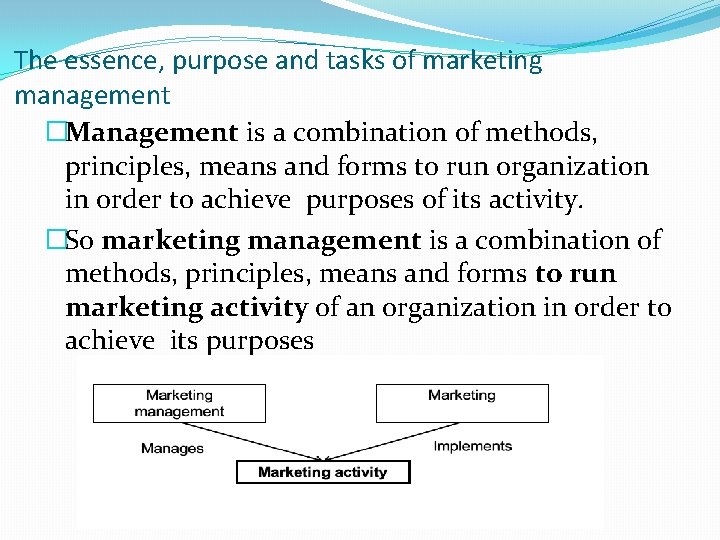
The essence, purpose and tasks of marketing management �Management is a combination of methods, principles, means and forms to run organization in order to achieve purposes of its activity. �So marketing management is a combination of methods, principles, means and forms to run marketing activity of an organization in order to achieve its purposes
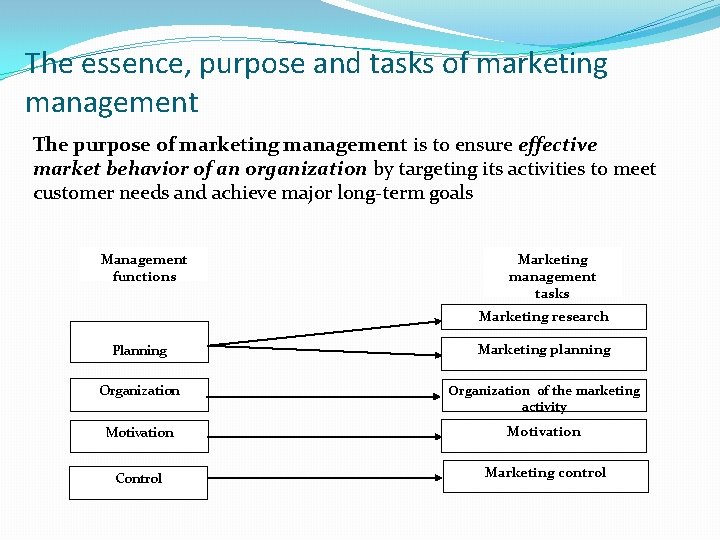
The essence, purpose and tasks of marketing management The purpose of marketing management is to ensure effective market behavior of an organization by targeting its activities to meet customer needs and achieve major long-term goals Management functions Marketing management tasks Marketing research Planning Marketing planning Organization of the marketing activity Motivation Control Marketing control
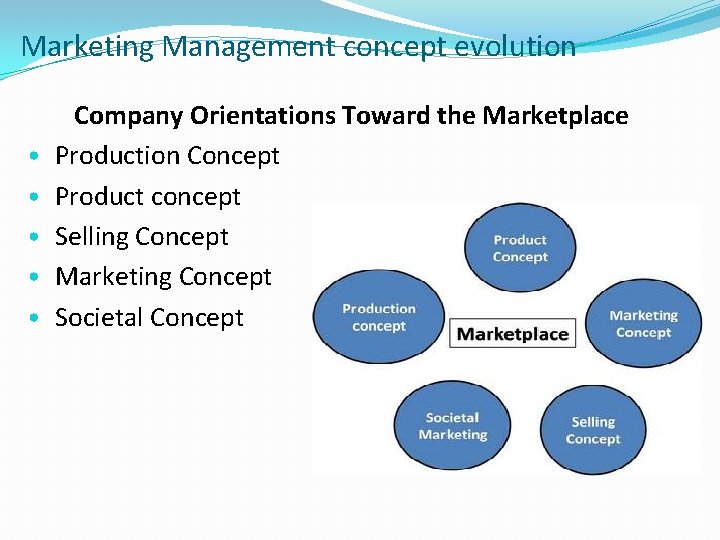
Marketing Management concept evolution • • • Company Orientations Toward the Marketplace Production Concept Product concept Selling Concept Marketing Concept Societal Concept
Marketing Management concept evolution Production Concept – In this concept the company mainly tries to increase production irrespective of demands of the customer. The production concept is almost extinct now with companies paying more and more attention to the customer. Product Concept – The product concept says that customers will always buy products which are better in terms of quality performance and features. The concept is especially applicable in terms of electronics and other techno gadgets nowadays. Selling concept – The selling concept believes that customers will not buy products unless persuaded to do so. As we know, this is true even today in case of certain products such as insurance. Although the customer should use it, they rarely do.
Marketing Management concept evolution Marketing Concept – Just like selling is a necessity, similarly branding and marketing are a necessity in some products. The marketing concept proposes that the success of a firm depends on the marketing efforts of the company in delivering a value proposition. Societal Marketing Concept – The societal marketing concept leads to a company orientation which believes in giving back to the society what it had received from the society. This concept believes that the company is profiting because of society and hence it should also take measures to make sure the society also benefits from the company.
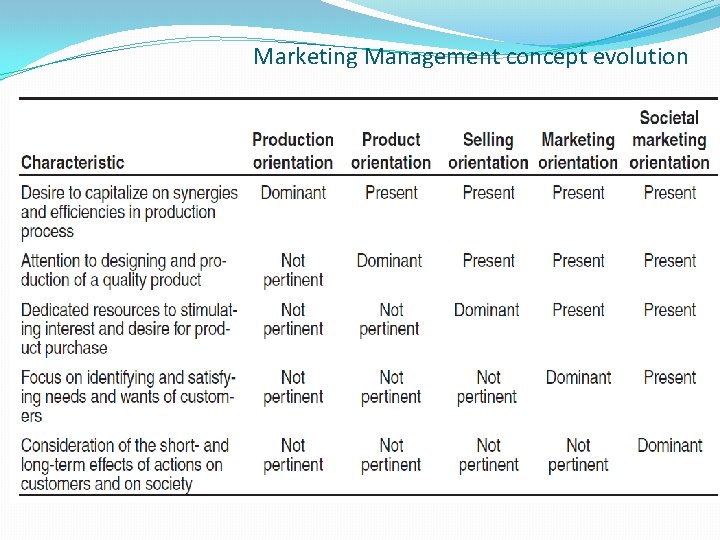
Marketing Management concept evolution
Trends in marketing management Scope of Marketing Management The scope of marketing is very wide and multiple discipline penetration for better results and functioning of the organization. It may be analyzed in term of Marketing Performance through various functions. The marketing function is inherent in every marketing process and marketing function is to be performed on the basis of various utilities. The major functions of Marketing are; a)Function of exchange. b)Function of physical distribution. c)Function of facilities.
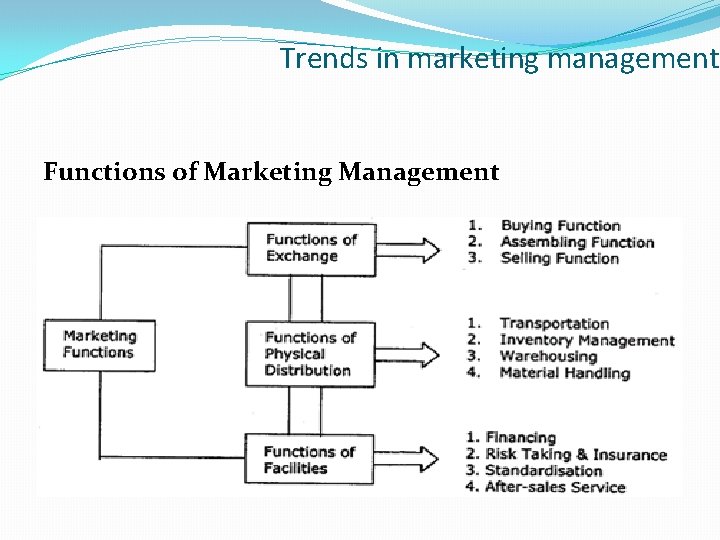
Trends in marketing management Functions of Marketing Management
Trends in marketing management � Objectives of Marketing Management 1. Sales and market analysis. 2. Determination of market goals. 3. Sales forecasting and marketing budgets. 4. Formulation of marketing strategies, policies and procedures. 5. Evolving an appropriate marketing-mix or programme. 6. Organizing of all marketing activities and instruments. 7. Assembling of necessary resources, viz marketing staff, finance, physical facilities etc. , to execute marketing campaign. 8. Active participation in product planning and development to establish best correlation between product attribute and customer demand. 9. Distribution Channels and physical distribution. 10. Effective communication, proper control and co-ordination of all marketing functions. 11. Post sales services and Customer relationship.
Trends in marketing management The New Economy • • • Substantial increase in buying power A greater variety of goods and services Consumers expect a perfect quality, service level etc. A greater amount of information about practically anything An ability to compare notes on products and services A greater ease in interacting and placing and receiving orders Retail overloading Selling of impression instead real benefits Low effectiveness of traditional marketing tools
Trends in marketing management �from an industrial society to an information, �the emergence of a global economy replacing national ones, �business management will shift from short-term planning to long-term perspectives motivated both by concern for the environment and by economic necessity, �shift from hierarchies to networks as the pyramid structure collapses.
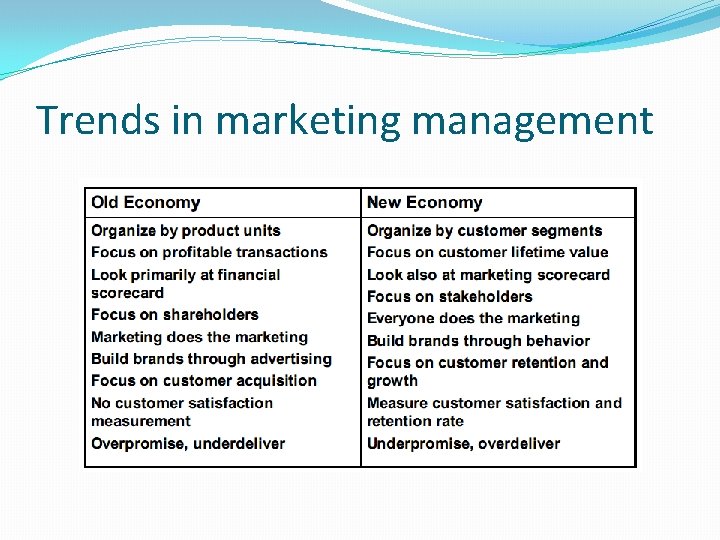
Trends in marketing management
Trends in marketing management Company responses and adjustments � Reengineering � Outsourcing � Suppliers are partners � Market orientation � E-commerce � Benchmarking � Alliances �Global and local competition, private labels � Decentralized
Trends in marketing management One of the most significant trends in recent marketing practice has been the emphasis on value — the right combination of product quality, service support, and timely delivery at a reasonable price. The customer chooses between different products and services on the basis of which is perceived to deliver the most value. Value = Benefits / Costs = = (Functional benefits + Emotional benefits) / (Monetary costs + Time costs + Energy costs + Psychic costs)
Trends in marketing management Problems in marketing management development in Ukraine: �Nonmarketing thinking �Low purchasing power f the population �High corruption level �Lack of marketing information �Lack of specialists
Summary Firms should identify the role of marketing and its distinctive tasks in the different stages of the marketing management process: · Marketing in the exploration phase: The exploration phase is concerned with new opportunities. Here marketing is concerned with unaddressed needs of users, user-based value of an innovation as well as perception of an innovation. A potential challenge of established companies is that relevant users of an innovation are not necessarily its present customers. A challenge of customer valuation and prioritization is to identify customers or users with potential future value. · Formulation of business models: The formulation of a business model is a vital step to make an innovation strategy operational. A business model aims to direct the introduction and capitalization of a value proposition. Thus a business model comprises: the formulation of a value proposition; the revenue-generation mechanism that a company intends to apply; and, the definition of the relevant resources and the value network needed for the realization. · The exploitation phase: Here the role of marketing is focused on generating the revenue stream. Communicating with prospective customers, orchestrating the value network, i. e. the distribution channel.
References � 1. Bose, B. S (2009). Marketing Management (2 nd ed. ). Mumbai: Himalaya Publishing House PVT. LTD. � 2. Blackwell, R. D. , Miniard, P. W and Engel, J. F. (2006). Consumer behaviour (10 th ed. ). South. Western: Thomas. � 3. Hawkins, D. I. , Best, R. J, and Coney, K. A. (1998). Consumer Behaviour; Building Marketing strategy (7 th ed. ). U. S: Mc Grew-Hill. � 4. Kazmi, S. (2007). Marketing Management: Text and Cases. New Delhi: Excel Books. � 5. Kotler, P. , and Keller, K. L. (2018). Marketing Management (15 th ed. ). Noida, Uttar Pradesh: Pearson. � 6. Kotler, P. , Koshy, A. , and Jha, M. (2012). Marketing Management: A South Asian perspective (13 th ed. ). Noida, Uttar Pradesh: Pearson. � 7. Kumar, A. , and Meenakshi, N. (2006). Marketing Management. New Delhi: Vikas Publishing House PVT LTD. � 8. Kumar, S. R. (2017). Consumer Behaviour: The Indian context (concepts and cases). Noida, Uttar Pradesh: Pearson. � 9. Varshney, R. L. , and Gupta, S. L. (2005). Marketing Management Text and Cases: An Indian Perspective (3 rd ed. ). New Delhi: Sultan Chand sons. � 10. Dutta, Bholanth. (2010). Marketing Management (2 nd ed. ). New Delhi: Excel Books. � 11. Vidhya, M. (2010). Marketing. Chennai: MJP Publishers. Consumer Behaviour-Decision Making. Retrieved from http: //www. tutorialspoint. com/consumer_behavior_decision_making. htm � 12. Jaideep, S. Top 5 Stages of Consumer Buying Process. Retrieved from http: //www. yourarticlelibrary. com/consumers/top-5 -stages-of-consumer-buyingprocess/48596 � 13. Stankevich, A, (2017). Explaining the Consumer Decision-Making Process: Critical Literature Review. Journal of International Business Research and Marketing, 2(6), 7 -14.
- Slides: 25