Marketing Management 2 Miss Eman Elfar Section 2
- Slides: 12
Marketing Management 2 Miss/ Eman Elfar Section 2 Spring 2017/2018
Competitor Analysis 3) Selecting Competitors to Attack and Avoid Customer value analysis : is a tool used to assess competitors' strength and weakness. It aims to determines the benefits that target customers’ value and how customers rate the relative value of various competitors’ offers. There are tow steps in performing customer value analysis: 1) Identification of major attributes that customers value and the importance of these values 2) Assessment of the company’s and competitors’ performance on the valued attributes
Competitor Analysis Good competitors: (what is the basic benefits a company could have from competitors? ) Ø Increase total demand Ø Share costs of market and product development Ø Legitimize new technologies Ø Serve less attractive market segments Ø Provide more product differentiation Ø Lower the anti-trust risk Ø Improve bargaining power versus legislators and regulators
Competitor Analysis Bad competitors: ( How do the bad competitors harm the company? ) v. Try to share rather than earn in the market v. Take large risks v. Create disruption
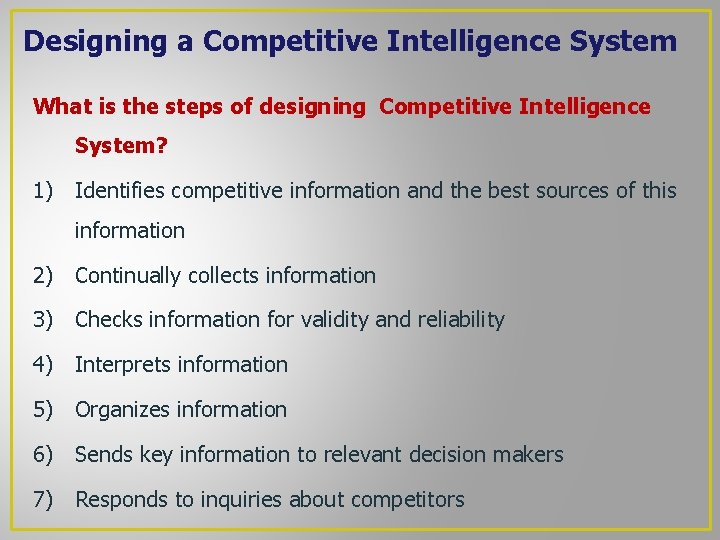
Designing a Competitive Intelligence System What is the steps of designing Competitive Intelligence System? 1) Identifies competitive information and the best sources of this information 2) Continually collects information 3) Checks information for validity and reliability 4) Interprets information 5) Organizes information 6) Sends key information to relevant decision makers 7) Responds to inquiries about competitors
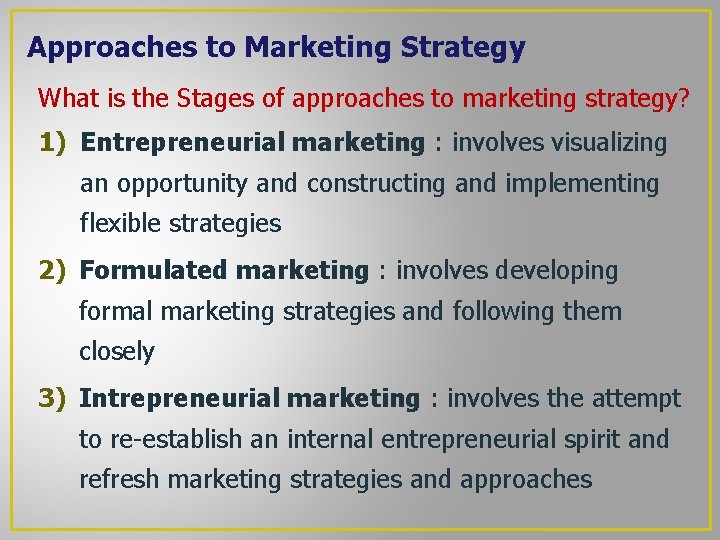
Approaches to Marketing Strategy What is the Stages of approaches to marketing strategy? 1) Entrepreneurial marketing : involves visualizing an opportunity and constructing and implementing flexible strategies 2) Formulated marketing : involves developing formal marketing strategies and following them closely 3) Intrepreneurial marketing : involves the attempt to re-establish an internal entrepreneurial spirit and refresh marketing strategies and approaches
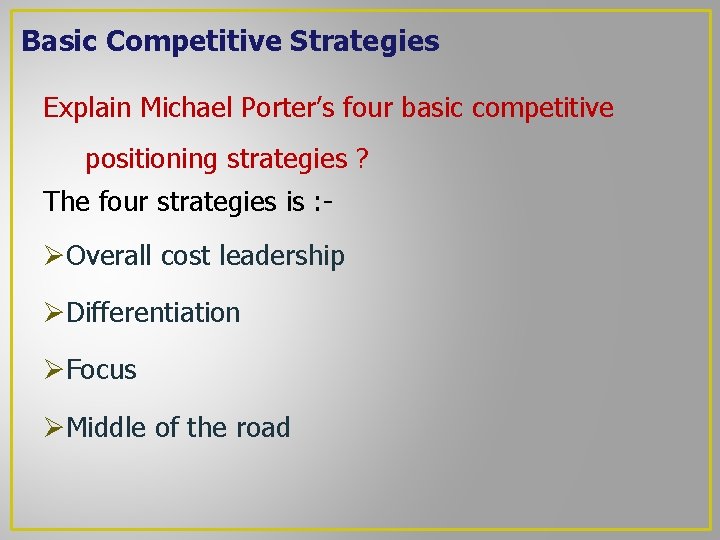
Basic Competitive Strategies Explain Michael Porter’s four basic competitive positioning strategies ? The four strategies is : - ØOverall cost leadership ØDifferentiation ØFocus ØMiddle of the road
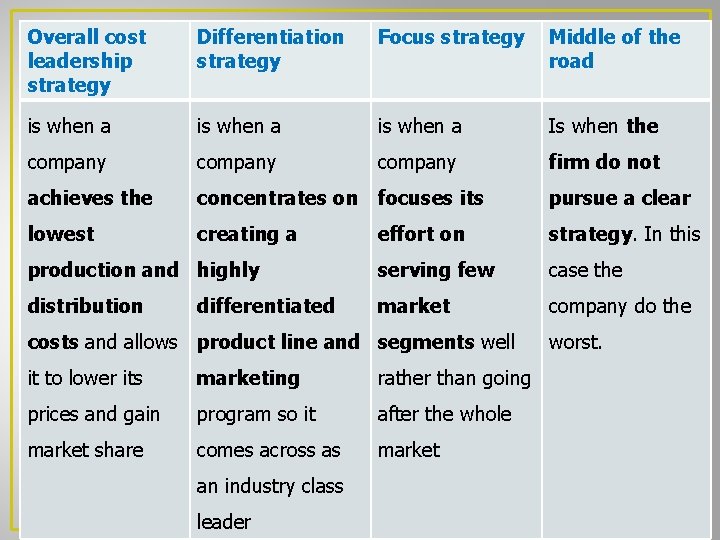
Overall cost leadership strategy Differentiation strategy Focus strategy Middle of the road is when a Is when the company firm do not achieves the concentrates on focuses its pursue a clear lowest creating a effort on strategy. In this production and highly serving few case the distribution market company do the differentiated costs and allows product line and segments well it to lower its marketing rather than going prices and gain program so it after the whole market share comes across as market an industry class leader worst.
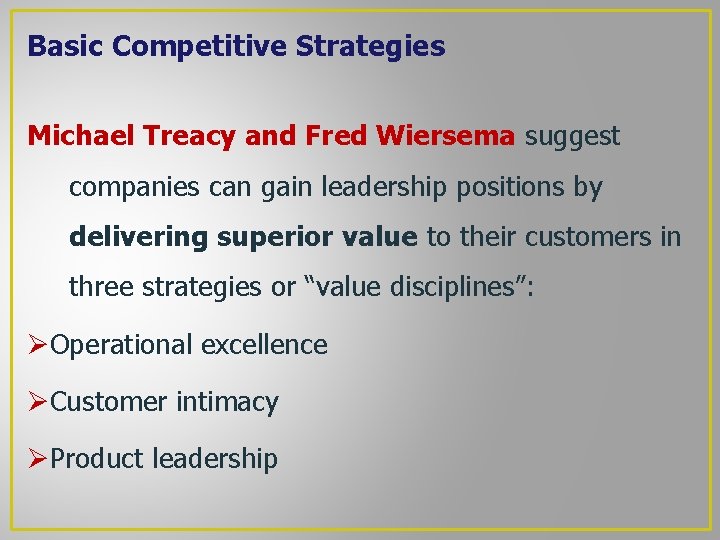
Basic Competitive Strategies Michael Treacy and Fred Wiersema suggest companies can gain leadership positions by delivering superior value to their customers in three strategies or “value disciplines”: ØOperational excellence ØCustomer intimacy ØProduct leadership
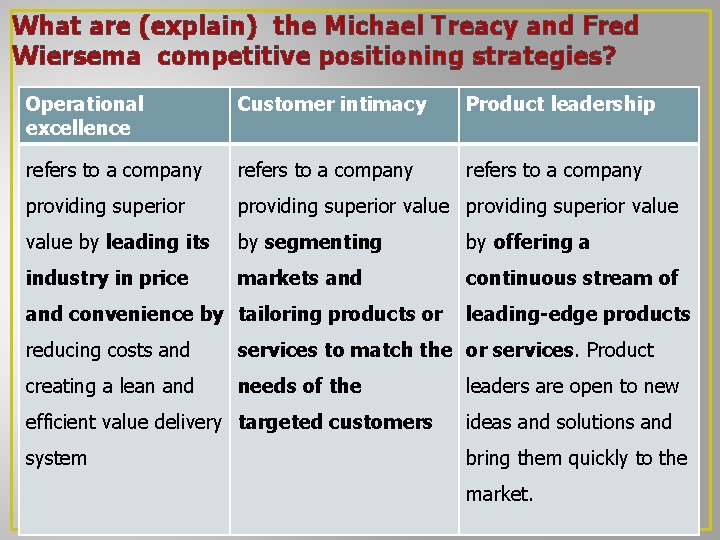
What are (explain) the Michael Treacy and Fred Wiersema competitive positioning strategies? Operational excellence Customer intimacy Product leadership refers to a company providing superior value by leading its by segmenting by offering a industry in price markets and continuous stream of and convenience by tailoring products or leading-edge products reducing costs and services to match the or services. Product creating a lean and needs of the leaders are open to new efficient value delivery targeted customers ideas and solutions and system bring them quickly to the market.
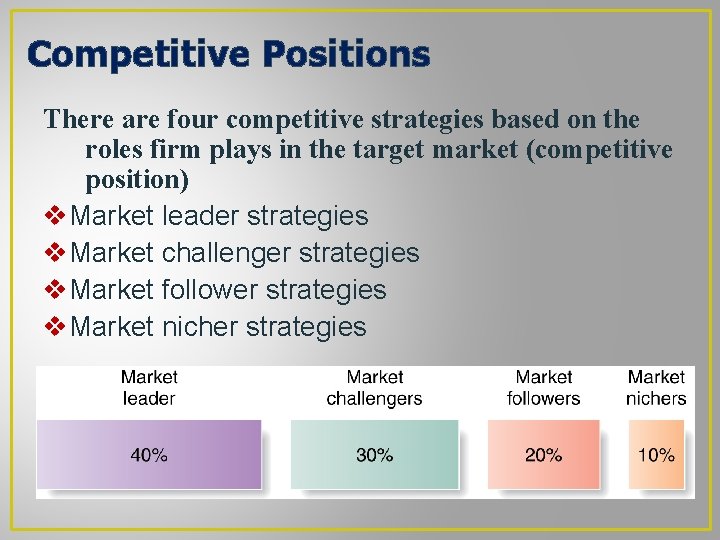
Competitive Positions There are four competitive strategies based on the roles firm plays in the target market (competitive position) v. Market leader strategies v. Market challenger strategies v. Market follower strategies v. Market nicher strategies
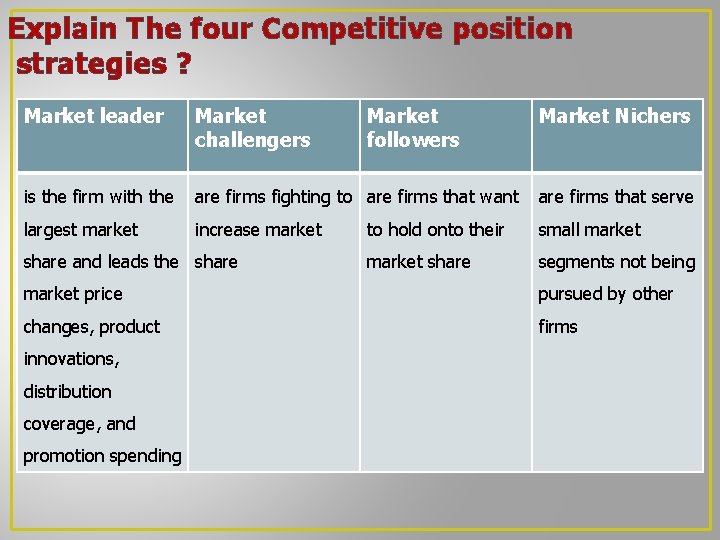
Explain The four Competitive position strategies ? Market leader Market challengers is the firm with the are firms fighting to are firms that want are firms that serve largest market increase market to hold onto their small market share segments not being share and leads the share Market followers Market Nichers market price pursued by other changes, product firms innovations, distribution coverage, and promotion spending