
Marketing Essentials Preparing Print Advertisements Chapter 20 n
- Slides: 41
Marketing Essentials Preparing Print Advertisements Chapter 20 n Preparing Print Advertisements 1
SECTION 20. 1 Essential Elements of Advertising What You'll Learn = How advertising campaigns are developed = The creation of advertising headlines = The preparation of advertising copy = The selection of advertising illustrations = The significance of advertising signatures Chapter 20 n Preparing Print Advertisements 2
SECTION 20. 1 Essential Elements of Advertising Why It's Important In order to understand how successful advertising campaigns help sell products, you need to know how essential advertising elements are used to develop effective advertisements. Chapter 20 n Preparing Print Advertisements 3
SECTION 20. 1 Essential Elements of Advertising Key Terms = advertising campaign = illustration = advertising agencies = clip art = headline = signature = copy = slogan Chapter 20 n Preparing Print Advertisements 4
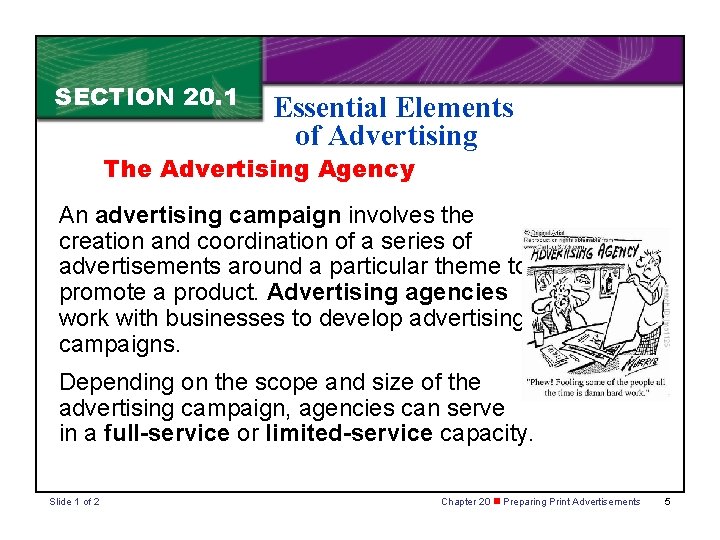
SECTION 20. 1 Essential Elements of Advertising The Advertising Agency An advertising campaign involves the creation and coordination of a series of advertisements around a particular theme to promote a product. Advertising agencies work with businesses to develop advertising campaigns. Depending on the scope and size of the advertising campaign, agencies can serve in a full-service or limited-service capacity. Slide 1 of 2 Chapter 20 n Preparing Print Advertisements 5
SECTION 20. 1 Essential Elements of Advertising The Advertising Agency Full-service agencies perform advertising research, media selection, copy development, and artwork for an advertising campaign. Limited-service agencies specialize in one aspect of the campaign, such as creative services. In-house agencies provide full or limited advertising services based upon the size of the company. Slide 2 of 2 Chapter 20 n Preparing Print Advertisements 6
SECTION 20. 1 Essential Elements of Advertising Agency Organization Advertising agencies are usually organized into four service departments: = client = creative = research = media Slide 1 of 5 Chapter 20 n Preparing Print Advertisements 7
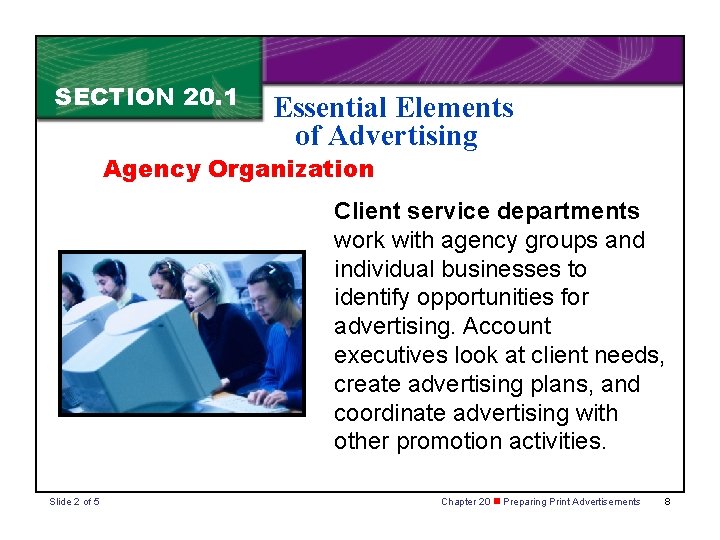
SECTION 20. 1 Essential Elements of Advertising Agency Organization Client service departments work with agency groups and individual businesses to identify opportunities for advertising. Account executives look at client needs, create advertising plans, and coordinate advertising with other promotion activities. Slide 2 of 5 Chapter 20 n Preparing Print Advertisements 8
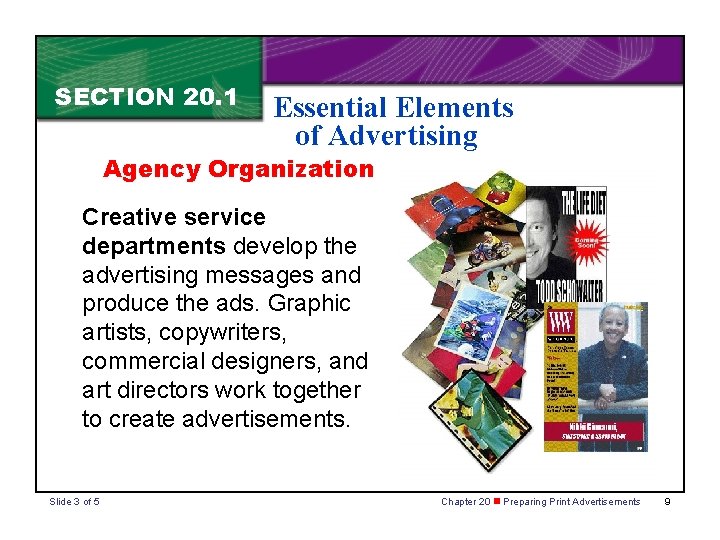
SECTION 20. 1 Essential Elements of Advertising Agency Organization Creative service departments develop the advertising messages and produce the ads. Graphic artists, copywriters, commercial designers, and art directors work together to create advertisements. Slide 3 of 5 Chapter 20 n Preparing Print Advertisements 9
SECTION 20. 1 Essential Elements of Advertising Agency Organization Research service departments study the target markets, the attitudes of potential customers, and their buying behaviors. This department helps determine the type of message that will have the greatest appeal for a particular market segment. Slide 4 of 5 Chapter 20 n Preparing Print Advertisements 10
SECTION 20. 1 Essential Elements of Advertising Agency Organization Media service departments advise clients on their media choices. This department suggests an advertising budget for television, radio, newspapers, magazines, and other forms of advertising, such as billboards and direct mail. This department also coordinates the timing, placement, and frequency of various advertisements. Slide 5 of 5 Chapter 20 n Preparing Print Advertisements 11
SECTION 20. 1 Essential Elements of Advertising New Models for Advertising Agencies Advertising experts predict that the following new models for advertising agencies will be used in the future: = creative boutiques = project team agencies = virtual agencies Slide 1 of 3 Chapter 20 n Preparing Print Advertisements 12
SECTION 20. 1 Essential Elements of Advertising New Models for Advertising Agencies A creative boutique is a specialized service agency where creative production is sent outside the business, but copy is provided by the business. This results in faster layout and production. Slide 2 of 3 Chapter 20 n Preparing Print Advertisements 13
SECTION 20. 1 Essential Elements of Advertising New Models for Advertising Agencies Project team agencies provide copywriting, creative execution and media placement without larger agency overhead. Teams work together on projects. Virtual agencies provide services coordinated by an individual who works with a network of experienced freelancers. Slide 3 of 3 Chapter 20 n Preparing Print Advertisements 14
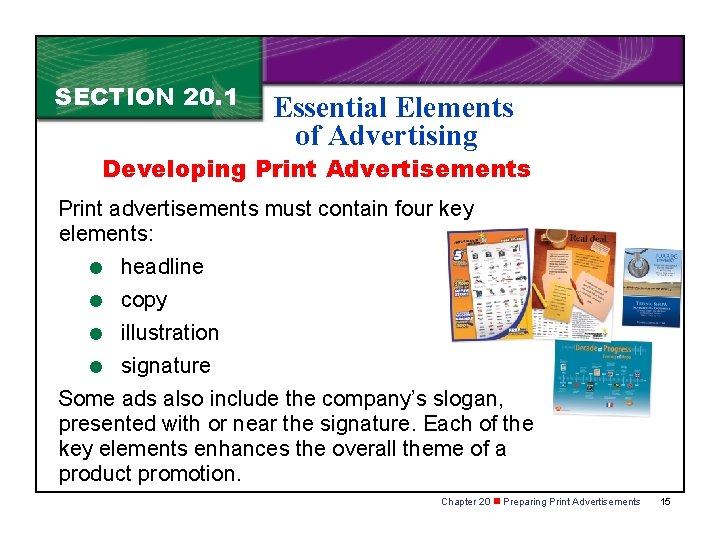
SECTION 20. 1 Essential Elements of Advertising Developing Print Advertisements Print advertisements must contain four key elements: = headline = copy = illustration = signature Some ads also include the company’s slogan, presented with or near the signature. Each of the key elements enhances the overall theme of a product promotion. Chapter 20 n Preparing Print Advertisements 15
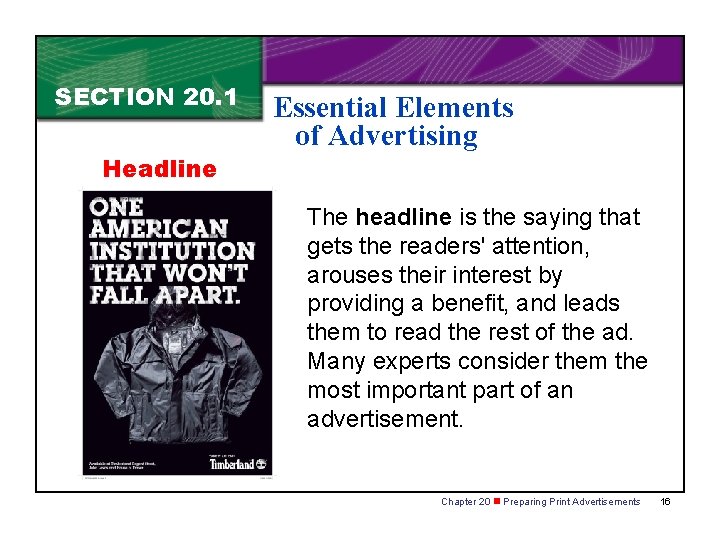
SECTION 20. 1 Headline Essential Elements of Advertising The headline is the saying that gets the readers' attention, arouses their interest by providing a benefit, and leads them to read the rest of the ad. Many experts consider them the most important part of an advertisement. Chapter 20 n Preparing Print Advertisements 16
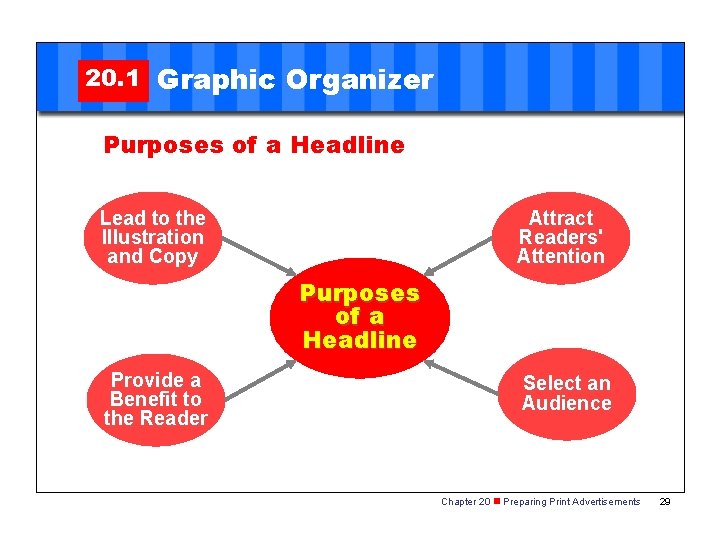
SECTION 20. 1 Essential Elements of Advertising Purposes of a Headline The purposes of a headline are to: = Attract readers' attention—effective words are new, now, and free. = Select an audience—project an image toward a specific type of customer. = Provide a benefit to the reader—promise something that matches a need or want. = Lead to the illustration and copy. Chapter 20 n Preparing Print Advertisements 17
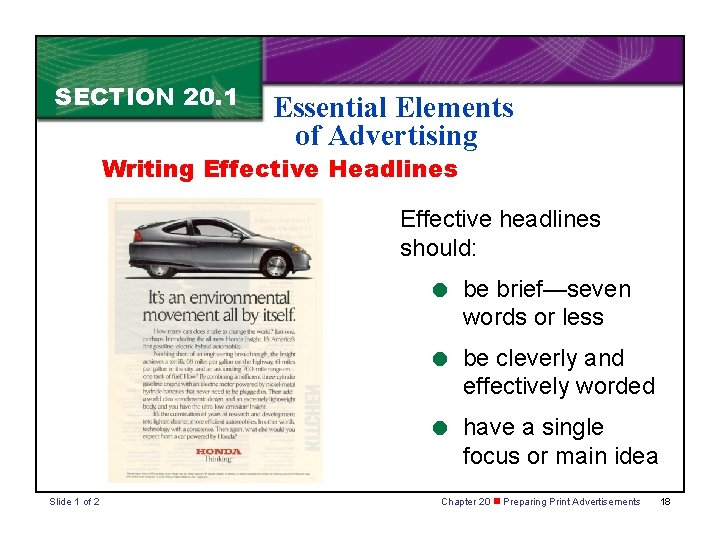
SECTION 20. 1 Essential Elements of Advertising Writing Effective Headlines Effective headlines should: = be brief—seven words or less = be cleverly and effectively worded = have a single focus or main idea Slide 1 of 2 Chapter 20 n Preparing Print Advertisements 18
SECTION 20. 1 Essential Elements of Advertising Writing Effective Headlines The following are some popular headline-writing techniques: = Alliteration uses repeating initial consonant sounds. = A paradox is a seeming contradiction that could be true. = Rhyme employs words that correspond in sound. = A pun is the humorous use of a word that suggests two or more of its meanings. = A play on words uses the same word in different senses or words similar in sound used in opposition to each other. Slide 2 of 2 Chapter 20 n Preparing Print Advertisements 19
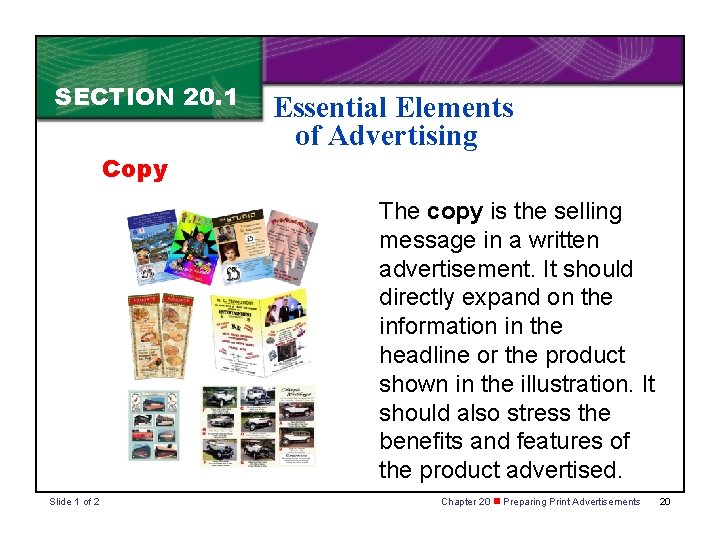
SECTION 20. 1 Copy Essential Elements of Advertising The copy is the selling message in a written advertisement. It should directly expand on the information in the headline or the product shown in the illustration. It should also stress the benefits and features of the product advertised. Slide 1 of 2 Chapter 20 n Preparing Print Advertisements 20
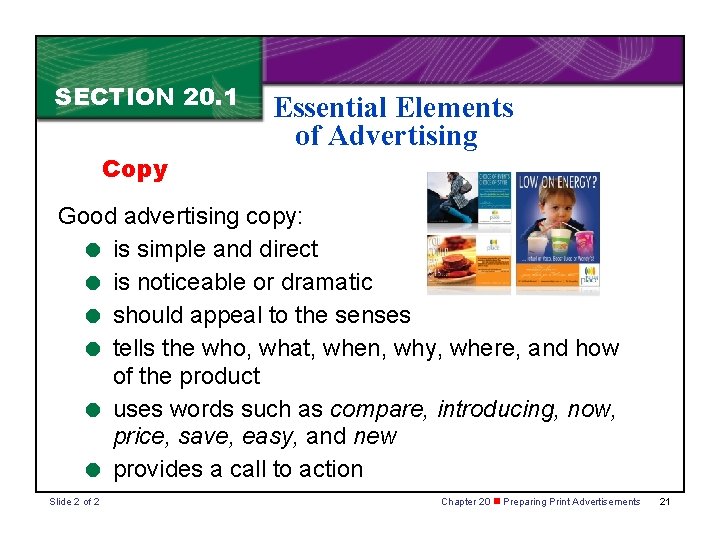
SECTION 20. 1 Copy Essential Elements of Advertising Good advertising copy: = is simple and direct = is noticeable or dramatic = should appeal to the senses = tells the who, what, when, why, where, and how of the product = uses words such as compare, introducing, now, price, save, easy, and new = provides a call to action Slide 2 of 2 Chapter 20 n Preparing Print Advertisements 21
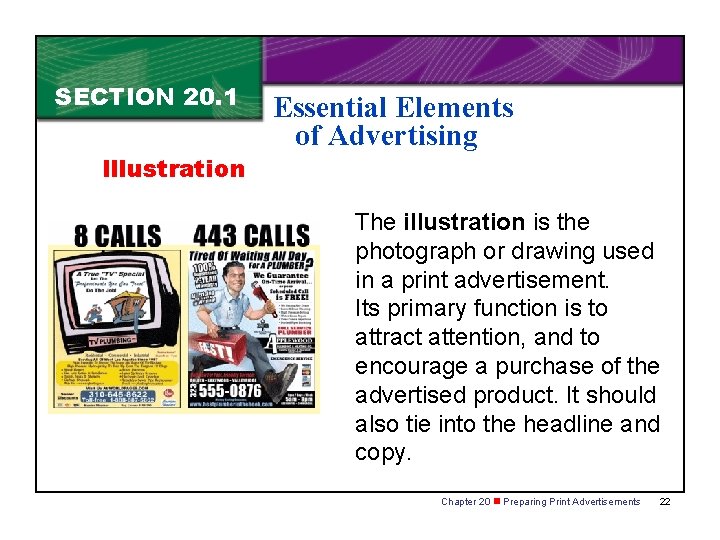
SECTION 20. 1 Illustration Essential Elements of Advertising The illustration is the photograph or drawing used in a print advertisement. Its primary function is to attract attention, and to encourage a purchase of the advertised product. It should also tie into the headline and copy. Chapter 20 n Preparing Print Advertisements 22
SECTION 20. 1 Essential Elements of Advertising Sources of Illustrations Clip art is any ready-for-production image, stock drawing, or photograph, often provided by suppliers, manufacturers, or trade associations for print advertisements. Clip art is inexpensive, quick, and easy to use. When stock art work is not sufficient, professionals may be hired to photograph situations or products. Chapter 20 n Preparing Print Advertisements 23
SECTION 20. 1 Signature Essential Elements of Advertising The signature, or logotype (logo), is the distinctive identification symbol for a business. = In national ads, the signature is the name of the firm, and sometimes the corporate symbol and slogan. = In local ads, the signature usually includes the business's name, hours, address, telephone number, or slogan. Chapter 20 n Preparing Print Advertisements 24
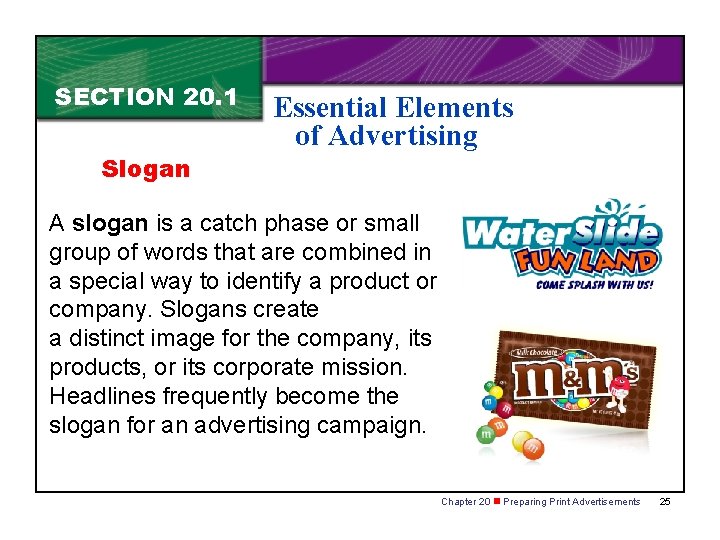
SECTION 20. 1 Slogan Essential Elements of Advertising A slogan is a catch phase or small group of words that are combined in a special way to identify a product or company. Slogans create a distinct image for the company, its products, or its corporate mission. Headlines frequently become the slogan for an advertising campaign. Chapter 20 n Preparing Print Advertisements 25
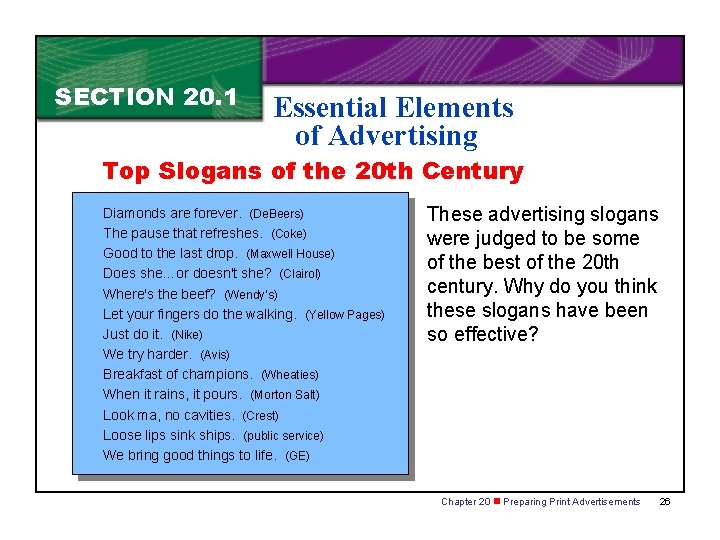
SECTION 20. 1 Essential Elements of Advertising Top Slogans of the 20 th Century Diamonds are forever. (De. Beers) The pause that refreshes. (Coke) Good to the last drop. (Maxwell House) Does she…or doesn't she? (Clairol) Where's the beef? (Wendy's) Let your fingers do the walking. (Yellow Pages) Just do it. (Nike) We try harder. (Avis) Breakfast of champions. (Wheaties) When it rains, it pours. (Morton Salt) Look ma, no cavities. (Crest) Loose lips sink ships. (public service) We bring good things to life. (GE) These advertising slogans were judged to be some of the best of the 20 th century. Why do you think these slogans have been so effective? Chapter 20 n Preparing Print Advertisements 26
20. 1 ASSESSMENT Reviewing Key Terms and Concepts 1. How are advertising campaigns developed? 2. Why are headlines considered by many to be the most important part of print advertisements? 3. What is the main purpose of advertising copy? 4. What should illustrations show about a product? 5. What is the signature in an advertisement? Chapter 20 n Preparing Print Advertisements 27
20. 1 ASSESSMENT Thinking Critically What is a problem with a well-designed ad that does not have a signature? Chapter 20 n Preparing Print Advertisements 28
20. 1 Graphic Organizer Purposes of a Headline Lead to the Illustration and Copy Attract Readers' Attention Purposes of a Headline Provide a Benefit to the Reader Select an Audience Chapter 20 n Preparing Print Advertisements 29
SECTION 20. 2 Ad Layouts What You'll Learn = The importance of advertising layouts = The principles of preparing an ad layout = The advantages and disadvantages of using color in advertising = How typefaces and type sizes can be changed to add variety and emphasis to print advertisements = How to check advertising proofs Chapter 20 n Preparing Print Advertisements 30
SECTION 20. 2 Ad Layouts Why It's Important Since print advertisements have only a few seconds to reach a reader, you’ll want to learn how to develop an advertising layout that will attract your target audience. Chapter 20 n Preparing Print Advertisements 31
SECTION 20. 2 Ad Layouts Key Terms = ad layout = advertising proof Chapter 20 n Preparing Print Advertisements 32
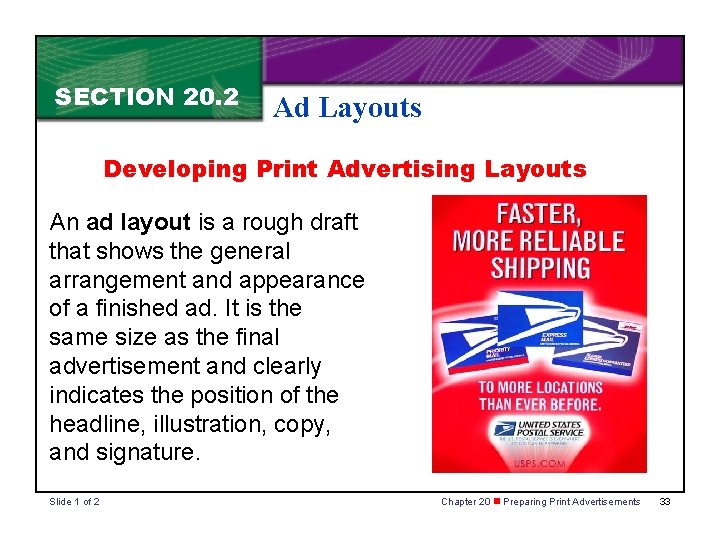
SECTION 20. 2 Ad Layouts Developing Print Advertising Layouts An ad layout is a rough draft that shows the general arrangement and appearance of a finished ad. It is the same size as the final advertisement and clearly indicates the position of the headline, illustration, copy, and signature. Slide 1 of 2 Chapter 20 n Preparing Print Advertisements 33
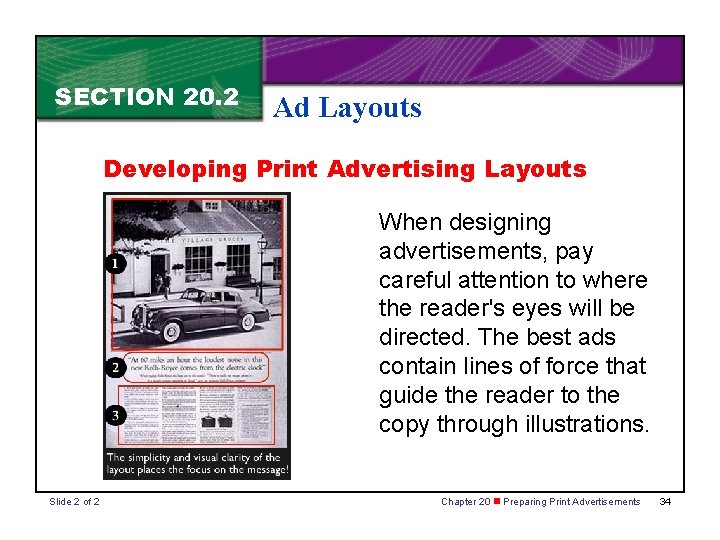
SECTION 20. 2 Ad Layouts Developing Print Advertising Layouts When designing advertisements, pay careful attention to where the reader's eyes will be directed. The best ads contain lines of force that guide the reader to the copy through illustrations. Slide 2 of 2 Chapter 20 n Preparing Print Advertisements 34
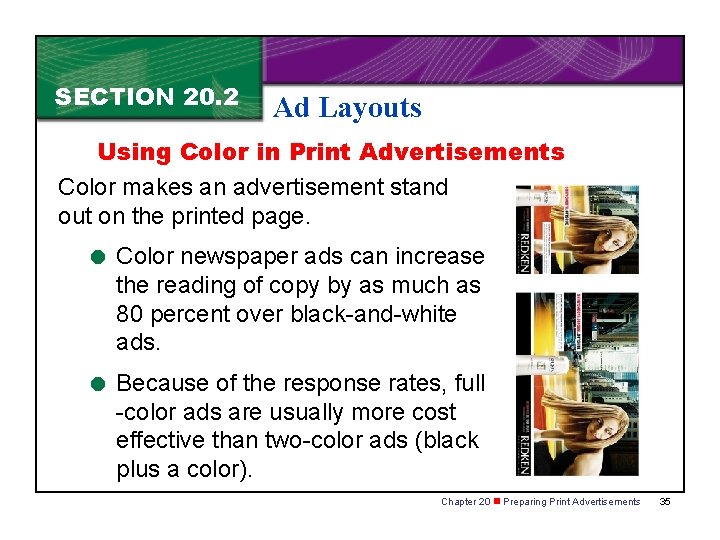
SECTION 20. 2 Ad Layouts Using Color in Print Advertisements Color makes an advertisement stand out on the printed page. = Color newspaper ads can increase the reading of copy by as much as 80 percent over black-and-white ads. = Because of the response rates, full -color ads are usually more cost effective than two-color ads (black plus a color). Chapter 20 n Preparing Print Advertisements 35
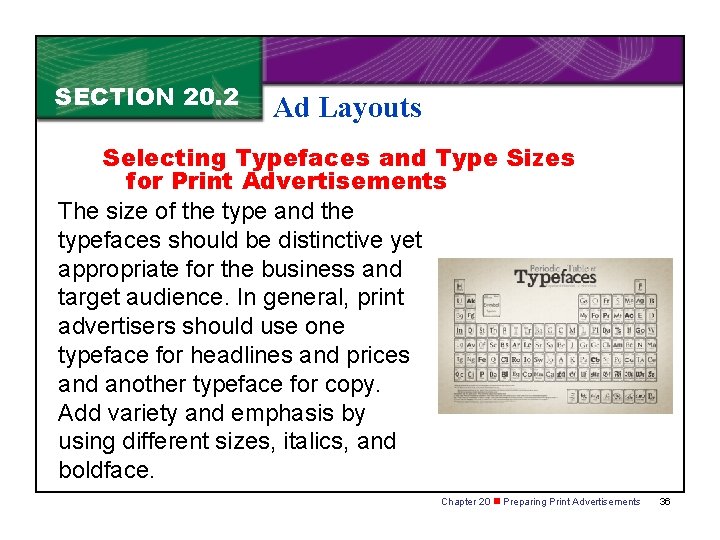
SECTION 20. 2 Ad Layouts Selecting Typefaces and Type Sizes for Print Advertisements The size of the type and the typefaces should be distinctive yet appropriate for the business and target audience. In general, print advertisers should use one typeface for headlines and prices and another typeface for copy. Add variety and emphasis by using different sizes, italics, and boldface. Chapter 20 n Preparing Print Advertisements 36
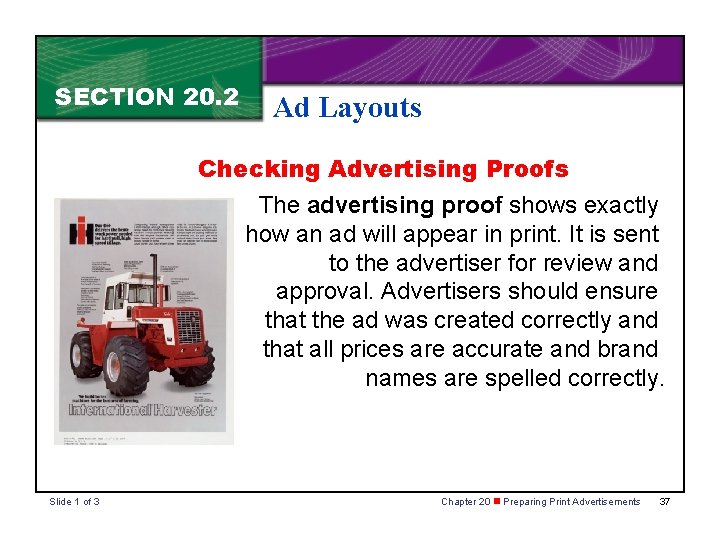
SECTION 20. 2 Ad Layouts Checking Advertising Proofs The advertising proof shows exactly how an ad will appear in print. It is sent to the advertiser for review and approval. Advertisers should ensure that the ad was created correctly and that all prices are accurate and brand names are spelled correctly. Slide 1 of 3 Chapter 20 n Preparing Print Advertisements 37
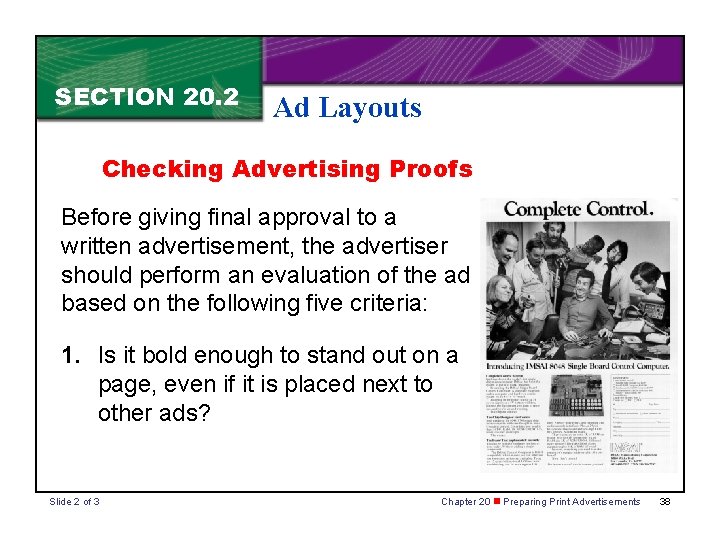
SECTION 20. 2 Ad Layouts Checking Advertising Proofs Before giving final approval to a written advertisement, the advertiser should perform an evaluation of the ad based on the following five criteria: 1. Is it bold enough to stand out on a page, even if it is placed next to other ads? Slide 2 of 3 Chapter 20 n Preparing Print Advertisements 38
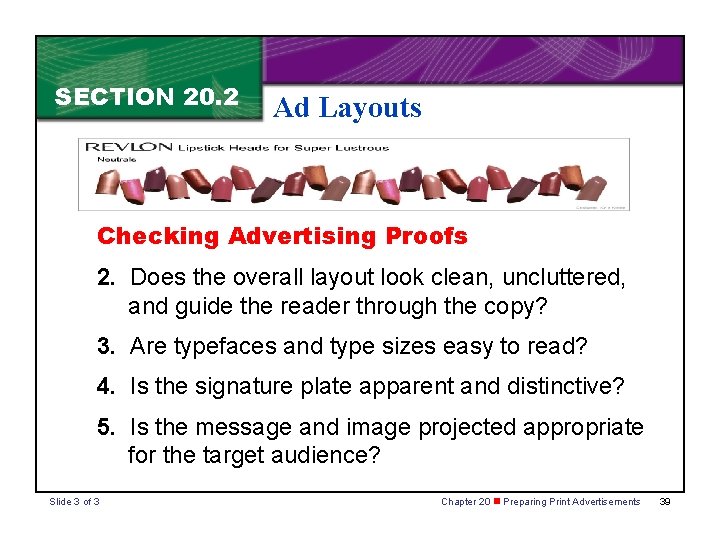
SECTION 20. 2 Ad Layouts Checking Advertising Proofs 2. Does the overall layout look clean, uncluttered, and guide the reader through the copy? 3. Are typefaces and type sizes easy to read? 4. Is the signature plate apparent and distinctive? 5. Is the message and image projected appropriate for the target audience? Slide 3 of 3 Chapter 20 n Preparing Print Advertisements 39
20. 2 ASSESSMENT Reviewing Key Terms and Concepts 1. What is an ad layout? 2. Why is color important in print advertisements? 3. How can variety be added to the type selected for print advertising? 4. What is the purpose of an advertising proof? 5. What should an advertiser review before submitting an advertising proof to a newspaper? Chapter 20 n Preparing Print Advertisements 40
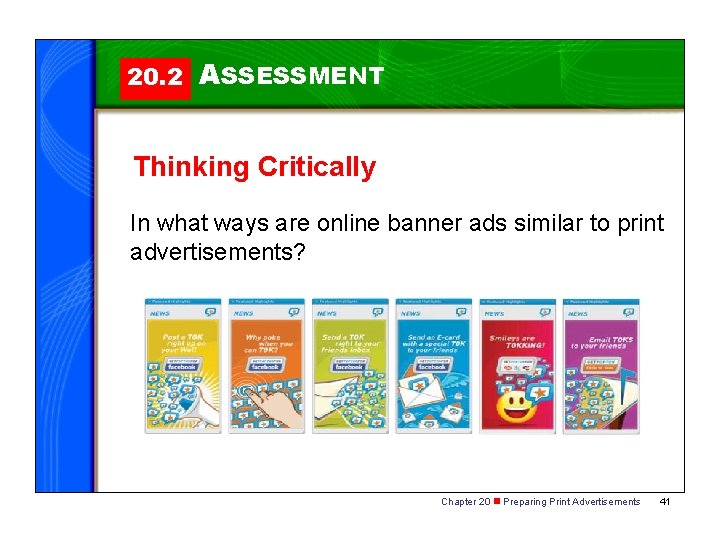
20. 2 ASSESSMENT Thinking Critically In what ways are online banner ads similar to print advertisements? Chapter 20 n Preparing Print Advertisements 41