
MARKETING Chapter Objectives 1 2 3 4 5

MARKETING
Chapter Objectives 1. 2. 3. 4. 5. Explain the purpose of market segmentation. Describe the importance of selecting a target market. Explain why it is important for a start-up to establish a unique position in its target market. Describe the importance of the ability to position a company’s products on benefits rather than features. Illustrate the two major ways in which a company builds a brand.
Chapter Objectives 6. 7. 8. 9. 10. Identify the four components of the marketing mix. Explain the difference between a core product and an actual product. Contrast cost-based pricing and value-based pricing. Explain the differences between advertising and public relations. Weigh the advantages and disadvantages of selling direct versus selling through intermediaries.
Selecting a Target Market and Establishing a Position in the Market � Important Questions That All Start-ups Must Ask ◦ In order to succeed, a new firm must address this important issue: Who are our customers and how will we appeal to them? ◦ A well-managed start-up approaches this query by following a three-step process: �Segmenting the market. �Selecting a target market. �Establishing a unique position in the target market.

Selecting a Target Market and Establishing a Position in the Market The Process of Selecting a Target Market and Positioning Strategy

Segmenting the Market � Market Segmentation ◦ The first step in selecting a target market is to study a firm’s industry and determine the different potential target markets in that industry. �This process is called market segmentation. �Markets can be segmented in a number of different ways, including product type, price point, and customers served. �For example, the computer industry can be segmented in the following ways: �Product type (handheld computers, laptops, PCs, Minicomputers, and mainframes). �Customers served (individuals, business, educational institutions, and government).
Selecting a Target Market � Target Market ◦ Once a firm has segmented the market, the next step is to select a target market. The market must be sufficiently attractive and the firm must have the capabilities to serve it. ◦ Typically, a firm does not target an entire segment of a market because many market segments are too large to target successfully. �Instead, most firms target a niche within a segment. �For example, one segment of the computer industry is handheld computers. Within this segment, there are several smaller niche markets that represent a narrower group of customers with similar needs.
Establishing a Unique Position � Positioning ◦ After selecting a target market, the firm’s next step is to establish a “position” within the market that differentiates it from its competitors. �In a sense, a “position” is the part of a market or of a segment of the market the firm is claiming as its own. ◦ A firm establishes a unique position in its customers’ minds by consistently drawing attention to two or three of its product’s attributes that define the essence of what the product is and what separates it from its competitors.

Establishing a Unique Position � Positioning (continued) ◦ Firms often develop a “tagline” to reinforce the position they have staked out in their market, or a phrase that is used consistently in a company’s literature and thus becomes associated with the company. ◦ An example is Nike’s familiar tagline, “Just do it. ” �The beauty of this simple three-word expression is that it applies equally to a 21 -year-old triathlete and a 65 -year-old mall walker.
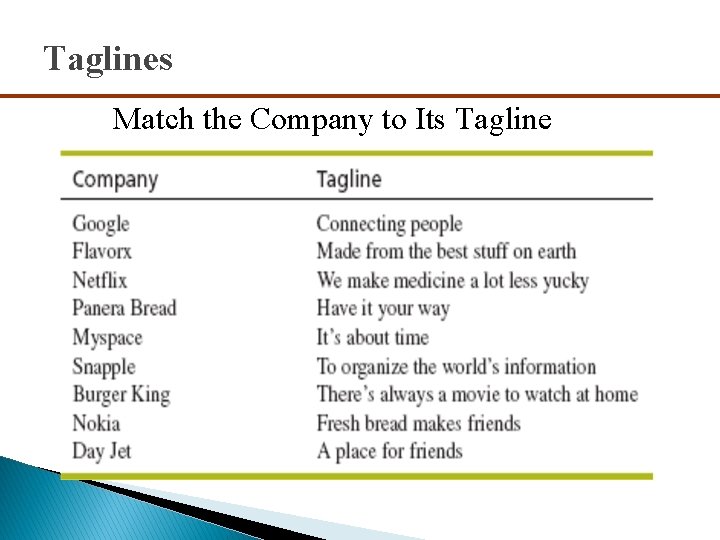
Taglines Match the Company to Its Tagline
Selling Benefits Rather Than Features � Selling Benefits Rather Than Features ◦ Many entrepreneurs make the mistake of positioning their company’s products or services on features rather than benefits. ◦ A positioning or marketing strategy that focuses on the features of a product, such as its technical merits, is usually much less effective than a campaign focusing on what the merits of the product can do. ◦ Consider the example on the following slide;
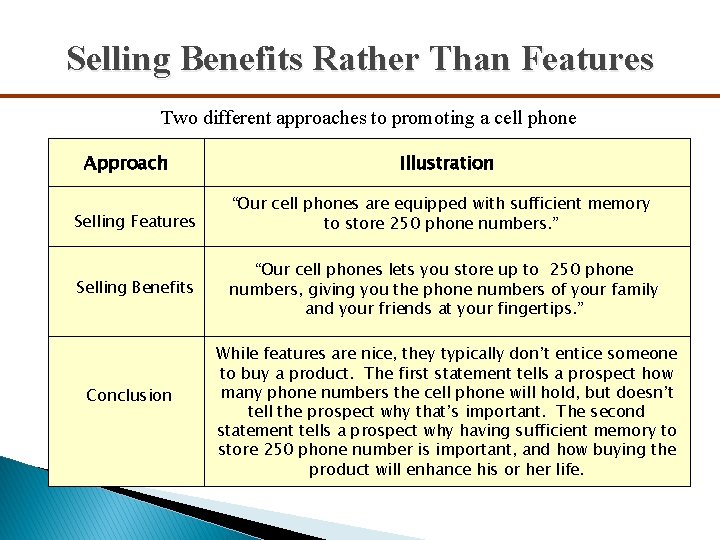
Selling Benefits Rather Than Features Two different approaches to promoting a cell phone Approach Selling Features Selling Benefits Conclusion Illustration “Our cell phones are equipped with sufficient memory to store 250 phone numbers. ” “Our cell phones lets you store up to 250 phone numbers, giving you the phone numbers of your family and your friends at your fingertips. ” While features are nice, they typically don’t entice someone to buy a product. The first statement tells a prospect how many phone numbers the cell phone will hold, but doesn’t tell the prospect why that’s important. The second statement tells a prospect why having sufficient memory to store 250 phone number is important, and how buying the product will enhance his or her life.
Establishing a Brand � Establishing a Brand ◦ A brand is the set of attributes—positive or negative—that people associate with a company. �These attributes can be positive, such as trustworthy, dependable, or easy to deal with. �Or they can be negative, such as cheap, unreliable, or difficult to deal with. ◦ The customer loyalty a company creates through its brand is one of its most valuable assets. � Brand Management ◦ Some companies monitor the integrity of their brands through a program called “brand management. ”
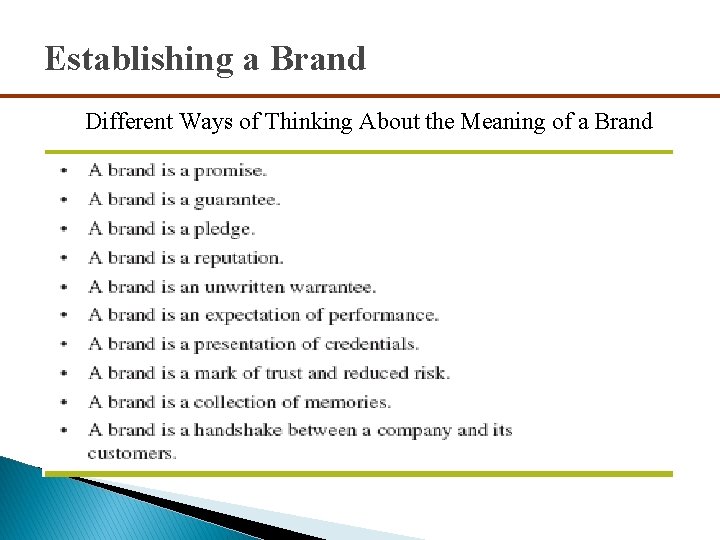
Establishing a Brand Different Ways of Thinking About the Meaning of a Brand
Establishing a Brand � Establishing a Brand ◦ How does a firm establish a brand? �On a philosophical level, a firm must have meaning in its customer’s lives. It must create value—something for which customers are willing to pay. �On a more practical level, brands are built through a number of techniques, including advertising, public relations, sponsorships, support of social causes, and good performance. �A firm’s name, logo, Web site design, and even its letterhead are part of its brand. �It’s important for start-ups to have a polished image immediately so that they have credibility when they approach potential customers.
Establishing a Brand � Power of a Strong Brand ◦ Ultimately, a strong brand can be a very powerful asset for a firm. It serves as another marketing tool. � Cobranding ◦ One technique that companies use to strengthen their brands is to enter into cobranding arrangements with other firms. ◦ Cobranding refers to a relationship between two or more firms where the firm’s brands promote each another.
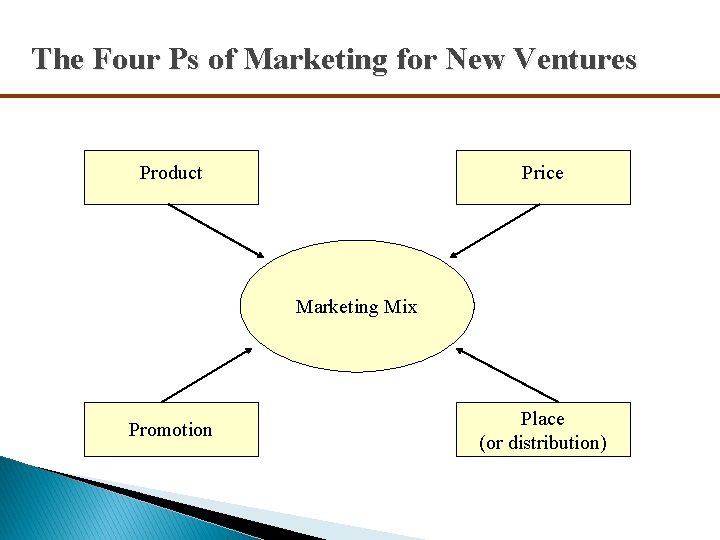
The Four Ps of Marketing for New Ventures Product Price Marketing Mix Promotion Place (or distribution)
Product � Product ◦ A firm’s product, in the context of the marketing mix, is the good or service it offers to its target market. ◦ The initial rollout is one of the most critical times in the marketing of a new product. �All new firms face the challenge that they are unknown and that it takes a leap of faith for their first customers to buy their products. �Some start-ups meet this challenge by using reference accounts. �A reference account is an early user of a firm’s product or service who is willing to give a testimonial regarding his or her experience with the product or service.
Core Product vs. Actual Product � Core Product vs. Actual Product ◦ As a firm prepares to sell its product, an important distinction should be made between the core product and the actual product. ◦ The core product is the product itself, such as a CD that contains an antivirus program. ◦ The actual product, which is what the customer buys, may have up to five attributes: �A quality level, features, design, a brand name, and packaging.
Price � Price ◦ Price is the amount of money consumers pay to buy a product. �It is the only element of the marketing mix that produces revenue; all other elements represent a cost. ◦ The price a company charges for its products sends an important message to its target market. �For example, Robert & Sons positions its medicated glasses as innovative, state-of-the-art products that are both high quality and visually appealing. �This position in the market suggests a premium price that Robert & Sons charges. ◦ Most entrepreneurs use one of two methods to set the price for their products, as shown on the next slide.
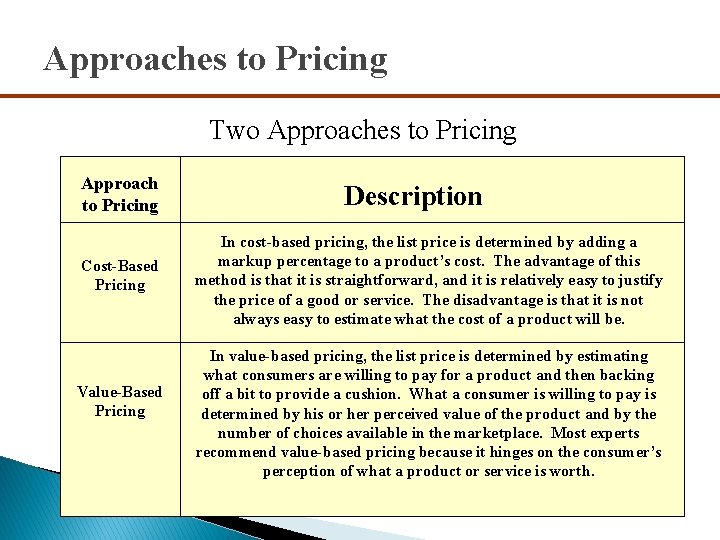
Approaches to Pricing Two Approaches to Pricing Approach to Pricing Cost-Based Pricing Value-Based Pricing Description In cost-based pricing, the list price is determined by adding a markup percentage to a product’s cost. The advantage of this method is that it is straightforward, and it is relatively easy to justify the price of a good or service. The disadvantage is that it is not always easy to estimate what the cost of a product will be. In value-based pricing, the list price is determined by estimating what consumers are willing to pay for a product and then backing off a bit to provide a cushion. What a consumer is willing to pay is determined by his or her perceived value of the product and by the number of choices available in the marketplace. Most experts recommend value-based pricing because it hinges on the consumer’s perception of what a product or service is worth.
Promotion � Promotion ◦ Refers to the activities the firm takes to communicate the merits of its product or service to its target market. ◦ There are several common activities that entrepreneurs use to promote their products and services. � Advertising ◦ Advertising is making people aware of a product or service in hopes of persuading them to buy it.
Promotion � Advertising (continued) ◦ Advertising’s major goals are to do the following: �Raise customer awareness of a product. �Explain a product’s comparative benefits. �Create associations between a product and a certain lifestyle. �Educate prospective buyers on the uses of the product/service. ◦ Advertising has some major weaknesses, including the following: �Low credibility. �The possibility that a high percentage of the people who see the ad will not be interested. �Message clutter. �Relatively costly compared to other forms of promotions. �The perception that advertising is intrusive.
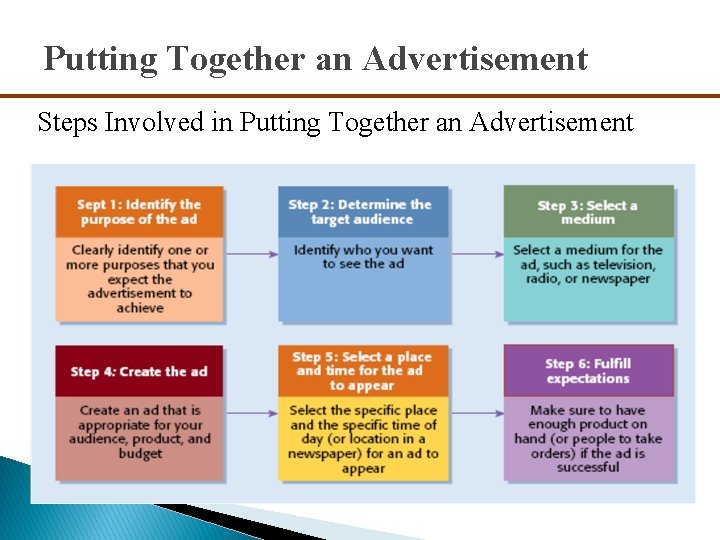
Putting Together an Advertisement Steps Involved in Putting Together an Advertisement
Google Ad. Words and Ad. Sense Program � Ad. Words ◦ Allows advertisers to buy keywords on the Google Home Page. ◦ Triggers text-based ads to the side (and sometimes above) search results when the keyword is used. ◦ The program includes local, national, and international distribution. ◦ Advertisers pay a certain amount per click. ◦ Advertisers benefit because they are able to place their ads in front of people who are already searching for information about their product.
Google Ad. Words and Ad. Sense Program � Ad. Sense ◦ Allows advertisers to buy ads that will be shown on other Web sites instead of Google’s Home Page. ◦ Google selects sites of interest to the advertiser’s customers. ◦ Advertisers are charged on a pay-per-click or a perthousand impression basis. ◦ Advertisers benefit because the content of the ad is often relevant to the Web site. ◦ Web site owners benefit by using the service to monetize their Web site.
Public Relations � Public Relations ◦ One of the most cost-effective ways to increase the awareness of the products of a company is through public relations. ◦ Public relations refers to efforts to establish and maintain a company’s image with the public. ◦ The major difference between public relations and advertising is that public relations is not paid for—directly. �The cost of public relations to a firm is the effort it makes to network with journalists and other people to try to interest them in saying or writing good things about the company and its products.
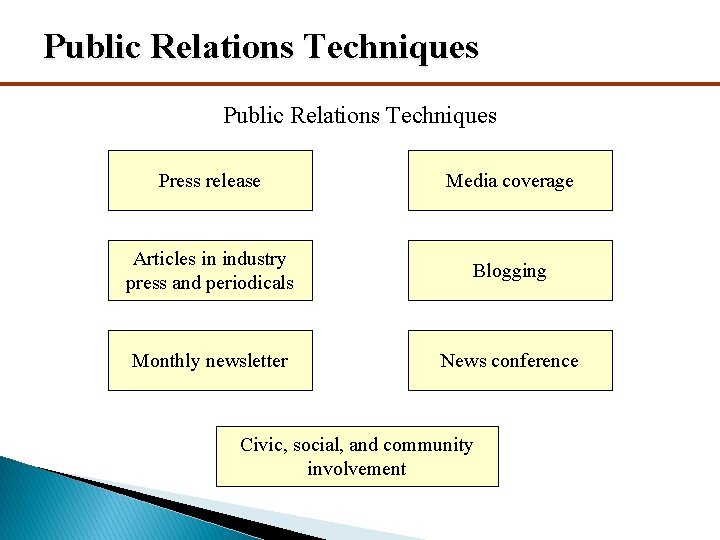
Public Relations Techniques Press release Media coverage Articles in industry press and periodicals Blogging Monthly newsletter News conference Civic, social, and community involvement
Place (or Distribution) � Place ◦ Place, or distribution, encompasses all the activities that move a firm’s product from its place of origin (production floor) to the consumer. ◦ The first choice a firm has to make regarding distribution is whether to sell its products directly to consumers or through intermediaries (such as wholesalers and retailers). ◦ Within most industries, both choices are available, so the decision typically depends on how a firm believes its target market wants to buy its product.
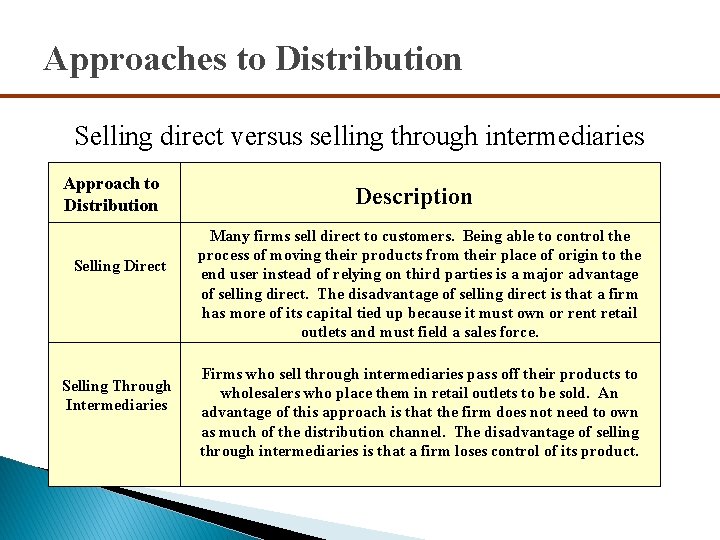
Approaches to Distribution Selling direct versus selling through intermediaries Approach to Distribution Selling Direct Selling Through Intermediaries Description Many firms sell direct to customers. Being able to control the process of moving their products from their place of origin to the end user instead of relying on third parties is a major advantage of selling direct. The disadvantage of selling direct is that a firm has more of its capital tied up because it must own or rent retail outlets and must field a sales force. Firms who sell through intermediaries pass off their products to wholesalers who place them in retail outlets to be sold. An advantage of this approach is that the firm does not need to own as much of the distribution channel. The disadvantage of selling through intermediaries is that a firm loses control of its product.
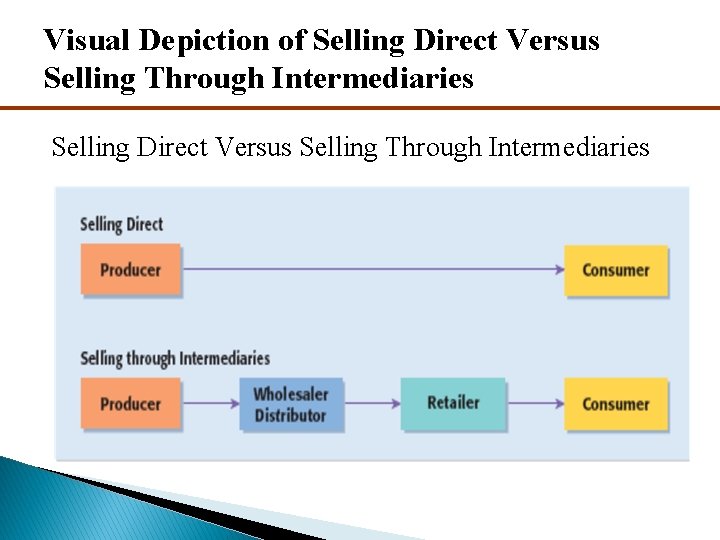
Visual Depiction of Selling Direct Versus Selling Through Intermediaries
- Slides: 31