
Marketing An Introduction 10 Marketing Channels Delivering Customer
- Slides: 31
Marketing An Introduction 10 Marketing Channels Delivering Customer Value 3 -1
Learning Objectives • Explain why companies use marketing channels and discuss the functions these channels perform. • Discuss how channel members interact and how they organize to perform the work of the channel. • Identify the major channel alternatives open to a company. 10 - 2
Learning Objectives • Explain how companies select, motivate, and evaluate channel members. • Discuss the nature and importance of marketing logistics and integrated supply chain management. 10 - 3
First Stop: Netflix’s Channel Innovation • Innovative distribution model of video entertainment: • • DVDs by mail Watch Instantly service Video streaming on almost any device Original content development • Stays ahead of the competition through innovation and revolutionizing distribution 10 - 4
Supply Chains • Upstream partners supply the raw materials, components, parts, information, finances, and expertise needed to create a product or service. • Downstream partners serve as distribution channels that link the firm and its customers. 10 - 5
Value Delivery Network • Company, suppliers, distributors, and customers who partner with each other to improve the performance of the entire system 10 - 6
Marketing Channels (Distribution Channels) • Interdependent organizations that help make a product or service available for use or consumption • Channel decisions • Affect every other marketing decision • Can lead to competitive advantage • May involve long-term commitments to other firms 10 - 7
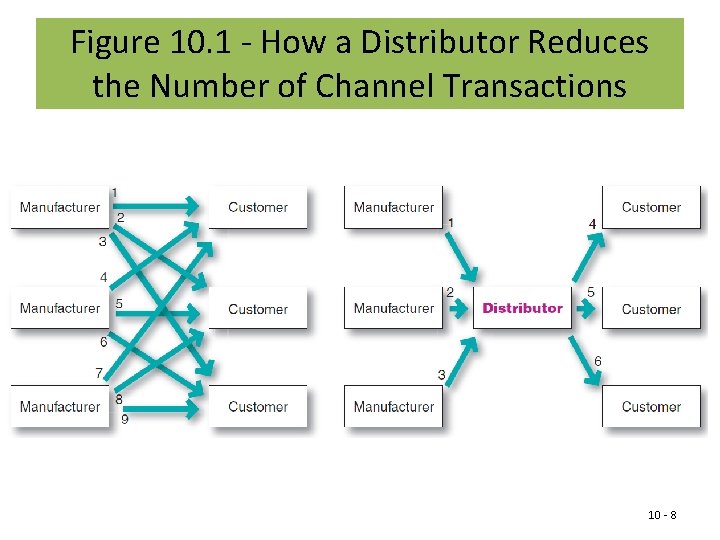
Figure 10. 1 - How a Distributor Reduces the Number of Channel Transactions 10 - 8
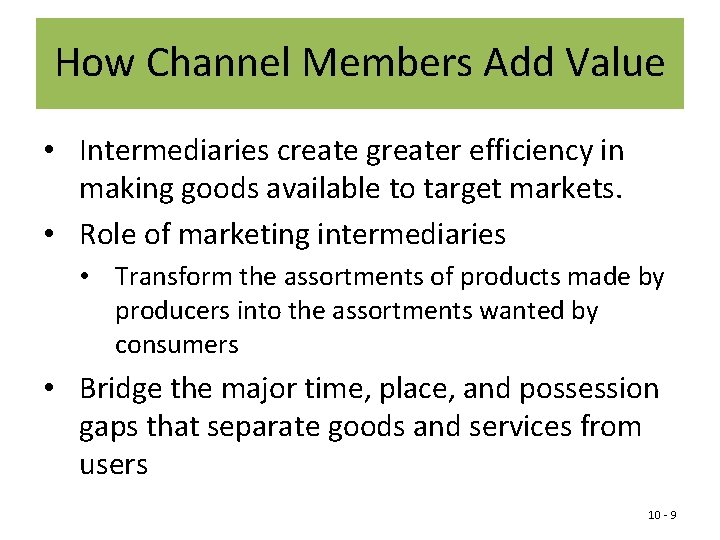
How Channel Members Add Value • Intermediaries create greater efficiency in making goods available to target markets. • Role of marketing intermediaries • Transform the assortments of products made by producers into the assortments wanted by consumers • Bridge the major time, place, and possession gaps that separate goods and services from users 10 - 9
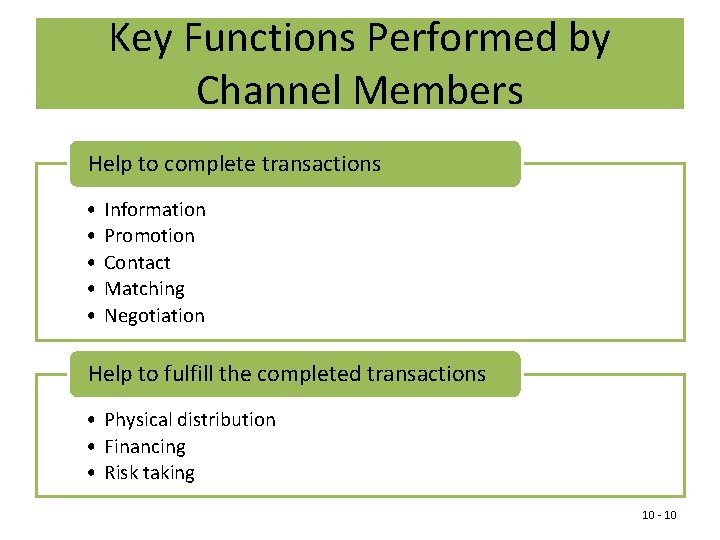
Key Functions Performed by Channel Members Help to complete transactions • • • Information Promotion Contact Matching Negotiation Help to fulfill the completed transactions • Physical distribution • Financing • Risk taking 10 - 10
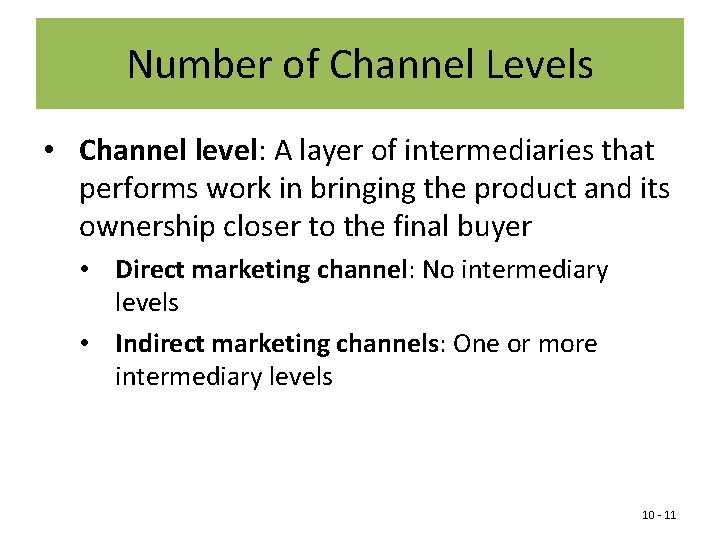
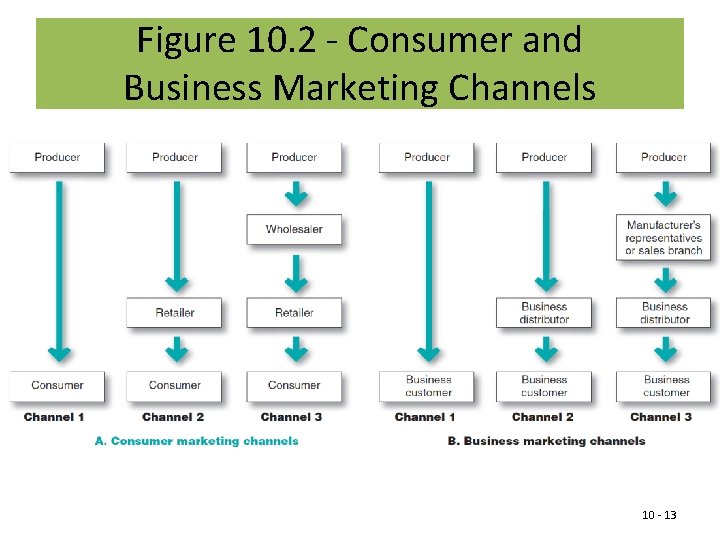
Number of Channel Levels • Channel level: A layer of intermediaries that performs work in bringing the product and its ownership closer to the final buyer • Direct marketing channel: No intermediary levels • Indirect marketing channels: One or more intermediary levels 10 - 11
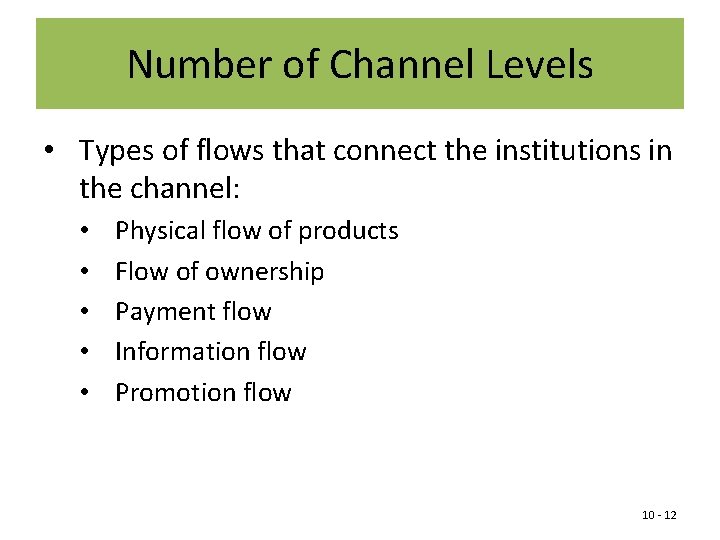
Number of Channel Levels • Types of flows that connect the institutions in the channel: • • • Physical flow of products Flow of ownership Payment flow Information flow Promotion flow 10 - 12
Figure 10. 2 - Consumer and Business Marketing Channels 10 - 13
Channel Behavior • Channel conflict: Disagreements among marketing channel members on goals, roles, and rewards • Horizontal conflict occurs among firms at the same level of the channel. • Vertical conflict occurs between different levels of the same channel. 10 - 14
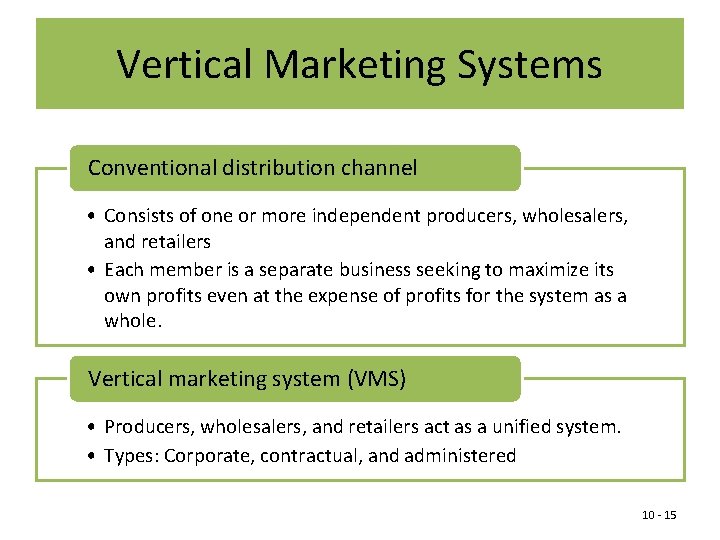
Vertical Marketing Systems Conventional distribution channel • Consists of one or more independent producers, wholesalers, and retailers • Each member is a separate business seeking to maximize its own profits even at the expense of profits for the system as a whole. Vertical marketing system (VMS) • Producers, wholesalers, and retailers act as a unified system. • Types: Corporate, contractual, and administered 10 - 15
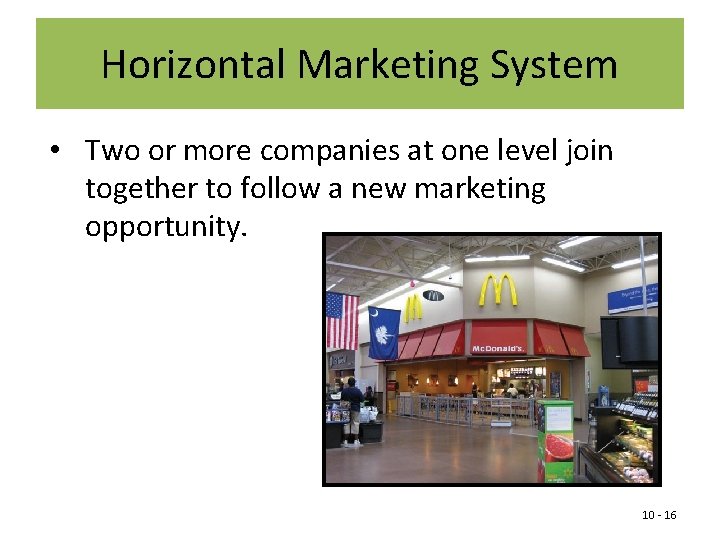
Horizontal Marketing System • Two or more companies at one level join together to follow a new marketing opportunity. 10 - 16
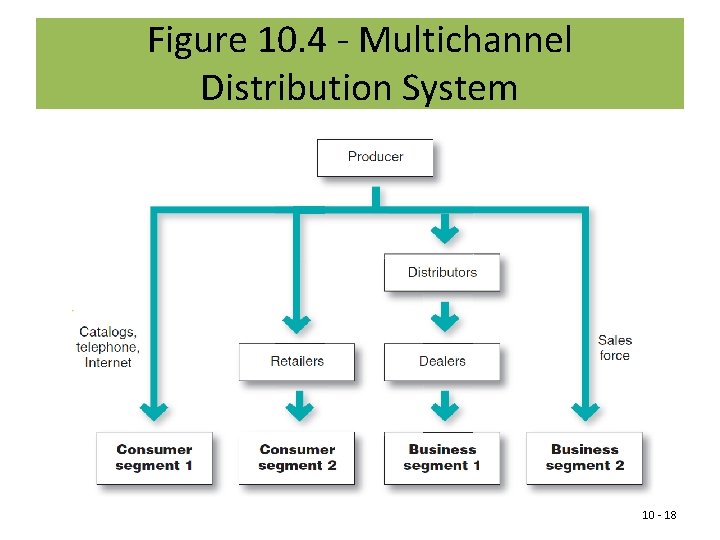
Multichannel Distribution Systems • A single firm sets up two or more marketing channels to reach customer segments. • Advantages: • Expansion of sales and marketing coverage • Tailor-made products and services for the specific needs of customer segments • Disadvantages: • Harder to control • Generates conflict 10 - 17
Figure 10. 4 - Multichannel Distribution System 10 - 18
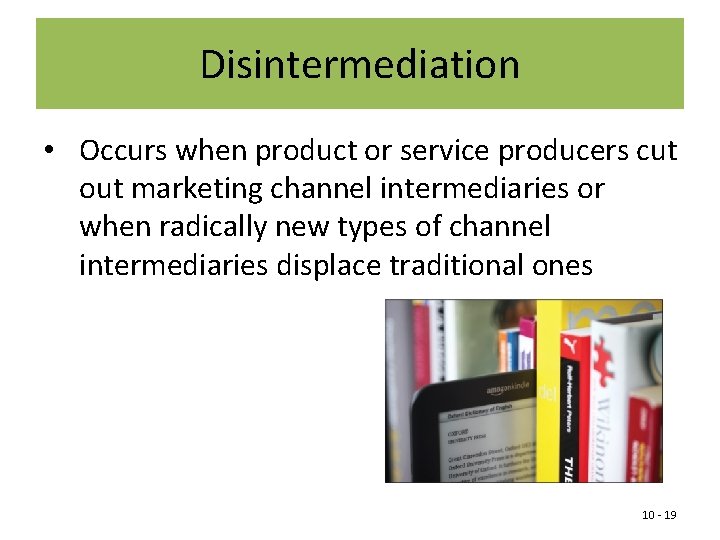
Disintermediation • Occurs when product or service producers cut out marketing channel intermediaries or when radically new types of channel intermediaries displace traditional ones 10 - 19
Channel Design Decisions • Marketing channel design involves designing effective marketing channels by: • • Analyzing customer needs Setting channel objectives Identifying major channel alternatives Evaluating the alternatives 10 - 20
Designing International Channels • Channel strategies should be adapted to the existing structures within each country. • Distribution systems can have many layers and a large number of intermediaries. • Customs and government regulation can restrict distribution in global markets. 10 - 21
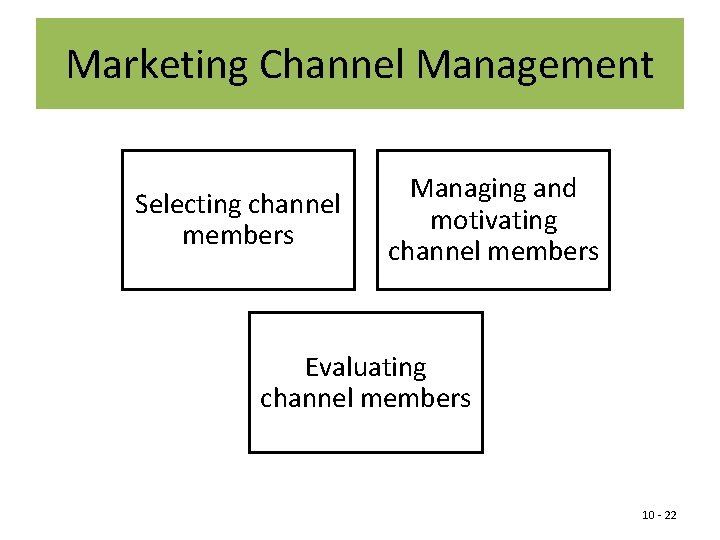
Marketing Channel Management Selecting channel members Managing and motivating channel members Evaluating channel members 10 - 22
Public Policy and Distribution Decisions • Exclusive distribution • Exclusive dealing • Clayton Act of 1914: Exclusive arrangements are legal as long as the parties: • Do not substantially lessen competition or tend to create a monopoly • Enter into the agreement voluntarily 10 - 23
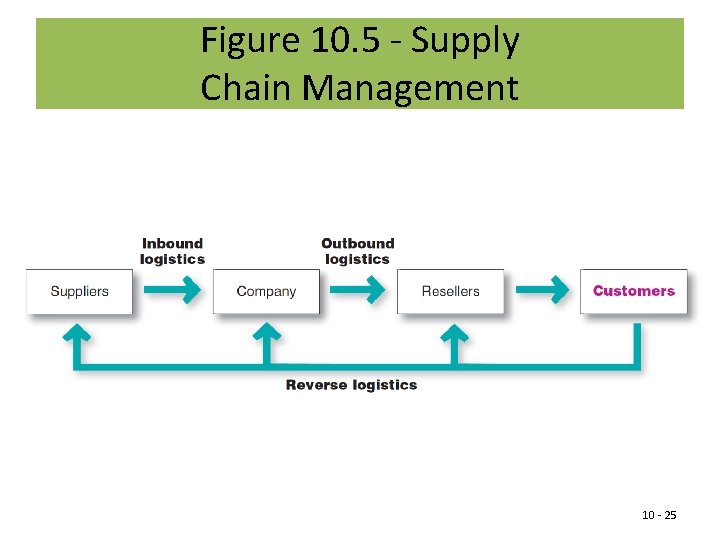
Marketing Logistics (Physical Distribution) • Planning, implementing, and controlling the physical flow of materials, final goods, and related information from points of origin to consumption • Customer-centered logistics: Marketplace to the factory or sources of supply • Outbound logistics • Inbound logistics • Reverse logistics 10 - 24
Figure 10. 5 - Supply Chain Management 10 - 25
Marketing Logistics and Supply Chain Management • The goal of marketing logistics is to deliver a targeted level of customer service at the least cost. • Logistics functions include: • • Warehousing Inventory management Transportation Logistics information management 10 - 26
Warehousing • Storage warehouses store goods for moderate to long periods. • Distribution centers are large, highly automated warehouses that receive goods, take orders, fill them, and deliver goods to customers. 10 - 27
Inventory Management • Should be done in a cost effective and profitable manner • Just-in-time logistics systems • Radio frequency identification (RFID), smart tag technology, gives the physical location of a product. 10 - 28
Transportation Factors affected by choice of transportation • • Pricing of products Delivery performance Condition of goods Customer satisfaction Modes • Trucks, railroads, water carriers, pipelines, air carriers, and the Internet Multimodal transportation • Combining two or more modes of transportation • Piggyback, fishyback, trainship, and airtruck 10 - 29
Logistics Information Management • Flows of information closely linked to channel performance • Information can be shared and managed through: • Electronic data interchange (EDI) • Vendor-managed inventory (VMI) 10 - 30
Integrated Logistics Management • Emphasizes teamwork both inside the company and among all the marketing channel organizations • Forming cross-functional teams inside the firm • Building logistics partnerships • Outsourcing to third-party logistics providers • Third-party logistics (3 PL) provider: Performs any or all of the functions required to get a client’s product to market 10 - 31