
MARKETING 3 02 Understand buying behaviors Marketing Strategy

MARKETING 3. 02 Understand buying behaviors.
Marketing Strategy �A marketing strategy provides vital information on how a business will meet its goals of satisfying customers that will result in making sales and profits. �Two Steps: �Target Market �Marketing Mix
Target Market �A specific group of consumers that have similar wants and needs. � 4 types of segmentation: �Demographic (age, gender, income, ethnicity) �Geographic (location) �Psychographic (values, attitudes, & lifestyles) �Behavioral (why customers buy the
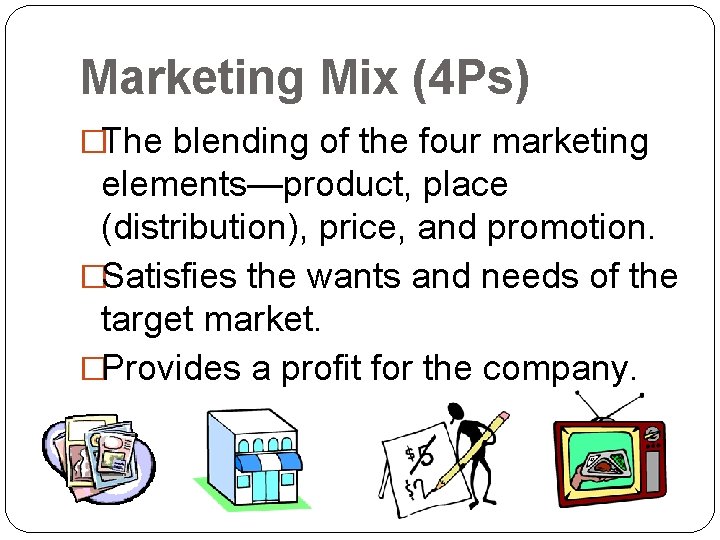
Marketing Mix (4 Ps) �The blending of the four marketing elements—product, place (distribution), price, and promotion. �Satisfies the wants and needs of the target market. �Provides a profit for the company.
Consumer Decision Making Process 1. Recognize a need. 2. Gather information. 3. Select and evaluate alternatives. 4. Make a purchase decision. 5. Determine the effectiveness of the decision.
Decision-Making �Extensive �Occurs when there is a high level or perceived risk, a product or service is very expensive or has a high value to the customer. �Limited �Occurs when a customer buys products that he or she has purchased before but not regularly. �Routine �Occurs when little information is needed about the product being purchased.
Consumer Buying Motives �Buying motives are the reasons consumers decide what products and services to purchase. �Emotional feelings, beliefs, and attitudes �Rational based on facts and logic �Patronage based on loyalty, customer service, merchandise, and convenience
Consumer Information Sources �Product Testing Organizations �Media �Government �Business �Personal
Product Testing Organizations �Test products and services to detect benefits. �Examples –Underwriter Laboratories –Association of Home Appliance Manufacturers –Consumers Union (Independent testing organizations) 9
Media Sources �Provide specific information about products and services. �Types of media sources: �Print �Magazines �Newspapers �Broadcast Organizations �Radio �Television �Internet 10
Government Agencies �Inform consumers and may handle consumer questions. �Types �Federal �State �Local 11
Business Sources �Business sources are available as a public service and to sell products and services. �Types �The main function of advertising is to 12 sell. �Product labels provide helpful information about nature of product, how to care for product, where product was made, and the size of the product. �Customer Service Departments focus on assisting customers. �Better Business Bureau (BBB) provide facts about products or services.
Personal Contacts “Word of mouth” advertising. 13
Traditional Retailers � Department Stores �Provide broad product lines and highlight their service � Discount Stores �Highlight their offering of lower prices for products � Specialty Stores �Provide a special line of products 14
Traditional Retailers �Supermarket �Large, full service store that offer many brands of products �Convenience Store �Provide popular items, offer long operating hours, and are usually located in highly accessible areas 15
Contemporary Retailers �Specialty Superstores �Provide wide variety of limited products at low prices �Superstores �Provide a wide variety of products in the retail services such as food, bakery, auto, and electronics. 16
Contemporary Retailers �Warehouse Club �Provide products in large quantities at practical prices. �Factory Outlets �Provide high-quality products at low prices 17
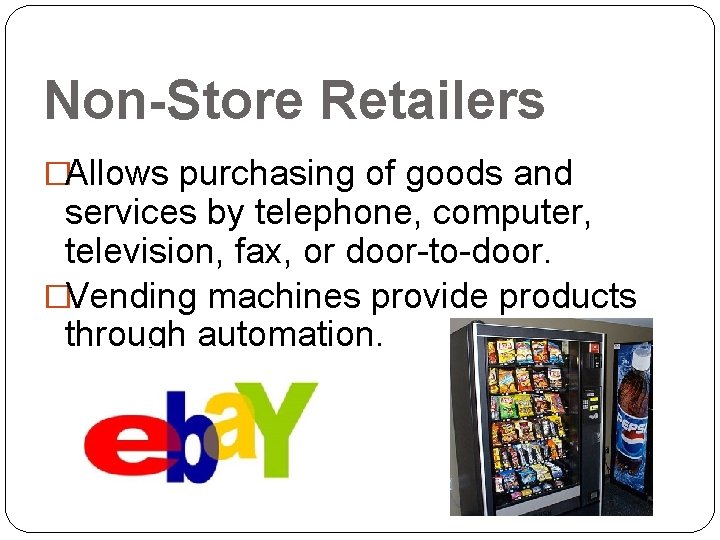
Non-Store Retailers �Allows purchasing of goods and services by telephone, computer, television, fax, or door-to-door. �Vending machines provide products through automation. 18
- Slides: 18