
MARKETING 1 1 An Introduction to Marketing Intro






- Slides: 17
MARKETING 1. 1 An Introduction to Marketing Intro to Marketing BMI 3 C 1 September 2009 Business Studies and Computer Science Department Prepared by: T. Nephin Page 1
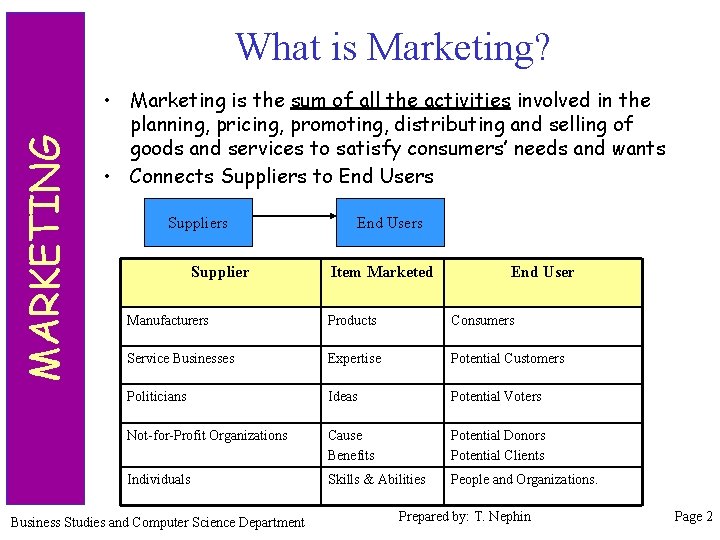
MARKETING What is Marketing? • Marketing is the sum of all the activities involved in the planning, pricing, promoting, distributing and selling of goods and services to satisfy consumers’ needs and wants • Connects Suppliers to End Users Supplier End Users Item Marketed End User Manufacturers Products Consumers Service Businesses Expertise Potential Customers Politicians Ideas Potential Voters Not-for-Profit Organizations Cause Benefits Potential Donors Potential Clients Individuals Skills & Abilities People and Organizations. Business Studies and Computer Science Department Prepared by: T. Nephin Page 2
MARKETING Marketing • Comes from the word ‘market’, which is used in two ways • For example General Motors markets cars to consumers by advertising their benefits • Marketing also refers to the potential buyers or end users of the product. • Coca-Cola is in the ‘soft drink market’ and markets several products – – Cola Diet cola Sprite Minute Maid to different consumers ( or market segments) • The ‘soft drink market’ is just a segment of the total beverage market that includes water, juice, coffee, teas, liquors, malts, etc… Business Studies and Computer Science Department Prepared by: T. Nephin Page 3
MARKETING An Important Business Activity – Can lead to the success or failure of a business activity – Just think of the Movies and Music released this year • Only some are hits, why? • Part of the reason for their success is marketing. Business Studies and Computer Science Department Prepared by: T. Nephin Page 4
MARKETING The Marketing Plan • Profit making companies want to make profits • Charities want to raise money for their causes • The first step in marketing anything is to determine a goal for the company or organization • After identifying the goal a marketing plan can be developed • A marketing plan consists of different parts referred to as the “Marketing Mix” (sometimes called the 7 P’s ) – – – – Product Price Place Promotion People Processes Physical Environment. Business Studies and Computer Science Department Prepared by: T. Nephin Page 5
MARKETING The Product • Refers to the item being sold by the business or organization • Products – – Snack foods Automobiles Sporting goods Clothing • Services – – Postal services Accounting services Legal services Services provided by trades people. Business Studies and Computer Science Department Prepared by: T. Nephin Page 6
MARKETING Product Marketing Strategies Methods used to improve/differentiate the product and increase sales or to target sales more effectively to gain a competitive advantage • • • Design Technology Usefulness Convenience Value Quality Packaging Branding Accessories Warranties. Business Studies and Computer Science Department Prepared by: T. Nephin Page 7
MARKETING Price • Generally refers to the selling price for the goods or services • Must cover – – – Raw materials Salaries Advertising Other operating expenses Profits • Setting price is not easy – Set too high and consumers may not buy – Set too low and consumers may think it is cheap or poorly made – If the price is too attractive, too many people will want the good or service leading to a shortage to satisfy demand therefore lost sales – Takes a good deal of planning and thought. Business Studies and Computer Science Department Prepared by: T. Nephin Page 8
MARKETING Price Marketing Strategies When pricing your products it is important to: • know your market • Know the price elasticity of the product • keep an eye on your rivals Strategies include: • Price Skimming • Penetration Pricing • Psychological Pricing • Cost-Plus Pricing • Loss Leader Pricing. Business Studies and Computer Science Department Prepared by: T. Nephin Page 9
MARKETING Place • Refers to the location where the companies goods or services are sold • Should they be where the customers go? – Stores – Vending machines • Should the salesperson go to the customer? – Door-to-door sales – Scalping tickets • Place also refers to how the goods and services get from the supplier to the customer through “channels of distribution” – The use of computers and telecommunications equipment have improved the channels of distribution. Business Studies and Computer Science Department Prepared by: T. Nephin Page 10
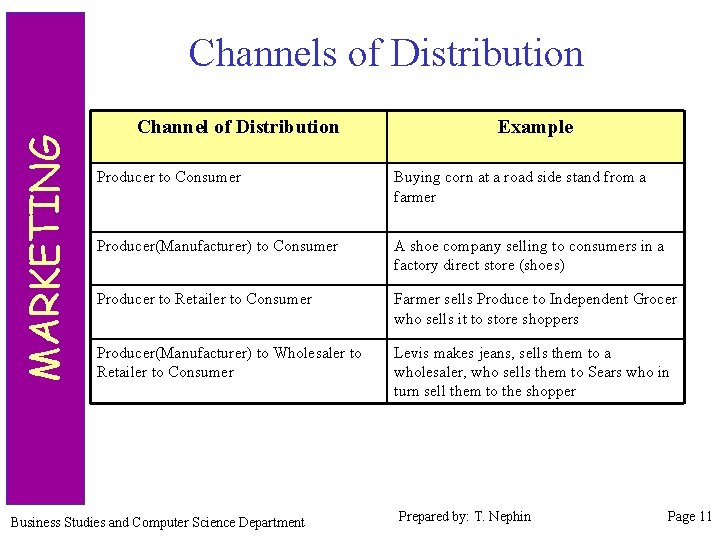
MARKETING Channels of Distribution Channel of Distribution Example Producer to Consumer Buying corn at a road side stand from a farmer Producer(Manufacturer) to Consumer A shoe company selling to consumers in a factory direct store (shoes) Producer to Retailer to Consumer Farmer sells Produce to Independent Grocer who sells it to store shoppers Producer(Manufacturer) to Wholesaler to Retailer to Consumer Levis makes jeans, sells them to a wholesaler, who sells them to Sears who in turn sell them to the shopper Business Studies and Computer Science Department Prepared by: T. Nephin Page 11
MARKETING Place Marketing Strategies The more places to buy the product and the easier it is made to buy it, the better for business Place strategies include: • Retail • Wholesale • Mail Order • Internet • Direct Sales • Peer to Peer • Multi-channel. Business Studies and Computer Science Department Prepared by: T. Nephin Page 12
MARKETING Promotion Includes all the marketing activities that communicate the organizations’ message to the consumer about the goods and services being sold The main promotional strategies include: – Special Offers – Personal selling – Advertising – Endorsements – User Trials – Leaflets/Posters – Free Gifts – Competitions – Direct Mailings. Business Studies and Computer Science Department Prepared by: T. Nephin Page 13
MARKETING People represent the business: • The image they present is important • First contact with the customer is often human –lasting first impression • Extent of the training and knowledge of the product is important • Mission Statement – how relevant, and do employees buy into it • Do staff represent the desired culture of the business? People Marketing Strategies include: • Employees • Management • Culture • Customer service. Business Studies and Computer Science Department Prepared by: T. Nephin Page 14
MARKETING Processes • Are especially relevant in the service industries • Deal with the processes people must go through to acquire the service • • The Marketing Strategies deal with: Contacts Reminders Registration Subscription Form Filling Use of technology. Business Studies and Computer Science Department Prepared by: T. Nephin Page 15
MARKETING Physical Environment The ambience, mood or physical presentation of the business environment is important to sell goods and services • Marketing Strategies dealing with the physical environment deal with: • Appearance – Trendy, retro, modern, old fashioned • Colours – Light, dark, bright, subdued • Neatness and cleanliness • Music • Smell. Business Studies and Computer Science Department Prepared by: T. Nephin Page 16
MARKETING A Companies Marketing Mix Blend of the mix depends upon: • The Marketing Objectives • Type of Product • Target Market • Market Structure • Rivals’ Behaviour • Global Impact – culture, religion etc… • Marketing Position • Product Portfolio – Product Lifecycle – Boston Matrix Business Studies and Computer Science Department Prepared by: T. Nephin Page 17