
Marketable emissions permits Marketable permit systems are based
Marketable emissions permits Marketable permit systems are based on the principle than any increase in emissions must be offset by an equivalent decrease elsewhere. There is a limit set on the total quantity of emissions allowed, but the regulator does not attempt to determine how that total allowed quantity is allocated among individual sources.
2 TRADABLE PERMITS • OBJECT: create an artificial price for the use and/or pollution of public environmental goods that can be used for free and have no market • HOW: the regulatory authority initially allocates permits among the polluters (users) of the natural resource on the basis of an ecological indicator (e. g. carrying capacity) of the ecosystem taken into account • Polluters (users) then trade permits among themselves, leading to a market price for the pollution (exploitation) of the natural resource • Market price signals scarcity of the resource and creates incentive to adopt a more environmental friendly technology (in order to avoid the cost of purchasing the permits)
Cap and trade permit systems (for UMP) A cap-and-trade emission permits scheme for a uniformly mixing pollutant involves: • A total quantity of emissions of some particular type (the ‘cap’) that is to be allowed by • • • a specified class of actual and potential emitters over some period of time. The creation of a quantity of emissions permits that in sum equal, in units of permitted emissions, the emissions cap (the target level of emissions). A mechanism by which the total quantity of emission permits is initially allocated between potential polluters. A rule which states that no firm is allowed to emit pollution (of the designated type) beyond the quantity of emission permits it possesses. A system whereby actual emissions are monitored and penalties – of sufficient deterrent power – are applied to sources which emit in excess of the quantity of permits they hold. A guarantee that emission permits can be freely traded between firms at whichever price is agreed for that trade.
The initial allocation of permits and the determination of the equilibrium market price of permits Two general methods of initial allocation: • Case 1: all permits by auction • Case 2 all permits at no charge (grandfathering)
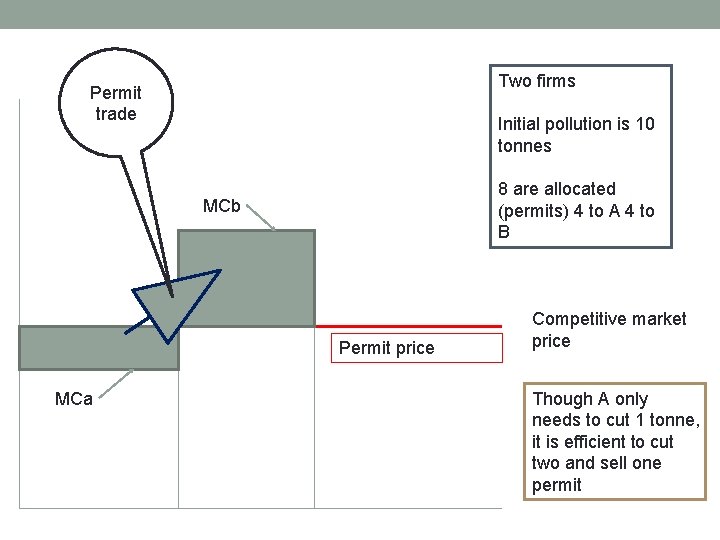
Two firms Permit trade Initial pollution is 10 tonnes 8 are allocated (permits) 4 to A 4 to B MCb Permit price MCa Competitive market price Though A only needs to cut 1 tonne, it is efficient to cut two and sell one permit
• ‘Coasian’ kind of bargaining based upon willingness to accept and pay for licences….
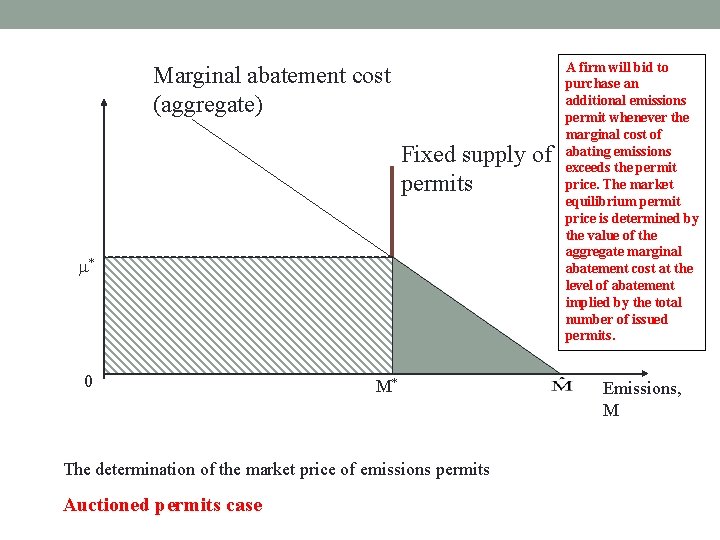
Marginal abatement cost (aggregate) Fixed supply of permits * 0 M* The determination of the market price of emissions permits Auctioned permits case A firm will bid to purchase an additional emissions permit whenever the marginal cost of abating emissions exceeds the permit price. The market equilibrium permit price is determined by the value of the aggregate marginal abatement cost at the level of abatement implied by the total number of issued permits. Emissions, M
Marketable permit systems and the distribution of income and wealth • In a perfectly functioning marketable permit system the method of initial allocation of permits has no effect on the short-run distribution of emissions between firms. • But it does have significant effects on the distribution of income and wealth between firms. • If the permits are sold by competitive auction, each permit purchased will involve a payment by the acquiring firm to the EPA equal to the equilibrium permit price. • Note that the transfer of income from the business sector to the government when successful bids are paid for is not a real resource cost to the economy. • If the EPA distributes permits at no charge, there is no transfer of income from businesses to government. However, there will be transfers between firms.
9 Tradable Permits: advantages • Creation of an artificial market • Pricing pollution/consumption natural resources → incentive to technological progress • Minimize abatement costs (incentive to reduce pollution/consumption is higher for the most efficient firms)
10 Tradable Permits: disadvantages • Price volatility due to scientific uncertainty → market instability and disincentive to invest in new technologies • Low number of agents → low market competition • Entry Barriers: auctions improve it • Allocation criteria
Existing ETS • AIR • EU ETS – biggest CO 2 market • California • RGGI (Regional Greenhouse Gas Initiative) • Australia • China • Others (New Zealand, Japan, Taiwan, South Korea, India, Switzerland…. ) • WATER • TWPR: Tradable Water Pollution Rights (US, Australia) • TWAR: Tradable Water Abstraction Rights (US, Australia, Chile, Mexico)
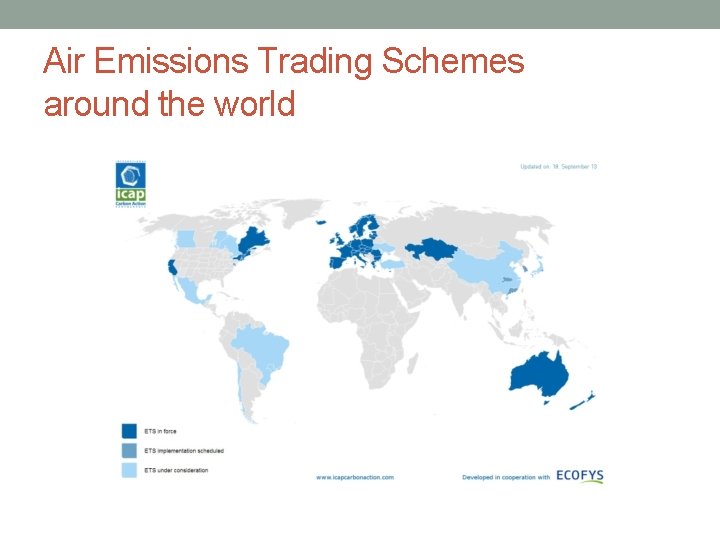
Air Emissions Trading Schemes around the world
THE EU-ETS • World’s largest carbon market and first transboundary cap • • • and-trade system EU Directives: 2003/87 & 2009/29 Each member estabilishes a national emission scheme to determine the allocation criteria of emission permits (mainly for free) and the share allocated to selected sectors in three trading phases: 2005 -’ 07, 2008 -’ 12, 2013 -’ 20. Sectors: energy activites (e. g. oil refineries); production and processing of ferrous metals; mineral industry; pulp and paper industry. Extension to further industries (petrochemical, aluminium and ammonia sectors) and gases (nitrous oxide and perfluorocarbons) Trading of emission permits within the EU. Penalties (art. 16): 40€ (2005 -2007) and 100€ (2008 -2012) per tonne of CO 2 emitted in excess of allowances at disposal
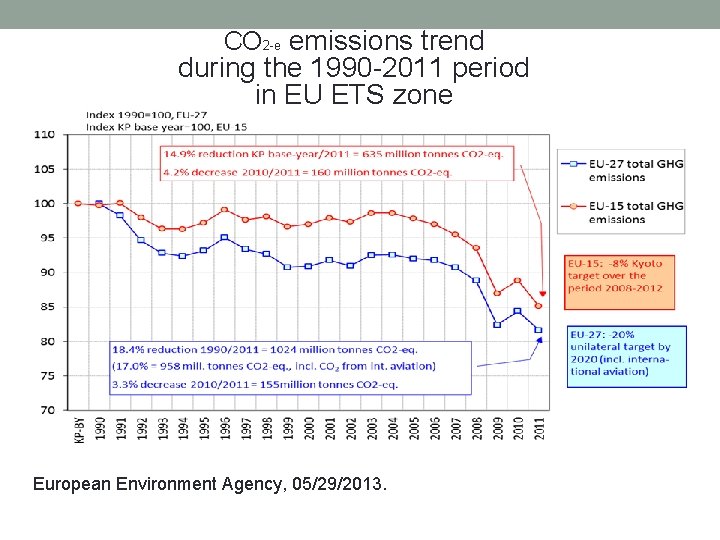
CO 2 -e emissions trend during the 1990 -2011 period in EU ETS zone European Environment Agency, 05/29/2013.
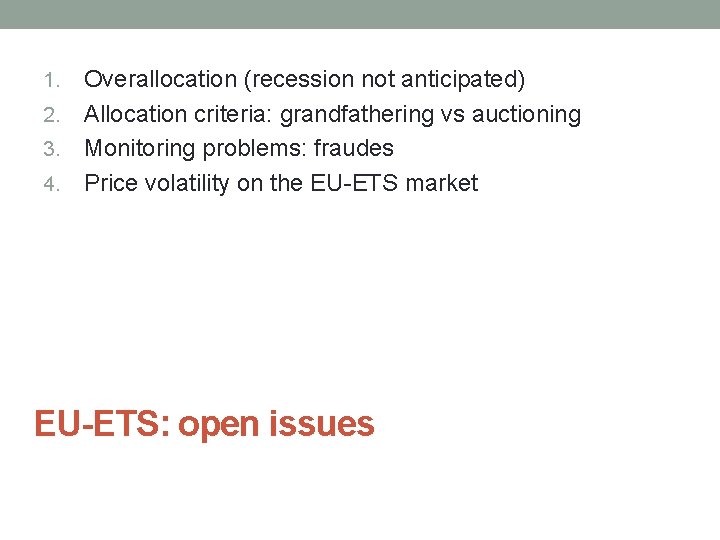
Overallocation (recession not anticipated) 2. Allocation criteria: grandfathering vs auctioning 3. Monitoring problems: fraudes 4. Price volatility on the EU-ETS market 1. EU-ETS: open issues
1. The “overallocation” issue • Most national allocation plans (NAP) allocated a number of emission permits well above the upper bound for each member state by the Kyoto Protocol during both 1 st phase (2005 -’ 07) and 2 nd phase (2008 -’ 12) (Gilbert et al. , 2004; Sijm, 2005) • Causes: • political pressures from interest groups • strong uncertainty on the actual emissions level • Effect: sharp fall in the spot price of the emissions permits during 1 st period → revision proposal: unique EU emission permits ceiling (rather than 27 national ceilings) that decreases every year during the third trading phase (2013 -2020)
17 2. Allocation criteria: grandfathering vs. auctioning • Tradable permits generally allocated according to historical emission levels (grandfathering) • Grandfathering tends to preserve status quo (reduces incentive to technological progress) • Grandfathering may create potential disparities in the permits market between large firms (that receive many initial permits to maintain their activity level) and small-medium enterprises • PROPOSAL: Higher share of emissions allocated through auctions rather than grandfathering; harmonization of allocation rules when permits given for free. • ADVANTAGES: increase authority’s financial entries that can be used for environmental purposes (double dividend)
3. Monitoring capacity of the ETS • On January 19, 2011 a market participant, Blackstone Global Ventures, said 475, 000 carbon permits (about 7 million euros) had vanished from its account in the Czech Republic. • 1. 6 million carbon permits went missing from the Romanian registry account of cement-maker Holcim in November 2010. • On January 19, the European Commission suspended spot trades (75% of the ETS market) until January 26, following the suspected theft from the Czech Republic's carbon registry. The Czech Republic, Greece, Estonia, Poland Austria closed their carbon trading registries. • This theft and a hacking attack on the Austrian registry on 10 January follows a raft of scandals in the market in the past two years e. g. the Value-Added Tax (VAT) fraud: permits imported into a country VAT-free and sold on in that country with VAT charged. Afterwards the importer disappears instead of paying VAT to the governent (Euractive, 2011) • → new anti-fraud measures, approved by the European Council's climate change committee on February 17, 2011
4. EU-ETS: market price volatility • Price of carbon permits tripled in the period January-July 2005, then more than halved in April 2006 (cf. The Economist, 2006) EU ETS: carbon price more than halved in a few months (from above 27 €/tonne in June 2008 to 13. 25 €/tonne as of 15 January 2009); extreme volatility in December 2009 (+3% ahead of COP-15, then 8. 7% immediately after Copenhagen) → crucial role of expectations and credibility • Effects: uncertainty discourage investments in environmental friendly technologies
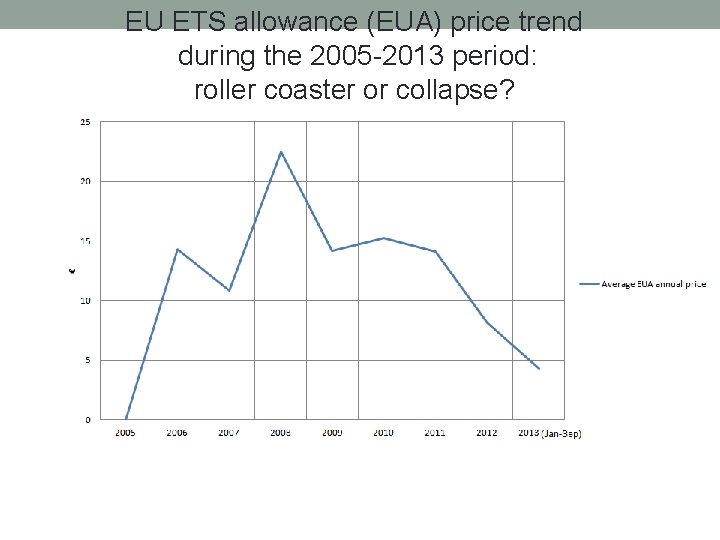
EU ETS allowance (EUA) price trend during the 2005 -2013 period: roller coaster or collapse?
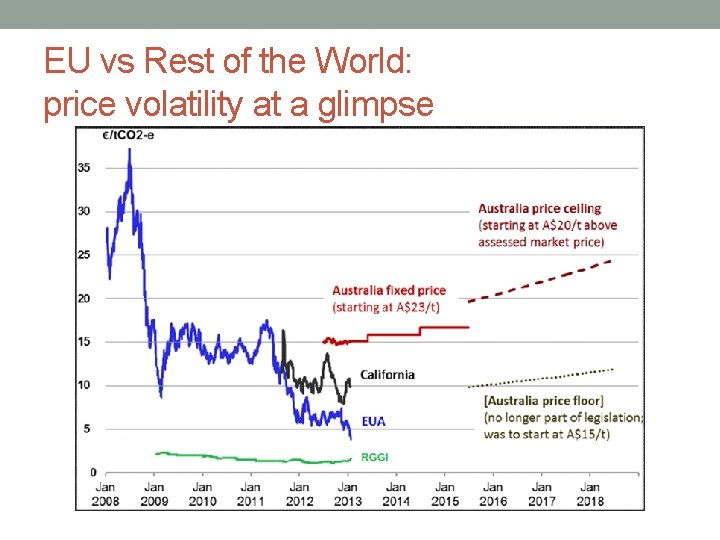
EU vs Rest of the World: price volatility at a glimpse
Rescuing the EU-ETS: recent reform proposals • Carbon price has collapsed due to overallocation of free permits, recession • “Backloading” proposal by the European parliament environment committee: to restrict over -supply of permits and raise carbon price, some allocations of permits by member states would be held back from auction and auctions postponed for several years.
5. EU-ETS: the penalty system • Art. 16: if an operator emits more than allowed by the permits at disposal, it will be liable to pay the penalty • Fees: F=40€ (1 st phase: 2005 -2007) and F=100€ (2 nd phase: 2008 -2012) per tonne of CO 2 emitted in excess of the allowances at disposal. • In addition the operator has to purchase the excess emissions “when surrendering allowances in relation to the following calendar year”. • → the price that the non-compliant firm has to pay for its excess emissions is given by the market price when the purchase is made. • market price volatility + possible limitations in the monitoring system → moral hazard behaviours among the operators.
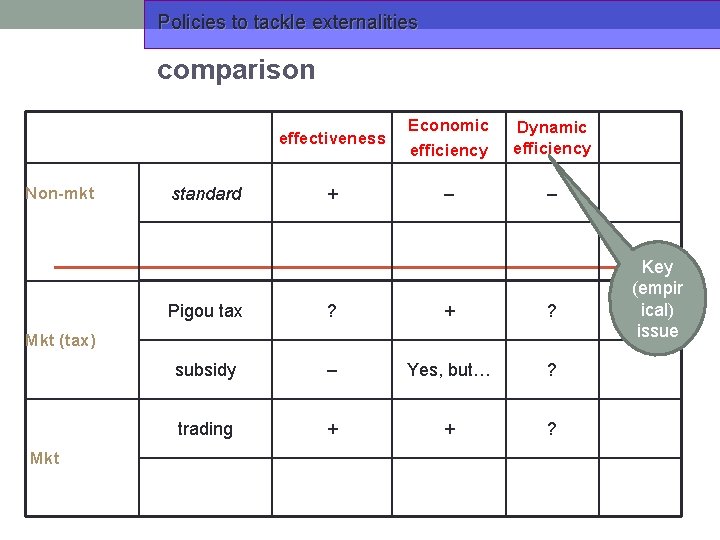
Policies to tackle externalities comparison Non-mkt standard effectiveness Economic efficiency Dynamic efficiency + – – Pigou tax ? + ? subsidy – Yes, but… ? trading + + ? Mkt (tax) Mkt Key (empir ical) issue
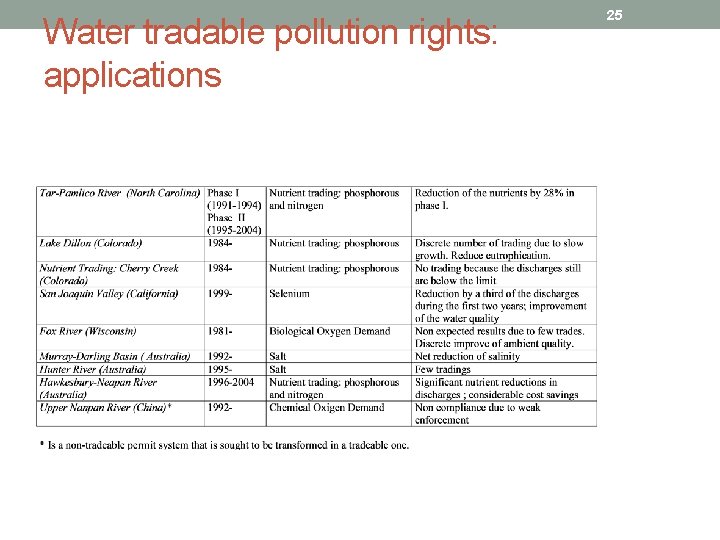
Water tradable pollution rights: applications 25

Water tradable abstraction rights: applications Water Basin or State California, Idaho, Montana, Oregon, Washington, Arizona, Nevada, New Mexico, Colorado Upper Snake River (Idaho) The Murray-Darling Basin (Australia) Chile Mexico Southern Asia (Pakistan, India, Yemen, Jordan, Palestinian territory) Application period Various start dates Principal Purchasers Federal agents, private firms, environmental groups Economic/environmental results Increase of flow in the main rivers Wide variability in the water price across States Numerous transfers, particularly in California Federal agencies Increased river flow Idaho Electric Ambiguous results on the protection 1980 Company of salmon in the rivers Significant success in the number of transfers (2 computerized centers Main city 1989 representatives created). Single farmers Temporary transfers, mainly limited to the agricultural sector Contradictory opinions in the literature: economic growth but less 1979 Single farmers transactions than expected Limited number of transactions Single farmers and High variability between the districts 1992 water management for the quantity of water used and associations transferred Informal or illegal Small farmers Depletion of the water resource markets Private Water High prices due to the monopolistic companies character of the market
References • Ellerman, A. Denny. 2010. “The EU's Emissions Trading Scheme: A Proto-type Global System? ” In Post-Kyoto International Climate Policy, edited by Joe Aldy and Robert N. Stavins, 88 -118. Cambridge: Cambridge University Press. http: //globalchange. mit. edu/files/document/MITJPSPGC_Rpt 170. pdf • Borghesi S. (2011) “The European emission trading scheme and renewable energy policies: credible targets for incredible results? ”, International Journal Sustainable Economy, vol. 3, n. 3, pp. 312 -327. http: //www. feem. it/userfiles/attach/201010291656484 NDL 2010 -141. pdf • Borghesi S. , (2013), “Water tradable permits: a review of theoretical and case studies”, Journal of Environmental Planning and Management, pp. 1 -28, forthcoming. http: //www. tandfonline. com/doi/full/10. 1080/09640568. 2013. 820175#. Ul. LAAet. H 4 W 4 • Jotzo F. , de Boer D. , Kater H. . 2013. “China Carbon Pricing Survey 2013” China Carbon Forum.
- Slides: 27