
MARKET STRUCTURES PERFECT COMPETITION It is the ideal


- Slides: 52
MARKET STRUCTURES
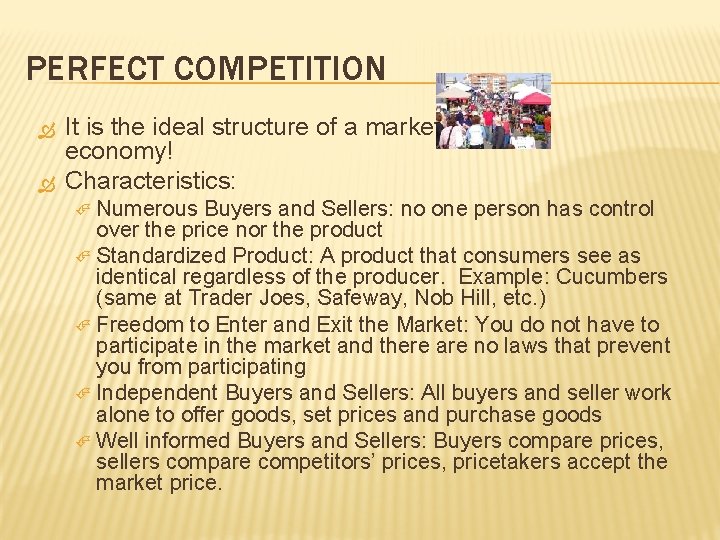
PERFECT COMPETITION It is the ideal structure of a market economy! Characteristics: Numerous Buyers and Sellers: no one person has control over the price nor the product Standardized Product: A product that consumers see as identical regardless of the producer. Example: Cucumbers (same at Trader Joes, Safeway, Nob Hill, etc. ) Freedom to Enter and Exit the Market: You do not have to participate in the market and there are no laws that prevent you from participating Independent Buyers and Sellers: All buyers and seller work alone to offer goods, set prices and purchase goods Well informed Buyers and Sellers: Buyers compare prices, sellers compare competitors’ prices, pricetakers accept the market price.
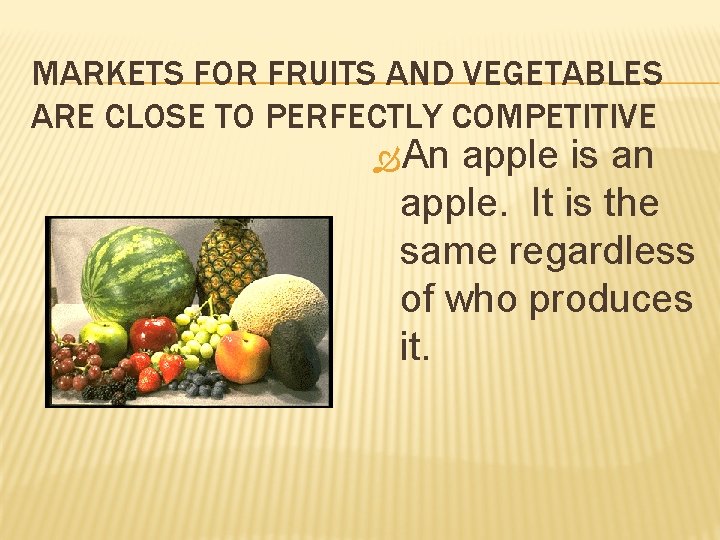
MARKETS FOR FRUITS AND VEGETABLES ARE CLOSE TO PERFECTLY COMPETITIVE An apple is an apple. It is the same regardless of who produces it.
THE REALITY… The reality is that most markets should really be categorized as Imperfect Competition occurs in markets that have few sellers or products that are not standardized. They tend to be almost perfect, but fail to meet one of the characteristics. Example: Corn The market for wholesale corn from a farm is close to perfect competition, but in reality it is imperfect. The US gov’t pays subsidies to corn farmers to protect them from low prices. This government involvement to influence the price bumps it out of perfect competition.
MONOPOLY When there is only one seller of a product that has no close substitutes. Characteristics: Only One Seller: 1 business controls the supply and the product has no close substitutes A restricted, regulated Market: There is a lot of influence and/or control over who can enter the market. Control of Prices: Firms can control prices because there are no close substitutes and no competition.
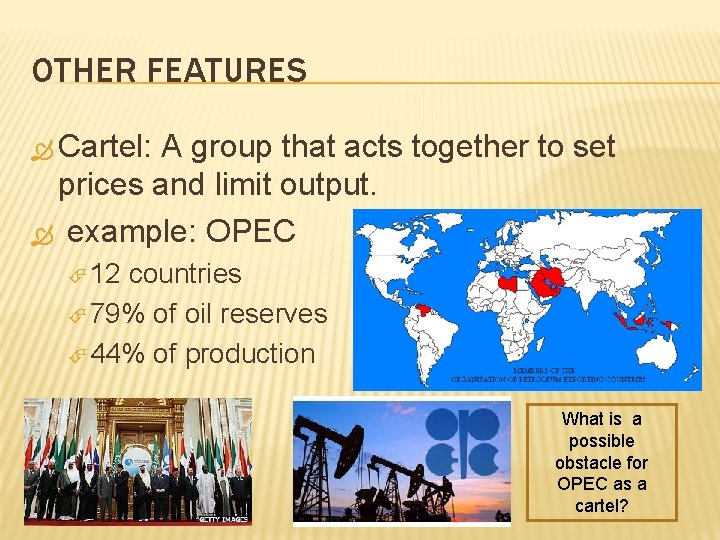
OTHER FEATURES Cartel: A group that acts together to set prices and limit output. example: OPEC 12 countries 79% of oil reserves 44% of production What is a possible obstacle for OPEC as a cartel?
Price Maker: a firm that does not have to consider competition when setting the prices of its products Barrier to Entry: Makes it harder for a new business to enter a market.
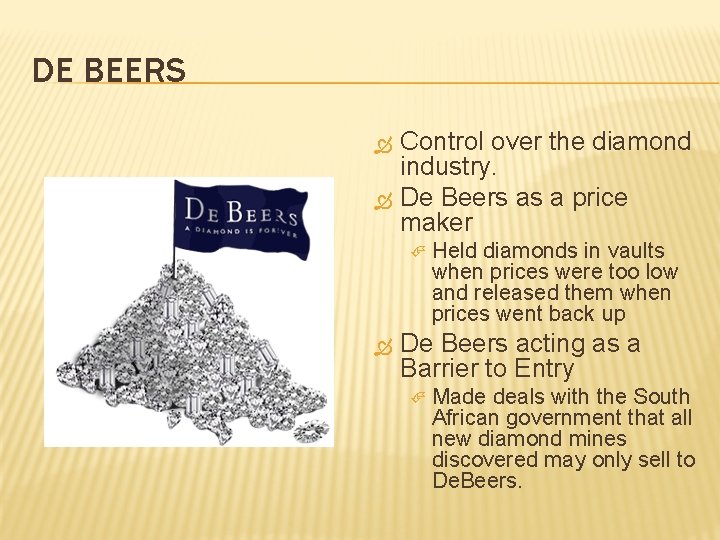
DE BEERS Control over the diamond industry. De Beers as a price maker Held diamonds in vaults when prices were too low and released them when prices went back up De Beers acting as a Barrier to Entry Made deals with the South African government that all new diamond mines discovered may only sell to De. Beers.
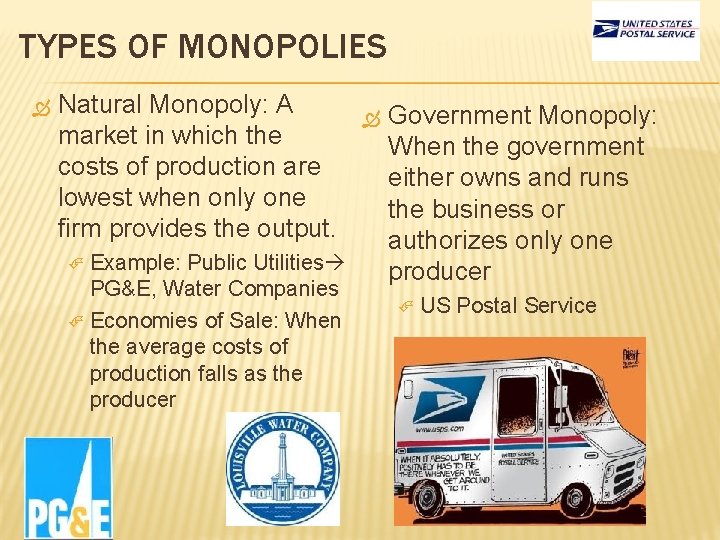
TYPES OF MONOPOLIES Natural Monopoly: A market in which the costs of production are lowest when only one firm provides the output. Example: Public Utilities PG&E, Water Companies Economies of Sale: When the average costs of production falls as the producer Government Monopoly: When the government either owns and runs the business or authorizes only one producer US Postal Service
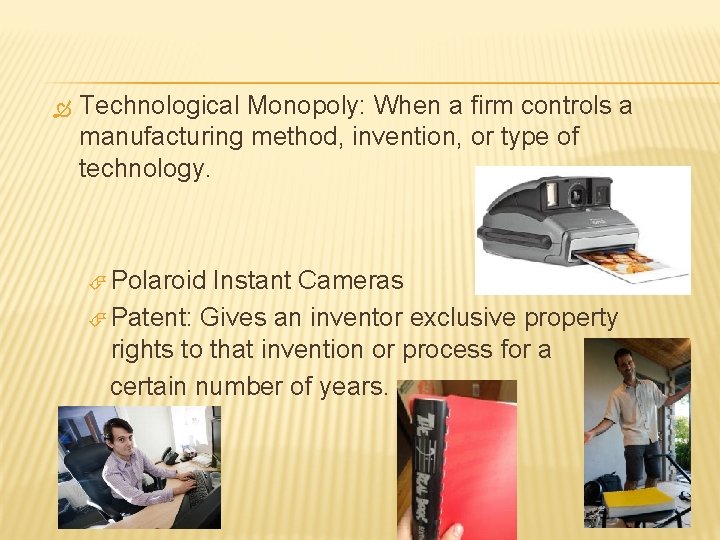
Technological Monopoly: When a firm controls a manufacturing method, invention, or type of technology. Polaroid Instant Cameras Patent: Gives an inventor exclusive property rights to that invention or process for a certain number of years.
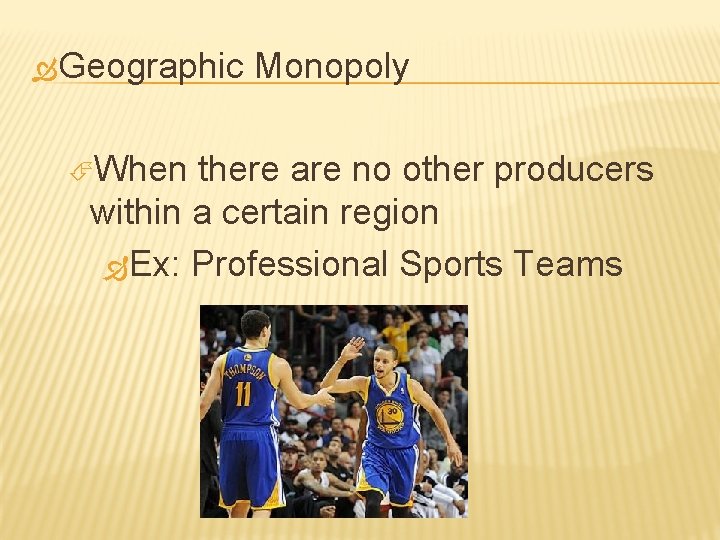
Geographic When Monopoly there are no other producers within a certain region Ex: Professional Sports Teams
PROFIT MAXIMIZATION BY MONOPOLIES: Monopolies still need to find an appropriate price to charge so that they can make money. A monopoly will produce less of a product than would be supplied in a competitive market, thereby artificially raising the equilibrium price. Example: Pharmaceutical Manufacturers
MONOPOLISTIC COMPETITION A market structure where many sellers offer similar, but not standardized products. The market is still considered monopolistic because each seller has influence over a small segment of the market with products that are not exactly like those of its competitors. Product Differentiation: Efforts to distinguish a product from similar products. Ex: Car gas mileage, longevity in batteries, ADVERTISING! Non-price Competition: Occurs when producers use factors other than price to convince consumers to buy their product. ADVERSTISING!
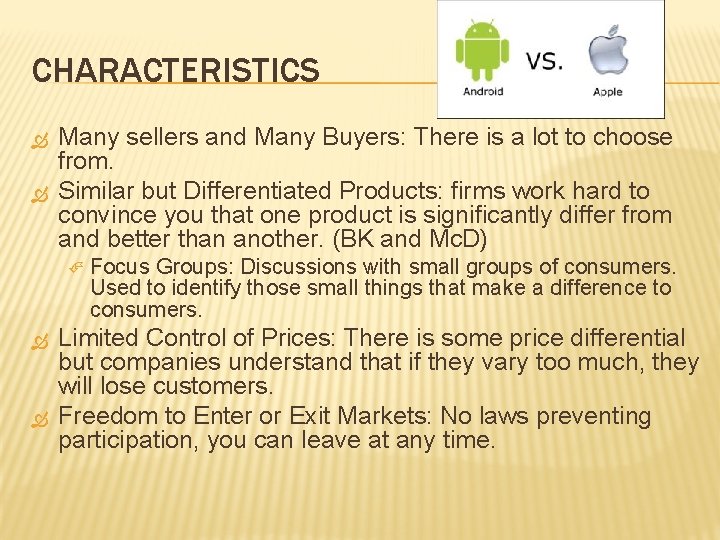
CHARACTERISTICS Many sellers and Many Buyers: There is a lot to choose from. Similar but Differentiated Products: firms work hard to convince you that one product is significantly differ from and better than another. (BK and Mc. D) Focus Groups: Discussions with small groups of consumers. Used to identify those small things that make a difference to consumers. Limited Control of Prices: There is some price differential but companies understand that if they vary too much, they will lose customers. Freedom to Enter or Exit Markets: No laws preventing participation, you can leave at any time.
OLIGOPOLY A market structure in which only a few sellers offer a similar product In an oligopoly, a few large firms have a large market share (% of total sales in a market) and dominate the market. There are only a few firms in an oligopoly because of high start-up costs which are the expenses that a new business must pay to enter a market and begin selling to consumers.
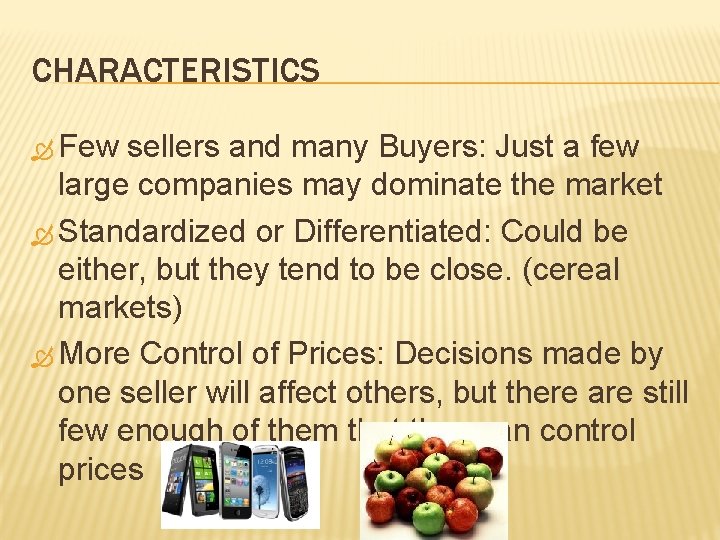
CHARACTERISTICS Few sellers and many Buyers: Just a few large companies may dominate the market Standardized or Differentiated: Could be either, but they tend to be close. (cereal markets) More Control of Prices: Decisions made by one seller will affect others, but there are still few enough of them that they can control prices
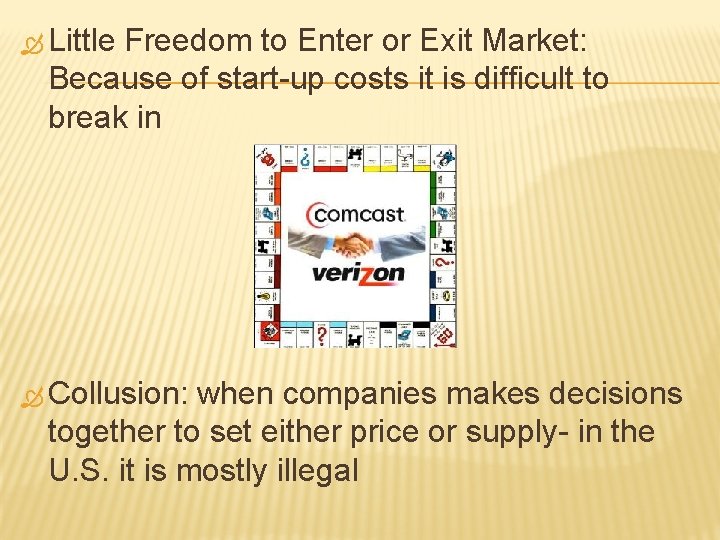
Little Freedom to Enter or Exit Market: Because of start-up costs it is difficult to break in Collusion: when companies makes decisions together to set either price or supply- in the U. S. it is mostly illegal
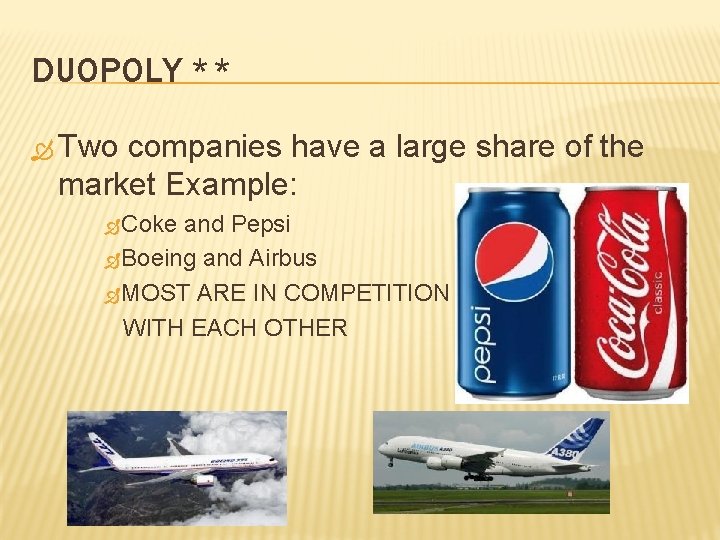
DUOPOLY ** Two companies have a large share of the market Example: Coke and Pepsi Boeing and Airbus MOST ARE IN COMPETITION WITH EACH OTHER
AIRLINE MERGER SIMULATION You are the consulting economist for the Antitrust Division of the Department of Justice. Read the following case and determine whether or not the Justice Department should oppose or support the merger? Answer the culminating question on the bottom and REPRESENT YOUR DECISION GRAPHICALLY ON THE BACK
MARKET STRUCTURE SKITS In your groups, read the excerpt that pertains to your group and then create a brief skit that demonstrates market structure you were assigned. Skits should include the important information highlighted in the readings 30 minutes to plan 3 mins to perform Grades based on effort and accuracy!
REGULATION AND DEREGULATION One way the government regulates business is by promoting competition. Antitrust Legislation defines monopolies and gives government the power to control them. Trusts—groups of firms combined to reduce competition in an industry Mergers—the joining of 2 firms to form a single firm. The Sherman Antitrust Act was passed in 1890 which allowed government the power to control and regulate monopolies. Today the responsibility of enforcing antitrust legislation is shared by the Federal Trade Commission and the Department of Justice.
ENSURING A LEVEL PLAYING FIELD Another way the government regulates business is by ensuring a level playing field Price fixing: when business agree to set prices for competing products (CD prices used to be set) Market Allocation: occurs when competing businesses divide a market amongst themselves Predatory pricing: occurs when businesses set prices for a time in order to drive competitors out of a marker. The US Government chooses to monitor all of these behaviors in an effort to level the playing field. However, it can be difficult to prove company’s calculated involvement in any of these actions.
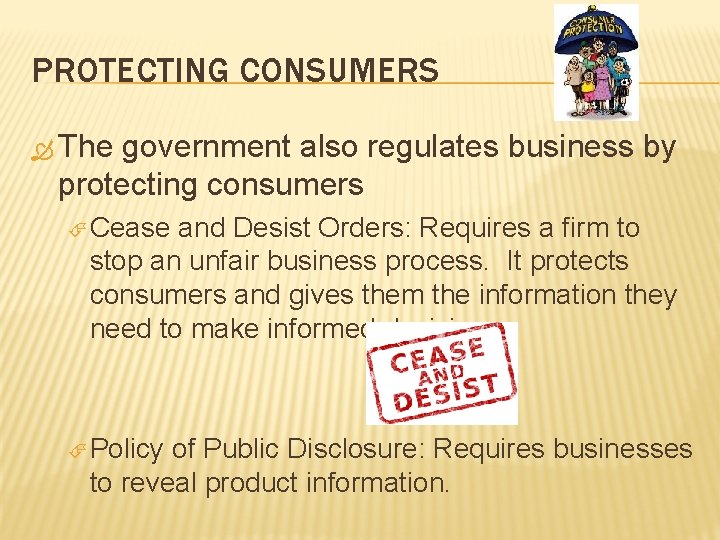
PROTECTING CONSUMERS The government also regulates business by protecting consumers Cease and Desist Orders: Requires a firm to stop an unfair business process. It protects consumers and gives them the information they need to make informed decisions. Policy of Public Disclosure: Requires businesses to reveal product information.
DEREGULATION The government has also made some attempts to deregulate industries Deregulation is good because it generally results in lower prices for consumers because the markets become more competitive However, deregulation may lead to fewer protections for consumers Example: Airline Deregulation no government control of airline routes and rates. More competition, but (customers complain) quality has declined.
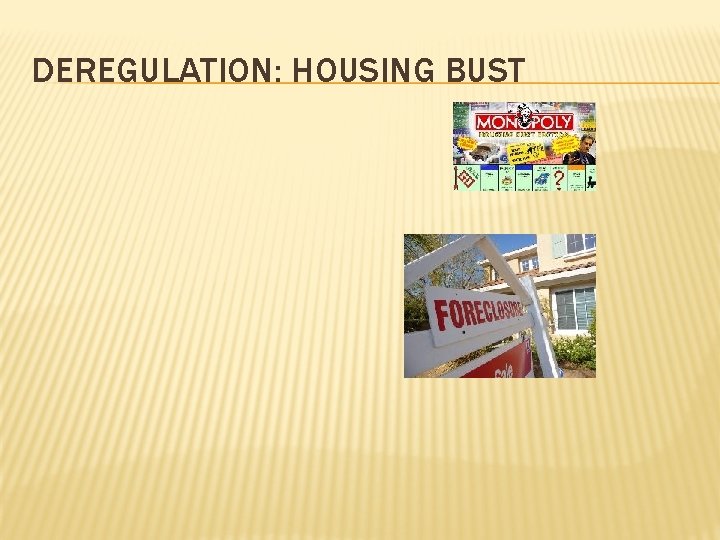
DEREGULATION: HOUSING BUST
BUSINESS ORGANIZATIONS
SOLE PROPRIETORSHIPS A business organization that is owned and controlled by one person Most sole proprietorships are small operations All together, sole proprietorships generate only about 6% of all US sales. Most sole proprietorships earn modest incomes Many proprietors run their businesses parttime.
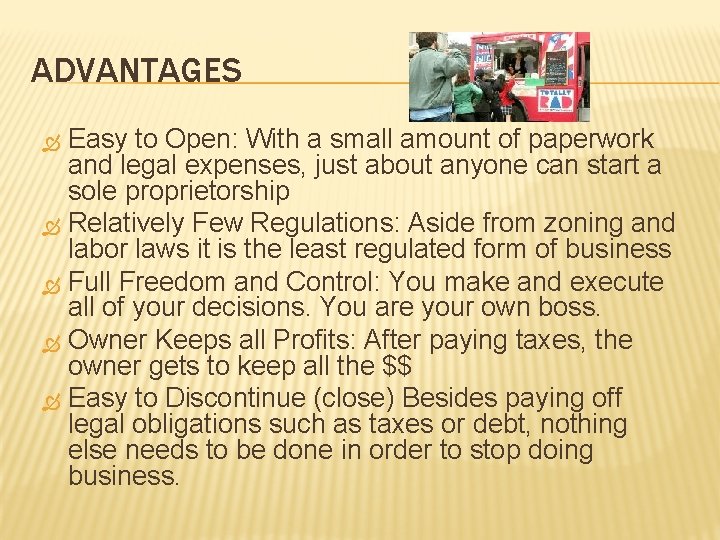
ADVANTAGES Easy to Open: With a small amount of paperwork and legal expenses, just about anyone can start a sole proprietorship Relatively Few Regulations: Aside from zoning and labor laws it is the least regulated form of business Full Freedom and Control: You make and execute all of your decisions. You are your own boss. Owner Keeps all Profits: After paying taxes, the owner gets to keep all the $$ Easy to Discontinue (close) Besides paying off legal obligations such as taxes or debt, nothing else needs to be done in order to stop doing business.
DISADVANTAGES Limited Funds: You need a lot of money up front to start a sole proprietorship. This is actual money, you are also limited in terms of access to human capital because no one knows everything! Limited Life: Once you are done with the business it ceases to exist Unlimited Liability: The biggest disadvantage of sole proprietorships is unlimited personal liability. Liability is the legally bound obligation to pay debts.
Unlimited Liability: The biggest disadvantage of sole proprietorships is unlimited personal liability. Liability is the legally bound obligation to pay debts.
KEY TAKEAWAY It’s all YOU! Your concepts your decisions, your structure, your rules All problems, stressors and decisions fall upon you!
PARTNERSHIPS What types of partnerships exist? What are the advantages of partnerships? What are the disadvantages of partnerships? Partnership: A business co-owned by 2 or more partners who agree on how responsibilities profits and losses should be divided.
TYPES OF PARTNERSHIPS General Partnership: Partners share management of the business and each one is liable for all debts and losses Limited Partnership: At least one partner is not involved in the day to day running of the business and is liable only for the funds he/she has invested.
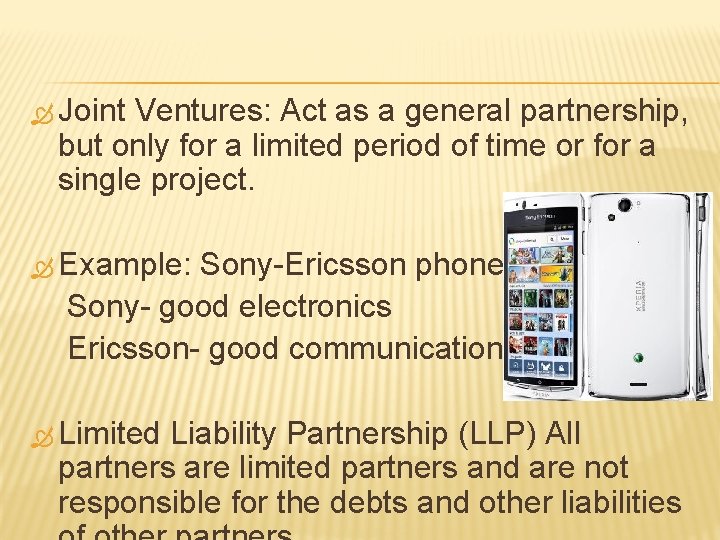
Joint Ventures: Act as a general partnership, but only for a limited period of time or for a single project. Example: Sony-Ericsson phones Sony- good electronics Ericsson- good communication Limited Liability Partnership (LLP) All partners are limited partners and are not responsible for the debts and other liabilities
ADVANTAGES Ease of Start-up: Partnerships are easy to establish. There is nothing required, but an articles of partnership is recommended. Access to Resources: Each partner’s assets, or money and other valuables, improve the firm’s ability to borrow funds for operations. Joint Decision Making: The addition of new ideas and perspectives often leads to better decisions. Specialization: Each person brings specific skills to the business allowing for maximum efficiency.
DISADVANTAGES Unlimited Liability: Partners are legally responsible for all losses and debts. Because general partners are bound by each other’s actions, this can be concerning.
Potential for Conflict: partners need to ensure they agree about work habits, goals, management styles, ethics and general business philosophies. Limited Life: If one partner dies, the business may die unless you buy out your partners share or draw up a new contract with a new partner.
CORPORATIONS, MERGERS AND MULTINATIONALS What types of corporations exist? What are the advantages of incorporation What are the disadvantages of incorporation? How can corporations combine? What role to multinational corporations play? What are the problems with corporations?
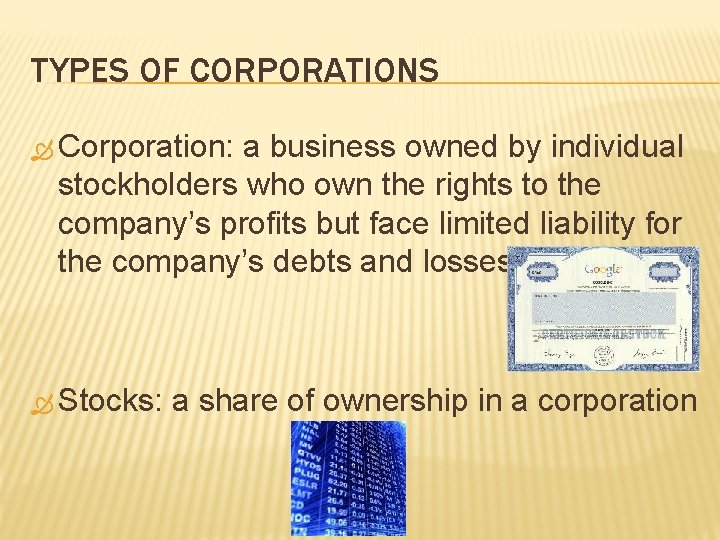
TYPES OF CORPORATIONS Corporation: a business owned by individual stockholders who own the rights to the company’s profits but face limited liability for the company’s debts and losses. Stocks: a share of ownership in a corporation
Dividend: A part of a corporation’s profit that is paid out to stockholders Public Company (publicly held corporation): Issues stock that can be publicly traded Private Company (closely held corporation) controls who can buy or sell it’s stock.
ADVANTAGES FOR THE STOCKHOLDERS Individual investors do not carry responsibility for the corporations actions. Shares of stock are transferable, which means that stockholders can sell their stock to others for money.
ADVANTAGES FOR THE CORPORATION Money and Resources: Easier to borrow $ from banks, huge potential for rapid growth, can offer stocks to raise $. Professional Managers: Corporations can hire the best available labor to create and market the best goods/services possible.
Limited Liability: The company alone is liable, not the personal money of owners nor stockholders Unlimited Life: Corporations have long lives and are now legally recognized as ‘people’ by the supreme court.
CITIZENS UNITED V. FEDERAL ELECTION COMMISSION (2010) The Supreme Court of the United States held that corporate funding of independent political broadcasts in candidate elections cannot be limited under the First Amendment. The previous law prohibited corporations and unions from using money to fund broadcast advertisements mentioning a candidate within 30 days before a primary or 60 days before a general election. The SC said that the First Amendment protects associations of individuals in addition to individual speakers, and further that the First Amendment does not allow prohibitions of speech based on the identity of the speaker. Corporations, as associations of individuals, therefore have speech rights under the First Amendment. Because spending money is essential to disseminating speech, limiting a corporations ability to spend money is unconstitutional because it limits the ability of its members to speak on political issues.
DISADVANTAGES OF INCORPORATION Start-Up cost and Effort: corporate charters can be expensive, time consuming. Must have a certificate of incorporation to exist. Complicated process often means hiring a lawyer. Heavy Regulation: Lots of government rules and regulations. Reports to stockholders, reports to the Securities and Exchange Commission.
Double Taxation: Corporations must pay taxes on their income, owners must also pay taxes on dividends. Loss of Control: Board of directors, managers and stockholders manage the corporation (not owners).
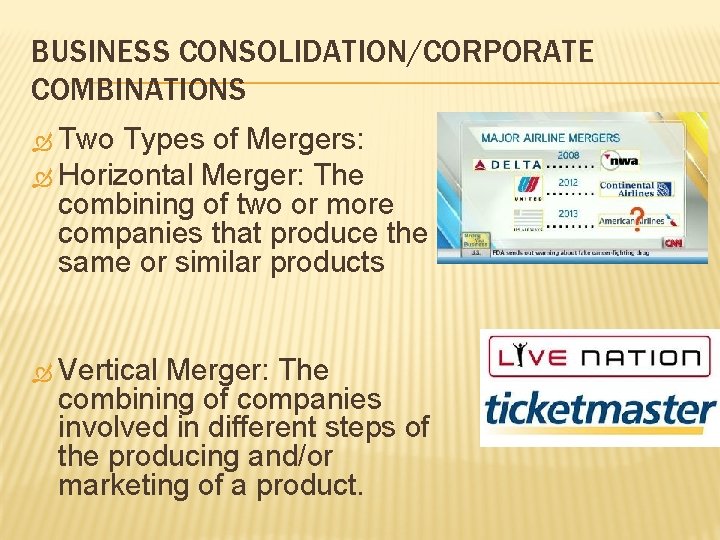
BUSINESS CONSOLIDATION/CORPORATE COMBINATIONS Two Types of Mergers: Horizontal Merger: The combining of two or more companies that produce the same or similar products Vertical Merger: The combining of companies involved in different steps of the producing and/or marketing of a product.
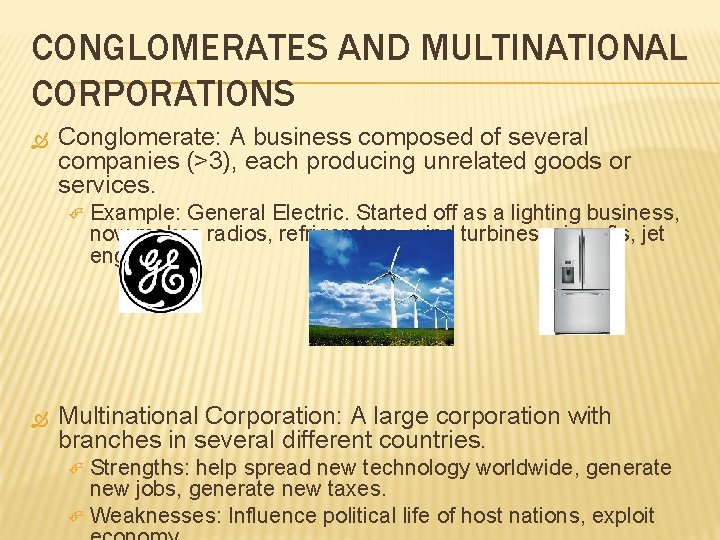
CONGLOMERATES AND MULTINATIONAL CORPORATIONS Conglomerate: A business composed of several companies (>3), each producing unrelated goods or services. Example: General Electric. Started off as a lighting business, now makes radios, refrigerators, wind turbines, aircrafts, jet engines. Multinational Corporation: A large corporation with branches in several different countries. Strengths: help spread new technology worldwide, generate new jobs, generate new taxes. Weaknesses: Influence political life of host nations, exploit
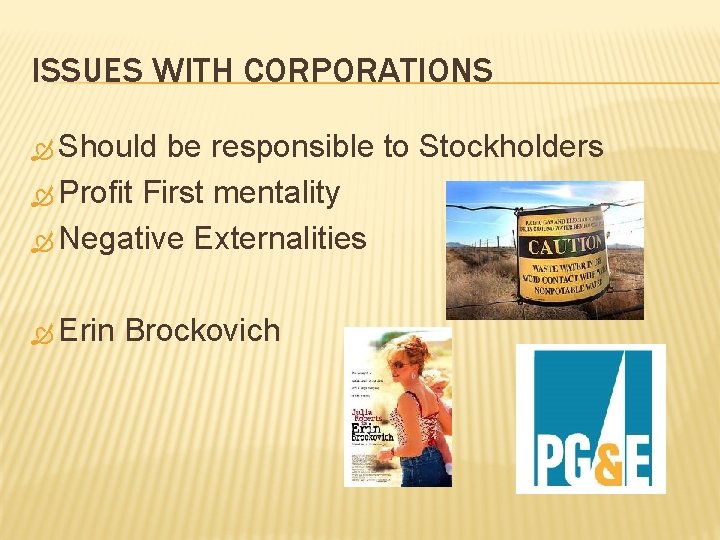
ISSUES WITH CORPORATIONS Should be responsible to Stockholders Profit First mentality Negative Externalities Erin Brockovich
FRANCHISES Franchise: A business that licenses the right to sell its products in a particular area Franchisee: A semi-independent business that buys the right to run a franchise. Advantages: running a franchise gives you some independence. A franchiser provides good training and ample resources Disadvantages: Share profits with Franchiser, loss of control over some aspects of the business, must follow all franchise rules (recipes).
NONPROFITS A business that aims to benefit society and not make a profit How are they structured? Need government charters, have unlimited live and are exempt from many taxes How do they raise money? Donation, grants member fees, sell some products Example: Salvation Army, American Lung Association
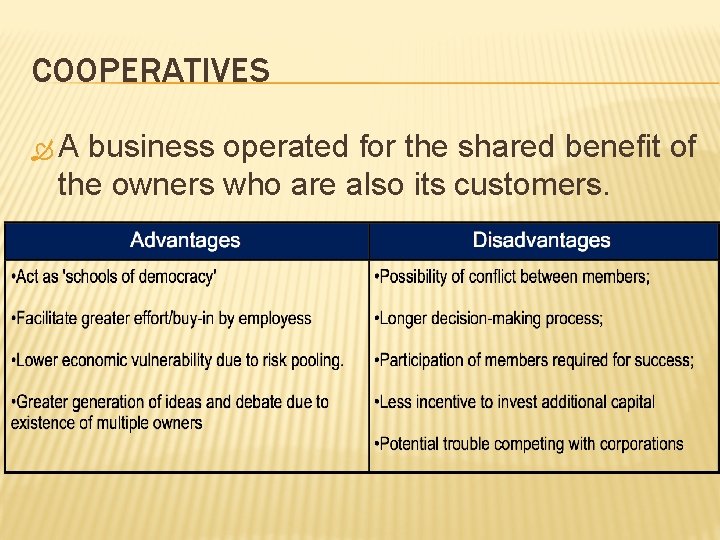
COOPERATIVES A business operated for the shared benefit of the owners who are also its customers.