
Market Structures Lesson 10 Module 57 Market Structures

- Slides: 7
Market Structures Lesson 10 Module 57
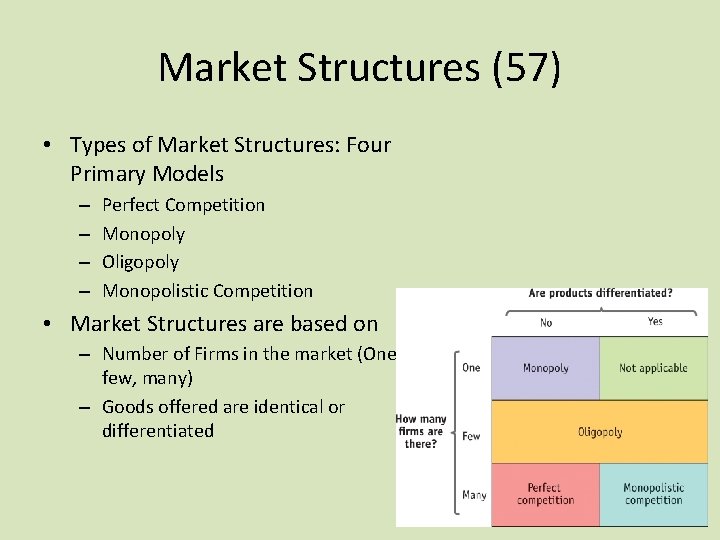
Market Structures (57) • Types of Market Structures: Four Primary Models – – Perfect Competition Monopoly Oligopoly Monopolistic Competition • Market Structures are based on – Number of Firms in the market (One, few, many) – Goods offered are identical or differentiated
Competition • Conditions of Perfect Competition – Perfect competition is the goal of economists for a stable free market. • • • Many sellers Selling identical products Able to enter and exit the market freely None of them are large enough to influence prices. There need to also be many well-informed buyers, all looking for the best prices. This keeps the system in equilibrium. • Price Takers and Price Makers • Market Share • Commodity (Standardized Product)
Barriers to Entry • Competitiveness in markets largely has to do with the ease with which new firms can enter the market. • Markets that require a lot of technical knowledge (computer hardware), large amounts of infrastructure (oil, transportation, factories), or difficult to get resources have large start up costs. • In these cases, there remains a relatively few businesses that are in the market, making perfect competition improbable.
Monopolies • Monopolies exist when there is a single supplier for a good, and the barriers to entry prevent other suppliers from entering the market. – – Control of Scarce Resources Economy of Scale Technological Superiority Government-created barriers • Patent or Copyright • While monopolies are generally considered to be bad because they can limit the quantity supplied and can charge whatever they want, there are other kinds of monopolies that economists love.
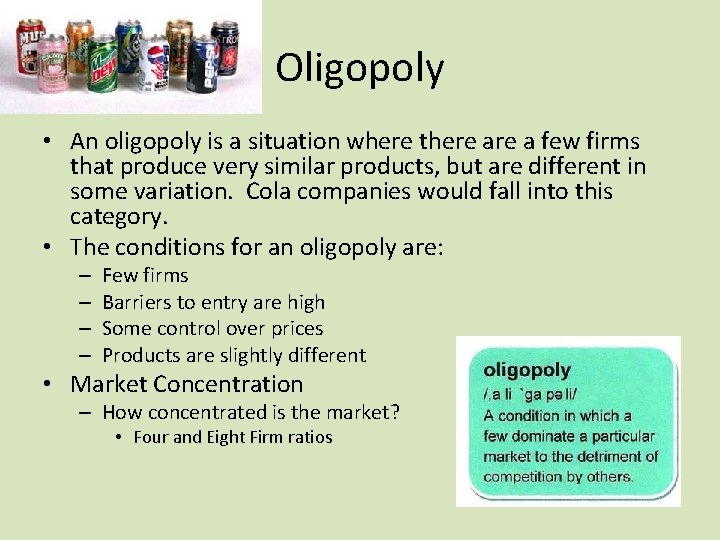
Oligopoly • An oligopoly is a situation where there a few firms that produce very similar products, but are different in some variation. Cola companies would fall into this category. • The conditions for an oligopoly are: – – Few firms Barriers to entry are high Some control over prices Products are slightly different • Market Concentration – How concentrated is the market? • Four and Eight Firm ratios
Monopolistic Competition • Monopolistic competition are where there are – – Many firms Barriers to entry are low Some control over prices Some variation of goods. • There are many examples of these kinds of businesses, like retail stores, or gas stations. They tend to have some kind of brand image, and differentiate themselves by service, product quality, or features. – Chinese Food versus Mexican Food • Not Perfect Competition (Products are different) • Not A Monopoly (faces competition) • Not An Oligopoly (many firms, free entry)