
Market Structure p Types n n Competitive Monopoly
- Slides: 17
Market Structure p Types n n Competitive Monopoly Monopolistic Competition Oligopoly This slideshow was written by Ken Chapman, but is substantially based on concepts from Managerial Economics and Organizational Architecture by Brickley Zimmerman & Smith, Mc. Graw-Hill, 2004.
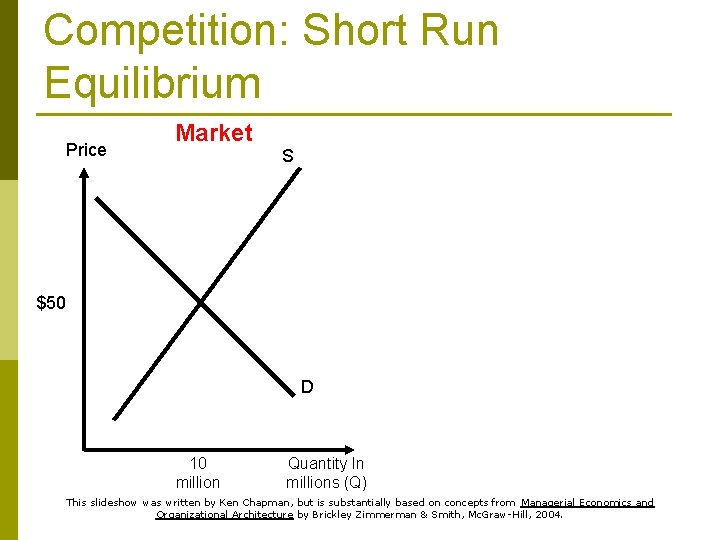
Competition: Short Run Equilibrium Price Market S $50 D 10 million Quantity In millions (Q) This slideshow was written by Ken Chapman, but is substantially based on concepts from Managerial Economics and Organizational Architecture by Brickley Zimmerman & Smith, Mc. Graw-Hill, 2004.
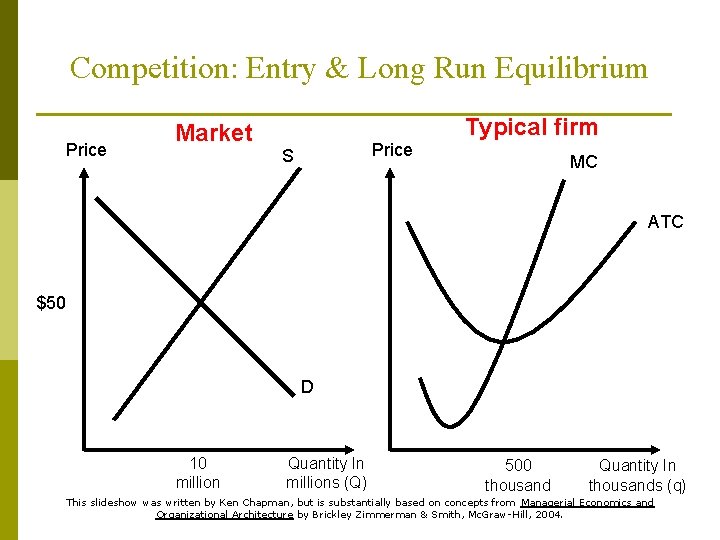
Competition: Entry & Long Run Equilibrium Price Market Price S Typical firm MC ATC $50 D 10 million Quantity In millions (Q) 500 thousand Quantity In thousands (q) This slideshow was written by Ken Chapman, but is substantially based on concepts from Managerial Economics and Organizational Architecture by Brickley Zimmerman & Smith, Mc. Graw-Hill, 2004.
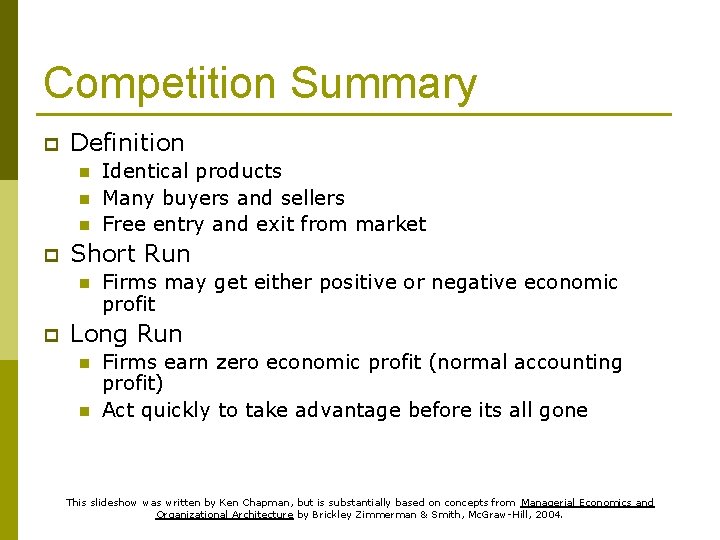
Competition Summary p Definition n p Short Run n p Identical products Many buyers and sellers Free entry and exit from market Firms may get either positive or negative economic profit Long Run n n Firms earn zero economic profit (normal accounting profit) Act quickly to take advantage before its all gone This slideshow was written by Ken Chapman, but is substantially based on concepts from Managerial Economics and Organizational Architecture by Brickley Zimmerman & Smith, Mc. Graw-Hill, 2004.
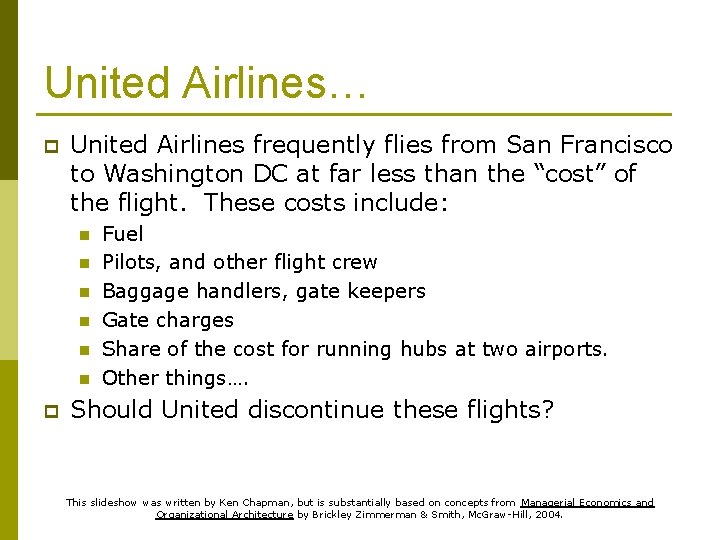
United Airlines… p United Airlines frequently flies from San Francisco to Washington DC at far less than the “cost” of the flight. These costs include: n n n p Fuel Pilots, and other flight crew Baggage handlers, gate keepers Gate charges Share of the cost for running hubs at two airports. Other things…. Should United discontinue these flights? This slideshow was written by Ken Chapman, but is substantially based on concepts from Managerial Economics and Organizational Architecture by Brickley Zimmerman & Smith, Mc. Graw-Hill, 2004.
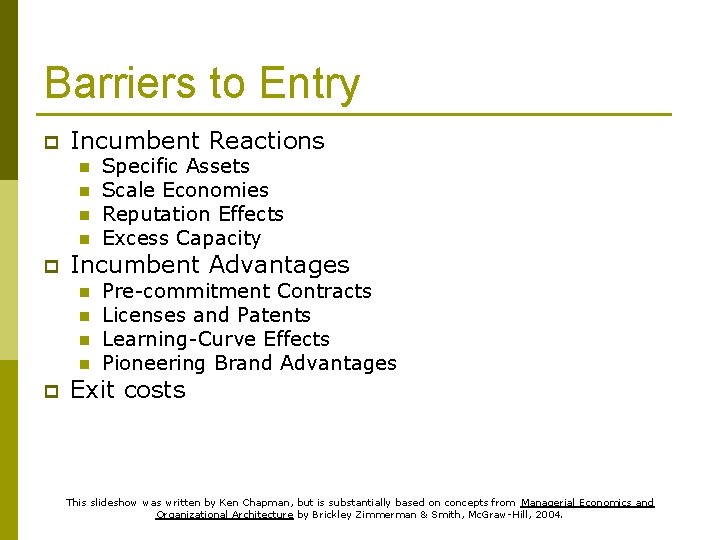
Barriers to Entry p Incumbent Reactions n n p Incumbent Advantages n n p Specific Assets Scale Economies Reputation Effects Excess Capacity Pre-commitment Contracts Licenses and Patents Learning-Curve Effects Pioneering Brand Advantages Exit costs This slideshow was written by Ken Chapman, but is substantially based on concepts from Managerial Economics and Organizational Architecture by Brickley Zimmerman & Smith, Mc. Graw-Hill, 2004.
Monopoly One firm producing a product with no close substitutes p Strong Barrier to Entry p Some unrealized gains-to-trade p This slideshow was written by Ken Chapman, but is substantially based on concepts from Managerial Economics and Organizational Architecture by Brickley Zimmerman & Smith, Mc. Graw-Hill, 2004.
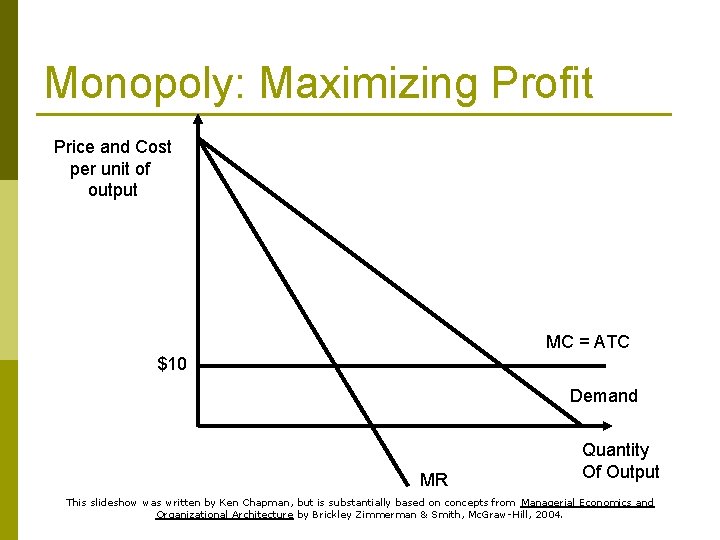
Monopoly: Maximizing Profit Price and Cost per unit of output MC = ATC $10 Demand MR Quantity Of Output This slideshow was written by Ken Chapman, but is substantially based on concepts from Managerial Economics and Organizational Architecture by Brickley Zimmerman & Smith, Mc. Graw-Hill, 2004.
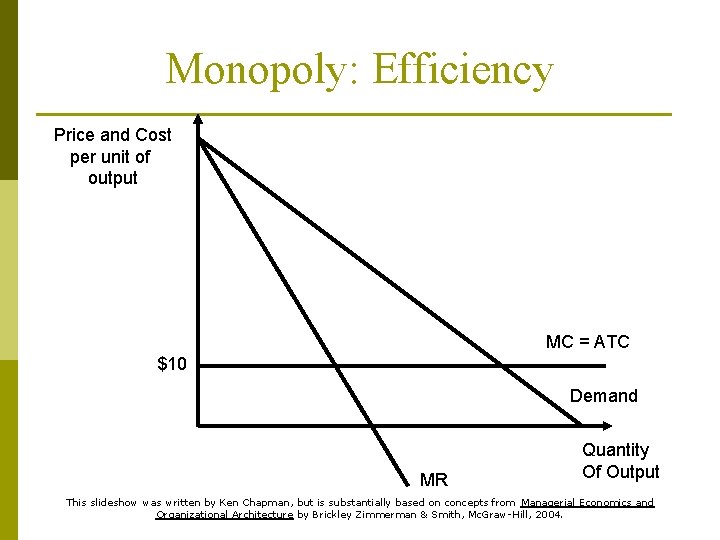
Monopoly: Efficiency Price and Cost per unit of output MC = ATC $10 Demand MR Quantity Of Output This slideshow was written by Ken Chapman, but is substantially based on concepts from Managerial Economics and Organizational Architecture by Brickley Zimmerman & Smith, Mc. Graw-Hill, 2004.
Monopolistic Competition Products are slightly different from each other p Free Entry and Exit of Firms in the Long Run p This slideshow was written by Ken Chapman, but is substantially based on concepts from Managerial Economics and Organizational Architecture by Brickley Zimmerman & Smith, Mc. Graw-Hill, 2004.
Oligopoly Few firms that are strategically connected p Strong barriers to entry p This slideshow was written by Ken Chapman, but is substantially based on concepts from Managerial Economics and Organizational Architecture by Brickley Zimmerman & Smith, Mc. Graw-Hill, 2004.
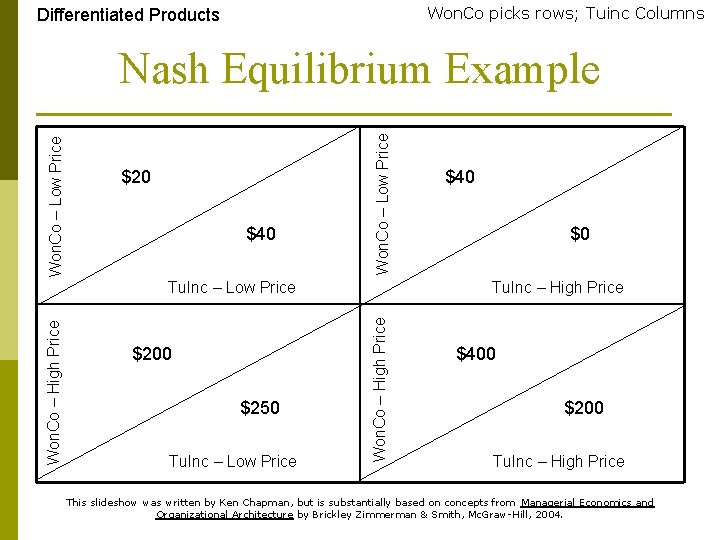
Nash Equilibrium p Each firm does the best it can given the strategy of the other firm This slideshow was written by Ken Chapman, but is substantially based on concepts from Managerial Economics and Organizational Architecture by Brickley Zimmerman & Smith, Mc. Graw-Hill, 2004.
Won. Co picks rows; Tuinc Columns Differentiated Products $20 $40 Won. Co – Low Price Nash Equilibrium Example $200 $250 Tu. Inc – Low Price $0 Tu. Inc – High Price Won. Co – High Price Tu. Inc – Low Price $400 $200 Tu. Inc – High Price This slideshow was written by Ken Chapman, but is substantially based on concepts from Managerial Economics and Organizational Architecture by Brickley Zimmerman & Smith, Mc. Graw-Hill, 2004.
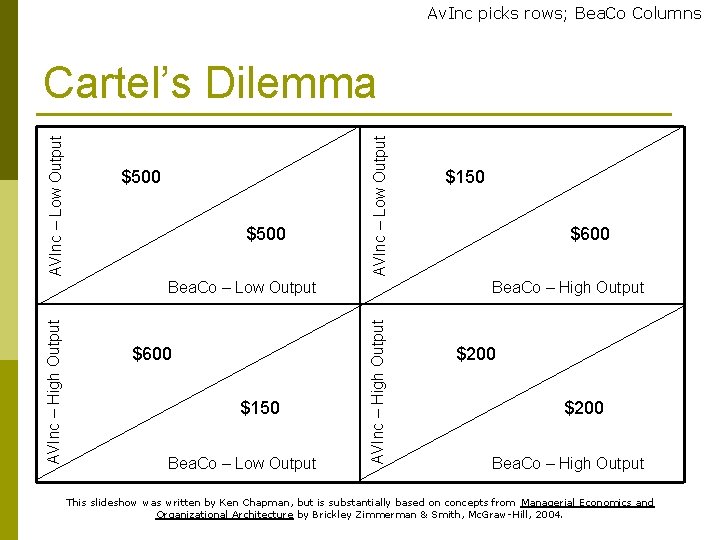
Av. Inc picks rows; Bea. Co Columns $500 AVInc – Low Output Cartel’s Dilemma $600 $150 Bea. Co – Low Output $600 Bea. Co – High Output AVInc – High Output Bea. Co – Low Output $150 $200 Bea. Co – High Output This slideshow was written by Ken Chapman, but is substantially based on concepts from Managerial Economics and Organizational Architecture by Brickley Zimmerman & Smith, Mc. Graw-Hill, 2004.
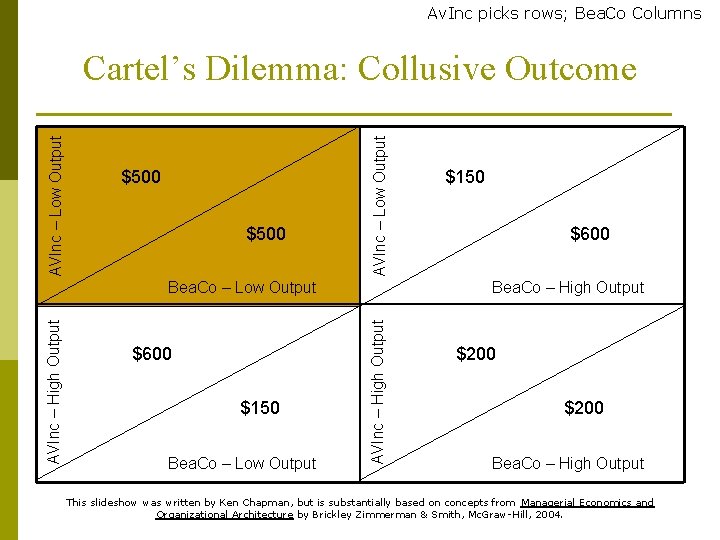
Av. Inc picks rows; Bea. Co Columns $500 AVInc – Low Output Cartel’s Dilemma: Collusive Outcome $600 $150 Bea. Co – Low Output $600 Bea. Co – High Output AVInc – High Output Bea. Co – Low Output $150 $200 Bea. Co – High Output This slideshow was written by Ken Chapman, but is substantially based on concepts from Managerial Economics and Organizational Architecture by Brickley Zimmerman & Smith, Mc. Graw-Hill, 2004.
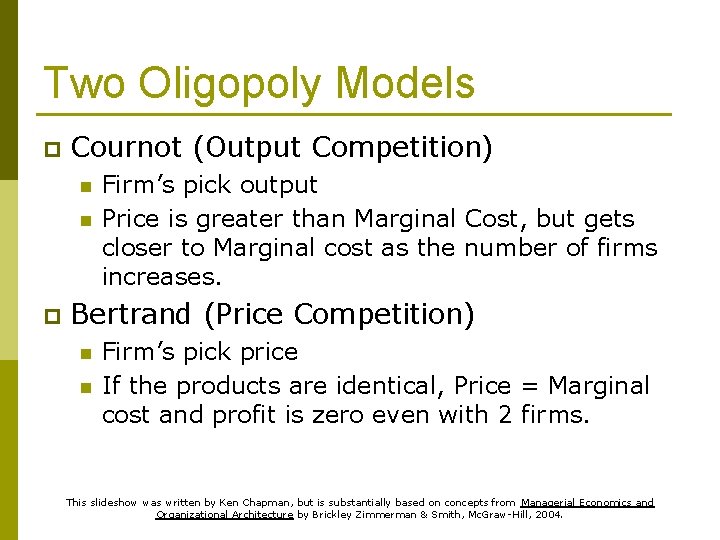
Two Oligopoly Models p Cournot (Output Competition) n n p Firm’s pick output Price is greater than Marginal Cost, but gets closer to Marginal cost as the number of firms increases. Bertrand (Price Competition) n n Firm’s pick price If the products are identical, Price = Marginal cost and profit is zero even with 2 firms. This slideshow was written by Ken Chapman, but is substantially based on concepts from Managerial Economics and Organizational Architecture by Brickley Zimmerman & Smith, Mc. Graw-Hill, 2004.
Work Space: Intentionally Blank This slideshow was written by Ken Chapman, but is substantially based on concepts from Managerial Economics and Organizational Architecture by Brickley Zimmerman & Smith, Mc. Graw-Hill, 2004.