
Market structure Equilibrium of the firm and industry

Market structure, Equilibrium of the firm and industry- Perfect completion and imperfect completion Week - 5 Prepared by: Dr Waqar Ahmad, Asstt. Prof.
Learning Objectives • Market • Perfect competition • Imperfect competition • Monopoly situation • Monopolistic situation • Oligopoly • Price discrimination Week -5

What is a Market? Market is defined as a place or point at which buyers and sellers negotiate their exchange of well-defined products or services. Market is a place where buyer and seller meet, goods and services are offered for the sale and transfer of ownership occurs.
Definition of Market is any area over which buyers and sellers are in close touch with one another, either directly or through dealers, that the price obtainable in one part of the market affects the prices paid in other parts. - Benham
COMPONENTS AND MARKET STRUCTURE As seen from the definition of market, the components of a market are: 1. Sellers (Producer) 2. Buyers (Customers) 3. Nature of product (Types of Product) 4. Conditions of entry and exit 5. Negotiation (Price) 6. Transfer of Ownership and Product 7. Transfer of Money or Equal Value
COMPETITIVE BASED MARKET STRUCTURE The less the power an individual firm has to influence the market in which it operates, the more competitive that market is. Types of Competition are. . Perfect Competition Markets II. Imperfect Competition Markets I.
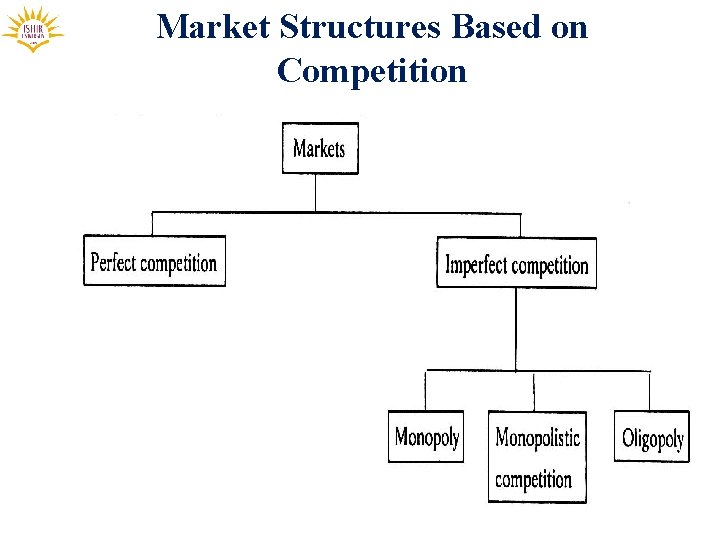
Market Structures Based on Competition

WHAT IS PERFECT COMPETITION MARKET A market structure in which all firms in an industry are price takers and in which there is freedom of entry into and exit from the industry is called Perfect Competition.
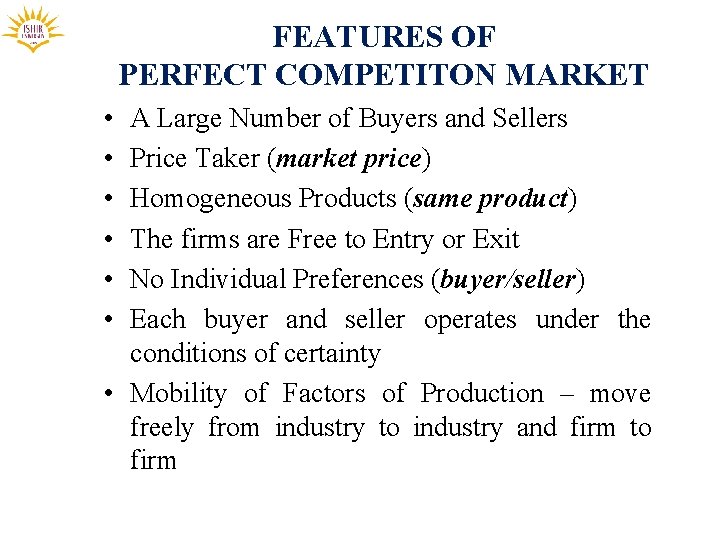
FEATURES OF PERFECT COMPETITON MARKET • • • A Large Number of Buyers and Sellers Price Taker (market price) Homogeneous Products (same product) The firms are Free to Entry or Exit No Individual Preferences (buyer/seller) Each buyer and seller operates under the conditions of certainty • Mobility of Factors of Production – move freely from industry to industry and firm to firm
FEATURES OF PERFECT COMPETITON MARKET Cont…… • • • Perfect knowledge A firm is price taker No govt. interference Perfectly elastic curve Revenue curve under perfect competition Producer equilibrium

IMPERFECT COMPETITION In this market there are small no of firms. Having Large number of buyers and sellers with product differentiation It covers three types of market are… 1. 2. 3. 4. Monopoly Market Monopolistic Market Oligopoly Market Duopoly Market

MONOPOLY A pure monopoly exists if one and only one firm produces and sells a particular commodity in the market. The single firm producing the product is itself both the firm and the industry. E. g. : Railways.
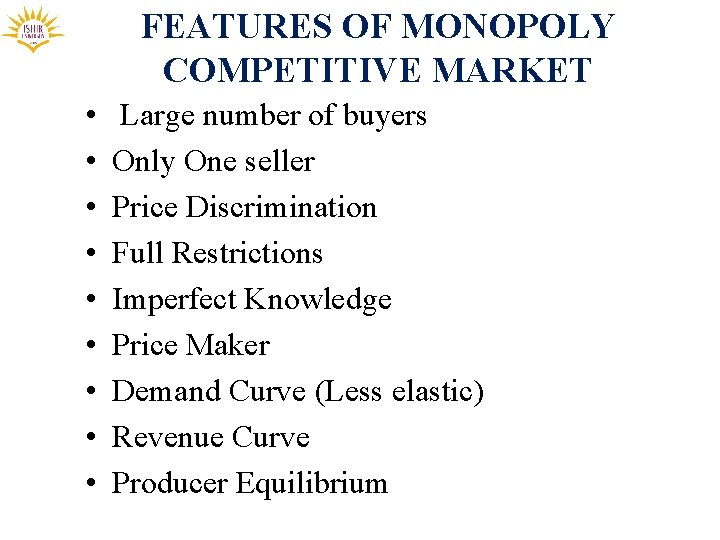
FEATURES OF MONOPOLY COMPETITIVE MARKET • • • Large number of buyers Only One seller Price Discrimination Full Restrictions Imperfect Knowledge Price Maker Demand Curve (Less elastic) Revenue Curve Producer Equilibrium
CAUSES OF MONOPOLY F Patent Rights give legal monopoly F Govt. policies such as granting licenses F Ownership and control of some strategic raw materials. F Exclusive knowledge of technology by the firm. F Size of the market may accommodate only a single firm F Limit pricing policy adopted to prevent new entrants.
MONOPOLISTIC COMPETITION Monopolistic competition is a market situation in which there are large number of buyers and seller which buys and sellers differentiated goods
Monopolistic Competition refers to a situation where there are many sellers of a differentiated product. There is competition which is not perfect, between many firms making very similar products which are close but not perfect substitutes. Monopolistic market exhibits characteristic of both perfect competition and monopoly
FEATURES OF MONOPOLISTIC COMPETITION 1. Large number of buyers 2. Large number of sellers/producers 3. Product Differentiation (Tooth paste) 4. Imperfect knowledge (Buyers) 5. Higher selling cost (Promotion cost) 6. Few Restrictions (Copyright, Patent right etc. ) 7. Freedom of entry and exist 8. Demand Curve (Price sensitivity market) 9. Revenue Curve under monopolistic competition 10. Producers equilibrium
OLIGOPOLY It is a market in which large number of buyer but only few sellers of the product it is know as Oligopoly. If there is a competition among a few sellers, oligopoly is said to exist.
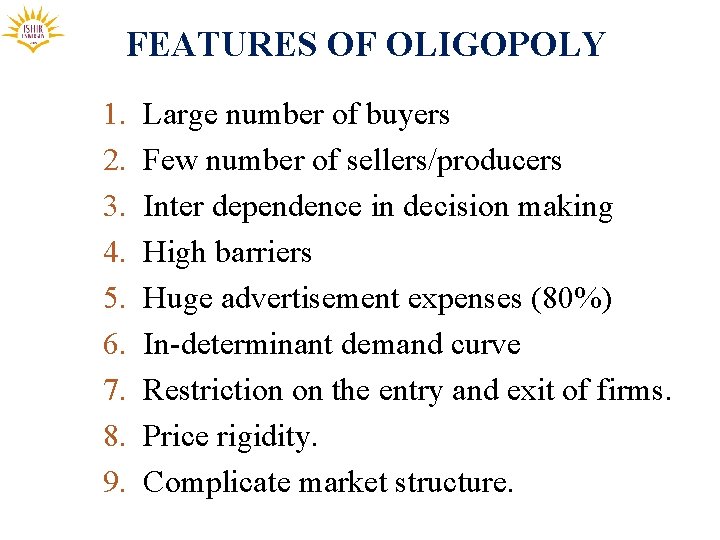
FEATURES OF OLIGOPOLY 1. 2. 3. 4. 5. 6. 7. 8. 9. Large number of buyers Few number of sellers/producers Inter dependence in decision making High barriers Huge advertisement expenses (80%) In-determinant demand curve Restriction on the entry and exit of firms. Price rigidity. Complicate market structure.
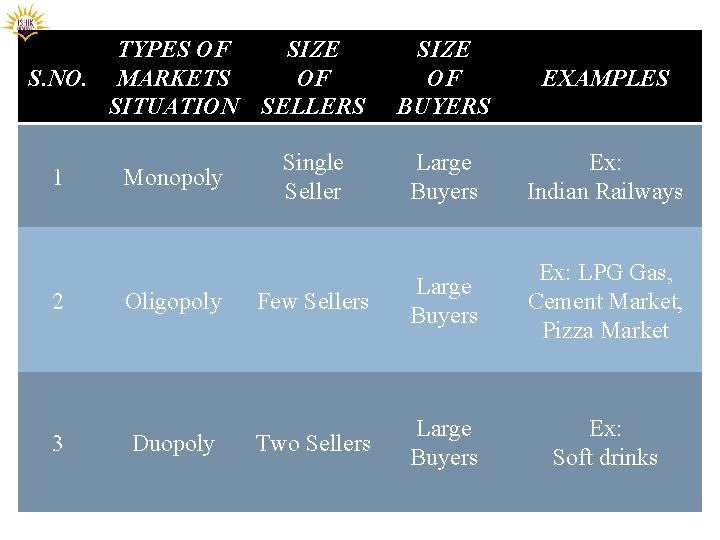
TYPES OF SIZE S. NO. MARKETS OF SITUATION SELLERS 1 Monopoly SIZE OF BUYERS EXAMPLES Single Seller Large Buyers Ex: Indian Railways Ex: LPG Gas, Cement Market, Pizza Market Ex: Soft drinks 2 Oligopoly Few Sellers Large Buyers 3 Duopoly Two Sellers Large Buyers
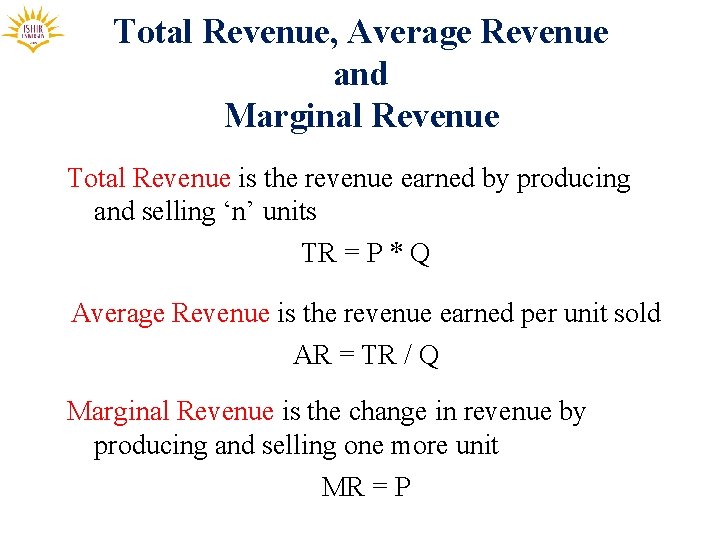
Total Revenue, Average Revenue and Marginal Revenue Total Revenue is the revenue earned by producing and selling ‘n’ units TR = P * Q Average Revenue is the revenue earned per unit sold AR = TR / Q Marginal Revenue is the change in revenue by producing and selling one more unit MR = P
EQUILIBRIUM POINT Equilibrium point refers to the position where the firm enjoys maximum profits and it has no incentive either to reduce or increase its output level. Equilibrium based on two conditions 1. MR = MC 2. MC curve should cut the MR curve from below
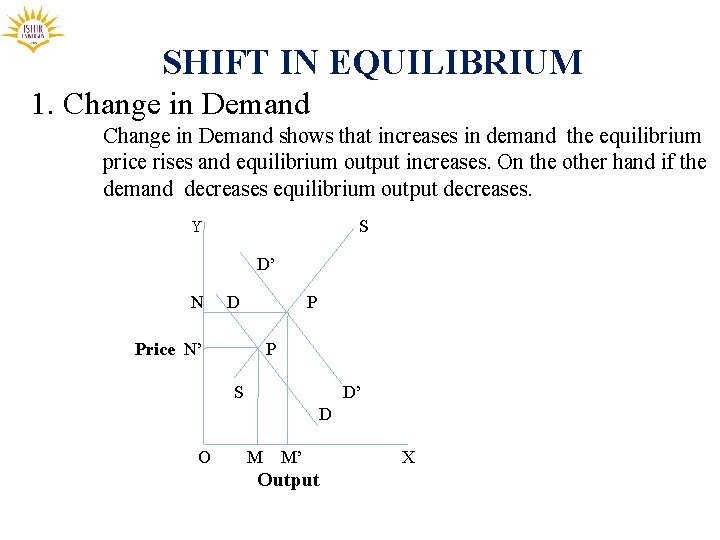
SHIFT IN EQUILIBRIUM 1. Change in Demand shows that increases in demand the equilibrium price rises and equilibrium output increases. On the other hand if the demand decreases equilibrium output decreases. S Y D’ N D P Price N’ P S D’ D O M M’ Output X
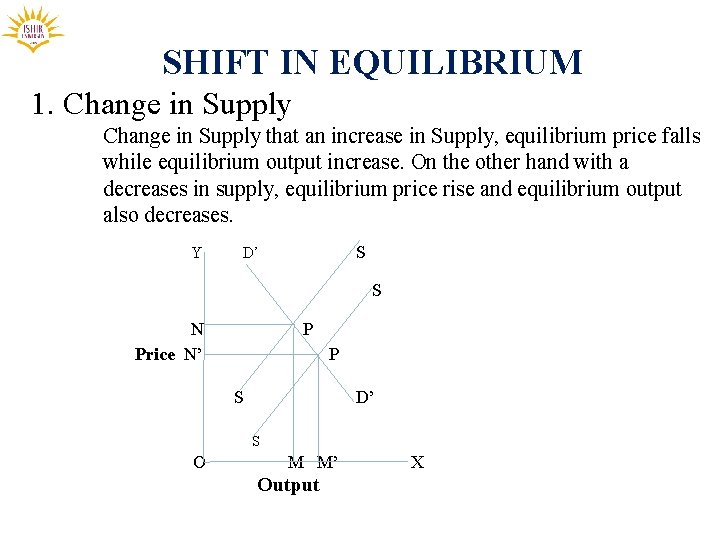
SHIFT IN EQUILIBRIUM 1. Change in Supply that an increase in Supply, equilibrium price falls while equilibrium output increase. On the other hand with a decreases in supply, equilibrium price rise and equilibrium output also decreases. Y S D’ S N Price N’ P P S D’ S O M M’ Output X
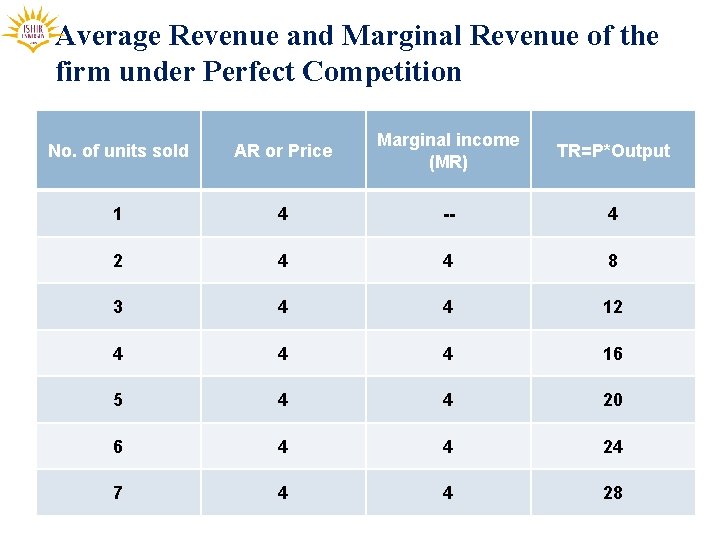
Average Revenue and Marginal Revenue of the firm under Perfect Competition No. of units sold AR or Price Marginal income (MR) TR=P*Output 1 4 -- 4 2 4 4 8 3 4 4 12 4 4 4 16 5 4 4 20 6 4 4 24 7 4 4 28
m a • Exploitative leader: It fixes a price at which small inefficient players may not survive and thus it gains large share of the market. • Barometric Firm: It has better industry intelligence and can preempt and interpret its external environment in an effective manner. No single player is so large to emerge as a leader, but be there may the markets.

Thank you
- Slides: 27