
MARKET SEGMENTATION TARGETING AND POSITIONING MARKET SEGMENTATION MARKET





- Slides: 24
MARKET SEGMENTATION, TARGETING AND POSITIONING
MARKET SEGMENTATION
MARKET SEGMENTATION Learning objectives At the end of this lesson, you should be able to understand the following: 1. 2. 3. 4. 5. 6. 7. 8. What is market segmentation The reasons for segmenting the market The bases for segmenting the market. The importance of segmenting the market. The criteria for segmenting the market. Segmentation variables in consumer and organisational markets. The importance of segmenting the market How companies identify attractive market segments and choose a market coverage strategy. d eate • Cr by • Jude • Asongwe
MARKET SEGMENTATION Definition What is market segmentation? Market segmentation is the process of identifying and classifying customers according to their different needs and wants. n n Market segmentation means dividing a market into distinct groups of buyers with different needs, characteristics or behaviour, who might require separate products or marketing mixes. d eate • Cr by • Jude • Asongwe
MARKET SEGMENTATION. Definition continues Marketing Fundamentals- n n It is the division of market in to distinct groups of customers and using the marketing mix to target customers in these groups. It is the splitting up of customers in to segments and using the marketing mix to target customers. d eate • Cr by • Jude • Asongwe
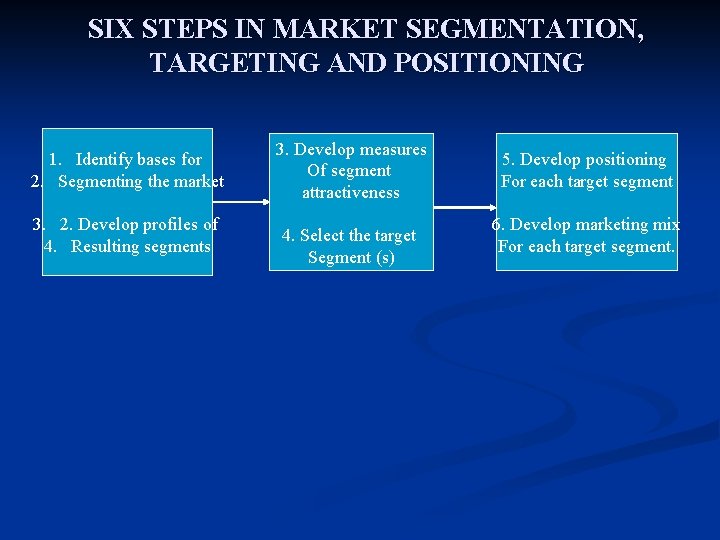
SIX STEPS IN MARKET SEGMENTATION, TARGETING AND POSITIONING 1. Identify bases for 2. Segmenting the market 3. 2. Develop profiles of 4. Resulting segments 3. Develop measures Of segment attractiveness 4. Select the target Segment (s) 5. Develop positioning For each target segment 6. Develop marketing mix For each target segment.
LEVELS OF MARKET SEGMENTATION: Mass marketing: Using almost the same product, promotion and distribution for all consumers. n Segmenting markets/ segment marketing: Adapting a company’s offerings so they more closely match the needs of one or more segments. n Niche marketing: Adapting a company’s offerings to more closely match the needs of one or more sub segments where there is often little competition. n Micromarketing: A form of target marketing in which companies tailor their marketing programmes to the needs and wants of narrowly defined geographic, demographic, psychographic or behavioural segments: Examples of Micromarketing: Local marketing and individual marketing. n
Marketing fundamentals- MARKET SEGMENTATION REASONS FOR SEGMENTING THE MARKET Because of differences that exist among customers with regards to the following: n Age Psychology n Sex Life cycle n Marital status Life style. n Behaviour Location n Income n Culture n Social status n Inadequate resources to mass market (satisfy the whole market). d eate • Cr by Marketing Fundamentals • Jude • Asongwe
Marketing fundamentals. MARKET SEGMENTATION THE CRITERIA FOR SEGMENTING THE MARKET n n n n n Identifiable: You must first of all identify the segment you want to target. It may be children, the young or older population or you may decide to target just the male or female population: What is important is the marketer should identify the market segment. Profitable: The segment should be profitable. This means that only those segments which the business can get more profit should be targeted. The segment targeted should be able to raise money for the organisation. Recognisable: The marketer should be able to recognise the segment and its needs. The segment should also recognise the fact that they have been segmented. Accessible: The business should be able to get access to the particular market segment. Goods and services should reach the segment targeted. The segment should be able to get the products of the organisation. Promotion and advertisement should be able to reach the segment. If the marketer cannot get access to the segment, then it will be difficult to satisfy the market segment. Actionable: The business must take action to provide the products needed by this segment. Customer complaints and queries should be dealt with in the fastest and reliable way as possible to satisfy the segment. Stable (reliable): The segment targeted should be a reliable segment. The segment should’nt appear today and disappear tomorrow, therefore before targeting a particular segment, the business should make sure the segment is reliable. It is the responsibility of the business to also should reliability and consistency in the provision of goods and services to the particular segment. Customers should have the goods they need at all time at the right price, quantity and quality. Customer complaints should also be dealt with in the fastest way possible. Substantial: The segment should be large enough so that the business can also get more profit. The business should focus on segments with many customers so that the profitability can be substantial. Measurable: The Marketer should be able to measure the amount of people in a particular segment, the resources needed satisfy customers in the segment and also the cost and benefit of targeting a particular segment. Affordable: The business should be able to take care of the needs and wants of a particular segment. Businesses shouldn't target segments that they won’t be able to provide the products needed by the segment. Part of customer satisfaction is to provide the products they need, but in a case where a business
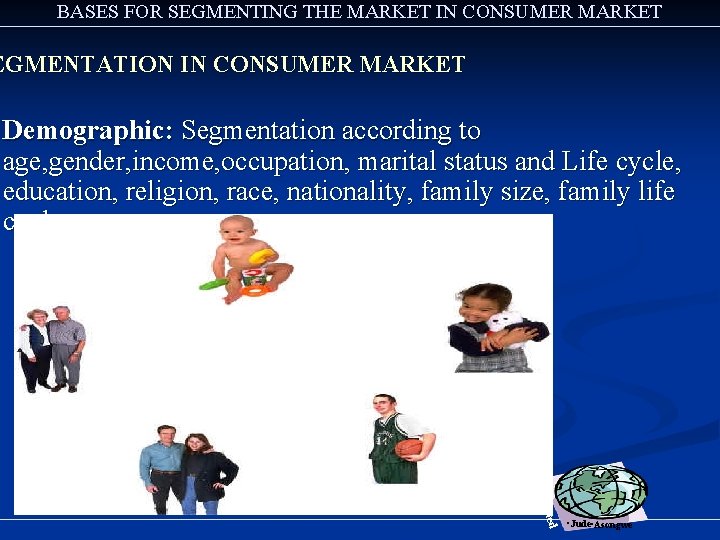
BASES FOR SEGMENTING THE MARKET IN CONSUMER MARKET EGMENTATION IN CONSUMER MARKET Demographic: Segmentation according to age, gender, income, occupation, marital status and Life cycle, education, religion, race, nationality, family size, family life cycle. d eate • Cr by • Jude • Asongwe
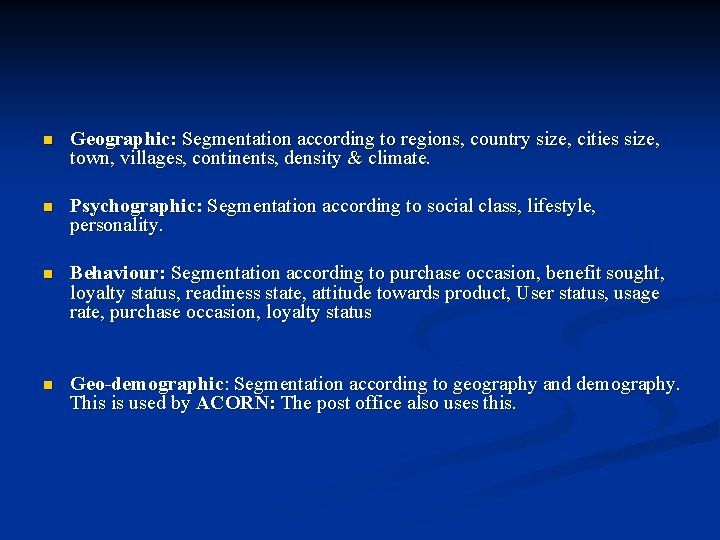
n Geographic: Segmentation according to regions, country size, cities size, town, villages, continents, density & climate. n Psychographic: Segmentation according to social class, lifestyle, personality. n Behaviour: Segmentation according to purchase occasion, benefit sought, loyalty status, readiness state, attitude towards product, User status, usage rate, purchase occasion, loyalty status n Geo-demographic: Segmentation according to geography and demography. This is used by ACORN: The post office also uses this.
SEGMENTING INDUSTRIAL MARKETS
MARKET TARGETING
MARKET TARGETING Learning Objectives: After completing this chapter, you should be able to: 1. Define market targeting 2. Explain the targeting strategies n
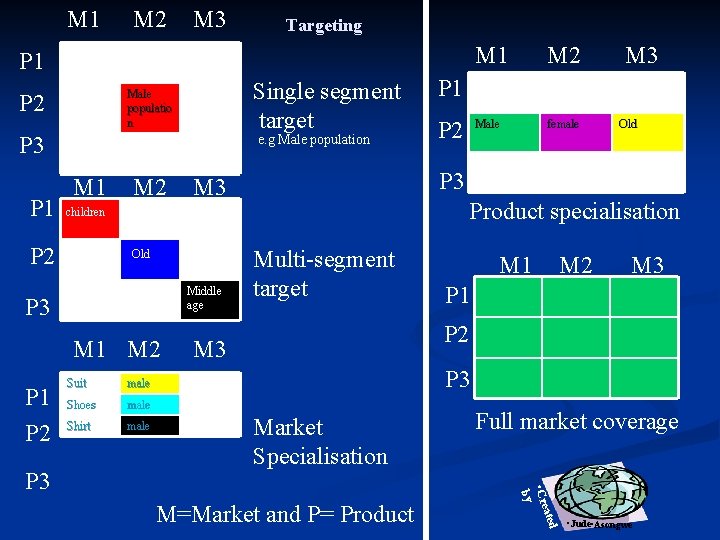
M 1 M 2 M 3 Targeting P 1 Single segment target Male populatio n P 2 P 3 P 1 e. g Male population M 1 M 2 Old Middle age P 3 M 1 M 2 P 1 P 2 male Shoes male Shirt male Male female M 3 P 1 P 2 Old Product specialisation Multi-segment target M 1 M 2 M 3 P 1 P 2 M 3 P 3 Market Specialisation d M=Market and P= Product Full market coverage eate • Cr by P 3 Suit M 2 P 3 M 3 children P 2 M 1 • Jude • Asongwe
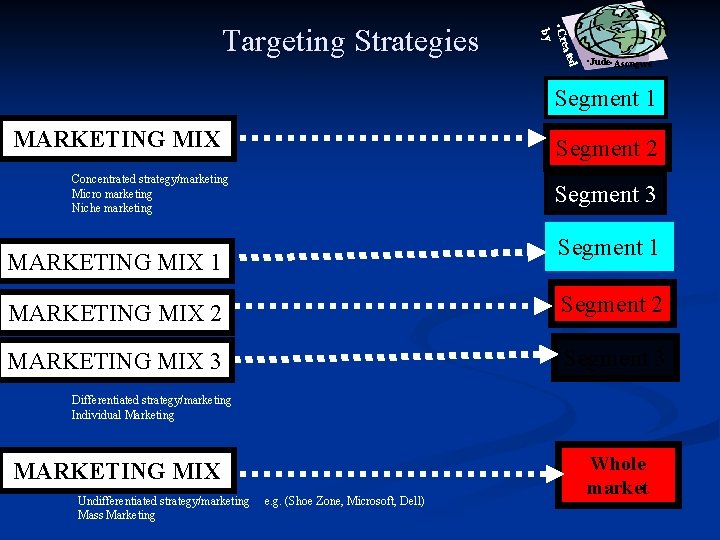
• Cr by d eate Targeting Strategies • Jude • Asongwe Segment 1 MARKETING MIX Segment 2 Concentrated strategy/marketing Micro marketing Niche marketing Segment 3 Segment 1 MARKETING MIX 2 Segment 2 MARKETING MIX 3 Segment 3 Differentiated strategy/marketing Individual Marketing MARKETING MIX Undifferentiated strategy/marketing Mass Marketing e. g. (Shoe Zone, Microsoft, Dell) Whole market
MARKET POSITIONING Learning Objectives After reading this chapter, you should be able to: 1. Define market positioning 2. Explain the positioning strategies – explain how companies can position the market and their products for maximum competitive advantage in the market place. 3. Define differentiation. 4. Explain why companies seek to differentiate their products, markets and use positioning strategies. 5. Examine the positioning map of an organisation 6. List and discuss the principal ways in which companies can differentiate their products. n
MARKET POSITIONING
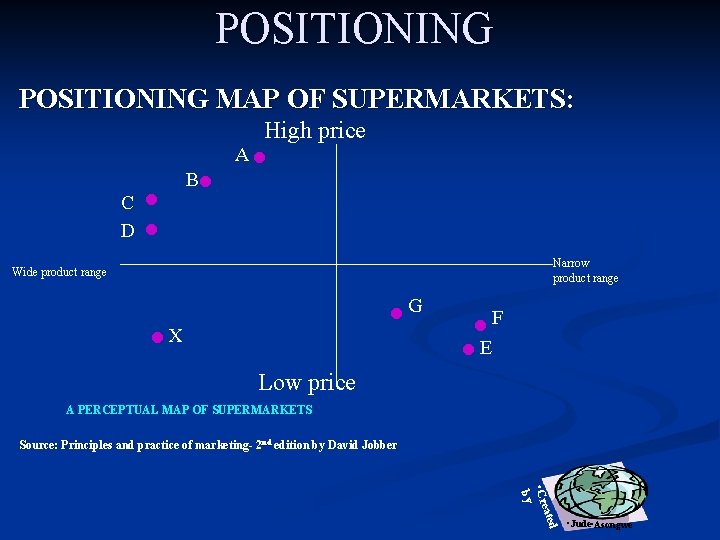
POSITIONING n Positioning means designing a product to occupy a distinct and valued place in the minds of customers. n Companies can position the market in terms of price, product, quality, brands, promotion, and customer service. n The essence of positioning is to enable the company to have more competitive advantage over its competitors. n When positioning, the company should identity customers needs, produce the product targeted at customers. n The product packaging, labelling, styling, branding, designing, pricing, promotion and distribution should seriously be analysed. A good marketing programme such as marketing research, Marketing mix, segmentation, targeting, new product development and market expansion will boost the company’s competitive advantage. n eate • Cr by d • Jude • Asongwe
POSITIONING Companies need to find out what position they are in, in relation to their competitors. Am I a market leader or a market follower? This is a question that should be asked by organisations. n Marketing planning, and marketing strategies should be implemented to enable the company to have competitive advantage. n eate • Cr by d • Jude • Asongwe
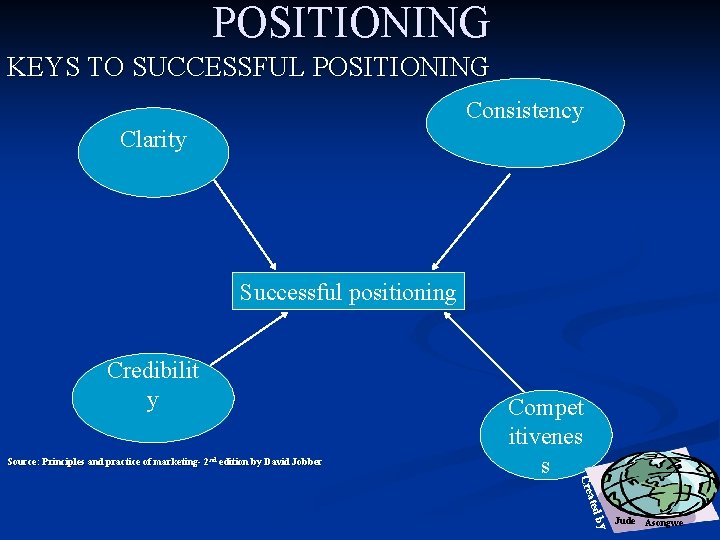
POSITIONING KEYS TO SUCCESSFUL POSITIONING Consistency Clarity Successful positioning Credibilit y Source: Principles and practice of marketing- 2 nd edition by David Jobber ated Cre Compet itivenes s by Jude Asongwe
POSITIONING . . . POSITIONING MAP OF SUPERMARKETS: A High price B C D Wide product range X Low price . . . G Narrow product range F E A PERCEPTUAL MAP OF SUPERMARKETS Source: Principles and practice of marketing- 2 nd edition by David Jobber eate • Cr by d • Jude • Asongwe
KEY DEFINITIONS Segmentation: The act of dividing a market in to distinct group of customers who share the same market characteristics. Targeting: The act of focusing on the particular segment or segments and providing the products needed by that particular segment. Positioning: It means making a product to occupy a distinct and valued place in the minds of customers. eate • Cr by d • Jude • Asongwe
REVISION QUESTIONS 1. 2. 3. 4. 5. Explain the value of market segmentation, targeting and positioning in modern businesses today. Explain what is market segmentation, targeting and positioning. Explain the criteria for segmenting the market Examine the bases for market segmentation Explain the various targeting strategies that businesses can use to target customers. d by eate • Cr • Jude • Asongwe