
Market Research Sampling Methods What is Sampling Choosing



- Slides: 13
Market Research Sampling Methods
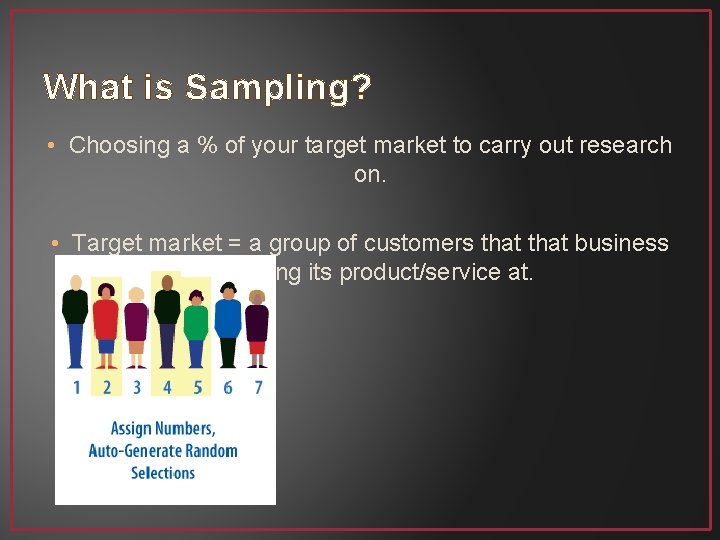
What is Sampling? • Choosing a % of your target market to carry out research on. • Target market = a group of customers that business is aiming its product/service at.
Why Do Firms Sample? • Cost – Market Research can be expensive • Time – Businesses often need information gathered from market research quickly
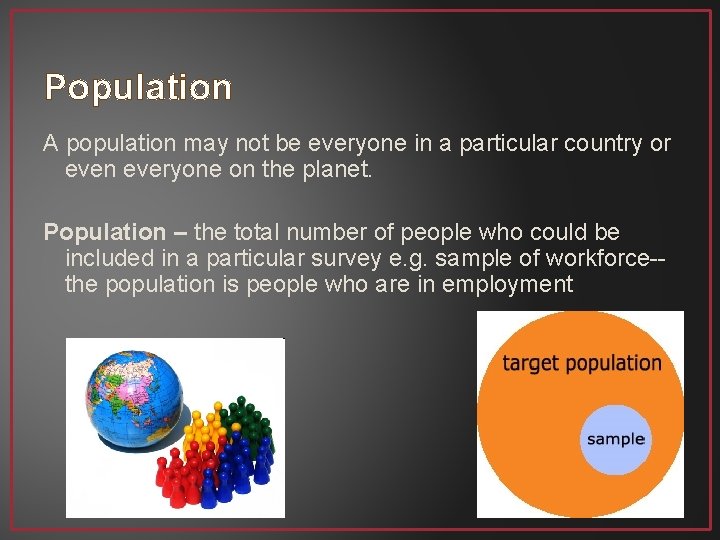
Population A population may not be everyone in a particular country or even everyone on the planet. Population – the total number of people who could be included in a particular survey e. g. sample of workforce-the population is people who are in employment
Sampling Methods
Market Research Random Sampling- where everyone in the population has an equal chance of being included in the survey • May select those not in the target group – indiscriminate • Sample sizes may need to be large to be representative • Can be very expensive
Market Research • Stratified sampling • where the population is divided into smaller groups, which are the ones most likely to be interested in the product being researched • Within the selected group a random or quota sample maybe used to determine the actual respondents
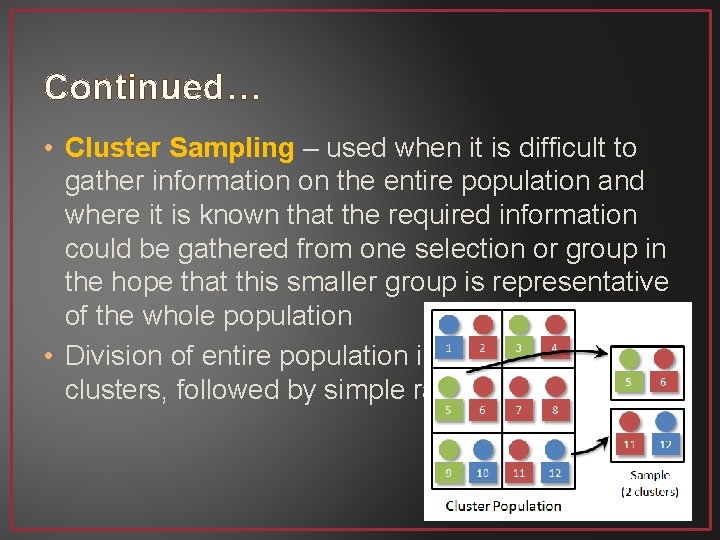
Continued… • Cluster Sampling – used when it is difficult to gather information on the entire population and where it is known that the required information could be gathered from one selection or group in the hope that this smaller group is representative of the whole population • Division of entire population into georgraphical clusters, followed by simple random sample.
Systematic Sampling • where a set formula is used (e. g. every tenth person) to select the people in the research
Which Method Should Be Chosen? • Each method has advantages and disadvantages • Choice depends on: • The need for accuracy • Time available • Research Budget
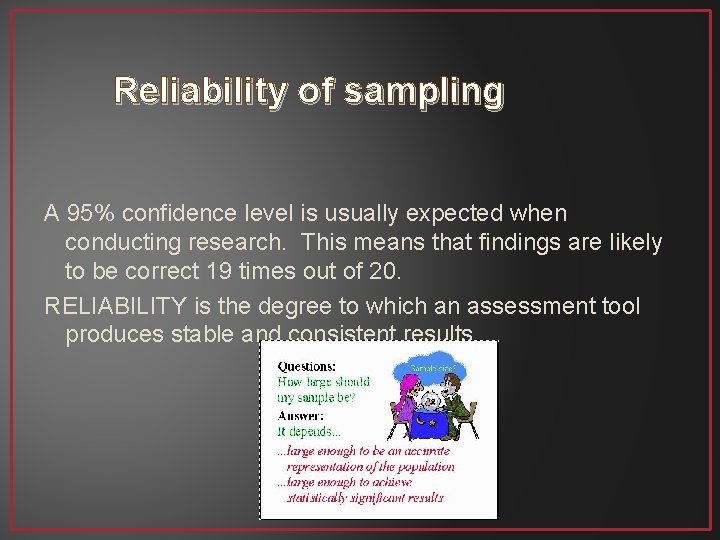
Sample Size The larger the sample size, the more reliable it is likely to be. However, larger samples incur greater costs: • Expense • Time Sample size should relate closely to the size of the specific population.
Reliability of sampling A 95% confidence level is usually expected when conducting research. This means that findings are likely to be correct 19 times out of 20. RELIABILITY is the degree to which an assessment tool produces stable and consistent results.
Validity • Validity of an assessment is the degree to which it measures what it is supposed to measure. This is not the same as reliability, which is the extent to which a measurement gives results that are consistent.