
Market Research Professor Lawrence Feick University of Pittsburgh

Market Research Professor Lawrence Feick University of Pittsburgh
Outline • • • Definition: what is market research? Examples of market research problems Who does market research? Glossary: types of data, studies, variables Focus on focus groups, surveys, observation, experiments • Sampling • Market research in 1998
What is market research? • Collection and organization of information to be used for marketing decision making
Examples of market research problems • • • Target market selection Product studies Pricing studies Distribution studies Promotion studies Sales research
Who does market research? • Managers or market researchers in the firm producing the product (clients) • Market research firms (suppliers) • Advertising agencies (agencies) • Organizations that produce market research information as a byproduct of other activities

The Largest Market Research Firms 1997 Source: Advertising Age May 25, 1998
Market research suppliers: types of services • Custom research • Syndicated research

A glossary of research terms • Types of data • Types of studies • Type of variables
Types of data • Secondary data – collected for another purpose – there is always relevant data available – sources of secondary data • Primary data – collected to answer the current question
Types of studies • Quantitative – quantity data: amounts, means, percentages – surveys, experiments, observation methods • Qualitative – richness, depth of understanding – directional, not quantified results – depth interviews, focus groups
Types of variables • Independent variable – a variable that has an effect on another – a predictor or explanatory variable • Dependent variable – a variable that is affected by another • Examples: – purchase patterns and income

Focus on: Focus Groups
Focus groups • • Most frequently used qualitative method Involves moderated group discussion Typically 1. 5 hours Example usage: product concept testing, name tests
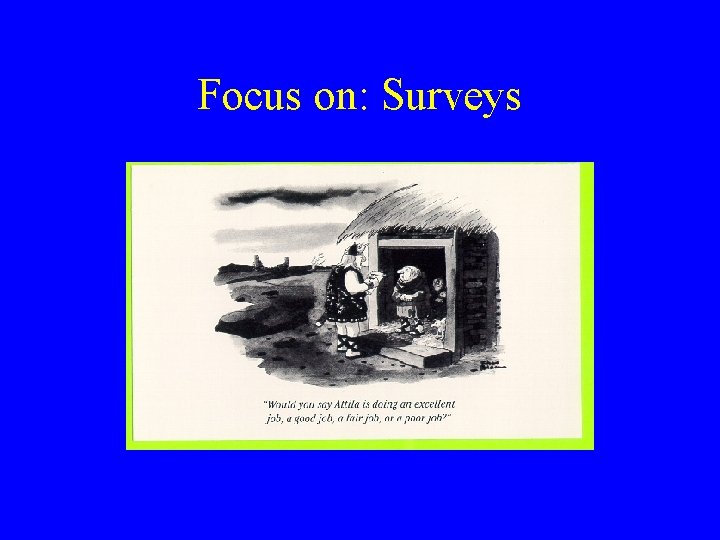
Focus on: Surveys
Surveys • Data collected by asking questions • Art and science of asking questions • Descriptive technique that yields: – averages: potato chip consumption – relationships: is potato chip consumption related to age? to income?

Interviewer-administered questionnaires • Personal interview surveys • Telephone surveys

Self-administered questionnaires • Mail surveys • Fax surveys • Computer surveys
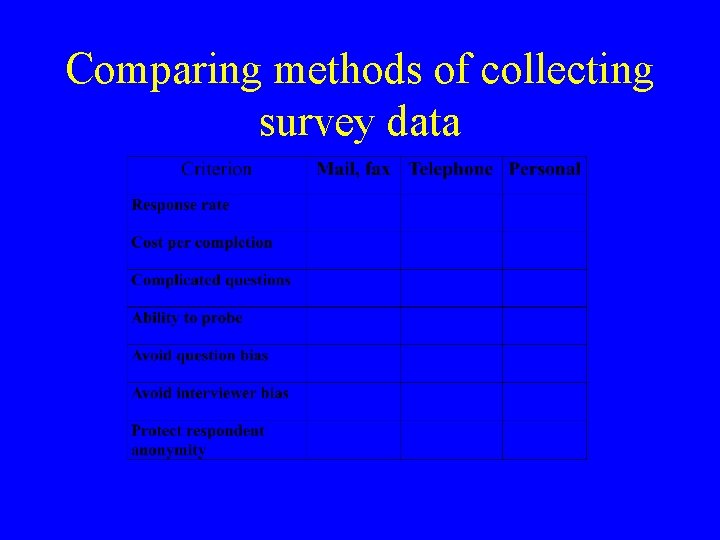
Comparing methods of collecting survey data
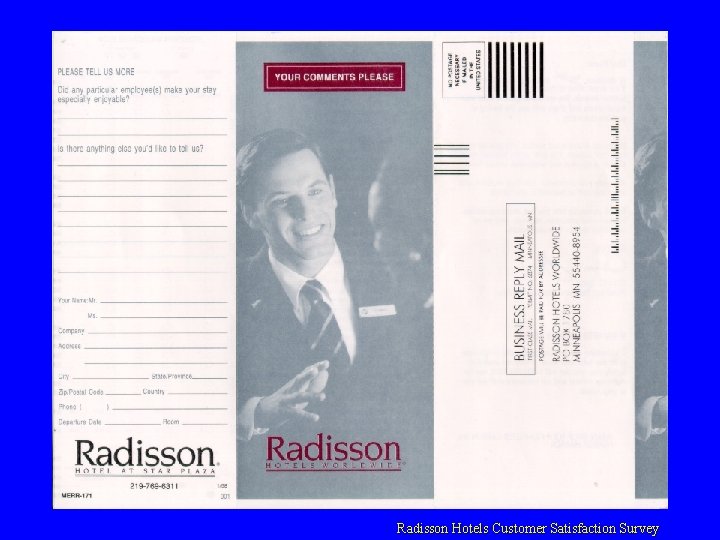
Radisson Hotels Customer Satisfaction Survey
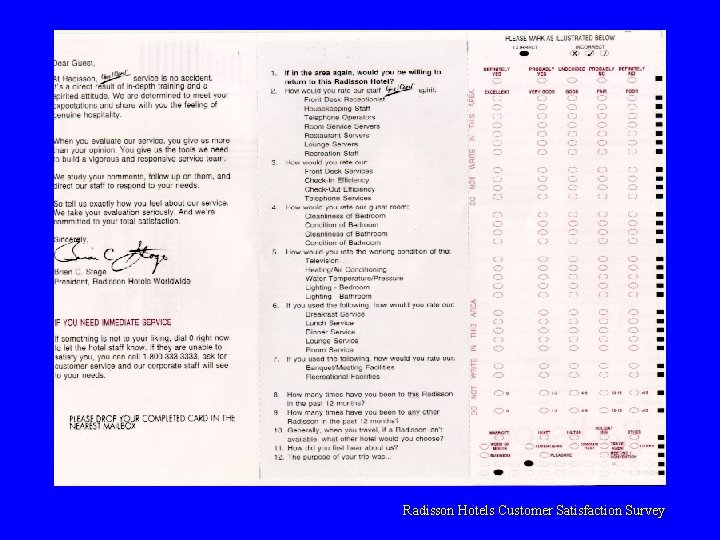
Radisson Hotels Customer Satisfaction Survey
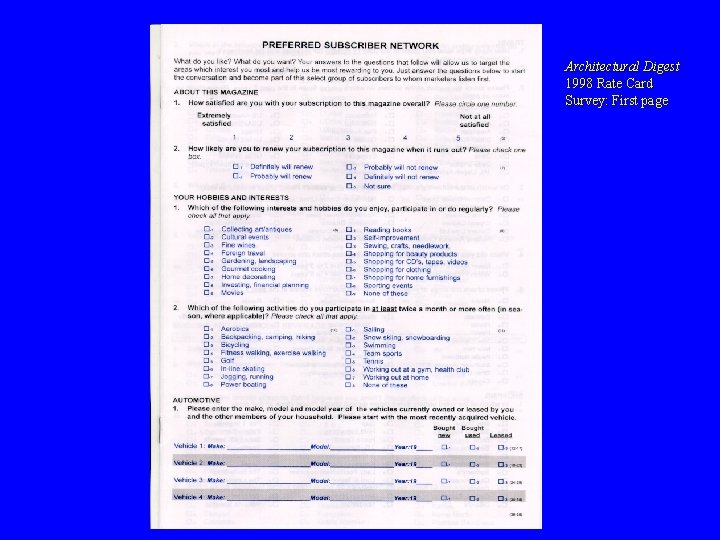
Architectural Digest 1998 Rate Card Survey: First page
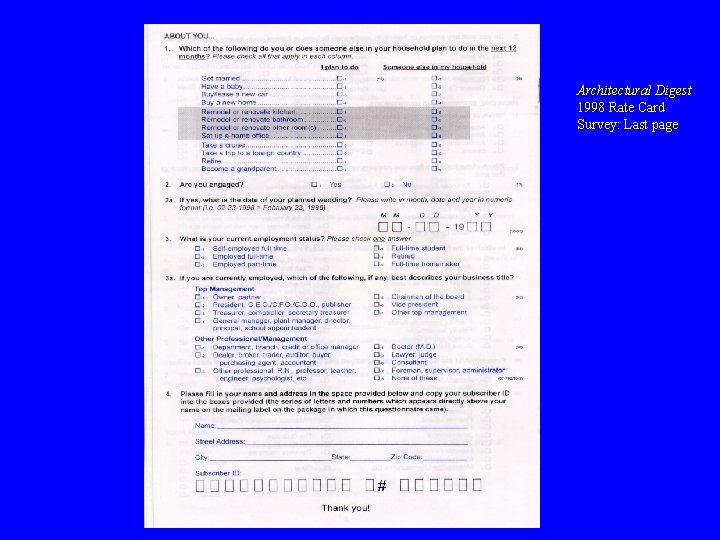
Architectural Digest 1998 Rate Card Survey: Last page

Focus on: Observation
Observation • Data collected by recording information • Avoid bias from contact that influences responses • UPC scanners, Nielson Media’s black boxes, hidden cameras

Focus on: Experiments
Experiments • Involve manipulated independent variables – provide insight into cause and effect • Data collected with surveys and observation • Package design tests, ad copy tests, test markets
Sampling: an aside • Population • Census versus sample • Types of samples – probability samples – nonprobability samples • Sampling and statistics
Market research in the late 1990 s: linked data • Supermarkets loyalty cards – purchase data from scanners – demographic data from membership – tailored promotions to members, neighborhoods • Reader’s Digest direct mail system – tailored mailings based on expected response and expected profitability – uses purchase data, survey data, purchased lists
Market research in the late 1990 s: single source data • Uses a consumer panel • Combines: – demographics from surveys – observed black box data – observed scanner data • Provides linkages among: – customer demos, media habits, purchases • Split cable experiments
Market research in the late 1990 s: brand anthropology • Developing new ways to understand brand meaning in consumers – collages – thick description – in-home observation
Market research: the bottom line • Market research defined--reprise – Collection and organization of information to be used for marketing decision making • Market research, to be useful, – focuses on manager’s problems – answers the right questions – affects decision making
- Slides: 31