
Market Failures The role of government and economics




- Slides: 43
Market Failures
The role of government and economics is to enhance public welfare n n Both seek to allocate scarce resources among alternative desirable ends When the market fails to allocate goods adequately, then the government should step in
Three questions n n What are the desirable ends towards which society should allocate its scarce resources? What are these scarce resources, and what are their characteristics relevant to allocation? Based on the nature of the scarce resources and human nature, what allocative mechanisms is best for achieving these desired ends? What allocative mechanisms are available?
The desirable ends: what improves social welfare? n Is it ever greater consumption of market goods? Can you buy and sell clean water, clean air, stable climate, biodiversity, ozone layer? n Why are we so obsessed with growth? n n n Does sustainability matter? Does distribution matter? n n Who should own goods and services created by nature and by society? Is stability desirable?
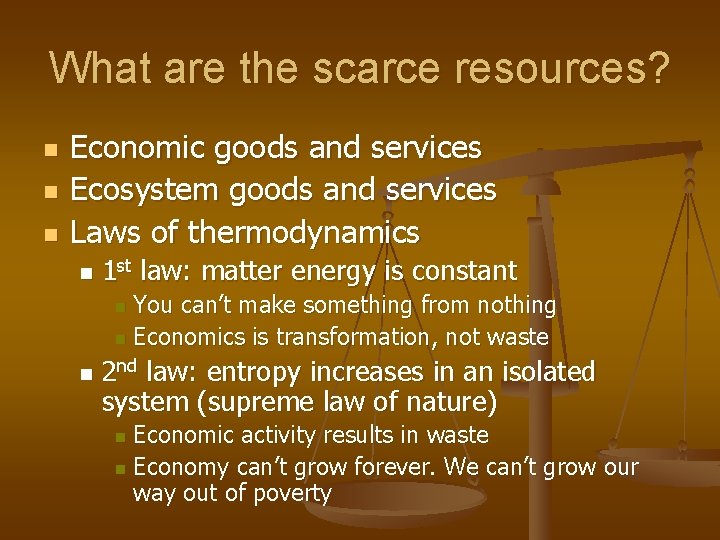
What are the scarce resources? n n n Economic goods and services Ecosystem goods and services Laws of thermodynamics n 1 st law: matter energy is constant You can’t make something from nothing n Economics is transformation, not waste n n 2 nd law: entropy increases in an isolated system (supreme law of nature) Economic activity results in waste n Economy can’t grow forever. We can’t grow our way out of poverty n
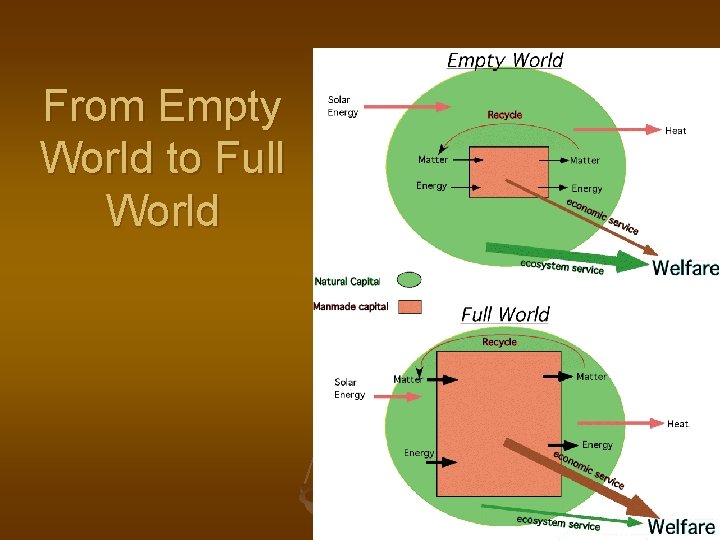
From Empty World to Full World
What are the characteristics of the scarce resources?
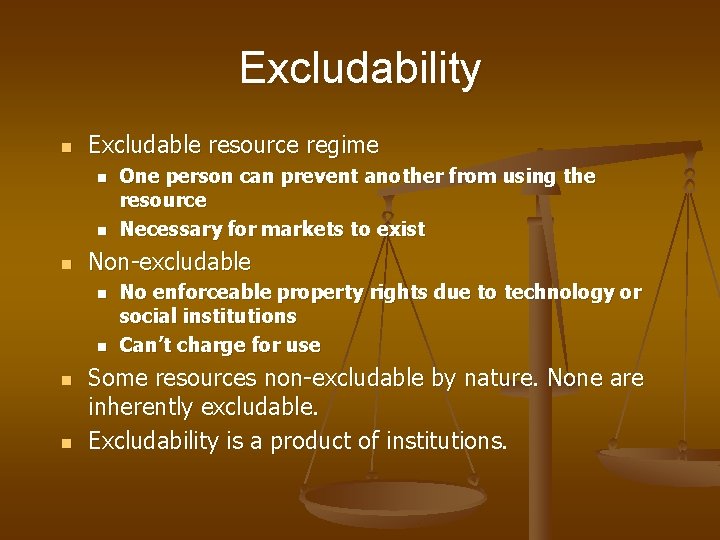
Excludability n Excludable resource regime n n n Non-excludable n n One person can prevent another from using the resource Necessary for markets to exist No enforceable property rights due to technology or social institutions Can’t charge for use Some resources non-excludable by nature. None are inherently excludable. Excludability is a product of institutions.
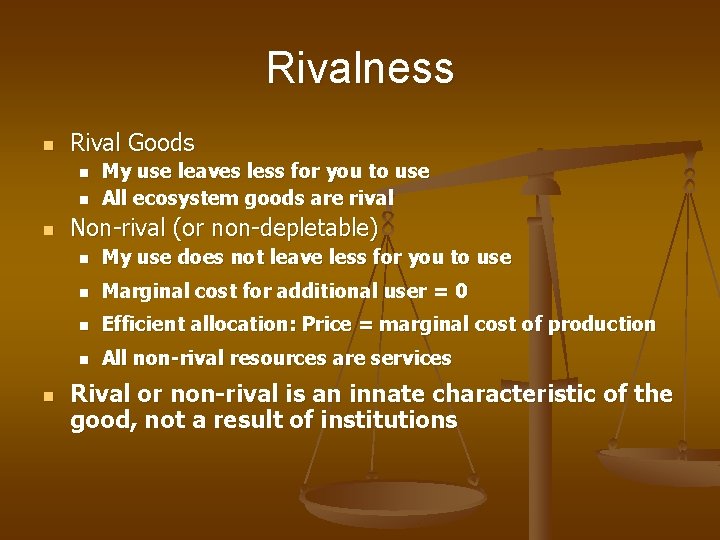
Rivalness n Rival Goods n n My use leaves less for you to use All ecosystem goods are rival Non-rival (or non-depletable) n My use does not leave less for you to use n Marginal cost for additional user = 0 n Efficient allocation: Price = marginal cost of production n All non-rival resources are services Rival or non-rival is an innate characteristic of the good, not a result of institutions
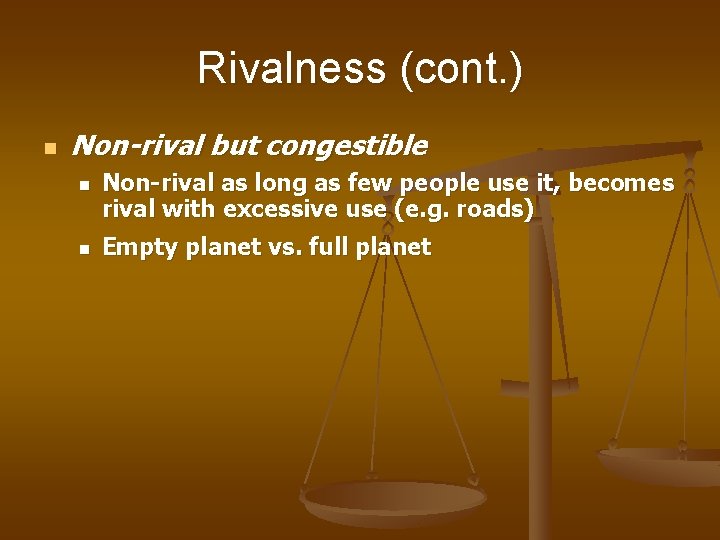
Rivalness (cont. ) n Non-rival but congestible n n Non-rival as long as few people use it, becomes rival with excessive use (e. g. roads) Empty planet vs. full planet
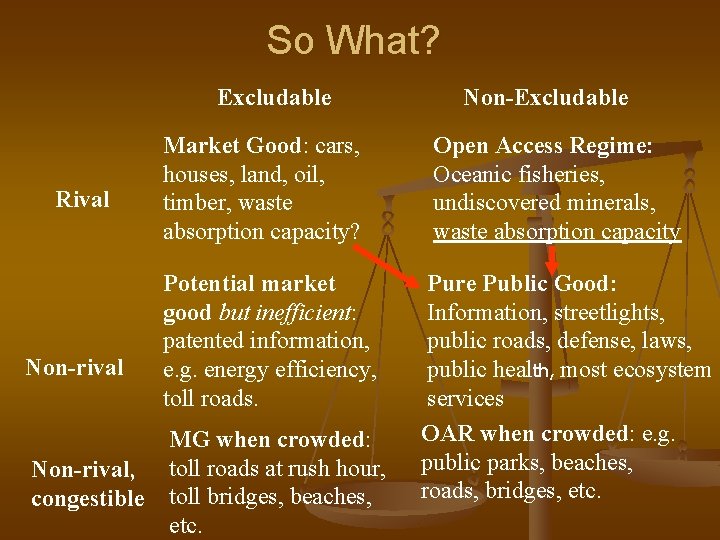
So What? Excludable Rival Non-rival, congestible Market Good: cars, houses, land, oil, timber, waste absorption capacity? Potential market good but inefficient: patented information, e. g. energy efficiency, toll roads. MG when crowded: toll roads at rush hour, toll bridges, beaches, etc. Non-Excludable Open Access Regime: Oceanic fisheries, undiscovered minerals, waste absorption capacity Pure Public Good: Information, streetlights, public roads, defense, laws, public health, most ecosystem services OAR when crowded: e. g. public parks, beaches, roads, bridges, etc.
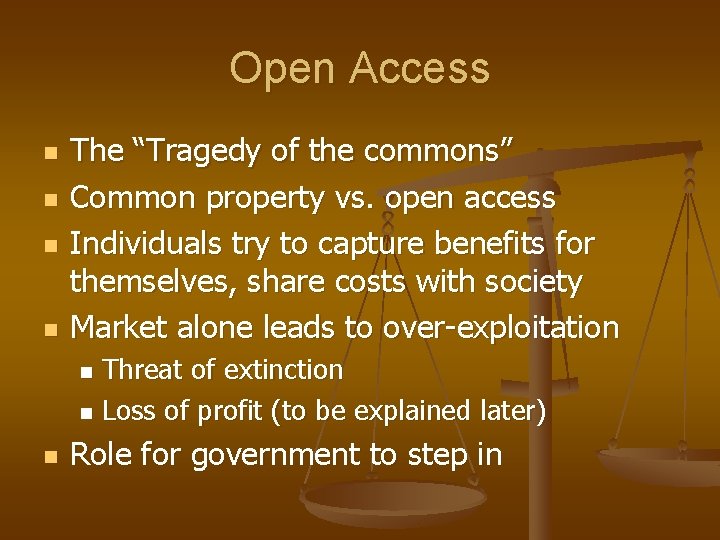
Open Access n n The “Tragedy of the commons” Common property vs. open access Individuals try to capture benefits for themselves, share costs with society Market alone leads to over-exploitation Threat of extinction n Loss of profit (to be explained later) n n Role for government to step in
Non-rival & Excludable n n Patents are protected by governments Why do we have patents? Patents, profit motive and innovation When did patents come about? 1790 s in US n 1947 international, rarely used before 1980 s n
Non-rival & Excludable (cont. ) n Patents and the WTO 97% owned by developed nations n Neem tree, steel drums, etc. n n n Samuel Slater, “Father of American industry” Should government spend scarce resources to make these information excludable?
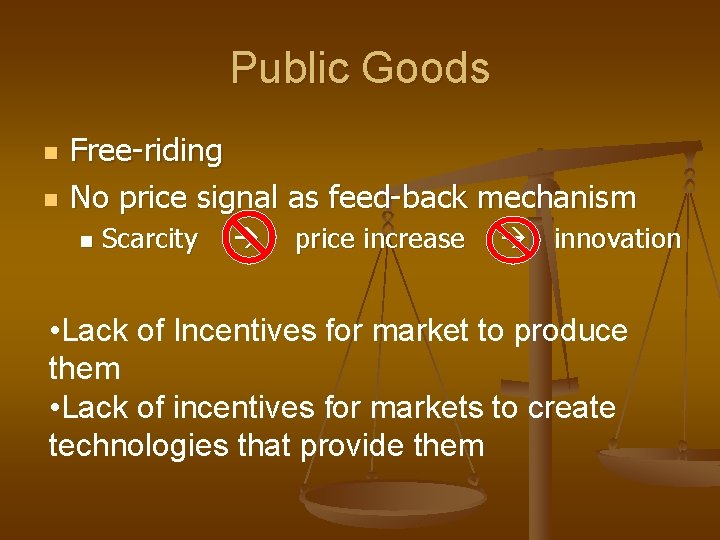
Public Goods n n Free-riding No price signal as feed-back mechanism n Scarcity price increase innovation • Lack of Incentives for market to produce them • Lack of incentives for markets to create technologies that provide them
Public Goods (cont. ) • n How important are public goods? • Life support functions (Vermont’s forests) • Flood protection (Winooski river) • Water purification • Lake Champlain Infrastructure Research and development n if all the scientists are working for profit, none are making PGs Provision widely accepted as government duty
Is government provision efficient? n n Privatization debate Read chapter on political economy
Market goods: The theory of Externalities
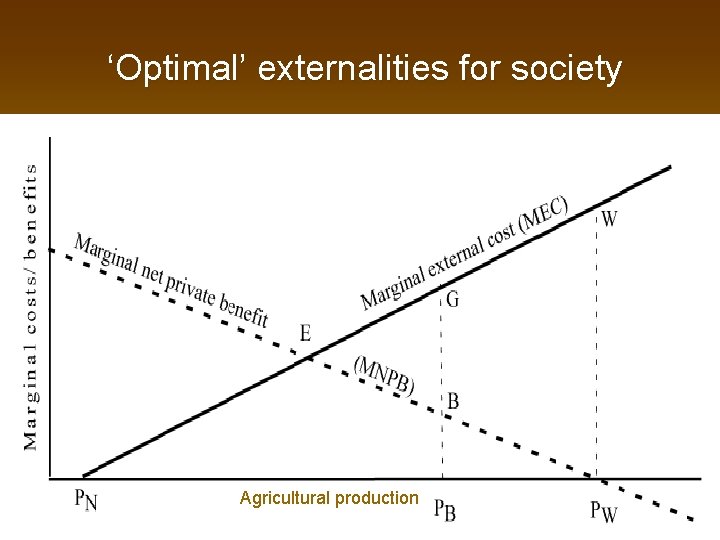
Externalities n Definition n n “an activity by one agent causes a loss (gain) of welfare to another agent” “The loss (gain) of welfare is uncompensated” Completely Internal to the Economic Process. Why? How are these related to public goods?
Examples n Individual consumption Waste outputs n Status effect n n Industry Pollution n Brownfields n n Agriculture Ecosystem conversion- loss of riparian zones n Phosphorous emissions n Siltation n Factory farming n
Examples (cont. ) n Natural resource harvest Depletion of ecosystem services n Waste emissions n n Community issues Crime reduction n Economic stability n Education n Health n
‘Optimal’ externalities for society Agricultural production
Property Rights n n Who owns the environment? polluter rights (privilege, no rights) sufferer rights (rights, duties) What about future generations?
Obstacles to Optimal n Transaction costs n n in absence of transaction costs, no negative externalities What are transaction costs likely to be for externalities affecting public goods? Wealth effect Intergenerational externalities
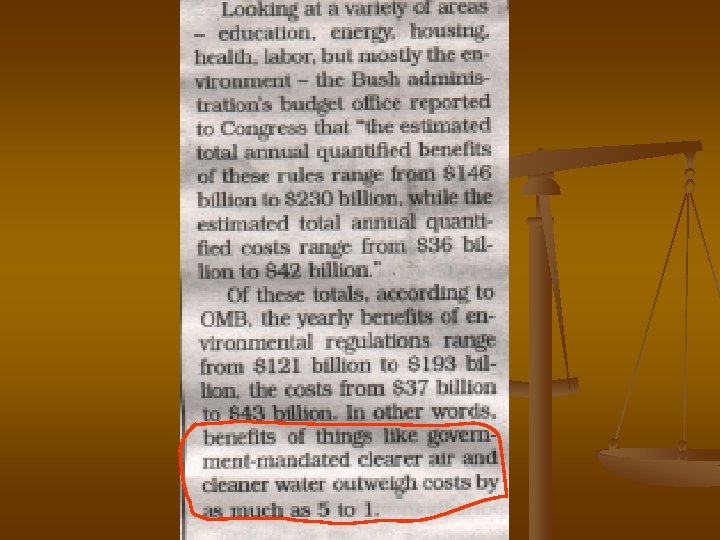
Government role n n What can the government do about externalities, and how does it relate to finance? Regulations n Cost money to enforce
Government role n n What can the government do about externalities, and how does it relate to finance? Regulations Cost money to enforce n Economically inefficient n No incentives to go beyond compliance n n n Taxes Auctioned quotas
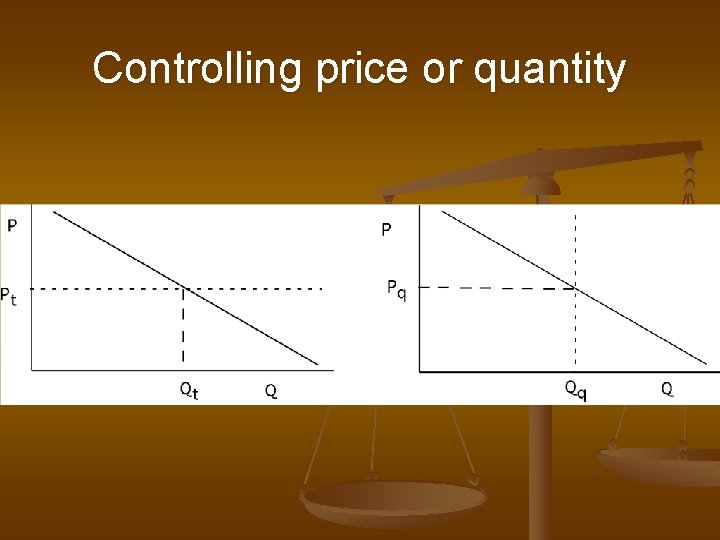
Controlling price or quantity
Marginal pollution abatement costs for three firms emitting 5000 tons of pollution each.
Pigouvian taxes and subsidies n n n Tax (subsidy) equal to value of negative (positive) externality theoretically leads to efficient outcome What is value of externality? Incentives
Tradable quotas n n n Example of sulfur dioxide First determine scale Next decide on distribution n n Justice vs. feasibility Allow market to allocate
Tax or quota? n n With a tax, you can theoretically get right amount, but amount will change with economic change. Better to let prices vary (economic) than amount of resource to be used (ecological) tax or quota on single resource leads to substitution, on all resources will not
Tax or quota n Uncertainty n We don’t know marginal abatement cost curves, nor marginal benefit curves n not only do we not know where we are on the curve, we don’t know the slope of the curve n Slope of curve very important n In full world, lower risks from quotas, in empty world, lower risks from tax
Ignorance and Uncertainty n n Perfect markets require perfect information Asymmetric information n n Nobel Prize in 2000 Poverty insurance Irreducible ignorance Time lags Ecosystem function
How do ignorance and uncertainty relate to budgeting and finance? n Who pays clean up costs when unexpected negative impacts occur? Health impacts n Superfund sites n n Role of government in providing social security (poverty insurance)
Natural Monopoly n n n High fixed cost, low marginal cost Roads How should hey be regulated?
Conclusions n n Many market economists and politicians argue that there is little role for government, market is best allocative mechanism Market systematically fails to provide many goods Government is essential Future lectures will examine just and efficient mechanisms for coping with these market failures
Naural Monopolies,
PG: the Privatization debate
Private Provision n Examples n n n n 3 private police for every public officer in US 2/3 of homes in Denmark with private fire service SUVs or plowed roads? Relative costs Administrative costs Diversity of tastes Distributional issues Skimming
Private Production: examples n n n Skating rink in Central park Trains in WWI Military personnel in Iraq Airport security Municipal water supply Education
Private Production : issues n Examples Skating rink in Central park n Trains in WWI n Military personnel in Iraq n Airport security n Municipal water supply n Education n