
Market Failure versus Government Failure 21 CHAPTER 21
- Slides: 14
Market Failure versus Government Failure 21 CHAPTER 21 Market Failure versus Government Failure The business of government is to keep the government out of business—that is unless business needs government aid. — Will Rogers Mc. Graw-Hill/Irwin Copyright © 2010 by the Mc. Graw-Hill Companies, Inc. All rights reserved.
Market Failure versus Government Failure 21 Market Failures • A market failure is a situation in which the invisible hand pushes in such a way that individual decisions do not lead to socially desirable outcomes • Externalities • Public goods • Imperfect information • Government failures are when the government intervention actually makes the situation worse 21 -2
Market Failure versus Government Failure 21 Externalities • Externalities are the effects of a decision on a third party that are not taken into account by the decision-maker • Negative externalities occur when the effects are detrimental to others • Ex. Second-hand smoke and carbon monoxide emissions • Positive externalities occur when the effects are beneficial to others • Ex. Education 21 -3
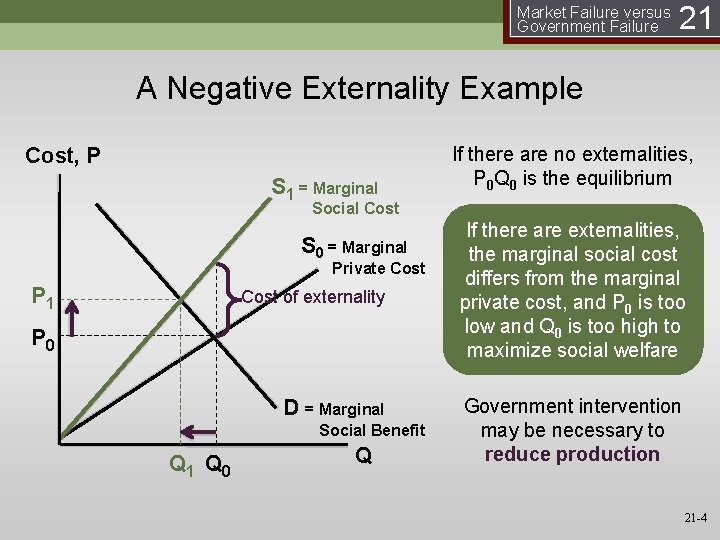
Market Failure versus Government Failure 21 A Negative Externality Example Cost, P S 1 = Marginal If there are no externalities, P 0 Q 0 is the equilibrium Social Cost S 0 = Marginal Private Cost P 1 Cost of externality P 0 D = Marginal Social Benefit Q 1 Q 0 Q If there are externalities, the marginal social cost differs from the marginal private cost, and P 0 is too low and Q 0 is too high to maximize social welfare Government intervention may be necessary to reduce production 21 -4
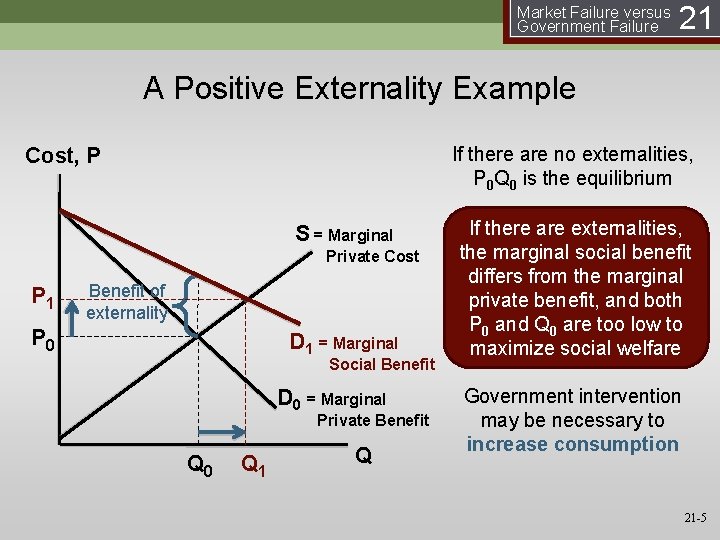
Market Failure versus Government Failure 21 A Positive Externality Example If there are no externalities, P 0 Q 0 is the equilibrium Cost, P S = Marginal Private Cost P 1 Benefit of externality P 0 D 1 = Marginal Social Benefit D 0 = Marginal Private Benefit Q 0 Q 1 Q If there are externalities, the marginal social benefit differs from the marginal private benefit, and both P 0 and Q 0 are too low to maximize social welfare Government intervention may be necessary to increase consumption 21 -5
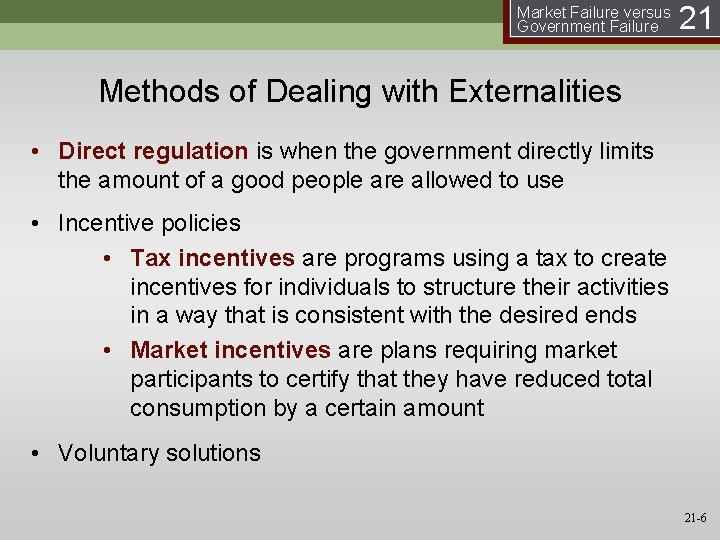
Market Failure versus Government Failure 21 Methods of Dealing with Externalities • Direct regulation is when the government directly limits the amount of a good people are allowed to use • Incentive policies • Tax incentives are programs using a tax to create incentives for individuals to structure their activities in a way that is consistent with the desired ends • Market incentives are plans requiring market participants to certify that they have reduced total consumption by a certain amount • Voluntary solutions 21 -6
Market Failure versus Government Failure 21 The Optimal Policy • An optimal policy is one in which the marginal cost of undertaking the policy equals the marginal benefit of that policy • Resources are being wasted if a policy isn’t optimal • For example, the optimal level of pollution is not zero pollution, but the amount where the marginal benefit of reducing pollution equals the marginal cost 21 -7
Market Failure versus Government Failure 21 Public Goods • A public good is nonexclusive and nonrival • Nonexclusive: no one can be excluded from its benefits • Nonrival: consumption by one does not preclude consumption by others • Many goods provided by the government have public good aspects to them • There are no pure public goods; national defense is the closest example 21 -8
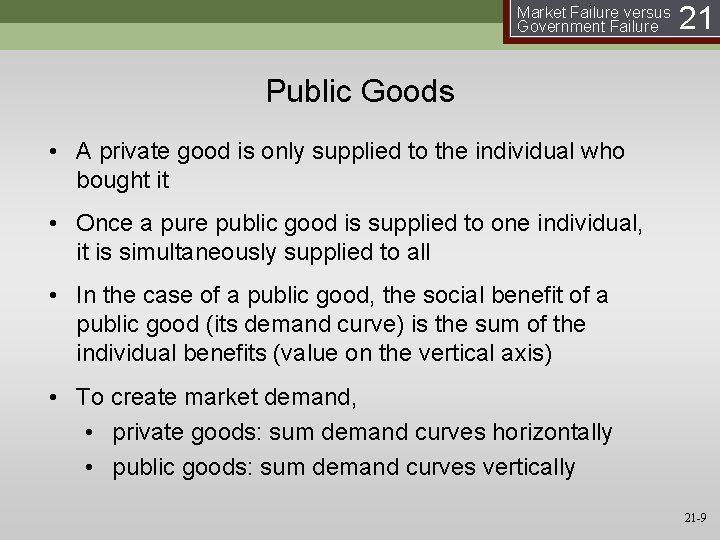
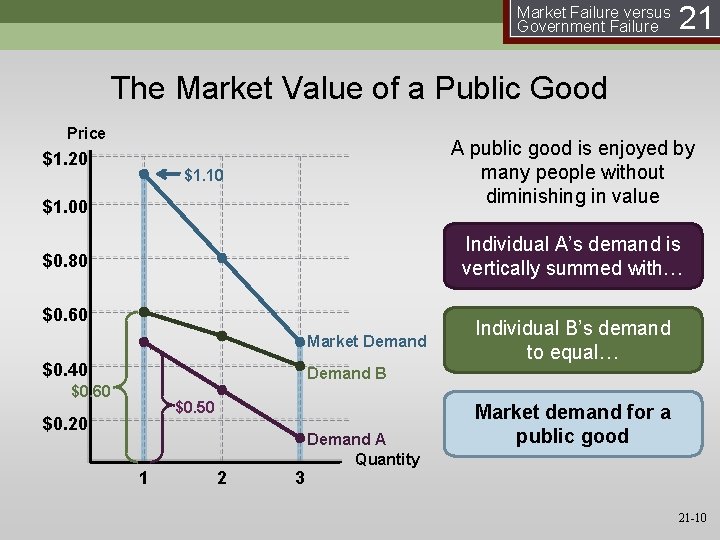
Market Failure versus Government Failure 21 Public Goods • A private good is only supplied to the individual who bought it • Once a pure public good is supplied to one individual, it is simultaneously supplied to all • In the case of a public good, the social benefit of a public good (its demand curve) is the sum of the individual benefits (value on the vertical axis) • To create market demand, • private goods: sum demand curves horizontally • public goods: sum demand curves vertically 21 -9
Market Failure versus Government Failure 21 The Market Value of a Public Good Price $1. 20 A public good is enjoyed by many people without diminishing in value $1. 10 $1. 00 Individual A’s demand is vertically summed with… $0. 80 $0. 60 Market Demand $0. 40 Individual B’s demand to equal… Demand B $0. 60 $0. 50 $0. 20 1 2 3 Demand A Quantity Market demand for a public good 21 -10
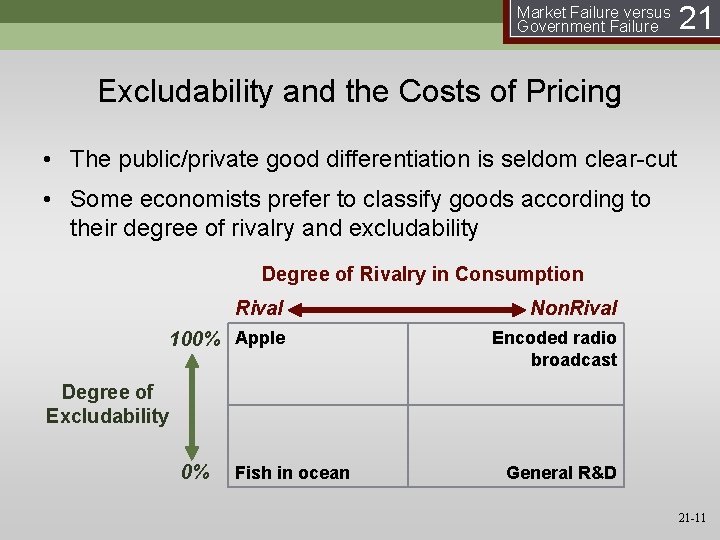
Market Failure versus Government Failure 21 Excludability and the Costs of Pricing • The public/private good differentiation is seldom clear-cut • Some economists prefer to classify goods according to their degree of rivalry and excludability Degree of Rivalry in Consumption Rival Non. Rival 100% Apple Encoded radio broadcast Degree of Excludability 0% Fish in ocean General R&D 21 -11
Market Failure versus Government Failure 21 Informational Problems • Signaling may offset information problems • Signaling refers to an action taken by an informed party that reveals information to an uninformed party that offsets the false signal that caused the adverse selection in the first place • Selling a used car may provide a false signal to the buyer that the car is a lemon • The false signal can be offset by a warranty 21 -12
Market Failure versus Government Failure 21 Government Failures and Market Failures • All real-world markets in some way fail • Market failures should not automatically call for government intervention because governments fail, too • Government failure occurs when the government intervention in the market to improve the market failure actually makes the situation worse 21 -13
Market Failure versus Government Failure 21 Reasons for Government Failures 1. Government doesn’t have an incentive to correct the problem 2. Government doesn’t have enough information to deal with the problem 3. Intervention in markets is almost always more complicated than it initially seems 4. The bureaucratic nature of government intervention does not allow fine-tuning 5. Government intervention leads to more government intervention 21 -14