
Market Failure Market Failure is the presence of


- Slides: 21
Market Failure
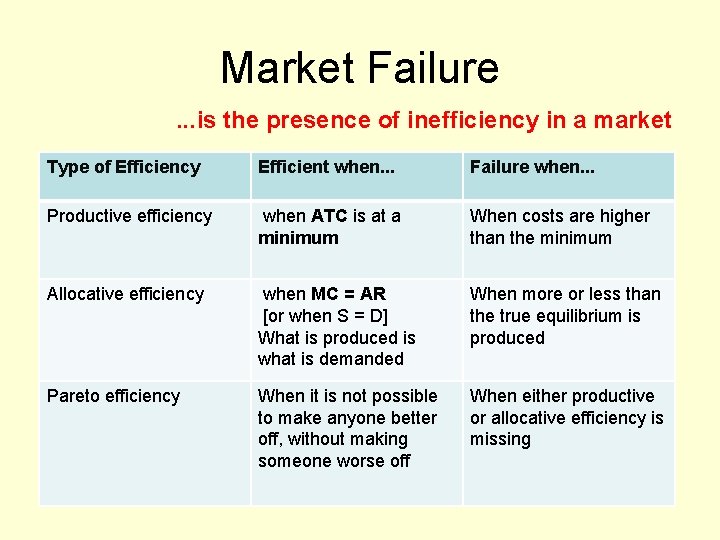
Market Failure. . . is the presence of inefficiency in a market Type of Efficiency Efficient when. . . Failure when. . . Productive efficiency when ATC is at a minimum When costs are higher than the minimum Allocative efficiency when MC = AR [or when S = D] What is produced is what is demanded When more or less than the true equilibrium is produced Pareto efficiency When it is not possible to make anyone better off, without making someone worse off When either productive or allocative efficiency is missing
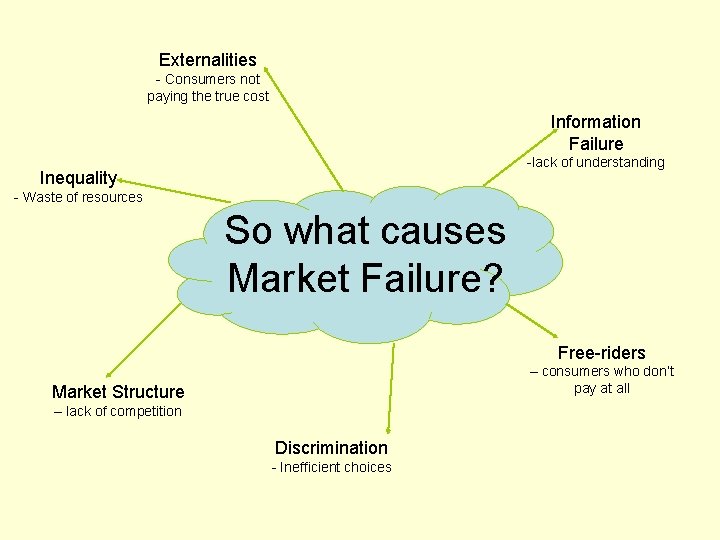
Externalities - Consumers not paying the true cost Information Failure -lack of understanding Inequality - Waste of resources So what causes Market Failure? Free-riders – consumers who don’t pay at all Market Structure – lack of competition Discrimination - Inefficient choices
Positive and Negative Externalities
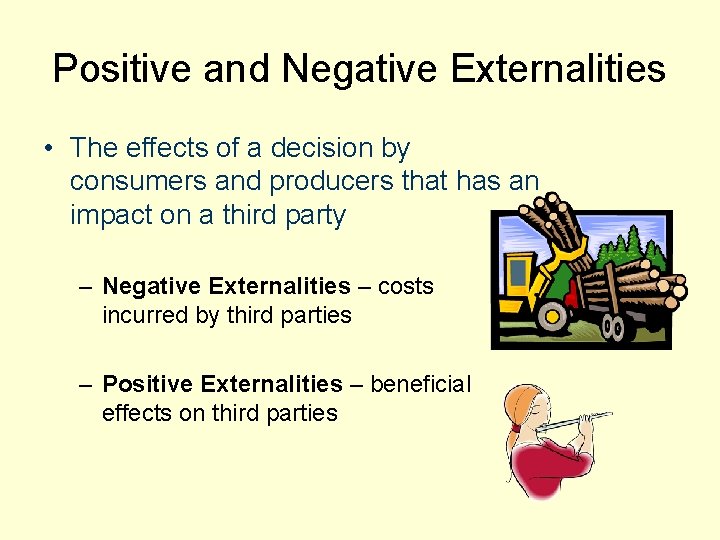
Positive and Negative Externalities • The effects of a decision by consumers and producers that has an impact on a third party – Negative Externalities – costs incurred by third parties – Positive Externalities – beneficial effects on third parties
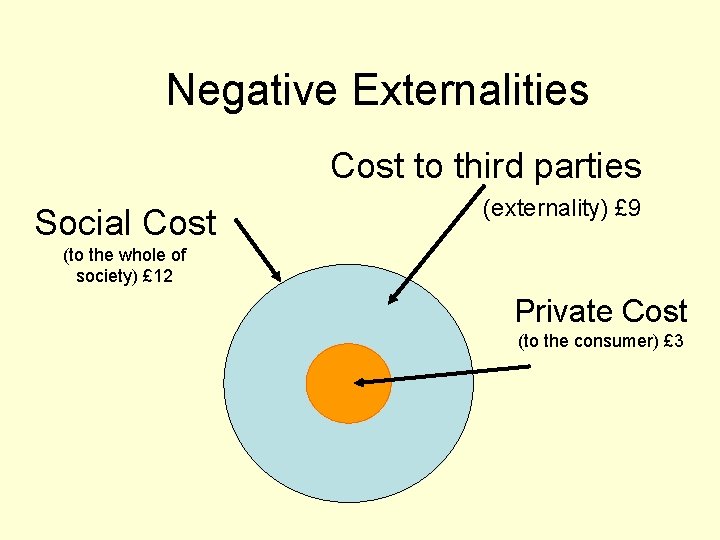
Negative Externalities Cost to third parties Social Cost (externality) £ 9 (to the whole of society) £ 12 Private Cost (to the consumer) £ 3
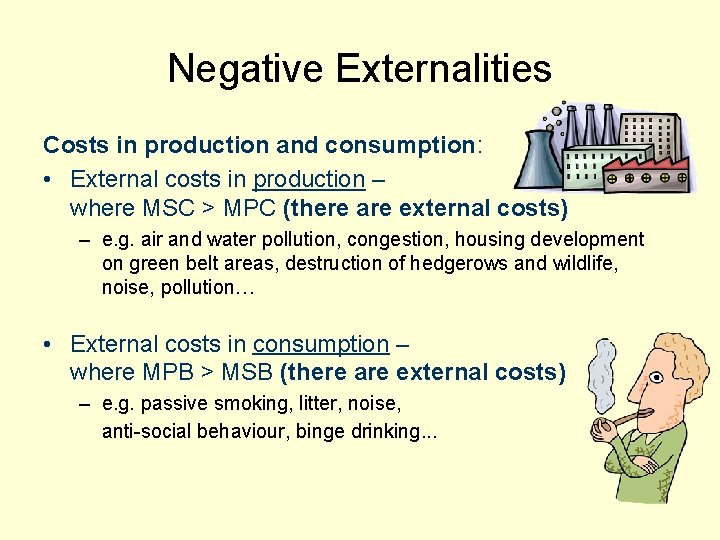
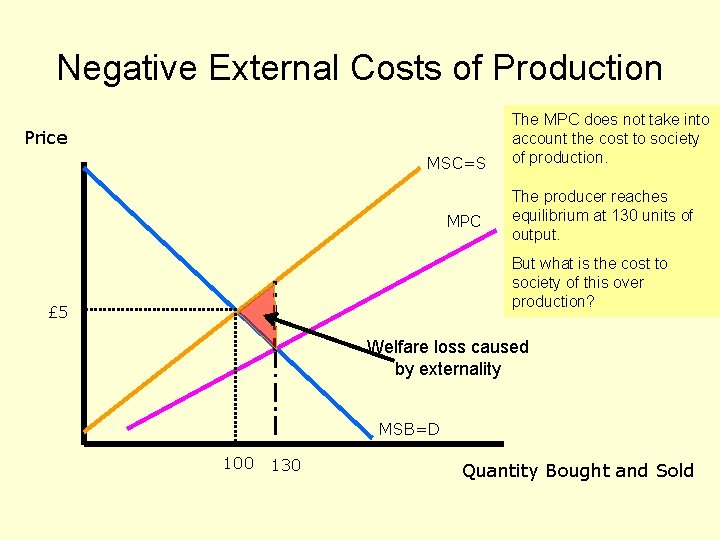
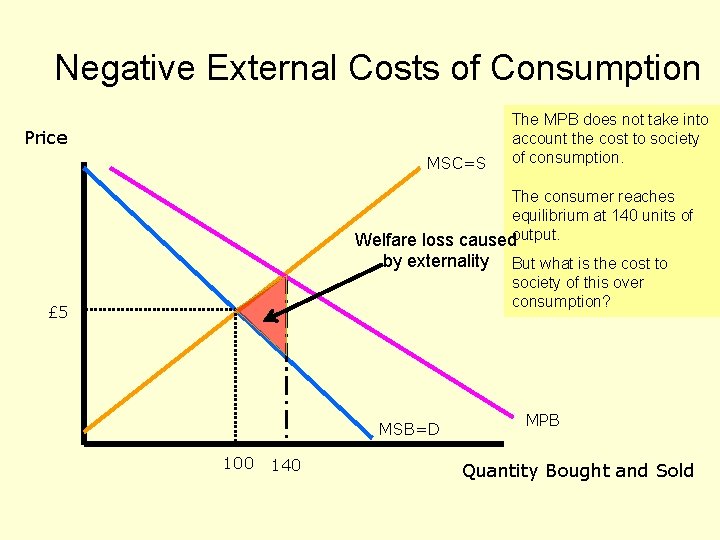
Negative Externalities Costs in production and consumption: • External costs in production – where MSC > MPC (there are external costs) – e. g. air and water pollution, congestion, housing development on green belt areas, destruction of hedgerows and wildlife, noise, pollution… • External costs in consumption – where MPB > MSB (there are external costs) – e. g. passive smoking, litter, noise, anti-social behaviour, binge drinking. . .
If there are externalities present. . . the market is inefficient
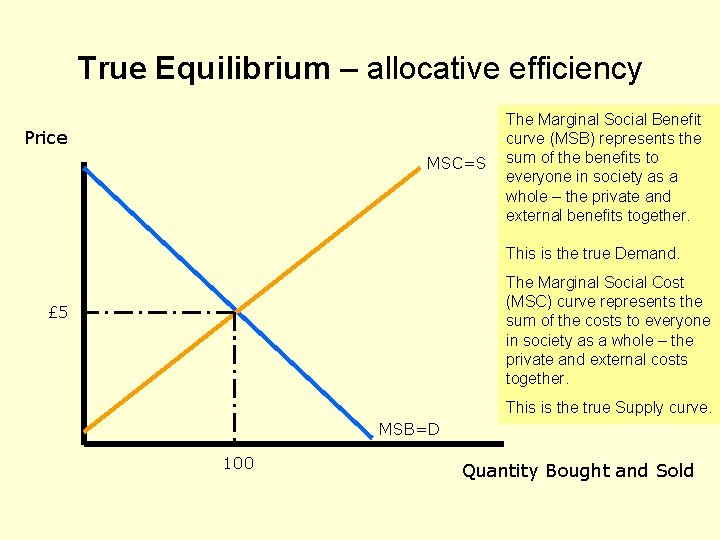
Why are externalities inefficient? • Negative Externalities– socially efficient output should be less than current output. So true allocative equilibrium in not achieved. . too much is produced. • Allocative Efficiency is only achieved where MSC = MSB [true supply = true demand]
True Equilibrium – allocative efficiency Price MSC=S The Marginal Social Benefit curve (MSB) represents the sum of the benefits to everyone in society as a whole – the private and external benefits together. This is the true Demand. The Marginal Social Cost (MSC) curve represents the sum of the costs to everyone in society as a whole – the private and external costs together. £ 5 This is the true Supply curve. MSB=D 100 Quantity Bought and Sold
Negative External Costs of Production Price MSC=S MPC The MPC does not take into account the cost to society of production. The producer reaches equilibrium at 130 units of output. But what is the cost to society of this over production? £ 5 Welfare loss caused by externality MSB=D 100 130 Quantity Bought and Sold
Negative External Costs of Consumption Price MSC=S The MPB does not take into account the cost to society of consumption. The consumer reaches equilibrium at 140 units of Welfare loss causedoutput. by externality But what is the cost to society of this over consumption? £ 5 MSB=D 100 140 MPB Quantity Bought and Sold
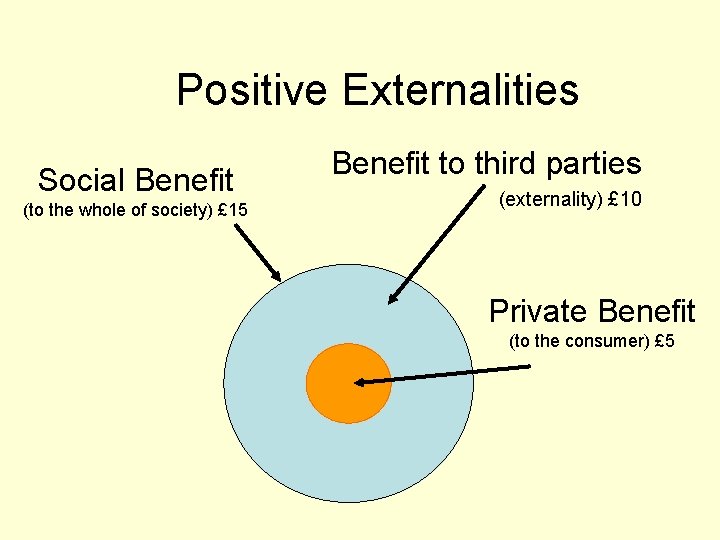
Positive Externalities Social Benefit (to the whole of society) £ 15 Benefit to third parties (externality) £ 10 Private Benefit (to the consumer) £ 5
Positive Externalities Benefits in production and consumption: • External benefit in production – where MPC > MSC (there are external benefits) – e. g. human resource development, research and development in industry, pleasant looking buildings, clean water… • External benefits in consumption – where MSB > MPB (there are external benefits) e. g. preventative health care – vaccinations, public transport, attractive private gardens, bathing regularly, pretty balloons in the sky. . .
If there are externalities present. . . the market is inefficient
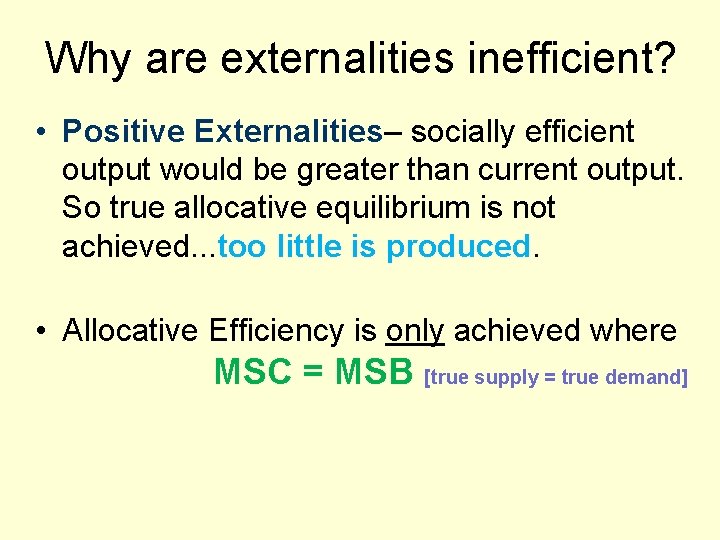
Why are externalities inefficient? • Positive Externalities– socially efficient output would be greater than current output. So true allocative equilibrium is not achieved. . . too little is produced. • Allocative Efficiency is only achieved where MSC = MSB [true supply = true demand]
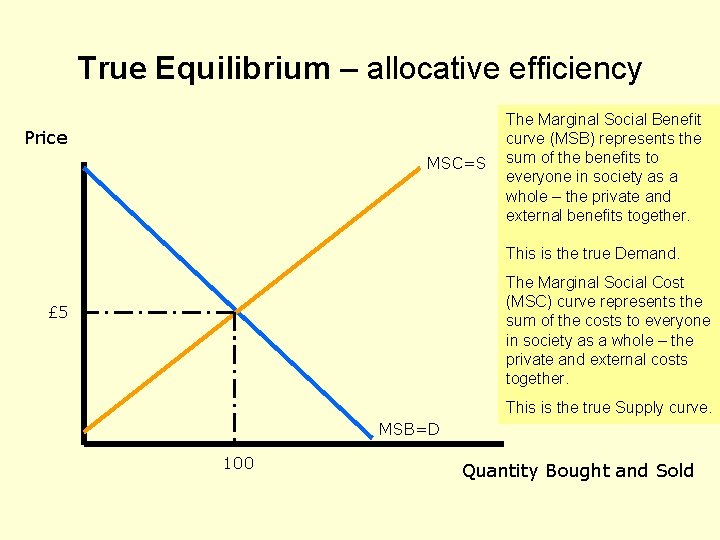
True Equilibrium – allocative efficiency Price MSC=S The Marginal Social Benefit curve (MSB) represents the sum of the benefits to everyone in society as a whole – the private and external benefits together. This is the true Demand. The Marginal Social Cost (MSC) curve represents the sum of the costs to everyone in society as a whole – the private and external costs together. £ 5 This is the true Supply curve. MSB=D 100 Quantity Bought and Sold
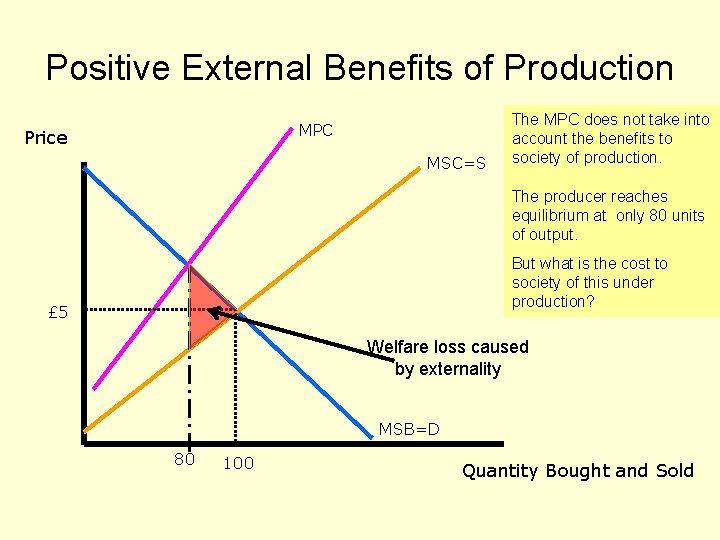
Positive External Benefits of Production MPC Price MSC=S The MPC does not take into account the benefits to society of production. The producer reaches equilibrium at only 80 units of output. But what is the cost to society of this under production? £ 5 Welfare loss caused by externality MSB=D 80 100 Quantity Bought and Sold
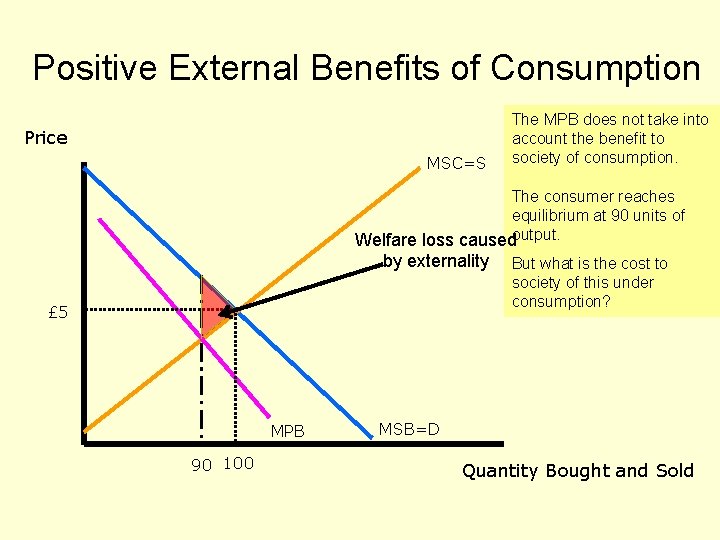
Positive External Benefits of Consumption Price MSC=S The MPB does not take into account the benefit to society of consumption. The consumer reaches equilibrium at 90 units of Welfare loss causedoutput. by externality But what is the cost to society of this under consumption? £ 5 MPB 90 100 MSB=D Quantity Bought and Sold
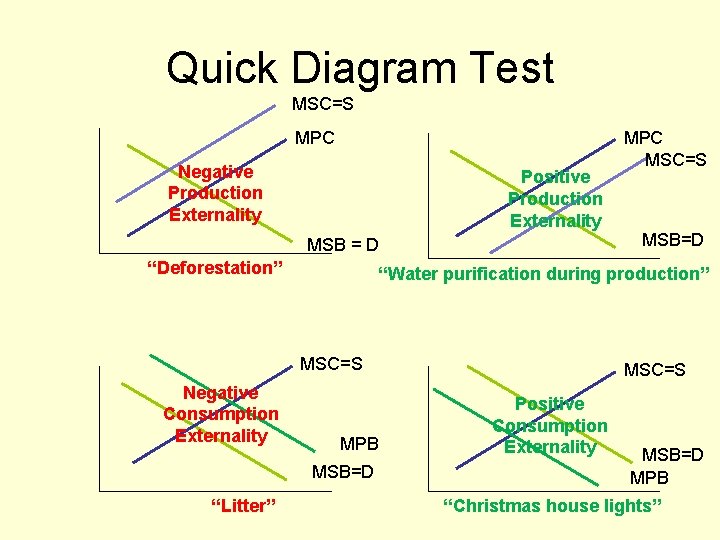
Quick Diagram Test MSC=S MPC Negative Production Externality Positive Production Externality MSB = D “Deforestation” MPB MSB=D “Litter” MSB=D “Water purification during production” MSC=S Negative Consumption Externality MPC MSC=S Positive Consumption Externality MSB=D MPB “Christmas house lights”
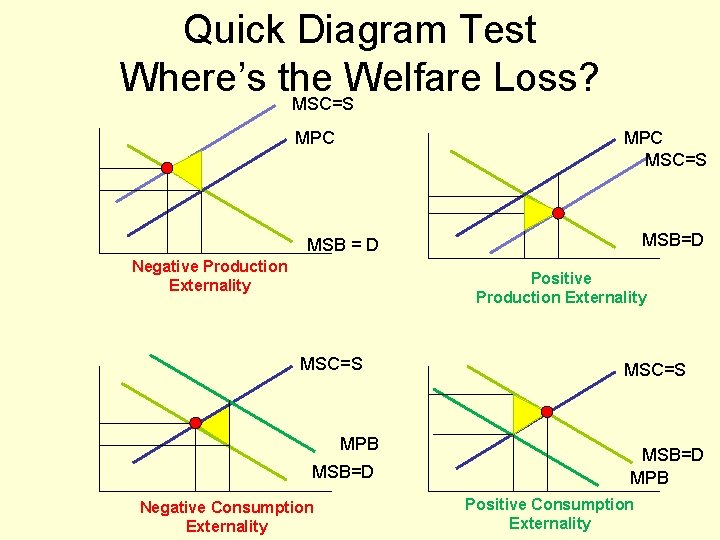
Quick Diagram Test Where’s the Welfare Loss? MSC=S MPC MSC=S MSB=D MSB = D Negative Production Externality Positive Production Externality MSC=S MPB MSB=D Negative Consumption Externality MSC=S MSB=D MPB Positive Consumption Externality