
Market Equilibrium SSMI 2 d Illustrate on a
Market Equilibrium SSMI 2 d – Illustrate on a graph how supply and demand determine equilibrium price and quantity. 1
Market Equilibrium 1. Dictionary definition - a situation in which various forces are in balance. 2. This also describes market equilibrium
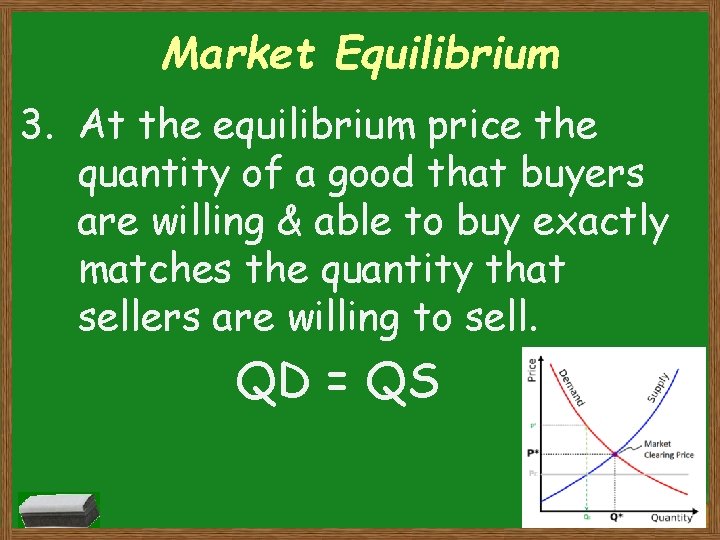
Market Equilibrium 3. At the equilibrium price the quantity of a good that buyers are willing & able to buy exactly matches the quantity that sellers are willing to sell. QD = QS
Market Equilibrium 4. Sometimes called the “market clearing price” – B/c at this price the demand for everyone in the market has been satisfied 5. Actions of buyers & sellers naturally move markets toward the equilibrium of supply & demand.
Supply and Demand Together • On the next 2 slides you will find an example of how supply and demand together determine the market price. • Copy everything you see on the second slide in your notes. 5
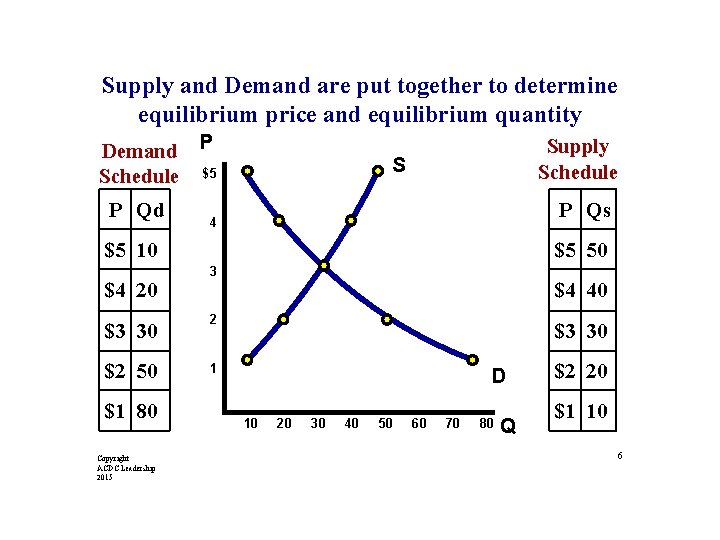
Supply and Demand are put together to determine equilibrium price and equilibrium quantity Demand P Schedule $5 P Qd Supply Schedule S P Qs 4 $5 10 $5 50 3 $4 20 $3 30 $2 50 $1 80 Copyright ACDC Leadership 2015 $4 40 2 $3 30 1 D 10 20 30 40 50 60 70 80 Q $2 20 $1 10 6
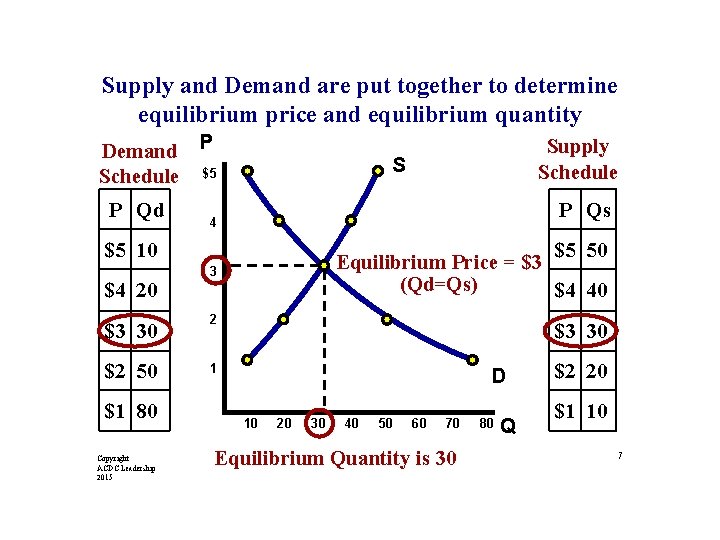
Supply and Demand are put together to determine equilibrium price and equilibrium quantity Demand P Schedule $5 P Qd S P Qs 4 $5 10 $5 50 Equilibrium Price = $3 (Qd=Qs) $4 40 3 $4 20 $3 30 $2 50 $1 80 Copyright ACDC Leadership 2015 Supply Schedule 2 $3 30 1 D 10 20 30 40 50 60 70 Equilibrium Quantity is 30 80 Q $2 20 $1 10 7
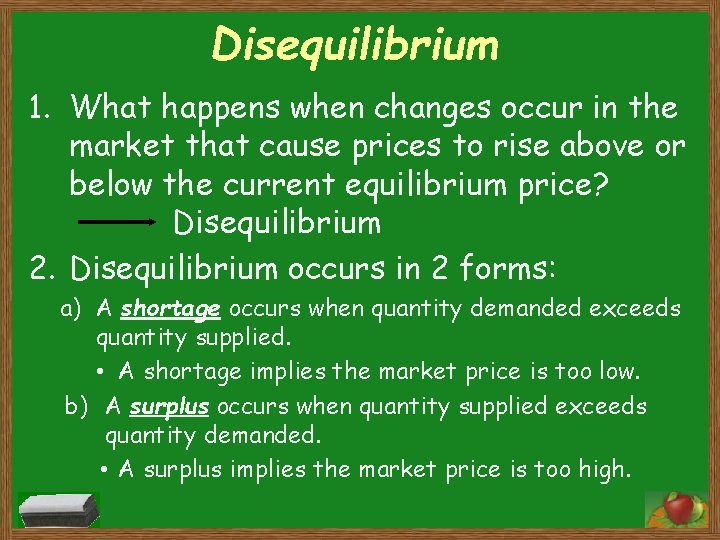
Disequilibrium 1. What happens when changes occur in the market that cause prices to rise above or below the current equilibrium price? Disequilibrium 2. Disequilibrium occurs in 2 forms: a) A shortage occurs when quantity demanded exceeds quantity supplied. • A shortage implies the market price is too low. b) A surplus occurs when quantity supplied exceeds quantity demanded. • A surplus implies the market price is too high.
Disequilibrium • On the next series of slides you will find examples of graphs that show disequilibrium. • In your notes create 2 graphs – one showing a shortage and one showing a surplus. 9

Supply and Demand are put together to determine equilibrium price and equilibrium quantity. Suppose the price goes up to $4. Demand P Schedule $5 P Qd Supply Schedule S P Qs 4 $5 10 $5 50 3 $4 20 $3 30 $2 50 $1 80 Copyright ACDC Leadership 2015 $4 40 2 $3 30 1 D 10 20 30 40 50 60 70 80 Q $2 20 $1 10 10
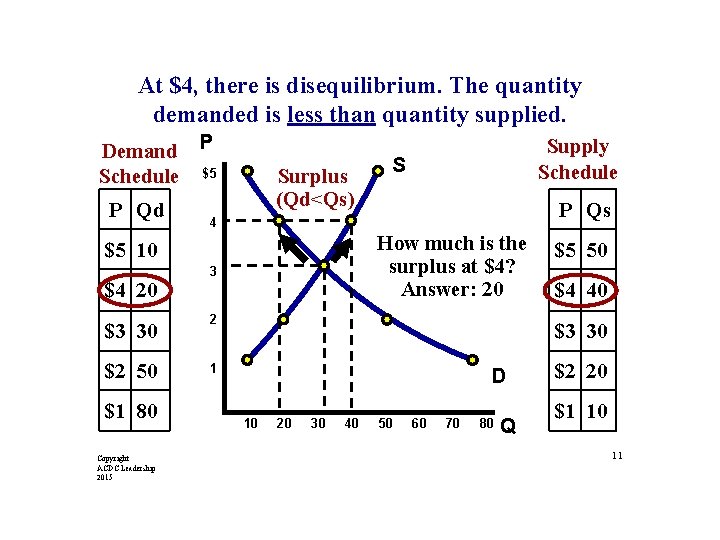
At $4, there is disequilibrium. The quantity demanded is less than quantity supplied. Demand P Schedule $5 P Qd Surplus (Qd<Qs) $4 20 $1 80 Copyright ACDC Leadership 2015 P Qs How much is the surplus at $4? Answer: 20 3 $2 50 S 4 $5 10 $3 30 Supply Schedule 2 $5 50 $4 40 $3 30 1 D 10 20 30 40 50 60 70 80 Q $2 20 $1 10 11
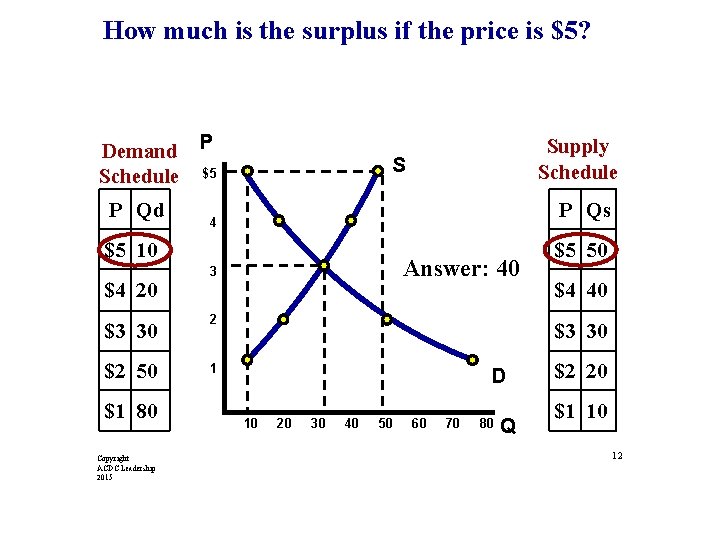
How much is the surplus if the price is $5? Demand P Schedule $5 P Qd S P Qs 4 $5 10 Answer: 40 3 $4 20 $3 30 $2 50 $1 80 Copyright ACDC Leadership 2015 Supply Schedule 2 $5 50 $4 40 $3 30 1 D 10 20 30 40 50 60 70 80 Q $2 20 $1 10 12
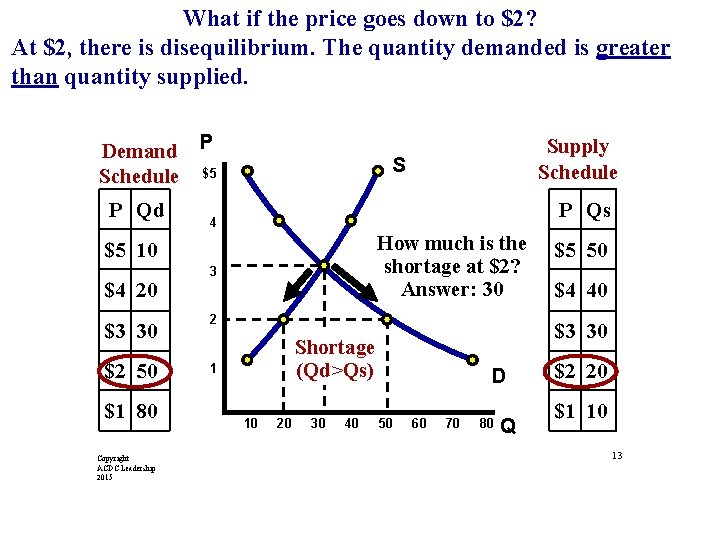
What if the price goes down to $2? At $2, there is disequilibrium. The quantity demanded is greater than quantity supplied. Demand P Schedule $5 P Qd S P Qs 4 How much is the shortage at $2? Answer: 30 $5 10 3 $4 20 $3 30 $2 50 $1 80 Copyright ACDC Leadership 2015 Supply Schedule 2 10 20 30 40 $4 40 $3 30 Shortage (Qd>Qs) 1 $5 50 D 50 60 70 80 Q $2 20 $1 10 13
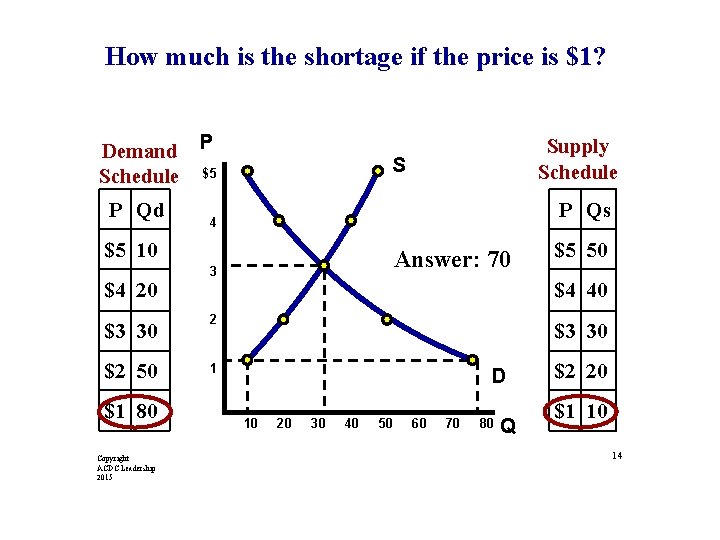
How much is the shortage if the price is $1? Demand P Schedule $5 P Qd Supply Schedule S P Qs 4 $5 10 Answer: 70 3 $4 20 $3 30 $2 50 $1 80 Copyright ACDC Leadership 2015 $5 50 $4 40 2 $3 30 1 D 10 20 30 40 50 60 70 80 Q $2 20 $1 10 14
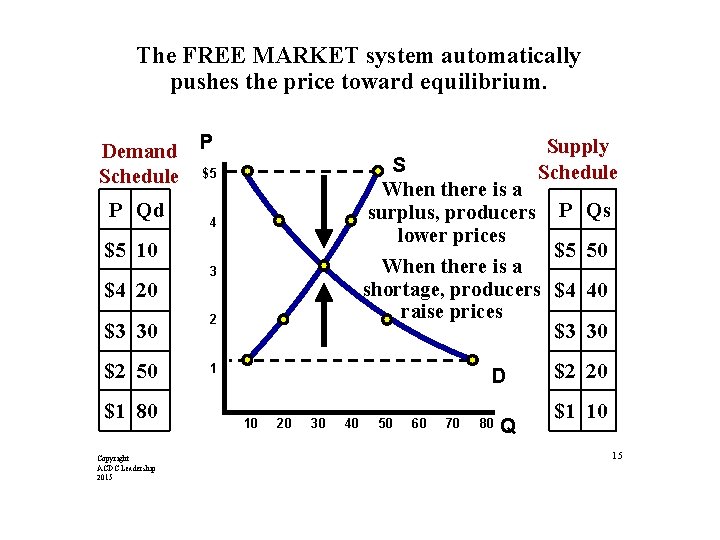
The FREE MARKET system automatically pushes the price toward equilibrium. Demand P Schedule $5 P Qd Supply Schedule S When there is a surplus, producers P Qs lower prices $5 50 When there is a shortage, producers $4 40 raise prices $3 30 4 $5 10 3 $4 20 $3 30 $2 50 $1 80 Copyright ACDC Leadership 2015 2 1 D 10 20 30 40 50 60 70 80 Q $2 20 $1 10 15
Price Controls SSMI 2 g – Explain and illustrate on a graph how prices set too high (e. g. , price floors) create surpluses, and prices set too low (e. g. , price ceilings) create shortages 1
System Overrides 1. The price adjustment process is not the only way that a shortage or surplus is created in the market 2. The government may place restrictions on certain goods or services that force those items’ prices to NEVER reach equilibrium! *Remember: Governments are involved in mixed market economies to promote fairness and equity – sometimes that requires adjusting prices! 17
Price Controls – 2 Types 1. Price Ceiling- the maximum you can legally charge for a product. a) It is always below the market equilibrium price. b) Problem – It causes shortages for the product. Examples - Rent control Credit card interest rates
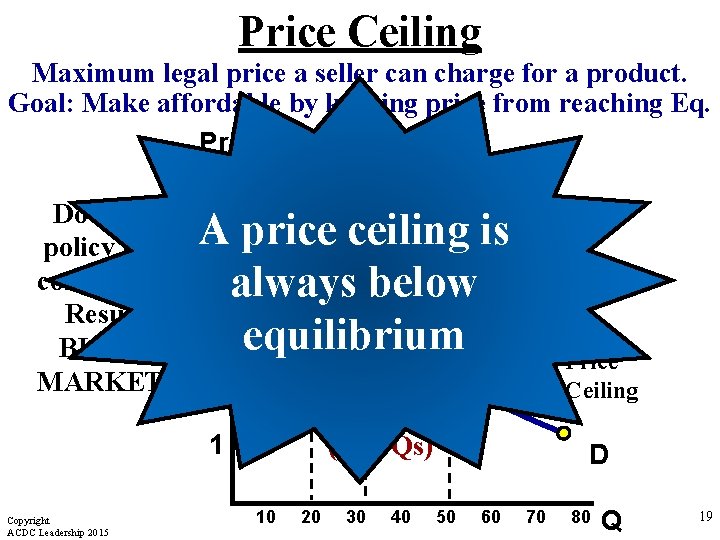
Price Ceiling Maximum legal price a seller can charge for a product. Goal: Make affordable by keeping price from reaching Eq. Price Gasoline S $8 Does this A price ceiling is 6 policy help consumers? always below 4 Result: equilibrium BLACK Price MARKETS 2 Ceiling Shortage 1 (Qd>Qs) D Copyright ACDC Leadership 2015 10 20 30 40 50 60 70 80 Q 19
Price Controls – 2 Types 2. Price Floor- the minimum price set for a good by the government. a) This is always higher than the market equilibrium price. b) Problem – buyers don’t buy at the new price, while suppliers are willing to supply more at the new price. Result ? A surplus Example - Minimum Wage
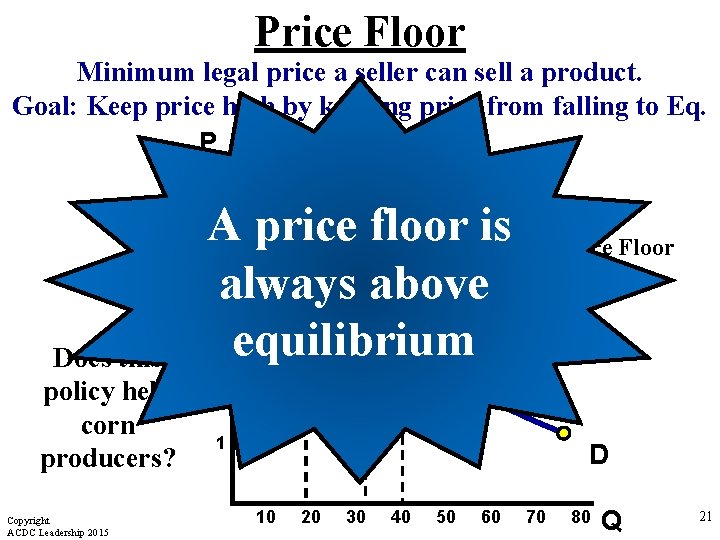
Price Floor Minimum legal price a seller can sell a product. Goal: Keep price high by keeping price from falling to Eq. P Corn S $ Surplus (Qd<Qs) A price floor is always above equilibrium Price Floor 4 3 Does this policy help corn producers? Copyright ACDC Leadership 2015 2 1 D 10 20 30 40 50 60 70 80 Q 21
Impact of Prices on a Market 1. Prices are Signals- communicates to both buyers and sellers whether goods or services are scarce or easily available. 2. Prices can encourage or discourage production. 3. Signals for Suppliers- High Price = MAKE MORE (GO) Low Price = MAKE LESS (STOP)
Impact of Prices on a Market 3. Signals for Buyers- High price= DON’T BUY (STOP). Low Prices=BUY (GO) 4. Flexibility- Prices can be easily increased or decreased to solve problems of excess supply or excess demand.
- Slides: 23