
MARKET ENTRY STRATEGIES Chapter 10 STRATEGIC PLANNING FOR


- Slides: 15
MARKET ENTRY STRATEGIES Chapter 10
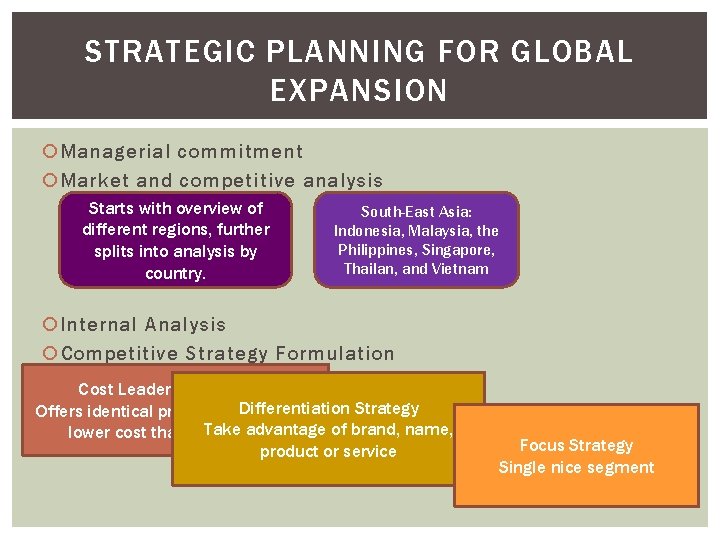
STRATEGIC PLANNING FOR GLOBAL EXPANSION Managerial commitment Market and competitive analysis Starts with overview of different regions, further splits into analysis by country. South-East Asia: Indonesia, Malaysia, the Philippines, Singapore, Thailan, and Vietnam Internal Analysis Competitive Strategy Formulation Cost Leadership Strategy Offers identical product or Differentiation service at Take advantage of brand, name, lower cost than competitors product or service Focus Strategy Single nice segment
INTERNATIONAL BUSINESS RESEARCH Research spotlights on new opportunities, exposes potential risk, vital in strategy development (identifying all requirements of market entry, penetration and expansion) Secondary and primary research
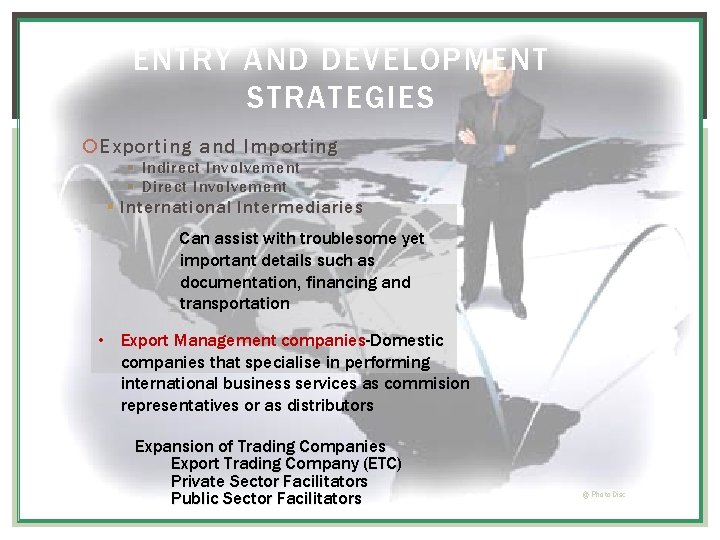
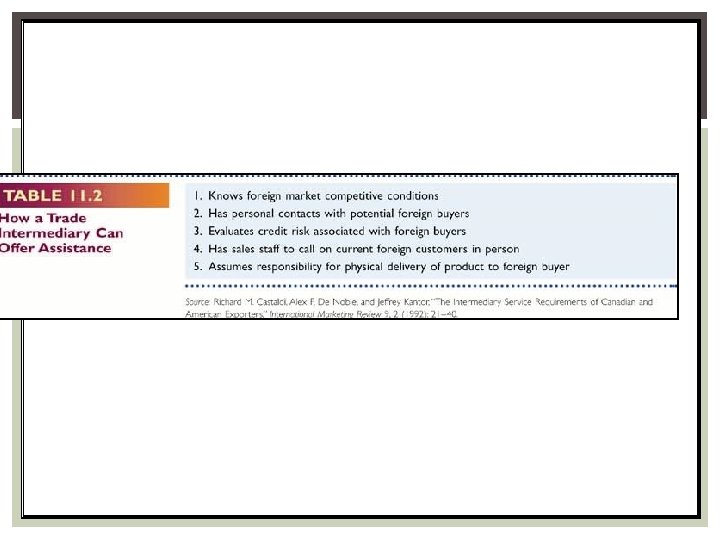
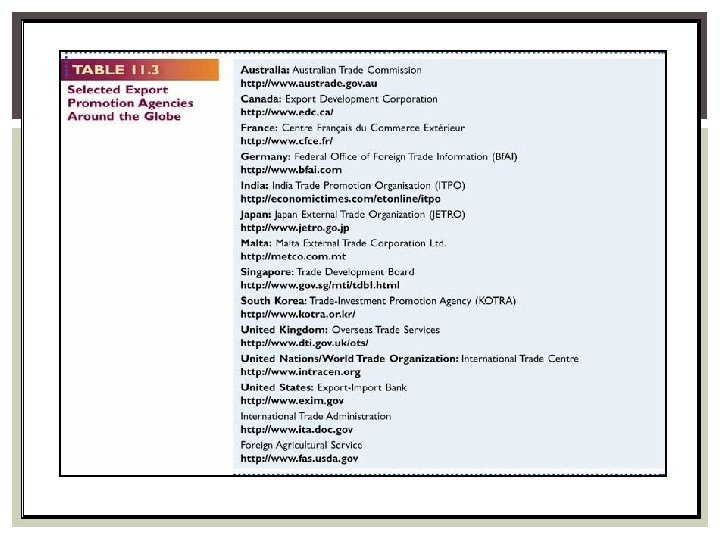
ENTRY AND DEVELOPMENT STRATEGIES Exporting and Importing § Indirect Involvement § Direct Involvement § International Intermediaries Can assist with troublesome yet important details such as documentation, financing and transportation • Export Management companies-Domestic companies that specialise in performing international business services as commision representatives or as distributors Expansion of Trading Companies Export Trading Company (ETC) Private Sector Facilitators Public Sector Facilitators © Photo. Disc
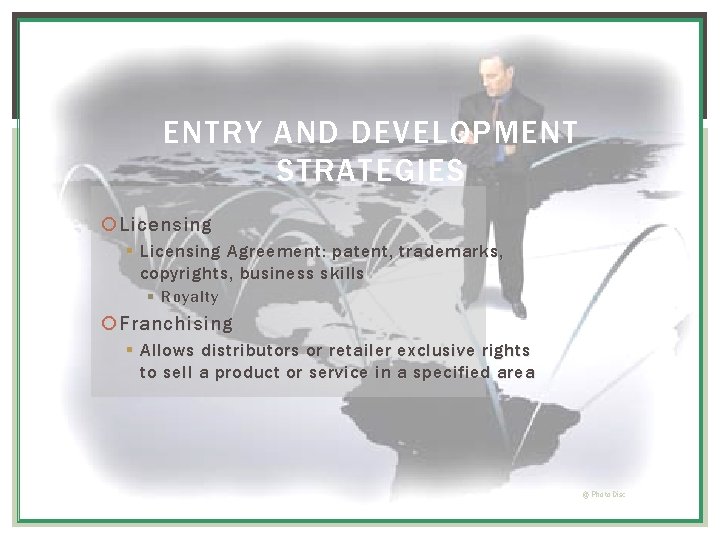
ENTRY AND DEVELOPMENT STRATEGIES Licensing § Licensing Agreement : patent, trademarks, copyrights, business skills § Royalty Franchising § Allows distributors or retailer exclusive rights to sell a product or service in a specified area © Photo. Disc
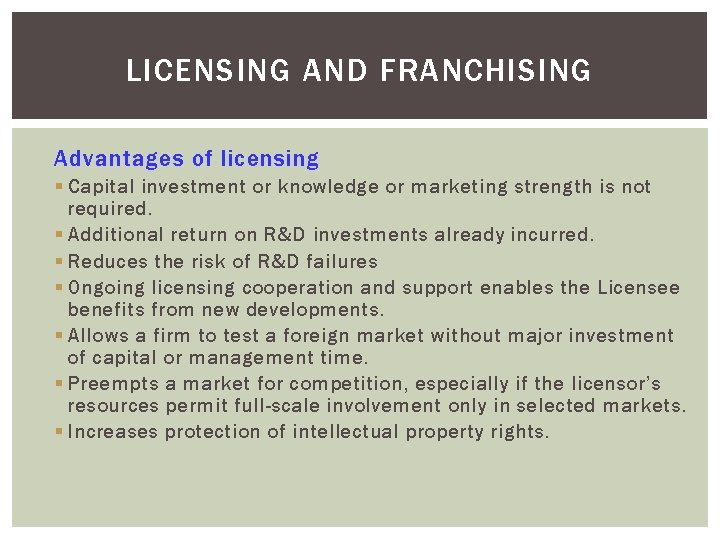
LICENSING AND FRANCHISING Advantages of licensing § Capital investment or knowledge or marketing strength is not required. § Additional return on R&D investments already incurred. § Reduces the risk of R&D failures § Ongoing licensing cooperation and support enables the Licensee benefits from new developments. § Allows a firm to test a foreign market without major investment of capital or management time. § Preempts a market for competition, especially if the licensor’s resources permit full-scale involvement only in selected markets. § Increases protection of intellectual property rights.
LICENSING AND FRANCHISING § Disadvantages of licensing § Licensor gets limited expertise. § Licensor creates its own competitor. § Allows multinational corporations (MNCs) to capitalize on older technology.
FOREIGN DIRECT INVESTMENT Types of ownership - Joint ventures § Collaborations of two or more organizations for more than a transitory period. § Partners share assets, risks, and profits in proportion to ownership. § Governmental and commercial reasons for joint ventures
FOREIGN DIRECT INVESTMENT Advantages of joint ventures § Pooling of resources. § Better relationships with local organizations. § The partner’s knowledge of the local market. § Minimize exposure to political risk. § Tap local capital markets. Disadvantages of joint ventures § Different levels of control are required. § Difficulty in maintaining the relationship. § Disagreements over business decisions. § Disagreements over profit accumulation and distribution (profit repatriation).
FOREIGN DIRECT INVESTMENT Firms are categorized as: § Resource seekers - Search for natural and human resources. § Market seekers - Search for better opportunities to enter and expand within markets. § Efficiency seekers - Attempt to obtain the most economic sources of production.
FOREIGN DIRECT INVESTORS § Bring in capital, economic activity, and employment. § Transfer technology and managerial skills. § Encourage competition, market choice, and competitiveness. But, they: § Drain resources from host countries. § Starve smaller capital markets. § Discourage local technology development. § Bring in outmoded technology. § Create new competition for local firms.
IN CLASS DISCUSSION Based on the information given on web site www. bestfoods. com, what benefits does a company derive from having a global presence? How is the acquisition by Unilever likely to affect the company’s future?