
Market Design and the Evolution of the Combinatorial
Market Design and the Evolution of the Combinatorial Clock Auction Lawrence M. Ausubel, University of Maryland Oleg V. Baranov, University of Colorado 5 January 2014
Combinatorial Clock Auction (current generation) • Has been used for digital dividend auctions of spectrum in Australia, Austria, Canada, Denmark , Ireland, the Netherlands, Slovakia, Switzerland the UK • Has been adopted for a second (upcoming) spectrum auction in Canada • In the past few years, CCAs have been used for more major spectrum auctions worldwide than any other auction format 6/13/2021 2
Combinatorial Clock Auction (current generation) • A three-phase auction with package bidding, consisting of a clock auction phase, followed by a supplementary round, and concluding with an assignment round • Clock auction phase: Auctioneer announces prices and bidders respond with quantities; bidders are constrained by eligibility points and/or a WARP-based activity rule • Supplementary round: Bidders can supplement their bids from the clock rounds with additional package bids, constrained by a WARP-based activity rule • Assignment stage: generic spectrum mapped to frequencies • Allocation and pricing are given by a core-selecting mechanism 6/13/2021 3
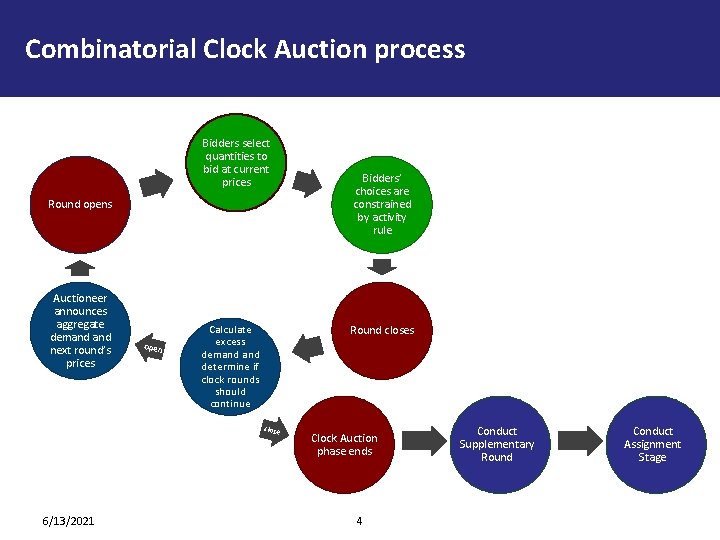
Combinatorial Clock Auction process Bidders select quantities to bid at current prices Round opens Auctioneer announces aggregate demand next round’s prices open Calculate excess demand determine if clock rounds should continue Round closes close 6/13/2021 Bidders’ choices are constrained by activity rule Clock Auction phase ends 4 Conduct Supplementary Round Conduct Assignment Stage
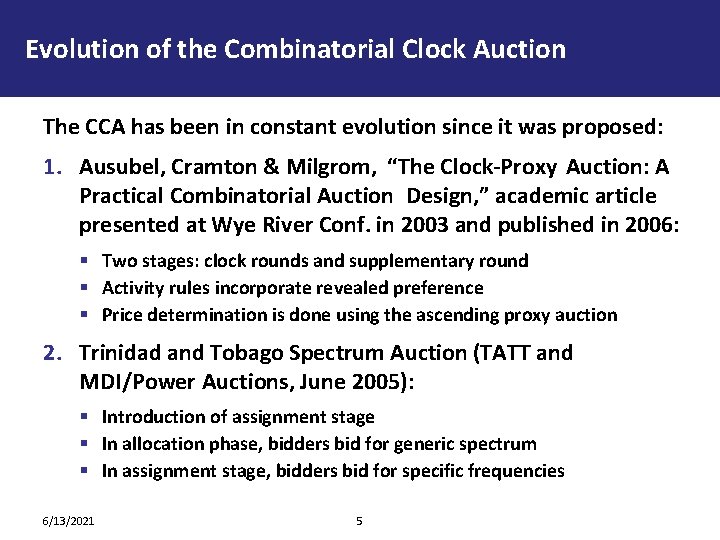
Evolution of the Combinatorial Clock Auction The CCA has been in constant evolution since it was proposed: 1. Ausubel, Cramton & Milgrom, “The Clock-Proxy Auction: A Practical Combinatorial Auction Design, ” academic article presented at Wye River Conf. in 2003 and published in 2006: § Two stages: clock rounds and supplementary round § Activity rules incorporate revealed preference § Price determination is done using the ascending proxy auction 2. Trinidad and Tobago Spectrum Auction (TATT and MDI/Power Auctions, June 2005): § Introduction of assignment stage § In allocation phase, bidders bid for generic spectrum § In assignment stage, bidders bid for specific frequencies 6/13/2021 5
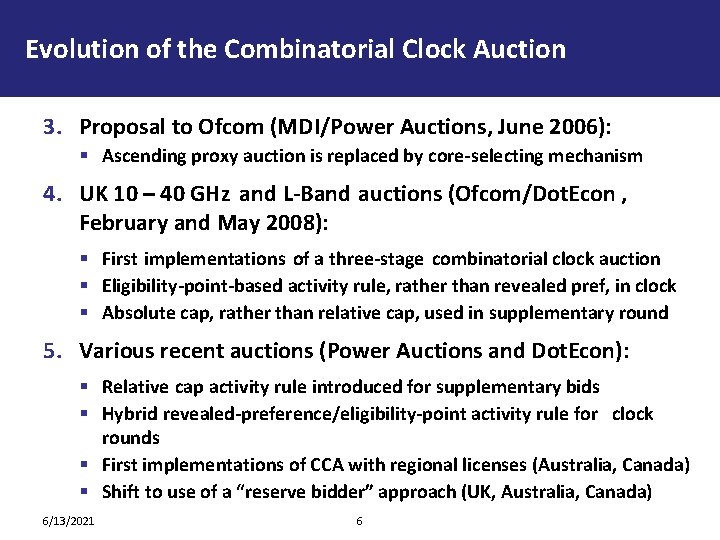
Evolution of the Combinatorial Clock Auction 3. Proposal to Ofcom (MDI/Power Auctions, June 2006): § Ascending proxy auction is replaced by core-selecting mechanism 4. UK 10 – 40 GHz and L-Band auctions (Ofcom/Dot. Econ , February and May 2008): § First implementations of a three-stage combinatorial clock auction § Eligibility-point-based activity rule, rather than revealed pref, in clock § Absolute cap, rather than relative cap, used in supplementary round 5. Various recent auctions (Power Auctions and Dot. Econ): § Relative cap activity rule introduced for supplementary bids § Hybrid revealed-preference/eligibility-point activity rule for clock rounds § First implementations of CCA with regional licenses (Australia, Canada) § Shift to use of a “reserve bidder” approach (UK, Australia, Canada) 6/13/2021 6
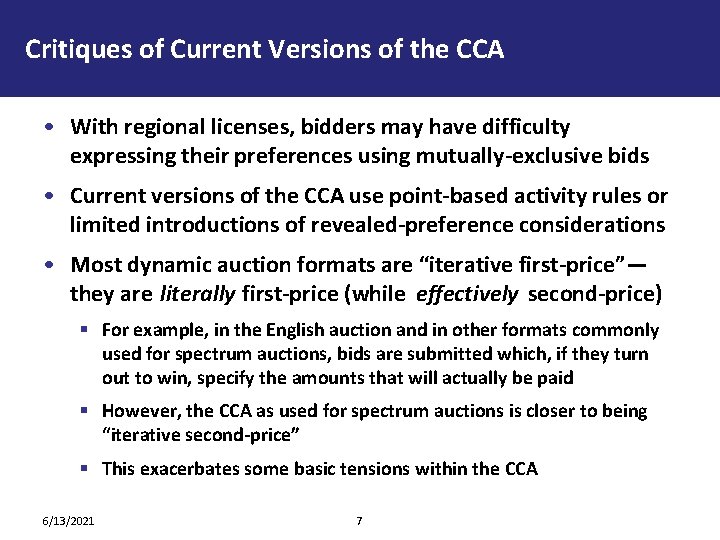
Critiques of Current Versions of the CCA • With regional licenses, bidders may have difficulty expressing their preferences using mutually-exclusive bids • Current versions of the CCA use point-based activity rules or limited introductions of revealed-preference considerations • Most dynamic auction formats are “iterative first-price”— they are literally first-price (while effectively second-price) § For example, in the English auction and in other formats commonly used for spectrum auctions, bids are submitted which, if they turn out to win, specify the amounts that will actually be paid § However, the CCA as used for spectrum auctions is closer to being “iterative second-price” § This exacerbates some basic tensions within the CCA 6/13/2021 7
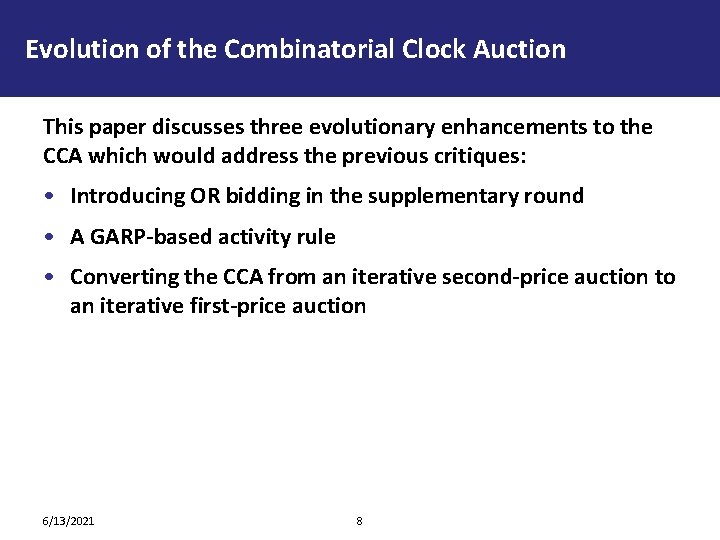
Evolution of the Combinatorial Clock Auction This paper discusses three evolutionary enhancements to the CCA which would address the previous critiques: • Introducing OR bidding in the supplementary round • A GARP-based activity rule • Converting the CCA from an iterative second-price auction to an iterative first-price auction 6/13/2021 8

Part I: OR bidding in the supplementary round
XOR versus OR bids • In the current version of the CCA, all bids by a given bidder are treated as mutually exclusive (“XOR” bids) § There is a good reason for this: otherwise, a bidder cannot express “I would like A or B, but not both” § Or, to put it differently, an XOR bidding language is fully general § However, with N regional licenses, there are 2 N possible packages § Thus, it may become difficult for a bidder to express valuations for all relevant packages § It may also contribute to the “missing bid problem” • A modest enhancement would be to permit bidders, on a voluntary basis, to include supplementary bids that may be accepted on an and/or basis (“OR” bids) 6/13/2021 10
An Example of a Collection of OR bids • Suppose that a bidder’s Final Clock Package is {A, B, C}, while the licenses D, E and F are unsold • A bidder might submit a bid for a base package of {A, B, C} together with OR bids for D, E and F • Submitting this is the same as enumerating XOR bids for: § § § {A, B, C} {A, B, C, D} {A, B, C, E} {A, B, C, F} {A, B, C, D, E}, etc. • This imposes an additive structure on bidders’ valuations, which may be a reasonable approximation on the margin 6/13/2021 11
OR bids • OR bidding languages have been used successfully in sealedbid combinatorial environments • A large number of OR bids tagged onto a base bid might cause a bidder to lose control over how much he wins, but control can be regained by adding control elements such as a size‑of‑package limit or a bid-amount limit defined by the bidder • One (perhaps the biggest) challenge with introducing OR bids into the CCA is integrating them with an effective activity rule 6/13/2021 12
Part II: Activity Rules
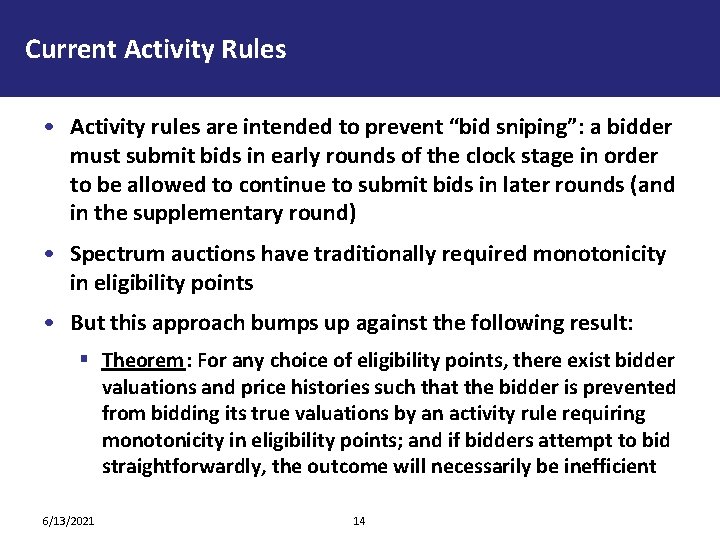
Current Activity Rules • Activity rules are intended to prevent “bid sniping”: a bidder must submit bids in early rounds of the clock stage in order to be allowed to continue to submit bids in later rounds (and in the supplementary round) • Spectrum auctions have traditionally required monotonicity in eligibility points • But this approach bumps up against the following result: § Theorem: For any choice of eligibility points, there exist bidder valuations and price histories such that the bidder is prevented from bidding its true valuations by an activity rule requiring monotonicity in eligibility points; and if bidders attempt to bid straightforwardly, the outcome will necessarily be inefficient 6/13/2021 14
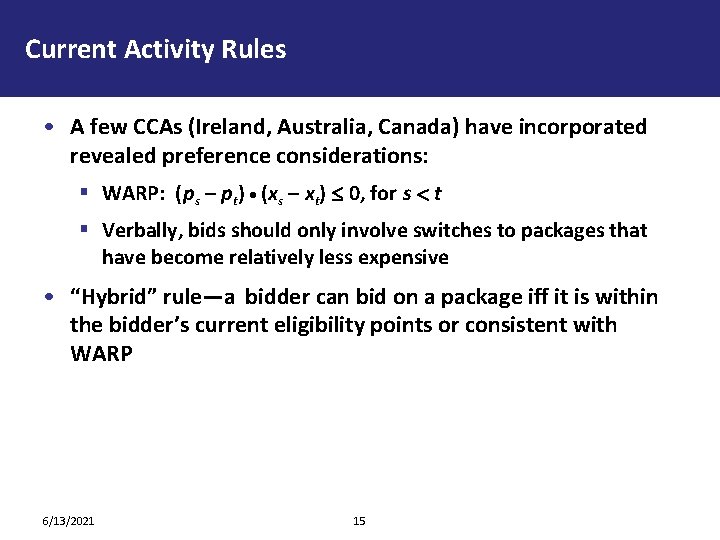
Current Activity Rules • A few CCAs (Ireland, Australia, Canada) have incorporated revealed preference considerations: § WARP: (ps – pt) (xs – xt) 0, for s t § Verbally, bids should only involve switches to packages that have become relatively less expensive • “Hybrid” rule—a bidder can bid on a package iff it is within the bidder’s current eligibility points or consistent with WARP 6/13/2021 15
Critiques of the current version of the CCA • The hybrid rule is an improvement upon using only eligibility points, but it is only a halfway measure § Only some of the revealed-preference constraints are imposed, in order to avoid “dead-ends” § This creates potential anomalies § Finally, it may be possible for a bidder to influence which revealed-preference constraints are imposed, leaving the bidder insufficiently constrained in the supplementary round 6/13/2021 16
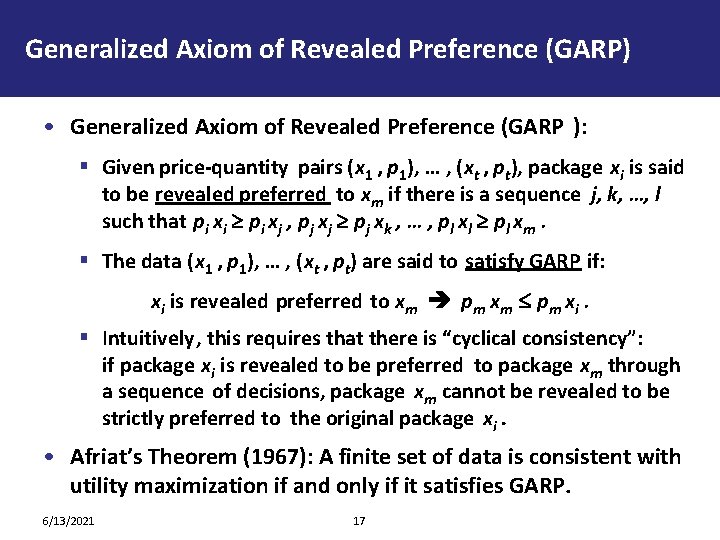
Generalized Axiom of Revealed Preference (GARP) • Generalized Axiom of Revealed Preference (GARP ): § Given price-quantity pairs (x 1 , p 1), … , (xt , pt), package xi is said to be revealed preferred to xm if there is a sequence j, k, …, l such that pi xi pi xj , p j xj pj xk , … , p l xl pl xm. § The data (x 1 , p 1), … , (xt , pt) are said to satisfy GARP if: xi is revealed preferred to xm pm xi. § Intuitively, this requires that there is “cyclical consistency”: if package xi is revealed to be preferred to package xm through a sequence of decisions, package xm cannot be revealed to be strictly preferred to the original package xi. • Afriat’s Theorem (1967): A finite set of data is consistent with utility maximization if and only if it satisfies GARP. 6/13/2021 17
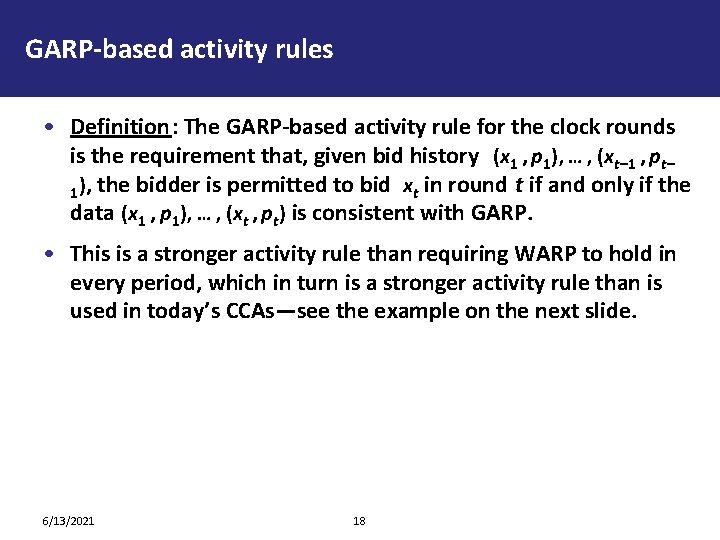
GARP-based activity rules • Definition: The GARP-based activity rule for the clock rounds is the requirement that, given bid history (x 1 , p 1), … , (xt– 1 , pt– 1), the bidder is permitted to bid xt in round t if and only if the data (x 1 , p 1), … , (xt , pt) is consistent with GARP. • This is a stronger activity rule than requiring WARP to hold in every period, which in turn is a stronger activity rule than is used in today’s CCAs—see the example on the next slide. 6/13/2021 18
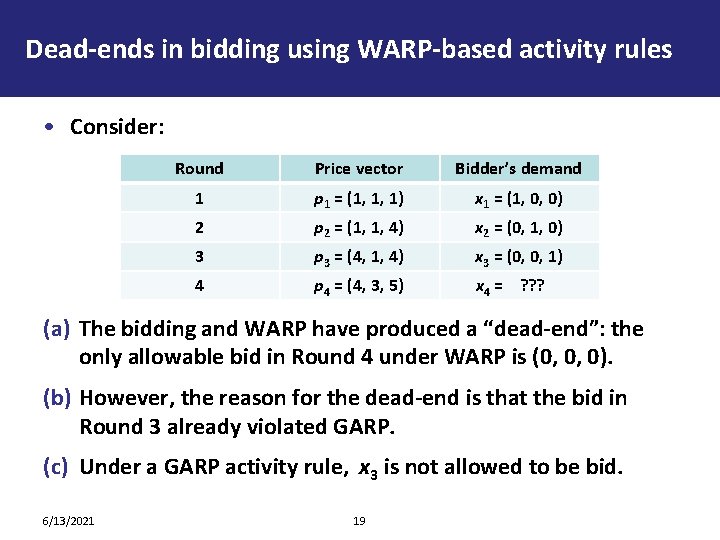
Dead-ends in bidding using WARP-based activity rules • Consider: Round Price vector Bidder’s demand 1 p 1 = (1, 1, 1) x 1 = (1, 0, 0) 2 p 2 = (1, 1, 4) x 2 = (0, 1, 0) 3 p 3 = (4, 1, 4) x 3 = (0, 0, 1) 4 p 4 = (4, 3, 5) x 4 = ? ? ? (a) The bidding and WARP have produced a “dead-end”: the only allowable bid in Round 4 under WARP is (0, 0, 0). (b) However, the reason for the dead-end is that the bid in Round 3 already violated GARP. (c) Under a GARP activity rule, x 3 is not allowed to be bid. 6/13/2021 19
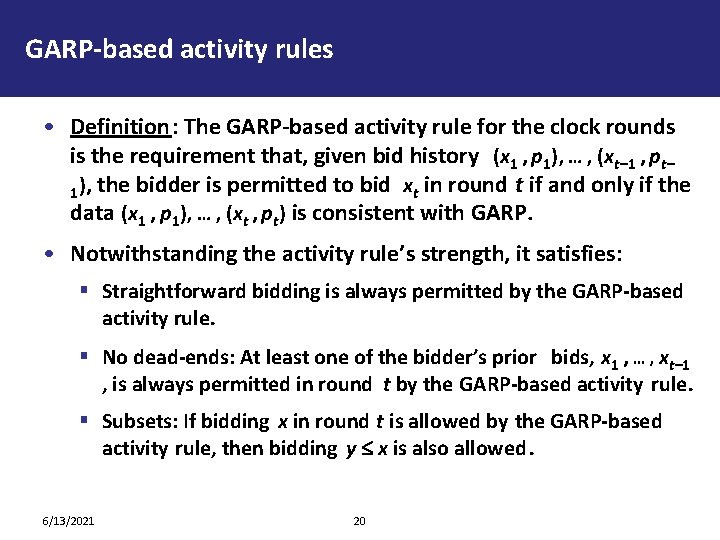
GARP-based activity rules • Definition: The GARP-based activity rule for the clock rounds is the requirement that, given bid history (x 1 , p 1), … , (xt– 1 , pt– 1), the bidder is permitted to bid xt in round t if and only if the data (x 1 , p 1), … , (xt , pt) is consistent with GARP. • Notwithstanding the activity rule’s strength, it satisfies: § Straightforward bidding is always permitted by the GARP-based activity rule. § No dead-ends: At least one of the bidder’s prior bids, x 1 , … , xt– 1 , is always permitted in round t by the GARP-based activity rule. § Subsets: If bidding x in round t is allowed by the GARP-based activity rule, then bidding y x is also allowed. 6/13/2021 20
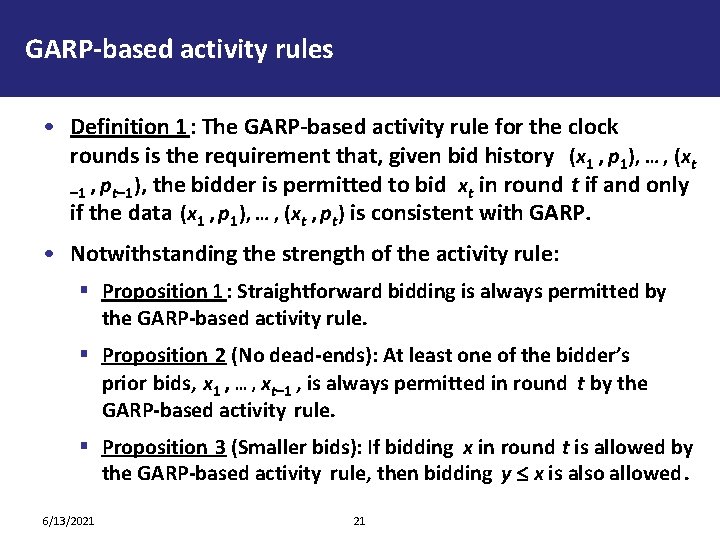
GARP-based activity rules • Definition 1 : The GARP-based activity rule for the clock rounds is the requirement that, given bid history (x 1 , p 1), … , (xt – 1 , pt– 1 ), the bidder is permitted to bid xt in round t if and only if the data (x 1 , p 1), … , (xt , pt) is consistent with GARP. • Notwithstanding the strength of the activity rule: § Proposition 1 : Straightforward bidding is always permitted by the GARP-based activity rule. § Proposition 2 (No dead-ends): At least one of the bidder’s prior bids, x 1 , … , xt– 1 , is always permitted in round t by the GARP-based activity rule. § Proposition 3 (Smaller bids): If bidding x in round t is allowed by the GARP-based activity rule, then bidding y x is also allowed. 6/13/2021 21
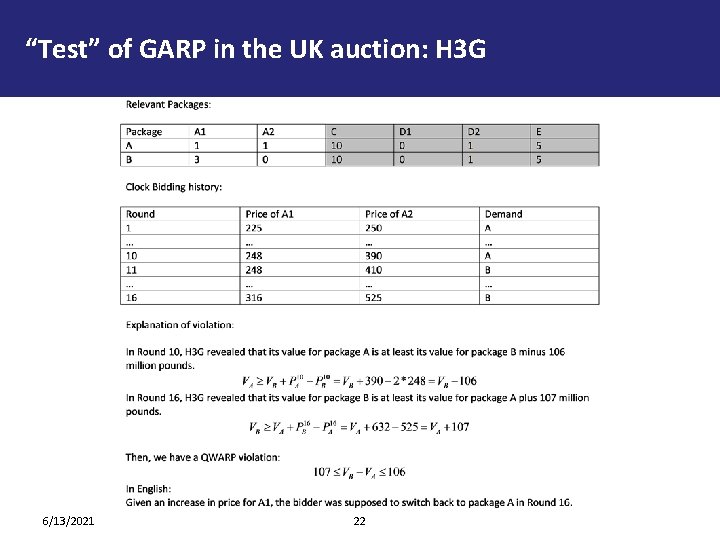
“Test” of GARP in the UK auction: H 3 G 6/13/2021 22
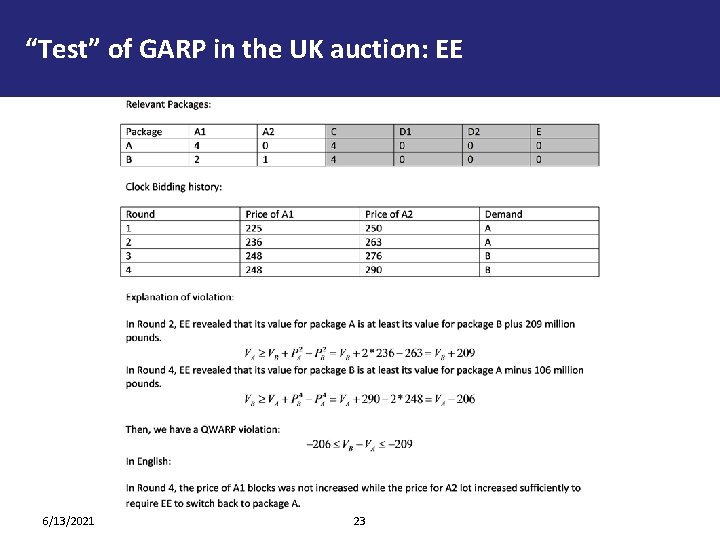
“Test” of GARP in the UK auction: EE 6/13/2021 23
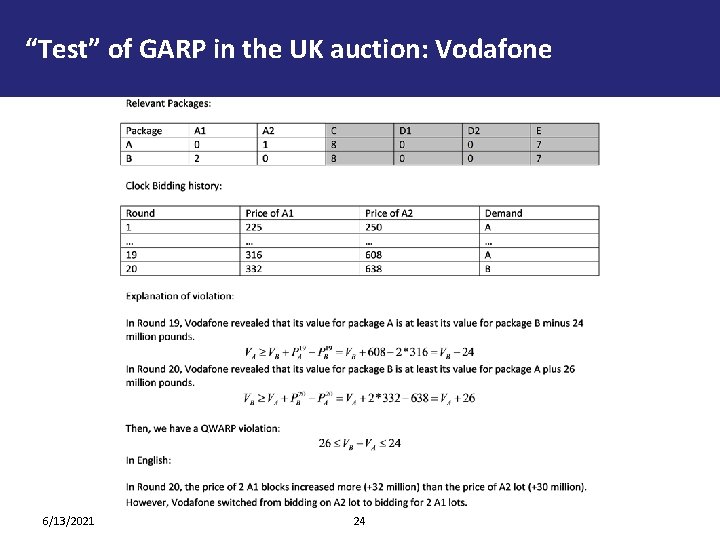
“Test” of GARP in the UK auction: Vodafone 6/13/2021 24

Part III: Pricing
Tensions from second pricing in the current CCA • There is a tension between strict activity rules and the use of a core-selecting mechanism (“second pricing”): § With strict activity rules and without undersell, each bidder is guaranteed to win its package from the final clock round § So bidders may lack incentive to submit supplementary bids § There may also be minimal consequences to a bidder inflating its expressed opportunity cost § Since the price determination depends on supplementary bids, prices may be too low (the “missing bid” problem) or too high (“spiteful bidding”) 6/13/2021 26
Transforming the CCA from second- to first-pricing • One can ask the question: Given opponents’ bids, and given the activity rule, what is the maximum amount that a bidder could ever have to pay to win a package if this were the final clock round of the auction (“exposure calculation”)? • Using the nominal clock prices as the bid amount for a package, as is done in the current CCA, is an arbitrary convention; all that matters are relative prices • Instead, for example, the bid amount for a package could be discounted, based upon the bidder’s exposure calculation • Furthermore, one could utilize the discounted bid amounts to make the pricing pay-as-bid • With first-pricing of the final clock packages, it doesn’t matter if there is insufficient incentive for supplementary bids 6/13/2021 27
The CCA as an iterative first-price auction • Much of the rationale for the strong GARP-based activity rule is that it generates reasonable exposure calculations • Under second price, supplementary bids serve both an allocation and a pricing role; under first price, attention is focused on the allocation role • A strong activity rule assures a high degree of stability and predictability in going from the clock rounds to the supplementary round (by contrast, a weak activity rule allows bid-sniping) • The use of first-pricing would also tend to reduce the importance of budget constraints 6/13/2021 28
Conclusion • The CCA has been reasonably successful in its use for spectrum auctions • The CCA has been continually evolving since its inception • There are new directions in which the CCA can further evolve that will make it still more effective 6/13/2021 29
- Slides: 29