
Mark Twain 1835 1910 Mark Twain Born as
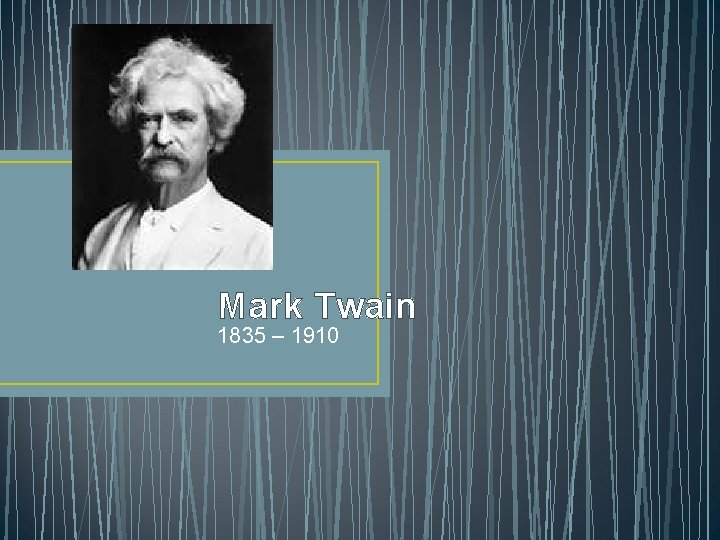
Mark Twain 1835 – 1910
Mark Twain - Born as Samuel Langhorne Clemens in Missouri - forced to go to work as a newspaper editor at the age of 12, after his father died (mostly to help support mother and sister) - At 18, he set out on his own as a printer for the next 15 years. - Discovered a love for steamboats that filled the Mississippi River. - Received his pen name “Mark Twain” from boat, dealing with marking water depth. - Most celebrated humorist in American history and literature. - In addition to being a humorist, he is also labeled as a Realist (a bit ironic) - Behind the humor in his literature, exists a revelation of reality - Active in Civil War with Confederates, but abandoned military life quickly to be a gold prospector in Nevada. - Didn’t get rich, but became inspired through storytelling
Mark Twain - In 1871, he moved to Connecticut and built a large home that is visited today by thousands of tourists yearly. - Began publishing work (including Roughing It and Life on the Mississippi) - Began writing The Adventures of Tom Sawyer (1876) - Tone and voice difficulties / couldn’t decide if he was writing for children or adults - In The Adventures of Huckleberry Finn (1884), Twain found the voice he was seeking. - Could never duplicate the success of this novel, but continued to write - His later years were filled with financial, professional and personal tragedy - Bankruptcy - Death – oldest daughter in 1896 (meningitis), wife in 1904 (chronic illness), and youngest daughter in 1909 (epileptic seizure) - “I know what the soldier feels when a bullet crashes through his heart. ”
Literary Focus • Vocabulary • Vernacular language – the language commonly spoken by people in a particular place or region • Idioms – expressions that make no literal sense, i. e. raining cats and dogs • Dialect – local variations of spoken words • Comic Devices • Hyperbole – outrageous exaggerations • Understatement – saying less than what is really meant, usually for ironic purposes • Comic comparisons – similes and metaphors that create colorful, outlandish images • Comic characters and situations – usual people dealing with unlikely events
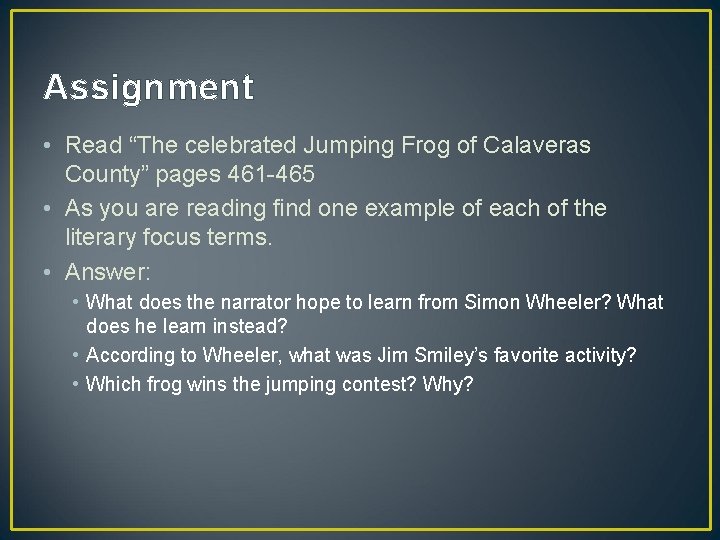
Assignment • Read “The celebrated Jumping Frog of Calaveras County” pages 461 -465 • As you are reading find one example of each of the literary focus terms. • Answer: • What does the narrator hope to learn from Simon Wheeler? What does he learn instead? • According to Wheeler, what was Jim Smiley’s favorite activity? • Which frog wins the jumping contest? Why?
- Slides: 5