
Mark Gerstein Yale University gersteinlab orgcourses452 last edit
Mark Gerstein, Yale University gersteinlab. org/courses/452 (last edit in fall 2005) 1 (c) Mark Gerstein, 1999, Yale, bioinfo. mbb. yale. edu BIOINFORMATICS Introduction
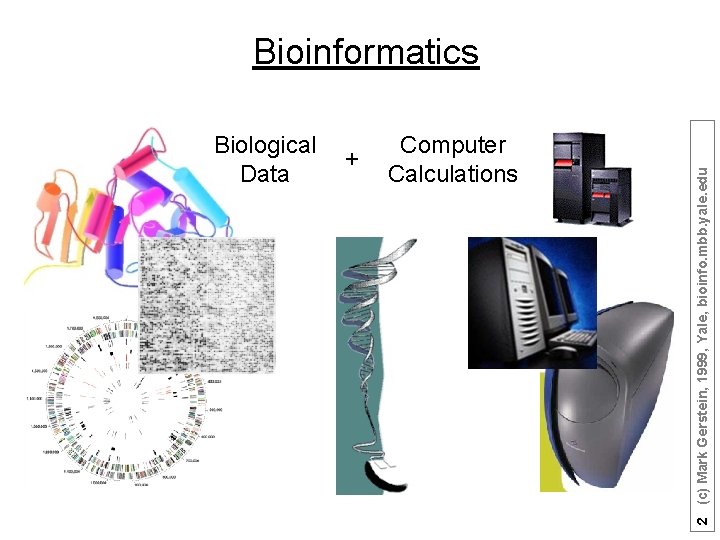
Biological Data + Computer Calculations 2 (c) Mark Gerstein, 1999, Yale, bioinfo. mbb. yale. edu Bioinformatics
Core • (Molecular) Bio - informatics • One idea for a definition? Bioinformatics is conceptualizing biology in terms of molecules (in the sense of physical-chemistry) and then applying “informatics” techniques (derived from disciplines such as applied math, CS, and statistics) to understand organize the information associated with these molecules, on a large-scale. • Bioinformatics is a practical discipline with many applications. 3 (c) Mark Gerstein, 1999, Yale, bioinfo. mbb. yale. edu What is Bioinformatics?
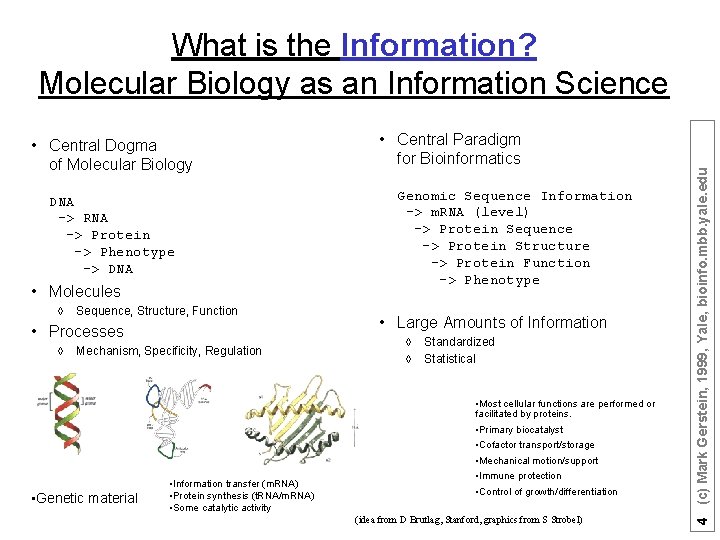
• Central Dogma of Molecular Biology DNA -> RNA -> Protein -> Phenotype -> DNA • Molecules à Sequence, Structure, Function • Processes à Mechanism, Specificity, Regulation • Genetic material • Information transfer (m. RNA) • Protein synthesis (t. RNA/m. RNA) • Some catalytic activity • Central Paradigm for Bioinformatics Genomic Sequence Information -> m. RNA (level) -> Protein Sequence -> Protein Structure -> Protein Function -> Phenotype • Large Amounts of Information à Standardized à Statistical • Most cellular functions are performed or facilitated by proteins. • Primary biocatalyst • Cofactor transport/storage • Mechanical motion/support • Immune protection • Control of growth/differentiation (idea from D Brutlag, Stanford, graphics from S Strobel) 4 (c) Mark Gerstein, 1999, Yale, bioinfo. mbb. yale. edu What is the Information? Molecular Biology as an Information Science
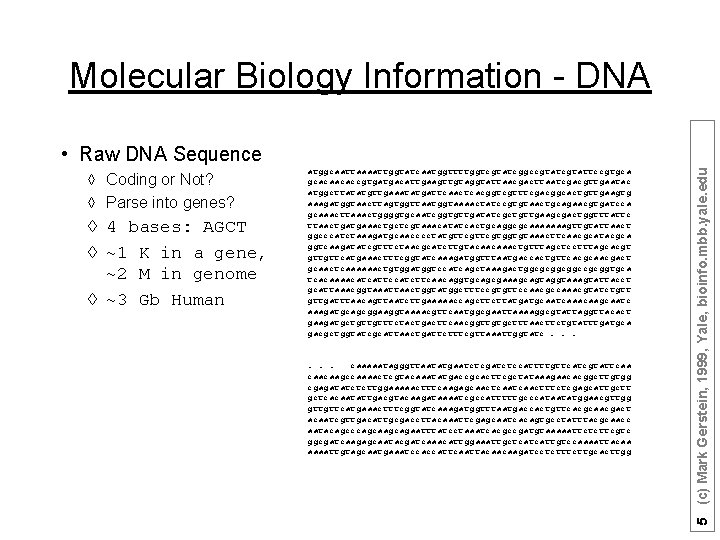
Molecular Biology Information - DNA à Coding or Not? à Parse into genes? à 4 bases: AGCT à ~1 K in a gene, ~2 M in genome à ~3 Gb Human atggcaattaaaattggtatcaatggttttggtcgtatcggccgtattccgtgca gcacaacaccgtgatgacattgaagttgtaggtattaacgacttaatcgacgttgaatac atggcttatatgttgaaatatgattcaactcacggtcgtttcgacggcactgttgaagtg aaagatggtaacttagtggttaatggtaaaactatccgtgtaactgcagaacgtgatcca gcaaacttaaactggggtgcaatcggtgttgatatcgctgttgaagcgactggtttattc ttaactgatgaaactgctcgtaaacatatcactgcaggcgcaaaaaaagttgtattaact ggcccatctaaagatgcaacccctatgttcgtggtgtaaacttcaacgcatacgca ggtcaagatatcgtttctaacgcatcttgtacaacaaactgtttagctcctttagcacgt gttgttcatgaaactttcggtatcaaagatggtttaatgaccactgttcacgcaacgact gcaactcaaaaaactgtggatggtccatcagctaaagactggcgcggcggccgcggtgca tcacaaaacatcattccatcttcaacaggtgcagcgaaagcagtaggtaaagtattacct gcattaaacggtaaattaactggtatggctttccgtgttccaacgccaaacgtatctgtt gttgatttaacagttaatcttgaaaaaccagcttcttatgatgcaatcaaacaagcaatc aaagatgcagcggaaggtaaaacgttcaatggcgaattaaaaggcgtattaggttacact gaagatgctgttgtttctactgacttcaacggttgtgctttaacttctgtatttgatgca gacgctggtatcgcattaactgattctttcgttaaattggtatc. . . caaaaatagggttaatatgaatctcgatctccattttgttcatcgtattcaa caacaagccaaaactcgtacaaatatgaccgcacttcgctataaagaacacggcttgtgg cgagatatctcttggaaaaactttcaagagcaactcaactttctcgagcattgctt gctcacaatattgacgtacaagataaaatcgccatttttgcccataatatggaacgttgg gttgttcatgaaactttcggtatcaaagatggtttaatgaccactgttcacgcaacgact acaatcgttgacattgcgaccttacaaattcgagcaatcacagtgcctatttacgcaacc aatacagcccagcagaatttatcctaaatcacgccgatgtaaaaattctcttcgtc ggcgatcaagagcaatacgatcaaacattggaaattgctcatcattgtccaaaattacaa aaaattgtagcaatgaaatccaccattcaattacaacaagatcctcttgcacttgg 5 (c) Mark Gerstein, 1999, Yale, bioinfo. mbb. yale. edu • Raw DNA Sequence
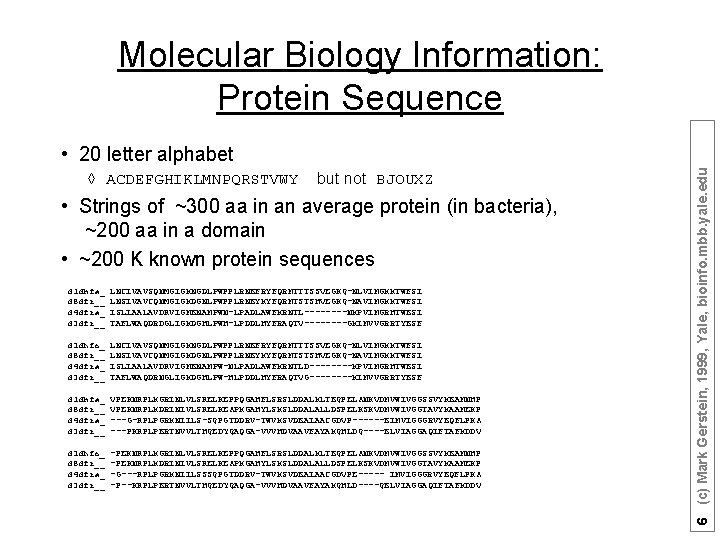
Molecular Biology Information: Protein Sequence à ACDEFGHIKLMNPQRSTVWY but not BJOUXZ • Strings of ~300 aa in an average protein (in bacteria), ~200 aa in a domain • ~200 K known protein sequences d 1 dhfa_ d 8 dfr__ d 4 dfra_ d 3 dfr__ LNCIVAVSQNMGIGKNGDLPWPPLRNEFRYFQRMTTTSSVEGKQ-NLVIMGKKTWFSI LNSIVAVCQNMGIGKDGNLPWPPLRNEYKYFQRMTSTSHVEGKQ-NAVIMGKKTWFSI ISLIAALAVDRVIGMENAMPWN-LPADLAWFKRNTL----NKPVIMGRHTWESI TAFLWAQDRDGLIGKDGHLPWH-LPDDLHYFRAQTV----GKIMVVGRRTYESF d 1 dhfa_ d 8 dfr__ d 4 dfra_ d 3 dfr__ LNCIVAVSQNMGIGKNGDLPWPPLRNEFRYFQRMTTTSSVEGKQ-NLVIMGKKTWFSI LNSIVAVCQNMGIGKDGNLPWPPLRNEYKYFQRMTSTSHVEGKQ-NAVIMGKKTWFSI ISLIAALAVDRVIGMENAMPW-NLPADLAWFKRNTLD----KPVIMGRHTWESI TAFLWAQDRNGLIGKDGHLPW-HLPDDLHYFRAQTVG----KIMVVGRRTYESF d 1 dhfa_ d 8 dfr__ d 4 dfra_ d 3 dfr__ VPEKNRPLKGRINLVLSRELKEPPQGAHFLSRSLDDALKLTEQPELANKVDMVWIVGGSSVYKEAMNHP VPEKNRPLKDRINIVLSRELKEAPKGAHYLSKSLDDALALLDSPELKSKVDMVWIVGGTAVYKAAMEKP ---G-RPLPGRKNIILS-SQPGTDDRV-TWVKSVDEAIAACGDVP------EIMVIGGGRVYEQFLPKA ---PKRPLPERTNVVLTHQEDYQAQGA-VVVHDVAAVFAYAKQHLDQ----ELVIAGGAQIFTAFKDDV d 1 dhfa_ d 8 dfr__ d 4 dfra_ d 3 dfr__ -PEKNRPLKGRINLVLSRELKEPPQGAHFLSRSLDDALKLTEQPELANKVDMVWIVGGSSVYKEAMNHP -PEKNRPLKDRINIVLSRELKEAPKGAHYLSKSLDDALALLDSPELKSKVDMVWIVGGTAVYKAAMEKP -G---RPLPGRKNIILSSSQPGTDDRV-TWVKSVDEAIAACGDVPE-----. IMVIGGGRVYEQFLPKA -P--KRPLPERTNVVLTHQEDYQAQGA-VVVHDVAAVFAYAKQHLD----QELVIAGGAQIFTAFKDDV 6 (c) Mark Gerstein, 1999, Yale, bioinfo. mbb. yale. edu • 20 letter alphabet
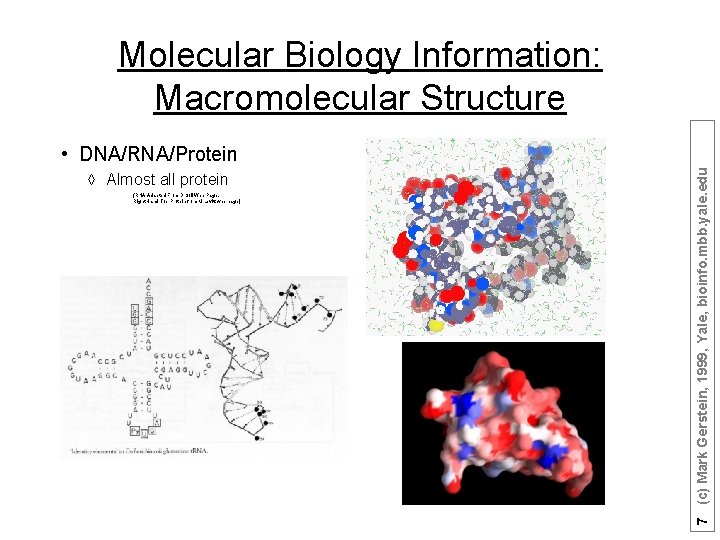
Molecular Biology Information: Macromolecular Structure à Almost all protein (RNA Adapted From D Soll Web Page, Right Hand Top Protein from M Levitt web page) 7 (c) Mark Gerstein, 1999, Yale, bioinfo. mbb. yale. edu • DNA/RNA/Protein
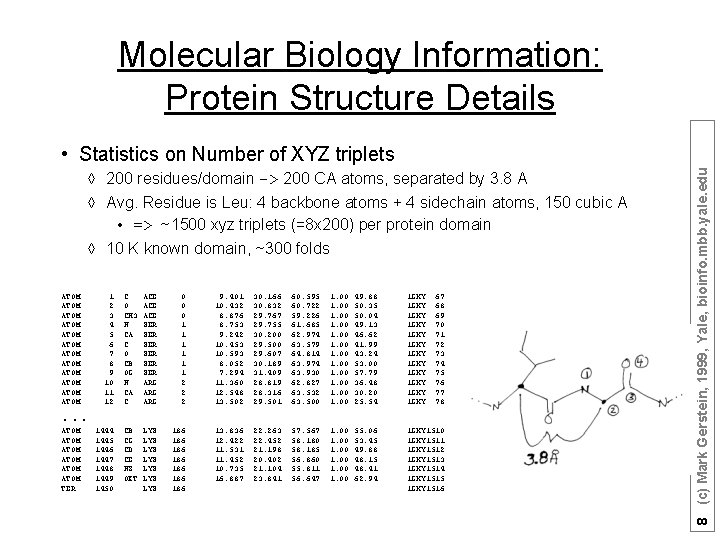
Molecular Biology Information: Protein Structure Details à 200 residues/domain -> 200 CA atoms, separated by 3. 8 A à Avg. Residue is Leu: 4 backbone atoms + 4 sidechain atoms, 150 cubic A • => ~1500 xyz triplets (=8 x 200) per protein domain à 10 K known domain, ~300 folds ATOM ATOM ATOM 1 2 3 4 5 6 7 8 9 10 11 12 C O CH 3 N CA C O CB OG N CA C ACE ACE SER SER SER ARG ARG 0 0 0 1 1 1 2 2 2 9. 401 10. 432 8. 876 8. 753 9. 242 10. 453 10. 593 8. 052 7. 294 11. 360 12. 548 13. 502 30. 166 30. 832 29. 767 29. 755 30. 200 29. 500 29. 607 30. 189 31. 409 28. 819 28. 316 29. 501 60. 595 60. 722 59. 226 61. 685 62. 974 63. 579 64. 814 63. 974 63. 930 62. 827 63. 532 63. 500 1. 00 1. 00 49. 88 50. 35 50. 04 49. 13 46. 62 41. 99 43. 24 53. 00 57. 79 36. 48 30. 20 25. 54 1 GKY 1 GKY 1 GKY 67 68 69 70 71 72 73 74 75 76 77 78 1444 1445 1446 1447 1448 1449 1450 CB CG CD CE NZ OXT LYS LYS 186 186 13. 836 12. 422 11. 531 11. 452 10. 735 16. 887 22. 263 22. 452 21. 198 20. 402 21. 104 23. 841 57. 567 58. 180 58. 185 56. 860 55. 811 56. 647 1. 00 55. 06 53. 45 49. 88 48. 15 48. 41 62. 94 1 GKY 1510 1 GKY 1511 1 GKY 1512 1 GKY 1513 1 GKY 1514 1 GKY 1515 1 GKY 1516 . . . ATOM ATOM TER 8 (c) Mark Gerstein, 1999, Yale, bioinfo. mbb. yale. edu • Statistics on Number of XYZ triplets
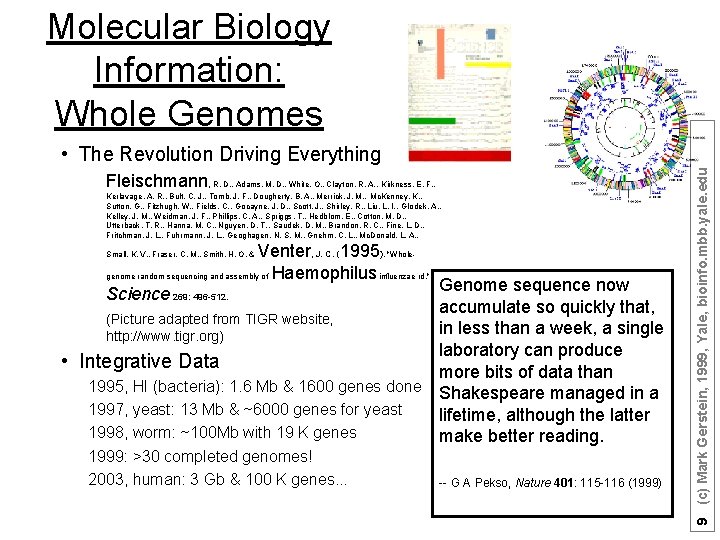
Molecular Biology Information: Whole Genomes Fleischmann, R. D. , Adams, M. D. , White, O. , Clayton, R. A. , Kirkness, E. F. , Kerlavage, A. R. , Bult, C. J. , Tomb, J. F. , Dougherty, B. A. , Merrick, J. M. , Mc. Kenney, K. , Sutton, G. , Fitzhugh, W. , Fields, C. , Gocayne, J. D. , Scott, J. , Shirley, R. , Liu, L. I. , Glodek, A. , Kelley, J. M. , Weidman, J. F. , Phillips, C. A. , Spriggs, T. , Hedblom, E. , Cotton, M. D. , Utterback, T. R. , Hanna, M. C. , Nguyen, D. T. , Saudek, D. M. , Brandon, R. C. , Fine, L. D. , Fritchman, J. L. , Fuhrmann, J. L. , Geoghagen, N. S. M. , Gnehm, C. L. , Mc. Donald, L. A. , Venter, J. C. (1995). "Wholegenome random sequencing and assembly of Haemophilus influenzae rd. " Genome sequence now Science 269: 496 -512. accumulate so quickly that, (Picture adapted from TIGR website, in less than a week, a single http: //www. tigr. org) laboratory can produce • Integrative Data more bits of data than 1995, HI (bacteria): 1. 6 Mb & 1600 genes done Shakespeare managed in a 1997, yeast: 13 Mb & ~6000 genes for yeast lifetime, although the latter 1998, worm: ~100 Mb with 19 K genes make better reading. Small, K. V. , Fraser, C. M. , Smith, H. O. & 1999: >30 completed genomes! 2003, human: 3 Gb & 100 K genes. . . -- G A Pekso, Nature 401: 115 -116 (1999) 9 (c) Mark Gerstein, 1999, Yale, bioinfo. mbb. yale. edu • The Revolution Driving Everything
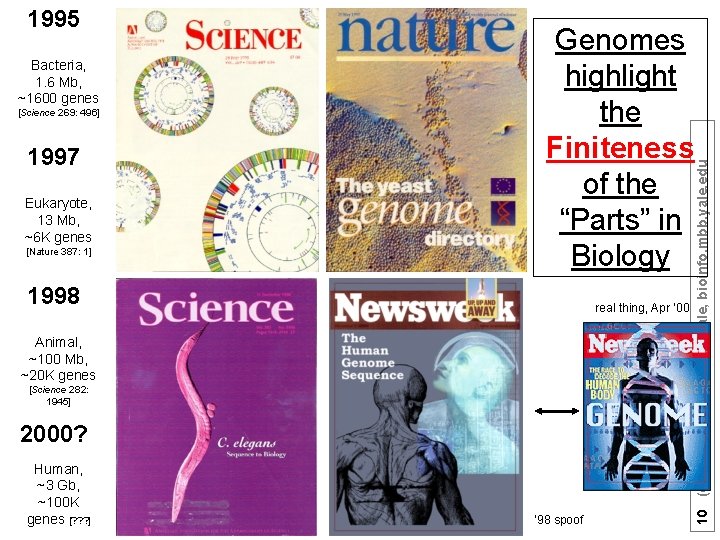
Bacteria, 1. 6 Mb, ~1600 genes [Science 269: 496] 1997 Eukaryote, 13 Mb, ~6 K genes [Nature 387: 1] Genomes highlight the Finiteness of the “Parts” in Biology 1998 real thing, Apr ‘ 00 Animal, ~100 Mb, ~20 K genes [Science 282: 1945] 2000? Human, ~3 Gb, ~100 K genes [? ? ? ] ‘ 98 spoof 10 (c) Mark Gerstein, 1999, Yale, bioinfo. mbb. yale. edu 1995
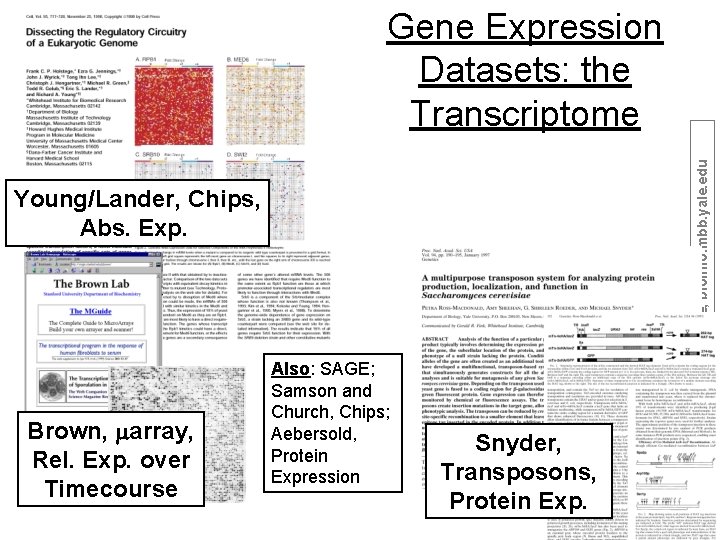
Young/Lander, Chips, Abs. Exp. Brown, marray, Rel. Exp. over Timecourse Also: SAGE; Samson and Church, Chips; Aebersold, Protein Expression Snyder, Transposons, Protein Exp. 11 (c) Mark Gerstein, 1999, Yale, bioinfo. mbb. yale. edu Gene Expression Datasets: the Transcriptome
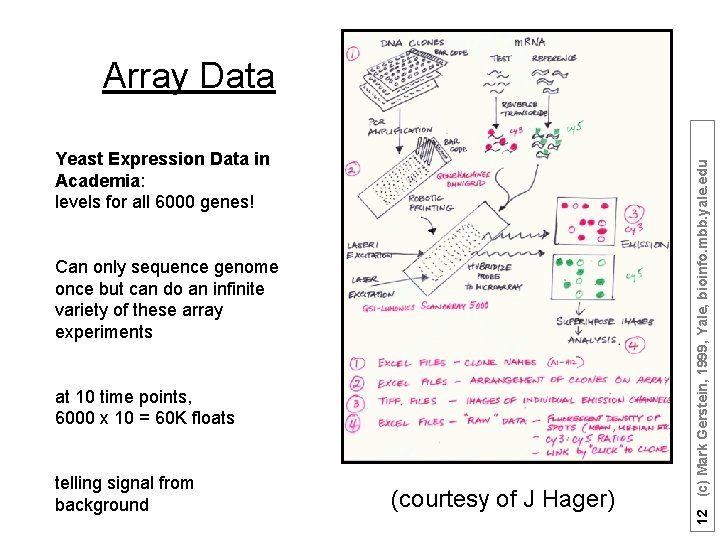
Yeast Expression Data in Academia: levels for all 6000 genes! Can only sequence genome once but can do an infinite variety of these array experiments at 10 time points, 6000 x 10 = 60 K floats telling signal from background (courtesy of J Hager) 12 (c) Mark Gerstein, 1999, Yale, bioinfo. mbb. yale. edu Array Data
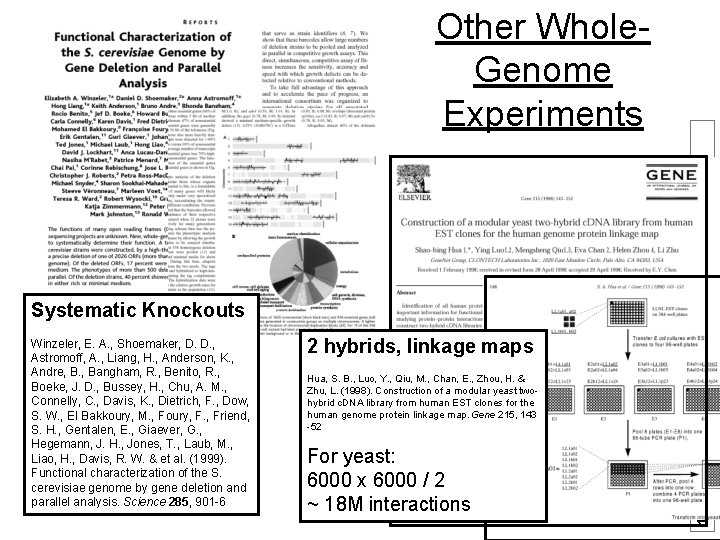
Systematic Knockouts Winzeler, E. A. , Shoemaker, D. D. , Astromoff, A. , Liang, H. , Anderson, K. , Andre, B. , Bangham, R. , Benito, R. , Boeke, J. D. , Bussey, H. , Chu, A. M. , Connelly, C. , Davis, K. , Dietrich, F. , Dow, S. W. , El Bakkoury, M. , Foury, F. , Friend, S. H. , Gentalen, E. , Giaever, G. , Hegemann, J. H. , Jones, T. , Laub, M. , Liao, H. , Davis, R. W. & et al. (1999). Functional characterization of the S. cerevisiae genome by gene deletion and parallel analysis. Science 285, 901 -6 2 hybrids, linkage maps Hua, S. B. , Luo, Y. , Qiu, M. , Chan, E. , Zhou, H. & Zhu, L. (1998). Construction of a modular yeast twohybrid c. DNA library from human EST clones for the human genome protein linkage map. Gene 215, 143 -52 For yeast: 6000 x 6000 / 2 ~ 18 M interactions 13 (c) Mark Gerstein, 1999, Yale, bioinfo. mbb. yale. edu Other Whole. Genome Experiments
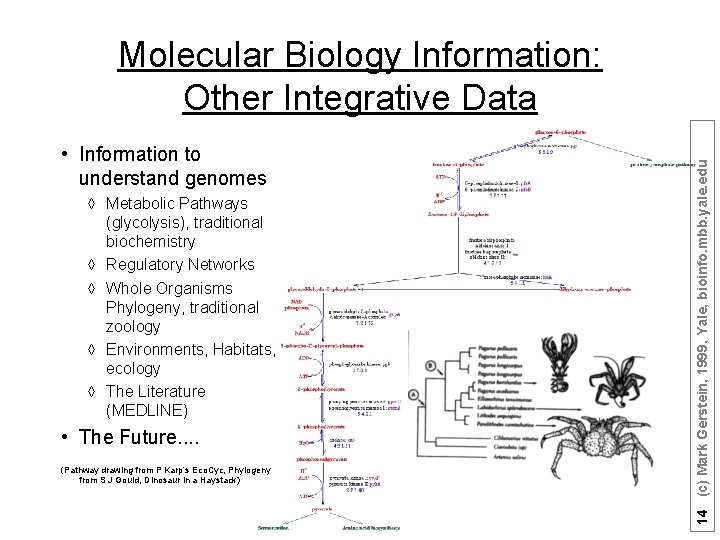
• Information to understand genomes à Metabolic Pathways (glycolysis), traditional biochemistry à Regulatory Networks à Whole Organisms Phylogeny, traditional zoology à Environments, Habitats, ecology à The Literature (MEDLINE) • The Future. . (Pathway drawing from P Karp’s Eco. Cyc, Phylogeny from S J Gould, Dinosaur in a Haystack) 14 (c) Mark Gerstein, 1999, Yale, bioinfo. mbb. yale. edu Molecular Biology Information: Other Integrative Data
• (Molecular) Bio - informatics • One idea for a definition? Bioinformatics is conceptualizing biology in terms of molecules (in the sense of physical-chemistry) and then applying “informatics” techniques (derived from disciplines such as applied math, CS, and statistics) to understand organize the information associated with these molecules, on a large-scale. • Bioinformatics is a practical discipline with many applications. 15 (c) Mark Gerstein, 1999, Yale, bioinfo. mbb. yale. edu What is Bioinformatics?
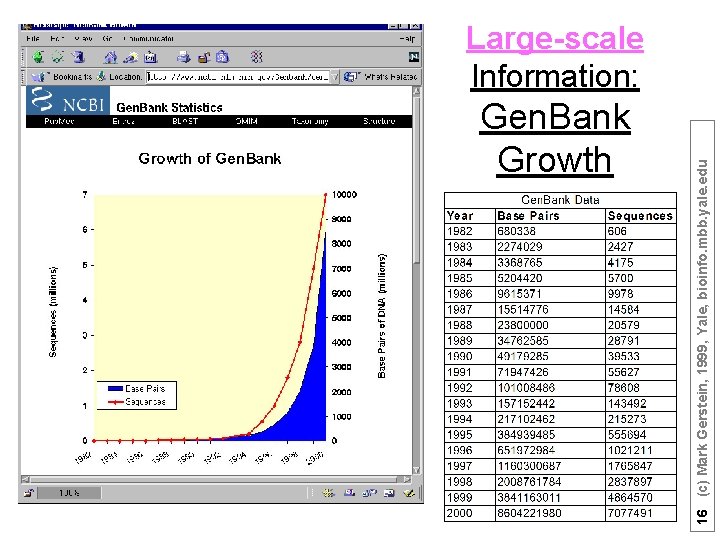
Gen. Bank Growth 16 (c) Mark Gerstein, 1999, Yale, bioinfo. mbb. yale. edu Large-scale Information:
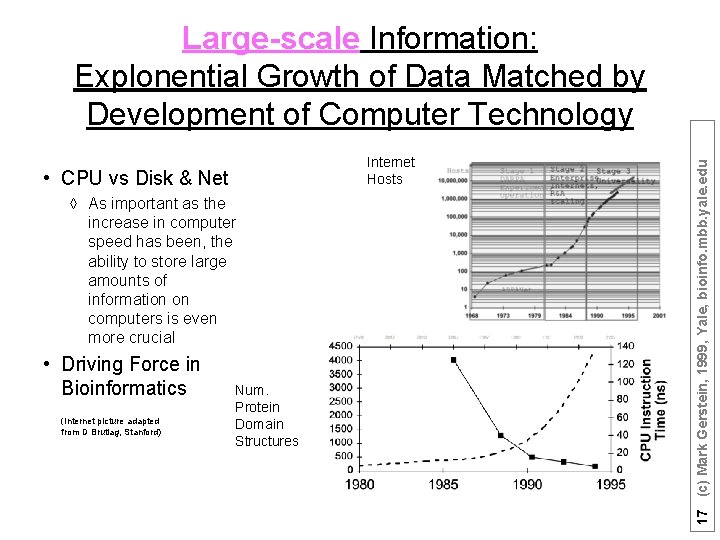
Internet Hosts • CPU vs Disk & Net à As important as the increase in computer speed has been, the ability to store large amounts of information on computers is even more crucial • Driving Force in Bioinformatics (Internet picture adapted from D Brutlag, Stanford) Num. Protein Domain Structures 17 (c) Mark Gerstein, 1999, Yale, bioinfo. mbb. yale. edu Large-scale Information: Explonential Growth of Data Matched by Development of Computer Technology
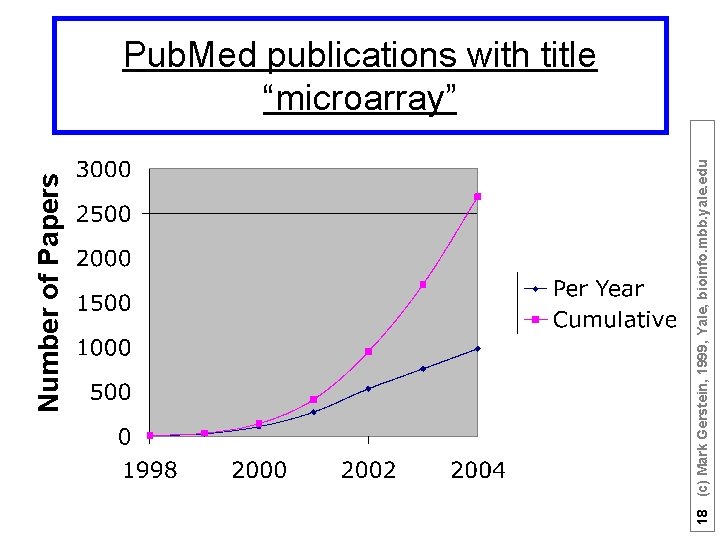
18 (c) Mark Gerstein, 1999, Yale, bioinfo. mbb. yale. edu Number of Papers Pub. Med publications with title “microarray”
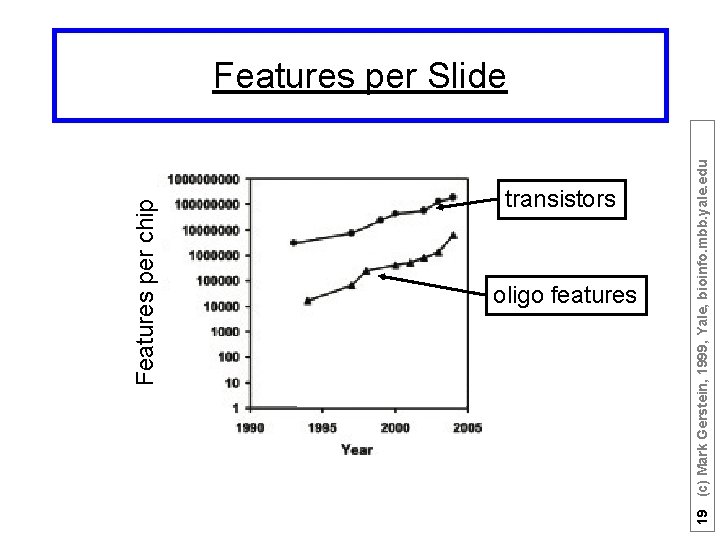
Features per chip transistors oligo features 19 (c) Mark Gerstein, 1999, Yale, bioinfo. mbb. yale. edu Features per Slide
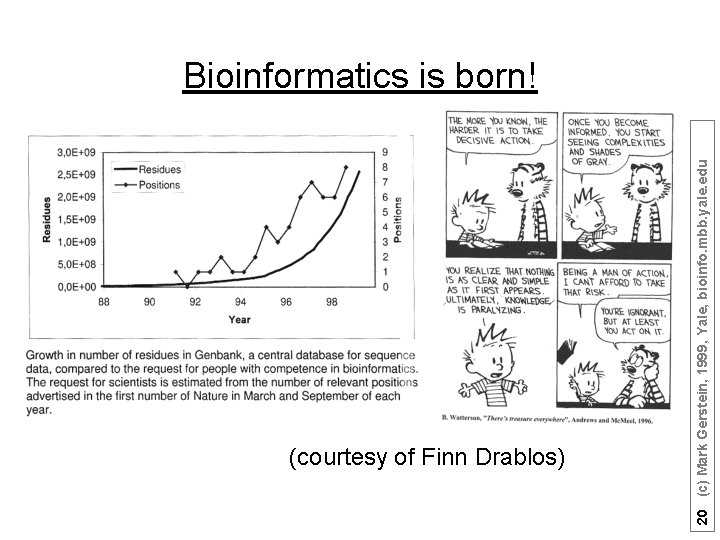
(courtesy of Finn Drablos) 20 (c) Mark Gerstein, 1999, Yale, bioinfo. mbb. yale. edu Bioinformatics is born!
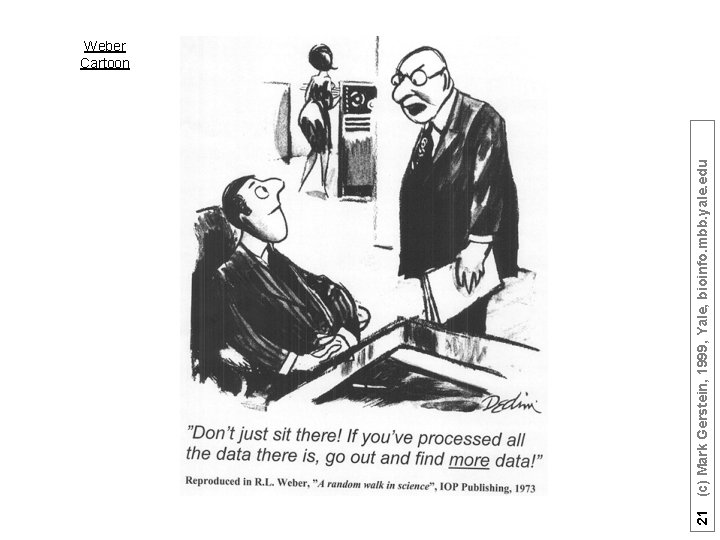
21 (c) Mark Gerstein, 1999, Yale, bioinfo. mbb. yale. edu Weber Cartoon
• (Molecular) Bio - informatics • One idea for a definition? Bioinformatics is conceptualizing biology in terms of molecules (in the sense of physical-chemistry) and then applying “informatics” techniques (derived from disciplines such as applied math, CS, and statistics) to understand organize the information associated with these molecules, on a large-scale. • Bioinformatics is a practical discipline with many applications. 22 (c) Mark Gerstein, 1999, Yale, bioinfo. mbb. yale. edu What is Bioinformatics?
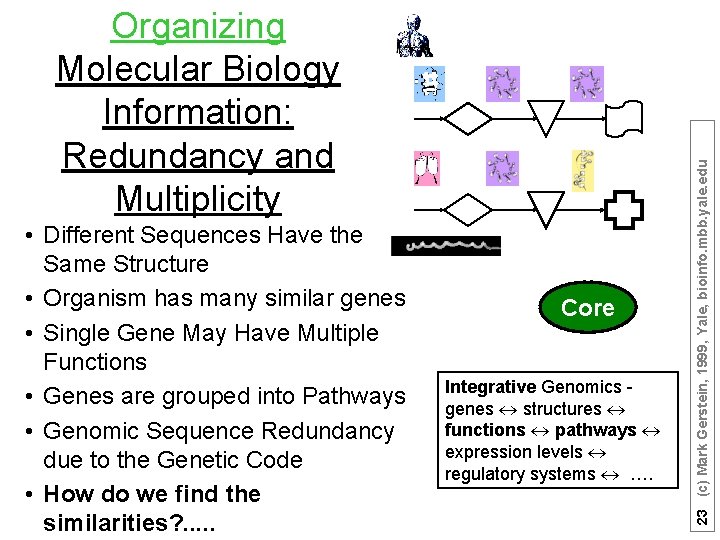
• Different Sequences Have the Same Structure • Organism has many similar genes • Single Gene May Have Multiple Functions • Genes are grouped into Pathways • Genomic Sequence Redundancy due to the Genetic Code • How do we find the similarities? . . . Core Integrative Genomics genes structures functions pathways expression levels regulatory systems …. 23 (c) Mark Gerstein, 1999, Yale, bioinfo. mbb. yale. edu Organizing Molecular Biology Information: Redundancy and Multiplicity
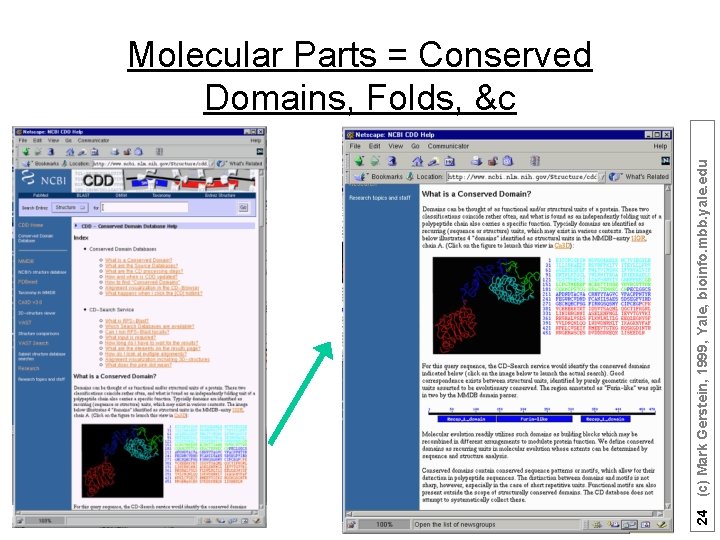
24 (c) Mark Gerstein, 1999, Yale, bioinfo. mbb. yale. edu Molecular Parts = Conserved Domains, Folds, &c
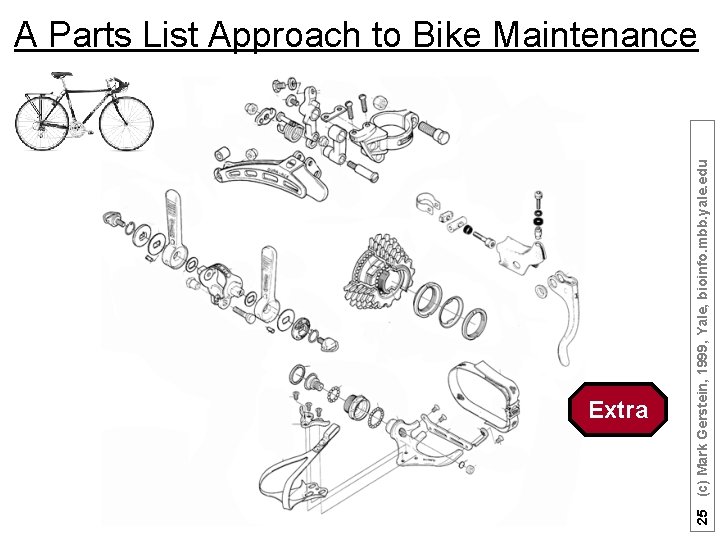
Extra 25 (c) Mark Gerstein, 1999, Yale, bioinfo. mbb. yale. edu A Parts List Approach to Bike Maintenance
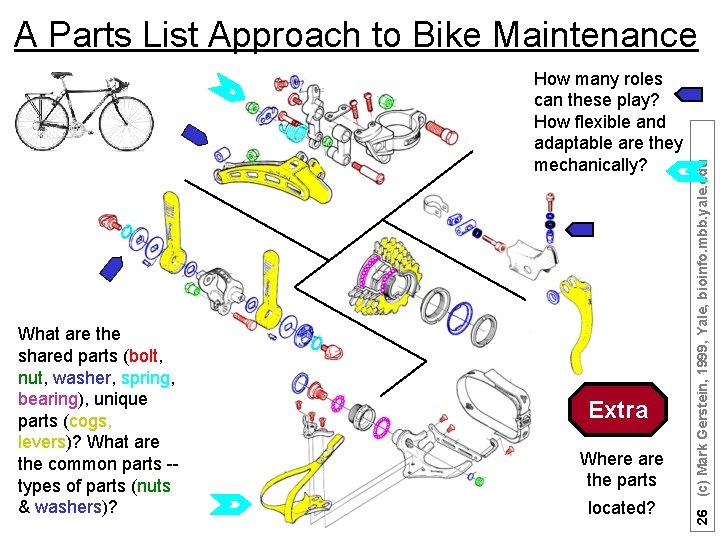
How many roles can these play? How flexible and adaptable are they mechanically? What are the shared parts (bolt, nut, washer, spring, bearing), unique parts (cogs, levers)? What are the common parts -types of parts (nuts & washers)? Extra Where are the parts located? 26 (c) Mark Gerstein, 1999, Yale, bioinfo. mbb. yale. edu A Parts List Approach to Bike Maintenance
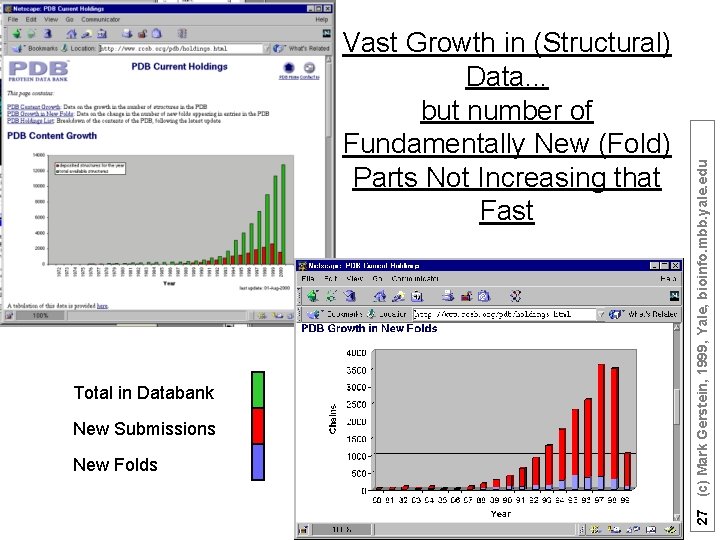
Total in Databank New Submissions New Folds 27 (c) Mark Gerstein, 1999, Yale, bioinfo. mbb. yale. edu Vast Growth in (Structural) Data. . . but number of Fundamentally New (Fold) Parts Not Increasing that Fast
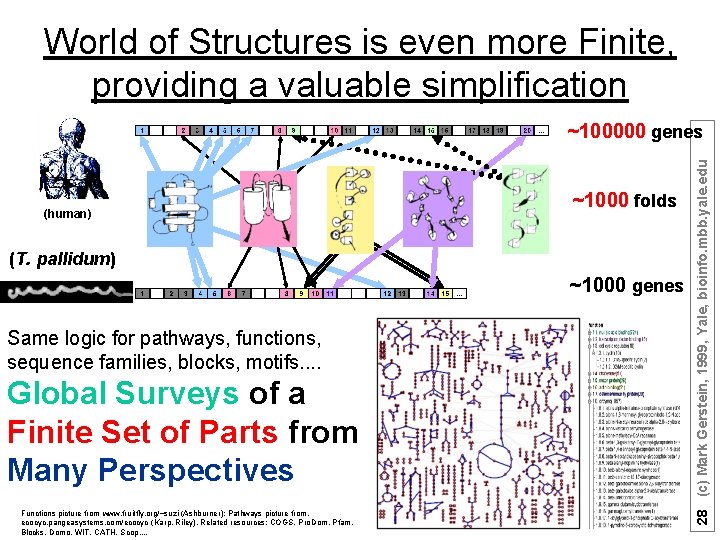
World of Structures is even more Finite, providing a valuable simplification (human) ~1000 folds (T. pallidum) ~1000 genes Same logic for pathways, functions, sequence families, blocks, motifs. . Global Surveys of a Finite Set of Parts from Many Perspectives Functions picture from www. fruitfly. org/~suzi (Ashburner); Pathways picture from, ecocyc. pangeasystems. com/ecocyc (Karp, Riley). Related resources: COGS, Pro. Dom, Pfam, Blocks, Domo, WIT, CATH, Scop. . 28 (c) Mark Gerstein, 1999, Yale, bioinfo. mbb. yale. edu ~100000 genes
• (Molecular) Bio - informatics • One idea for a definition? Bioinformatics is conceptualizing biology in terms of molecules (in the sense of physical-chemistry) and then applying “informatics” techniques (derived from disciplines such as applied math, CS, and statistics) to understand organize the information associated with these molecules, on a large-scale. • Bioinformatics is a practical discipline with many applications. 29 (c) Mark Gerstein, 1999, Yale, bioinfo. mbb. yale. edu What is Bioinformatics?
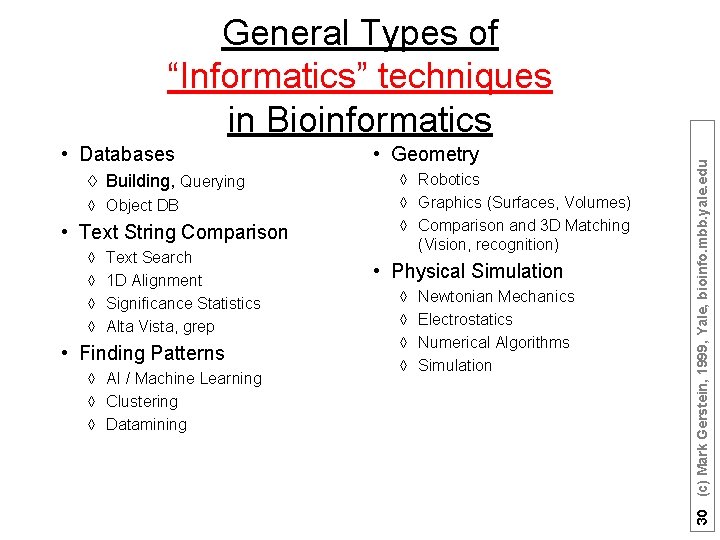
• Databases à Building, Querying à Object DB • Text String Comparison à à Text Search 1 D Alignment Significance Statistics Alta Vista, grep • Finding Patterns à AI / Machine Learning à Clustering à Datamining • Geometry à Robotics à Graphics (Surfaces, Volumes) à Comparison and 3 D Matching (Vision, recognition) • Physical Simulation à à Newtonian Mechanics Electrostatics Numerical Algorithms Simulation 30 (c) Mark Gerstein, 1999, Yale, bioinfo. mbb. yale. edu General Types of “Informatics” techniques in Bioinformatics
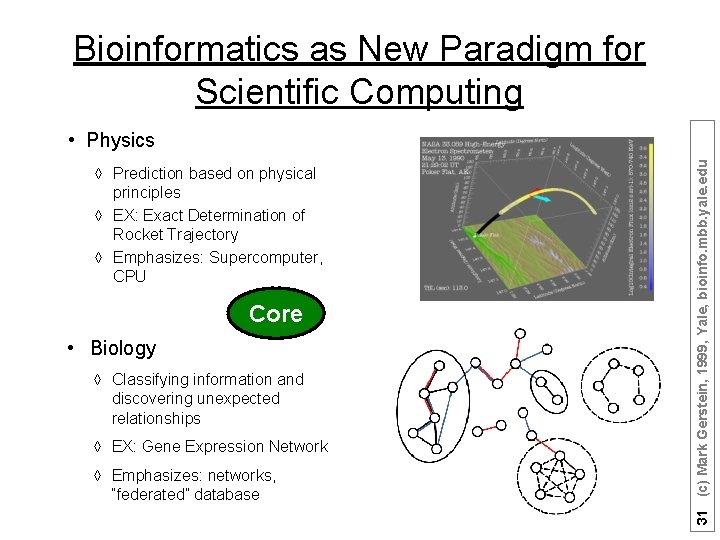
Bioinformatics as New Paradigm for Scientific Computing à Prediction based on physical principles à EX: Exact Determination of Rocket Trajectory à Emphasizes: Supercomputer, CPU Core • Biology à Classifying information and discovering unexpected relationships à EX: Gene Expression Network à Emphasizes: networks, “federated” database 31 (c) Mark Gerstein, 1999, Yale, bioinfo. mbb. yale. edu • Physics
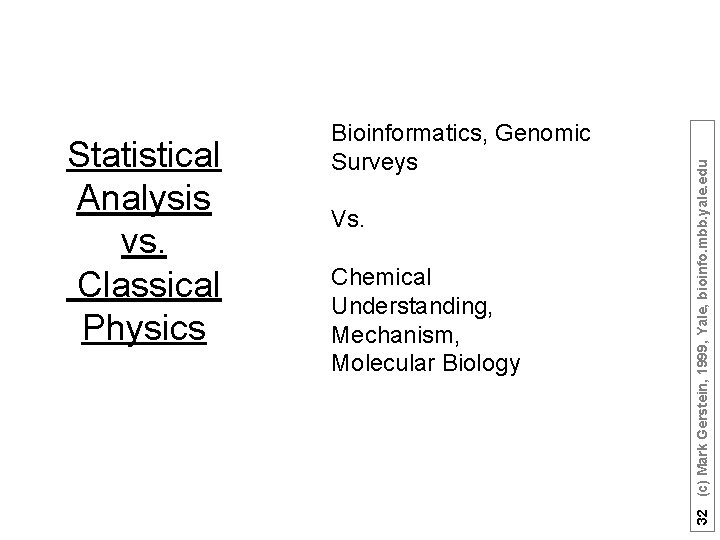
Vs. Chemical Understanding, Mechanism, Molecular Biology 32 (c) Mark Gerstein, 1999, Yale, bioinfo. mbb. yale. edu Statistical Analysis vs. Classical Physics Bioinformatics, Genomic Surveys
• Finding Genes in Genomic DNA à introns à exons à promotors • Characterizing Repeats in Genomic DNA à Statistics à Patterns • Duplications in the Genome à Large scale genomic alignment 33 (c) Mark Gerstein, 1999, Yale, bioinfo. mbb. yale. edu Bioinformatics Topics -Genome Sequence
à non-exact string matching, gaps à How to align two strings optimally via Dynamic Programming à Local vs Global Alignment à Suboptimal Alignment à Hashing to increase speed (BLAST, FASTA) à Amino acid substitution scoring matrices • Multiple Alignment and Consensus Patterns à How to align more than one sequence and then fuse the result in a consensus representation à Transitive Comparisons à HMMs, Profiles à Motifs Bioinformatics Topics -Protein Sequence • Scoring schemes and Matching statistics à How to tell if a given alignment or match is statistically significant à A P-value (or an e-value)? à Score Distributions (extreme val. dist. ) à Low Complexity Sequences • Evolutionary Issues à Rates of mutation and change 34 (c) Mark Gerstein, 1999, Yale, bioinfo. mbb. yale. edu • Sequence Alignment
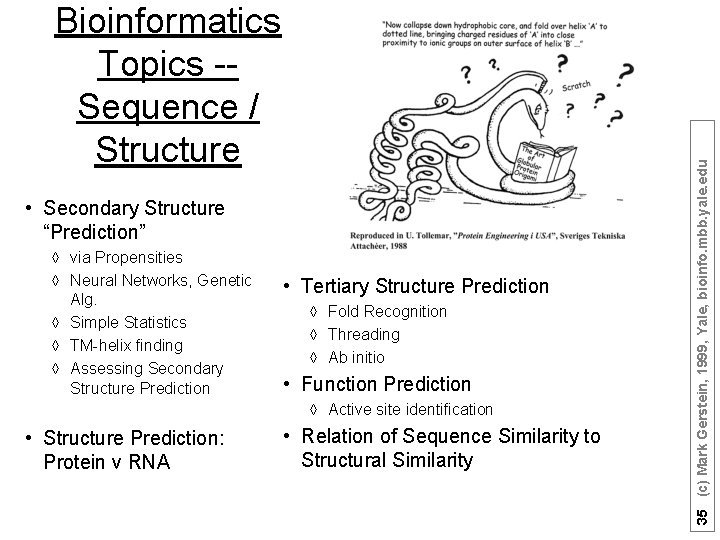
• Secondary Structure “Prediction” à via Propensities à Neural Networks, Genetic Alg. à Simple Statistics à TM-helix finding à Assessing Secondary Structure Prediction • Tertiary Structure Prediction à Fold Recognition à Threading à Ab initio • Function Prediction à Active site identification • Structure Prediction: Protein v RNA • Relation of Sequence Similarity to Structural Similarity 35 (c) Mark Gerstein, 1999, Yale, bioinfo. mbb. yale. edu Bioinformatics Topics -Sequence / Structure
• Basic Protein Geometry and Least-Squares Fitting à Distances, Angles, Axes, Rotations • Calculating a helix axis in 3 D via fitting a line à LSQ fit of 2 structures à Molecular Graphics • Calculation of Volume and Surface à à How to represent a plane How to represent a solid How to calculate an area Docking and Drug Design as Surface Matching à Packing Measurement • Structural Alignment à Aligning sequences on the basis of 3 D structure. à DP does not converge, unlike sequences, what to do? à Other Approaches: Distance Matrices, Hashing à Fold Library 36 (c) Mark Gerstein, 1999, Yale, bioinfo. mbb. yale. edu Topics -- Structures
à Keys, Foreign Keys à SQL, OODBMS, views, forms, transactions, reports, indexes à Joining Tables, Normalization • Natural Join as "where" selection on cross product • Array Referencing (perl/dbm) à Forms and Reports à Cross-tabulation • Protein Units? à What are the units of biological information? • sequence, structure • motifs, modules, domains à How classified: folds, motions, pathways, functions? Topics -Databases • Clustering and Trees à Basic clustering • UPGMA • single-linkage • multiple linkage à Other Methods • Parsimony, Maximum likelihood à Evolutionary implications • Visualization of Large Amounts of Information • The Bias Problem à sequence weighting à sampling 37 (c) Mark Gerstein, 1999, Yale, bioinfo. mbb. yale. edu • Relational Database Concepts and how they interface with Biological Information
• Expression Analysis à Time Courses clustering à Measuring differences à Identifying Regulatory Regions • Large scale cross referencing of information • Function Classification and Orthologs • The Genomic vs. Singlemolecule Perspective • Genome Comparisons à à à Ortholog Families, pathways Large-scale censuses Frequent Words Analysis Genome Annotation Trees from Genomes Identification of interacting proteins • Structural Genomics à Folds in Genomes, shared & common folds à Bulk Structure Prediction • Genome Trees 38 (c) Mark Gerstein, 1999, Yale, bioinfo. mbb. yale. edu Topics -- Genomics
• Molecular Simulation à Geometry -> Energy -> Forces à Basic interactions, potential energy functions à Electrostatics à VDW Forces à Bonds as Springs à How structure changes over time? • How to measure the change in a vector (gradient) à Molecular Dynamics & MC à Energy Minimization • • Parameter Sets Number Density Poisson-Boltzman Equation Lattice Models and Simplification 39 (c) Mark Gerstein, 1999, Yale, bioinfo. mbb. yale. edu Topics -- Simulation
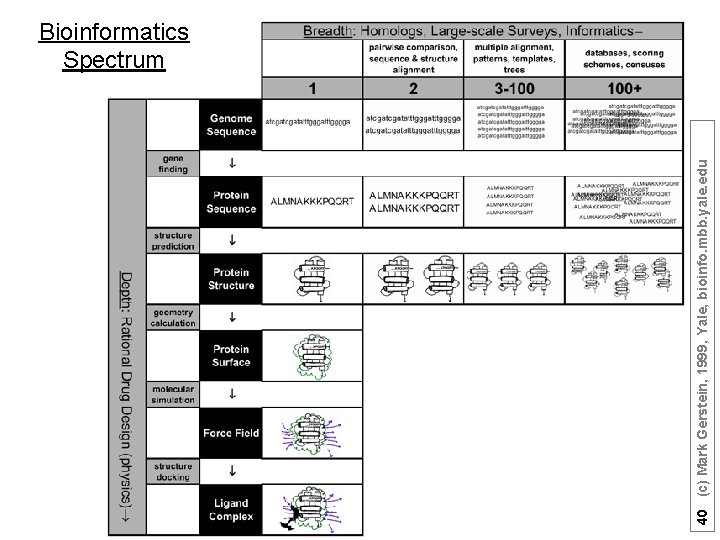
40 (c) Mark Gerstein, 1999, Yale, bioinfo. mbb. yale. edu Bioinformatics Spectrum
• (Molecular) Bio - informatics • One idea for a definition? Bioinformatics is conceptualizing biology in terms of molecules (in the sense of physical-chemistry) and then applying “informatics” techniques (derived from disciplines such as applied math, CS, and statistics) to understand organize the information associated with these molecules, on a large-scale. • Bioinformatics is a practical discipline with many applications. 41 (c) Mark Gerstein, 1999, Yale, bioinfo. mbb. yale. edu What is Bioinformatics?
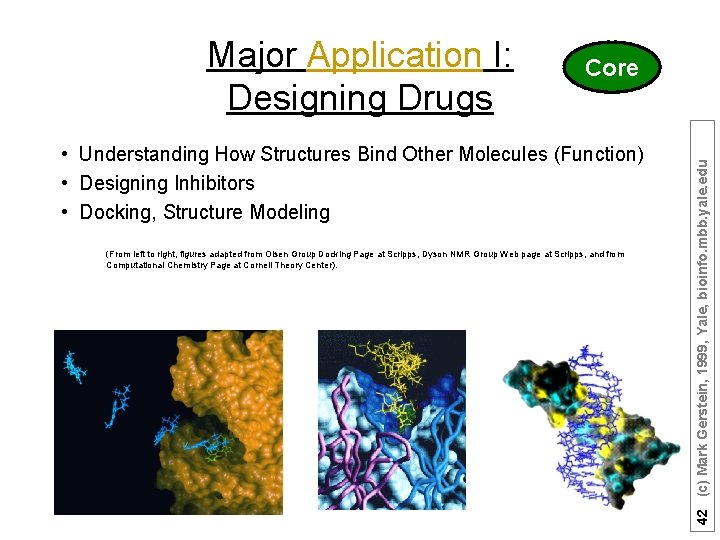
Core • Understanding How Structures Bind Other Molecules (Function) • Designing Inhibitors • Docking, Structure Modeling (From left to right, figures adapted from Olsen Group Docking Page at Scripps, Dyson NMR Group Web page at Scripps, and from Computational Chemistry Page at Cornell Theory Center). 42 (c) Mark Gerstein, 1999, Yale, bioinfo. mbb. yale. edu Major Application I: Designing Drugs
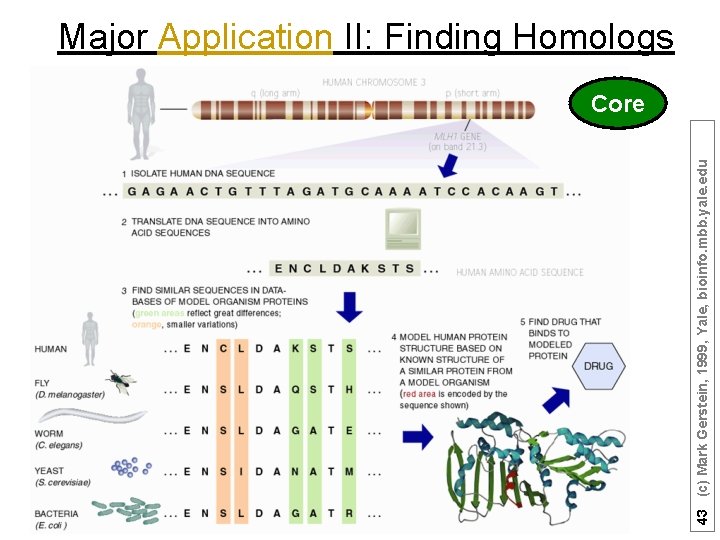
43 (c) Mark Gerstein, 1999, Yale, bioinfo. mbb. yale. edu Major Application II: Finding Homologs Core
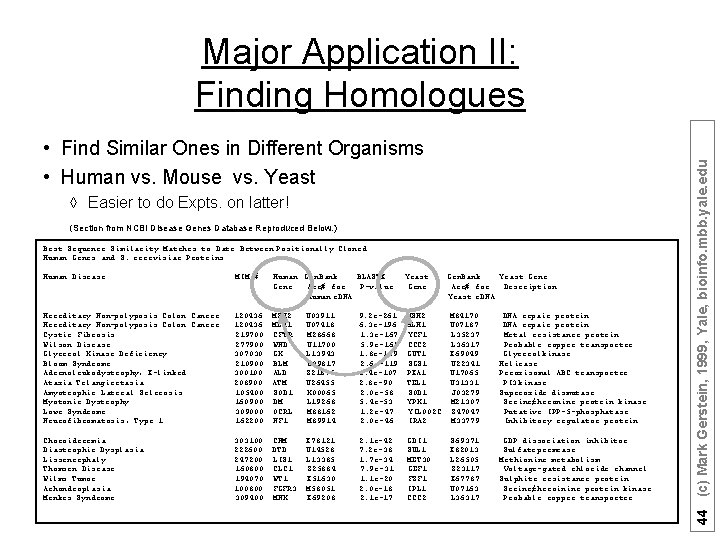
• Find Similar Ones in Different Organisms • Human vs. Mouse vs. Yeast à Easier to do Expts. on latter! (Section from NCBI Disease Genes Database Reproduced Below. ) Best Sequence Similarity Matches to Date Between Positionally Cloned Human Genes and S. cerevisiae Proteins Human Disease MIM # Human Gen. Bank BLASTX Gene Acc# for P-value Human c. DNA Yeast Gene Gen. Bank Yeast Gene Acc# for Description Yeast c. DNA Hereditary Non-polyposis Colon Cancer Cystic Fibrosis Wilson Disease Glycerol Kinase Deficiency Bloom Syndrome Adrenoleukodystrophy, X-linked Ataxia Telangiectasia Amyotrophic Lateral Sclerosis Myotonic Dystrophy Lowe Syndrome Neurofibromatosis, Type 1 120436 219700 277900 307030 210900 300100 208900 105400 160900 309000 162200 MSH 2 MLH 1 CFTR WND GK BLM ALD ATM SOD 1 DM OCRL NF 1 U 03911 U 07418 M 28668 U 11700 L 13943 U 39817 Z 21876 U 26455 K 00065 L 19268 M 88162 M 89914 9. 2 e-261 6. 3 e-196 1. 3 e-167 5. 9 e-161 1. 8 e-129 2. 6 e-119 3. 4 e-107 2. 8 e-90 2. 0 e-58 5. 4 e-53 1. 2 e-47 2. 0 e-46 MSH 2 MLH 1 YCF 1 CCC 2 GUT 1 SGS 1 PXA 1 TEL 1 SOD 1 YPK 1 YIL 002 C IRA 2 M 84170 U 07187 L 35237 L 36317 X 69049 U 22341 U 17065 U 31331 J 03279 M 21307 Z 47047 M 33779 DNA repair protein Metal resistance protein Probable copper transporter Glycerol kinase Helicase Peroxisomal ABC transporter PI 3 kinase Superoxide dismutase Serine/ threonine protein kinase Putative IPP-5 -phosphatase Inhibitory regulator protein Choroideremia Diastrophic Dysplasia Lissencephaly Thomsen Disease Wilms Tumor Achondroplasia Menkes Syndrome 303100 222600 247200 160800 194070 100800 309400 CHM DTD LIS 1 CLC 1 WT 1 FGFR 3 MNK X 78121 U 14528 L 13385 Z 25884 X 51630 M 58051 X 69208 2. 1 e-42 7. 2 e-38 1. 7 e-34 7. 9 e-31 1. 1 e-20 2. 0 e-18 2. 1 e-17 GDI 1 SUL 1 MET 30 GEF 1 FZF 1 IPL 1 CCC 2 S 69371 X 82013 L 26505 Z 23117 X 67787 U 07163 L 36317 GDP dissociation inhibitor Sulfate permease Methionine metabolism Voltage-gated chloride channel Sulphite resistance protein Serine/ threoinine protein kinase Probable copper transporter 44 (c) Mark Gerstein, 1999, Yale, bioinfo. mbb. yale. edu Major Application II: Finding Homologues
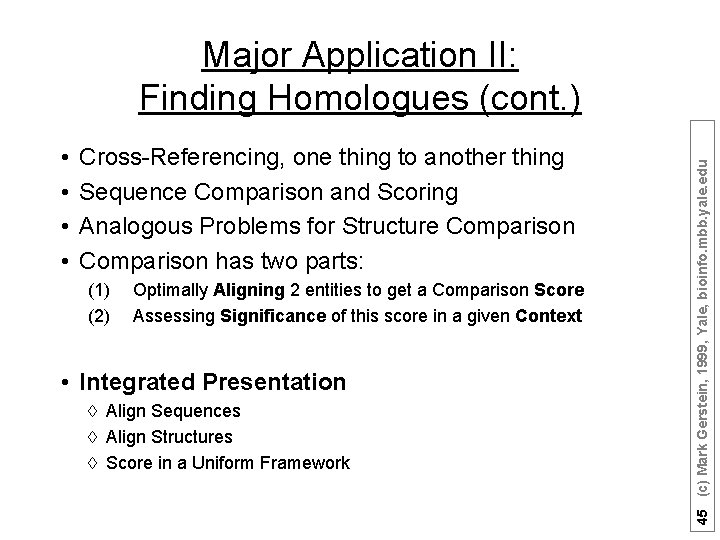
• • Cross-Referencing, one thing to another thing Sequence Comparison and Scoring Analogous Problems for Structure Comparison has two parts: (1) (2) Optimally Aligning 2 entities to get a Comparison Score Assessing Significance of this score in a given Context • Integrated Presentation à Align Sequences à Align Structures à Score in a Uniform Framework 45 (c) Mark Gerstein, 1999, Yale, bioinfo. mbb. yale. edu Major Application II: Finding Homologues (cont. )
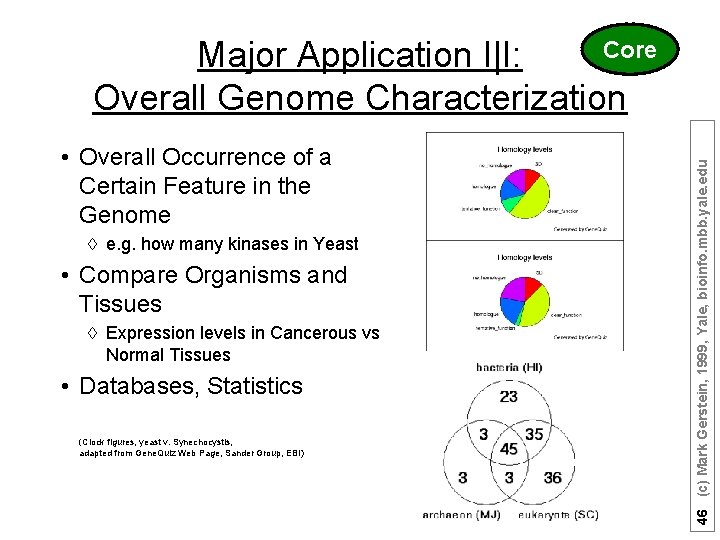
• Overall Occurrence of a Certain Feature in the Genome à e. g. how many kinases in Yeast • Compare Organisms and Tissues à Expression levels in Cancerous vs Normal Tissues • Databases, Statistics (Clock figures, yeast v. Synechocystis, adapted from Gene. Quiz Web Page, Sander Group, EBI) 46 (c) Mark Gerstein, 1999, Yale, bioinfo. mbb. yale. edu Core Major Application I|I: Overall Genome Characterization
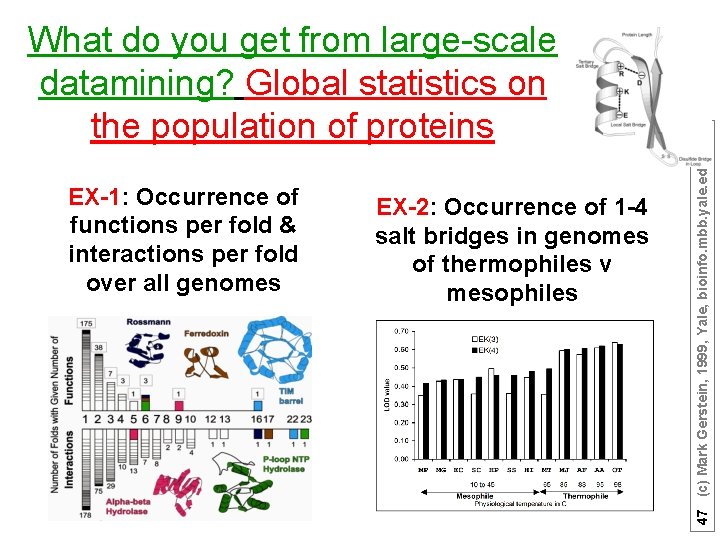
EX-1: Occurrence of functions per fold & interactions per fold over all genomes EX-2: Occurrence of 1 -4 salt bridges in genomes of thermophiles v mesophiles 47 (c) Mark Gerstein, 1999, Yale, bioinfo. mbb. yale. edu What do you get from large-scale datamining? Global statistics on the population of proteins
(Bioinfo-1) [next class joins intro & seqs. ] 48 (c) Mark Gerstein, 1999, Yale, bioinfo. mbb. yale. edu End of class 2005, 10. 23
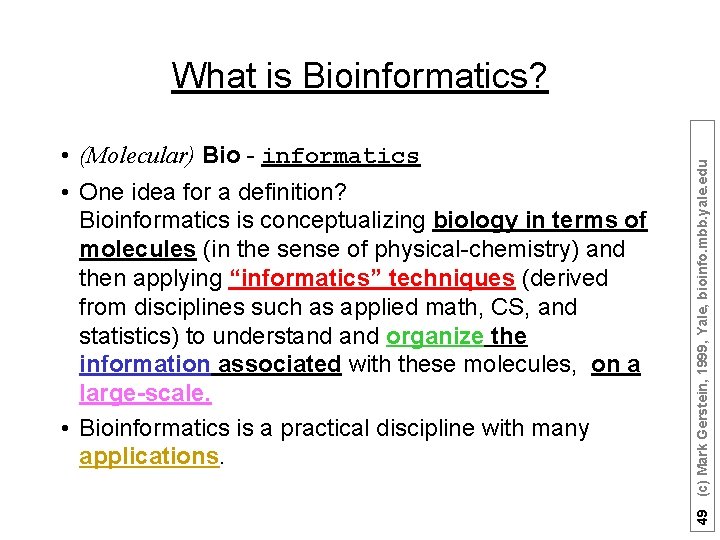
• (Molecular) Bio - informatics • One idea for a definition? Bioinformatics is conceptualizing biology in terms of molecules (in the sense of physical-chemistry) and then applying “informatics” techniques (derived from disciplines such as applied math, CS, and statistics) to understand organize the information associated with these molecules, on a large-scale. • Bioinformatics is a practical discipline with many applications. 49 (c) Mark Gerstein, 1999, Yale, bioinfo. mbb. yale. edu What is Bioinformatics?
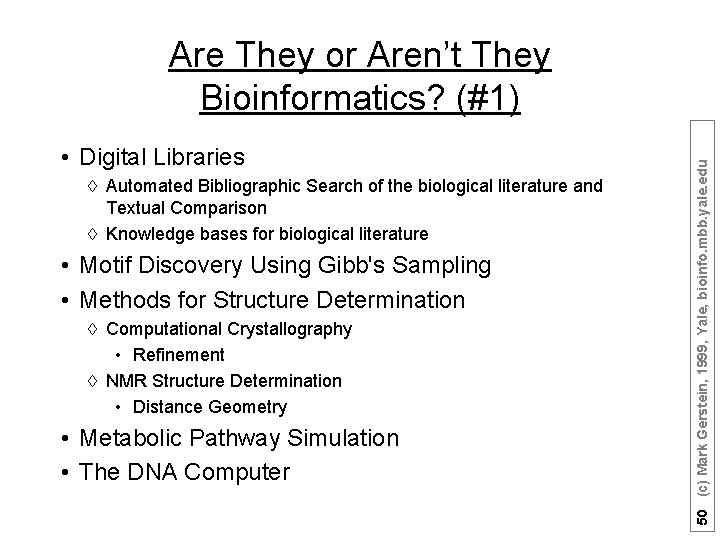
• Digital Libraries à Automated Bibliographic Search of the biological literature and Textual Comparison à Knowledge bases for biological literature • Motif Discovery Using Gibb's Sampling • Methods for Structure Determination à Computational Crystallography • Refinement à NMR Structure Determination • Distance Geometry • Metabolic Pathway Simulation • The DNA Computer 50 (c) Mark Gerstein, 1999, Yale, bioinfo. mbb. yale. edu Are They or Aren’t They Bioinformatics? (#1)
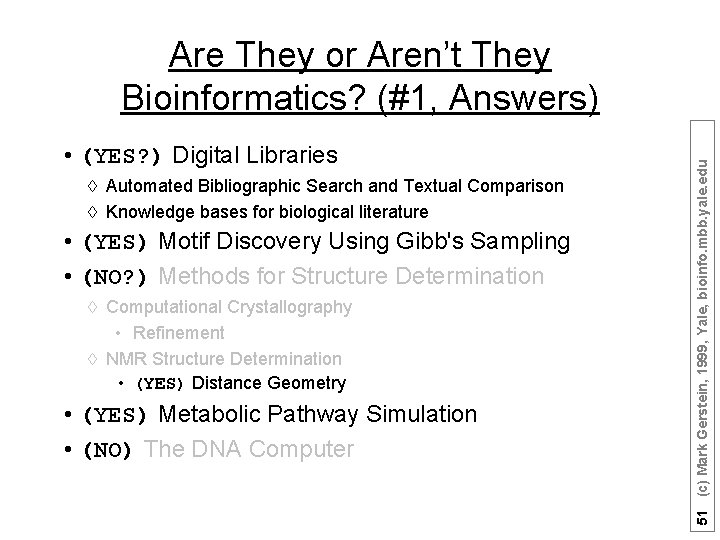
• (YES? ) Digital Libraries à Automated Bibliographic Search and Textual Comparison à Knowledge bases for biological literature • (YES) Motif Discovery Using Gibb's Sampling • (NO? ) Methods for Structure Determination à Computational Crystallography • Refinement à NMR Structure Determination • (YES) Distance Geometry • (YES) Metabolic Pathway Simulation • (NO) The DNA Computer 51 (c) Mark Gerstein, 1999, Yale, bioinfo. mbb. yale. edu Are They or Aren’t They Bioinformatics? (#1, Answers)
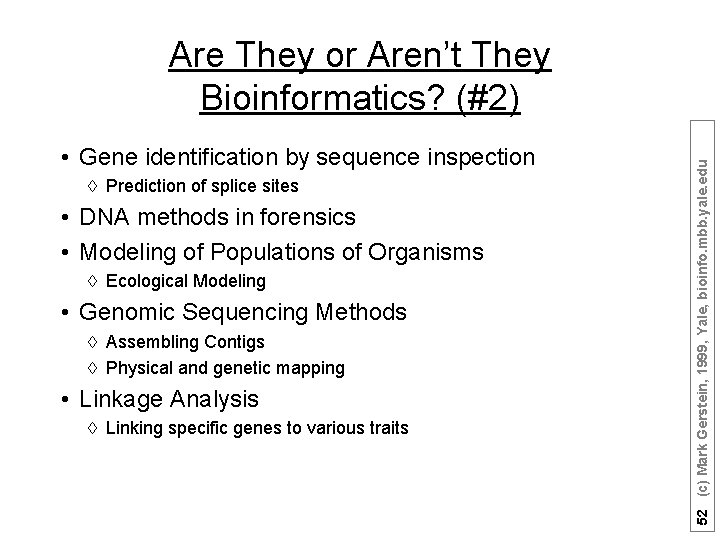
• Gene identification by sequence inspection à Prediction of splice sites • DNA methods in forensics • Modeling of Populations of Organisms à Ecological Modeling • Genomic Sequencing Methods à Assembling Contigs à Physical and genetic mapping • Linkage Analysis à Linking specific genes to various traits 52 (c) Mark Gerstein, 1999, Yale, bioinfo. mbb. yale. edu Are They or Aren’t They Bioinformatics? (#2)
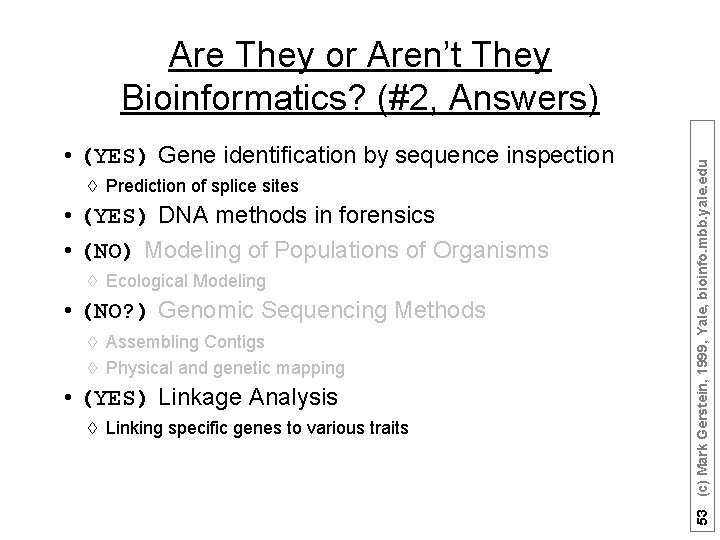
• (YES) Gene identification by sequence inspection à Prediction of splice sites • (YES) DNA methods in forensics • (NO) Modeling of Populations of Organisms à Ecological Modeling • (NO? ) Genomic Sequencing Methods à Assembling Contigs à Physical and genetic mapping • (YES) Linkage Analysis à Linking specific genes to various traits 53 (c) Mark Gerstein, 1999, Yale, bioinfo. mbb. yale. edu Are They or Aren’t They Bioinformatics? (#2, Answers)
• RNA structure prediction Identification in sequences • Radiological Image Processing à Computational Representations for Human Anatomy (visible human) • Artificial Life Simulations à Artificial Immunology / Computer Security à Genetic Algorithms in molecular biology • Homology modeling • Determination of Phylogenies Based on Nonmolecular Organism Characteristics • Computerized Diagnosis based on Genetic Analysis (Pedigrees) 54 (c) Mark Gerstein, 1999, Yale, bioinfo. mbb. yale. edu Are They or Aren’t They Bioinformatics? (#3)
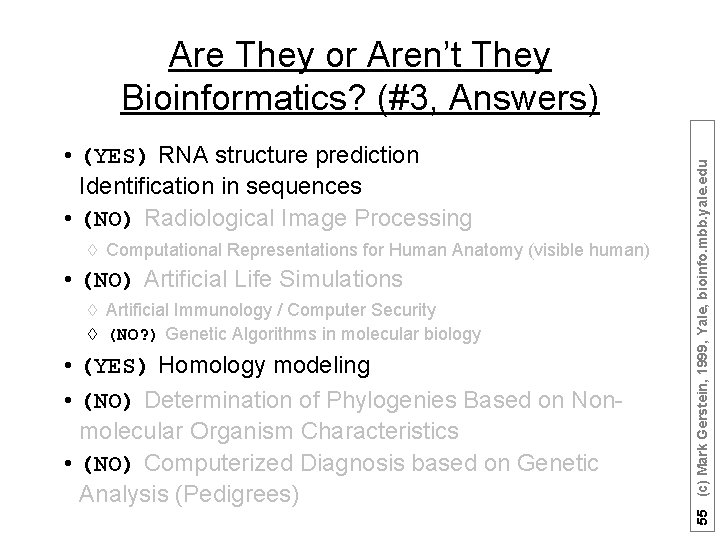
• (YES) RNA structure prediction Identification in sequences • (NO) Radiological Image Processing à Computational Representations for Human Anatomy (visible human) • (NO) Artificial Life Simulations à Artificial Immunology / Computer Security à (NO? ) Genetic Algorithms in molecular biology • (YES) Homology modeling • (NO) Determination of Phylogenies Based on Nonmolecular Organism Characteristics • (NO) Computerized Diagnosis based on Genetic Analysis (Pedigrees) 55 (c) Mark Gerstein, 1999, Yale, bioinfo. mbb. yale. edu Are They or Aren’t They Bioinformatics? (#3, Answers)
• Issues that were uncovered à Does topic stand alone? à Is bioinformatics acting as tool? à How does it relate to lab work? • Relationship to other disciplines à Medical informatics à Synthetic biology à Systems biology • Biological question is important, not the specific technique -- but it has to be computational à Using computers to understand biology vs using biology to inspire computation • Some new ones (2005) à Disease modeling [are you modeling molecules? ] à Enzymology (kinetics and rates? ) [is it a simulation or is it interpreting 1 expt. ? ] à Genetic algs used in gene finding HMMs used in gene finding • vs. Genetic algs used in speech recognition HMMs used in speech recognition à Semantic web used for representing biological information 56 (c) Mark Gerstein, 1999, Yale, bioinfo. mbb. yale. edu Further Thoughts in 2005 on the "Boundary of Bioinformatics"
- Slides: 56