
Mario Bieringer Neutron Powder Diffraction Mario Bieringer Department
Mario Bieringer_____________________________________ Neutron Powder Diffraction Mario Bieringer Department of Chemistry University of Manitoba presented at the 10 th Canadian Neutron Summer School June 15 – 18, 2009 Chalk River, Ontario _____________________________ 10 th Canadian Neutron Summer School slide 1 June 16 th, 2009
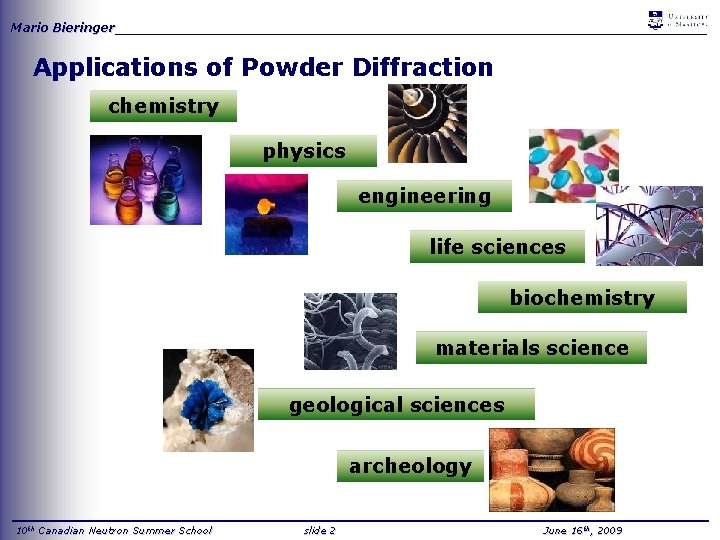
Mario Bieringer_____________________________________ Applications of Powder Diffraction chemistry physics engineering life sciences biochemistry materials science geological sciences archeology _____________________________ 10 th Canadian Neutron Summer School slide 2 June 16 th, 2009
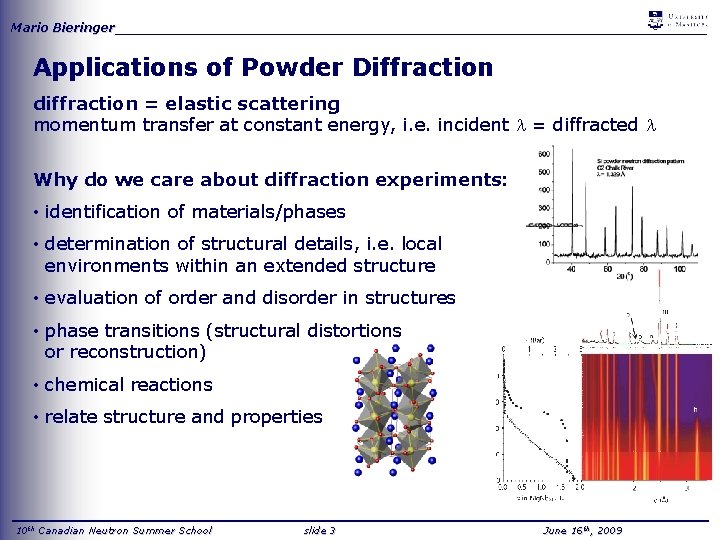
Mario Bieringer_____________________________________ Applications of Powder Diffraction diffraction = elastic scattering momentum transfer at constant energy, i. e. incident l = diffracted l Why do we care about diffraction experiments: • identification of materials/phases • determination of structural details, i. e. local environments within an extended structure • evaluation of order and disorder in structures • phase transitions (structural distortions or reconstruction) • chemical reactions • relate structure and properties _____________________________ 10 th Canadian Neutron Summer School slide 3 June 16 th, 2009
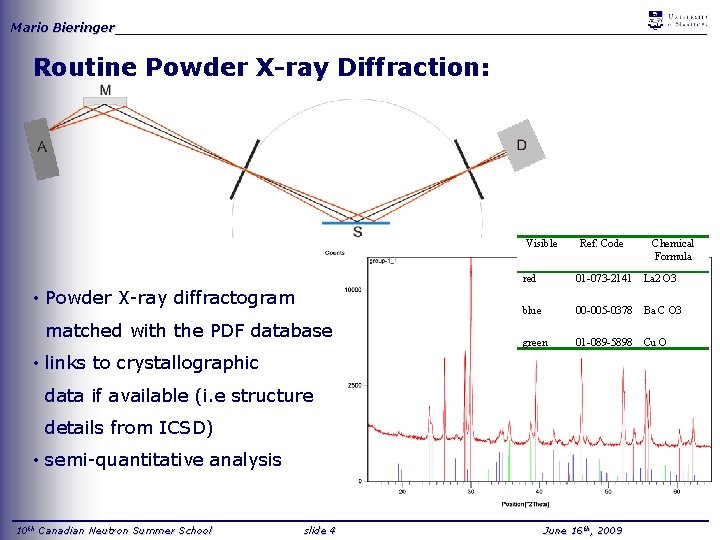
Mario Bieringer_____________________________________ Routine Powder X-ray Diffraction: Visible • Powder X-ray diffractogram matched with the PDF database Ref. Code Chemical Formula red 01 -073 -2141 La 2 O 3 blue 00 -005 -0378 Ba C O 3 green 01 -089 -5898 Cu O • links to crystallographic data if available (i. e structure details from ICSD) • semi-quantitative analysis _____________________________ 10 th Canadian Neutron Summer School slide 4 June 16 th, 2009
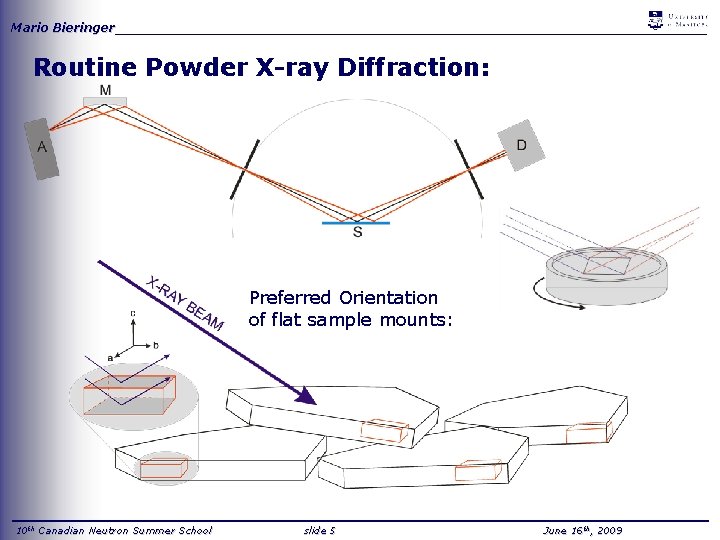
Mario Bieringer_____________________________________ Routine Powder X-ray Diffraction: Preferred Orientation of flat sample mounts: _____________________________ 10 th Canadian Neutron Summer School slide 5 June 16 th, 2009
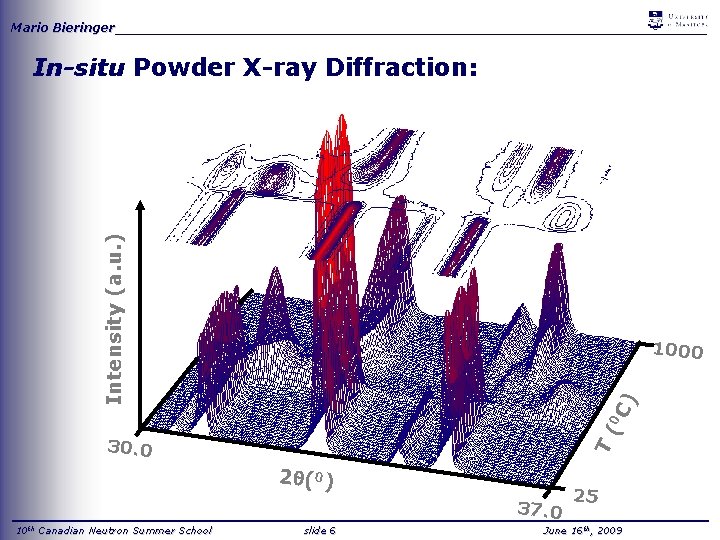
Mario Bieringer_____________________________________ Intensity (a. u. ) In-situ Powder X-ray Diffraction: T (0 C) 1000 30. 0 2 q( 0) 25 3 7. 0 _____________________________ 10 th Canadian Neutron Summer School slide 6 June 16 th, 2009
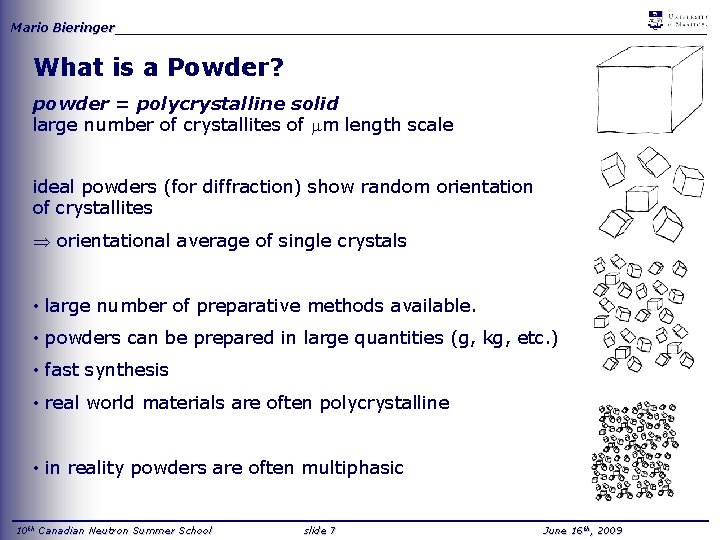
Mario Bieringer_____________________________________ What is a Powder? powder = polycrystalline solid large number of crystallites of mm length scale ideal powders (for diffraction) show random orientation of crystallites Þ orientational average of single crystals • large number of preparative methods available. • powders can be prepared in large quantities (g, kg, etc. ) • fast synthesis • real world materials are often polycrystalline • in reality powders are often multiphasic _____________________________ 10 th Canadian Neutron Summer School slide 7 June 16 th, 2009
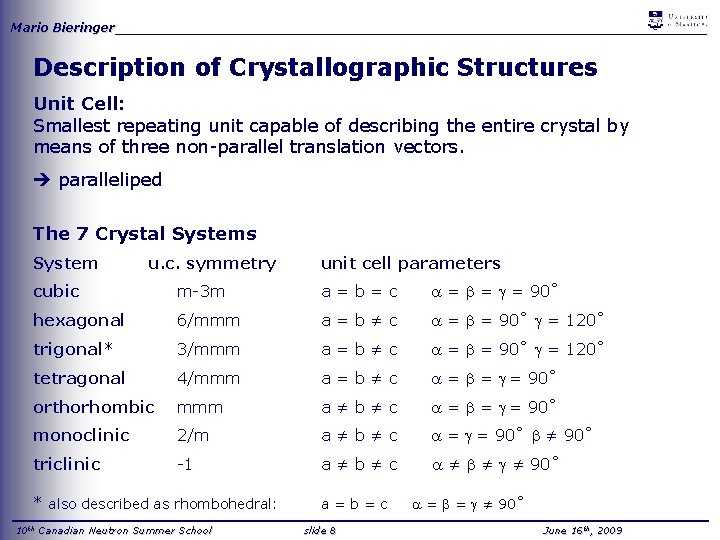
Mario Bieringer_____________________________________ Description of Crystallographic Structures Unit Cell: Smallest repeating unit capable of describing the entire crystal by means of three non-parallel translation vectors. paralleliped The 7 Crystal Systems System u. c. symmetry unit cell parameters cubic m-3 m a=b=c a = b = g = 90˚ hexagonal 6/mmm a=b≠c a = b = 90˚ g = 120˚ trigonal* 3/mmm a=b≠c a = b = 90˚ g = 120˚ tetragonal 4/mmm a=b≠c a = b = g = 90˚ orthorhombic mmm a≠b≠c a = b = g = 90˚ monoclinic 2/m a≠b≠c a = g = 90˚ b ≠ 90˚ triclinic -1 a≠b≠c a ≠ b ≠ g ≠ 90˚ * also described as rhombohedral: a=b=c a = b = g ≠ 90˚ _____________________________ 10 th Canadian Neutron Summer School slide 8 June 16 th, 2009
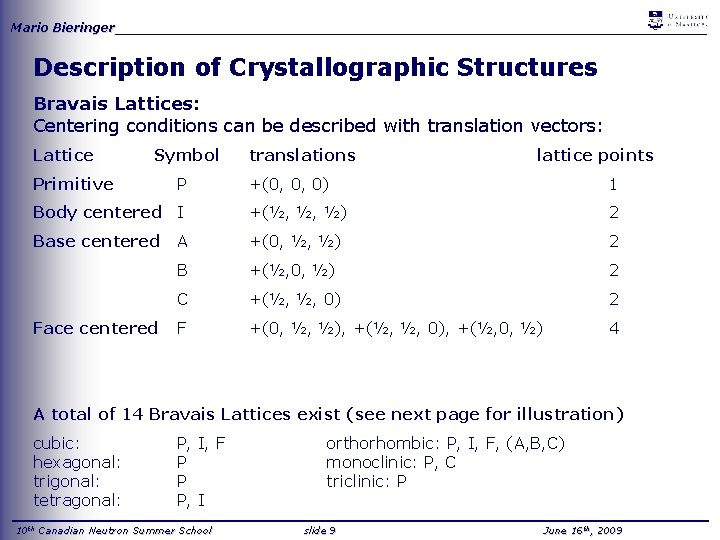
Mario Bieringer_____________________________________ Description of Crystallographic Structures Bravais Lattices: Centering conditions can be described with translation vectors: Lattice Symbol Primitive lattice points +(0, 0, 0) 1 Body centered I +(½, ½, ½) 2 Base centered A +(0, ½, ½) 2 B +(½, 0, ½) 2 C +(½, ½, 0) 2 F +(0, ½, ½), +(½, ½, 0), +(½, 0, ½) 4 Face centered P translations A total of 14 Bravais Lattices exist (see next page for illustration) cubic: hexagonal: trigonal: tetragonal: P, I, F P P P, I orthorhombic: P, I, F, (A, B, C) monoclinic: P, C triclinic: P _____________________________ 10 th Canadian Neutron Summer School slide 9 June 16 th, 2009
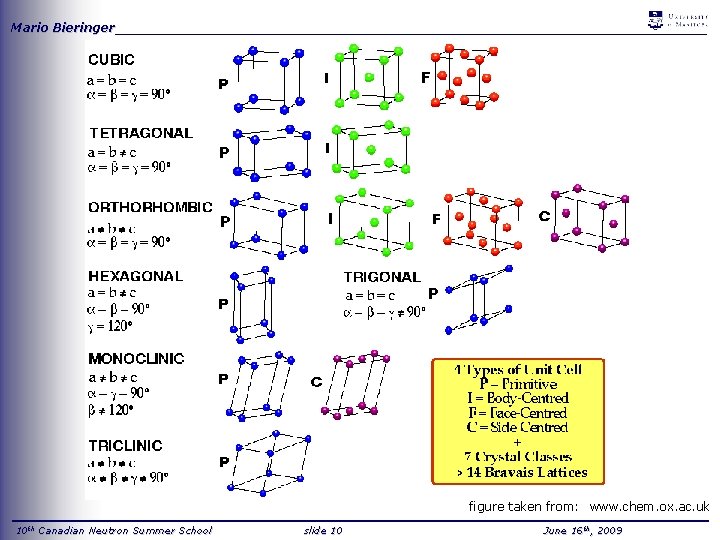
Mario Bieringer_____________________________________ figure taken from: www. chem. ox. ac. uk _____________________________ 10 th Canadian Neutron Summer School slide 10 June 16 th, 2009
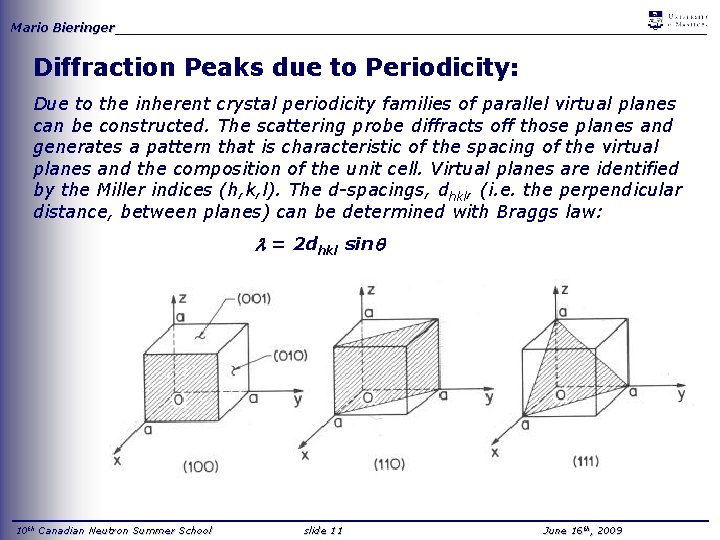
Mario Bieringer_____________________________________ Diffraction Peaks due to Periodicity: Due to the inherent crystal periodicity families of parallel virtual planes can be constructed. The scattering probe diffracts off those planes and generates a pattern that is characteristic of the spacing of the virtual planes and the composition of the unit cell. Virtual planes are identified by the Miller indices (h, k, l). The d-spacings, dhkl, (i. e. the perpendicular distance, between planes) can be determined with Braggs law: l = 2 dhkl sinq _____________________________ 10 th Canadian Neutron Summer School slide 11 June 16 th, 2009
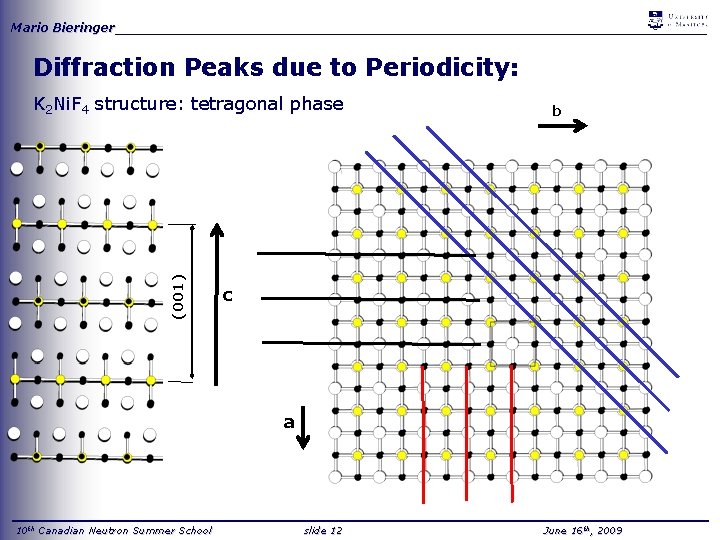
Mario Bieringer_____________________________________ Diffraction Peaks due to Periodicity: (001) K 2 Ni. F 4 structure: tetragonal phase b c a _____________________________ 10 th Canadian Neutron Summer School slide 12 June 16 th, 2009
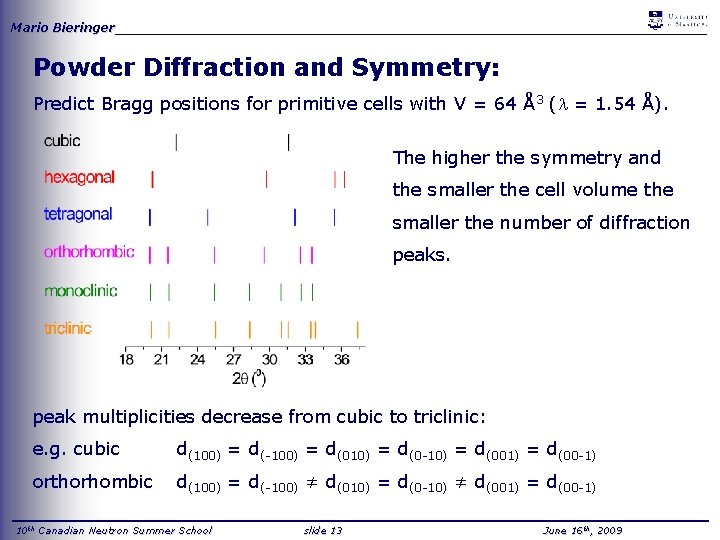
Mario Bieringer_____________________________________ Powder Diffraction and Symmetry: Predict Bragg positions for primitive cells with V = 64 Å 3 (l = 1. 54 Å). The higher the symmetry and the smaller the cell volume the smaller the number of diffraction peaks. peak multiplicities decrease from cubic to triclinic: e. g. cubic d(100) = d(-100) = d(010) = d(0 -10) = d(001) = d(00 -1) orthorhombic d(100) = d(-100) ≠ d(010) = d(0 -10) ≠ d(001) = d(00 -1) _____________________________ 10 th Canadian Neutron Summer School slide 13 June 16 th, 2009
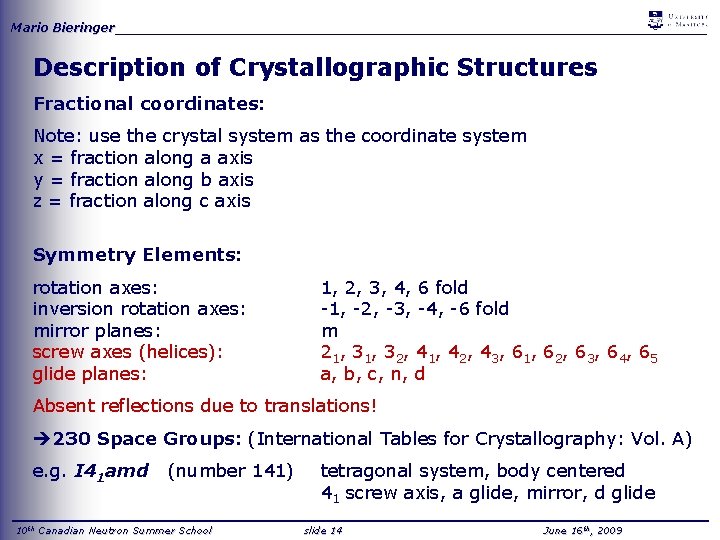
Mario Bieringer_____________________________________ Description of Crystallographic Structures Fractional coordinates: Note: use the crystal system as the coordinate system x = fraction along a axis y = fraction along b axis z = fraction along c axis Symmetry Elements: rotation axes: inversion rotation axes: mirror planes: screw axes (helices): glide planes: 1, 2, 3, 4, 6 fold -1, -2, -3, -4, -6 fold m 21, 32, 41, 42, 43, 61, 62, 63, 64, 65 a, b, c, n, d Absent reflections due to translations! 230 Space Groups: (International Tables for Crystallography: Vol. A) e. g. I 41 amd (number 141) tetragonal system, body centered 41 screw axis, a glide, mirror, d glide _____________________________ 10 th Canadian Neutron Summer School slide 14 June 16 th, 2009
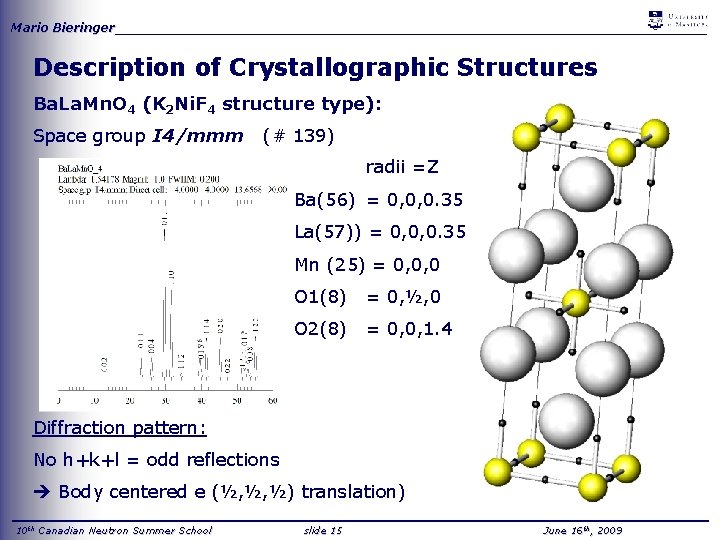
Mario Bieringer_____________________________________ Description of Crystallographic Structures Ba. La. Mn. O 4 (K 2 Ni. F 4 structure type): Space group I 4/mmm (# 139) radii =Z Ba(56) = 0, 0, 0. 35 La(57)) = 0, 0, 0. 35 Mn (25) = 0, 0, 0 O 1(8) = 0, ½, 0 O 2(8) = 0, 0, 1. 4 Diffraction pattern: No h+k+l = odd reflections Body centered e (½, ½, ½) translation) _____________________________ 10 th Canadian Neutron Summer School slide 15 June 16 th, 2009
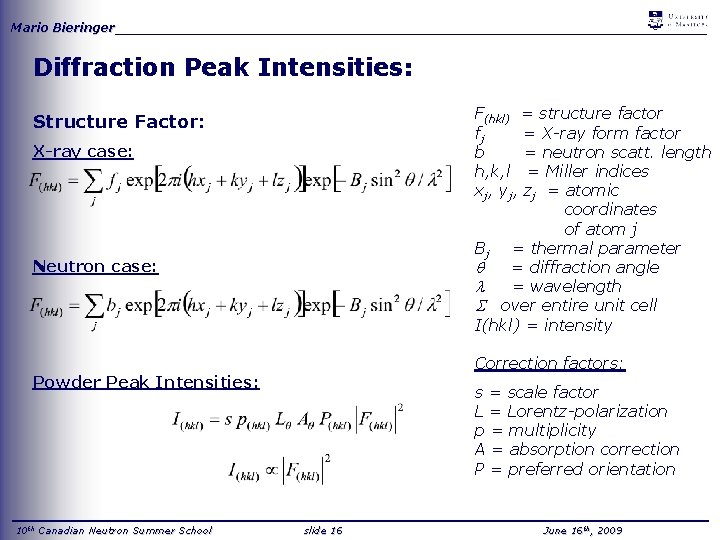
Mario Bieringer_____________________________________ Diffraction Peak Intensities: F(hkl) = structure factor fj = X-ray form factor b = neutron scatt. length h, k, l = Miller indices xj, yj, zj = atomic coordinates of atom j Bj = thermal parameter q = diffraction angle l = wavelength S over entire unit cell I(hkl) = intensity Structure Factor: X-ray case: Neutron case: Correction factors: Powder Peak Intensities: s = scale factor L = Lorentz-polarization p = multiplicity A = absorption correction P = preferred orientation _____________________________ 10 th Canadian Neutron Summer School slide 16 June 16 th, 2009
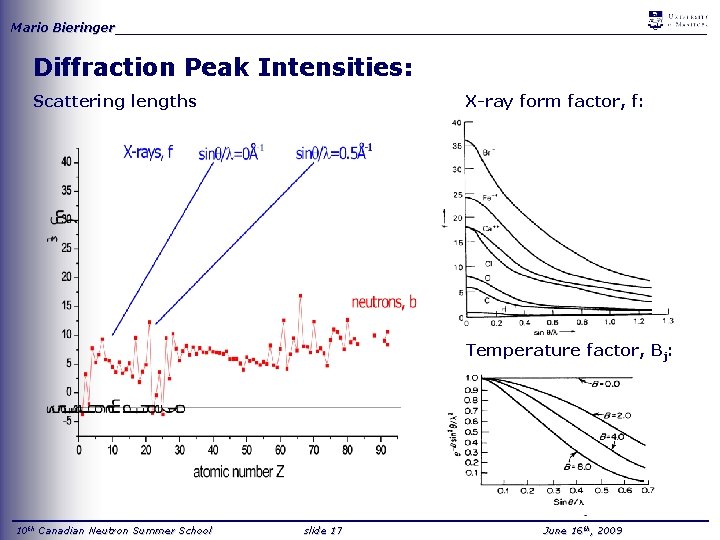
Mario Bieringer_____________________________________ Diffraction Peak Intensities: Scattering lengths X-ray form factor, f: Temperature factor, Bj: _____________________________ 10 th Canadian Neutron Summer School slide 17 June 16 th, 2009

Mario Bieringer_____________________________________ Description of Crystallographic Structures Ba. La. Mn. O 4 (K 2 Ni. F 4 structure type): b atom=x, y, z Z 5. 07 fm Ba=0, 0, 0. 35 56 e 8. 24 fm La=0, 0, 0. 35 57 e -3. 73 fm Mn=0, 0, 0 25 e 5. 80 fm O 1=0, ½, 0 8 e 5. 80 fm O 2=0, 0, 1. 4 8 e _____________________________ 10 th Canadian Neutron Summer School slide 18 June 16 th, 2009
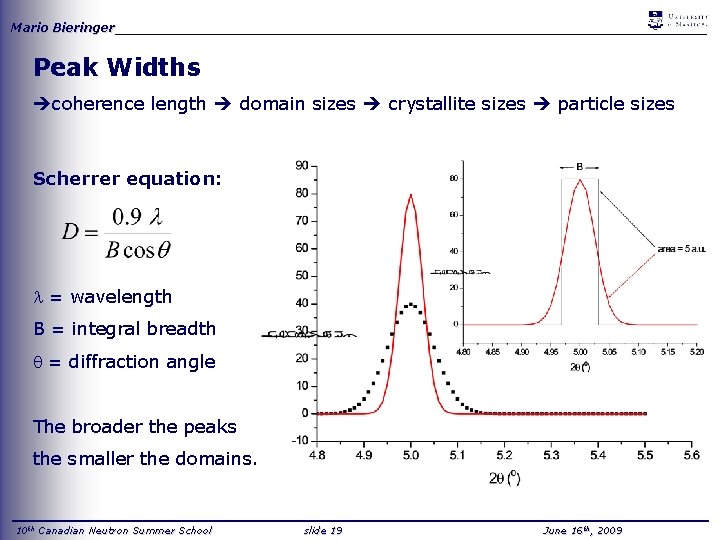
Mario Bieringer_____________________________________ Peak Widths coherence length domain sizes crystallite sizes particle sizes Scherrer equation: l = wavelength B = integral breadth q = diffraction angle The broader the peaks the smaller the domains. _____________________________ 10 th Canadian Neutron Summer School slide 19 June 16 th, 2009
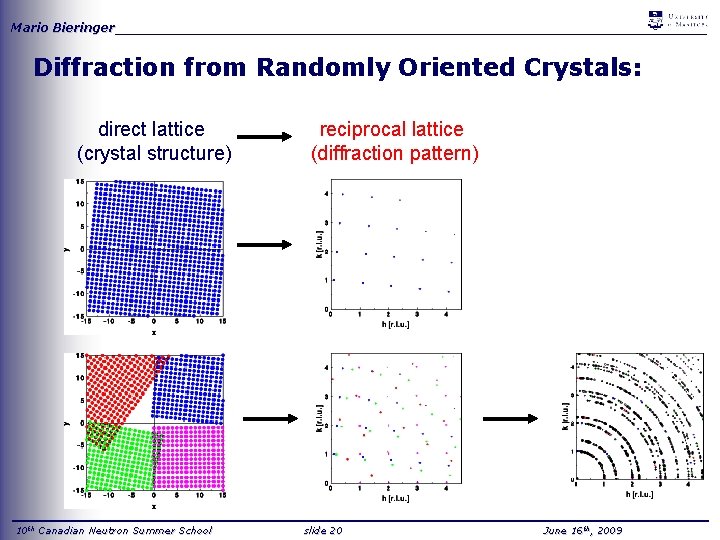
Mario Bieringer_____________________________________ Diffraction from Randomly Oriented Crystals: direct lattice (crystal structure) reciprocal lattice (diffraction pattern) _____________________________ 10 th Canadian Neutron Summer School slide 20 June 16 th, 2009
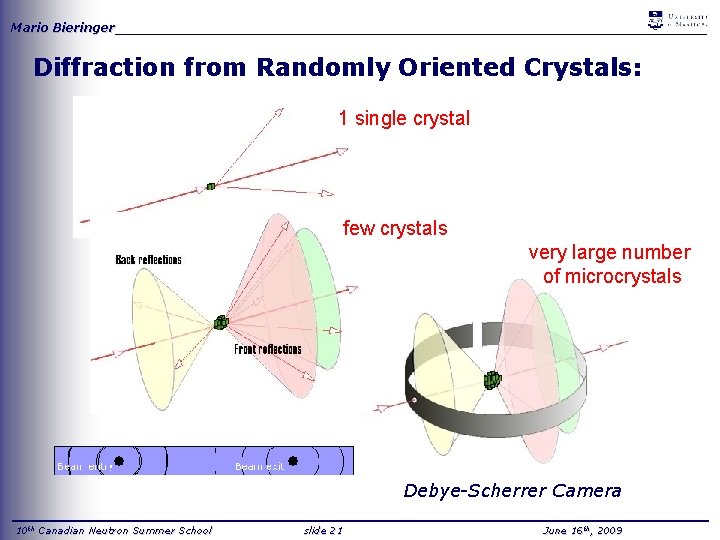
Mario Bieringer_____________________________________ Diffraction from Randomly Oriented Crystals: 1 single crystal few crystals very large number of microcrystals Debye-Scherrer Camera _____________________________ 10 th Canadian Neutron Summer School slide 21 June 16 th, 2009
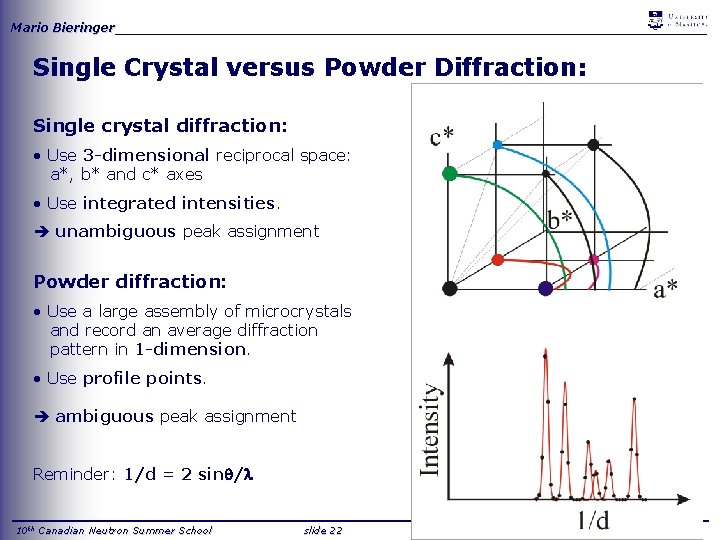
Mario Bieringer_____________________________________ Single Crystal versus Powder Diffraction: Single crystal diffraction: • Use 3 -dimensional reciprocal space: a*, b* and c* axes • Use integrated intensities. unambiguous peak assignment Powder diffraction: • Use a large assembly of microcrystals and record an average diffraction pattern in 1 -dimension. • Use profile points. ambiguous peak assignment Reminder: 1/d = 2 sinq/l _____________________________ 10 th Canadian Neutron Summer School slide 22 June 16 th, 2009

Mario Bieringer_____________________________________ Powder diffraction: • Information gets buried in powder average. • Try to extract peak intensities or fit the entire profile. Rietveld Method _____________________________ 10 th Canadian Neutron Summer School slide 23 June 16 th, 2009
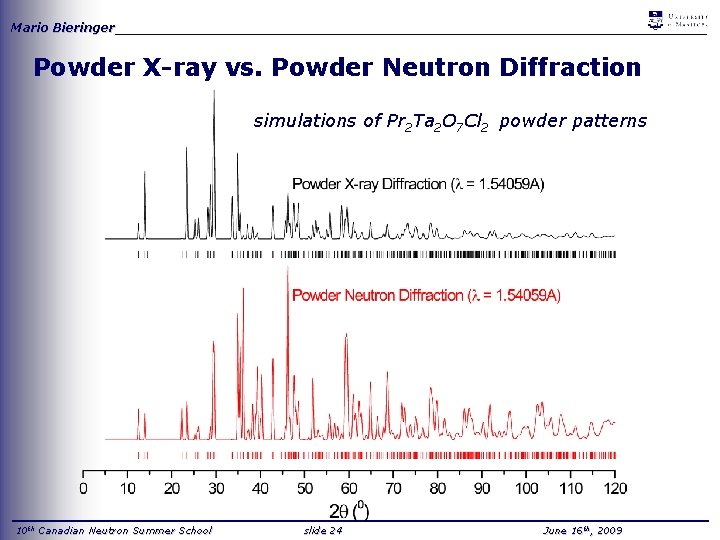
Mario Bieringer_____________________________________ Powder X-ray vs. Powder Neutron Diffraction simulations of Pr 2 Ta 2 O 7 Cl 2 powder patterns _____________________________ 10 th Canadian Neutron Summer School slide 24 June 16 th, 2009
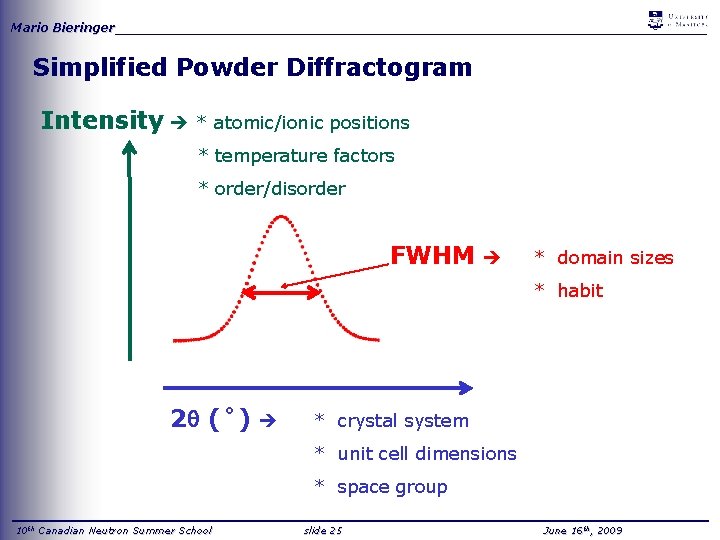
Mario Bieringer_____________________________________ Simplified Powder Diffractogram Intensity * atomic/ionic positions * temperature factors * order/disorder FWHM * domain sizes * habit 2 q (˚) * crystal system * unit cell dimensions * space group _____________________________ 10 th Canadian Neutron Summer School slide 25 June 16 th, 2009
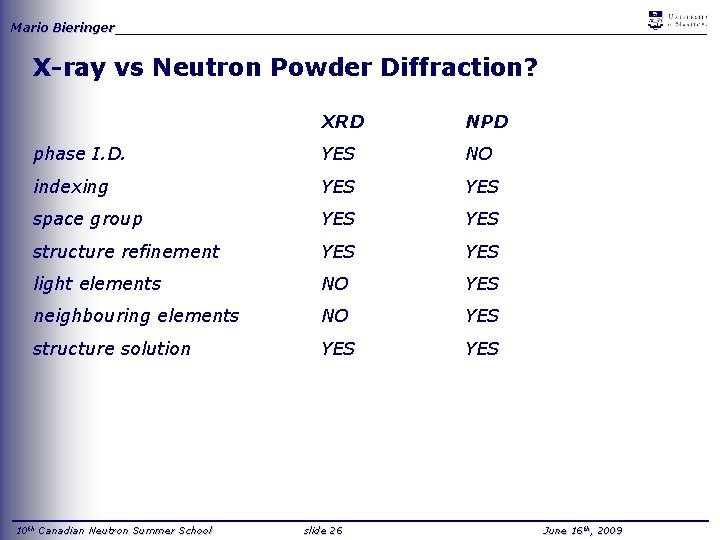
Mario Bieringer_____________________________________ X-ray vs Neutron Powder Diffraction? XRD NPD phase I. D. YES NO indexing YES space group YES structure refinement YES light elements NO YES neighbouring elements NO YES structure solution YES _____________________________ 10 th Canadian Neutron Summer School slide 26 June 16 th, 2009
Mario Bieringer_____________________________________ When to Use Neutrons: Ideally: always (most structure determinations and refinements benefit from independent measurements (X-ray + neutron)) In particular: • light and heavy elements present (e. g. oxides, fluoride, hydrides (deuterides) of heavy metals) • neighbouring elements: e. g. Al & Si, Fe & Co, Yb & Lu, Ti & V, etc. • multiple site occupancies: e. g. disordered structures • interest in true bulk properties (i. e averaging over large samples) • complex experimental set ups: chemical reactions, high temperatures, high pressures, low temperatures, magnetic fields, electrochemical cells, chemical/structural processes etc. • magnetic samples • etc. _____________________________ 10 th Canadian Neutron Summer School slide 27 June 16 th, 2009
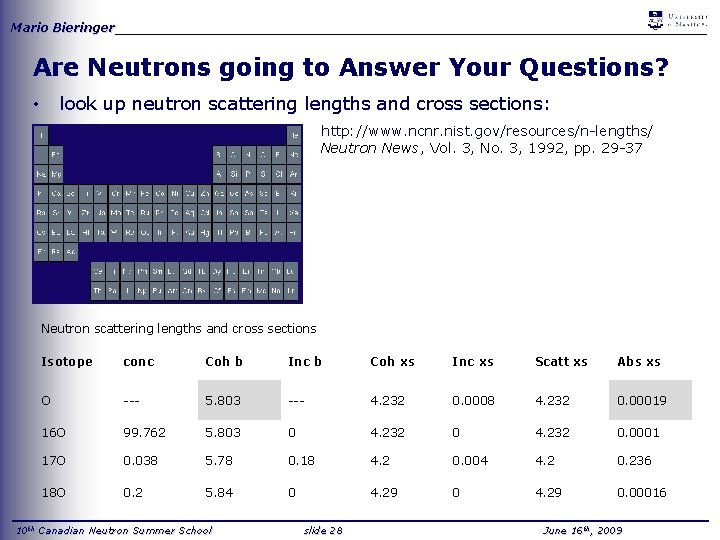
Mario Bieringer_____________________________________ Are Neutrons going to Answer Your Questions? look up neutron scattering lengths and cross sections: • http: //www. ncnr. nist. gov/resources/n-lengths/ Neutron News, Vol. 3, No. 3, 1992, pp. 29 -37 Neutron scattering lengths and cross sections Isotope conc Coh b Inc b Coh xs Inc xs Scatt xs Abs xs O --- 5. 803 --- 4. 232 0. 0008 4. 232 0. 00019 16 O 99. 762 5. 803 0 4. 232 0. 0001 17 O 0. 038 5. 78 0. 18 4. 2 0. 004 4. 2 0. 236 18 O 0. 2 5. 84 0 4. 29 0. 00016 _____________________________ 10 th Canadian Neutron Summer School slide 28 June 16 th, 2009
Mario Bieringer_____________________________________ Are Neutrons going to Answer Your Questions? La. Fe. As(O 1−x. Fx) Li. Co. O 2, Li. Ni 1 -x. Cox. O 2, Li. Mn 2 O 4 b(La=57) = 8. 24 fm b(Li=3) = -1. 90 fm b(Fe=26) = 6. 58 fm b(Co=27) = 2. 49 fm b(As=33) = 9. 45 fm b(Ni=28) = 10. 3 fm b(O=8) = 5. 803 fm b(Mn=25) = -3. 73 fm b(F=9) = 5. 654 fm b(O=8) = 5. 803 fm Bi. Fe. O 3, Ba. Ti. O 3, Ln. Mn. O 3 La 0. 9 Ba 0. 1 Ga 0. 8 Mg 0. 2 O 2. 8 b(Bi=83) = 8. 532 fm b(La=57) = 8. 24 fm b(Fe 26) = 6. 58 fm b(Ba=56) = 5. 07 fm b(O=8) = 5. 803 fm b(Ga=31) = 7. 288 fm b(Mg=12) = 5. 375 fm _____________________________ 10 th Canadian Neutron Summer School slide 29 June 16 th, 2009
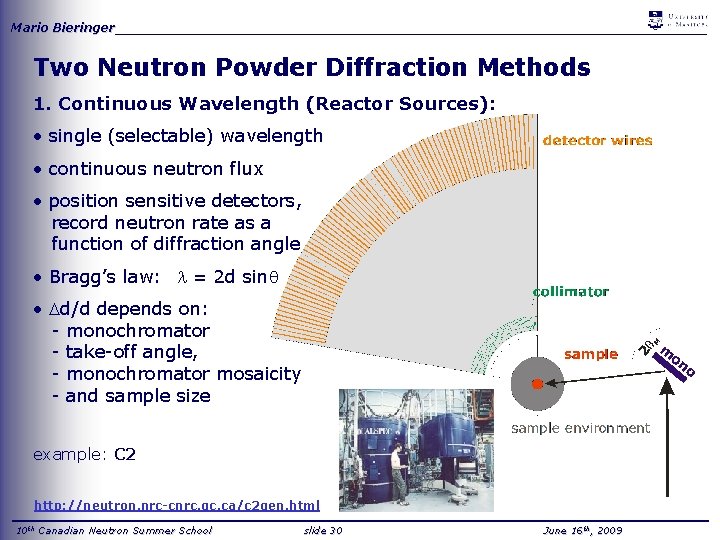
Mario Bieringer_____________________________________ Two Neutron Powder Diffraction Methods 1. Continuous Wavelength (Reactor Sources): • single (selectable) wavelength • continuous neutron flux • position sensitive detectors, record neutron rate as a function of diffraction angle • Bragg’s law: l = 2 d sinq • Dd/d depends on: - monochromator - take-off angle, - monochromator mosaicity - and sample size example: C 2 http: //neutron. nrc-cnrc. gc. ca/c 2 gen. html _____________________________ 10 th Canadian Neutron Summer School slide 30 June 16 th, 2009
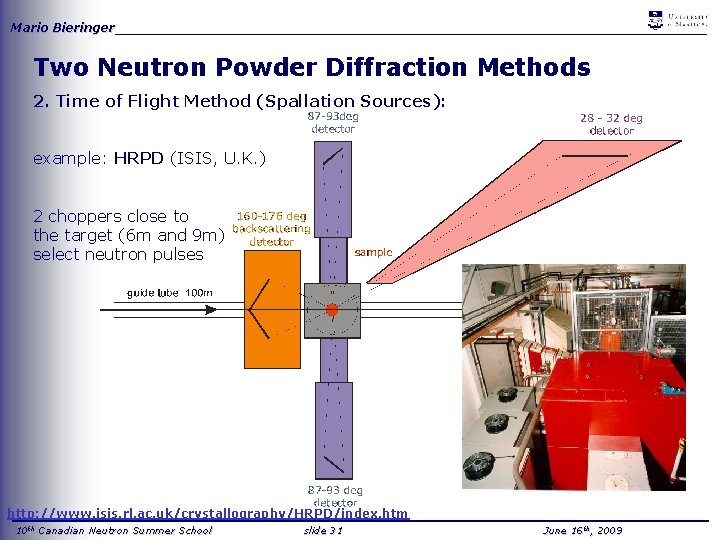
Mario Bieringer_____________________________________ Two Neutron Powder Diffraction Methods 2. Time of Flight Method (Spallation Sources): example: HRPD (ISIS, U. K. ) 2 choppers close to the target (6 m and 9 m) select neutron pulses _____________________________ http: //www. isis. rl. ac. uk/crystallography/HRPD/index. htm 10 th Canadian Neutron Summer School slide 31 June 16 th, 2009
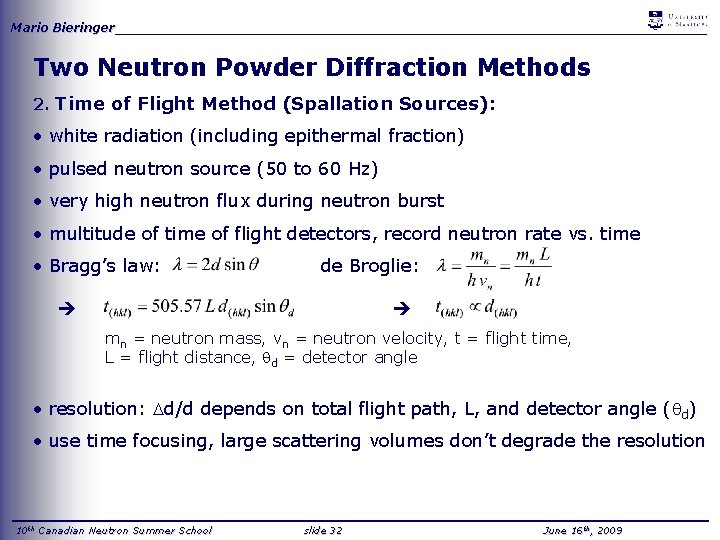
Mario Bieringer_____________________________________ Two Neutron Powder Diffraction Methods 2. Time of Flight Method (Spallation Sources): • white radiation (including epithermal fraction) • pulsed neutron source (50 to 60 Hz) • very high neutron flux during neutron burst • multitude of time of flight detectors, record neutron rate vs. time • Bragg’s law: de Broglie: mn = neutron mass, vn = neutron velocity, t = flight time, L = flight distance, qd = detector angle • resolution: Dd/d depends on total flight path, L, and detector angle (qd) • use time focusing, large scattering volumes don’t degrade the resolution _____________________________ 10 th Canadian Neutron Summer School slide 32 June 16 th, 2009
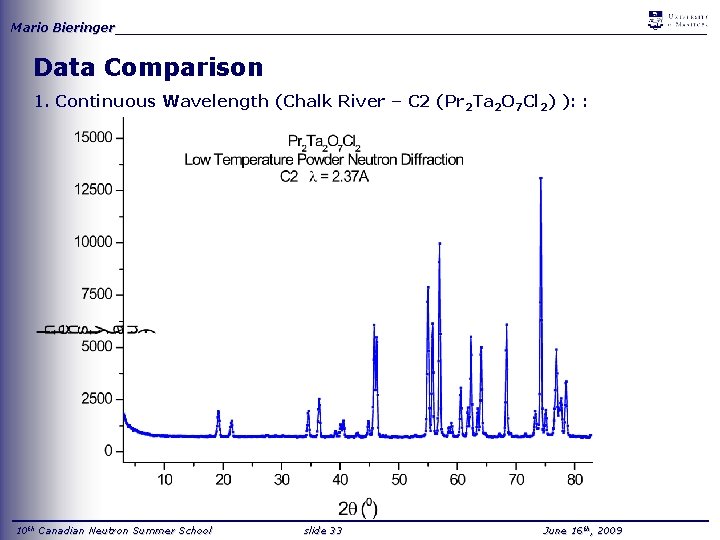
Mario Bieringer_____________________________________ Data Comparison 1. Continuous Wavelength (Chalk River – C 2 (Pr 2 Ta 2 O 7 Cl 2) ): : _____________________________ 10 th Canadian Neutron Summer School slide 33 June 16 th, 2009
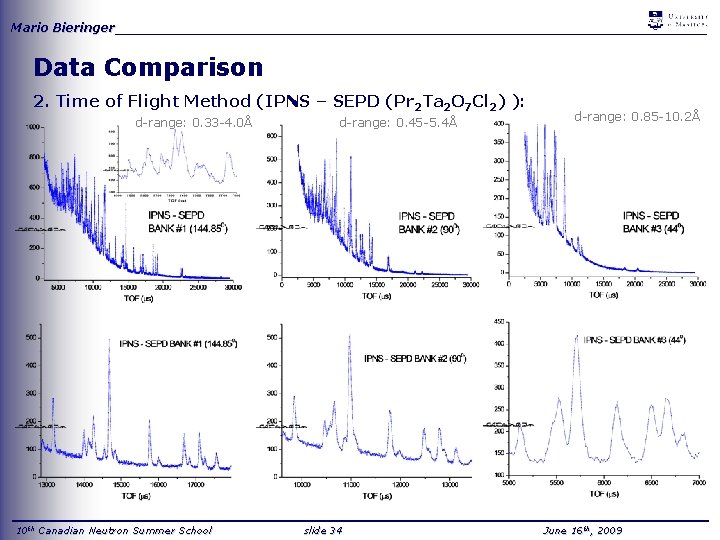
Mario Bieringer_____________________________________ Data Comparison 2. Time of Flight Method (IPNS – SEPD (Pr 2 Ta 2 O 7 Cl 2) ): d-range: 0. 33 -4. 0Å d-range: 0. 45 -5. 4Å d-range: 0. 85 -10. 2Å _____________________________ 10 th Canadian Neutron Summer School slide 34 June 16 th, 2009
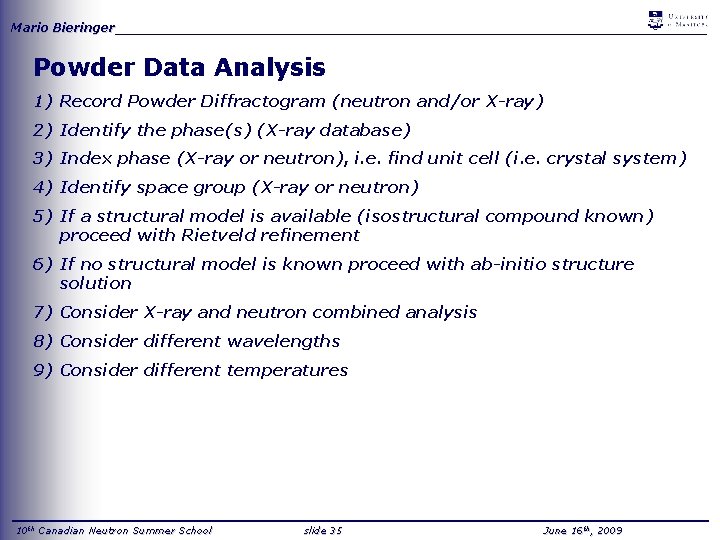
Mario Bieringer_____________________________________ Powder Data Analysis 1) Record Powder Diffractogram (neutron and/or X-ray) 2) Identify the phase(s) (X-ray database) 3) Index phase (X-ray or neutron), i. e. find unit cell (i. e. crystal system) 4) Identify space group (X-ray or neutron) 5) If a structural model is available (isostructural compound known) proceed with Rietveld refinement 6) If no structural model is known proceed with ab-initio structure solution 7) Consider X-ray and neutron combined analysis 8) Consider different wavelengths 9) Consider different temperatures _____________________________ 10 th Canadian Neutron Summer School slide 35 June 16 th, 2009

Mario Bieringer_____________________________________ Rietveld Method Profile Fitting Method: 1. use a crystallographic model and compute the corresponding powder diffraction pattern 2. compare simullation with experimental diffraction data 3. minimize the difference between experimental and calculated diffraction pattern in a least squares refinement by varying a number of parameters: minimize: wi = 1/yi yi = observed intensity yci = calculated intensity s = scale factor, L(hkl) = Lorentz, polarization and multipicity factors f(2 qi-2 q(hkl)) = reflection profile function, P(hkl) = preferred orientation function, A = absorption factor, F(hkl) = structure factor, ybi = background intensity _____________________________ 10 th Canadian Neutron Summer School slide 36 June 16 th, 2009
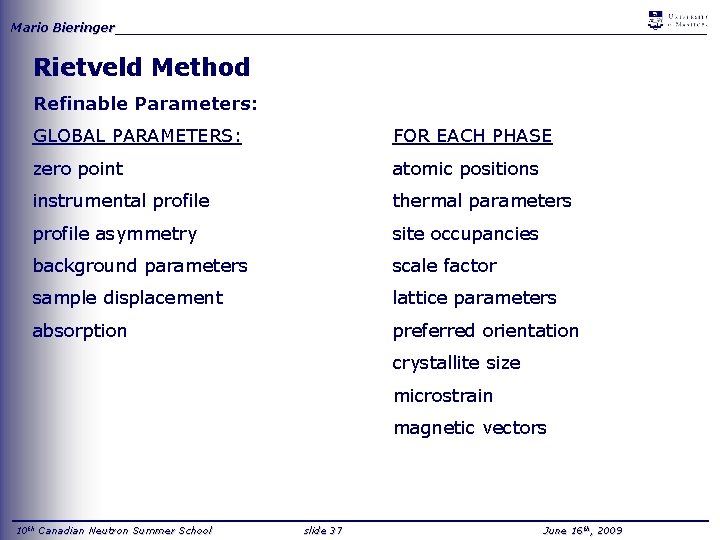
Mario Bieringer_____________________________________ Rietveld Method Refinable Parameters: GLOBAL PARAMETERS: FOR EACH PHASE zero point atomic positions instrumental profile thermal parameters profile asymmetry site occupancies background parameters scale factor sample displacement lattice parameters absorption preferred orientation crystallite size microstrain magnetic vectors _____________________________ 10 th Canadian Neutron Summer School slide 37 June 16 th, 2009
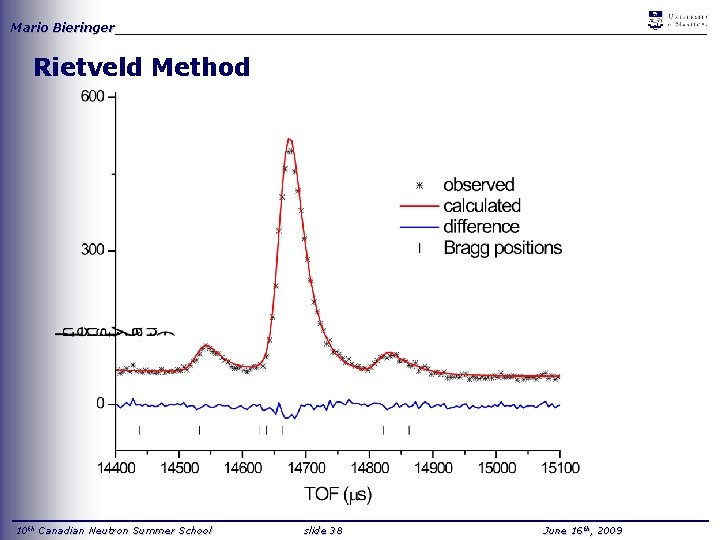
Mario Bieringer_____________________________________ Rietveld Method _____________________________ 10 th Canadian Neutron Summer School slide 38 June 16 th, 2009
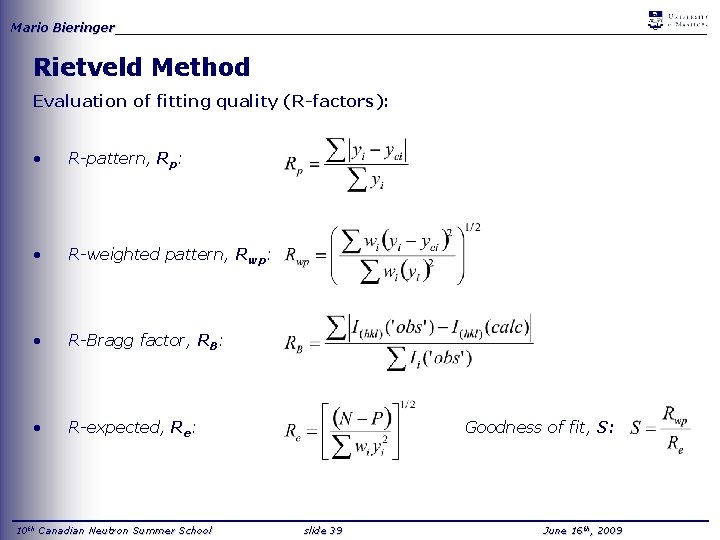
Mario Bieringer_____________________________________ Rietveld Method Evaluation of fitting quality (R-factors): • R-pattern, Rp: • R-weighted pattern, Rwp: • R-Bragg factor, RB: • R-expected, Re: Goodness of fit, S: _____________________________ 10 th Canadian Neutron Summer School slide 39 June 16 th, 2009

Mario Bieringer_____________________________________ Rietveld Method A large number of Rietveld programs are available: To a large extent these programs have similar capabilities with individual strengths: Rietveld Programs: GSAS Full. Prof Rietica Rietan BGMN TOPAS etc. http: //www. ccp 14. ac. uk/ _____________________________ 10 th Canadian Neutron Summer School slide 40 June 16 th, 2009
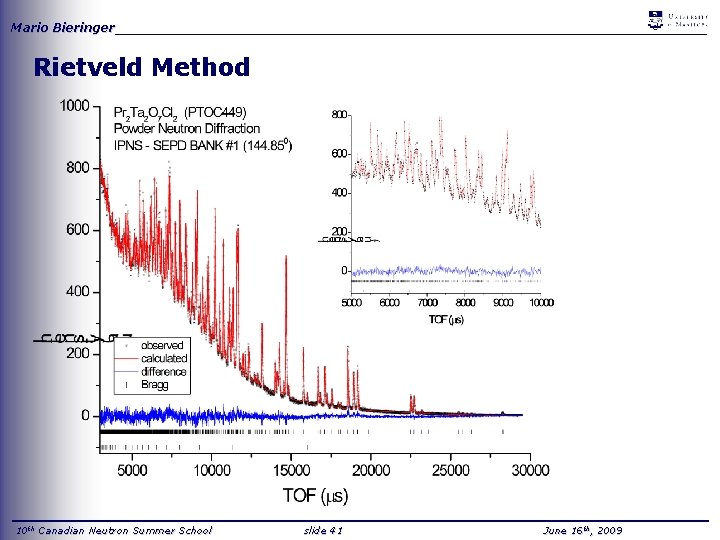
Mario Bieringer_____________________________________ Rietveld Method _____________________________ 10 th Canadian Neutron Summer School slide 41 June 16 th, 2009
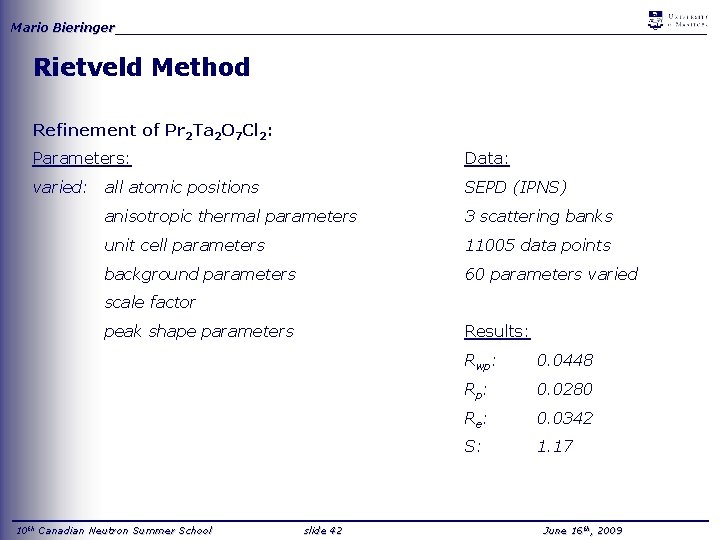
Mario Bieringer_____________________________________ Rietveld Method Refinement of Pr 2 Ta 2 O 7 Cl 2: Parameters: Data: varied: all atomic positions SEPD (IPNS) anisotropic thermal parameters 3 scattering banks unit cell parameters 11005 data points background parameters 60 parameters varied scale factor peak shape parameters Results: Rwp: 0. 0448 Rp : 0. 0280 Re: 0. 0342 S: 1. 17 _____________________________ 10 th Canadian Neutron Summer School slide 42 June 16 th, 2009
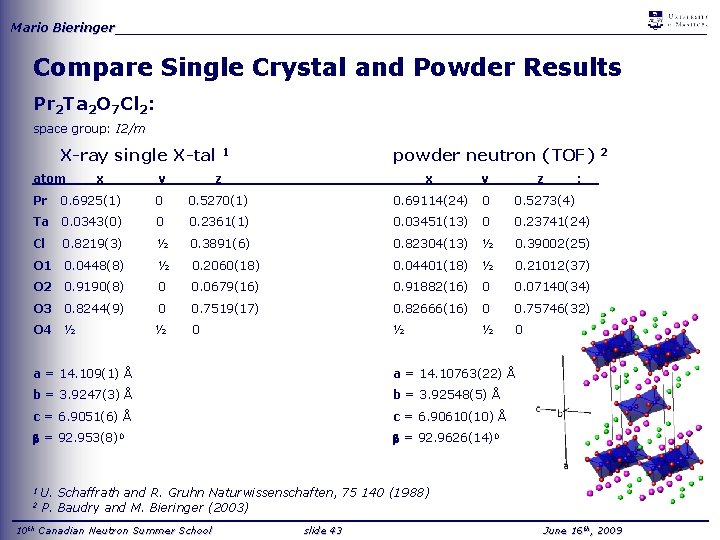
Mario Bieringer_____________________________________ Compare Single Crystal and Powder Results Pr 2 Ta 2 O 7 Cl 2: space group: I 2/m X-ray single X-tal atom x y powder neutron (TOF) 1 z_____ x y z : Pr 0. 6925(1) 0 0. 5270(1) 0. 69114(24) 0 0. 5273(4) Ta 0. 0343(0) 0 0. 2361(1) 0. 03451(13) 0 0. 23741(24) Cl 0. 8219(3) ½ 0. 3891(6) 0. 82304(13) ½ 0. 39002(25) O 1 0. 0448(8) ½ 0. 2060(18) 0. 04401(18) ½ 0. 21012(37) O 2 0. 9190(8) 0 0. 0679(16) 0. 91882(16) 0 0. 07140(34) O 3 0. 8244(9) 0 0. 7519(17) 0. 82666(16) 0 0. 75746(32) O 4 ½ ½ 0 a = 14. 109(1) Å a = 14. 10763(22) Å b = 3. 9247(3) Å b = 3. 92548(5) Å c = 6. 9051(6) Å c = 6. 90610(10) Å b = 92. 953(8)0 b = 92. 9626(14)0 1 2 U. Schaffrath and R. Gruhn Naturwissenschaften, 75 140 (1988) P. Baudry and M. Bieringer (2003) _____________________________ 2 10 th Canadian Neutron Summer School slide 43 June 16 th, 2009
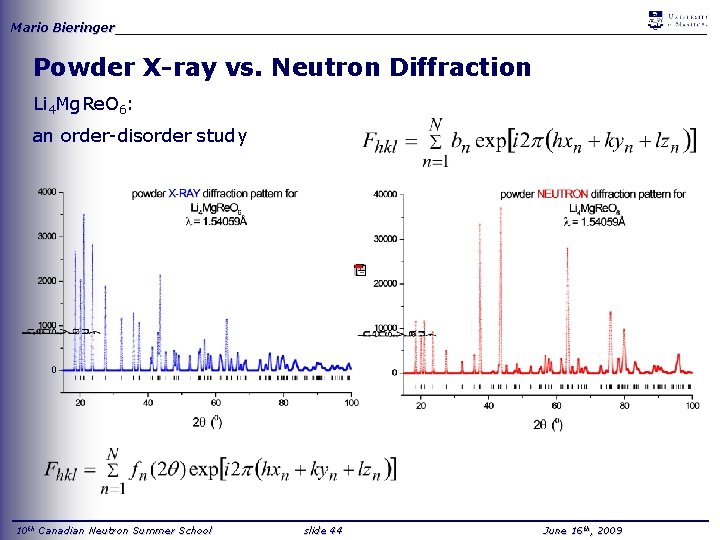
Mario Bieringer_____________________________________ Powder X-ray vs. Neutron Diffraction Li 4 Mg. Re. O 6: an order-disorder study _____________________________ 10 th Canadian Neutron Summer School slide 44 June 16 th, 2009
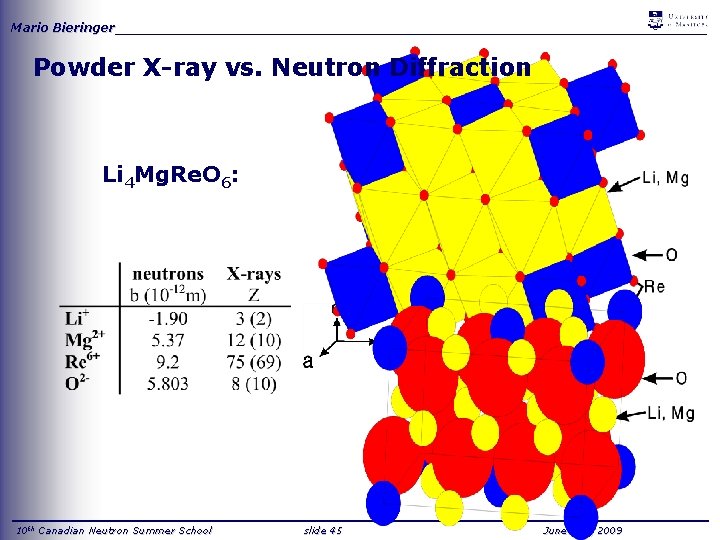
Mario Bieringer_____________________________________ Powder X-ray vs. Neutron Diffraction Li 4 Mg. Re. O 6: _____________________________ 10 th Canadian Neutron Summer School slide 45 June 16 th, 2009
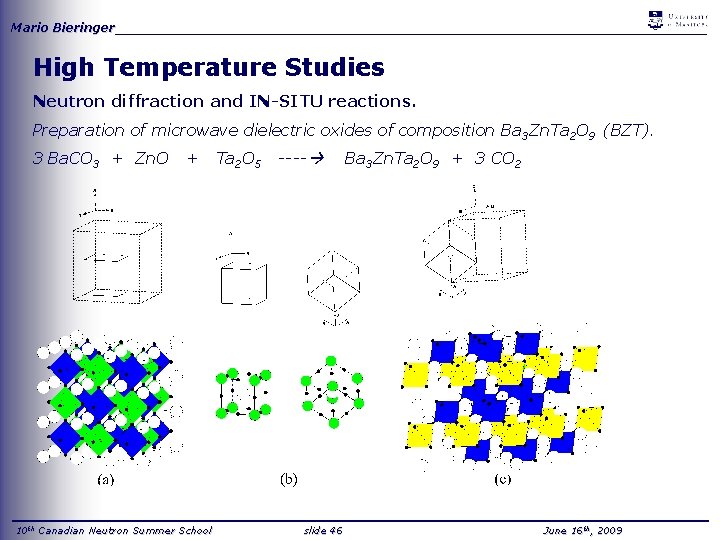
Mario Bieringer_____________________________________ High Temperature Studies Neutron diffraction and IN-SITU reactions. Preparation of microwave dielectric oxides of composition Ba 3 Zn. Ta 2 O 9 (BZT). 3 Ba. CO 3 + Zn. O + Ta 2 O 5 ---- Ba 3 Zn. Ta 2 O 9 + 3 CO 2 _____________________________ 10 th Canadian Neutron Summer School slide 46 June 16 th, 2009

Mario Bieringer_____________________________________ High Temperature Studies Only a high flux neutron diffractometer will permit collection of diffraction patterns within one 1 minute. GEM (ISIS, U. K. ) TOF instrument with more than 6000 detectors and medium resolution (18 – 20 m flight path). _____________________________ 10 th Canadian Neutron Summer School slide 47 June 16 th, 2009
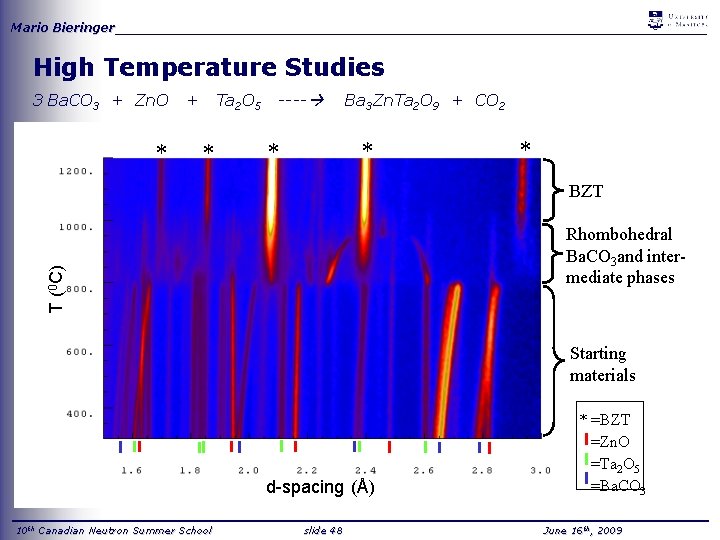
Mario Bieringer_____________________________________ High Temperature Studies 3 Ba. CO 3 + Zn. O * + Ta 2 O 5 * ---- Ba 3 Zn. Ta 2 O 9 + CO 2 * * * BZT T (0 C) Rhombohedral Ba. CO 3 and intermediate phases Starting materials d-spacing (Å) * =BZT =Zn. O =Ta 2 O 5 =Ba. CO 3 _____________________________ 10 th Canadian Neutron Summer School slide 48 June 16 th, 2009
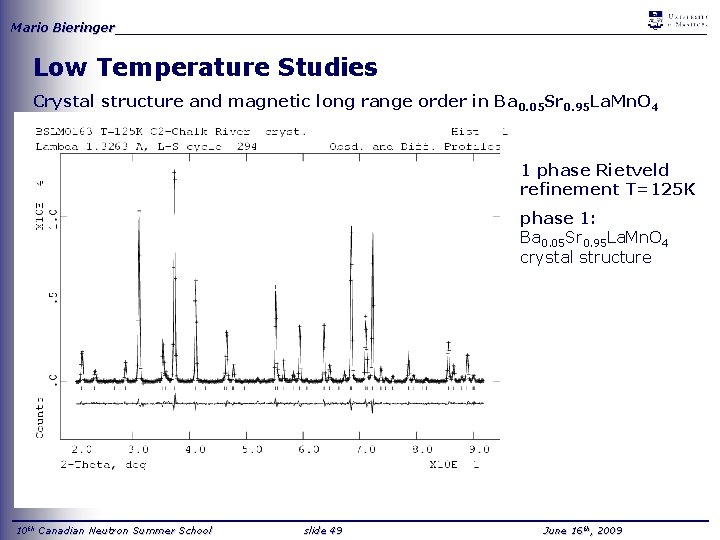
Mario Bieringer_____________________________________ Low Temperature Studies Crystal structure and magnetic long range order in Ba 0. 05 Sr 0. 95 La. Mn. O 4 1 phase Rietveld refinement T=125 K phase 1: Ba 0. 05 Sr 0. 95 La. Mn. O 4 crystal structure _____________________________ 10 th Canadian Neutron Summer School slide 49 June 16 th, 2009
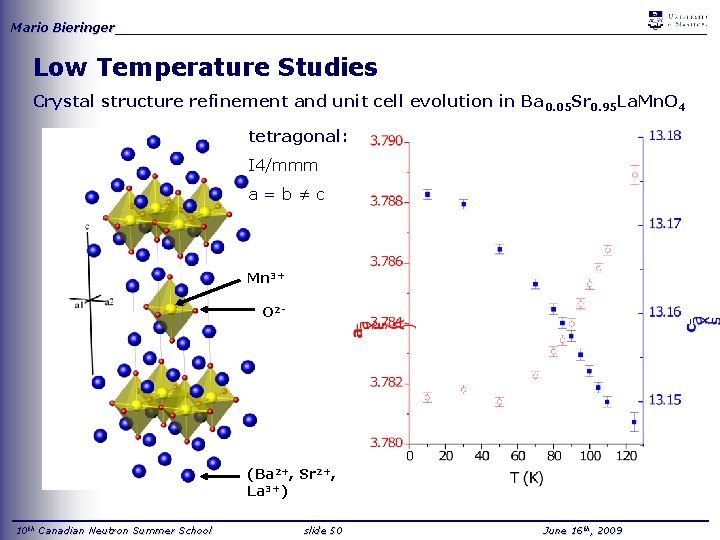
Mario Bieringer_____________________________________ Low Temperature Studies Crystal structure refinement and unit cell evolution in Ba 0. 05 Sr 0. 95 La. Mn. O 4 tetragonal: I 4/mmm a=b≠c Mn 3+ O 2 - (Ba 2+, Sr 2+, La 3+) _____________________________ 10 th Canadian Neutron Summer School slide 50 June 16 th, 2009
Mario Bieringer_____________________________________ Resources R. A. Young, ‘The Rietveld Method’, IUCr Monographs on Crystallography 5, Oxford University Press, New York (1993) W. I. F. David, K. Shankland, L. B. Mc. Cusker, Ch. Baerlocher, ‘Structure Determination from Powder Diffraction Data’, IUCr Monographs on Crystallography 13, Oxford University Press, New York (1993) J. Baruchel, J. L. Hodeau, M. S. Lehmann, J. R. Regnard, C. Schlenker, ‘ Neutron and Synchrotron Radiation for Condensed Matter Studies’, Volume 1, 2 and 3, Springer Verlag, Berlin (1993) G. E. Bacon, ‘Neutron Diffraction’, Claredon Press, Oxford, 3 rd edition (1975) Allen C. Larson, Robert von Dreele, ‘GSAS - General Structure Analysis System’ Juan Rodriguz-Carvajal, ‘An Introduction to the Program FULLPROF 2000’, Saclay, 2001 (ftp: //ftp. cea. fr/pub/llb/divers/fullprof. 2 k/ ) Mark Ladd, Rex Palmer, ‘Structure Determination by X-Ray Crystallography’, Kluwer Academic, New York, 2003, 4 th Edition Vitalij K. Pecharsky, Peter Y. Zavalij, ‘Fundamentals of Powder Diffraction and Structural Characterization of Materials’, Springer, 2005 G. L. Squires, ‘Introduction to theory of thermal neutron scattering’, Dover Publications, New York, 1978 Georg Will, ‘Powder Diffraction: The Rietveld Method and the Two-Stage Method’, Springer, Heidelberg, 2006 Abraham Clearfield, Joseph Reibenspies, Nattamai Bhuvanesh, ‘Principles and Applications of Powder Diffraction’ Wiley, 2008 Rietveld program downloads, manuals and tutorials can be found at: http: //www. ccp 14. ac. uk More: Structures: http: //www. chem. ox. ac. uk/icl/heyes/structure_of_solids/lecture 1/Lec 1. html _____________________________ 10 th Canadian Neutron Summer School slide 51 June 16 th, 2009
- Slides: 51