
MARINE STRATEGY FRAMEWORK DIRECTIVE MSFD COMMON IMPLEMENTATION STRATEGY
- Slides: 12
MARINE STRATEGY FRAMEWORK DIRECTIVE (MSFD) COMMON IMPLEMENTATION STRATEGY MSFD regional data work flow DIKE 8/2013/10 Proposal for work flows to support access to MSFD data 1 WG-DIKE 08 OCTOBER 2013 Neil Holdsworth, ICES
MSFD DATA FLOWS: SUMMARY WHAT: An approach to an agreed workflow between EU, MS, RSC, EMODnet, etc. HOW: Mapping out the necessary components, actors and agreements needed to provide the workflow (collection to assessment) 2 WG-DIKE 08 OCTOBER 2013 Neil Holdsworth, ICES WHY: To achieve greater regional coherence AND ensure efficient use of resources WHO: MS through TSG- and WGDIKE WHEN: 2013 i. e. now!
MSFD DATA FLOWS: COHERENCY MS to achieve coherence and consistency within and between MSFD regions/sub-regions - Regional coordination not so evident from 2012 reporting - Need for support from Regional Sea Conventions - Streamline data/information management 3 WG-DIKE 08 OCTOBER 2013 Neil Holdsworth, ICES
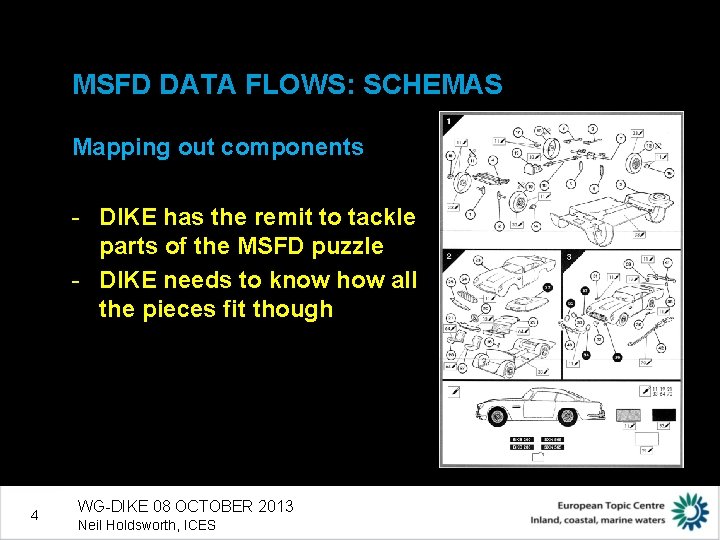
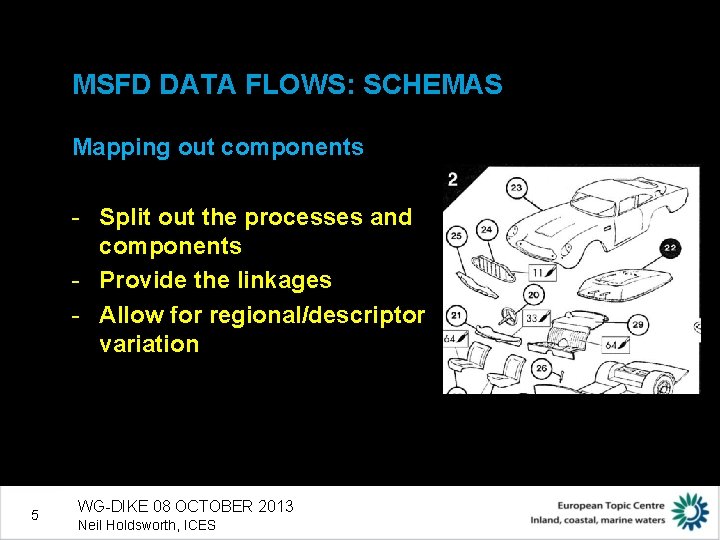
MSFD DATA FLOWS: SCHEMAS Mapping out components - DIKE has the remit to tackle parts of the MSFD puzzle - DIKE needs to know how all the pieces fit though 4 WG-DIKE 08 OCTOBER 2013 Neil Holdsworth, ICES
MSFD DATA FLOWS: SCHEMAS Mapping out components - Split out the processes and components - Provide the linkages - Allow for regional/descriptor variation 5 WG-DIKE 08 OCTOBER 2013 Neil Holdsworth, ICES
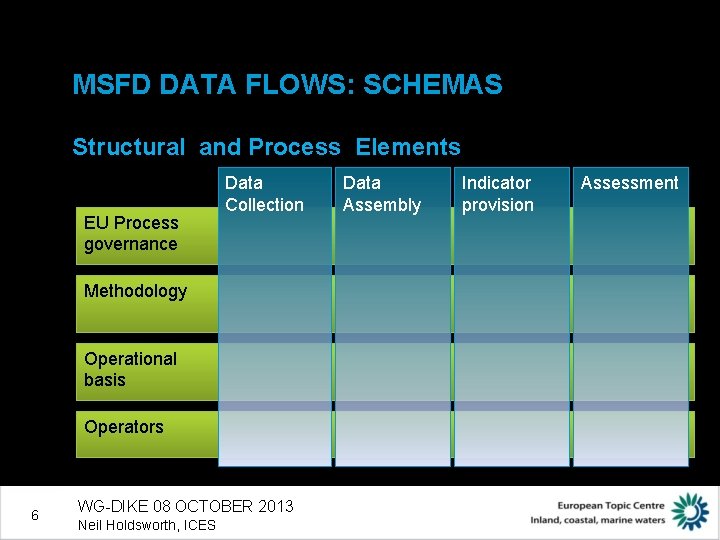
MSFD DATA FLOWS: SCHEMAS Structural and Process Elements EU Process governance Data Collection Methodology Operational basis Operators 6 WG-DIKE 08 OCTOBER 2013 Neil Holdsworth, ICES Data Assembly Indicator provision Assessment
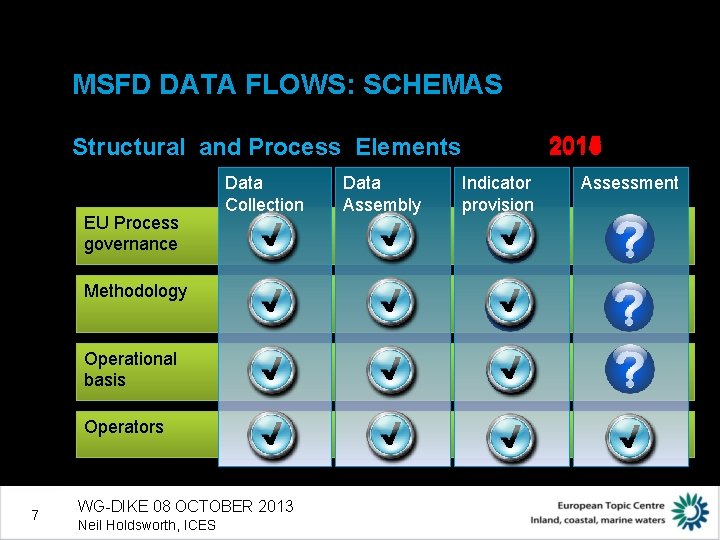
MSFD DATA FLOWS: SCHEMAS 2015 2014 2016 Structural and Process Elements EU Process governance Data Collection Methodology Operational basis Operators 7 WG-DIKE 08 OCTOBER 2013 Neil Holdsworth, ICES Data Assembly Indicator provision Assessment
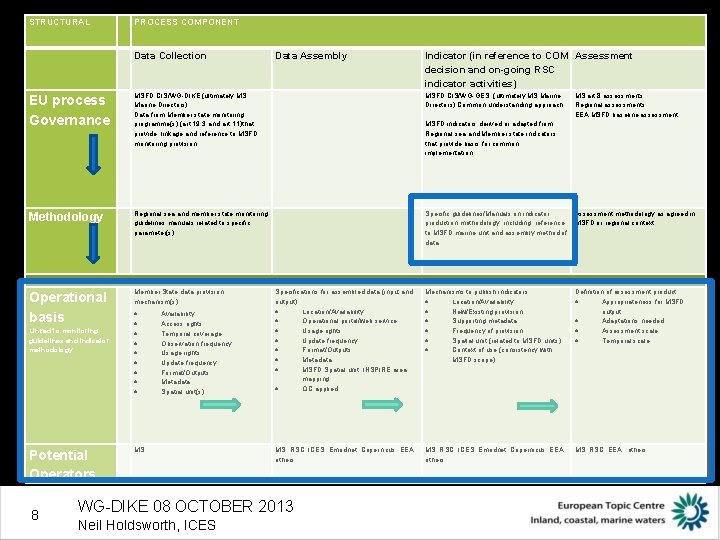
STRUCTURAL PROCESS COMPONENT Data Collection Data Assembly Indicator (in reference to COM Assessment decision and on-going RSC indicator activities) EU process Governance MSFD CIS/WG-DIKE (ultimately MS Marine Directors) Data from Member state monitoring programme(s) (art 19. 3 and art 11)that provide linkage and reference to MSFD monitoring provision MSFD CIS/WG-GES (ultimately MS Marine Directors) Common understanding approach Methodology Regional sea and member state monitoring guidelines manuals related to specific parameter(s) Specific guidelines/Manuals on indicator production methodology, including reference to MSFD marine unit and assembly method of data Assessment methodology as agreed in MSFD or regional context Operational basis Member State data provision mechanism(s) Specifications for assembled data (input and output) Location/Availability Operational portal/web service Usage rights Update frequency Format/Outputs Metadata MSFD Spatial unit: INSPIRE area mapping QC applied Mechanisms to publish indicators: Location/Availability New/Existing provision Supporting metadata Frequency of provision Spatial unit (related to MSFD units) Context of use (consistency with MSFD scope) Definition of assessment product : Appropriateness for MSFD output Adaptations needed Assessment scale Temporal scale MS, RSC, ICES, Emodnet, Copernicus, EEA, others MS, RSC, EEA , others Linked to monitoring guidelines and indicator methodology Potential Operators 8 Availability Access rights Temporal coverage Observation frequency Usage rights Update frequency Format/Outputs Metadata Spatial unit(s) MS MSFD indicators derived or adapted from Regional sea and Member state indicators that provide basis for common implementation WG-DIKE 08 OCTOBER 2013 Neil Holdsworth, ICES MS art 8 assessments, Regional assessments, EEA MSFD baseline assessment
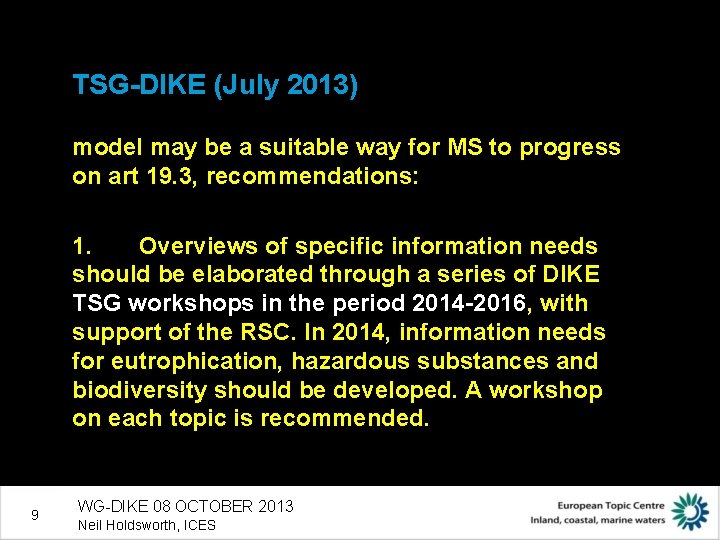
TSG-DIKE (July 2013) model may be a suitable way for MS to progress on art 19. 3, recommendations: 1. Overviews of specific information needs should be elaborated through a series of DIKE TSG workshops in the period 2014 -2016, with support of the RSC. In 2014, information needs for eutrophication, hazardous substances and biodiversity should be developed. A workshop on each topic is recommended. 9 WG-DIKE 08 OCTOBER 2013 Neil Holdsworth, ICES
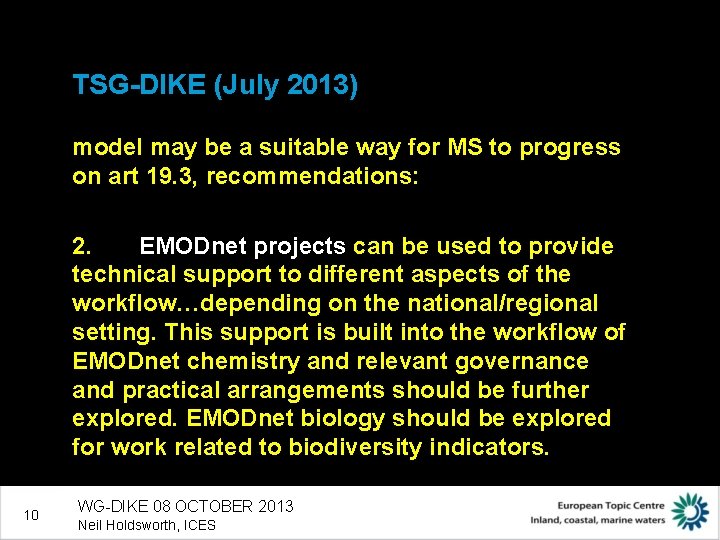
TSG-DIKE (July 2013) model may be a suitable way for MS to progress on art 19. 3, recommendations: 2. EMODnet projects can be used to provide technical support to different aspects of the workflow…depending on the national/regional setting. This support is built into the workflow of EMODnet chemistry and relevant governance and practical arrangements should be further explored. EMODnet biology should be explored for work related to biodiversity indicators. 10 WG-DIKE 08 OCTOBER 2013 Neil Holdsworth, ICES
TSG-DIKE (July 2013) model may be a suitable way for MS to progress on art 19. 3, recommendations: 3. A DIKE TSG workshop to specifically discuss My. Ocean/Copernicus marine service product applications for MSFD purposes was also recommended. 11 WG-DIKE 08 OCTOBER 2013 Neil Holdsworth, ICES
WG DIKE is invited to: a. Consider the work flow model proposed, together with the conclusions of the first meeting of DIKE TSG (DIKE TSG 1/2013/08). b. To consider the proposed activities for the WG DIKE Technical Subgroup in 2014, and provide feedback in terms of adequacy and support for the MSFD process as a whole. c. Consider and indicate its support to the three workshops with scope as proposed. 12 WG-DIKE 08 OCTOBER 2013 Neil Holdsworth, ICES