
Marine macroparasite behavior and mitigation techniques in bay

Marine macroparasite behavior and mitigation techniques in bay scallop aquaculture Harrison Tobi Ward Aquafarms, LLC

Bay scallop research • Ward Aquafarms has been growing bay scallops for four years • High prevalence of pea crabs and mud blister worms ▫ Prevalence appeared to coincide with poor meat quality ▫ Question: How can we mitigate the prevalence of pea crabs and mud blister worms to enhance meat quality?
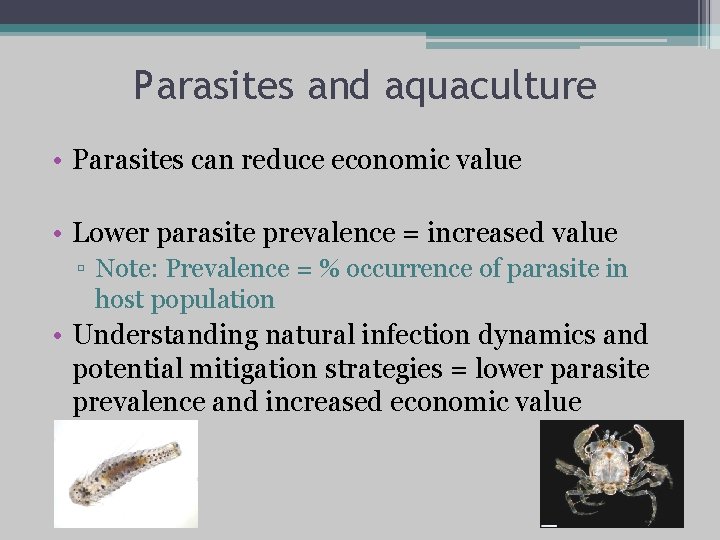
Parasites and aquaculture • Parasites can reduce economic value • Lower parasite prevalence = increased value ▫ Note: Prevalence = % occurrence of parasite in host population • Understanding natural infection dynamics and potential mitigation strategies = lower parasite prevalence and increased economic value
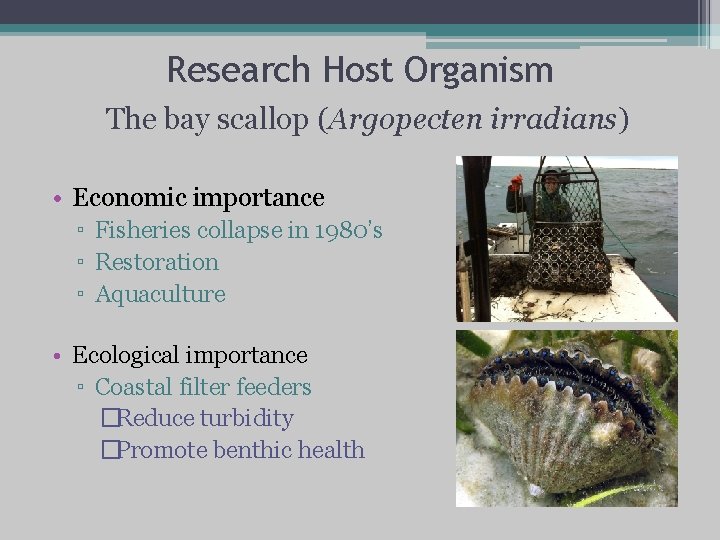
Research Host Organism The bay scallop (Argopecten irradians) • Economic importance ▫ Fisheries collapse in 1980’s ▫ Restoration ▫ Aquaculture • Ecological importance ▫ Coastal filter feeders �Reduce turbidity �Promote benthic health

Parasite: Pea crab (Pinnotheres maculatus) • Parasitic marine crab • Lives in host’s mantle cavity • Feeds off food particles on host’s gills ▫ Reduction in food for host ▫ Physical irritation

Parasite: Mud blister worm (Polydora sp. ) • Parasitic polychaete worm • Shell-borer • Reduces shell integrity • Host redirects energy towards “mud blister”
Research Objectives 1. Document seasonal timing of infection by mud blister worms and pea crabs in bay scallops 2. Determine the effectiveness of Netminder paint in reducing mud blister worm and pea crab prevalence in bay scallops 3. Determine infection success of pea crabs in bay scallops based on water temperature
Research Objectives 1. Document seasonal timing of infection by mud blister worms and pea crabs in bay scallops 2. Determine the effectiveness of Netminder paint in reducing mud blister worm and pea crab prevalence in bay scallops 3. Determine infection success of pea crabs in bay scallops based on water temperature
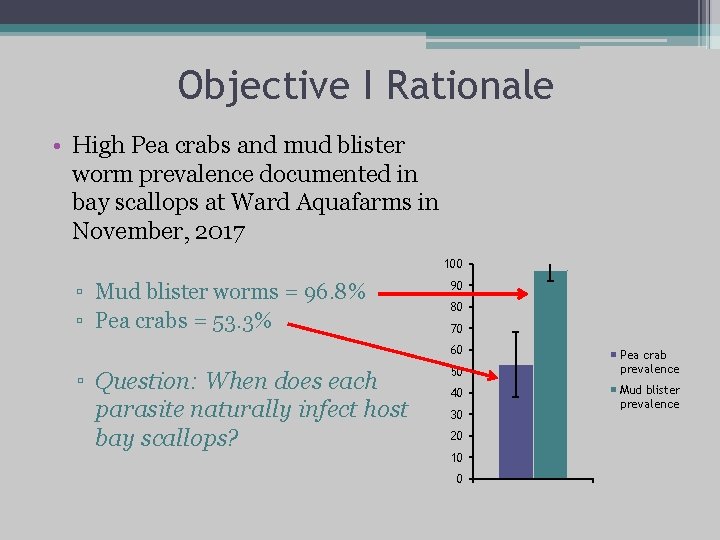
Objective I Rationale • High Pea crabs and mud blister worm prevalence documented in bay scallops at Ward Aquafarms in November, 2017 100 ▫ Mud blister worms = 96. 8% ▫ Pea crabs = 53. 3% 90 80 70 60 ▫ Question: When does each parasite naturally infect host bay scallops? 50 40 30 20 10 0 Pea crab prevalence Mud blister prevalence
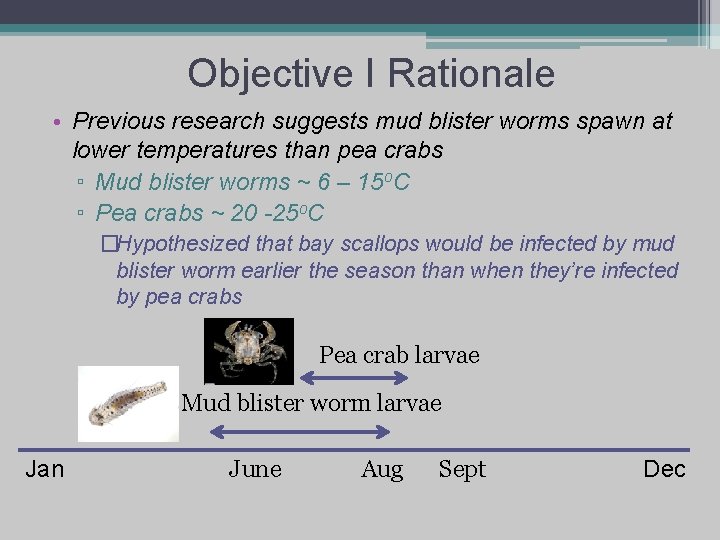
Objective I Rationale • Previous research suggests mud blister worms spawn at lower temperatures than pea crabs ▫ Mud blister worms ~ 6 – 15 o. C ▫ Pea crabs ~ 20 -25 o. C �Hypothesized that bay scallops would be infected by mud blister worm earlier the season than when they’re infected by pea crabs Pea crab larvae Mud blister worm larvae Jan June Aug Sept Dec
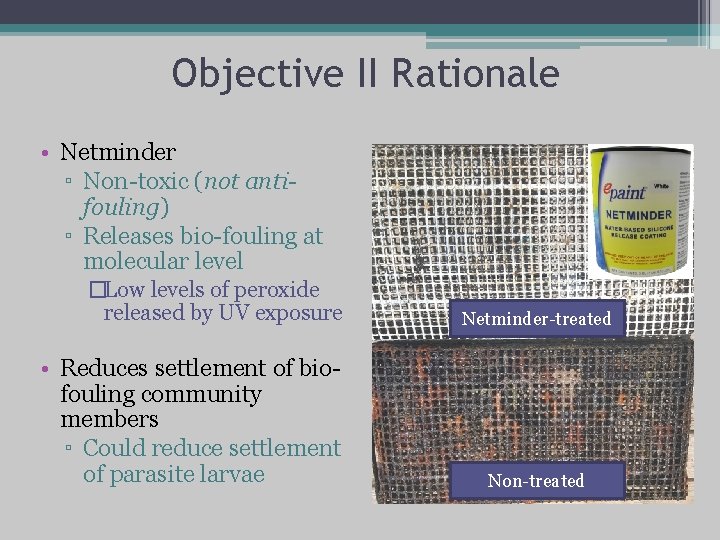
Objective II Rationale • Netminder ▫ Non-toxic (not antifouling) ▫ Releases bio-fouling at molecular level �Low levels of peroxide released by UV exposure • Reduces settlement of biofouling community members ▫ Could reduce settlement of parasite larvae Netminder-treated Non-treated
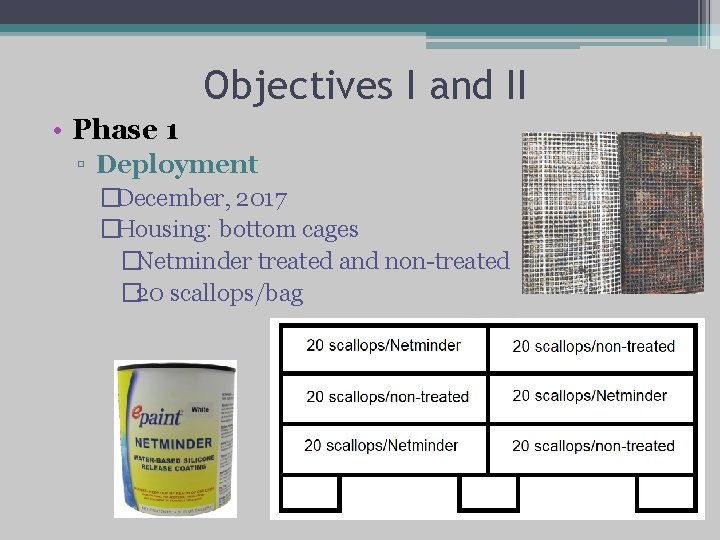
Objectives I and II • Phase 1 ▫ Deployment �December, 2017 �Housing: bottom cages �Netminder treated and non-treated � 20 scallops/bag
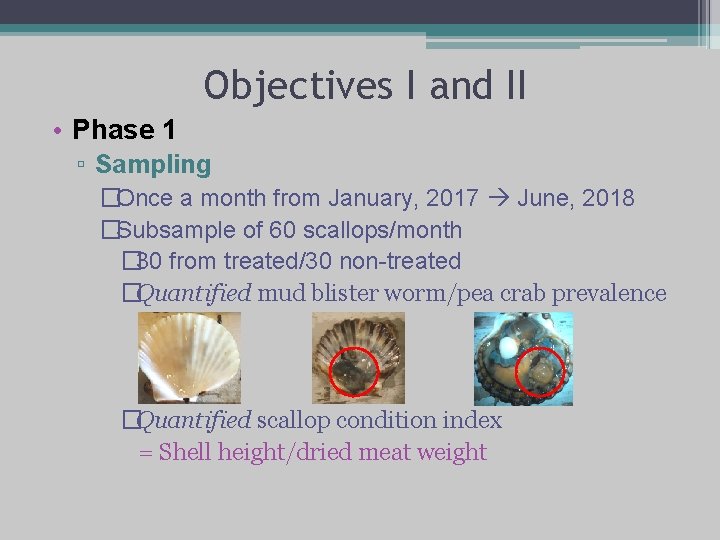
Objectives I and II • Phase 1 ▫ Sampling �Once a month from January, 2017 June, 2018 �Subsample of 60 scallops/month � 30 from treated/30 non-treated �Quantified mud blister worm/pea crab prevalence �Quantified scallop condition index = Shell height/dried meat weight
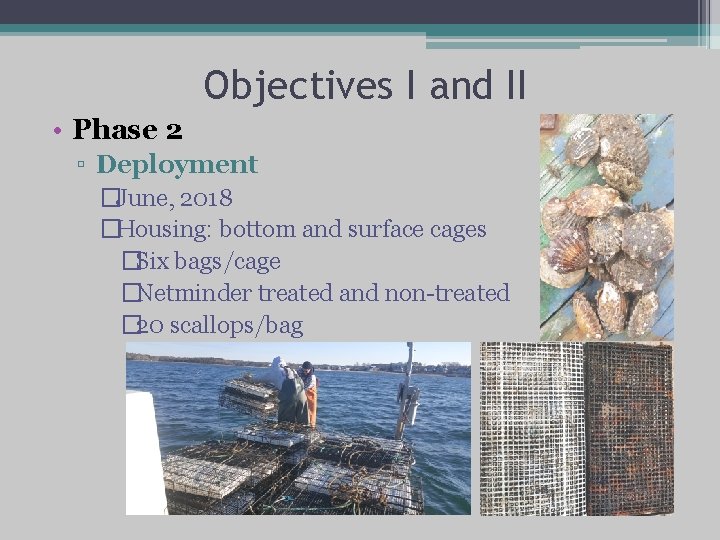
Objectives I and II • Phase 2 ▫ Deployment �June, 2018 �Housing: bottom and surface cages �Six bags/cage �Netminder treated and non-treated � 20 scallops/bag
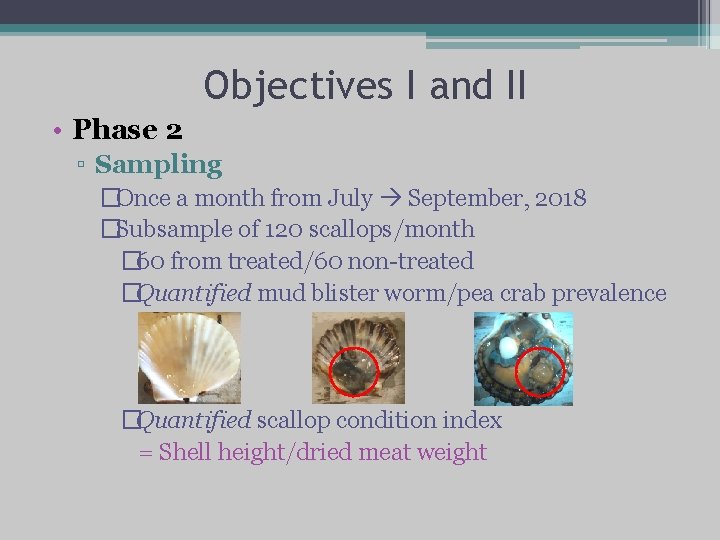
Objectives I and II • Phase 2 ▫ Sampling �Once a month from July September, 2018 �Subsample of 120 scallops/month � 60 from treated/60 non-treated �Quantified mud blister worm/pea crab prevalence �Quantified scallop condition index = Shell height/dried meat weight
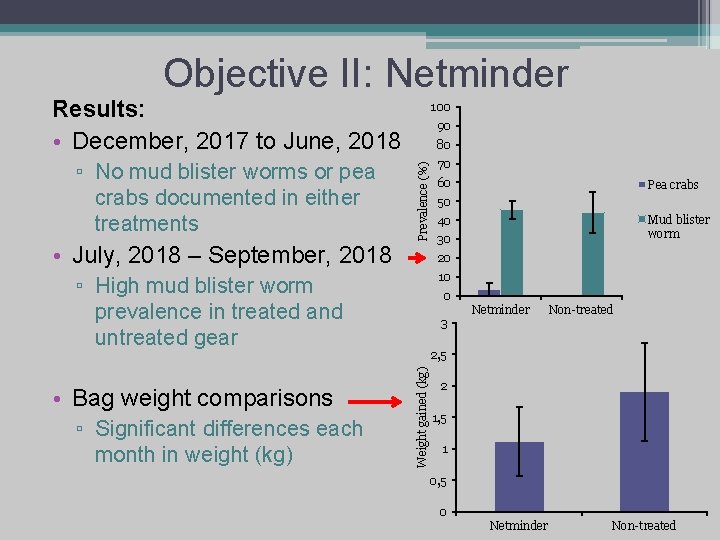
Objective II: Netminder Results: • December, 2017 to June, 2018 100 ▫ No mud blister worms or pea crabs documented in either treatments 70 80 Prevalence (%) • July, 2018 – September, 2018 90 50 Mud blister worm 40 30 10 0 3 Netminder Non-treated 2, 5 Weight gained (kg) ▫ Significant differences each month in weight (kg) Pea crabs 20 ▫ High mud blister worm prevalence in treated and untreated gear • Bag weight comparisons 60 2 1, 5 1 0, 5 0 Netminder Non-treated
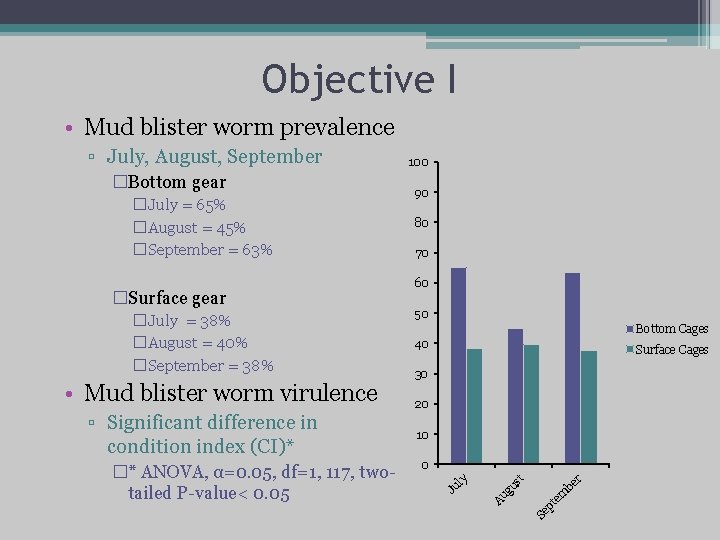
Objective I • Mud blister worm prevalence Bottom Cages 40 Surface Cages 30 20 10 0 r be �* ANOVA, α=0. 05, df=1, 117, twotailed P-value< 0. 05 50 em ▫ Significant difference in condition index (CI)* 60 Se pt • Mud blister worm virulence 70 t �July = 38% �August = 40% �September = 38% 80 us �Surface gear 90 Au g �July = 65% �August = 45% �September = 63% ly �Bottom gear 100 Ju ▫ July, August, September
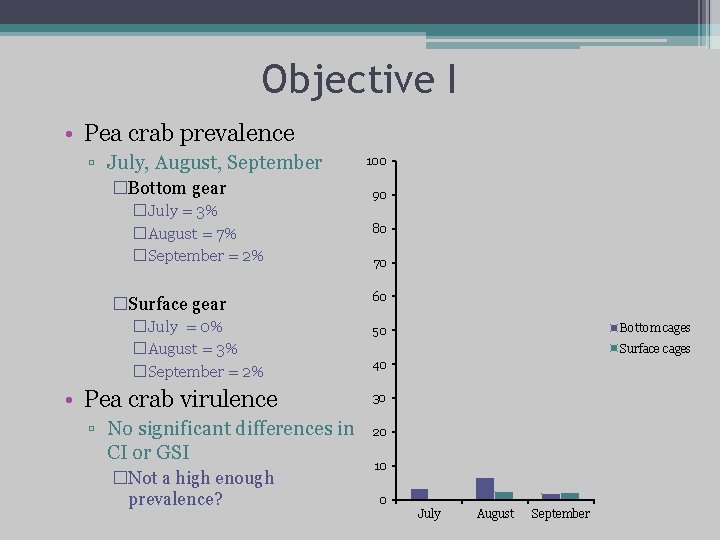
Objective I • Pea crab prevalence ▫ July, August, September �Bottom gear �July = 3% �August = 7% �September = 2% �Surface gear �July = 0% �August = 3% �September = 2% • Pea crab virulence ▫ No significant differences in CI or GSI �Not a high enough prevalence? 100 90 80 70 60 Bottom cages 50 Surface cages 40 30 20 10 0 July August September
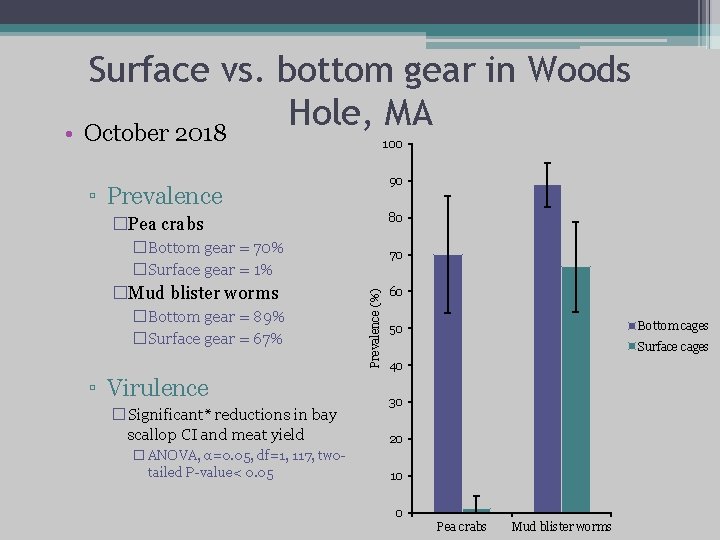
Surface vs. bottom gear in Woods Hole, MA • October 2018 100 90 ▫ Prevalence 80 �Pea crabs �Bottom gear = 70% �Surface gear = 1% �Bottom gear = 89% �Surface gear = 67% ▫ Virulence � Significant* reductions in bay scallop CI and meat yield � ANOVA, α=0. 05, df=1, 117, twotailed P-value< 0. 05 Prevalence (%) �Mud blister worms 70 60 Bottom cages 50 Surface cages 40 30 20 10 0 Pea crabs Mud blister worms
Research Objectives 1. Document seasonal timing of infection by mud blister worms and pea crabs in bay scallops 2. Determine the effectiveness of Netminder paint in reducing mud blister worm and pea crab prevalence in bay scallops 3. Determine infection success of pea crabs in bay scallops based on water temperature
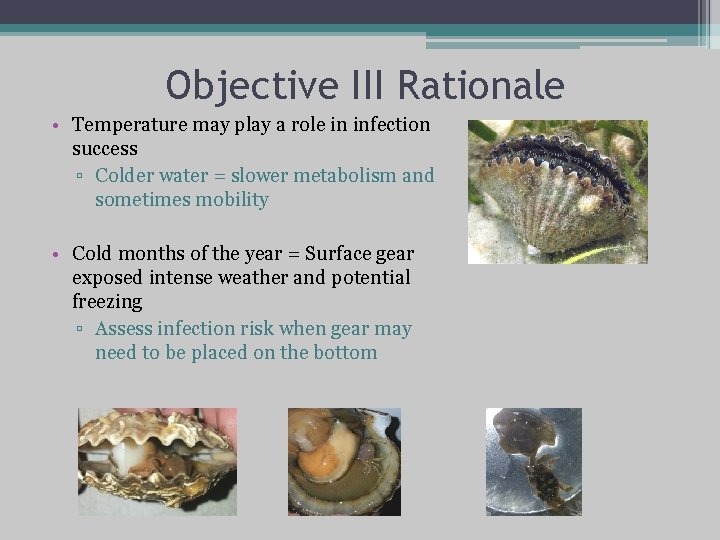
Objective III Rationale • Temperature may play a role in infection success ▫ Colder water = slower metabolism and sometimes mobility • Cold months of the year = Surface gear exposed intense weather and potential freezing ▫ Assess infection risk when gear may need to be placed on the bottom
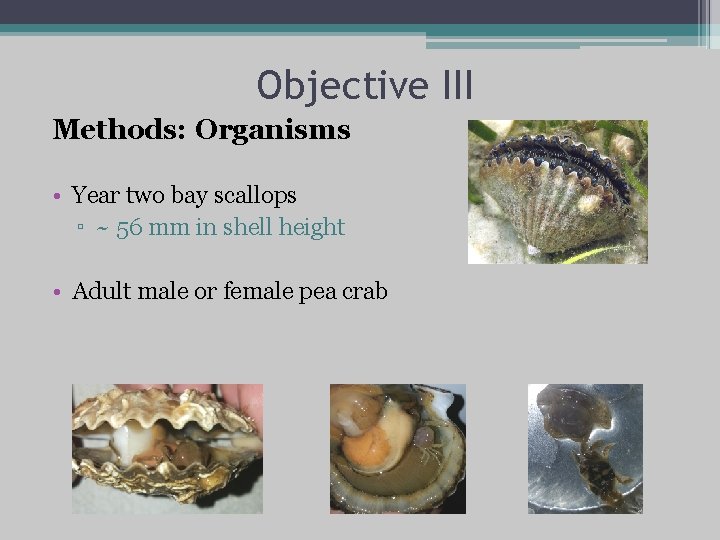
Objective III Methods: Organisms • Year two bay scallops ▫ ~ 56 mm in shell height • Adult male or female pea crab
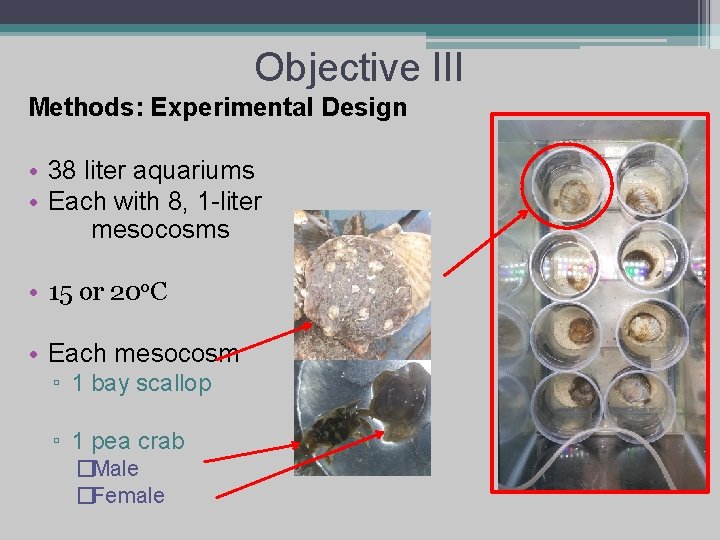
Objective III Methods: Experimental Design • 38 liter aquariums • Each with 8, 1 -liter mesocosms • 15 or 20 o. C • Each mesocosm ▫ 1 bay scallop ▫ 1 pea crab �Male �Female
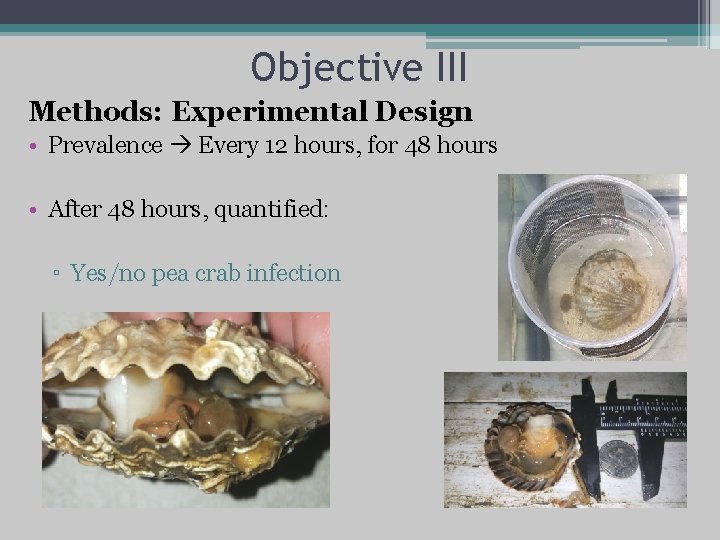
Objective III Methods: Experimental Design • Prevalence Every 12 hours, for 48 hours • After 48 hours, quantified: ▫ Yes/no pea crab infection
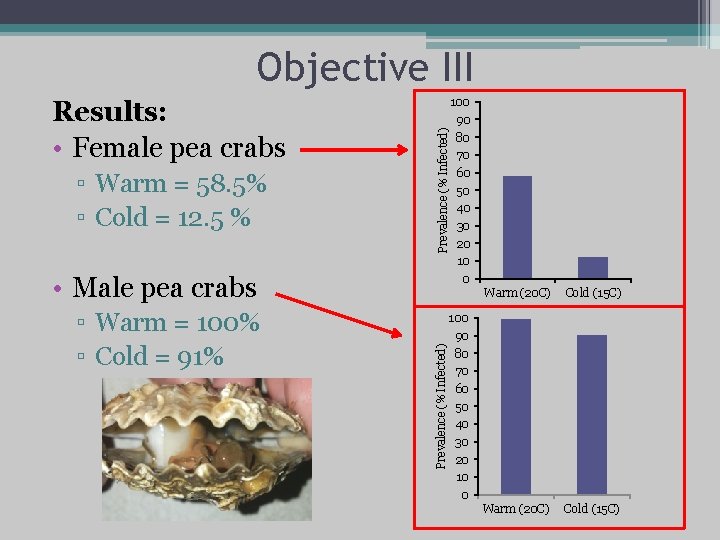
Results: • Female pea crabs ▫ Warm = 58. 5% ▫ Cold = 12. 5 % Prevalence (% Infected) Objective III ▫ Warm = 100% ▫ Cold = 91% Prevalence (% Infected) • Male pea crabs 100 90 80 70 60 50 40 30 20 10 0 Warm (20 C) Cold (15 C) 100 90 80 70 60 50 40 30 20 10 0
• Objective I: Conclusion ▫ Timing of infections �Bay scallops are naturally infected by mud blister worms when water temperatures hit 20 o. C ▫ Bottom and surface gear �Both susceptible to mud blister worm infection �Surface gear may be a good pea crab mitigation strategy (Site and weather permitting)
• Objective II: Conclusion ▫ Netminder �Significantly reduces biofouling �Reducing time needed to clean gear �Does not prevent settlement of mud blister worms on bay scallop �Not enough data on it’s ability to prevent pea crab infection
• Objective III: Conclusion ▫ Effects of temperature on pea crab prevalence �Prevalence significantly reduced when temperature drops from 20 to 15 o. C �When water temps are below 15 o. C, risk of infection for bay scallops housed in bottom gear may be significantly reduced �Winter months ▫ Rough surface conditions/ice ▫ Cold water, reduced infection risk for bay scallops housed in bottom gear
Acknowledgements • • Dr. Ward, Ph. D, Owner of Ward Aquafarms Dr. Koop, Ph. D Dr. Bromage, Ph. D Matt Paquette – Ward Aquafarms Andrew Davidsohn – Ward Aquafarms Mike Coutes – Ward Aquafarms Alex Walsh – Netminder, LLC Mary Murphy – Sippewissett Oysters

Questions
- Slides: 30