
Marine Life Classification and Evolution Big Concepts Classification
Marine Life Classification and Evolution
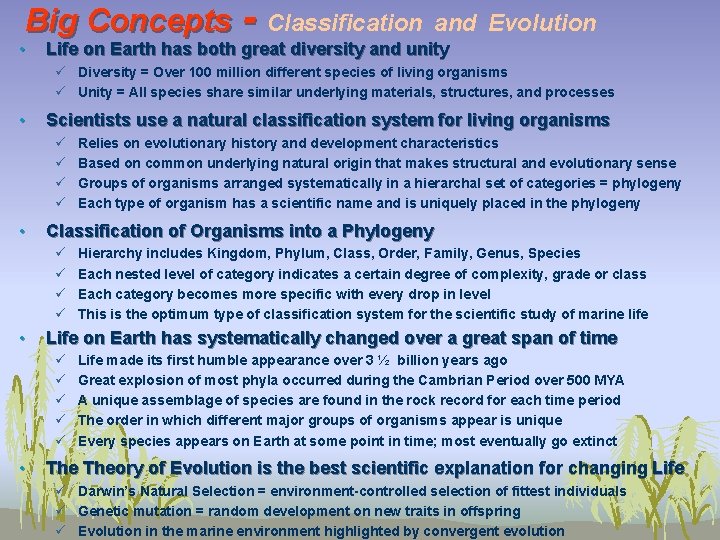
Big Concepts • - Classification and Evolution Life on Earth has both great diversity and unity ü Diversity = Over 100 million different species of living organisms ü Unity = All species share similar underlying materials, structures, and processes • Scientists use a natural classification system for living organisms ü ü • Classification of Organisms into a Phylogeny ü ü • Hierarchy includes Kingdom, Phylum, Class, Order, Family, Genus, Species Each nested level of category indicates a certain degree of complexity, grade or class Each category becomes more specific with every drop in level This is the optimum type of classification system for the scientific study of marine life Life on Earth has systematically changed over a great span of time ü ü ü • Relies on evolutionary history and development characteristics Based on common underlying natural origin that makes structural and evolutionary sense Groups of organisms arranged systematically in a hierarchal set of categories = phylogeny Each type of organism has a scientific name and is uniquely placed in the phylogeny Life made its first humble appearance over 3 ½ billion years ago Great explosion of most phyla occurred during the Cambrian Period over 500 MYA A unique assemblage of species are found in the rock record for each time period The order in which different major groups of organisms appear is unique Every species appears on Earth at some point in time; most eventually go extinct Theory of Evolution is the best scientific explanation for changing Life ü Darwin’s Natural Selection = environment-controlled selection of fittest individuals ü Genetic mutation = random development on new traits in offspring ü Evolution in the marine environment highlighted by convergent evolution
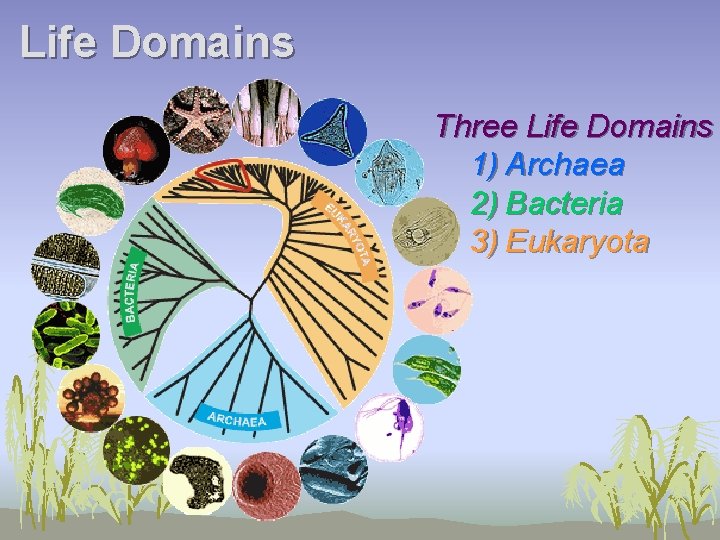
Life Domains Three Life Domains 1) Archaea 2) Bacteria 3) Eukaryota
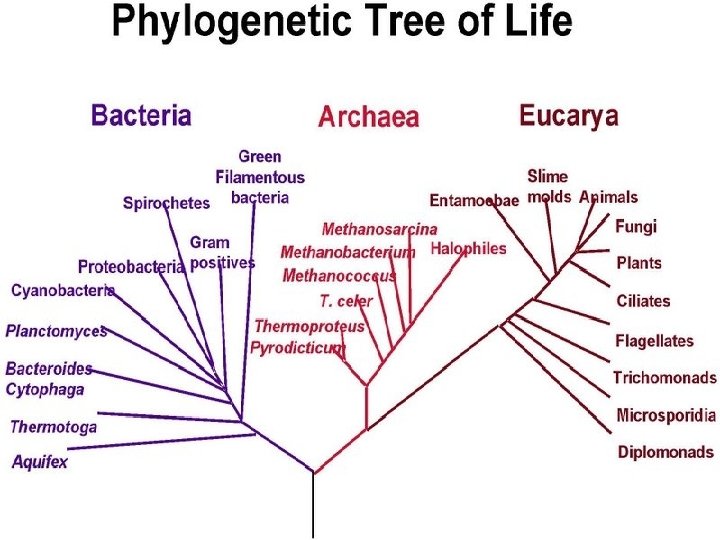
Phylogenetic Tree of Life
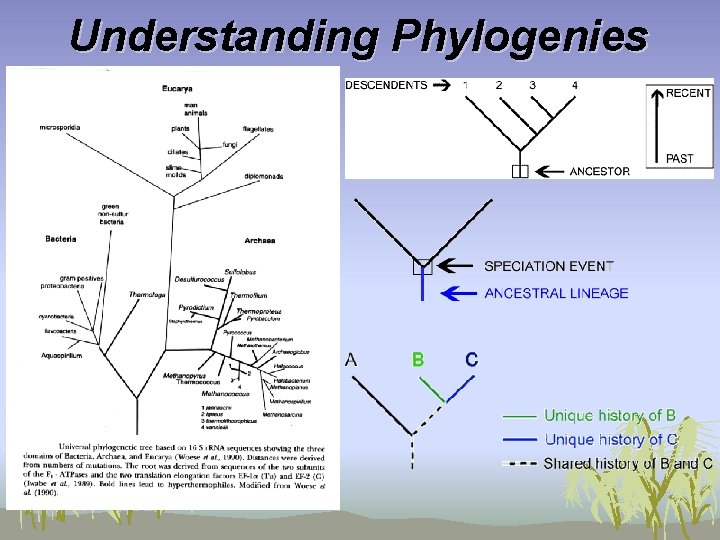
Understanding Phylogenies
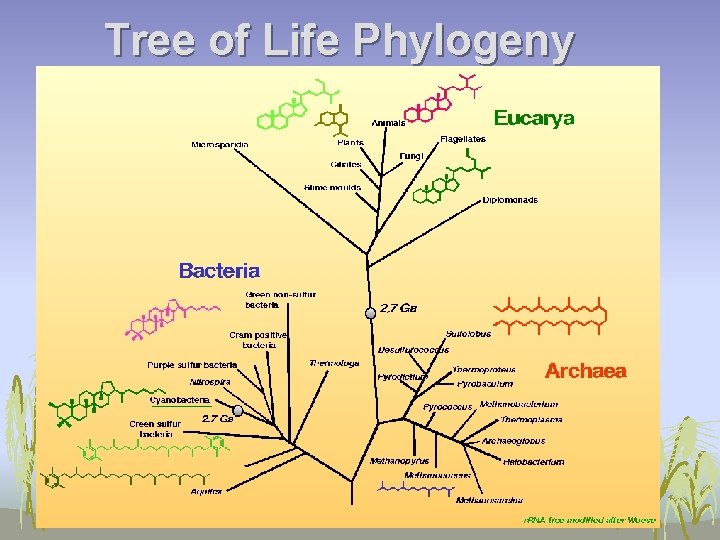
Tree of Life Phylogeny
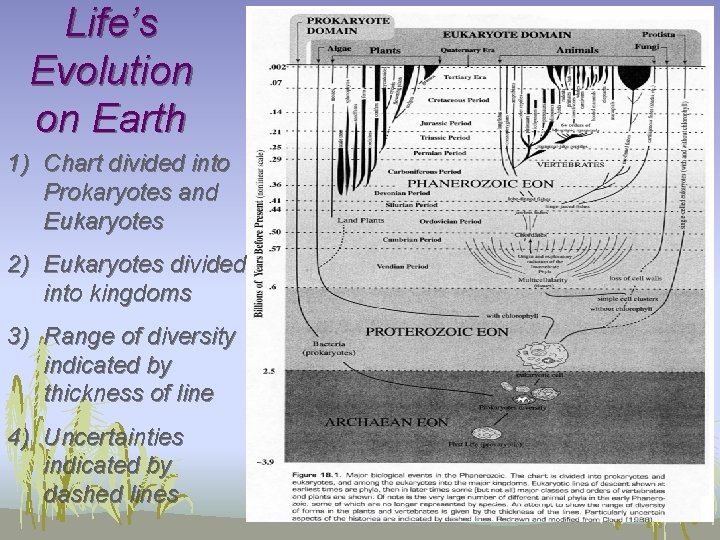
Life’s Evolution on Earth 1) Chart divided into Prokaryotes and Eukaryotes 2) Eukaryotes divided into kingdoms 3) Range of diversity indicated by thickness of line 4) Uncertainties indicated by dashed lines
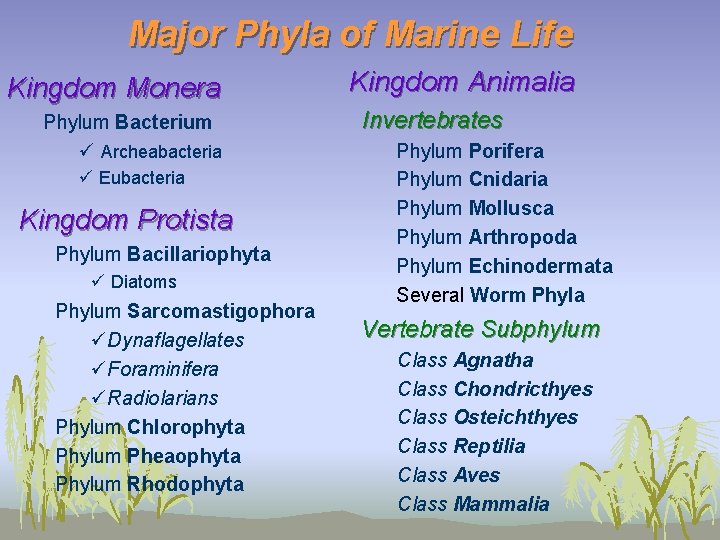
Major Phyla of Marine Life Kingdom Monera Phylum Bacterium ü Archeabacteria ü Eubacteria Kingdom Protista Phylum Bacillariophyta ü Diatoms Phylum Sarcomastigophora üDynaflagellates üForaminifera üRadiolarians Phylum Chlorophyta Phylum Pheaophyta Phylum Rhodophyta Kingdom Animalia Invertebrates Phylum Porifera Phylum Cnidaria Phylum Mollusca Phylum Arthropoda Phylum Echinodermata Several Worm Phyla Vertebrate Subphylum Class Agnatha Class Chondricthyes Class Osteichthyes Class Reptilia Class Aves Class Mammalia
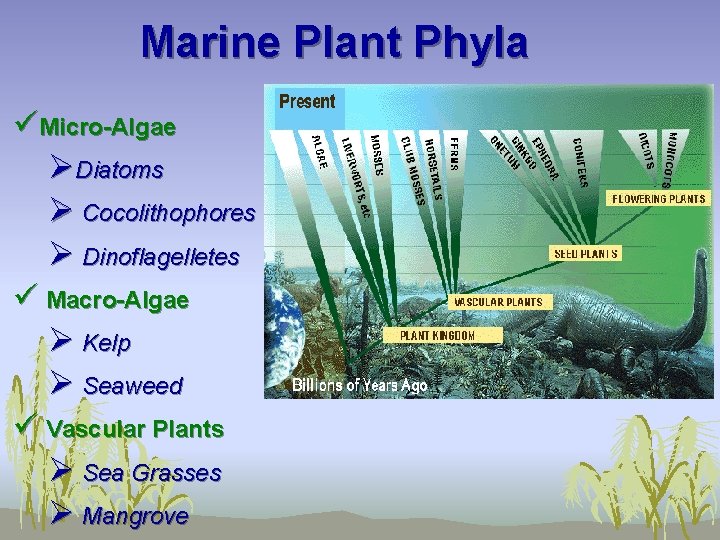
Marine Plant Phyla üMicro-Algae ØDiatoms Ø Cocolithophores Ø Dinoflagelletes ü Macro-Algae Ø Kelp Ø Seaweed ü Vascular Plants Ø Sea Grasses Ø Mangrove
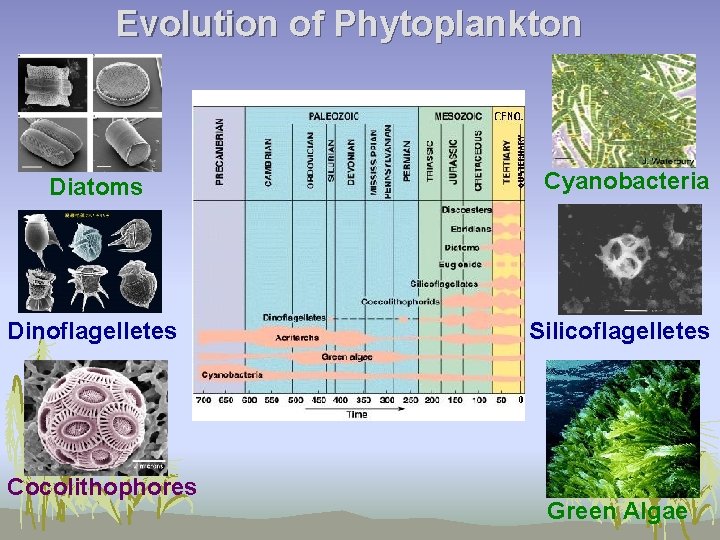
Evolution of Phytoplankton Diatoms Cyanobacteria Dinoflagelletes Silicoflagelletes Cocolithophores Green Algae
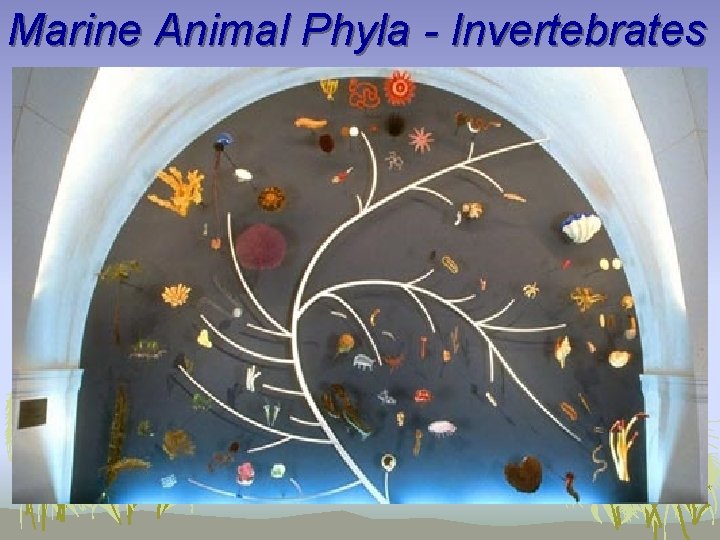
Marine Animal Phyla - Invertebrates
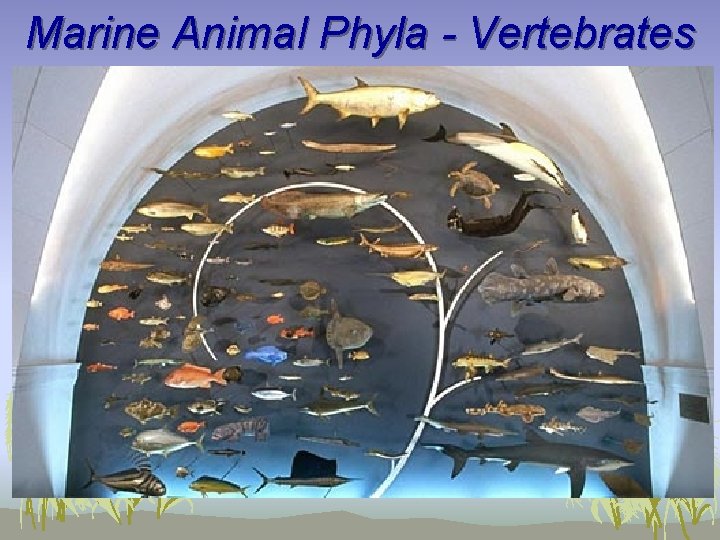
Marine Animal Phyla - Vertebrates
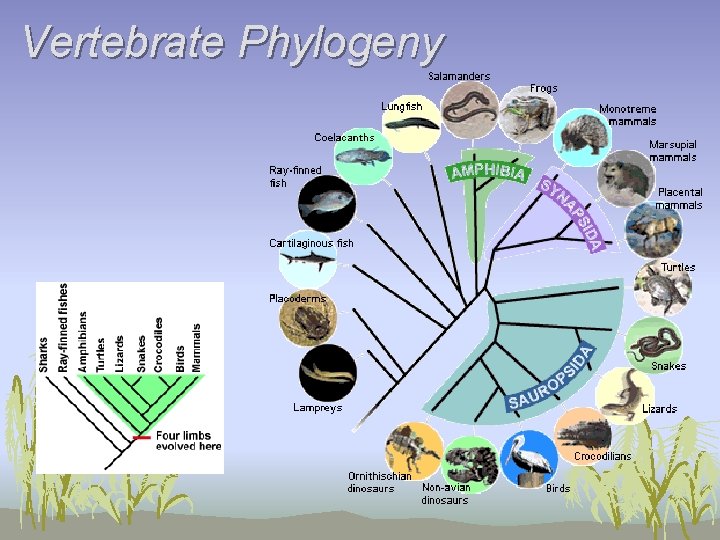
Vertebrate Phylogeny
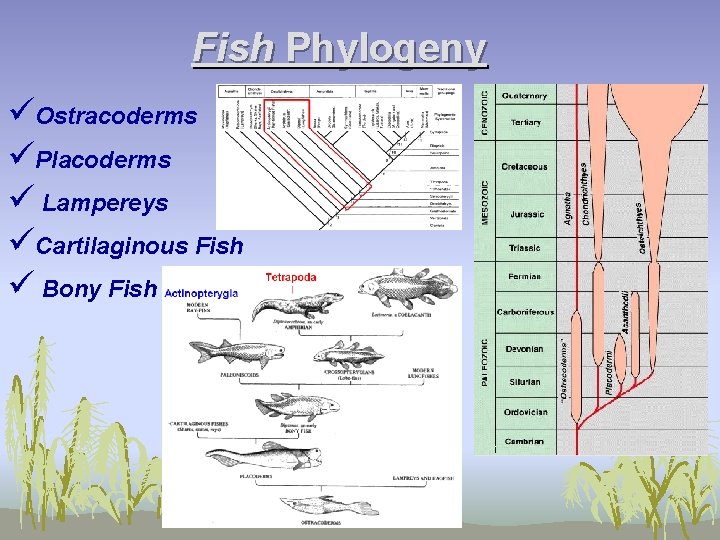
Fish Phylogeny üOstracoderms üPlacoderms ü Lampereys üCartilaginous Fish ü Bony Fish
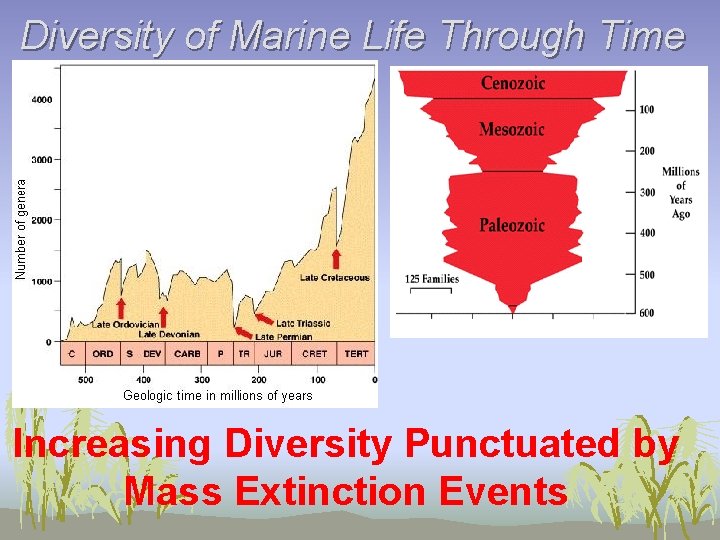
Diversity of Marine Life Through Time Increasing Diversity Punctuated by Mass Extinction Events
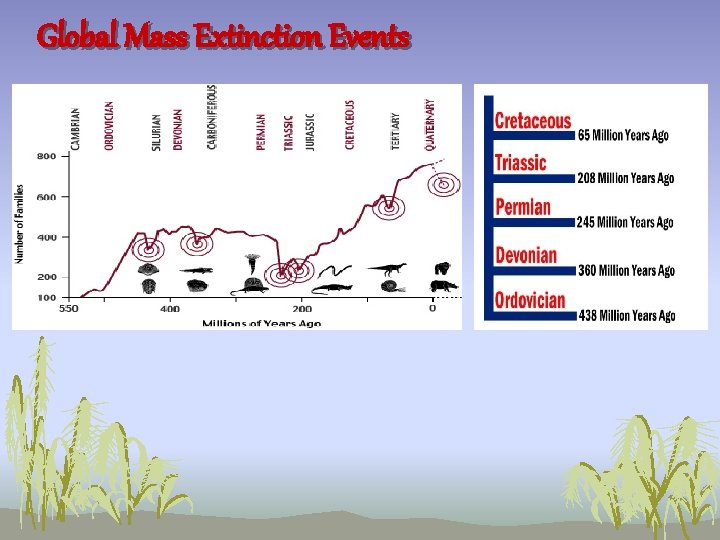
Global Mass Extinction Events
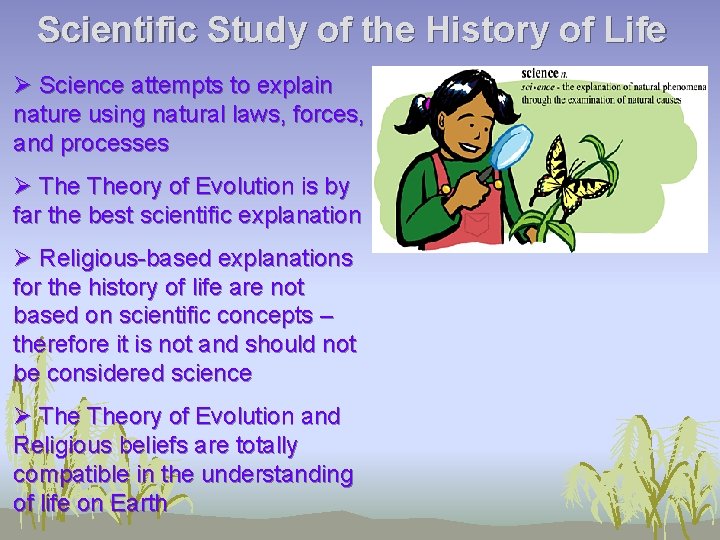
Scientific Study of the History of Life Ø Science attempts to explain nature using natural laws, forces, and processes Ø Theory of Evolution is by far the best scientific explanation Ø Religious-based explanations for the history of life are not based on scientific concepts – therefore it is not and should not be considered science Ø Theory of Evolution and Religious beliefs are totally compatible in the understanding of life on Earth
Definition of Biological Evolution v Evolution is the maintenance of life under changing conditions by the continuous adaptation of successive generations of a species to its environment v Biological evolution refers to populations and not to individuals and that the changes must be passed on to the next generation. v Evolution is a process that results in heritable changes in a population spread over many generations. v Evolution is any change in the frequency of alleles within a gene pool from one generation to the next. " - Helena Curtis and N. Sue Barnes, Biology, 5 th ed. 1989 Worth Publishers, p. 974 v New forms of life are derived from earlier forms of life
Incorrect Definitions of Biological Evolution v “Evolution: The gradual process by which the present diversity of plant and animal life arose from the earliest and most primitive organisms, which is believed to have been continuing for the past 3000 million years. " - Oxford Concise Science Dictionary v “Evolution: . . . the doctrine according to which higher forms of life have gradually arisen out of lower. . " – Chambers v“Evolution: . . . the development of a species, organism, or organ from its original or primitive state to its present or specialized state; phylogeny or ontogeny" - Webster's v Advanced forms of life are derived from primitive forms of life
Theory of Evolution and Natural Selection Ø Darwin’s and Wallace’s Ideas on How life may have changed through long spans of time ü More offspring are produced than can survive to reproduce ü Random variations occur in all organisms – some passable to offspring v Meiosis v Mutations ü Favorable inheritable traits increase the likelihood that the organism will survive to reproduction age ü Unfavorable traits decrease the likelihood that the organism will survive to reproductive age ü The organism’s natural environment itself does the selection
Evolution = Survival of the Fit Enough Ø No biological predetermination = Purely a response to environmental pressures Ø Accumulation of beneficial inherited structural or behavioral traits = favorable adaptations Ø Organisms evolve to adequately fit their environment Ø Rates of change are variable, depending primarily on environmental stress, population size, and degree of geographic isolation Ø Mass extinction events create extreme environmental pressures on species
- Classification and Evolution Life on Earth has both great diversity and unity Big Concepts • ü Diversity = Over 100 million different species of living organisms ü Unity = All species share similar underlying materials, structures, and processes • Scientists use a natural classification system for living organisms ü ü • Classification of Organisms into a Phylogeny ü ü • Hierarchy includes Kingdom, Phylum, Class, Order, Family, Genus, Species Each nested level of category indicates a certain degree of complexity, grade or class Each category becomes more specific with every drop in level This is the optimum type of classification system for the scientific study of marine life Life on Earth has systematically changed over a great span of time ü ü ü • Relies on evolutionary history and development characteristics Based on common underlying natural origin that makes structural and evolutionary sense Groups of organisms arranged systematically in a hierarchal set of categories = phylogeny Each type of organism has a scientific name and is uniquely placed in the phylogeny Life made its first humble appearance over 3 ½ billion years ago Great explosion of most phyla occurred during the Cambrian Period over 500 MYA A unique assemblage of species are found in the rock record for each time period The order in which different major groups of organisms appear is unique Every species appears on Earth at some point in time; most eventually go extinct Theory of Evolution is the best scientific explanation for changing Life ü Darwin’s Natural Selection = environment-controlled selection of fittest individuals ü Genetic mutation = random development on new traits in offspring ü Evolution in the marine environment highlighted by convergent evolution
Discussion
Conclusion
- Slides: 24