
Marine Insurance Table of Contents 1 Basics of
Marine Insurance
Table of Contents 1. Basics of Marine Insurance 2. Marine Insurance Contracts 3. Maritime Perils 4. Maritime Losses 5. Insurance Policy
Marine Insurance 1 Basics of Marine Insurance (1) General ○ It is customary to insure the goods sold for export against the various kind of perils of the journey − Marine insurance is a financial security to the cargo which is being transported on seas and covers the risks of physical loss or damage to goods and merchandise while in transit. − A contract of marine insurance is a contract whereby the insurer undertakes to indemnify the assured, in manner and to the extent thereby agreed, against marine losses, that is to say, the losses incident to marine adventure (Marine Insurance Act(1906) s. 1).
Marine Insurance 1 ○ Basics of Marine Insurance However, the meaning of term, “marine insurance” can be extended so as to protect the assured against losses on inland waters or land which are incidental to the sea voyage. − In the export trade, extended marine insurance arrangements are made in order to cover not only the sea voyage but also transportation of the goods from the warehouse of the seller to that of the overseas buyer.
Marine Insurance 1 Basics of Marine Insurance ○ The Principle of Indemnity − The insured should not profit from a loss or damage but should be returned (as near as possible) to the same financial position that existed before the loss or damage occurred. − In other words, the insured cannot recover more than his or her actual loss from the insurer. − Cf. The principle of indemnity is not applicable to life insurance.
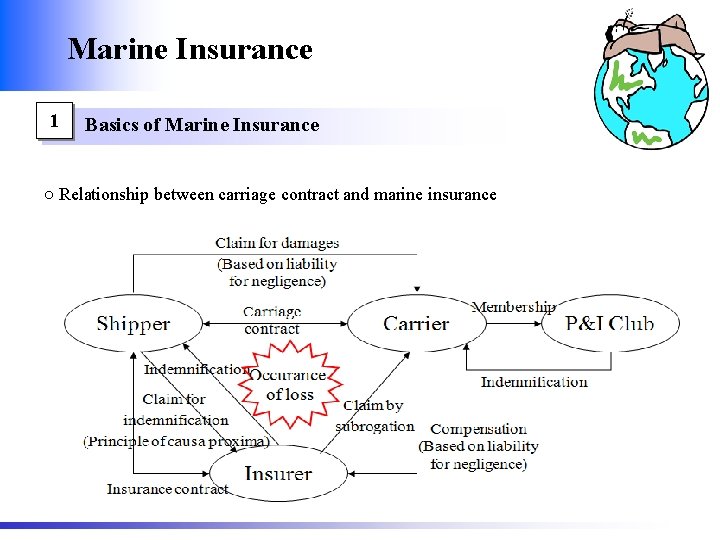
Marine Insurance 1 Basics of Marine Insurance ○ Relationship between carriage contract and marine insurance

Marine Insurance 1 Basics of Marine Insurance (2) Terminology ○ Subject-matter insured and Insurable interest − Subject-matter insured: This is the insured object exposed to risk to which the assured's insurable interest attaches. − Insurable interest: if an insured wishes to enforce a contract of insurance, he must have an insurable interest in the subject matter of the insurance, which is to say that he stands to benefit from its preservation and will suffer from its loss.
Marine Insurance 1 Basics of Marine Insurance ○ Premium, Claim amount, Amount insured and Insurable value − Premium: The amount of money which a policy holder pays to the insurer for an insurance. − Claim amount: the amount of money which an insurer pays to the insured when the loss or damage occurs. − Amount insured: the maximum amount of money which an insurer pays to the insured when the loss or damage occurs. − Insurable value: economical value of the subject-matter insured.

Marine Insurance 1 Basics of Marine Insurance ○ Under insurance, Full insurance and Over insurance − Under insurance: amount insured < insurable value − Full insurance: amount insured = insurable value − Over insurance: amount insured > insurable value Under Insurance Full Insurance Over Insurance Insurable Value 1, 000 Amount Insured 500 1, 000 1, 500 Loss/Damage 300 300 Claim Amount 150 300
Marine Insurance 1 Basics of Marine Insurance ○ Co-insurance and Double insurance − Co-insurance; more than two different contracts for insurance are concluded for one subject-matter insured, but the amount insured does not exceed the insurable value. − Double insurance; more than two different contracts for insurance are concluded for one subject-matter insured, and the amount insured exceeds the insurable value.
Marine Insurance 2 Marine Insurance Contracts (1) Definition of Marine Insurance Contract ○ A contract of marine insurance is a contract whereby the insurer undertakes to indemnify the assured, in manner and to the extent thereby agreed, against marine losses, that is to say, the losses incident to marine adventure.
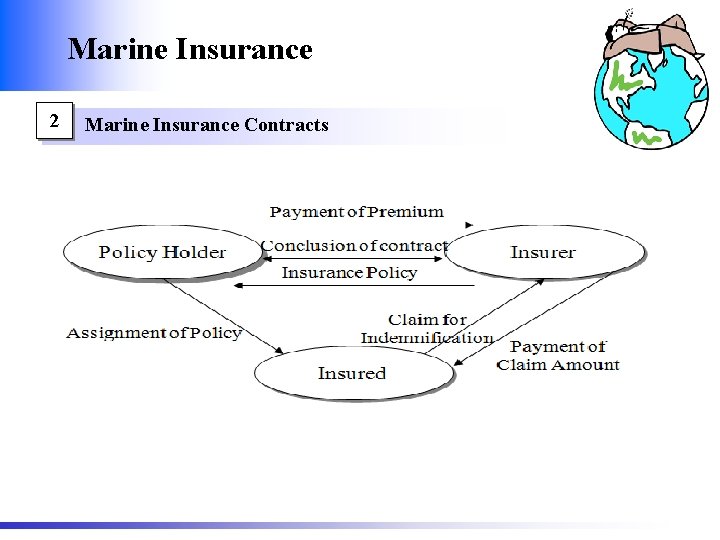
Marine Insurance 2 Marine Insurance Contracts (2) Parties of Marine Insurance Contract ○ Insurer(assurer), Policy holder, and Insured(assured) − Insurer(assurer): An individual or company who, through a contractual agreement, undertakes to compensate specified losses, liability, or damages incurred by another individual. − Policy holder: An individual or company who makes a contract for the insurance and pay the premium and a policy holder may or may not be the insured, or the sole or one of the beneficiaries of the policy. − Insured(assured): An individual or company who is covered under an insurance policy against insured perils.
Marine Insurance 2 Marine Insurance Contracts
Marine Insurance 3 Maritime Perils (1) Definition of Maritime Perils ○ "Maritime perils" means the perils consequent on or incidental to the navigation of the sea, that is to say, perils of the seas, fire, war perils, pirates, rovers, thieves, captures, seizures, restraints, and detainments of princes and peoples, jettisons, barratry, and any other perils, either of the like kind or which may be designated by the policy.
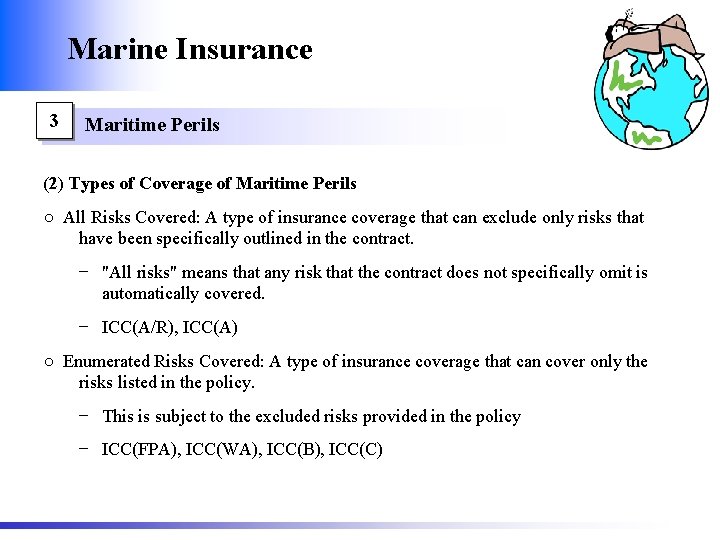
Marine Insurance 3 Maritime Perils (2) Types of Coverage of Maritime Perils ○ All Risks Covered: A type of insurance coverage that can exclude only risks that have been specifically outlined in the contract. − "All risks" means that any risk that the contract does not specifically omit is automatically covered. − ICC(A/R), ICC(A) ○ Enumerated Risks Covered: A type of insurance coverage that can cover only the risks listed in the policy. − This is subject to the excluded risks provided in the policy − ICC(FPA), ICC(WA), ICC(B), ICC(C)
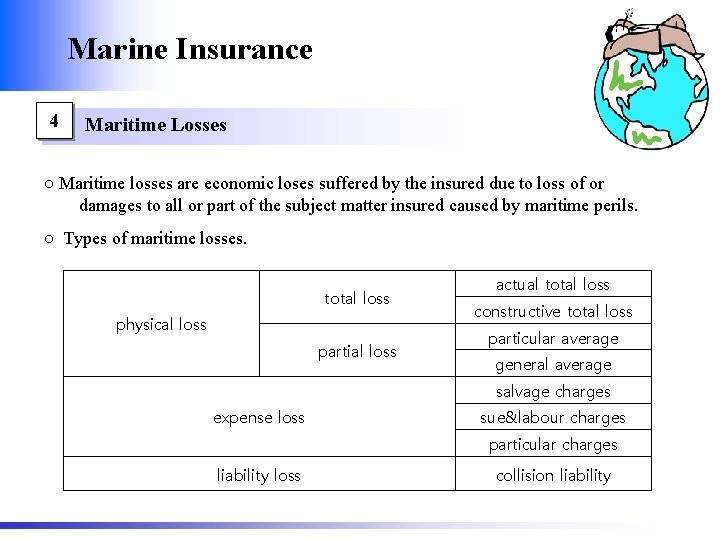
Marine Insurance 4 Maritime Losses ○ Maritime losses are economic loses suffered by the insured due to loss of or damages to all or part of the subject matter insured caused by maritime perils. ○ Types of maritime losses. total loss physical loss partial loss actual total loss constructive total loss particular average general average salvage charges expense loss sue&labour charges particular charges liability loss collision liability
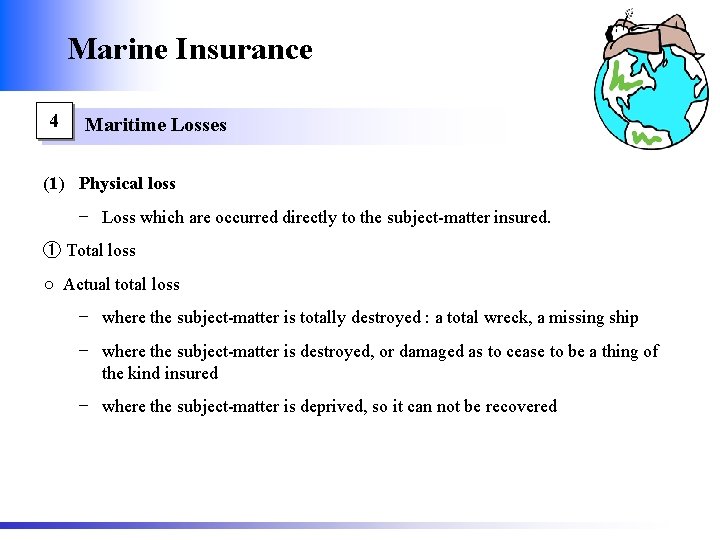
Marine Insurance 4 Maritime Losses (1) Physical loss − Loss which are occurred directly to the subject-matter insured. ① Total loss ○ Actual total loss − where the subject-matter is totally destroyed : a total wreck, a missing ship − where the subject-matter is destroyed, or damaged as to cease to be a thing of the kind insured − where the subject-matter is deprived, so it can not be recovered
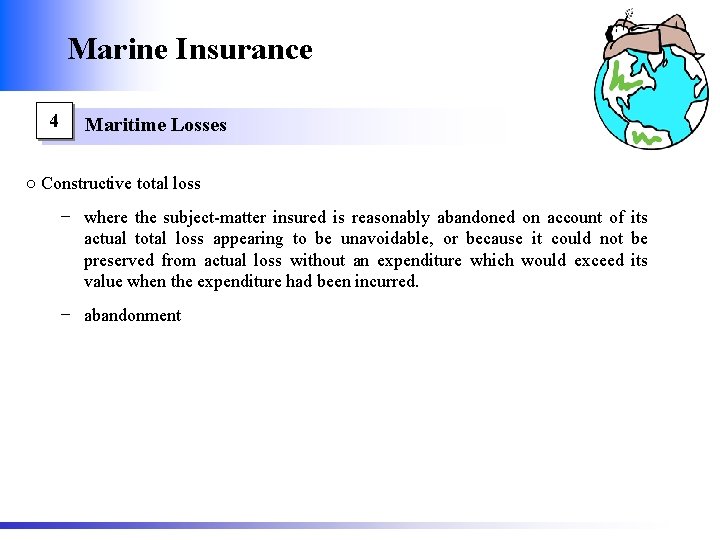
Marine Insurance 4 Maritime Losses ○ Constructive total loss − where the subject-matter insured is reasonably abandoned on account of its actual total loss appearing to be unavoidable, or because it could not be preserved from actual loss without an expenditure which would exceed its value when the expenditure had been incurred. − abandonment
Marine Insurance 4 Maritime Losses ② Partial loss ○ Particular average loss: partial loss of the subject-matter insured, caused by a peril insured against, and which is not general average loss ○ General average loss: all loss which arises in consequence of extraordinary sacrifices made or expenses incurred for the preservation of the ship and cargo come within general average, and must be born proportionately by all who are interested.
Marine Insurance 4 Maritime Losses (2) Expenses loss ① Salvage charge ○ Salvage charges are expenses incurred in preventing a loss by perils insured against and they are recoverable under maritime law by a salvor independently of contract. ⇒ Such expenses, where properly incurred, may be recovered as particular charges or as a general average loss, according to the circumstances under which they were incurred.
Marine Insurance 4 Maritime Losses (2) Expenses loss ② Sue & labor charge ○ Sue & labor charges are expenses which are incurred by the insured in order to minimize or avert a loss or damage to the cargo insured, for which the insurer would have been liable under the policy.
Marine Insurance 4 Maritime Losses ③ Particular charge ○ Any expenses except general average and salvage charge. (3) Liability loss ○ Collision liability − Marine insurance does not in principle cover liability, but exceptionally the liability for general average contribution and for both to blame collision.
Marine Insurance 5 Insurance Policy ○ Lloyd’s S. G. Policy (1779) : used for both vessels and goods ○ Company’s Combined Policy (1884) : by I. L. U (Institute London Underwriter), based Lloyd’s S. G. Policy, but policy for vessels and goods are separated ○ MAR Policy (1982) : Lloyd’s and I. L. U. made a new marine insurance policy for goods, and Institute Cargo Clause (A), (B), (C) were formed and used with a new marine insurance policy.
- Slides: 23