
Marine Fishes What is a fish Classic definition

![Salt Balance Revisited Rem: Freshwater fish [salt] inside fish > [salt] outside Saltwater fish](https://slidetodoc.com/presentation_image_h2/b0d89bb152f739554fba94a3cbf60917/image-52.jpg "Salt Balance Revisited Rem: Freshwater fish [salt] inside fish > [salt] outside Saltwater fish")
- Slides: 62
Marine Fishes
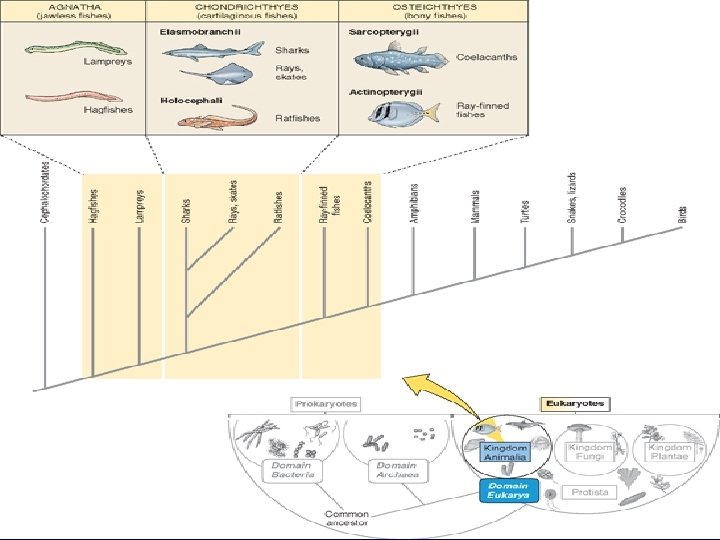
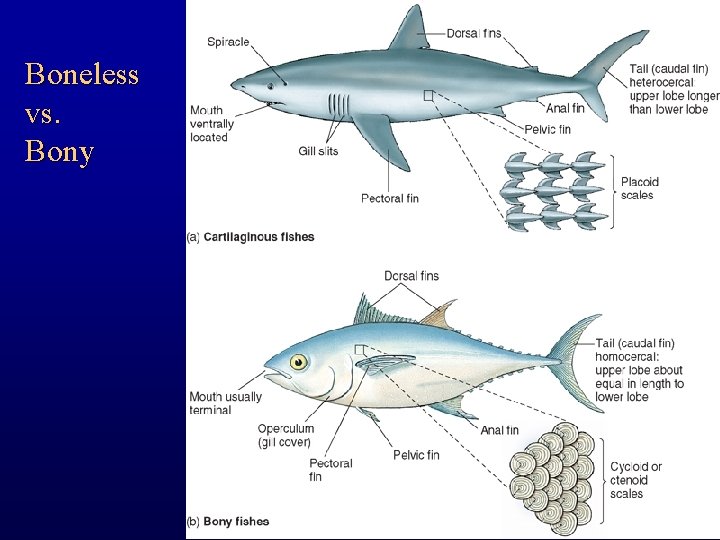
What is a fish? Classic definition: • Any of numerous cold-blooded aquatic vertebrates of the superclass Pisces, characteristically having fins, gills, and a streamlined body, including specifically – Any of the class Osteichthyes, having a bony skeleton, and – Any of the class Chondrichthyes, having a cartilaginous skeleton and including the sharks, rays, and skates. Although this is all accurate. . . we will find that fish are considerably MORE!!
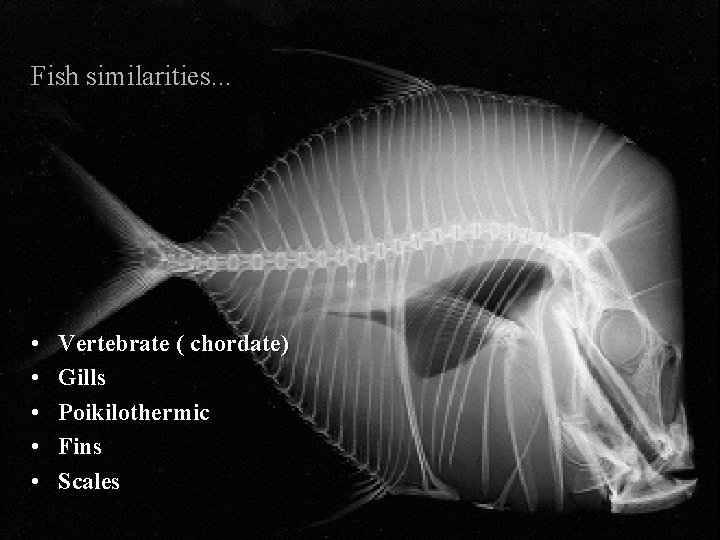
Fish similarities. . . • • • Vertebrate ( chordate) Gills Poikilothermic Fins Scales
Drag Reduction Features in Fish • “Fusiform” body shape – Reduction of body wave amplitude – Reduction of surface area – Boundary layer modifications
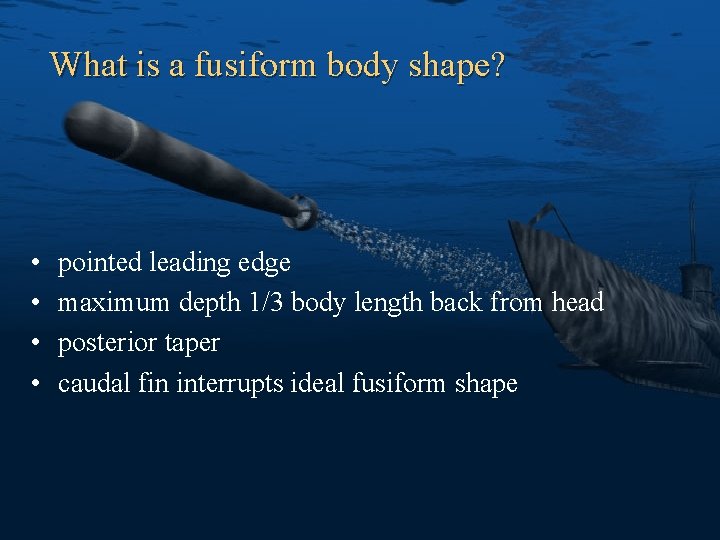
What is a fusiform body shape? • • pointed leading edge maximum depth 1/3 body length back from head posterior taper caudal fin interrupts ideal fusiform shape
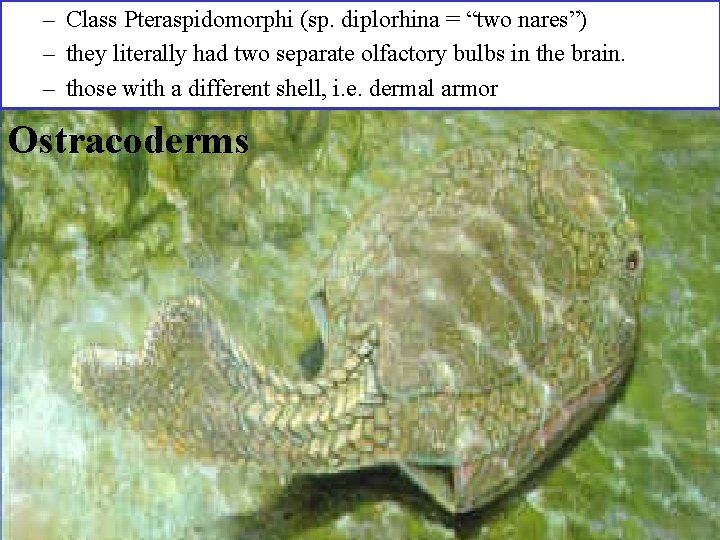
– Class Pteraspidomorphi (sp. diplorhina = “two nares”) – they literally had two separate olfactory bulbs in the brain. – those with a different shell, i. e. dermal armor Ostracoderms
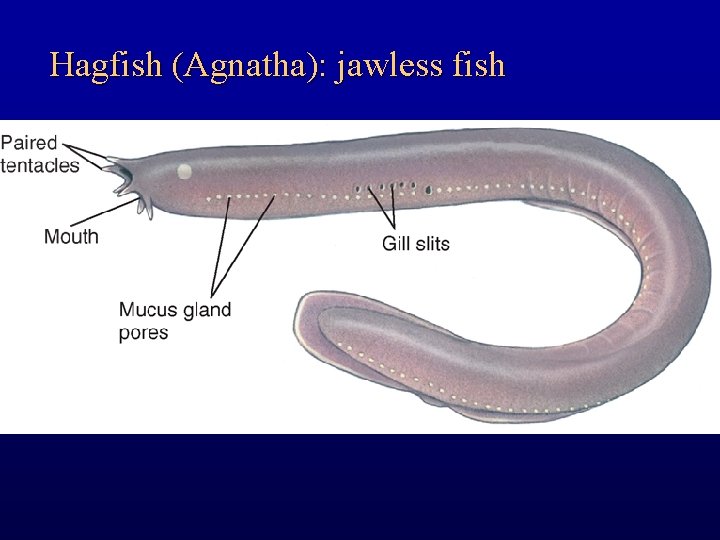
Hagfish (Agnatha): jawless fish
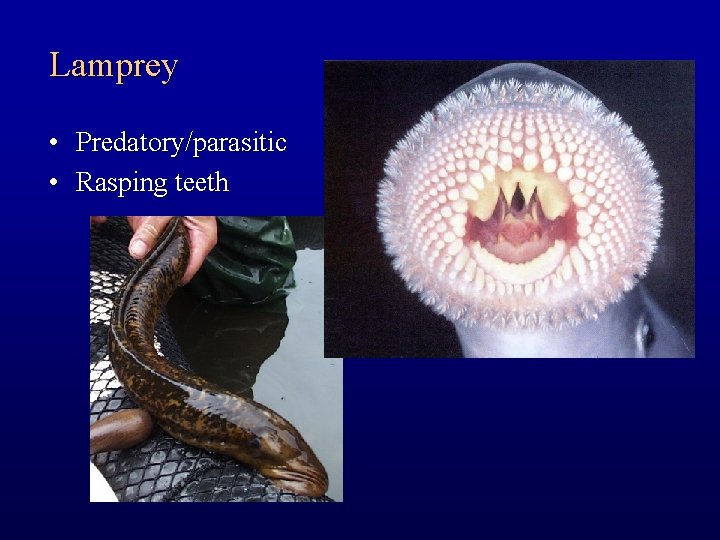
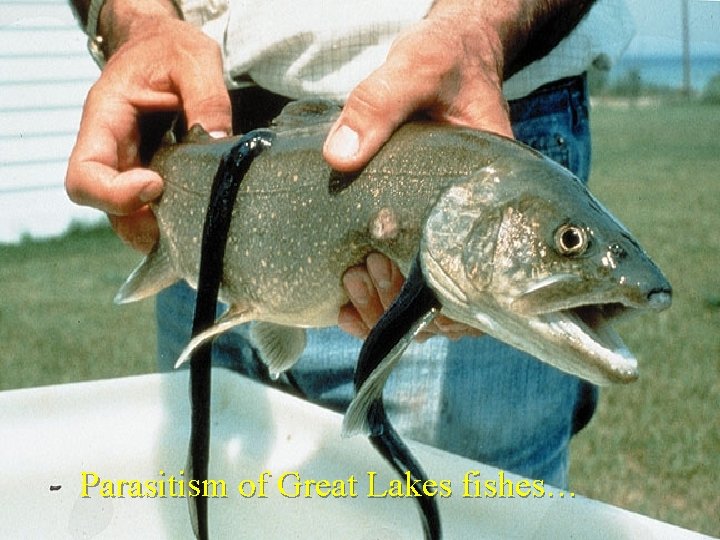
Lamprey • Predatory/parasitic • Rasping teeth
Parasitism of Great Lakes fishes…
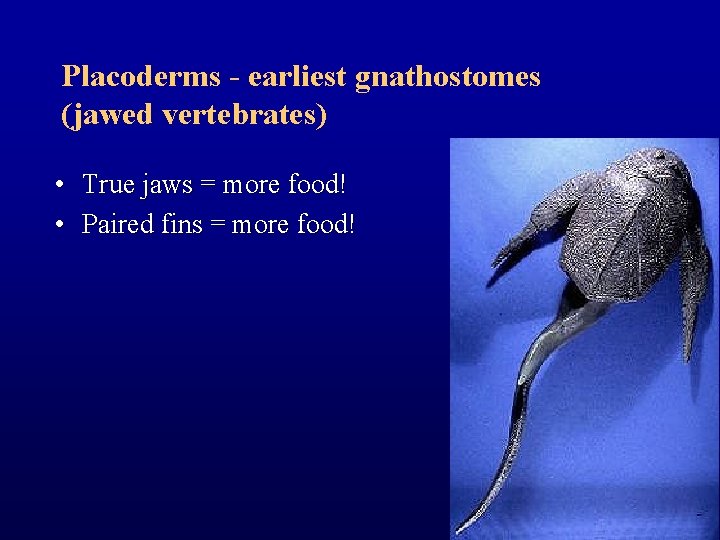
Placoderms - earliest gnathostomes (jawed vertebrates) • True jaws = more food! • Paired fins = more food!
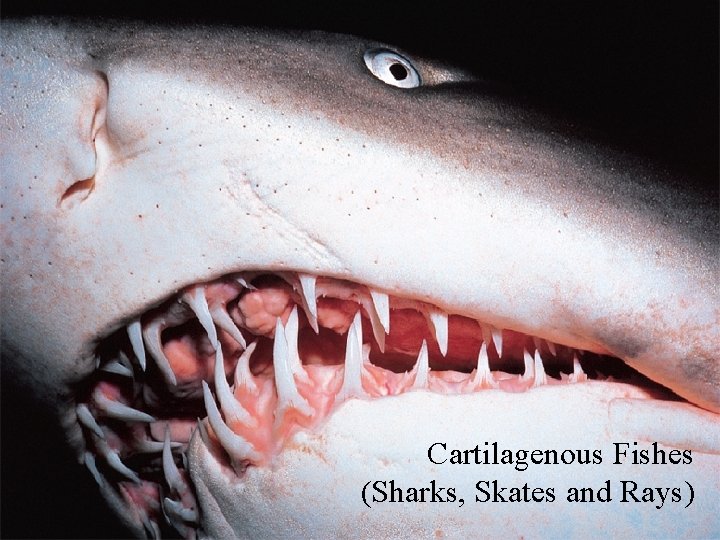
Cartilagenous Fishes (Sharks, Skates and Rays)
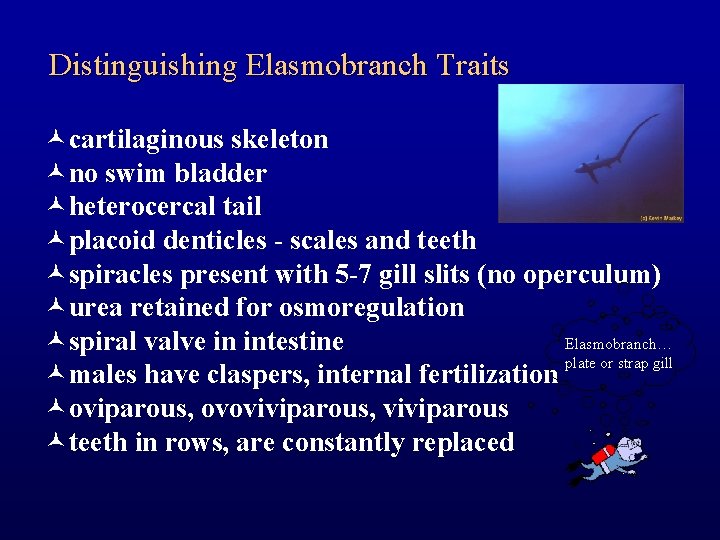
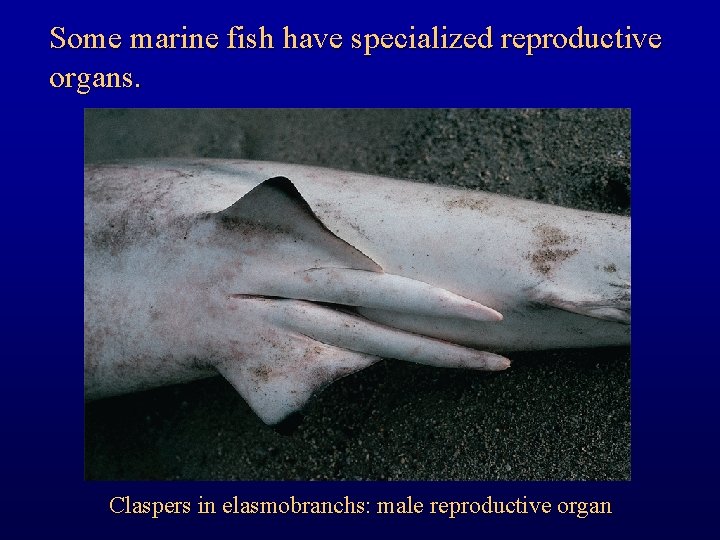
Distinguishing Elasmobranch Traits ©cartilaginous skeleton ©no swim bladder ©heterocercal tail ©placoid denticles - scales and teeth ©spiracles present with 5 -7 gill slits (no operculum) ©urea retained for osmoregulation Elasmobranch… ©spiral valve in intestine plate or strap gill ©males have claspers, internal fertilization ©oviparous, ovoviviparous, viviparous ©teeth in rows, are constantly replaced
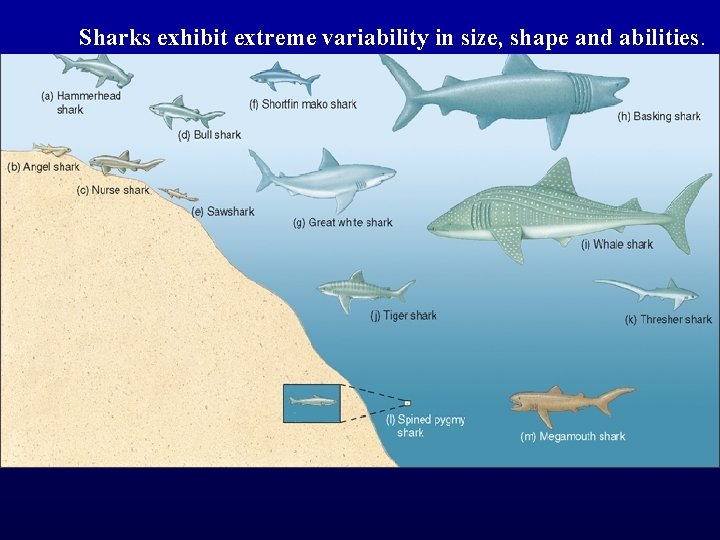
Sharks exhibit extreme variability in size, shape and abilities.
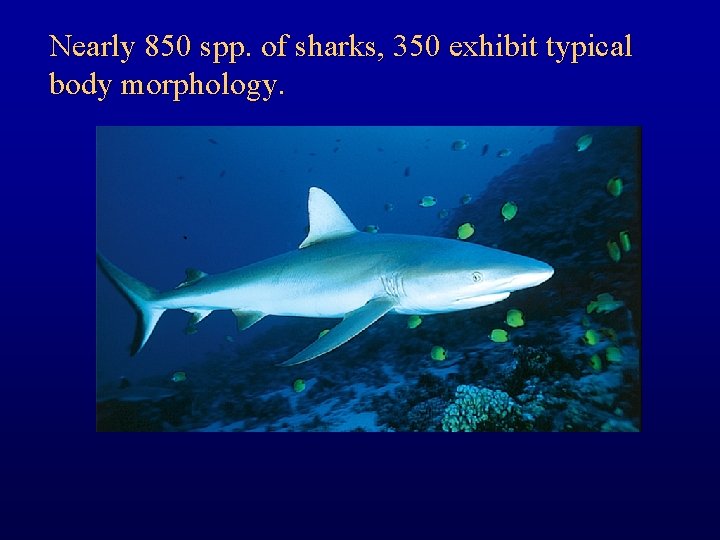
Nearly 850 spp. of sharks, 350 exhibit typical body morphology.
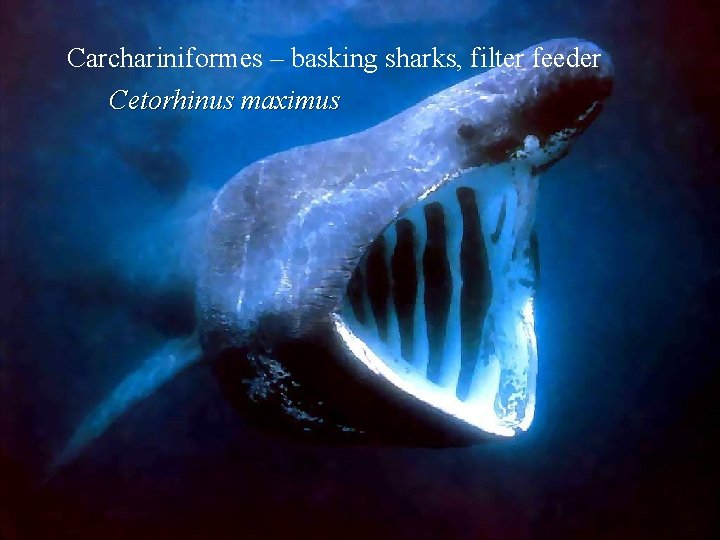
Carchariniformes – basking sharks, filter feeder Cetorhinus maximus
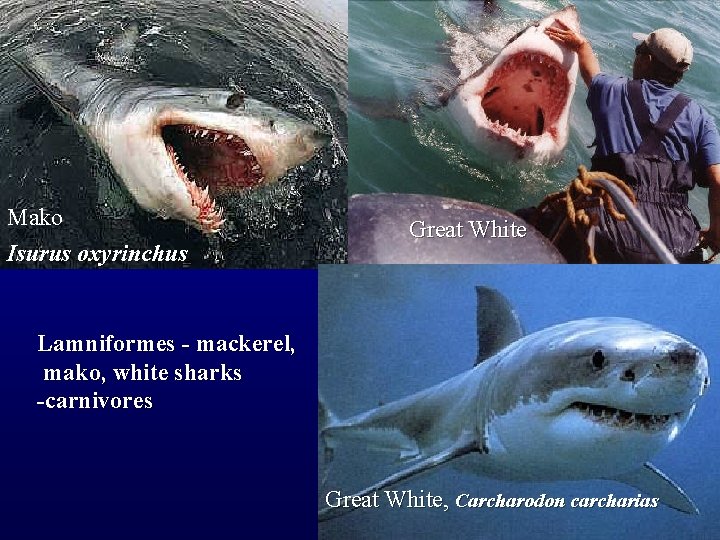
Mako Isurus oxyrinchus Great White Lamniformes - mackerel, mako, white sharks -carnivores Great White, Carcharodon carcharias
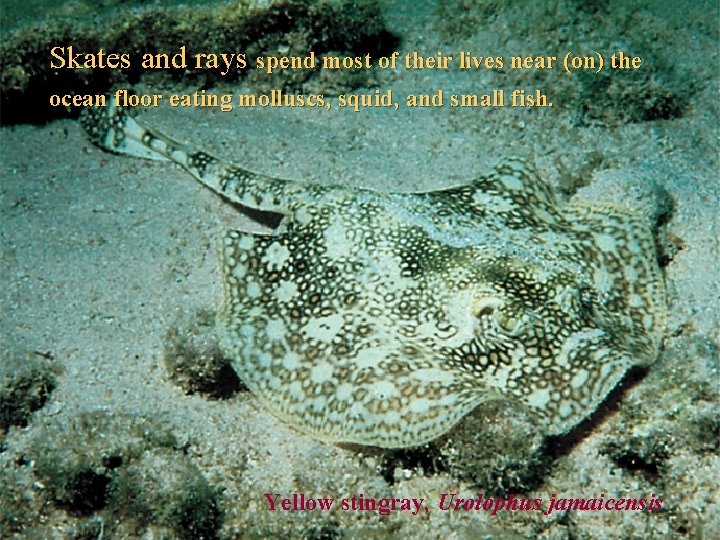
Skates and rays spend most of their lives near (on) the ocean floor eating molluscs, squid, and small fish. Yellow stingray, Urolophus jamaicensis
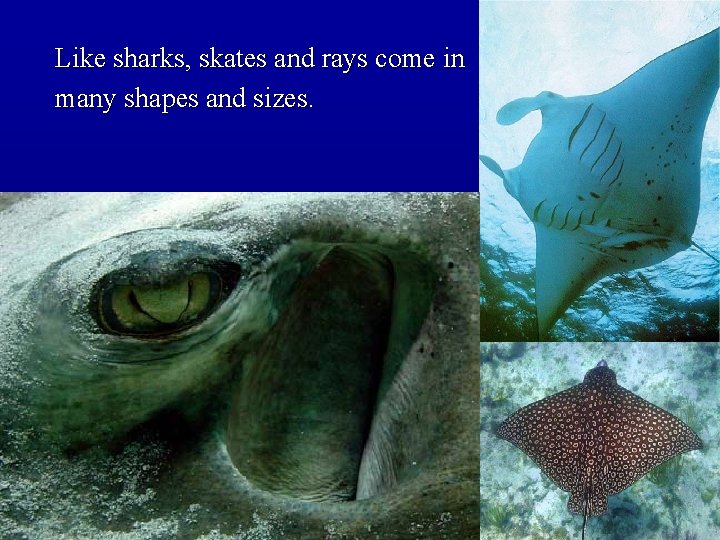
Like sharks, skates and rays come in many shapes and sizes.
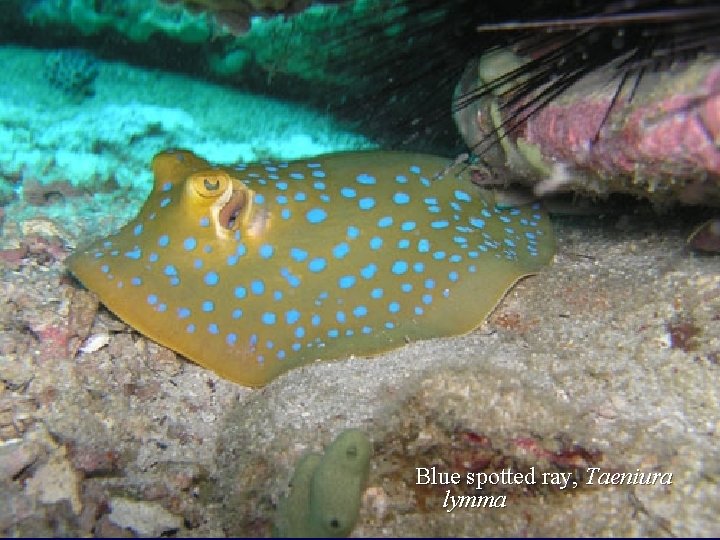
Blue spotted ray, Taeniura lymma
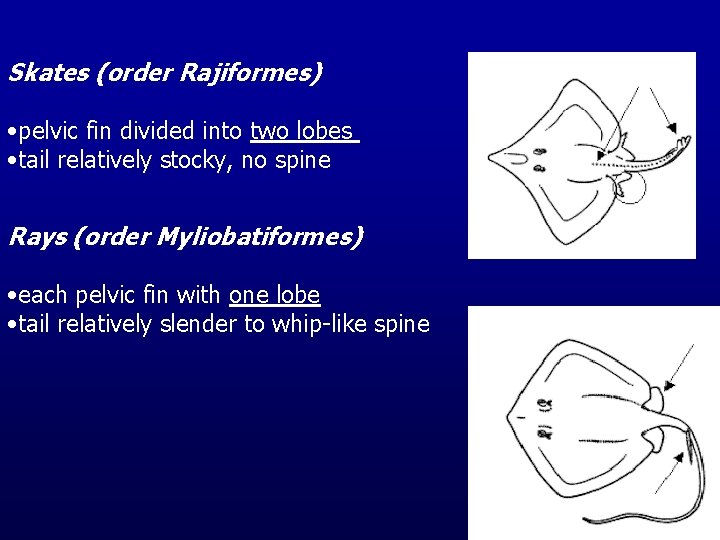
Skates (order Rajiformes) • pelvic fin divided into two lobes • tail relatively stocky, no spine Rays (order Myliobatiformes) • each pelvic fin with one lobe • tail relatively slender to whip-like spine
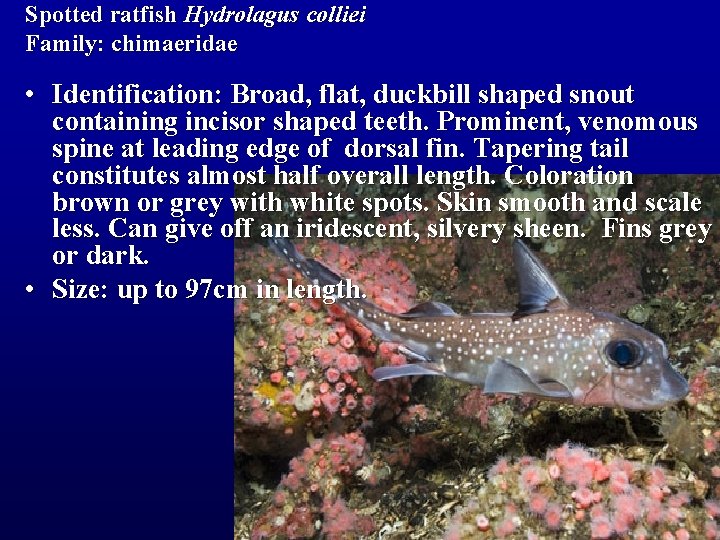
Spotted ratfish Hydrolagus colliei Family: chimaeridae • Identification: Broad, flat, duckbill shaped snout containing incisor shaped teeth. Prominent, venomous spine at leading edge of dorsal fin. Tapering tail constitutes almost half overall length. Coloration brown or grey with white spots. Skin smooth and scale less. Can give off an iridescent, silvery sheen. Fins grey or dark. • Size: up to 97 cm in length.
Boneless vs. Bony
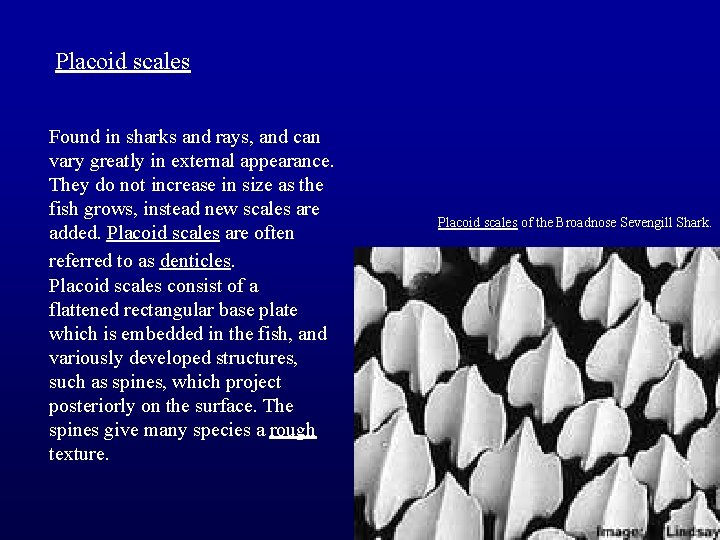
Placoid scales Found in sharks and rays, and can vary greatly in external appearance. They do not increase in size as the fish grows, instead new scales are added. Placoid scales are often referred to as denticles. Placoid scales consist of a flattened rectangular base plate which is embedded in the fish, and variously developed structures, such as spines, which project posteriorly on the surface. The spines give many species a rough texture. Placoid scales of the Broadnose Sevengill Shark.
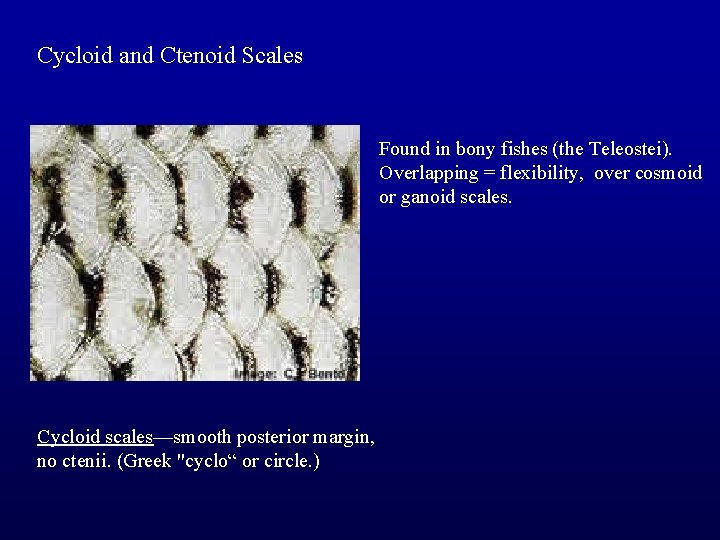
Cycloid and Ctenoid Scales Found in bony fishes (the Teleostei). Overlapping = flexibility, over cosmoid or ganoid scales. Cycloid scales—smooth posterior margin, no ctenii. (Greek "cyclo“ or circle. )
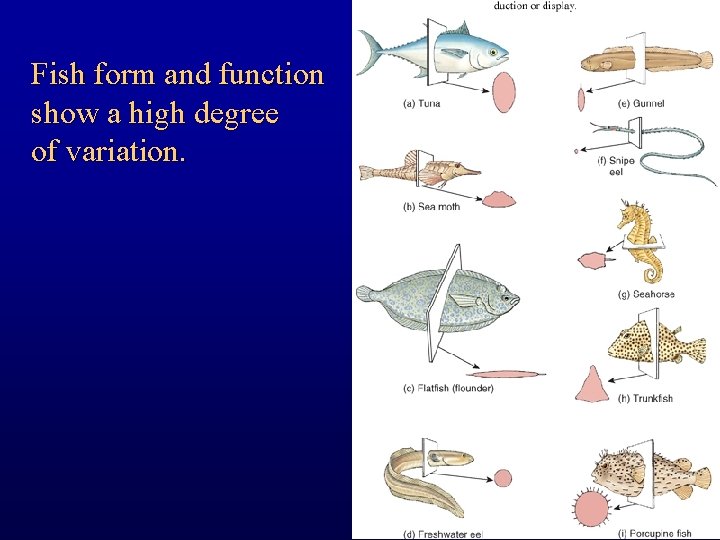
Fish form and function show a high degree of variation.
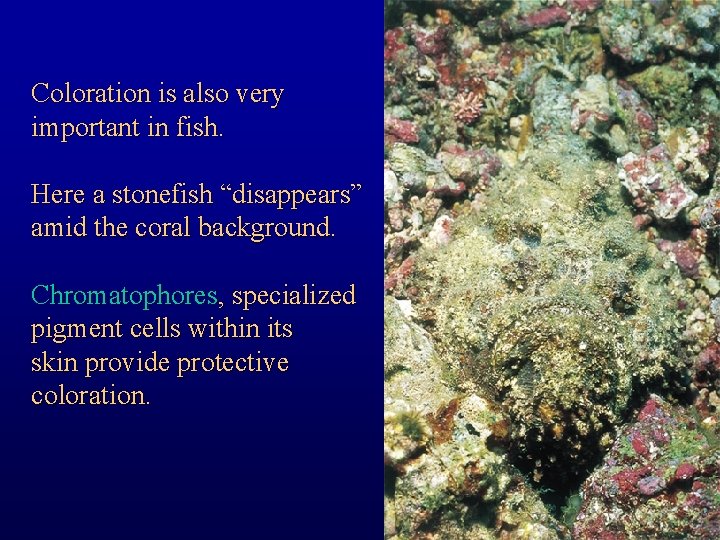
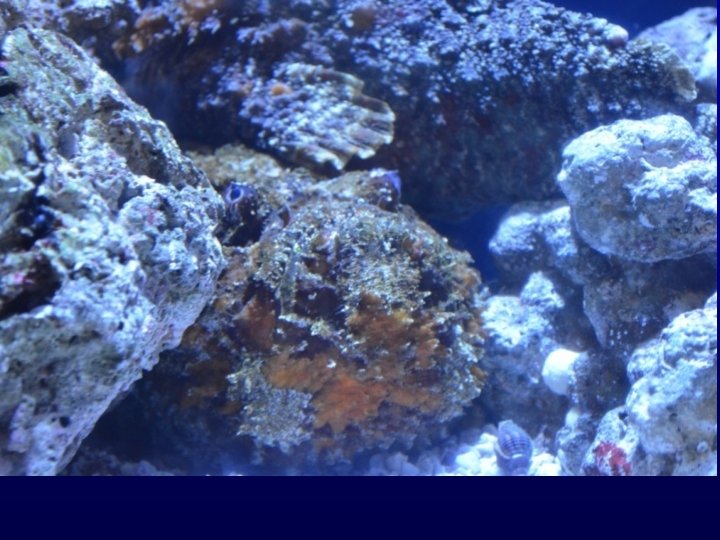
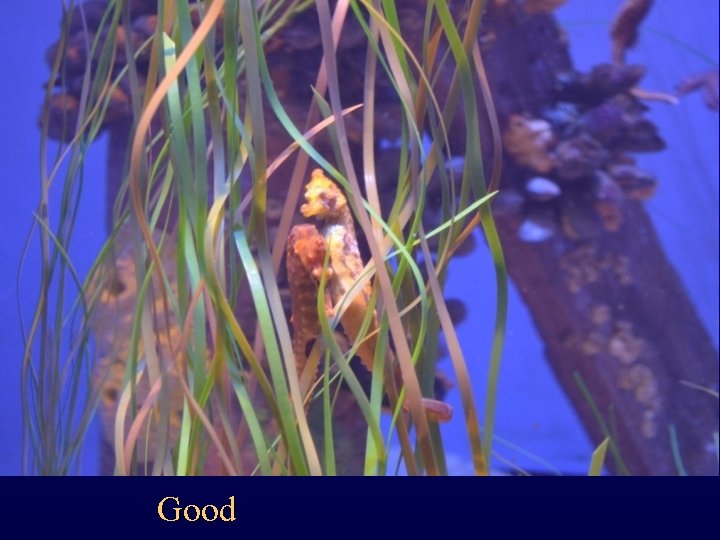
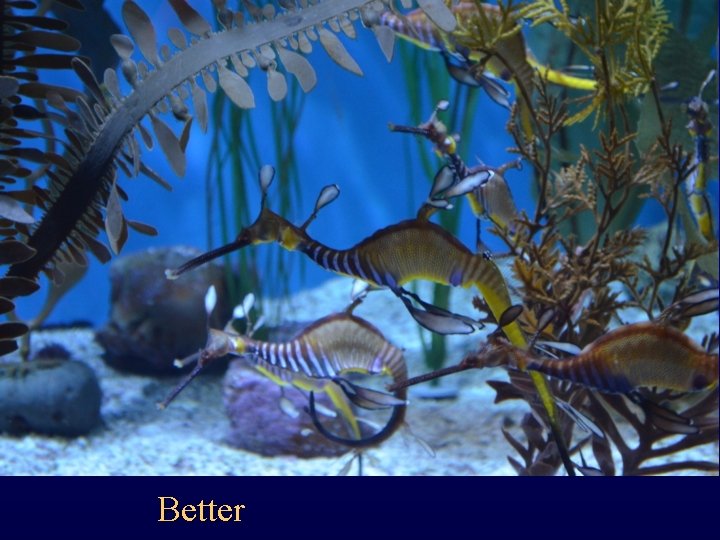
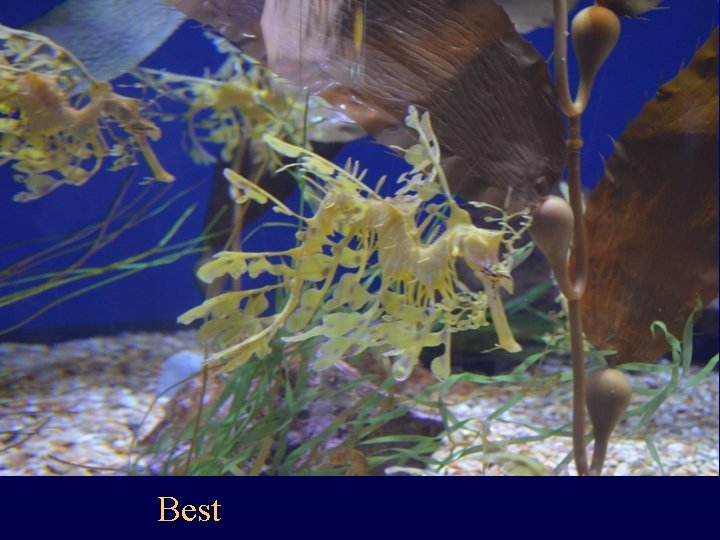
Coloration is also very important in fish. Here a stonefish “disappears” amid the coral background. Chromatophores, specialized pigment cells within its skin provide protective coloration.
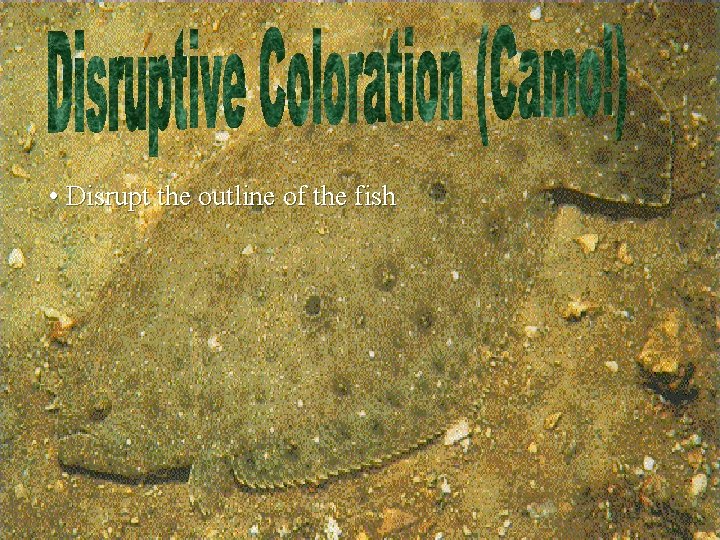
• Disrupt the outline of the fish
Good
Better
Best
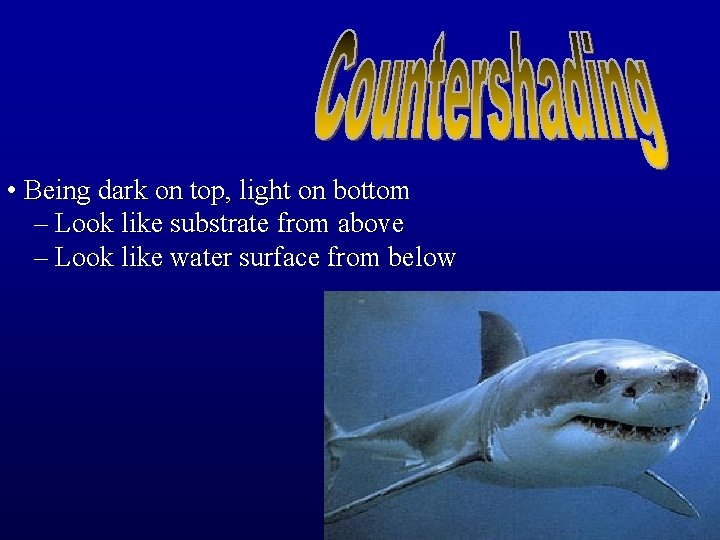
• Being dark on top, light on bottom – Look like substrate from above – Look like water surface from below
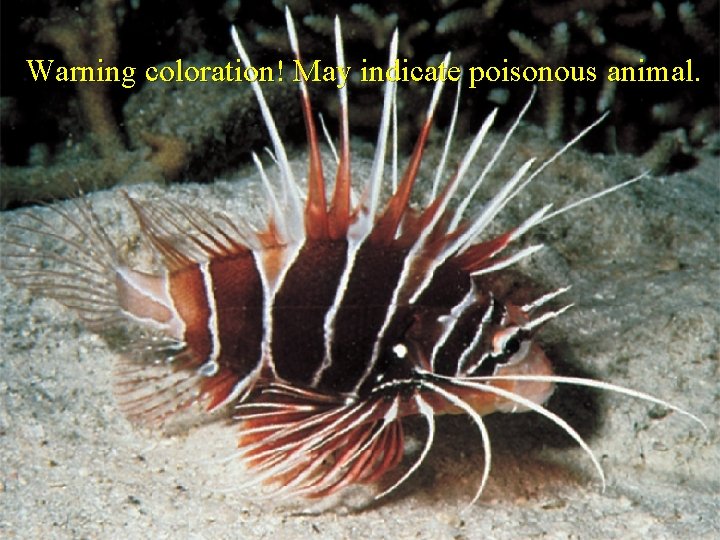
Warning coloration! May indicate poisonous animal.
Fish Locomotion • Primary forces involved in fish swimming: – Thrust - force that propels forward – Drag - friction produced from passing an object through a medium – Gravity – force from earth’s magnetic pull (partially counterbalanced by density of water) – Lift - upward force that counteracts gravity
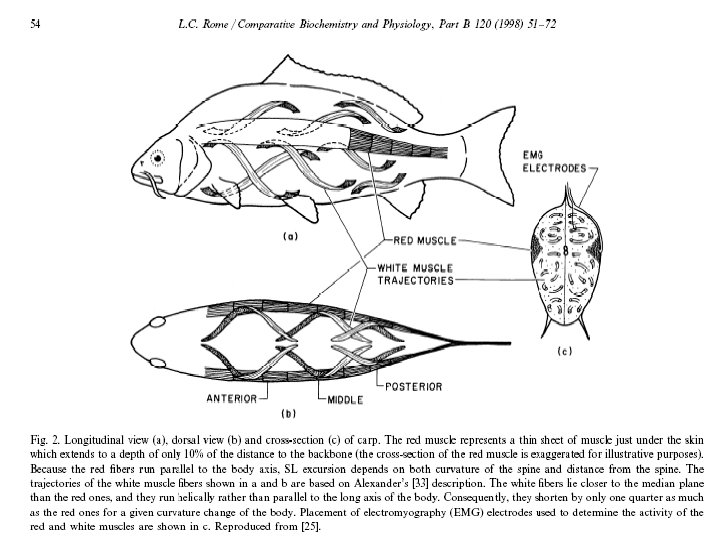
Skeletal Fish Muscle: • Essentially three types of fish muscle: red, white, pink. • Red muscle (oxidative): Highly vascularized, myoglobin containing tissue used during sustained swimming. Small diameter and high blood volume = rich O 2 supply! Presence leads to strong flavor in some fishes (tuna). • White muscle (glycolytic): Little vascularization. Used during “sprint” swimming. Large diameter fibers. • Pink muscle: This one is sort of in between red and white. Serves in sustained swimming, but not to the extent that red muscle is used.
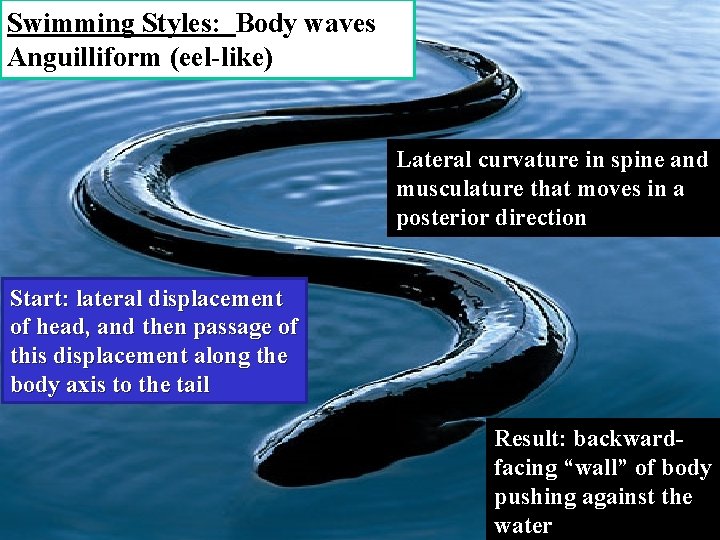
Swimming Styles: Body waves Anguilliform (eel-like) Lateral curvature in spine and musculature that moves in a posterior direction Start: lateral displacement of head, and then passage of this displacement along the body axis to the tail Result: backwardfacing “wall” of body pushing against the water
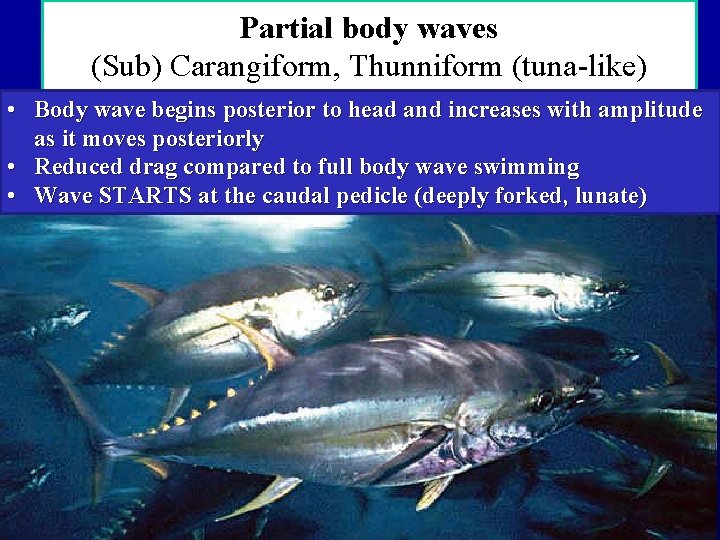
Partial body waves (Sub) Carangiform, Thunniform (tuna-like) • Body wave begins posterior to head and increases with amplitude as it moves posteriorly • Reduced drag compared to full body wave swimming • Wave STARTS at the caudal pedicle (deeply forked, lunate)
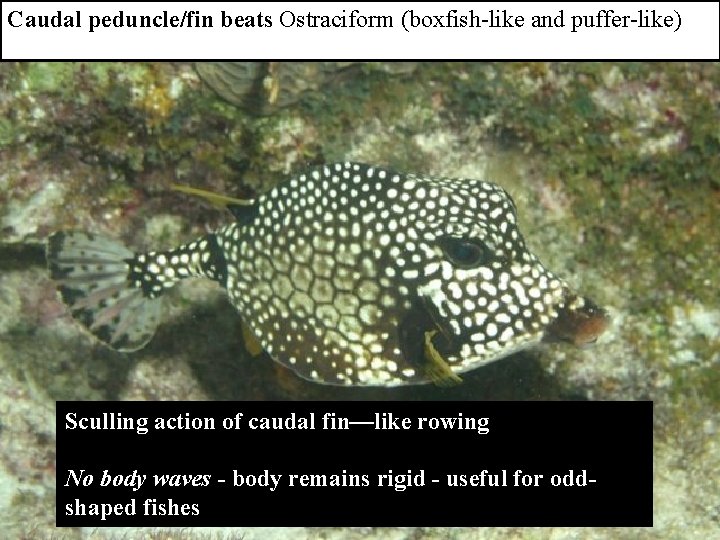
Caudal peduncle/fin beats Ostraciform (boxfish-like and puffer-like) Sculling action of caudal fin—like rowing No body waves - body remains rigid - useful for oddshaped fishes
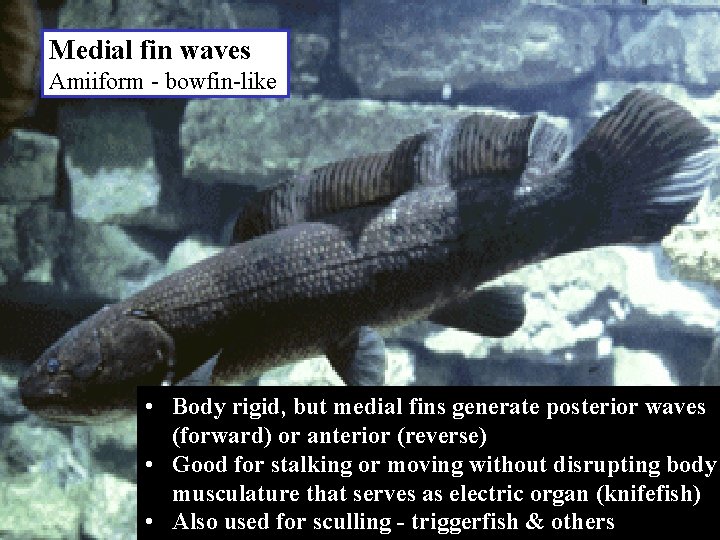
Medial fin waves Amiiform - bowfin-like • Body rigid, but medial fins generate posterior waves (forward) or anterior (reverse) • Good for stalking or moving without disrupting body musculature that serves as electric organ (knifefish) • Also used for sculling - triggerfish & others
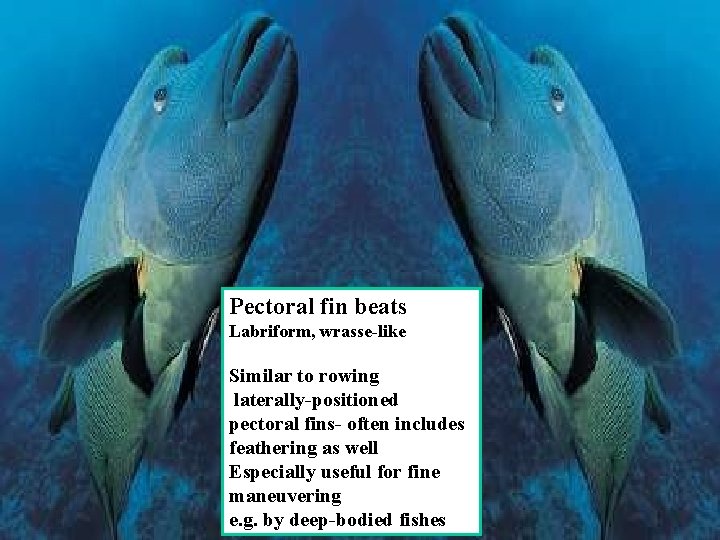
Pectoral fin beats Labriform, wrasse-like Similar to rowing laterally-positioned pectoral fins- often includes feathering as well Especially useful for fine maneuvering e. g. by deep-bodied fishes
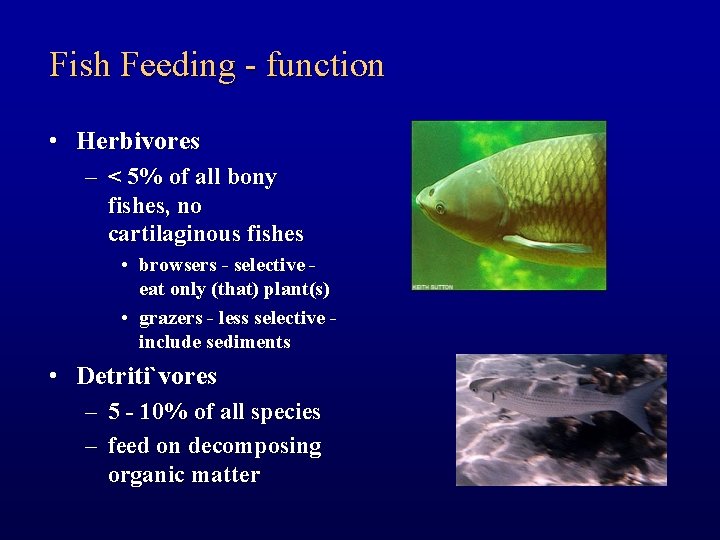
Fish Feeding - function • Herbivores – < 5% of all bony fishes, no cartilaginous fishes • browsers - selective eat only (that) plant(s) • grazers - less selective include sediments • Detriti`vores – 5 - 10% of all species – feed on decomposing organic matter
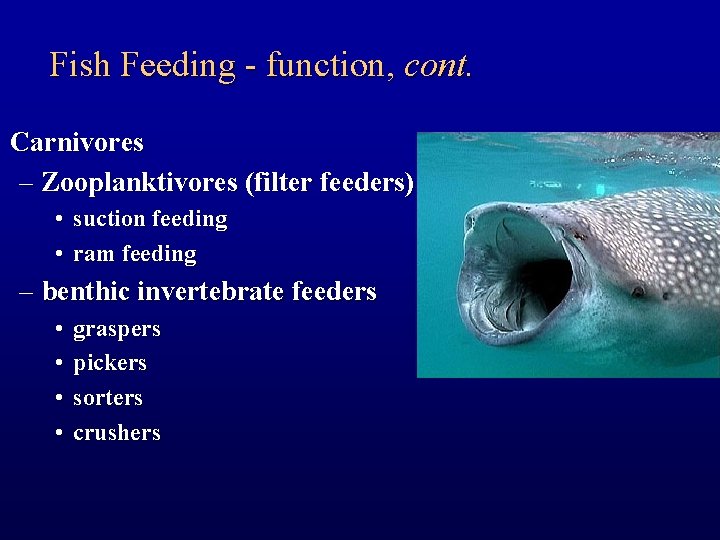
Fish Feeding - function, cont. Carnivores – Zooplanktivores (filter feeders) • suction feeding • ram feeding – benthic invertebrate feeders • • graspers pickers sorters crushers
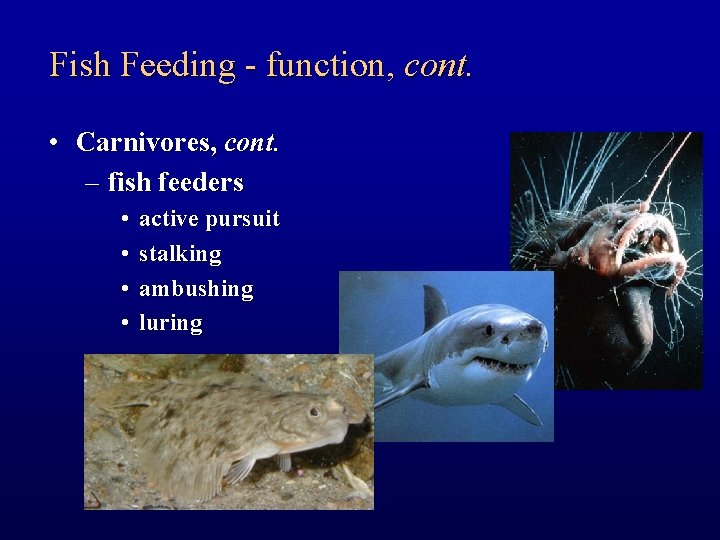
Fish Feeding - function, cont. • Carnivores, cont. – fish feeders • • active pursuit stalking ambushing luring
Fish feeding behavior • Fish feeding behavior integrates morphology with perception to obtain food: – >Search – --> Detection – --> Pursuit – --> Capture – --> Ingestion
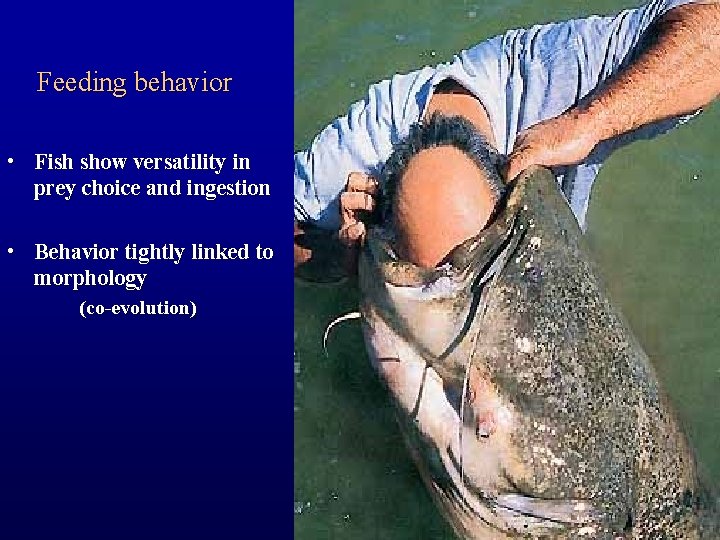
Feeding behavior • Fish show versatility in prey choice and ingestion • Behavior tightly linked to morphology (co-evolution)
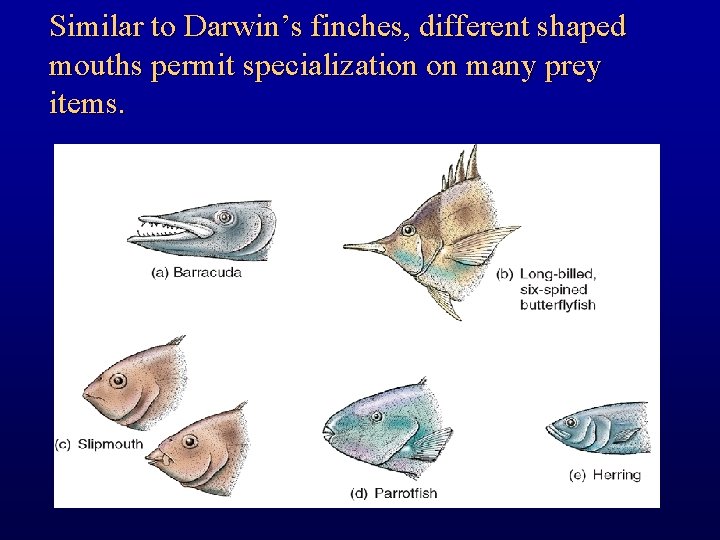
Similar to Darwin’s finches, different shaped mouths permit specialization on many prey items.
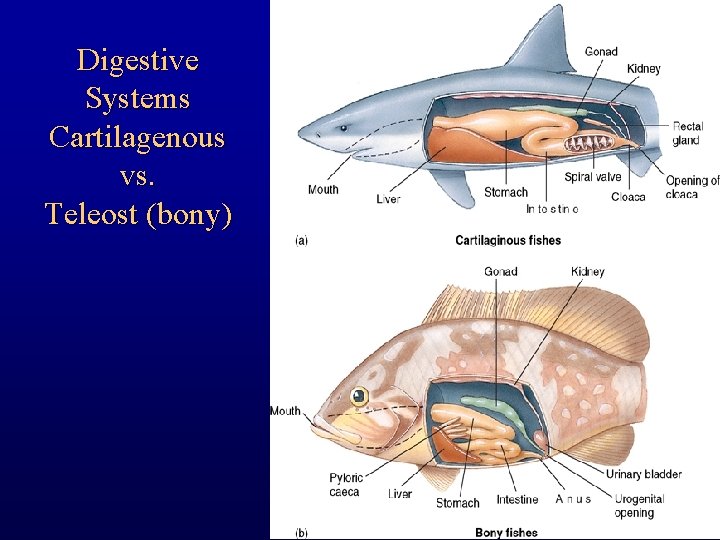
Digestive Systems Cartilagenous vs. Teleost (bony)
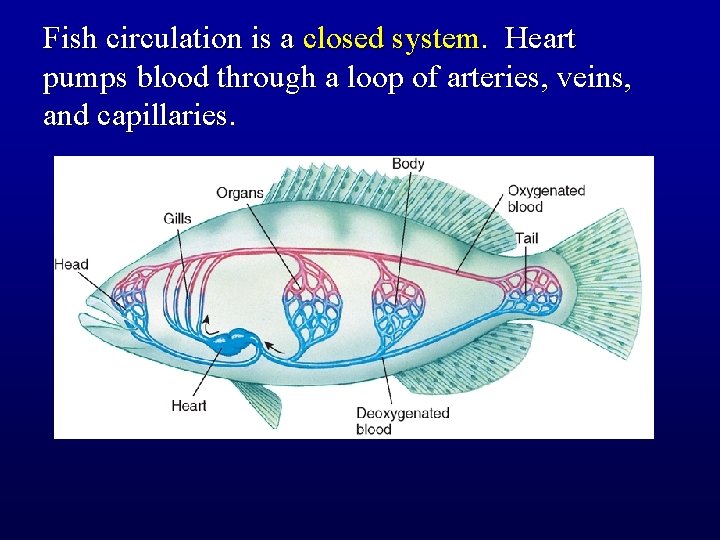
Fish circulation is a closed system. Heart pumps blood through a loop of arteries, veins, and capillaries.
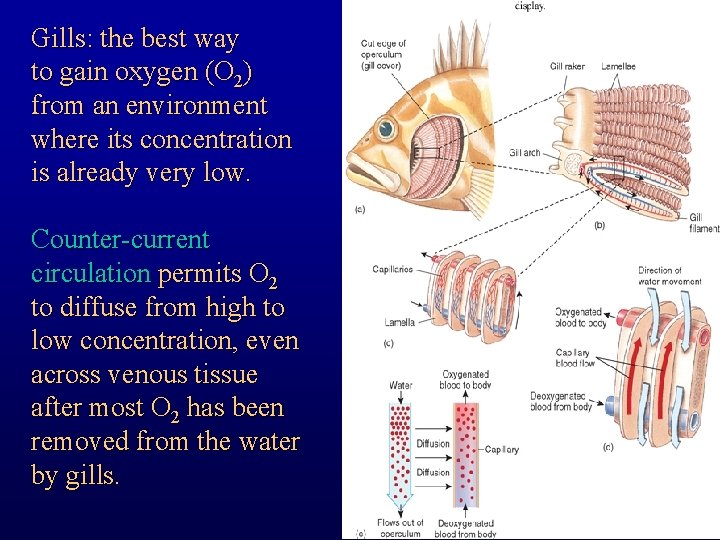
Gills: the best way to gain oxygen (O 2) from an environment where its concentration is already very low. Counter-current circulation permits O 2 to diffuse from high to low concentration, even across venous tissue after most O 2 has been removed from the water by gills.
Salt Balance Revisited Rem: Freshwater fish [salt] inside fish > [salt] outside Saltwater fish [salt] inside < [salt] outside fish
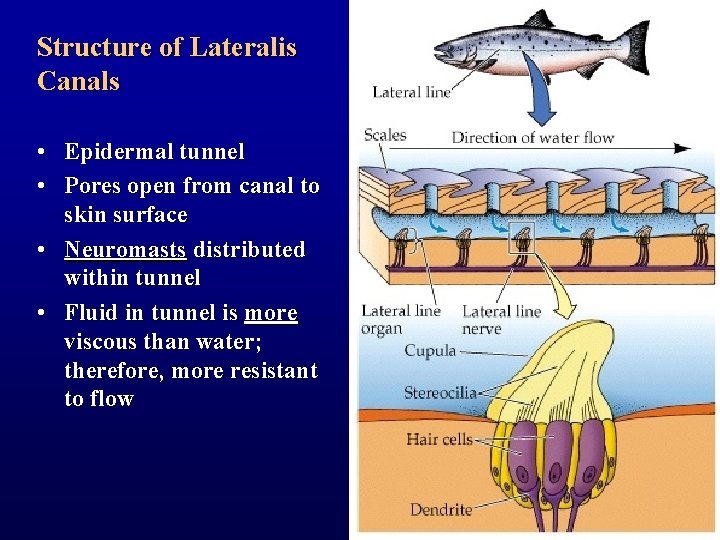
Structure of Lateralis Canals • Epidermal tunnel • Pores open from canal to skin surface • Neuromasts distributed within tunnel • Fluid in tunnel is more viscous than water; therefore, more resistant to flow
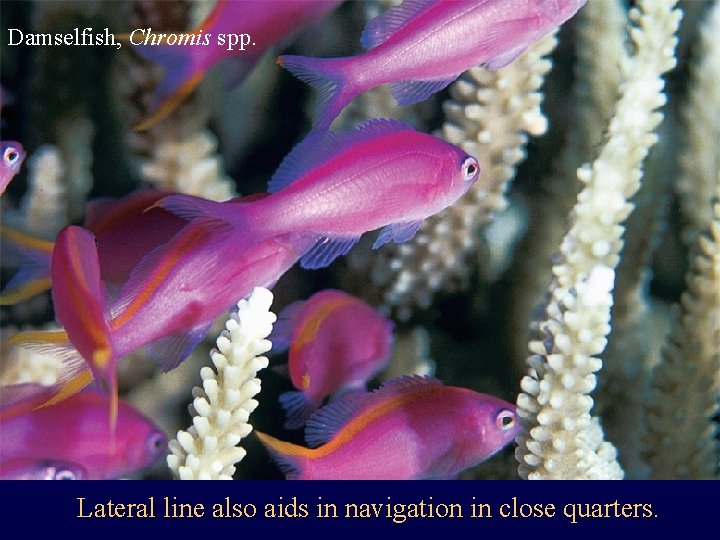
Damselfish, Chromis spp. Lateral line also aids in navigation in close quarters.
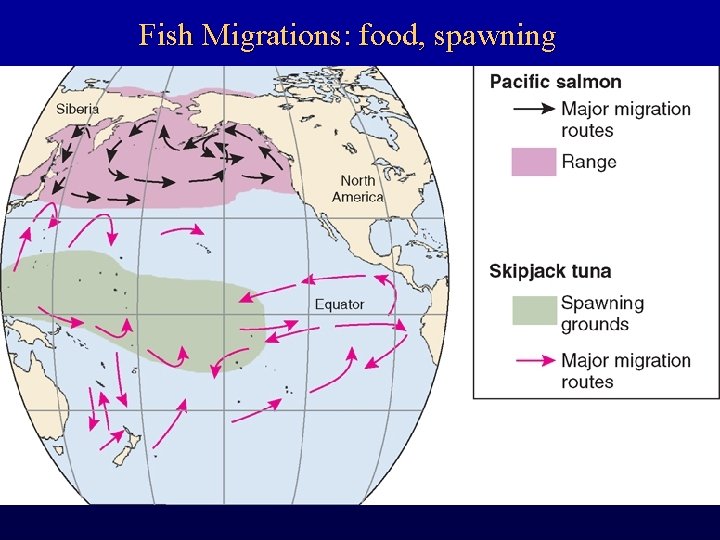
Fish Migrations: food, spawning
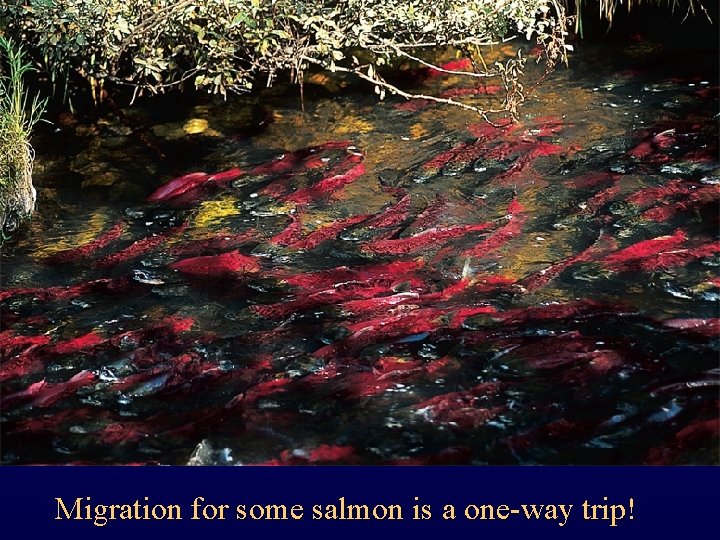
Migration for some salmon is a one-way trip!
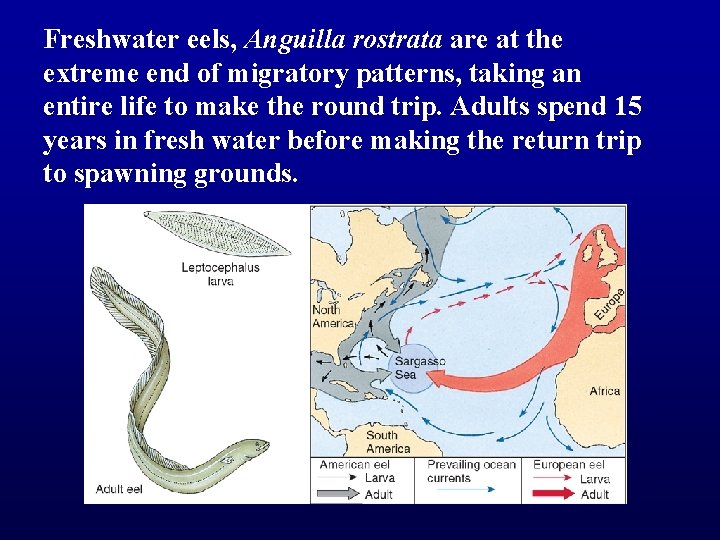
Freshwater eels, Anguilla rostrata are at the extreme end of migratory patterns, taking an entire life to make the round trip. Adults spend 15 years in fresh water before making the return trip to spawning grounds.
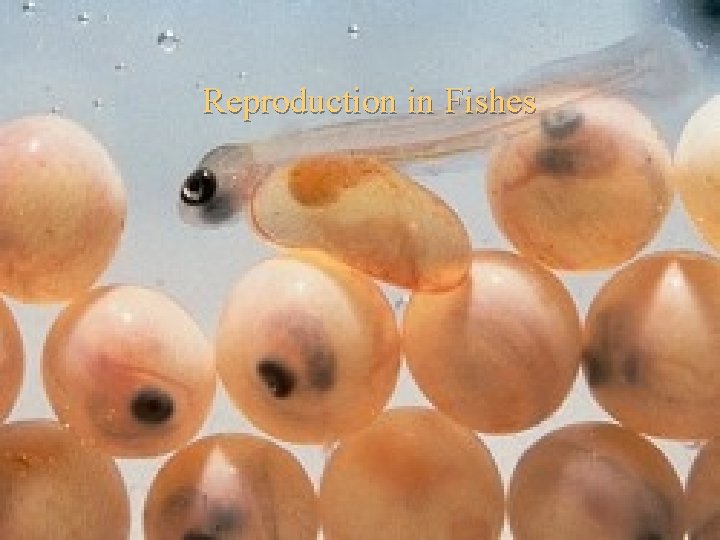
Reproduction in Fishes
Reproductive traits and life-history patterns Mating systems: – Promiscuous - both sexes with multiple partners most (common) – Polygynous - males with multiple mates (cichlids) – Polyandry - females with multiple mates – few (Anglerfish, males “parasitize” females, clownfish) – Monogamy - mating pair remains together over time, long gestation of young (some cichlids, seahorses, pipefish, clowfishes)
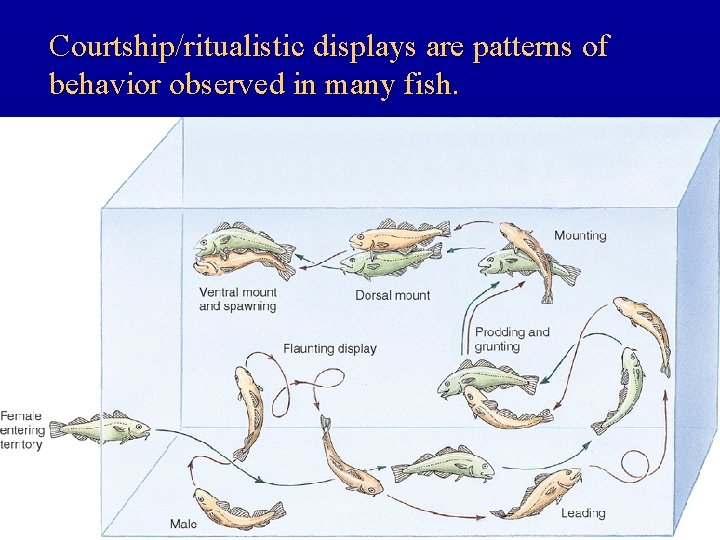
Courtship/ritualistic displays are patterns of behavior observed in many fish.
Some marine fish have specialized reproductive organs. Claspers in elasmobranchs: male reproductive organ
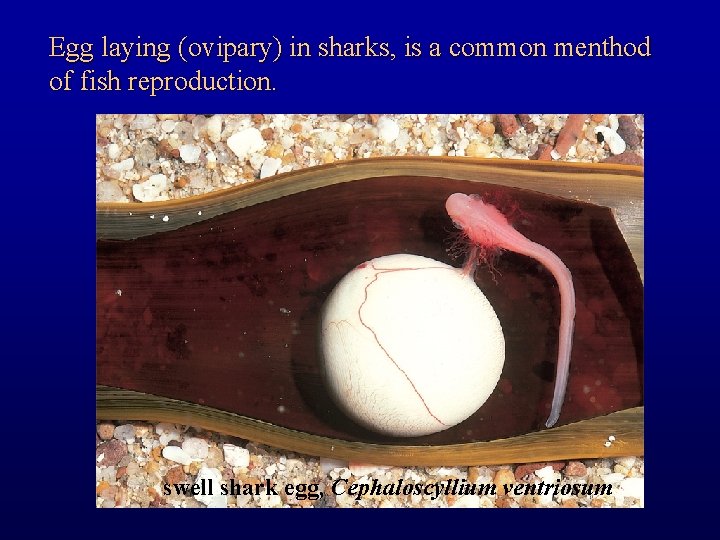
Egg laying (ovipary) in sharks, is a common menthod of fish reproduction. swell shark egg, Cephaloscyllium ventriosum