
MARINE FAMILY PROGRAMS C A M P PENDLETONBARSTOW
MARINE & FAMILY PROGRAMS C A M P PENDLETON/BARSTOW STRATEGIC P L A N 2021 -2025
M&FP DIRECTOR’S GUIDANCE To the Marine & Family Programs Team: Our mission , as detailed within the contents of this Strategic Plan is one of significant importance. We will support the mission readiness of those we serve by exceeding the Quality of Life requirements of our military family through the provision a full continuum of services across all facets of Family Readiness (Marine Corps Family Team Building), Personal and Professional Development, Behavioral Health and Family Care. This strategic plan provides guidance on how Marine & Family Programs, Camp Pendleton/Barstow will continue to provide world class service and viable options to the Operating Forces, Tenant Commands and the individual Marine, Sailor and their family. This strategic plan provides the foundation to support those we serve as we align our efforts to the mission, vision, strategic plan, objectives and embrace the need to measure our impact. We will remain committed to open communication and ongoing dialogue with all levels of command, individual service members and their families to seek out those areas that we can further assist. Our ability to have the pulse on current requirements, coupled with our team approach to anticipating future requirements, will enable us to meet the demand of our customers. We will balance resources and continue to refine our cross-organizational collaboration since we recognize that we are stronger as we integrate programs in order to achieve enhanced services. It is critical that we employ collaboration and resource allocation, which will be key to continue achieving the level of support required. We will innovate and advance initiatives that enhance our service delivery models while increasing coordination and collaboration. Regular communication and a clear understanding of the challenges facing leaders aboard our installation will also provide key points in which we can and will offer solutions. Our team will continue to play a vital role in this effort and our ability to recognize and acknowledge evolving needs, feedback and further analysis of our impact across programs will enable us to drive towards providing even greater options. We will promote mission readiness for those we serve as we are here to support the commands, and the individual health, wellness, and stability of those within our Marine Corps Family. Our perseverance and purpose is a driving force behind the tremendous support that we provide. We will build on our successes, improve in all areas, and renew our commitment to grow stronger through cross-organizational collaboration both internally and across external support organizations. We will develop, mentor, and grow our future leaders while enhancing the skills and capabilities of our current executive and supervisory staff. 2

In summary we will be guided by the following: T E We are a team focused on providing professional, timely, and flexible support to those we serve while remaining cognizant that we must d o so together. Each member of the team is vital to Marine & Family Programs overall success. We are excited about being part of an organization with such an incredibly important mission— a key element to this is maintaining professional relationships. We should treat one another with dignity and respect for we are stronger in accomplishing our mission together. A We have the ability to anticipate and react with the support needed for our customers while staying in tune with how best to assist our fellow Marine & Family Programs teammates. We take the initiative, generate ideas, and employ innovative approaches. Each one of us makes the difference. M We will maintain a positive attitude with a focus on mission accomplishment. Our attitude is contagious— and can and should be a force multiplier for great support to the team and our customers. I am extremely proud of you and am honored to be on the same team with so many dedicated professionals. V/r, D e r r i c k Christovale Sr. Director, Marine & Family Programs Division Marine Corps Base Camp Pendleton Marine Corps Logistics Base Barstow 3
W H A T M A K E S MARINE & FAMILY P R O G R A M S A B O A R D CAMP PENDLETON/BARSTOW P UR P O SE The Marine & Family Programs Division Strategic Plan for Camp Pendleton/Barstow provides the foundation to support those we serve as we align our efforts to the mission, vision, strategic plan, objectives and embrace the need to measure our impact. The implementation of this Strategic Plan will provide a common vision for the current and future efforts of Marine & Family Programs aboard Camp Pendleton/Barstow. SERVICE PHILOSOPHY To provide support capabilities to operational commanders in order to increase individual and unit readiness. To assist Service Members and their families in managing the challenges of daily living experienced in the unique context of military service. To provide a collaborative, forward leaning and engaged system of support to the Marines, Sailors and their families of Camp Pendleton/Barstow across a full continuum of family readiness, personal and professional development, family care, and behavioral health needs. To work closely with commands to improve quality of life through the provision of relevant programs that evolve with current needs as envisioned by Service Members and their families. VISION We are focused on sustaining our expeditionary forces while promoting retention through support of Operating Forces, Tenant Commands, and the families of Camp Pendleton/Barstow. We will continue to maintain our focus in order to achieve feedback from our stakeholders while anticipating their needs, requirements, and that which will positively impact their ability to thrive in the Marine Corps Family. We will be an organization that provides premier services and customer support through easily accessible programs that are ready to assist with unwavering support. We will make a difference in the lives of those we serve through our ability to provide unmatched program delivery while creating a culture of trust. We will provide responsible stewardship as we anticipate future requirements and position our organization to remain steadily focused on the Marines, Sailors, and their families. We will d o this by working as a cross-organizationally collaborative team where we recognize that by working together to incorporate innovative ways to integrate programs we will better serve our customers. With a willingness to share best practices and integrate processes, we will continue to develop the network and continuum of support across each area within Marine & Family Programs. 4
LEADERSHIP PHILOSOPHY A N D TENETS Marine & Family Programs Division is guided in its mission and vision by the following tenets which underscore our intent: • S u p p o r t the O p e r a t i n g Forces, Tenant C o m m a n d s a n d families of C a m p Pendleton/Barstow — We are here to support and we must remain committed to this very critical component. Our positive impact in assisting those we serve has and will continue to enhance mission readiness. We are excited to serve and look at every opportunity to assist as one that will make a positive and lasting difference by providing world class service. We are proud to serve in an organization that has an unparalleled legacy. We will continue to make a difference— by working across all levels of command with individual Marines, Sailors, and their families to maintain mission readiness of the war fighter. • Building the Team – Take C a r e of our People—We must continue to seek opportunities for professional development of those on our team. Employees within the division are truly what makes Marine & Family Programs aboard Camp Pendleton/Barstow a leader in programmatic service delivery to commands, Marines, Sailors, and their families. The continual development and professional growth of those on our team is an integral part of today’s success, and is what will be instrumental in meeting future challenges. • Cross-Organizational Collaboration — In an era of fiscal austerity, coupled with the changing environment within the Marine Corps, we must look for new methods of partnership across programs. We must seek common ground and connect in a manner that enhances support to those we serve. Simply, where we work together we strengthen support, flexibility and capability to those we serve. • Anticipation of Requirements — A s we deal with change, we must learn to embrace the transformation as the Marine Corps evolves. We must respond quickly to change and be readily capable of providing support. B y anticipating the need, which can only come through regular communication across our organization, commands and individual Marines, Sailors and their families, we will be where the need is prior to it being needed. • Plan for S u c c e s s —What we d o has an impact on the success of those we serve. We will plan to be where our customers need in order to meet them where they are in the life continuum. B y planning for success, we are planning to meet and exceed the requirements of our stakeholders in both current and future requirements. We look for methods that will allow us to sustain current programs while enhancing capabilities for optimum outcomes. • A n a l y z e Performance a n d I m p a c t of Data PQI—All organizations must tie their daily efforts and tasks to clear objectives aimed at accomplishing the mission. We are committed to this philosophy and will continue to d o so by ensuring that we understand our goals and focus on analyzing performance. We will seek stakeholder and customer feedback, review performance metrics including utilization rates, and review the accomplishment of programmatic goals. • Challenges —We must remain cognizant of challenges including lack of program awareness and stove piped approaches. B y remaining keenly aware of the opportunity for programmatic marketing and opportunities for collaboration, we will position Marine & Family Programs aboard Camp Pendleton/ Barstow with an eye towards the future. We will seek every opportunity to inform our customers of who we are, what we can do, where we can support, and ensure that everyone we come in contact with knows just how much we care. • Take Action—Never hesitate to take action, communicate a challenge to management or generally step in and make a positive difference. 5
THE G O A L S O F MARINE & FAMILY P R O G R A M S A B O A R D C A M P PENDLETON/BARSTOW The goals of Marine & Family Programs aboard Camp Pendleton/Barstow are to meet the vision and intent of the Marine Corps in that we will focus on ensuring mission readiness through our provision of services. Those goals and objectives that we have set and work diligently to achieve, align to this intent as we seek new methods of service delivery while making communication with stakeholders a key pillar to our success. A s part of this methodology, we must remember that cross-organizational collaboration and teamwork amongst our four major branches will inevitably enable us to further reach and exceed our goals. We recognize that we operate in an environment that is ever changing and dynamic. Our installation houses the Marine Corps premier amphibious training base, and as such we see a high rate of deployments and training evolutions. This fast paced and ever-evolving environment creates both the need and opportunity for us to truly make a difference in the lives of our Marines, Sailors and their families as they navigate the unique military lifestyle. A s we advocate for and provide service delivery to our customers, we are focused on our objectives, measurables, and initiatives. All of these areas keep Marine & Family Programs nimble and able to seek out the opportunity to assist as opposed to awaiting its arrival. B y clearly focusing on anticipation, we will both be able to apply staff resources and fiscal resources in the right areas at the right time. The goal of analyzing our movement towards and achievement of our mission, vision, objectives and intent will be the rudder by which we will drive the division. B y doing this, we will continually provide our own internal assessment and verify through analysis that we are in fact focusing our efforts in the right area. Conducting focus groups and receiving stakeholder feedback is a key goal and objective for our division. Knowing what is needed and how we can better assist only makes us stronger and places us in the best position to support the Marine Corps Mission and that of assisting Marines, Sailors and their families with thriving in this military lifestyle. The goal of sharing and distributing best practices must remain a focus of our efforts. Together, we will identify areas that are potential opportunities to further impact readiness. A s we have seen with multiple branch initiatives, when branches work together and share ideas, collectively we have the opportunity to become stronger. There always opportunities for these initiatives and one of our key goals is to find them and implement measures to make them a reality. Our customers benefit when we link them to resources across of the division. We all must remember that each of us can and should provide information and referral. Resources Needed: We must plan resource allocation, focus, and review ranging from budgetary requirements to support methodologies. We will d o this through: 6 · Maintaining a needs awareness perspective through constant organizational assessment and communication with commands along with customers. · Continuously assess Programmatic, Branch, and M&FP Division level support through a Performance and Quality Improvement (PQI) process. · Assessing the trending needs of supported commands and individual customers.
T H E MARINE & FAMILY P R O G R A M S TEAM A B O A R D CAMP P E N D L E T O N / B A R S T O W A N D T H E A L I G N E D MISSION STATEMENTS MARINE & FAMILY P R O G R A M S (DIVISION) “To provide capabilities to operational commanders in order to increase individual and unit readiness through a collaborative, forward leaning and engaged system of support to the Marines, Sailors and their families of Camp Pendleton/Barstow across a full continuum of family readiness, personal and professional development, family care and behavioral health needs. ” FAMILY READINESS (MARINE C O R P S FAMILY TEAM BUILDING) “The mission of Marine Corps Family Team Building (MCFTB) is to enhance personal & family readiness for the service members aboard Camp Pendleton/Barstow & prepare our families to successfully meet the challenges of the military lifestyle, ultimately enhancing mission readiness. ” Summary: Family Readiness provides training, education, and services designed to assist Marines, Sailors and their families. The Family Readiness Branch consists of six distinct areas including Readiness and Deployment Support, Deployment/Uniformed Readiness Coordinator Training, Lifestyle, Insight, Networking, Knowledge, and Skills (L. I. N. K. S. ), Life. Skills, Information & Referral, and the Volunteer Coordinator Program. B y working in close coordination and collaboration with various stakeholders, including Deployment/Uniformed Readiness Coordinators and Command Representatives, the Family Readiness Branch works to align efforts with the needs of our military community by providing briefs, workshops and participating in family readiness events. BEHAVIORAL HEALTH “The mission of Behavioral Health Branch is to promote military readiness and improve quality of life for our military (active duty) and their family members aboard Camp Pendleton/Barstow. ” The Behavioral Health Programs at Camp Pendleton/Barstow provide a continuum of care for Marines, Sailors, and their families. This integrated behavioral health system includes the Family Advocacy Program (FAP), New Parent Support Program (NPSP), the Community Counseling Center (CCC), the Substance Abuse Counseling Center (SACC) and the Sexual Assault Prevention and Response Program (SAPR). F A P provides 24/7 victim advocacy services for victims of domestic violence. The New Parent Support Program (NPSP) provides education, prevention and home visiting professionals for families with children 0 -5 and families with older children as directed. The C C C provides individual, family, couple and child counseling and group treatment for issues such as anger management. The S A C C provides a robust prevention and education program as well as intensive outpatient treatment services. The S A P R is led by two installation Sexual Assault Response Coordinators and employs an experienced team of victim advocates providing coverage 24/7 for all victims of sexual assault. These programs work in collaboration with all other Marine & Family Programs as well as Naval medicine, IMEF prevention assets, Military Family Life Counselors (MFLCS), Operational Stress Control and Readiness (OSCARS), Deployment/Uniformed Readiness Coordinators and Chaplains, to provide a seamless spectrum of behavioral health services to support personal, unit and mission readiness. 7
PERSONAL & PROFESSIONAL DEVELOPMENT (P&PD) “P&PD’s primary mission is to assist Marines and their spouses in achieving their personal and professional goals during their active duty service and to prepare them for separation. We work to support mission readiness and assist with improving morale through services such as Transition Assistance, Higher Education, Library Services, Family Member Employment Assistance, and Financial Education. ” Summary: Personal and professional development starts at the very beginning when recruits arrive at one of the recruit depots or candidates arrive at Officer Candidate School, and continues throughout the lifetime of the Marine, regardless of their length of service. We provide a continuum of tangible learning or experienced based opportunities supporting performance or career goals of Marines and their families. We strive to establish a one- stop-shop to help Marines navigate more effectively throughout their military career in preparation for a successful transition. FAMILY CARE “The mission of Family Care is to provide quality care for children and youth as well as family programs that support operational readiness, mission accomplishment and retention of military and civilian families aboard Camp Pendleton/Barstow. ” Summary: Family Care focuses on the needs of families by encompassing all aspects of childcare as well as providing high quality developmental and recreational programs that supports the care and developmental continuum of Marine Corps children from birth to age 18. The Exceptional Family Member Program and School Liaison Programs form the basis of support and attend to unique and typical family needs while addressing or mitigating the impacts of mission and other environmental factors that may challenge the resiliency, care, health, quick acclimation, education or safety of Marine Corps Children. 8
DEMOGRAPHICS The Marine Corps is unique from the other services as there are more active duty personnel than family members. There are 182, 954 active duty Marines and 154, 224 family members: 64, 953 spouses, 89, 128 children, and 143 parents. This close relationship, 49: 51, is unique among the military services. The active duty to family member ratios of the Army, Navy, and Air Force are all approximately 40% Service Members to 60% family members. When considering the number of Active Duty Marines and Family members, the enlisted ranks account for approximately 84% of the combined population. The ratio of Enlisted Marine and family member to Officer Marine and family member is approximately 5. 1: 1. 1 Marines are the youngest, most junior, and least married of the four military services. With approximately 64, 953 spouses and 89, 128 children, there are nearly just as many active duty Marines as there are respective Family members. For purposes of this document, the Marine Family is defined as the number of married Marines with a child, the number of married Marines without a child, and the number of single Marines with a dependent child. • A s of J u n 2 0 , there were 182, 954 A c t i v e D u t y Marines • 6 6 % are 2 5 or y o u n g e r • 3 9 % are L a n c e C o r p o r a l or b e l o w • 2 4 % are not o l d e n o u g h to legally c o n s u m e alcohol • A s of J u n 2 0 , 4 2 % of Marines are married • A v e r a g e of a married, Enlisted Marine is 30. 7 years o l d • A n n u a l divorce rate is 3. 1%, the lowest of all the military services • A v e r a g e of 1. 2 children involved in e a c h divorce • A s of J u n 2 0 , there were 89, 128 children of Marines • A v e r a g e of a Marine at birth of first child is 24. 1 years o l d • 4 , 0 9 0 single Marines have 6 , 0 6 3 d e p e n d e n t children (2. 2% of all Marines) • 8, 595 Marines with 11, 026 exceptional family m e m b e r s • 4 8 % of Marine C o r p s children are 5 years of a g e or younger, c o m p a r e d to approximately 41% for the other services • Marines overall divorce rate in F Y 2 0 w a s 2 % • In F Y 2 0 , the divorce rate for Marines with a d e p l o y m e n t history w a s 1. 9%, c o m p a r e d to 2. 2% for Marines with n o d e p l o y m e n t history. S i n c e F Y 2 0 0 4 , there has b e e n n o large difference in the divorce rate for Marines with a d e p l o y m e n t history a n d with n o d e p l o y m e n t history 9
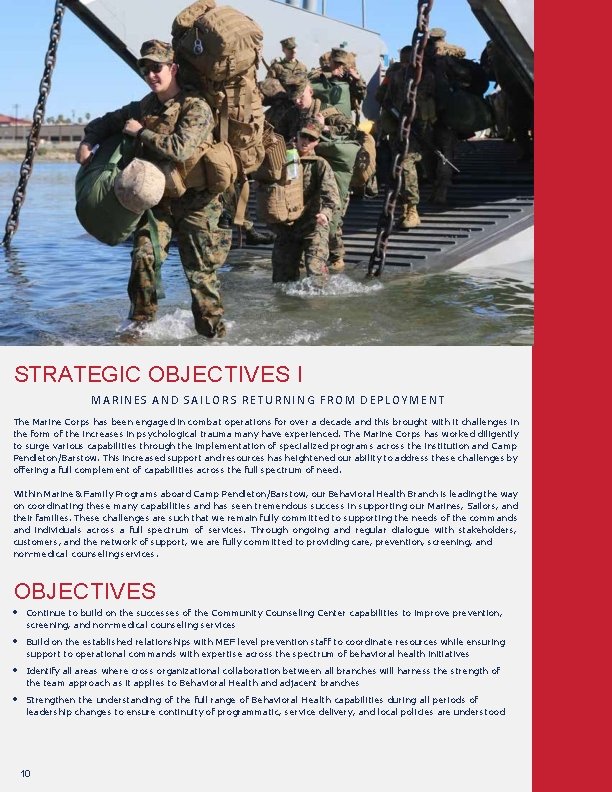
STRATEGIC OBJECTIVES I MARINES AND SAILORS RETURNING FROM DEPLOYMENT The Marine Corps has been engaged in combat operations for over a decade and this brought with it challenges in the form of the increases in psychological trauma many have experienced. The Marine Corps has worked diligently to surge various capabilities through the implementation of specialized programs across the institution and Camp Pendleton/Barstow. This increased support and resources has heightened our ability to address these challenges by offering a full complement of capabilities across the full spectrum of need. Within Marine & Family Programs aboard Camp Pendleton/Barstow, our Behavioral Health Branch is leading the way on coordinating these many capabilities and has seen tremendous success in supporting our Marines, Sailors, and their families. These challenges are such that we remain fully committed to supporting the needs of the commands and individuals across a full spectrum of services. Through ongoing and regular dialogue with stakeholders, customers, and the network of support, we are fully committed to providing care, prevention, screening, and non-medical counseling services. OBJECTIVES • Continue to build on the successes of the Community Counseling Center capabilities to improve prevention, screening, and non-medical counseling services • Build on the established relationships with M E F level prevention staff to coordinate resources while ensuring support to operational commands with expertise across the spectrum of behavioral health initiatives • Identify all areas where cross organizational collaboration between all branches will harness the strength of the team approach as it applies to Behavioral Health and adjacent branches • Strengthen the understanding of the full range of Behavioral Health capabilities during all periods of leadership changes to ensure continuity of programmatic, service delivery, and local policies are understood 10
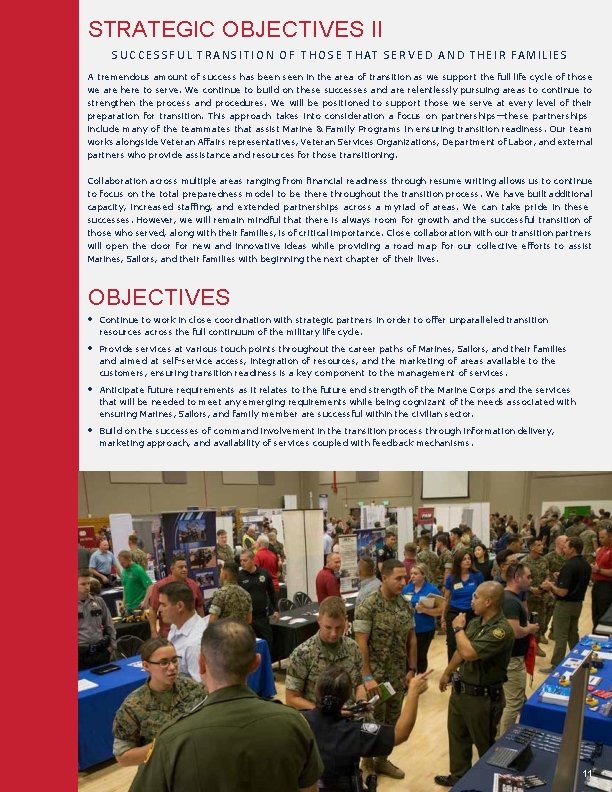
STRATEGIC OBJECTIVES II S U C C E S S F U L TRANSITION O F T H O S E THAT S E R V E D A N D THEIR FAMILIES A tremendous amount of success has been seen in the area of transition as we support the full life cycle of those we are here to serve. We continue to build on these successes and are relentlessly pursuing areas to continue to strengthen the process and procedures. We will be positioned to support those we serve at every level of their preparation for transition. This approach takes into consideration a focus on partnerships—these partnerships include many of the teammates that assist Marine & Family Programs in ensuring transition readiness. Our team works alongside Veteran Affairs representatives, Veteran Services Organizations, Department of Labor, and external partners who provide assistance and resources for those transitioning. Collaboration across multiple areas ranging from financial readiness through resume writing allows us to continue to focus on the total preparedness model to be there throughout the transition process. We have built additional capacity, increased staffing, and extended partnerships across a myriad of areas. We can take pride in these successes. However, we will remain mindful that there is always room for growth and the successful transition of those who served, along with their families, is of critical importance. Close collaboration with our transition partners will open the door for new and innovative ideas while providing a road map for our collective efforts to assist Marines, Sailors, and their families with beginning the next chapter of their lives. OBJECTIVES • Continue to work in close coordination with strategic partners in order to offer unparalleled transition resources across the full continuum of the military life cycle. • Provide services at various touch points throughout the career paths of Marines, Sailors, and their families and aimed at self-service access, integration of resources, and the marketing of areas available to the customers, ensuring transition readiness is a key component to the management of services. • Anticipate future requirements as it relates to the future end strength of the Marine Corps and the services that will be needed to meet any emerging requirements while being cognizant of the needs associated with ensuring Marines, Sailors, and family member are successful within the civilian sector. • Build on the successes of command involvement in the transition process through information delivery, marketing approach, and availability of services coupled with feedback mechanisms. 11
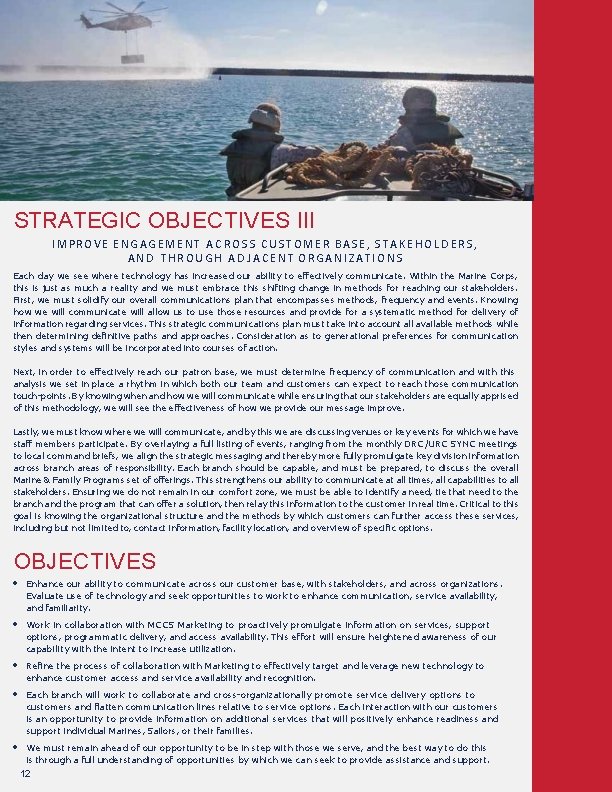
STRATEGIC OBJECTIVES III IMPROVE ENGAGEMENT A C R O S S CUSTOMER BASE, STAKEHOLDERS, AND THROUGH ADJACENT ORGANIZATIONS Each day we see where technology has increased our ability to effectively communicate. Within the Marine Corps, this is just as much a reality and we must embrace this shifting change in methods for reaching our stakeholders. First, we must solidify our overall communications plan that encompasses methods, frequency and events. Knowing how we will communicate will allow us to use those resources and provide for a systematic method for delivery of information regarding services. This strategic communications plan must take into account all available methods while then determining definitive paths and approaches. Consideration as to generational preferences for communication styles and systems will be incorporated into courses of action. Next, in order to effectively reach our patron base, we must determine frequency of communication and with this analysis we set in place a rhythm in which both our team and customers can expect to reach those communication touch-points. By knowing when and how we will communicate while ensuring that our stakeholders are equally apprised of this methodology, we will see the effectiveness of how we provide our message improve. Lastly, we must know where we will communicate, and by this we are discussing venues or key events for which we have staff members participate. By overlaying a full listing of events, ranging from the monthly DRC/URC SYNC meetings to local command briefs, we align the strategic messaging and thereby more fully promulgate key division information across branch areas of responsibility. Each branch should be capable, and must be prepared, to discuss the overall Marine & Family Programs set of offerings. This strengthens our ability to communicate at all times, all capabilities to all stakeholders. Ensuring we do not remain in our comfort zone, we must be able to identify a need, tie that need to the branch and the program that can offer a solution, then relay this information to the customer in real time. Critical to this goal is knowing the organizational structure and the methods by which customers can further access these services, including but not limited to, contact information, facility location, and overview of specific options. OBJECTIVES • Enhance our ability to communicate across our customer base, with stakeholders, and across organizations. Evaluate use of technology and seek opportunities to work to enhance communication, service availability, and familiarity. • Work in collaboration with M C C S Marketing to proactively promulgate information on services, support options, programmatic delivery, and access availability. This effort will ensure heightened awareness of our capability with the intent to increase utilization. • Refine the process of collaboration with Marketing to effectively target and leverage new technology to enhance customer access and service availability and recognition. • Each branch will work to collaborate and cross-organizationally promote service delivery options to customers and flatten communication lines relative to service options. Each interaction with our customers is an opportunity to provide information on additional services that will positively enhance readiness and support individual Marines, Sailors, or their families. • We must remain ahead of our opportunity to be in step with those we serve, and the best way to d o this is through a full understanding of opportunities by which we can seek to provide assistance and support. 12
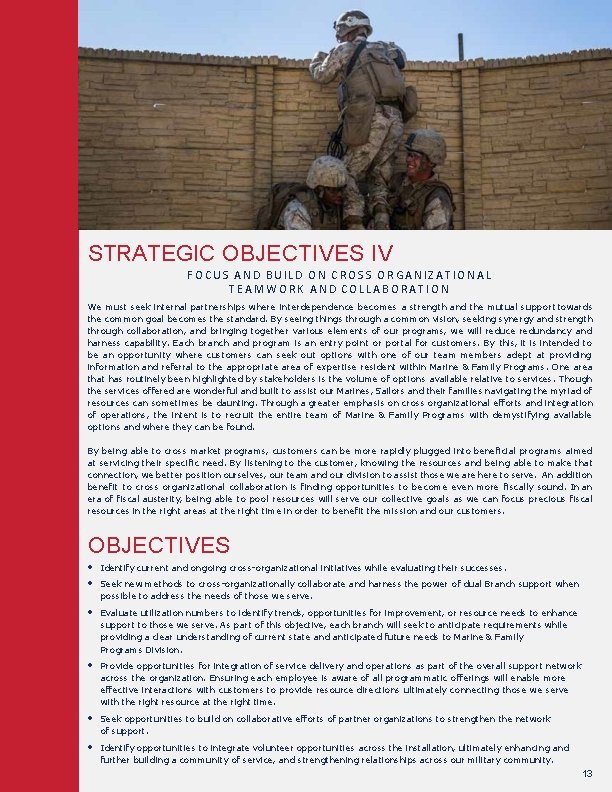
STRATEGIC OBJECTIVES IV FOCUS AND BUILD ON CROSS ORGANIZATIONAL TEAMWORK AND COLLABORATION We must seek internal partnerships where interdependence becomes a strength and the mutual support towards the common goal becomes the standard. B y seeing things through a common vision, seeking synergy and strength through collaboration, and bringing together various elements of our programs, we will reduce redundancy and harness capability. Each branch and program is an entry point or portal for customers. B y this, it is intended to be an opportunity where customers can seek out options with one of our team members adept at providing information and referral to the appropriate area of expertise resident within Marine & Family Programs. One area that has routinely been highlighted by stakeholders is the volume of options available relative to services. Though the services offered are wonderful and built to assist our Marines, Sailors and their families navigating the myriad of resources can sometimes be daunting. Through a greater emphasis on cross organizational efforts and integration of operations, the intent is to recruit the entire team of Marine & Family Programs with demystifying available options and where they can be found. B y being able to cross market programs, customers can be more rapidly plugged into beneficial programs aimed at servicing their specific need. B y listening to the customer, knowing the resources and being able to make that connection, we better position ourselves, our team and our division to assist those we are here to serve. A n addition benefit to cross organizational collaboration is finding opportunities to become even more fiscally sound. In an era of fiscal austerity, being able to pool resources will serve our collective goals as we can focus precious fiscal resources in the right areas at the right time in order to benefit the mission and our customers. OBJECTIVES • • Identify current and ongoing cross-organizational initiatives while evaluating their successes. • Evaluate utilization numbers to identify trends, opportunities for improvement, or resource needs to enhance support to those we serve. A s part of this objective, each branch will seek to anticipate requirements while providing a clear understanding of current state and anticipated future needs to Marine & Family Programs Division. • Provide opportunities for integration of service delivery and operations as part of the overall support network across the organization. Ensuring each employee is aware of all programmatic offerings will enable more effective interactions with customers to provide resource directions ultimately connecting those we serve with the right resource at the right time. • Seek opportunities to build on collaborative efforts of partner organizations to strengthen the network of support. • Identify opportunities to integrate volunteer opportunities across the installation, ultimately enhancing and further building a community of service, and strengthening relationships across our military community. Seek new methods to cross-organizationally collaborate and harness the power of dual Branch support when possible to address the needs of those we serve. 13
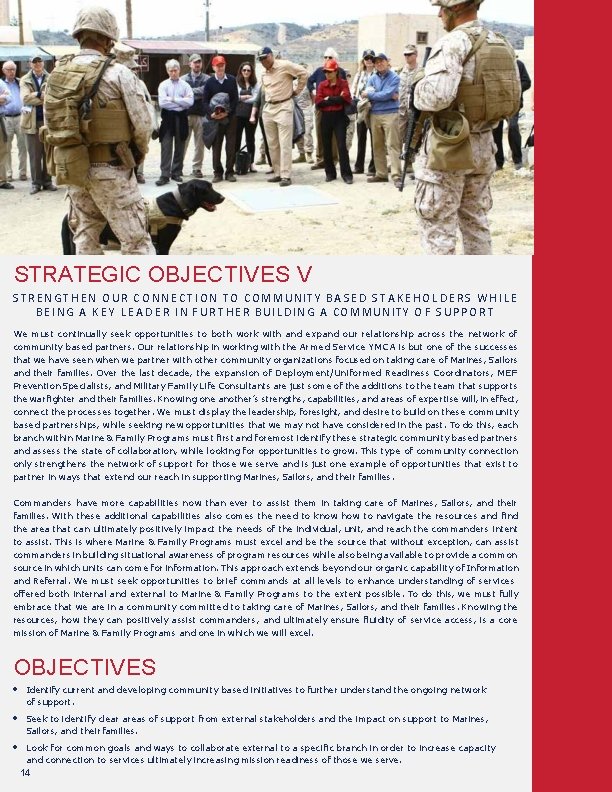
STRATEGIC OBJECTIVES V S T R E N G T H E N O U R C O N N E C T I O N TO COMMUNITY B A S E D S T A K E H O L D E R S W H I L E B E I N G A K E Y L E A D E R IN F U R T H E R BUILDING A COMMUNITY O F S U P P O R T We must continually seek opportunities to both work with and expand our relationship across the network of community based partners. Our relationship in working with the Armed Service Y M C A is but one of the successes that we have seen when we partner with other community organizations focused on taking care of Marines, Sailors and their families. Over the last decade, the expansion of Deployment/Uniformed Readiness Coordinators, M E F Prevention Specialists, and Military Family Life Consultants are just some of the additions to the team that supports the warfighter and their families. Knowing one another’s strengths, capabilities, and areas of expertise will, in effect, connect the processes together. We must display the leadership, foresight, and desire to build on these community based partnerships, while seeking new opportunities that we may not have considered in the past. To d o this, each branch within Marine & Family Programs must first and foremost identify these strategic community based partners and assess the state of collaboration, while looking for opportunities to grow. This type of community connection only strengthens the network of support for those we serve and is just one example of opportunities that exist to partner in ways that extend our reach in supporting Marines, Sailors, and their families. Commanders have more capabilities now than ever to assist them in taking care of Marines, Sailors, and their families. With these additional capabilities also comes the need to know how to navigate the resources and find the area that can ultimately positively impact the needs of the individual, unit, and reach the commanders intent to assist. This is where Marine & Family Programs must excel and be the source that without exception, can assist commanders in building situational awareness of program resources while also being available to provide a common source in which units can come for information. This approach extends beyond our organic capability of Information and Referral. We must seek opportunities to brief commands at all levels to enhance understanding of services offered both internal and external to Marine & Family Programs to the extent possible. To d o this, we must fully embrace that we are in a community committed to taking care of Marines, Sailors, and their families. Knowing the resources, how they can positively assist commanders, and ultimately ensure fluidity of service access, is a core mission of Marine & Family Programs and one in which we will excel. OBJECTIVES • Identify current and developing community based initiatives to further understand the ongoing network of support. • Seek to identify clear areas of support from external stakeholders and the impact on support to Marines, Sailors, and their families. • Look for common goals and ways to collaborate external to a specific branch in order to increase capacity and connection to services ultimately increasing mission readiness of those we serve. 14
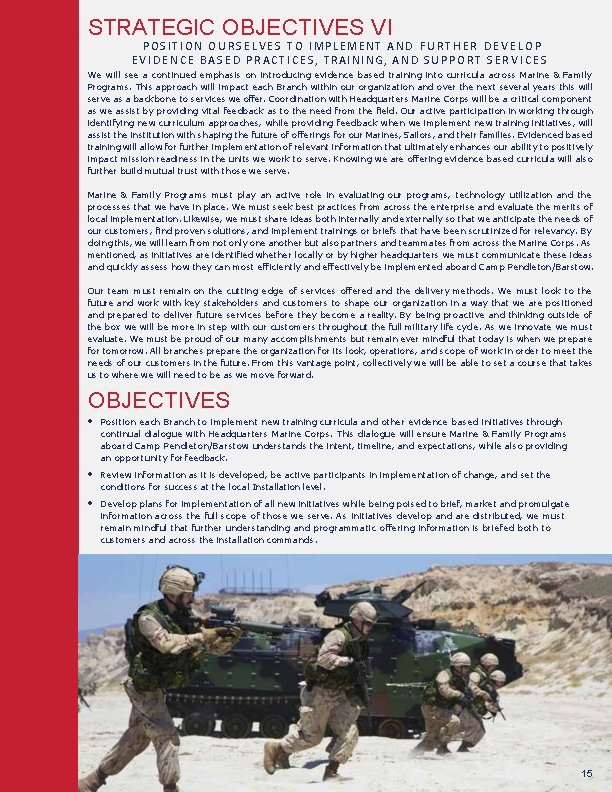
STRATEGIC OBJECTIVES VI POSITION O U R S E L V E S TO IMPLEMENT A N D F U R T H E R D E V E L O P E V I D E N C E B A S E D PRACTICES, TRAINING, A N D SUPPORT S E R V I C E S We will see a continued emphasis on introducing evidence based training into curricula across Marine & Family Programs. This approach will impact each Branch within our organization and over the next several years this will serve as a backbone to services we offer. Coordination with Headquarters Marine Corps will be a critical component as we assist by providing vital feedback as to the need from the field. Our active participation in working through identifying new curriculum approaches, while providing feedback when we implement new training initiatives, will assist the institution with shaping the future of offerings for our Marines, Sailors, and their families. Evidenced based training will allow for further implementation of relevant information that ultimately enhances our ability to positively impact mission readiness in the units we work to serve. Knowing we are offering evidence based curricula will also further build mutual trust with those we serve. Marine & Family Programs must play an active role in evaluating our programs, technology utilization and the processes that we have in place. We must seek best practices from across the enterprise and evaluate the merits of local implementation. Likewise, we must share ideas both internally and externally so that we anticipate the needs of our customers, find proven solutions, and implement trainings or briefs that have been scrutinized for relevancy. By doing this, we will learn from not only one another but also partners and teammates from across the Marine Corps. A s mentioned, as initiatives are identified whether locally or by higher headquarters we must communicate these ideas and quickly assess how they can most efficiently and effectively be implemented aboard Camp Pendleton/Barstow. Our team must remain on the cutting edge of services offered and the delivery methods. We must look to the future and work with key stakeholders and customers to shape our organization in a way that we are positioned and prepared to deliver future services before they become a reality. By being proactive and thinking outside of the box we will be more in step with our customers throughout the full military life cycle. A s we innovate we must evaluate. We must be proud of our many accomplishments but remain ever mindful that today is when we prepare for tomorrow. All branches prepare the organization for its look, operations, and scope of work in order to meet the needs of our customers in the future. From this vantage point, collectively we will be able to set a course that takes us to where we will need to be as we move forward. OBJECTIVES • Position each Branch to implement new training curricula and other evidence based initiatives through continual dialogue with Headquarters Marine Corps. This dialogue will ensure Marine & Family Programs aboard Camp Pendleton/Barstow understands the intent, timeline, and expectations, while also providing an opportunity for feedback. • Review information as it is developed, be active participants in implementation of change, and set the conditions for success at the local Installation level. • Develop plans for implementation of all new initiatives while being poised to brief, market and promulgate information across the full scope of those we serve. A s initiatives develop and are distributed, we must remain mindful that further understanding and programmatic offering information is briefed both to customers and across the installation commands. 15
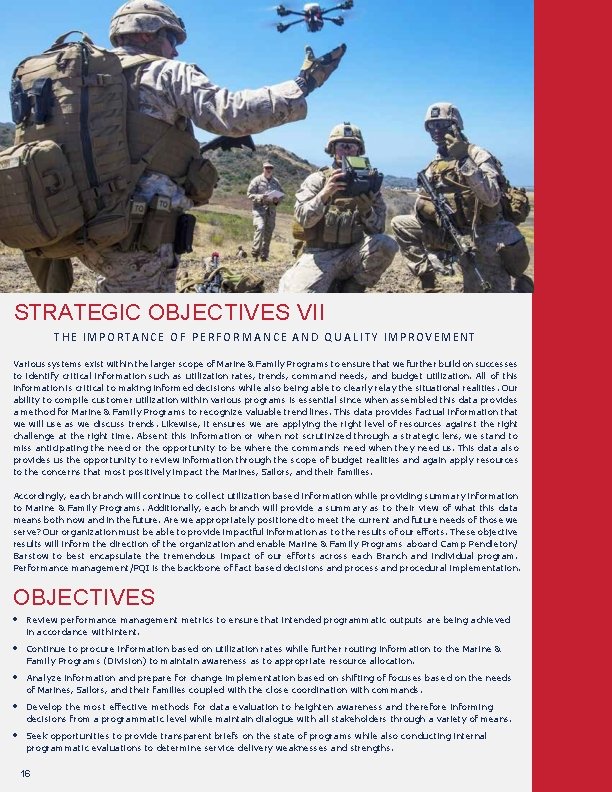
STRATEGIC OBJECTIVES VII THE IMPORTANCE O F P E R F O R M A N C E A N D QUALITY IMPROVEMENT Various systems exist within the larger scope of Marine & Family Programs to ensure that we further build on successes to identify critical information such as utilization rates, trends, command needs, and budget utilization. All of this information is critical to making informed decisions while also being able to clearly relay the situational realities. Our ability to compile customer utilization within various programs is essential since when assembled this data provides a method for Marine & Family Programs to recognize valuable trend lines. This data provides factual information that we will use as we discuss trends. Likewise, it ensures we are applying the right level of resources against the right challenge at the right time. Absent this information or when not scrutinized through a strategic lens, we stand to miss anticipating the need or the opportunity to be where the commands need when they need us. This data also provides us the opportunity to review information through the scope of budget realities and again apply resources to the concerns that most positively impact the Marines, Sailors, and their families. Accordingly, each branch will continue to collect utilization based information while providing summary information to Marine & Family Programs. Additionally, each branch will provide a summary as to their view of what this data means both now and in the future. Are we appropriately positioned to meet the current and future needs of those we serve? Our organization must be able to provide impactful information as to the results of our efforts. These objective results will inform the direction of the organization and enable Marine & Family Programs aboard Camp Pendleton/ Barstow to best encapsulate the tremendous impact of our efforts across each Branch and individual program. Performance management/PQI is the backbone of fact based decisions and process and procedural implementation. OBJECTIVES • Review performance management metrics to ensure that intended programmatic outputs are being achieved in accordance with intent. • Continue to procure information based on utilization rates while further routing information to the Marine & Family Programs (Division) to maintain awareness as to appropriate resource allocation. • Analyze information and prepare for change implementation based on shifting of focuses based on the needs of Marines, Sailors, and their families coupled with the close coordination with commands. • Develop the most effective methods for data evaluation to heighten awareness and therefore informing decisions from a programmatic level while maintain dialogue with all stakeholders through a variety of means. • Seek opportunities to provide transparent briefs on the state of programs while also conducting internal programmatic evaluations to determine service delivery weaknesses and strengths. 16
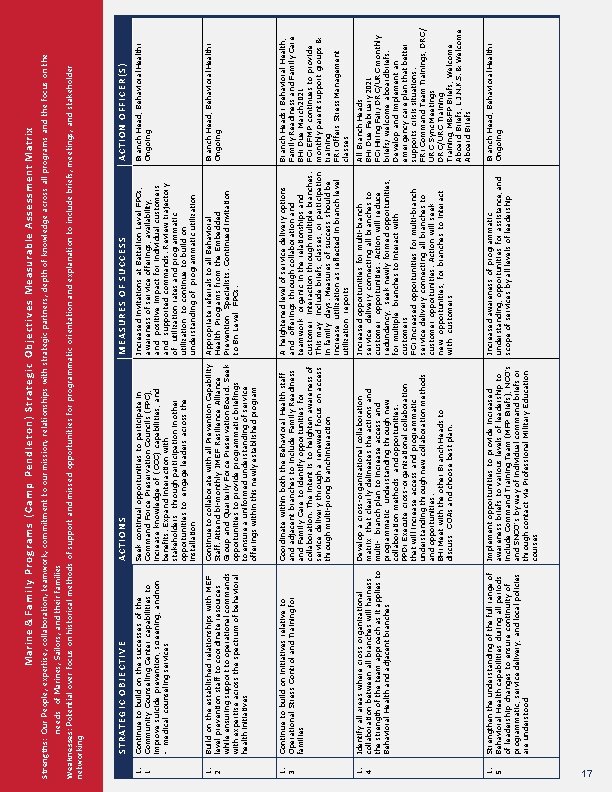
Marine & F a m i l y P r o g r a m s ( C a m p P e n d l e t o n ) S t r a t e g i c O b j e c t i v e s Measurable A s s e s s m e n t Matrix 1. 5 1. 4 1. 3 1. 2 1. 1 Implement opportunities to provide increased awareness briefs to various levels of leadership to include Command Training Team (MFP Briefs), NCO’s and SNCO’s by way of individual command briefs or through contact via Professional Military Education courses Strengthen the understanding of the full range of Behavioral Health capabilities during all periods of leadership changes to ensure continuity of programmatic, service delivery, and local policies are understood Increased awareness of programmatic understanding, opportunities for assistance, and scope of services by all levels of leadership Branch Head, Behavioral Health: Ongoing All Branch Heads BH: Due February 2021 FC: Hiring Fair; D R C / U R C monthly briefs; welcome aboard briefs. Develop and implement an emergency care plan that better supports crisis situations. FR: Command Team Trainings, D R C / U R C Sync Meetings D R C / U R C Training, M&FP Briefs, Welcome Aboard Briefs, L. I. N. K. S. & Welcome Aboard Briefs Develop a cross-organizational collaboration matrix that clearly delineates the actions and multi- branch plan to increase access and programmatic understanding through new collaboration methods and opportunities. PPD: Execute cross-organizational collaboration that will increase access and programmatic understanding through new collaboration methods and opportunities. BH: Meet with the other Branch Heads to discuss C O A s and choose best plan. Identify all areas where cross organizational collaboration between all branches will harness the strength of the team approach as it applies to Behavioral Health and adjacent branches Increased opportunities for multi-branch service delivery connecting all branches to customer opportunities. Action will reduce redundancy, seek newly formed opportunities, for multiple branches to interact with customers FC: Increased opportunities for multi-branch service delivery connecting all branches to customer opportunities. Action will seek new opportunities, for branches to interact with customers Coordinate within both the Behavioral Health staff and adjacent branches to include Family Readiness and Family Care to identify opportunities for collaboration. The intent is to heighten awareness of service delivery through a renewed focus on access through multi-prong branch interaction Continue to build on initiatives relative to Operational Stress Control and Training for families Branch Heads: Behavioral Health, Family Readiness and Family Care BH: Due March 2021 FC: E F M P continues to provide monthly parent support groups & training FR: Offers Stress Management classes Branch Head, Behavioral Health: Ongoing Appropriate referrals to all Behavioral Health Programs from the Embedded Prevention Specialists. Continued invitation to Bn Level FPCs. Continue to collaborate with all Prevention Capability Staff. Attend bi-monthly I M E F Resilience Alliance Group and Quarterly Force Preservation Board. Seek opportunities to provide programmatic briefings to ensure a uniformed understanding of service offerings within this newly established program Build on the established relationships with M E F level prevention staff to coordinate resources while ensuring support to operational commands with expertise across the spectrum of behavioral health initiatives A heightened level of service delivery options and offerings through collaboration and teamwork organic in the relationships and customer interaction through multiple branches. This may include briefs, classes, or participation in family days. Measures of success should be increase utilization as reflected in branch level utilization reports Branch Head, Behavioral Health: Ongoing Increased invitations at Battalion Level FPCs, awareness of service offerings, availability, and positive impact for individual customers and supported commands. Review trajectory of utilization rates and programmatic utilization to continue to build on understanding of programmatic utilization Seek continual opportunities to participate in Command Force Preservation Councils (FPC), increase knowledge of (CCC) capabilities, and benefits. Expand interaction with stakeholders through participation in other opportunities to engage leaders across the installation Continue to build on the successes of the Community Counseling Center capabilities to improve suicide prevention, screening, and non - medical counseling services ACTION OFFICER(S) MEASURES O F SUCCESS ACTIONS STRATEGIC OBJECTIVE needs of Marines, Sailors, and their families Weaknesses: Potential over focus on historical methods of support and missed opportunities for programmatic orientation and explanation to include briefs, meetings, and stakeholder networking Strengths: Our People, expertise, collaboration, teamwork, commitment to our mission, relationships with strategic partners, depth of knowledge across all programs and the focus on the 17
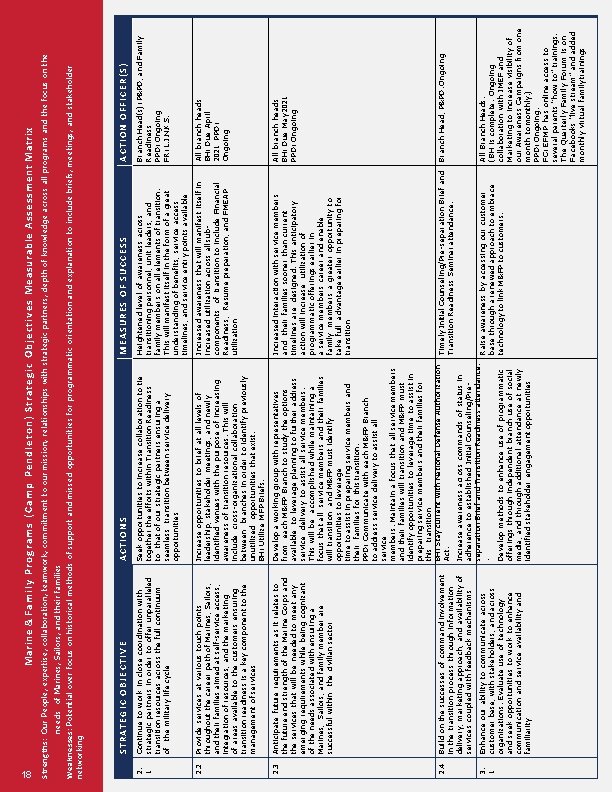
Marine & F a m i l y P r o g r a m s ( C a m p P e n d l e t o n ) S t r a t e g i c O b j e c t i v e s Measurable A s s e s s m e n t Matrix Build on the successes of command involvement in the transition process through information delivery, marketing approach, and availability of services coupled with feedback mechanisms Enhance our ability to communicate across customer base, with stakeholders, and across organizations. Evaluate use of technology and seek opportunities to work to enhance communication and service availability and familiarity 2. 4 3. 1 Develop methods to enhance use of programmatic offerings through independent branch use of social media, and through additional attendance at newly identified stakeholder engagement opportunities Increase awareness across commands of status in adherence to established Initial Counseling/Preseparation Brief and Transition Readiness attendance. . Raise awareness by accessing our customer base through a renewed approach to embrace technology to link M&FP to customers. Timely Initial Counseling/Pre-separation Brief and Transition Readiness Seminar attendance. All Branch Heads. (BH is complete. Ongoing collaboration with IMEF and Marketing to increase visibility of our Awareness Campaigns from one month to monthly. ) PPD: Ongoing. FC: E F M P has online access to several parents “how to” trainings. The Quarterly Family Forum is on Facebooks “live stream” and added monthly virtual family trainings Branch Head, P&PD. Ongoing All branch heads BH: Due May 2021 PPD: Ongoing Increased interaction with service members and their families sooner than current timelines are designed. This anticipatory action will increase utilization of programmatic offerings earlier in a service members career and enable family members a greater opportunity to take full advantage earlier in preparing for transition Develop a working group with representatives from each M&FP Branch to study the options available to leverage planning to further address service delivery to assist all service members. This will be accomplished while maintaining a focus that all service members and their families will transition and M&FP must identify opportunities to leverage time to assist in preparing service members and their families for this transition. PPD: Communicate with each M&FP Branch to address service delivery to assist all service members. Maintain a focus that all service members and their families will transition and M&FP must identify opportunities to leverage time to assist in preparing service members and their families for this transition BH: Stay current with National Defense Authorization Act. Anticipate future requirements as it relates to the future end strength of the Marine Corps and the services that will be needed to meet any emerging requirements while being cognizant of the needs associated with ensuring a Marines, Sailors, and family member are successful within the civilian sector 2. 3 All branch heads BH: Due April 2021 PPD: Ongoing Increased awareness that will manifest itself in increased utilization across all subcomponents of transition to include Financial Readiness, Resume preparation, and F M E A P utilization Increase opportunities to brief at all levels of leadership, stakeholder meetings, and newly identified venues with the purpose of increasing awareness of transition resources. This will include cross-organizational collaboration between branches in order to identify previously unutilized opportunities that exist. BH: Utilize M F P Briefs. Provide services at various touch points throughout the career path of Marines, Sailors, and their families aimed at self-service access, integration of resources, and the marketing of areas available to the customers ensuring transition readiness is a key component to the management of services 2. 2 ACTION OFFICER(S) Branch Head(s): P&PD, and Family Readiness PPD: Ongoing FR: L. I. N. K. S. Seek opportunities to increase collaboration to tie together the efforts within Transition Readiness to that of our strategic partners ensuring a seamless transition between service delivery opportunities Continue to work in close coordination with strategic partners in order to offer unparalleled transition resources across the full continuum of the military life cycle 2. 1 MEASURES O F SUCCESS Heightened level of awareness across transitioning personnel, unit leaders, and family members on all elements of transition. This will manifest itself in the form of a great understanding of benefits, service access timelines, and service entry points available ACTIONS STRATEGIC OBJECTIVE needs of Marines, Sailors, and their families Weaknesses: Potential over focus on historical methods of support and missed opportunities for programmatic orientation and explanation to include briefs, meetings, and stakeholder networking Strengths: Our People, expertise, collaboration, teamwork, commitment to our mission, relationships with strategic partners, depth of knowledge across all programs and the focus on the 18
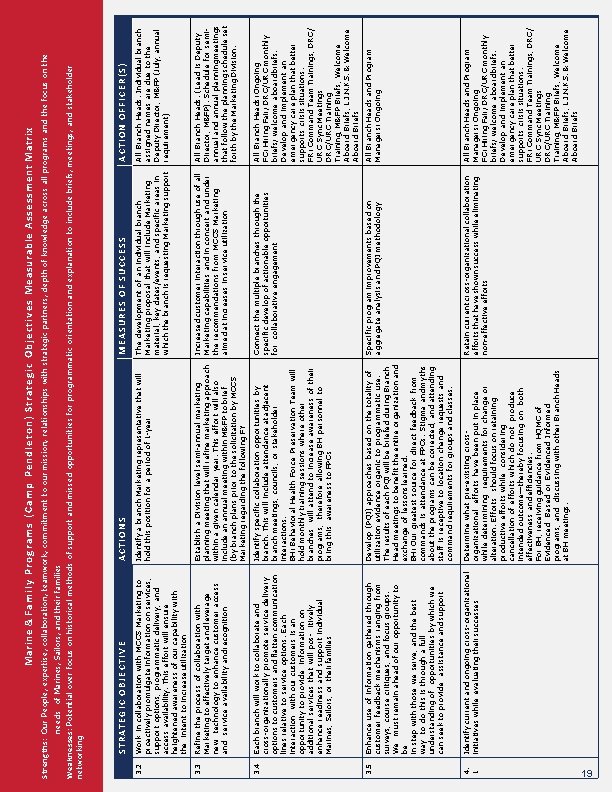
Marine & F a m i l y P r o g r a m s ( C a m p P e n d l e t o n ) S t r a t e g i c O b j e c t i v e s Measurable A s s e s s m e n t Matrix The development of an individual branch Marketing proposal that will include Marketing material, key dates/events, and specific areas in which the branch is requesting Marketing support Increased customer interaction through use of all Marketing capabilities and in concert and under the recommendations from M C C S Marketing aimed at increases in service utilization Connect the multiple branches through the specific develop of actionable opportunities for collaborative engagement Specific program improvements based on aggregate analysis and PQI methodology Retain current cross-organizational collaboration efforts that have shown success while eliminating non-effective efforts Identify a branch Marketing representative that will hold this position for a period of 1 -year Establish a Division level semi-annual marketing planning meeting that will refine marketing approach within a given calendar year. This effort will also include an annual meeting within M&FP to brief (by branch plans prior to the solicitation by M C C S Marketing regarding the following F Y Identify specific collaboration opportunities by branch. This will include attendance at adjacent branch meetings, councils, or stakeholder interactions. BH: Behavioral Health Force Preservation Team will hold monthly training sessions where other branches will attend to increase awareness of their programs, therefore allowing B H personnel to bring this awareness to F P C s Develop (PQI) approaches based on the totality of utilization evidence organic to programmatic use. The results of each PQI will be briefed during Branch Head meetings to benefit the entire organization and exchange of lessons learned. BH: Our greatest source for direct feedback from commands is attendance at FPCs. Stigma and myths about the programs can be corrected, and attending staff is receptive to location change requests and command requirements for groups and classes. Determine what pre-existing crossorganizational efforts have been put in place while determining requirements for change or alteration. Efforts should focus on retaining productive efforts while considering cancellation of efforts which d o not produce intended outcome—thereby focusing on both effectiveness and efficiencies. For BH, receiving guidance from H Q M C of Evidenced Based or Evidenced Informed programs, and discussing with other Branch Heads at B H meetings. Work in collaboration with M C C S Marketing to proactively promulgate information on services, support options, programmatic delivery, and access availability. This effort will ensure heightened awareness of our capability with the intent to increase utilization Refine the process of collaboration with Marketing to effectively target and leverage new technology to enhance customer access and service availability and recognition Each branch will work to collaborate and cross-organizationally promote service delivery options to customers and flatten communication lines relative to service options. Each interaction with our customers is an opportunity to provide information on additional services that will pos- itively enhance readiness and support individual Marines, Sailors, or their families Enhance use of information gathered through customer feedback mechanisms ranging from surveys, course critiques, and focus groups. We must remain ahead of our opportunity to be in step with those we serve, and the best way to d o this is through a full understanding of opportunities by which we can seek to provide assistance and support Identify current and ongoing cross-organizational initiatives while evaluating their successes 3. 2 3. 3 3. 4 3. 5 4. 1 MEASURES O F SUCCESS ACTIONS STRATEGIC OBJECTIVE All Branch Heads and Program Managers: Ongoing FC: Hiring Fair; D R C / U R C monthly briefs; welcome aboard briefs. Develop and implement an emergency care plan that better supports crisis situations. FR: Command Team Trainings, D R C / U R C Sync Meetings D R C / U R C Training, M&FP Briefs, Welcome Aboard Briefs, L. I. N. K. S. & Welcome Aboard Briefs All Branch Heads and Program Managers: Ongoing All Branch Heads: Ongoing FC: Hiring Fair; D R C / U R C monthly briefs; welcome aboard briefs. Develop and implement an emergency care plan that better supports crisis situations. FR: Command Team Trainings, D R C / U R C Sync Meetings D R C / U R C Training, M&FP Briefs, Welcome Aboard Briefs, L. I. N. K. S. & Welcome Aboard Briefs All Branch Heads. (Lead is Deputy Director, M&FP). Schedule for semiannual and annual planning meetings that follow the planning schedule set forth by the Marketing Division. All Branch Heads. Individual branch assigned names are due to the Deputy Director, M&FP (July, annual requirement) ACTION OFFICER(S) needs of Marines, Sailors, and their families Weaknesses: Potential over focus on historical methods of support and missed opportunities for programmatic orientation and explanation to include briefs, meetings, and stakeholder networking Strengths: Our People, expertise, collaboration, teamwork, commitment to our mission, relationships with strategic partners, depth of knowledge across all programs and the focus on the 19
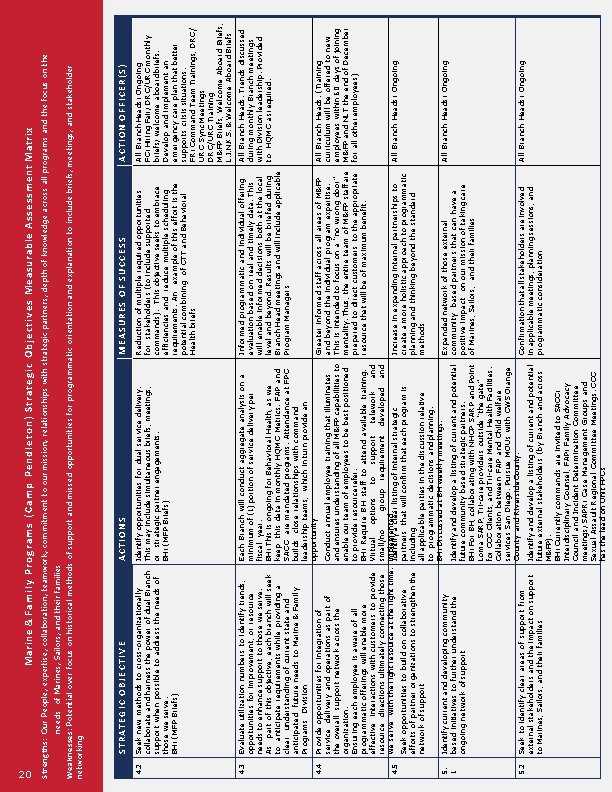
Marine & F a m i l y P r o g r a m s ( C a m p P e n d l e t o n ) S t r a t e g i c O b j e c t i v e s Measurable A s s e s s m e n t Matrix Identify current and developing community based initiatives to further understand the ongoing network of support Seek to identify clear areas of support from external stakeholders and the impact on support to Marines, Sailors, and their families 5. 1 5. 2 Seek opportunities to build on collaborative efforts of partner organizations to strengthen the network of support Provide opportunities for integration of service delivery and operations as part of the overall support network across the organization. Ensuring each employee is aware of all programmatic offerings will enable more effective interactions with customers to provide resource directions ultimately connecting those we serve with the right resource at the right time. 4. 4 4. 5 Evaluate utilization numbers to identify trends, opportunities for improvement, or resource needs to enhance support to those we serve. A s part of this objective, each branch will seek to anticipate requirements while providing a clear understanding of current state and anticipated future needs to Marine & Family Programs Division 4. 3 Identify and develop a listing of current and potential future external stakeholders (by Branch and across M&FP). BH: Currently commands are invited to SACC: Interdisciplinary Counsel, FAP: Family Advocacy Council and Incident Determination Committee meetings; SAPR: Case Management Groups and Sexual Assault Regional Committee Meetings. C C C has the lead on Unit F P C s Identify and develop a listing of current and potential future community based strategic partners. BH: For BH, collaborating with N H C P S A R P and Point Loma SARP, Tri-care providers outside “the gate” for C Clients, and Tri-care Mental Health Facilities. Collaboration between F A P and Child welfare services San Diego. Pursue MOUs with C W S Orange County and Riverside County. Conduct annual employee training that illuminates and ensures understanding of all M&FP capabilities to enable our team of employees to be best positioned to provide resource refer. BH: Require B H staff to attend available training. Virtual options to support telework and small/no group requirement developed and implemented. Identify a clear listing of internal strategic partners that will confirm that each program is including all applicable parties in the discussion relative to programmatic decisions and planning. BH: Discussed at B H weekly meetings. Confirmation that all stakeholders are involved in applicable meetings, planning sessions, and programmatic consideration Expanded network of those external community based partners that can have a positive impact on our mission of taking care of Marines, Sailors, and their families Increase in expanding internal partnerships to create a more holistic approach to programmatic planning and thinking beyond the standard methods Greater informed staff across all areas of M&FP and beyond the individual program expertise. This is intended to focus on a “no wrong door” mentality. Thus, the entire team of M&FP staff are prepared to direct customers to the appropriate resource that will be of maximum benefit. Informed programmatic and individual offering evaluation based on real and timely data. This will enable informed decisions both at the local level and beyond. Results will be briefed during Branch Head meetings and will include applicable Program Managers Reduction of multiple required opportunities for stakeholders (to include supported commands). This objective seeks to embrace efficiencies and reduce multiple scheduling requirements. A n example of this effort is the potential combining of CTT and Behavioral Health briefs Identify opportunities for dual service delivery. This may include simultaneous briefs, meetings, or strategic partner engagements. BH: (MFP Briefs) Seek new methods to cross-organizationally collaborate and harness the power of dual Branch support when possible to address the needs of those we serve. BH: (MFP Briefs) 4. 2 Each Branch will conduct aggregate analysis on a minimum of (1) portion of service delivery per fiscal year. BH: This is ongoing for Behavioral Health, as we keep this data in monthly H Q M C Metrics. F A P and S A C C are mandated programs. Attendance at F P C builds close relationships with command leadership teams, which in turn provide an opportunity MEASURES O F SUCCESS ACTIONS STRATEGIC OBJECTIVE All Branch Heads: Ongoing All Branch Heads. (Training curriculum will be offered to new employees within 6 0 days of joining M&FP and NLT the end of December for all other employees) All Branch Heads. Trends discussed during monthly Branch meetings with Division leadership. Provided to H Q M C as required. All Branch Heads: Ongoing FC: Hiring Fair; D R C / U R C monthly briefs; welcome aboard briefs. Develop and implement an emergency care plan that better supports crisis situations. FR: Command Team Trainings, D R C / U R C Sync Meetings D R C / U R C Training M&FP Briefs, Welcome Aboard Briefs, L. I. N. K. S. & Welcome Aboard Briefs ACTION OFFICER(S) needs of Marines, Sailors, and their families Weaknesses: Potential over focus on historical methods of support and missed opportunities for programmatic orientation and explanation to include briefs, meetings, and stakeholder networking Strengths: Our People, expertise, collaboration, teamwork, commitment to our mission, relationships with strategic partners, depth of knowledge across all programs and the focus on the 20
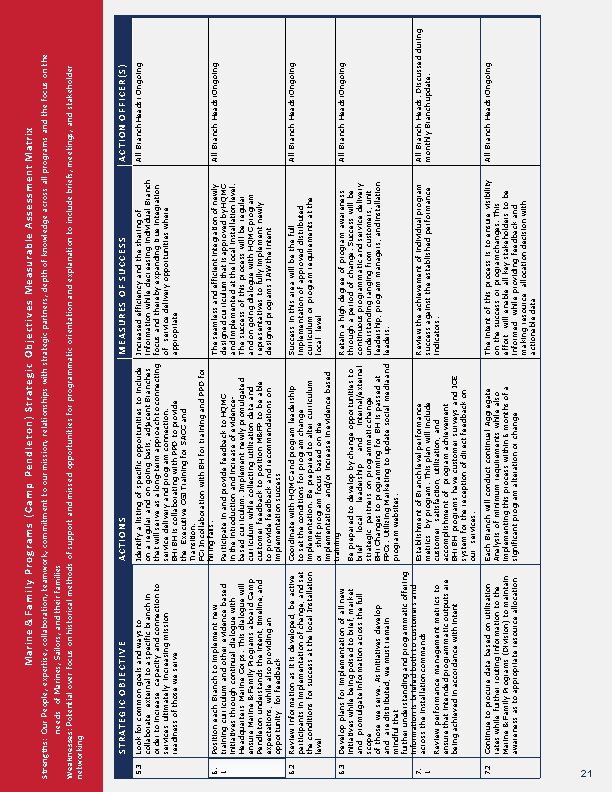
Marine & F a m i l y P r o g r a m s ( C a m p P e n d l e t o n ) S t r a t e g i c O b j e c t i v e s Measurable A s s e s s m e n t Matrix Develop plans for implementation of all new initiatives while being poised to brief, market and promulgate information across the full scope of those we serve. A s initiatives develop and are distributed, we must remain mindful that further understanding and programmatic offering information is briefed both to customers and across the installation commands 6. 3 7. 2 Continue to procure data based on utilization rates while further routing information to the Marine & Family Programs (Division) to maintain awareness as to appropriate resource allocation Review performance management metrics to ensure that intended programmatic outputs are being achieved in accordance with intent Review information as it is developed, be active participants in implementation of change, and set the conditions for success at the local Installation level 6. 2 7. 1 Position each Branch to implement new training curriculum and other evidence based initiatives through continual dialogue with Headquarters Marine Corps. This dialogue will ensure Marine & Family Programs aboard Camp Pendleton understands the intent, timeline, and expectations, while also providing an opportunity for feedback Each Branch will conduct continual Aggregate Analysis of minimum requirements while also implementing this process within 6 months of a significant program alteration or change Establishment of Branch level performance metrics by program. This plan will include customer satisfaction, utilization, and accomplishment of program achievement BH: B H programs have customer surveys and ICE system for the reception of direct feedback on our services. Be prepared to develop by change opportunities to brief local leadership and internal/external strategic partners on programmatic change BH: Changes to programming for B H is passed at FPCs. Utilizing Marketing to update social media and program websites. Coordinate with H Q M C and program leadership to set the conditions for program change implementation. Be prepared to alter curriculum or shift program focus based on the implementation and/or increase in evidence based training Participate in and provide feedback to H Q M C in the introduction and increase of evidencebased curriculum. Implement newly promulgated curriculum while collecting utilization data and customer feedback to position M&FP to be able to provide feedback and recommendations on implementation success Identify a listing of specific opportunities to include on a regular and on going basis, adjacent Branches that will serve as a long-term approach to connecting service delivery and program connection. BH: B H is collaborating with P P D to provide the Executive CGI Training for S A C C and Transition. FC: In collaboration with B H for training and P P D for hiring fairs. Look for common goals and ways to collaborate external to a specific branch in order to increase capacity and connection to services ultimately increasing mission readiness of those we serve 6. 1 5. 3 ACTIONS STRATEGIC OBJECTIVE The intent of this process is to ensure visibility on the success or program changes. This effort will enable all key stakeholders to be informed while providing feedback and making resource allocation decision with actionable data Review the achievement of individual program success against the established performance indicators. Retain a high degree of program awareness through a period of change. Success will be continuous programmatic and service delivery understanding ranging from customers, unit leadership, program managers, and installation leaders. All Branch Heads: Ongoing All Branch Heads. Discussed during monthly Branch update. All Branch Heads: Ongoing The seamless and efficient integration of newly designed curriculum that is approved by H Q M C and implemented at the local installation level. The success of this process will be regular and on going dialogue with H Q M C program representatives to fully implement newly designed programs IAW the intent Success in this area will be the full implementation of approved distributed curriculum or program requirements at the local level All Branch Heads: Ongoing ACTION OFFICER(S) Increased efficiency and the sharing of information while decreasing individual Branch focus and thereby expanding true integration of service delivery opportunities where appropriate MEASURES O F SUCCESS needs of Marines, Sailors, and their families Weaknesses: Potential over focus on historical methods of support and missed opportunities for programmatic orientation and explanation to include briefs, meetings, and stakeholder networking Strengths: Our People, expertise, collaboration, teamwork, commitment to our mission, relationships with strategic partners, depth of knowledge across all programs and the focus on the 21
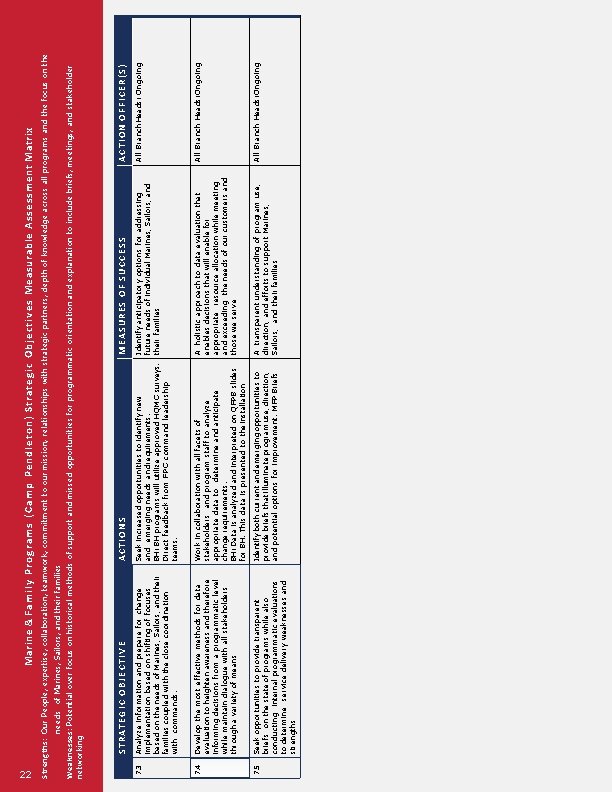
Marine & F a m i l y P r o g r a m s ( C a m p P e n d l e t o n ) S t r a t e g i c O b j e c t i v e s Measurable A s s e s s m e n t Matrix Seek opportunities to provide transparent briefs on the state of programs while also conducting internal programmatic evaluations to determine service delivery weaknesses and strengths 7. 5 A transparent understanding of program use, direction, and efforts to support Marines, Sailors, and their families A holistic approach to data evaluation that enables decisions that will enable for appropriate resource allocation while meeting and exceeding the needs of our customers and those we serve Work in collaboration with all facets of stakeholders and program staff to analyze appropriate data to determine and anticipate change requirements. BH: Data is analyzed and interpreted on Q F P B slides for BH. This data is presented to the installation Develop the most effective methods for data evaluation to heighten awareness and therefore informing decisions from a programmatic level while maintain dialogue with all stakeholders through a variety of means 7. 4 Identify both current and emerging opportunities to provide briefs that illuminate program use, direction, and potential options for improvement. M F P Briefs Identify anticipatory options for addressing future needs of individual Marines, Sailors, and their families Seek increased opportunities to identify new and emerging needs and requirements. BH: B H programs will utilize approved H Q M C surveys. Direct feedback from F P C command leadership teams. Analyze information and prepare for change implementation based on shifting of focuses based on the needs of Marines, Sailors, and their families coupled with the close coordination with commands. 7. 3 MEASURES O F SUCCESS ACTIONS STRATEGIC OBJECTIVE All Branch Heads: Ongoing ACTION OFFICER(S) needs of Marines, Sailors, and their families Weaknesses: Potential over focus on historical methods of support and missed opportunities for programmatic orientation and explanation to include briefs, meetings, and stakeholder networking Strengths: Our People, expertise, collaboration, teamwork, commitment to our mission, relationships with strategic partners, depth of knowledge across all programs and the focus on the 22


- Slides: 24