
Marine Corps OnBoard Vehicle Power Joint Service Power
Marine Corps On-Board Vehicle Power Joint Service Power Expo May 2005 1
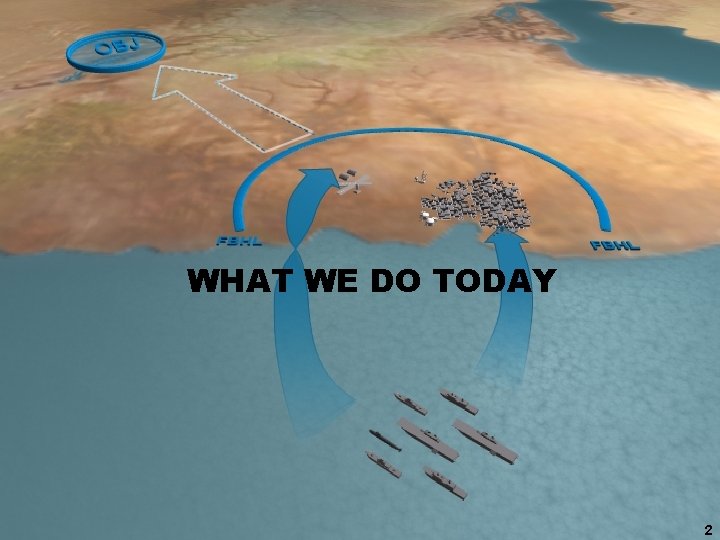
WHAT WE DO TODAY 2
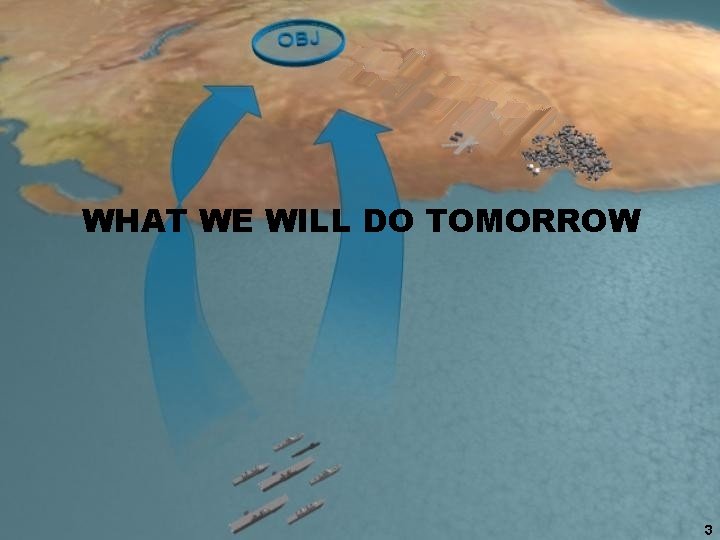
WHAT WE WILL DO TOMORROW 3

Required Capabilities § Ship – to – Objective Maneuver § Launch from Expeditionary Strike Force at sea § Maneuver space includes Air, Land, and Sea § Tailorable forces § Rapidly executable § Highly Maneuverable § Self-sufficient § Combined Arms capability 4
Implications on Power § Appetite for electric power is increasing § Space and weight are at a premium § Efficiency of energy use § Power sources to support maneuver forces § Rapid Reconstitution § Joint Services approach § Commonality across Marine Units & Reserves 5
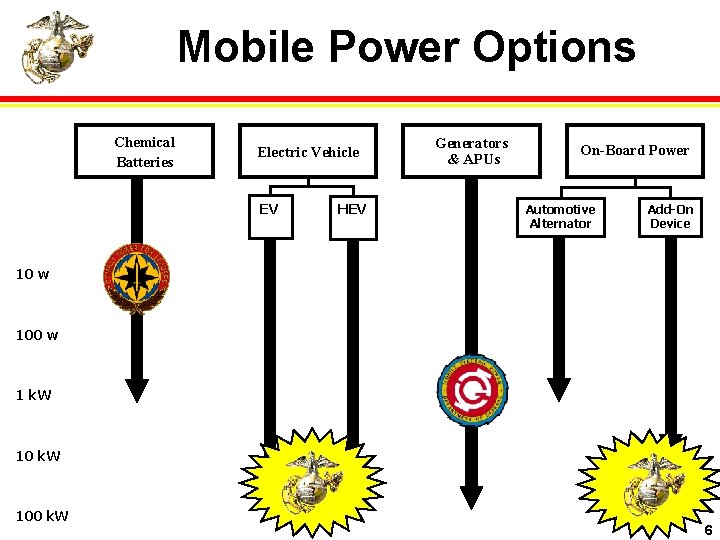
Mobile Power Options Chemical Batteries Electric Vehicle EV HEV Generators & APUs On-Board Power Automotive Alternator Add-On Device 10 w 100 w 1 k. W 100 k. W 6
Vehicle Power Initiatives § On-Board Vehicle Power – Small § On-Board Vehicle Power – Medium § On-Board Vehicle Power – Large § Power Distribution / Solar Charging 7
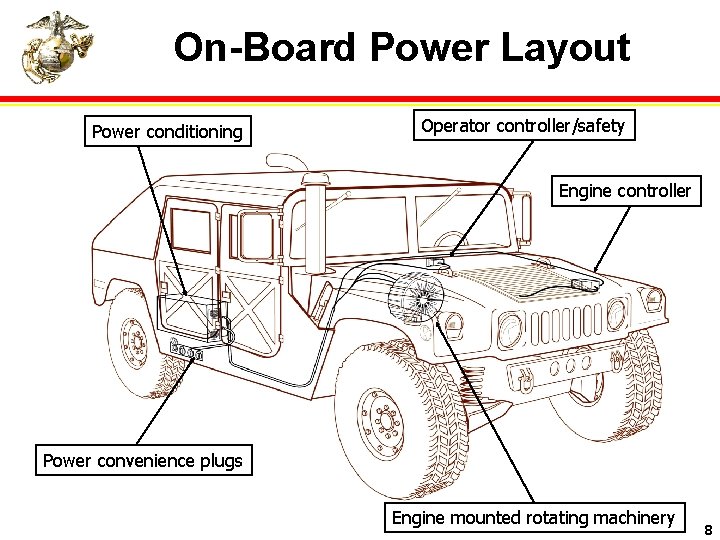
On-Board Power Layout Power conditioning Operator controller/safety Engine controller Power convenience plugs Engine mounted rotating machinery 8
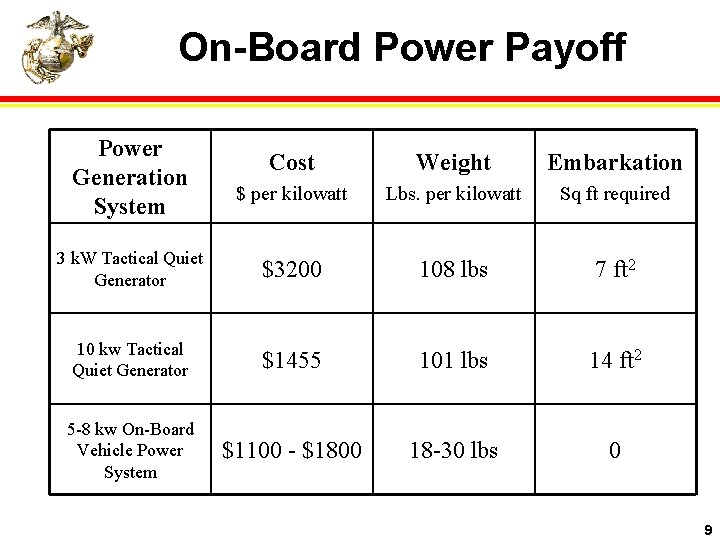
On-Board Power Payoff Power Generation System Cost Weight Embarkation $ per kilowatt Lbs. per kilowatt Sq ft required 3 k. W Tactical Quiet Generator $3200 108 lbs 7 ft 2 10 kw Tactical Quiet Generator $1455 101 lbs 14 ft 2 5 -8 kw On-Board Vehicle Power System $1100 - $1800 18 -30 lbs 0 9
On-Board Power Activities § § § Purpose is to prepare USMC: • For future power needs / requirements • For potential future acquisition programs • For assisting the FMF when they take action on their own MCSC efforts at this time are toward supporting users / buyers with: • Performance data & cost data • Market availability to deliver via GSA schedule / NSN’d items Limited User’s Evaluation § 22 nd MEU (Deployment) - 4 systems in FY 04 § Integration, Power, Reliability & Qualification Testing (3 vendors) • § Completed at Aberdeen Test Center Power Inverter Testing § Currently underway at NSWC-Crane and Dayton T. Brown § Results in Summer 2005 § Durability Testing (single system) § Nevada Automotive Test Center § Results in Summer 2005 10
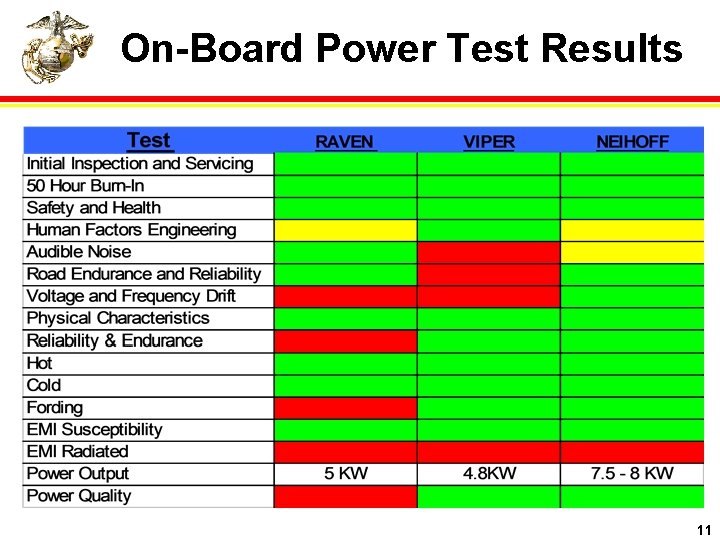
On-Board Power Test Results 11
On Board Power Path Forward § This is USMC decision & direction only § Joint PM Power and PM Motor Transport decision § Aberdeen Test Center Reports delivered § C. E. Neihoff System – Rpt # ATC-8929, Feb 2005 § Raven Technology – Rpt # ATC-8930, Feb 2005 § Aura. Gen System – Rpt # ATC-8933, Feb 2005 § Release Authority: Marine Corps Systems Command § No formal requirement exists § No formal source selection was made § But when asked, our recommendation will be to utilize the C. E. Neihoff system when 5 -8 k. W of on-board AC power is needed § C. E. Neihoff system will be taken to NATC for durability tests § USMC is continuing DC-AC Inverter evaluations 12
DC-AC Inverter Evaluation § Steady-state load test. § Output loading set to 0%, 50%, and 100% of full load § Power factor set to 0. 8 leading and unity § § Dynamic load test Overload test Steady-state line regulation test Environmental testing IAW MIL-PRF-28800 § Temperature tests @ 50% and 70% of full nominal load § Electromagnetic Interference. § Excepted tests from MIL-PRF-28800 F not be performed: § § Splash proof Fungus Resistance Solar Radiation Drip-proof Watertight Explosive Atmosphere Humidity 13
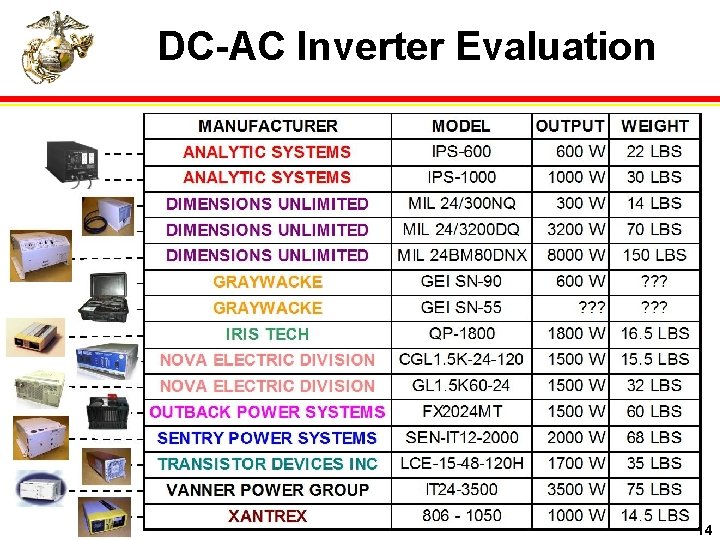
DC-AC Inverter Evaluation 14
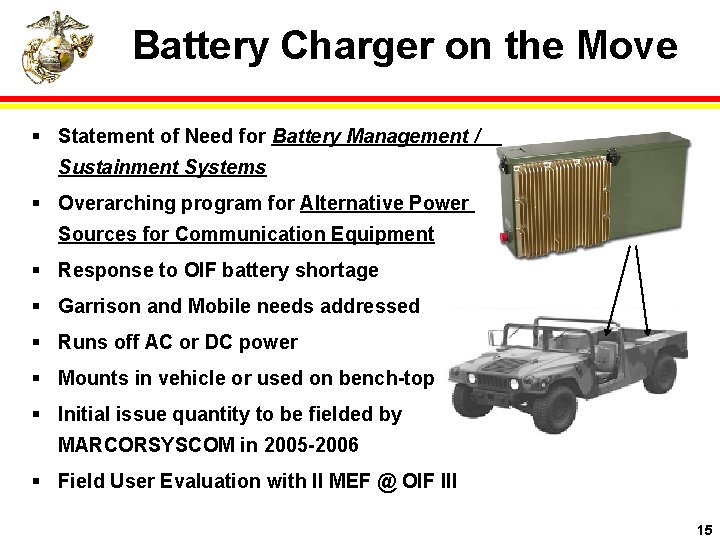
Battery Charger on the Move § Statement of Need for Battery Management / Sustainment Systems § Overarching program for Alternative Power Sources for Communication Equipment § Response to OIF battery shortage § Garrison and Mobile needs addressed § Runs off AC or DC power § Mounts in vehicle or used on bench-top § Initial issue quantity to be fielded by MARCORSYSCOM in 2005 -2006 § Field User Evaluation with II MEF @ OIF III 15

Vehicle Power System Solar Charging Panel • Part of Battery Management Statement of Need • Provides charging (not desulfating) • Overcomes battery self-discharge and helps ensure vehicles start on demand. • First fielding to MARFORRES Vehicle Power Distribution • Fuse and Circuit Breaker Protection • Waterproof enclosure • Waterproof connectors • Fielding concept TBD 16
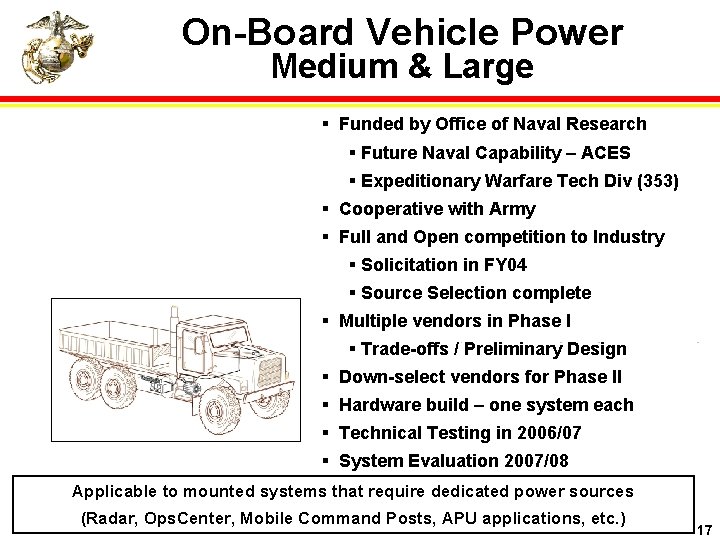
On-Board Vehicle Power Medium & Large § Funded by Office of Naval Research § Future Naval Capability – ACES § Expeditionary Warfare Tech Div (353) § Cooperative with Army § Full and Open competition to Industry § Solicitation in FY 04 § Source Selection complete § Multiple vendors in Phase I § Trade-offs / Preliminary Design § Down-select vendors for Phase II § Hardware build – one system each § Technical Testing in 2006/07 § System Evaluation 2007/08 Applicable to mounted systems that require dedicated power sources (Radar, Ops. Center, Mobile Command Posts, APU applications, etc. ) 17
On-Board Vehicle Power-Medium • 20 – 30 kilowatts continuous • HMMWV M 1123 • 120 VAC, 60 hz electric power • Two vehicles can be connected in parallel • Parallelable with Tactical Quiet Generator Phase I Vendors • BAE Systems, Oswego, NY • General Dynamics Land Systems, Muskegon, MI • DRS Technologies, Huntsville, AL 18
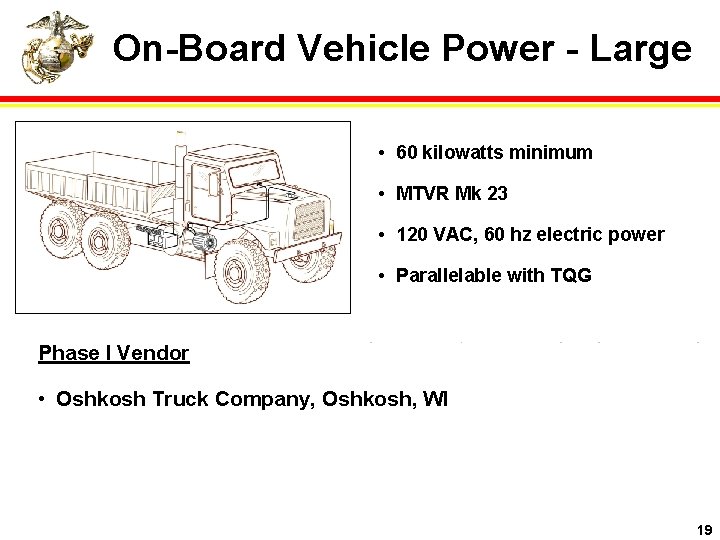
On-Board Vehicle Power - Large • 60 kilowatts minimum • MTVR Mk 23 • 120 VAC, 60 hz electric power • Parallelable with TQG Phase I Vendor • Oshkosh Truck Company, Oshkosh, WI 19
Questions 20
- Slides: 20