
Mariebs Human Anatomy and Physiology Marieb w Hoehn
Marieb’s Human Anatomy and Physiology Marieb w Hoehn Chapter 10 Muscular System Lecture 17 1
Lecture Overview • Review of how muscles are named • Skeletal muscle actions • What you should know for the exam about skeletal muscle actions • Compartments and compartment syndrome • Hernias 2
How Skeletal Muscles Are Named • Characteristics used to name skeletal muscles – Direction • Orientation relative to body midline • Rectus, transverse, oblique – Size • Relative size of muscle • Maximus, minimus, longus, brevis, lattissimus, vastus – Shape • Relative shape of muscle • Deltoid, trapezius, serratus, rhomboid 3
How Skeletal Muscles Are Named • Characteristics used to name skeletal muscles – Action • Principle action • Flexor, extensor, abductor, adductor, rotator – Number of origins • Number of tendons of origin • Biceps, triceps, quadriceps – Location • Temporalis, femoris – Origin and insertion • Sternocleidomastoid, stylohyoid 4
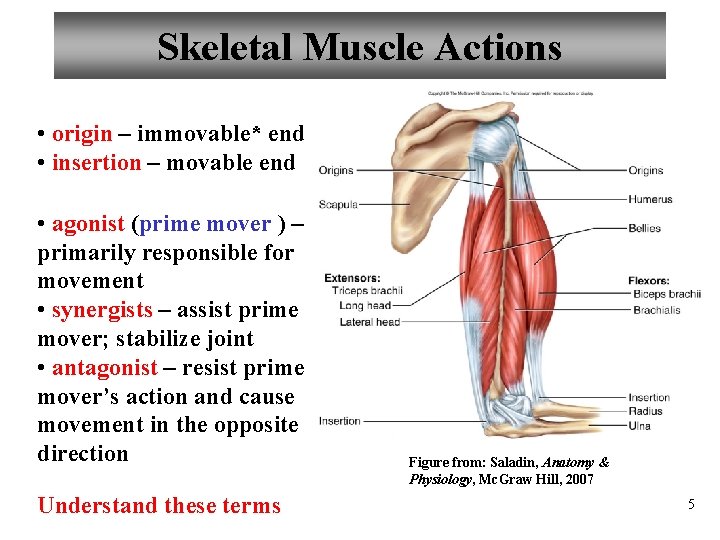
Skeletal Muscle Actions • origin – immovable* end • insertion – movable end • agonist (prime mover ) – primarily responsible for movement • synergists – assist prime mover; stabilize joint • antagonist – resist prime mover’s action and cause movement in the opposite direction Understand these terms Figure from: Saladin, Anatomy & Physiology, Mc. Graw Hill, 2007 5
What You Should Know About Muscle Actions • The muscles you will need to know for the lecture exam (name, general location, action) are in the Muscle Action Table on next slide. • Given the name of an UNKNOWN muscle – Based on the naming conventions discussed previously, – And using your previous knowledge about the anatomy of the body, – And using the starred items on the chart handed out in class (from Martini – see two slides ahead), – You should be able to tell me what the name of a muscle implies, e. g. , where it is, what it’s attached to, is it long or short, etc. 6
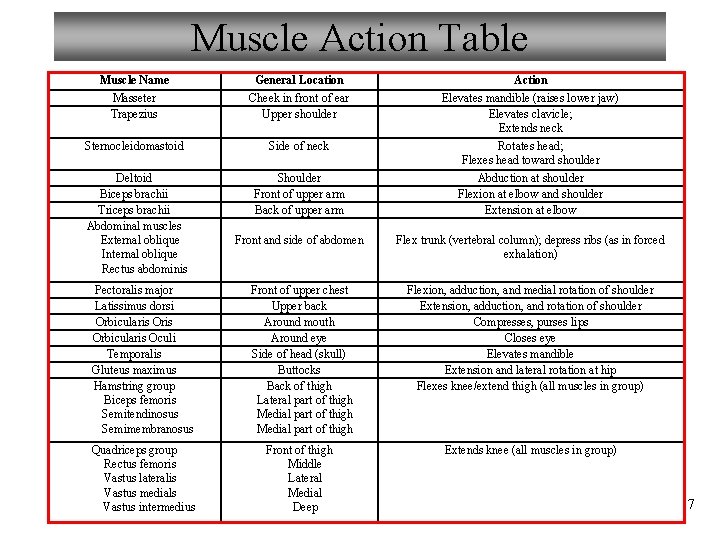
Muscle Action Table Muscle Name Masseter Trapezius General Location Cheek in front of ear Upper shoulder Sternocleidomastoid Side of neck Deltoid Biceps brachii Triceps brachii Abdominal muscles External oblique Internal oblique Rectus abdominis Shoulder Front of upper arm Back of upper arm Action Elevates mandible (raises lower jaw) Elevates clavicle; Extends neck Rotates head; Flexes head toward shoulder Abduction at shoulder Flexion at elbow and shoulder Extension at elbow Front and side of abdomen Flex trunk (vertebral column); depress ribs (as in forced exhalation) Pectoralis major Latissimus dorsi Orbicularis Oculi Temporalis Gluteus maximus Hamstring group Biceps femoris Semitendinosus Semimembranosus Front of upper chest Upper back Around mouth Around eye Side of head (skull) Buttocks Back of thigh Lateral part of thigh Medial part of thigh Flexion, adduction, and medial rotation of shoulder Extension, adduction, and rotation of shoulder Compresses, purses lips Closes eye Elevates mandible Extension and lateral rotation at hip Flexes knee/extend thigh (all muscles in group) Quadriceps group Rectus femoris Vastus lateralis Vastus medials Vastus intermedius Front of thigh Middle Lateral Medial Deep Extends knee (all muscles in group) 7
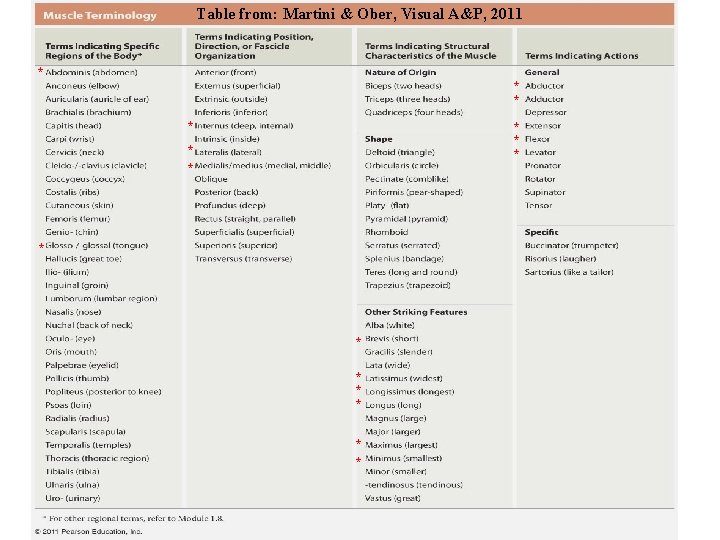
Table from: Martini & Ober, Visual A&P, 2011 * * * *
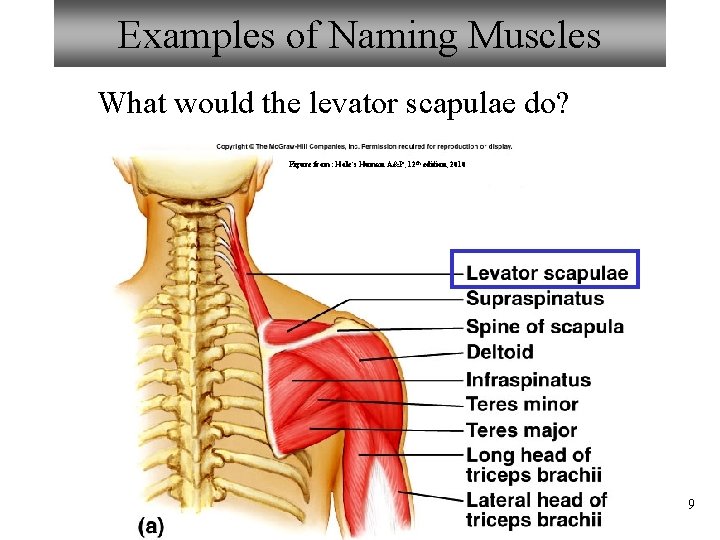
Examples of Naming Muscles What would the levator scapulae do? Figure from: Hole’s Human A&P, 12 th edition, 2010 9
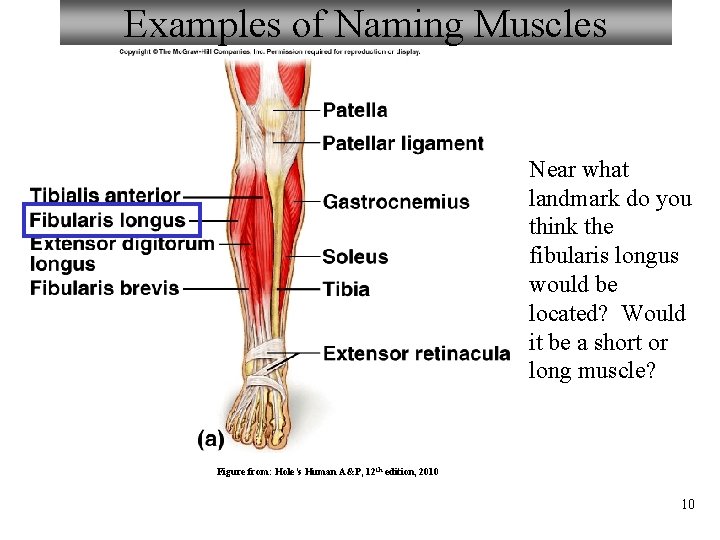
Examples of Naming Muscles Near what landmark do you think the fibularis longus would be located? Would it be a short or long muscle? Figure from: Hole’s Human A&P, 12 th edition, 2010 10
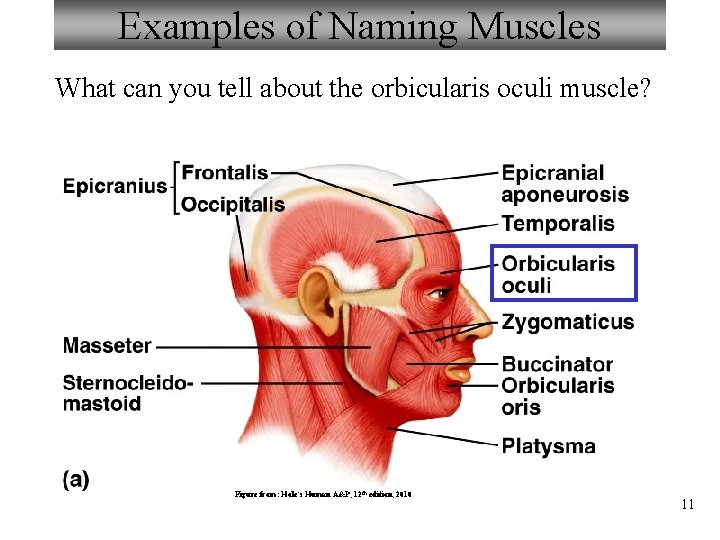
Examples of Naming Muscles What can you tell about the orbicularis oculi muscle? Figure from: Hole’s Human A&P, 12 th edition, 2010 11
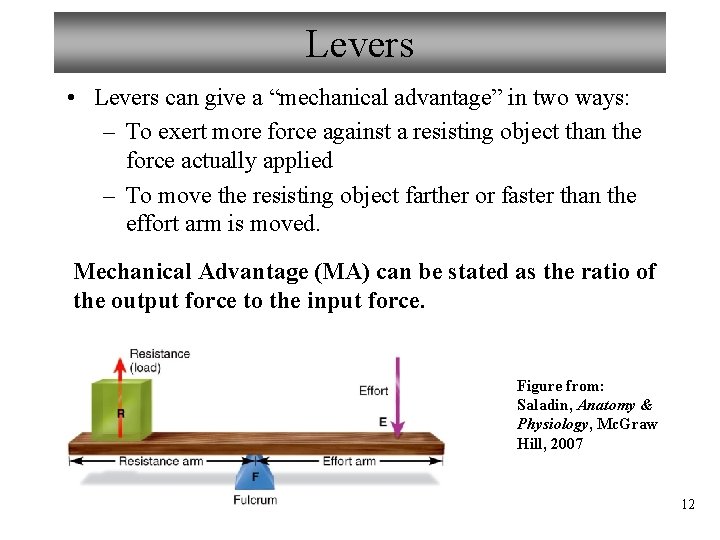
Levers • Levers can give a “mechanical advantage” in two ways: – To exert more force against a resisting object than the force actually applied – To move the resisting object farther or faster than the effort arm is moved. Mechanical Advantage (MA) can be stated as the ratio of the output force to the input force. Figure from: Saladin, Anatomy & Physiology, Mc. Graw Hill, 2007 12
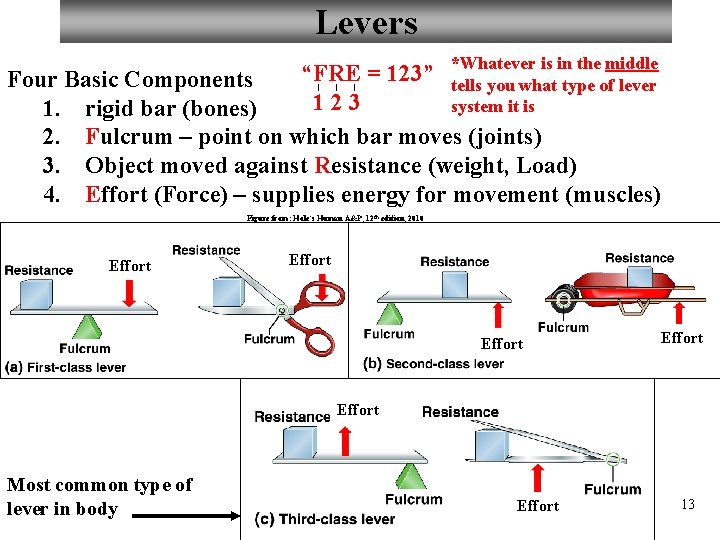
Levers *Whatever is in the middle “FRE = 123” Four Basic Components tells you what type of lever 123 system it is 1. rigid bar (bones) 2. Fulcrum – point on which bar moves (joints) 3. Object moved against Resistance (weight, Load) 4. Effort (Force) – supplies energy for movement (muscles) Figure from: Hole’s Human A&P, 12 th edition, 2010 Effort Effort Most common type of lever in body Effort 13
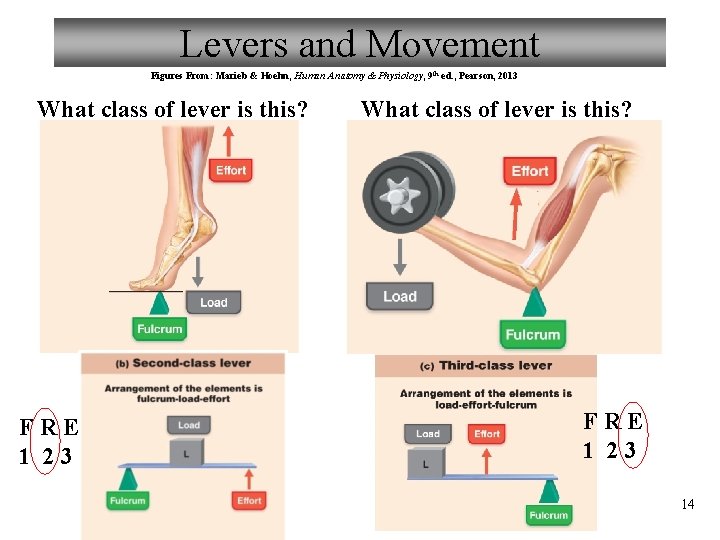
Levers and Movement Figures From: Marieb & Hoehn, Human Anatomy & Physiology, 9 th ed. , Pearson, 2013 What class of lever is this? FRE 1 23 14
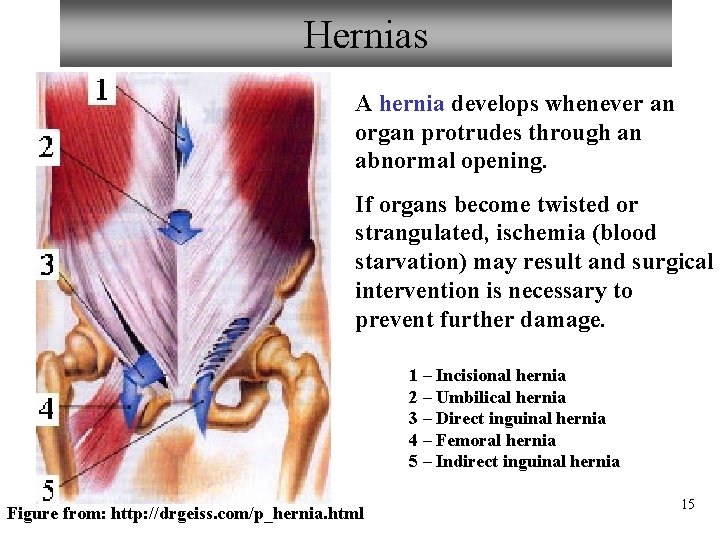
Hernias A hernia develops whenever an organ protrudes through an abnormal opening. If organs become twisted or strangulated, ischemia (blood starvation) may result and surgical intervention is necessary to prevent further damage. 1 – Incisional hernia 2 – Umbilical hernia 3 – Direct inguinal hernia 4 – Femoral hernia 5 – Indirect inguinal hernia Figure from: http: //drgeiss. com/p_hernia. html 15
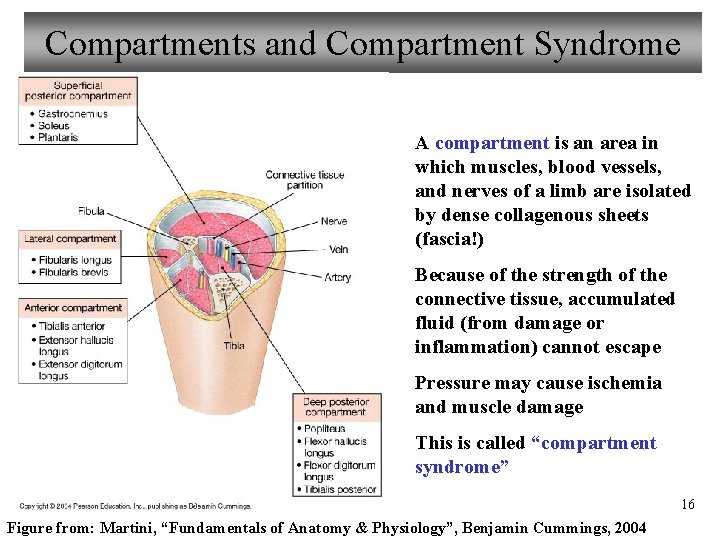
Compartments and Compartment Syndrome A compartment is an area in which muscles, blood vessels, and nerves of a limb are isolated by dense collagenous sheets (fascia!) Because of the strength of the connective tissue, accumulated fluid (from damage or inflammation) cannot escape Pressure may cause ischemia and muscle damage This is called “compartment syndrome” 16 Figure from: Martini, “Fundamentals of Anatomy & Physiology”, Benjamin Cummings, 2004
Review • Muscles are named according to – Direction – Size – Shape – Action – Number of origins – Location – Origin and insertion 17
Review • An origin of a muscle is the fixed end of a muscle, i. e. the end that moves the least • An insertion of a muscle is the movable end of a muscle, i. e. , the end that moves the most • A prime mover (agonist) is a muscle whose contraction is chiefly responsible for a movement • A synergist helps a larger agonist work efficiently • An antagonist opposes the action of an prime mover (agonist) 18
Review • Regarding muscle actions, you should know… – Names and actions of muscles reviewed in lab – Naming convention for muscles on Tortora handout chart • Levers – Be able to identify the type of lever that is represented by a muscle/bone/joint diagram 19
Review • Compartments of the limbs – group of muscles, blood vessels and nerves isolated by thick CT sheets – Inflammation or damage can cause fluid accumulation an swelling with danger of ischemia • A hernia – Is a protrusion of organs through an abnormal opening – Is dangerous, especially if the protruding organs become strangulated or twisted 20
- Slides: 20