
Marie Raupp Mark Miller YOU be the auditor
Marie Raupp & Mark Miller YOU be the auditor
Clinical Chart Audit Marie Raupp, LSW, CFE, CHC Manager of Compliance Marie. Raupp@phila. gov
Presentation will review: • New audit codes • Most common audit findings • Practice notes
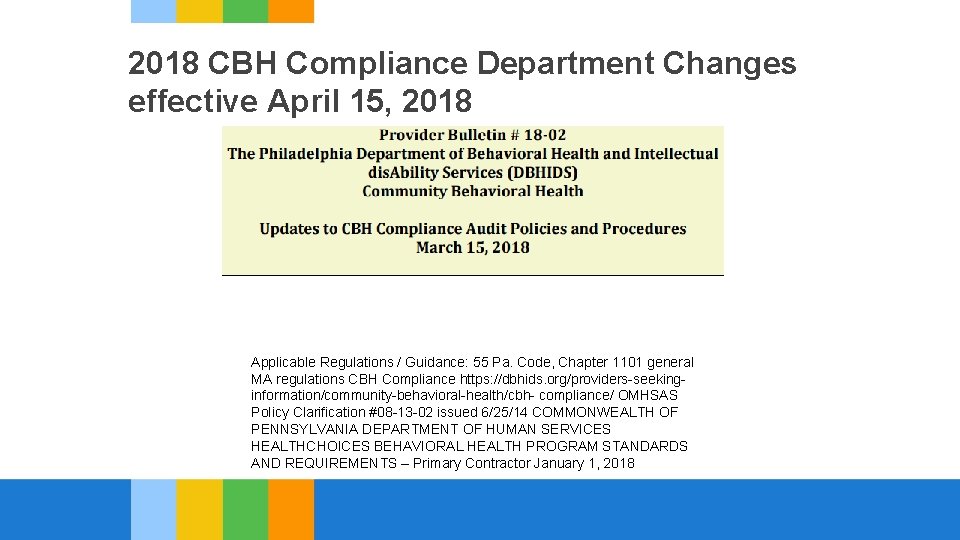
2018 CBH Compliance Department Changes effective April 15, 2018 Applicable Regulations / Guidance: 55 Pa. Code, Chapter 1101 general MA regulations CBH Compliance https: //dbhids. org/providers-seekinginformation/community-behavioral-health/cbh- compliance/ OMHSAS Policy Clarification #08 -13 -02 issued 6/25/14 COMMONWEALTH OF PENNSYLVANIA DEPARTMENT OF HUMAN SERVICES HEALTHCHOICES BEHAVIORAL HEALTH PROGRAM STANDARDS AND REQUIREMENTS – Primary Contractor January 1, 2018
Highlights of Bulletin: 1. Elimination of Allowable Time for Submission of Missing Documentation for Audits at Provider’s Location 2. Request for Documentation for Audits at Provider’s Location 3. Request for Documentation for Desk Audits Conducted at CBH 4. Unannounced Audits 5. Educational Audits 6. Repayment Plan Policy 7. Audit Codes 8. Document Scanning During On-Site Audits 9. Provider Scanned Documents and Digital Record-Keeping

Current Codes for Compliance Audits (* = new) B - Billed to Incorrect Service Location or N - Non-Billable Activity Service Type Error (Differs from upcoding) C - Date Error D - Discrepant Information *E - Services Provided by an Excluded Individual or Entity *G - Group Size Noted or Exceeds Allowable Number of Participants *H - Upcoding *IC - Insufficient: Clinical *ID - Insufficient: Documentation M - Missing Documentation O - Clock Times Not Documented *P - Services exceed MA allowable contacts period Q - Services Provided by an Unqualified Individual *S - Services Not Rendered R - Re-Use of Content T - Treatment Plan Concerns U - Unit Error *Y - Unbundling Codes
New Audit Codes in 2018 E – Services Provided by Excluded Individual or Entity Regulatory Support for Code E: MA Bulletin ISSUE DATE August 15, 2011 EFFECTIVE DATE August 15, 2011 NUMBER 9911 -05 Provider Screening of Employees and Contractors for Exclusion from Participation in Federal Health Care Programs and the Effect of Exclusion on Participation
New Audit Code G – Group Size Not Documented or Exceeds Allowable Number of Participants Regulatory Support for Code G: Mental Health, MA Regulations Title 55, CHAPTER 1153. OUTPATIENT PSYCHIATRIC SERVICES; GENERAL PROVISIONS: • 1153. 2. Definitions “Group psychotherapy—Psychotherapy provided to no less than two and no more than ten persons with diagnosed mental disorders for a period of at least one hour. These sessions shall be conducted by a clinical staff person. ” Drug and Alcohol, MA Regulations Title 55, CHAPTER 1223. OUTPATIENT DRUG AND ALCOHOL CLINIC SERVICES, GENERAL PROVISIONS: • 1223. 2. Definitions “Group psychotherapy—Psychotherapy provided to no less than two and no more than ten persons with diagnosed drug/alcohol abuse or dependence problems for a minimum of one hour. These sessions shall be conducted by drug/alcohol clinic psychotherapy personnel under the supervision of a physician. ”
CBH Provider Notice on Group Size https: //dbhids. org/providers-seeking-information/community-behavioral-health/cbh-providernotices-2/ November 18, 2016 PROVIDER NOTICE: GROUP THERAPY SIZE LIMITATIONS Community Behavioral Health (CBH) is issuing this Provider Notice as a reminder regarding the limitations on the number of participants in Group Therapy in Outpatient Mental Health and Addictions Services. Medicaid restricts the number of participants, as noted below. Billing for services provided in excess of these parameters is subject to repayment for all CBH participants, not just those exceeding the limits. CBH will be adding this element to Compliance Department reviews in future audits. It is important that documentation allows for group size to be ascertained. Progress notes should clearly indicate the number of participants in the group, without listing names or identifiers of other group members.
CBH Provider Notice, Continued “…Psychoeducational Groups: Often, valuable and medically necessary group treatment occurs outside of the traditional group psychotherapy models. Typically these groups are labeled as “psychoeducational. ” Psychoeducational groups are permissible as a limited adjunct to more traditional therapy modalities (Individual, Group, and Family). Psychoeducational groups are permitted as part of a treatment course in programs such as Partial Hospital Programs, Intensive Outpatient Programs (IOP), Residential Treatment Facilities, Inpatient and Non-Hospital Detoxification and Rehabilitation Units, and Halfway Houses. Psychoeducational groups are not billable as standalone services…The maximum group size for psychoeducational groups in order to be reimbursed by CBH is 15 participants. This number excludes any treatment staff and may not be increased by using co-facilitators. ”
CBH Provider Notice, Continued Examples of Psychoeducational Group topics include, but are not limited to: Vocational and Occupational training Life skills Parenting/Family Reunification Structured Social Activities Dynamics and Medical Aspects of Addiction Abstinence and Its Role in Recovery Use of Self Help and Support Group Nutrition Sex and Sexuality Family Dynamics of Addiction Confrontation Skills Refusal Skills Avoiding and Defusing Triggers for Relapse HIV and STDs
New Audit Code H – Upcoding Billing for a service that is more expensive than the service that was performed Examples: Billing Psychiatrist LOC for a Master’s-level provider of service Billing Family when Individual was provided
Regulatory Support for Code H: https: //www. pacode. com/secure/data/055/chapter 1101/s 1101. 75. html § 1101. 75. Provider prohibited acts. (a) An enrolled provider may not, either directly or indirectly, do any of the following acts: (8) Submit a claim which misrepresents the description of the services, supplies or equipment dispensed or provided, the date of service, the identity of the recipient or of the attending, prescribing, referring or actual provider.
New Audit Codes IC and ID? What’s the difference? IC = Insufficient: Clinical – used to be Insufficient ID = Insufficient: Documentation – used to be Date Of Service Noted; No Clinical Signatures; No Original Signature (photocopy or stamp); Photocopied Note; Client not ID’s on progress note; Illegible; Late Note Entries
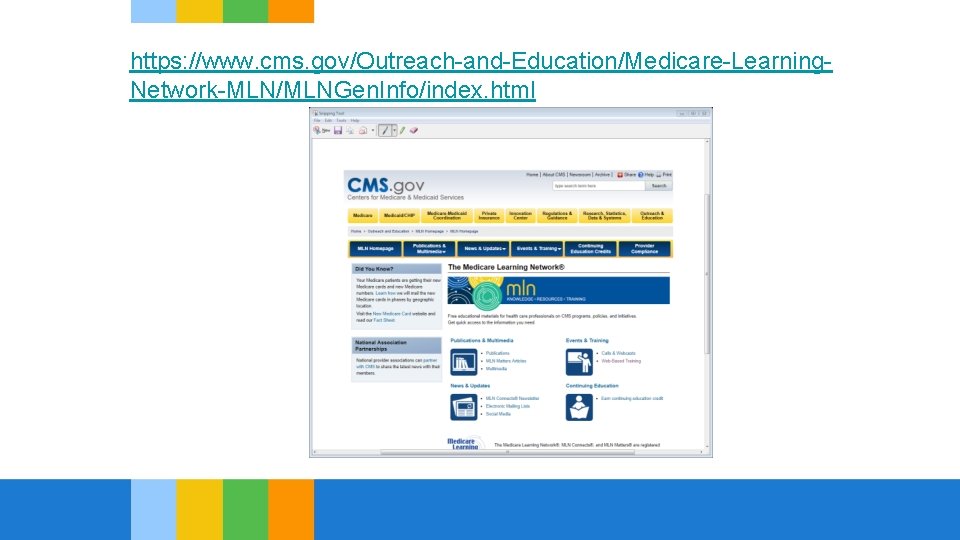
https: //www. cms. gov/Outreach-and-Education/Medicare-Learning. Network-MLN/MLNGen. Info/index. html
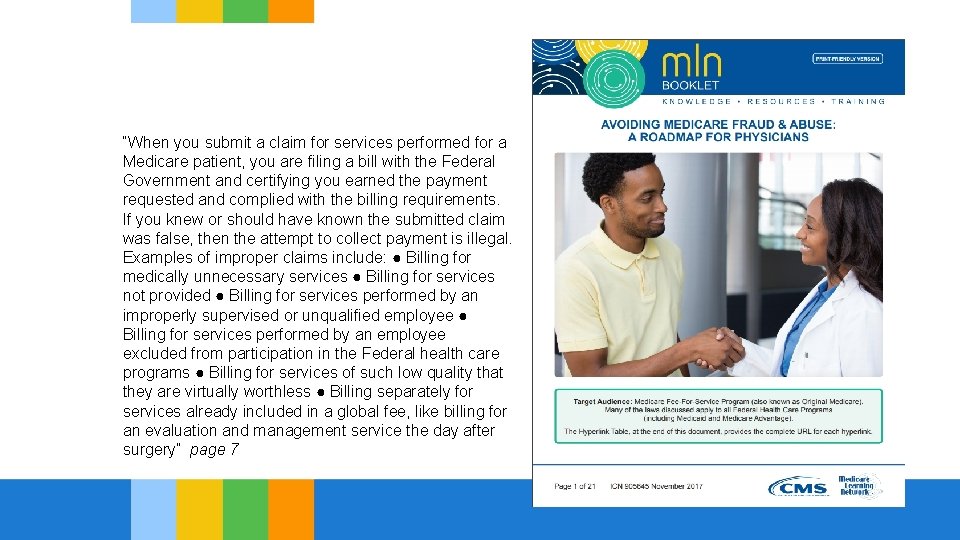
“When you submit a claim for services performed for a Medicare patient, you are filing a bill with the Federal Government and certifying you earned the payment requested and complied with the billing requirements. If you knew or should have known the submitted claim was false, then the attempt to collect payment is illegal. Examples of improper claims include: ● Billing for medically unnecessary services ● Billing for services not provided ● Billing for services performed by an improperly supervised or unqualified employee ● Billing for services performed by an employee excluded from participation in the Federal health care programs ● Billing for services of such low quality that they are virtually worthless ● Billing separately for services already included in a global fee, like billing for an evaluation and management service the day after surgery” page 7
Regulatory Support for Codes IC and ID § 1101. 51. Ongoing responsibilities of providers. (d) Standards of practice. (e) Record keeping requirements and onsite access. (1) General standards for medical records. § 1101. 75. Provider prohibited acts. Documentation and Medical Record Keeping Requirements http: //www. dhs. pa. gov/cs/groups/webcontent/documents/bulletin_ admin/d_006952. pdf
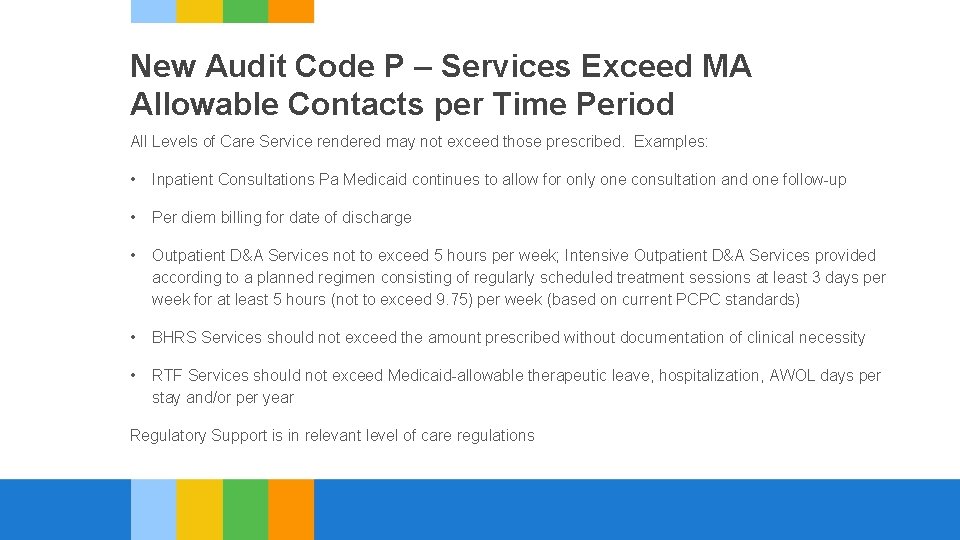
New Audit Code P – Services Exceed MA Allowable Contacts per Time Period All Levels of Care Service rendered may not exceed those prescribed. Examples: • Inpatient Consultations Pa Medicaid continues to allow for only one consultation and one follow-up • Per diem billing for date of discharge • Outpatient D&A Services not to exceed 5 hours per week; Intensive Outpatient D&A Services provided according to a planned regimen consisting of regularly scheduled treatment sessions at least 3 days per week for at least 5 hours (not to exceed 9. 75) per week (based on current PCPC standards) • BHRS Services should not exceed the amount prescribed without documentation of clinical necessity • RTF Services should not exceed Medicaid-allowable therapeutic leave, hospitalization, AWOL days per stay and/or per year Regulatory Support is in relevant level of care regulations
New Audit Code S – Services Not Rendered Billing for services that were not provided Regulatory Support for Code S: § 1101. 75. Provider prohibited acts. (a) An enrolled provider may not, either directly or indirectly, do any of the following acts: (5) Submit a claim for services or items which were not rendered by the provider or were not rendered to a recipient.
New Audit Code Y – Unbundling Billing separately for services in lieu of an available combination code Examples: Billing for an inpatient psych consult during an inpatient psych hospitalization; Billing a therapy session as part of a partial hospital and as a separate service; Billing separately for labs that are included in a per diem Regulatory Support for Code Y: “Examples of fraud and abuse appropriate for reporting are set forth below: Falsifying Claims/Encounters http: //www. dhs. pa. gov/learnaboutdhs/fraudandabuse/mafraudandabusegeneralinformation/index. htm
Audit Codes That Stayed the Same (Letter Code may have changed): B = Billed to Incorrect Location; Service Type Errors – differs from Upcoding C = Date Errors D = Discrepant Information M = Missing Documentation N = Non-Billable Activity O = Clock Times not Documented Q = Services provided by an unqualified individual R = Re-use of Content T = Treatment Plan Concerns U = Unit Errors
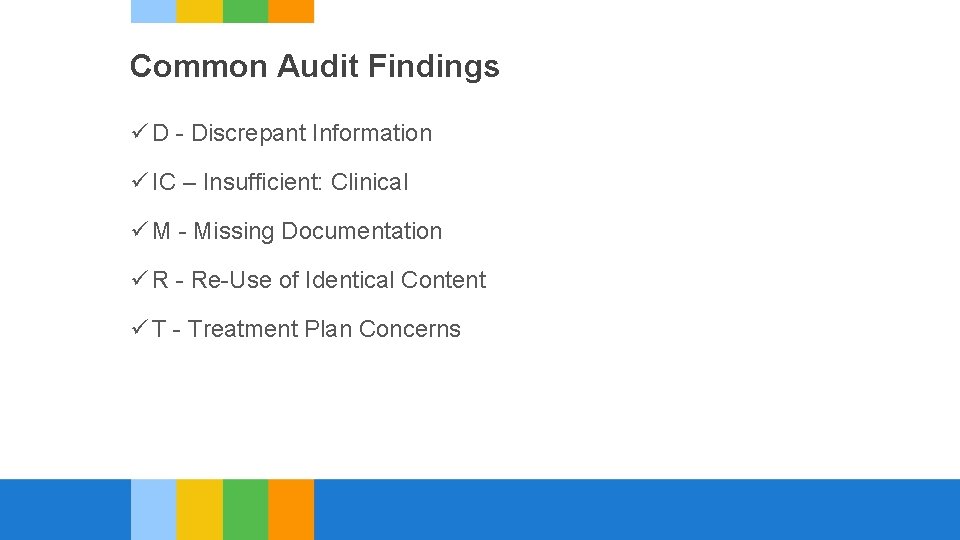
Common Audit Findings ü D - Discrepant Information ü IC – Insufficient: Clinical ü M - Missing Documentation ü R - Re-Use of Identical Content ü T - Treatment Plan Concerns
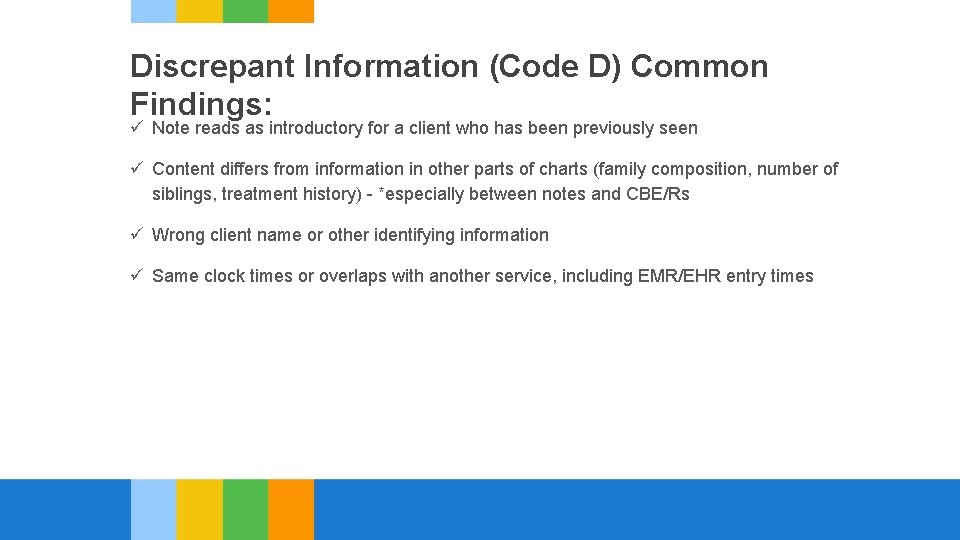
Discrepant Information (Code D) Common Findings: ü Note reads as introductory for a client who has been previously seen ü Content differs from information in other parts of charts (family composition, number of siblings, treatment history) - *especially between notes and CBE/Rs ü Wrong client name or other identifying information ü Same clock times or overlaps with another service, including EMR/EHR entry times
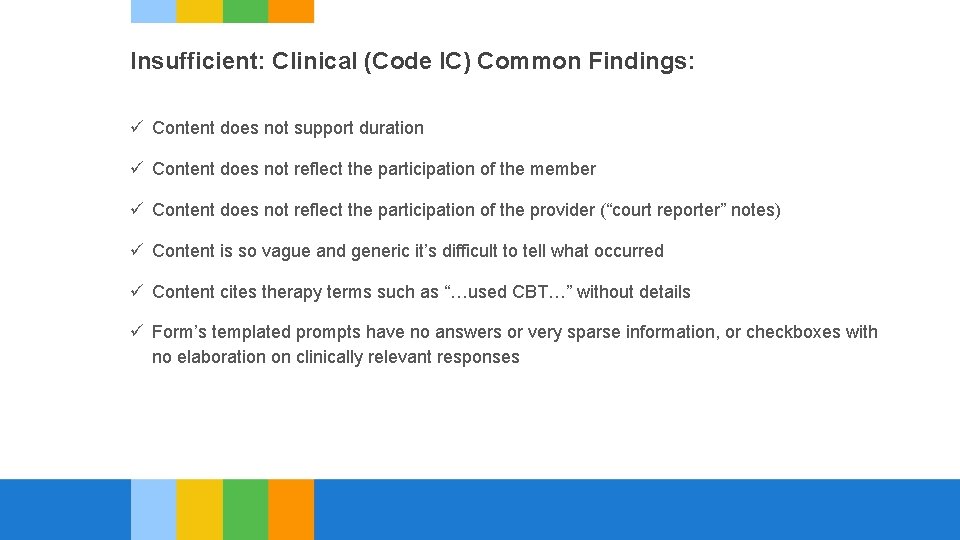
Insufficient: Clinical (Code IC) Common Findings: ü Content does not support duration ü Content does not reflect the participation of the member ü Content does not reflect the participation of the provider (“court reporter” notes) ü Content is so vague and generic it’s difficult to tell what occurred ü Content cites therapy terms such as “…used CBT…” without details ü Form’s templated prompts have no answers or very sparse information, or checkboxes with no elaboration on clinically relevant responses
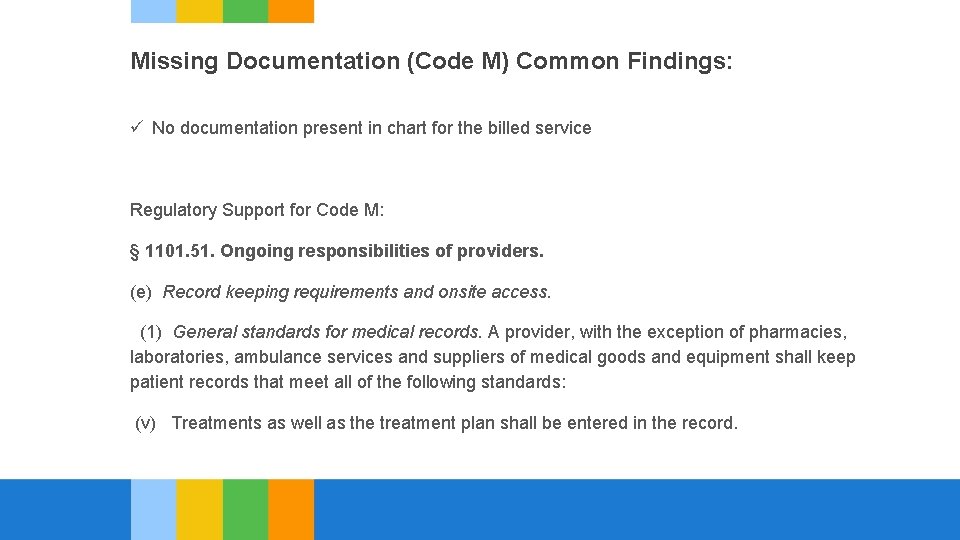
Missing Documentation (Code M) Common Findings: ü No documentation present in chart for the billed service Regulatory Support for Code M: § 1101. 51. Ongoing responsibilities of providers. (e) Record keeping requirements and onsite access. (1) General standards for medical records. A provider, with the exception of pharmacies, laboratories, ambulance services and suppliers of medical goods and equipment shall keep patient records that meet all of the following standards: (v) Treatments as well as the treatment plan shall be entered in the record.
2018 Changes to Process re: Missing Documentation Provider Bulletin # 18 -02 The Philadelphia Department of Behavioral Health and Intellectual dis. Ability Services (DBHIDS) Community Behavioral Health Updates to CBH Compliance Audit Policies and Procedures March 15, 2018: Elimination of Allowable Time for Submission of Missing Documentation for Audits at Provider’s Location: Providers are responsible for ensuring documentation of services is present in the clinical record within seven days of the service or before the service is billed, whichever comes first. The CBH Compliance Department has historically allowed providers to submit missing documentation as part of the provider’s response to the audit. Previously, providers have had until 10: 00 AM of the business day after the daily onsite audit to submit progress note and treatment plan documentation listed as missing at the audit. Providers will now be required to locate the documentation during the audit in the event CBH Compliance Analysts are unable to locate documentation related to a paid claim. Procedure: The CBH Compliance Audit Team Lead, or designee, will communicate with the provider representative periodically throughout the audit day when an analyst is unable to locate required documentation in the record. The provider representative will be asked to review the member record in the presence of the CBH auditing team to determine if the documentation is present. Documentation not filed in the record at the time of the audit, i. e. located in a clinician’s desk or field folder, will not be accepted for credit. Providers may not create new documentation to replace that which is unable to be located. As a reminder: CBH is no longer accepting new paper claims for the correct dates and types of service as part of the provider’s compliance audit response. Claims appeals will also not be accepted for these billing errors.
Re-Use of Content (Code R) Common Findings ü Repeated content or one word changes or moving words around: “M said he is feeling sad today because he was thinking about his recent loss. We processed how to deal with the loss” “M said he was feeling anxious today because he was thinking about his recent loss. We processed how to deal with the loss” “M said he was again feeling anxious today because he was thinking about his recent loss. We processed how to deal with the loss” “We processed how to deal with the loss M said he was feeling anxious about today”
Re-Use of Content (Code R) Common Findings, Continued ü Including content from a book or website: “Today’s group dealt with how addiction can affect a person’s family. We watched Drugstore cowboy. The story follows Bob Hughes (Matt Dillon) and his crew of drug addicts as they travel across the U. S. Pacific Northwest in 1971, supporting their habit by robbing pharmacies and hospitals. After a tragedy strikes the group, Bob decides to try to “go straight”, but finds that there is more to extricating himself from the drug user’s lifestyle than just giving up drugs. ” 2
Treatment Plan Concerns (Code T) Common Findings ü No plan found to cover date of service ü Plan not signed by all required individuals ü Plan does not include all services being provided ü Plans are identical across time and/or members, often with re-used content for progress update section ü Plan has the wrong client name and/or other information
Example Note #1 Billed as One Hour OP MH Family Therapy with Psychiatrist
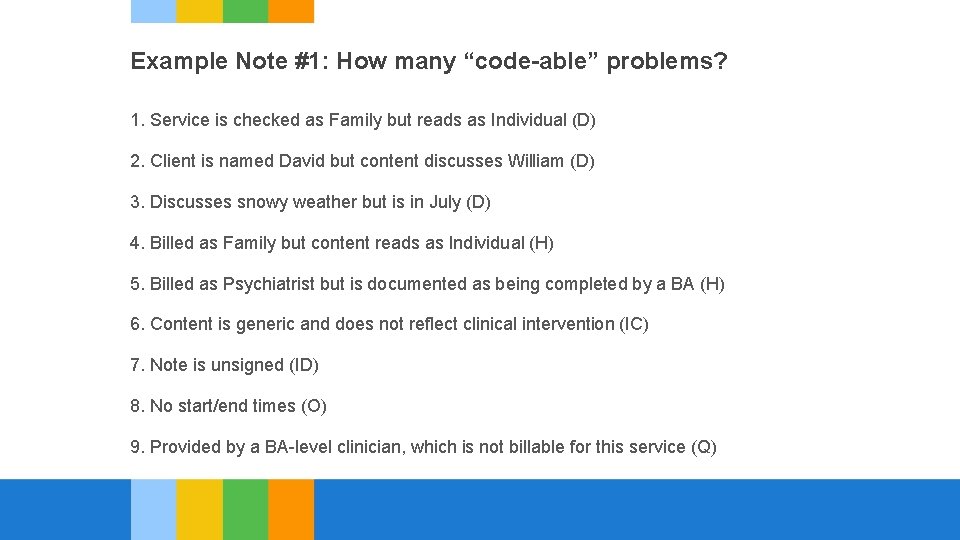
Example Note #1: How many “code-able” problems? 1. Service is checked as Family but reads as Individual (D) 2. Client is named David but content discusses William (D) 3. Discusses snowy weather but is in July (D) 4. Billed as Family but content reads as Individual (H) 5. Billed as Psychiatrist but is documented as being completed by a BA (H) 6. Content is generic and does not reflect clinical intervention (IC) 7. Note is unsigned (ID) 8. No start/end times (O) 9. Provided by a BA-level clinician, which is not billable for this service (Q)
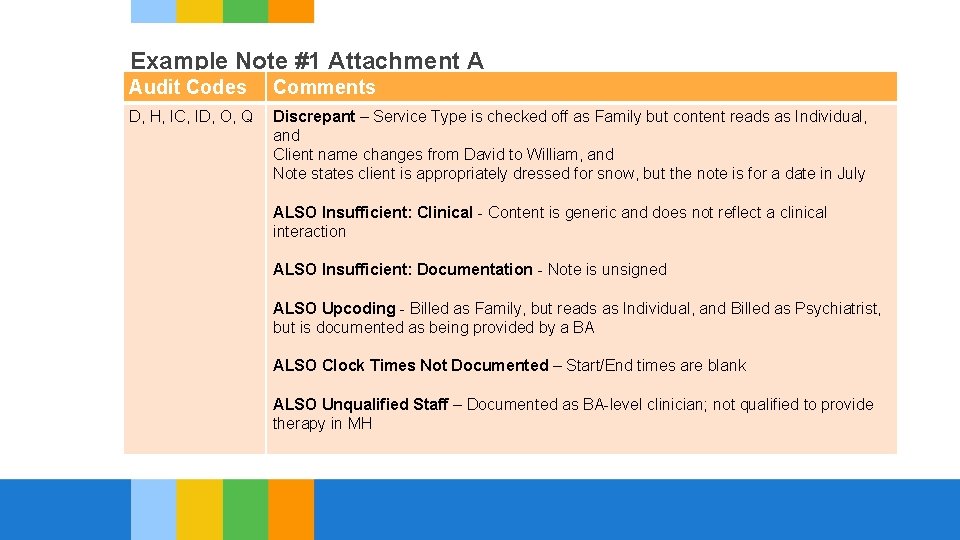
Example Note #1 Attachment A Audit Codes Comments D, H, IC, ID, O, Q Discrepant – Service Type is checked off as Family but content reads as Individual, and Client name changes from David to William, and Note states client is appropriately dressed for snow, but the note is for a date in July ALSO Insufficient: Clinical - Content is generic and does not reflect a clinical interaction ALSO Insufficient: Documentation - Note is unsigned ALSO Upcoding - Billed as Family, but reads as Individual, and Billed as Psychiatrist, but is documented as being provided by a BA ALSO Clock Times Not Documented – Start/End times are blank ALSO Unqualified Staff – Documented as BA-level clinician; not qualified to provide therapy in MH
Example Note #2 Billed as One Hour BSC-ASD
Example Note #2: How many “code-able” problems (There is no Example Note #2) 1. Missing Documentation (M)
Example Note #2 Attachment A Audit Codes Comments M Missing Documentation – Note not found in chart; requested during audit and not found by provider. Deadline has passed – provider unable to submit as part of response
Example Note #3 Billed as 3 hours (12 units) IOP
Example Note #3: How many “code-able” problems? 1. Group Size Not Documented (G) 2. Client Not Identified (ID)
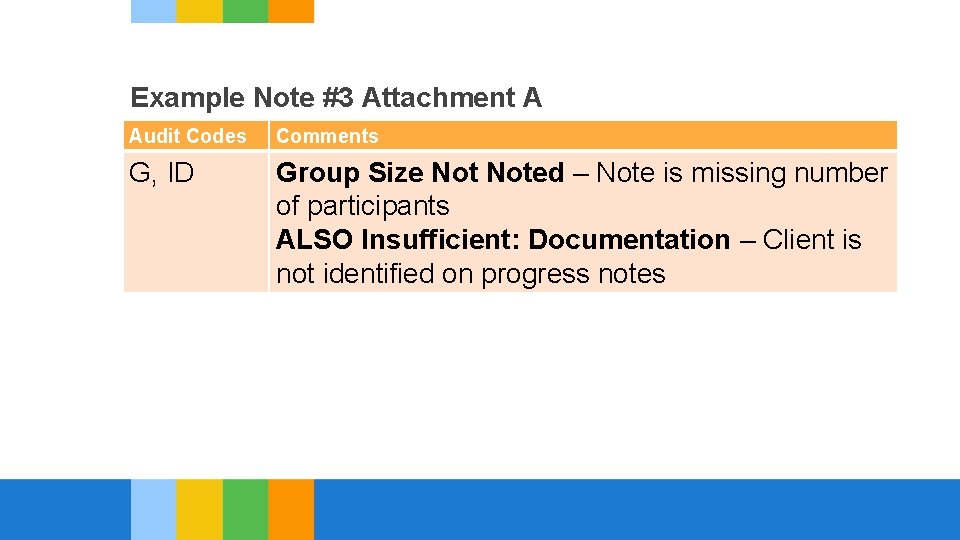
Example Note #3 Attachment A Audit Codes Comments G, ID Group Size Noted – Note is missing number of participants ALSO Insufficient: Documentation – Client is not identified on progress notes
Example Note #4 Billed as 6 hours (24 units) Non-School TSS for Date of Service 2/13/17
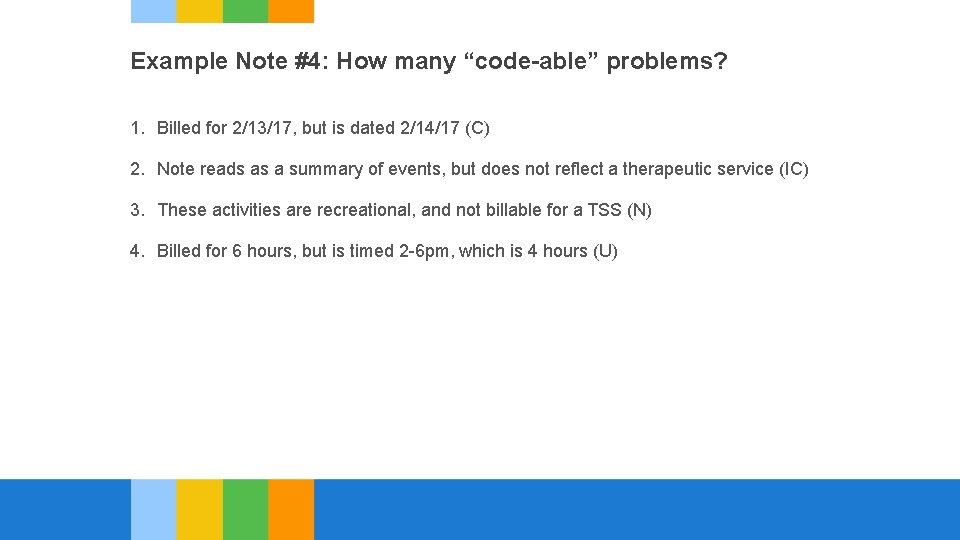
Example Note #4: How many “code-able” problems? 1. Billed for 2/13/17, but is dated 2/14/17 (C) 2. Note reads as a summary of events, but does not reflect a therapeutic service (IC) 3. These activities are recreational, and not billable for a TSS (N) 4. Billed for 6 hours, but is timed 2 -6 pm, which is 4 hours (U)
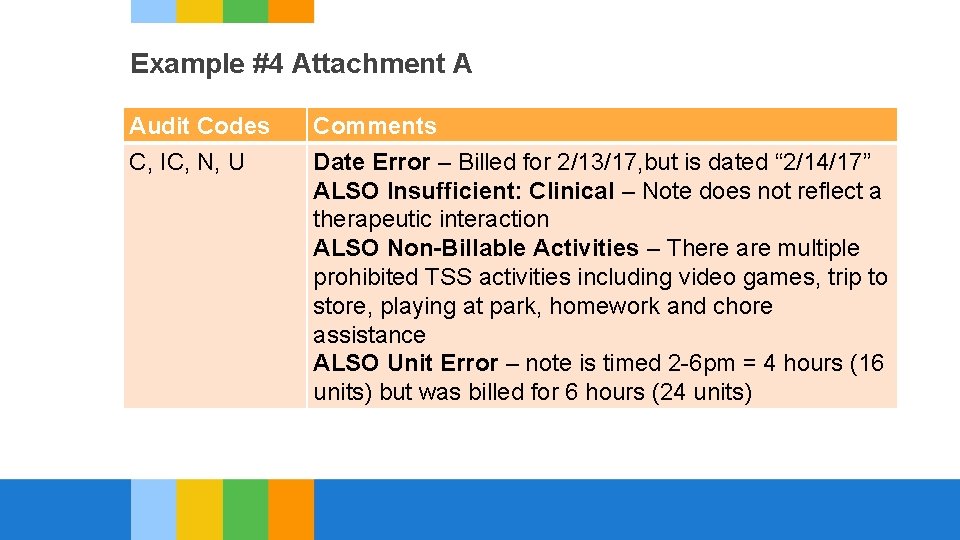
Example #4 Attachment A Audit Codes C, IC, N, U Comments Date Error – Billed for 2/13/17, but is dated “ 2/14/17” ALSO Insufficient: Clinical – Note does not reflect a therapeutic interaction ALSO Non-Billable Activities – There are multiple prohibited TSS activities including video games, trip to store, playing at park, homework and chore assistance ALSO Unit Error – note is timed 2 -6 pm = 4 hours (16 units) but was billed for 6 hours (24 units)
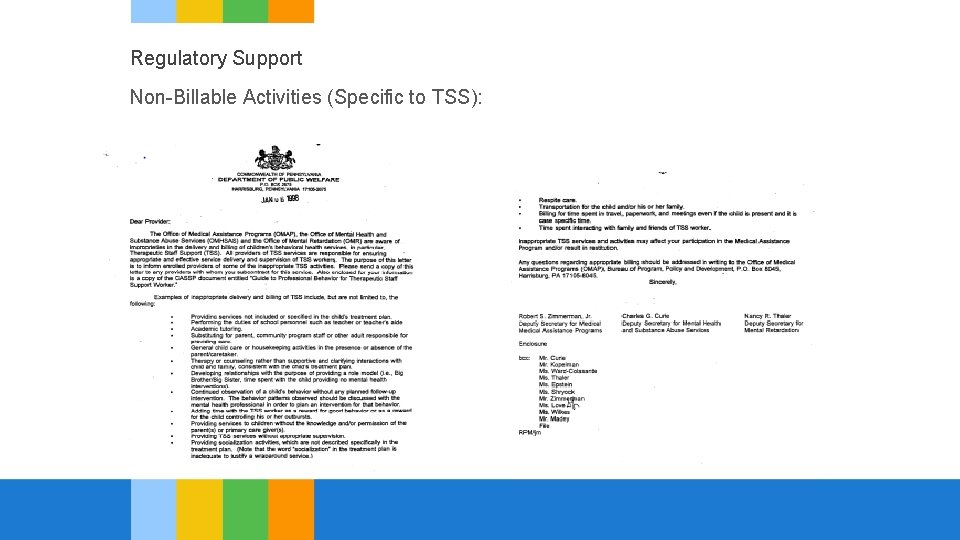
Regulatory Support Non-Billable Activities (Specific to TSS):

Keep up the great work!
Provider Personnel Audit Mark Miller, MEd, LPC Compliance Supervisor Mark. D. Miller@phila. gov
Types of Providers Credentialed by CBH Independent/Individual Practitioner – a clinician (e. g. psychiatrist, psychologist, licensed clinical social worker) who provides behavioral healthcare services and bills under their own Taxpayer Identification Number. Group Practice – a practice contracted with CBH as a group entity and as such bills as a group entity for the services performed by its CBH credentialed clinicians. Primary source verification for these providers will be conducted through the Council for Affordable Quality Healthcare's (CAQH). Enrollment in CAQH is required for these providers. https: //proview. caqh. org/PR/Registration
Types of Providers Provider is Responsible Facility – an agency licensed by the state of Pennsylvania to provide behavioral health services. Examples of facilities include, but are not limited to psychiatric hospitals, partial hospital programs, mental health clinics, residential treatment facilities, substance use disorder clinics and rehabilitation providers. Facilities are solely responsible for primary source verification and ensuring that the staff they employ, or contract with, meet all education and experience requirements for the positions held as well as possess all the appropriate certifications and clearances.
Staff Roster Submitted yearly and by special request 2019 will be the fourth year Importance of submitting complete rosters / Utility Aggregate Analysis of network staffing patterns Licensure Physician coverage Supervision / staffing ratios Combined with audit tool
Manual for Review of Provider Personnel Files (MRPPF) 8/21/2014 Supplement to the MRPPF 6/11/2018 State and Federal Regulations CBH Requirements Covers the most frequently seen positions in the network Incorporated into the Provider Manual
The Personnel File License (when required) www. pals. pa. gov Education Experience Clearances Trainings Signed current job description Additional documentation for physicians, nurse practitioners and physician assistants Insurance, DEA, NPDB, board certification or residency View originals and sign “original seen by…, date” Necessary to have a file for all direct care staff including contracted, temps, and interns
The Personnel File Education: Qualifications for the position Diploma Transcript Foreign degree verified by a National Association of Credential Evaluation Services (NACES) member organization. www. naces. org/members. html Accredited school in the US: Accrediting agency must be recognized by the Council for Higher Education Accreditation (CHEA) or the U. S. Department of Education (USDE). A current list of accrediting agencies can be found at www. chea. org


The Personnel File Experience: Verification of previous employment Relevant Dates Position HR or person of authority Internal documentation for promotions Not a ‘reference’
Clearances Pennsylvania Criminal History Checks (SP 4164): Required for all personnel working with members in all programs Pennsylvania Child Abuse History Clearances (CY 113): Required for all personnel working with children Federal Bureau of Investigation (FBI) Criminal Background Checks: Required for all personnel working with children. (Also required for those living out of state within the past 2 years. ) Updated every 60 months Must have before employment or service (or 90 day provisional) (Pennsylvania General Assembly, Title 23 § 6344 of the Child Protective Services Law)
Exclusions The following databases must be accessed to determine exclusion status: Medicheck List: This list identifies providers, individuals, and other entities that are precluded from participation in the Medical Assistance (MA) Program. http: //www. dhs. pa. gov/publications/medichecksearch/ List of Excluded Individuals/Entities (LEIE), maintained by the Department of Health and Human Services, Office of Inspector General (DHHS/OIG), is a data base of all individuals or entities that have been excluded nationwide from participation in any federal health care program, e. g. , Medicaid and Medicare. http: //oig. hhs. gov/exclusions/index. asp System for Award Management (SAM), combines federal procurement systems and the Catalog of Federal Domestic Assistance into one system. This consolidation includes the Excluded Parties List System (EPLS). https: //www. sam. gov
Exclusions Screen all employees and contractors to determine if they have been excluded from participation in federal health care programs At the time of hire or contracting, and thereafter on a monthly basis Maintain auditable documentation of screenings Periodic self-audits should also be conducted [Medical Assistance Bulletin #99 -11 -05, Commonwealth of Pennsylvania, Department of Public Welfare]
Trainings CBH mandatory trainings Level of care specific trainings Training plan Training log Pre and post test
You Be the Auditor Education & Experience: Applicant 1: Mental Health Professional Applicant 2: Mental Health Professional Applicant 2: Behavioral Specialist Consultant / Mobile Therapist Applicant 3: Substance Abuse Counselor
You Be the Auditor Applicant 1: Mental Health Professional Education: Does not have education in “a generally recognized clinical discipline which includes mental health clinical experience” Experience: Experience piece is part of the education
You Be the Auditor Applicant 2: Mental Health Professional Education Has education in “a generally recognized clinical discipline which includes mental health clinical experience” Experience piece is part of the education
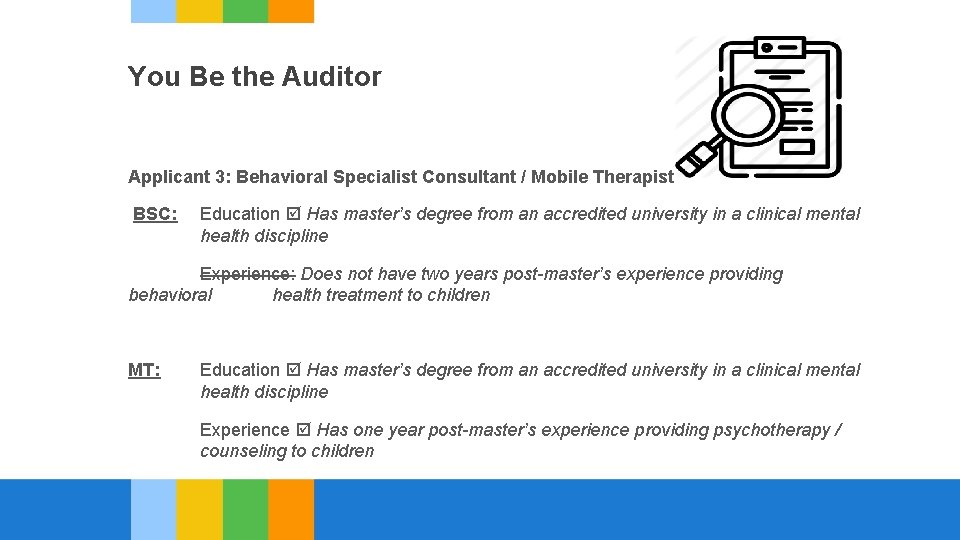
You Be the Auditor Applicant 3: Behavioral Specialist Consultant / Mobile Therapist BSC: Education Has master’s degree from an accredited university in a clinical mental health discipline Experience: Does not have two years post-master’s experience providing behavioral health treatment to children MT: Education Has master’s degree from an accredited university in a clinical mental health discipline Experience Has one year post-master’s experience providing psychotherapy / counseling to children

You Be the Auditor Applicant 4: Substance Abuse Counselor Education Has a bachelor’s degree in a required field Experience Has over one year of experience

Great Job, Auditor!
Marie Raupp, LSW, CFE, CHC, Manager of Compliance Marie. Raupp@phila. gov Mark Miller, MEd, LPC, Compliance Supervisor Mark. D. Miller@phila. gov General Compliance Questions: CBH. Compliance. Contact@phila. gov Compliance Hotline: CBH. Compliance. Hotline@phila. gov 800 -229 -3050
Media Credits 1 Icons made by [Freepik] from www. flaticon. com 2 https: //www. recoveryfirst. org/blog/the-big-list-of-addiction-recovery-movies/
- Slides: 65