
MARIE An Introduction to a Simple Computer Lecture

- Slides: 14
MARIE: An Introduction to a Simple Computer
Lecture Overview § A simple program § A discussion on assemblers § Extending our ISA 2
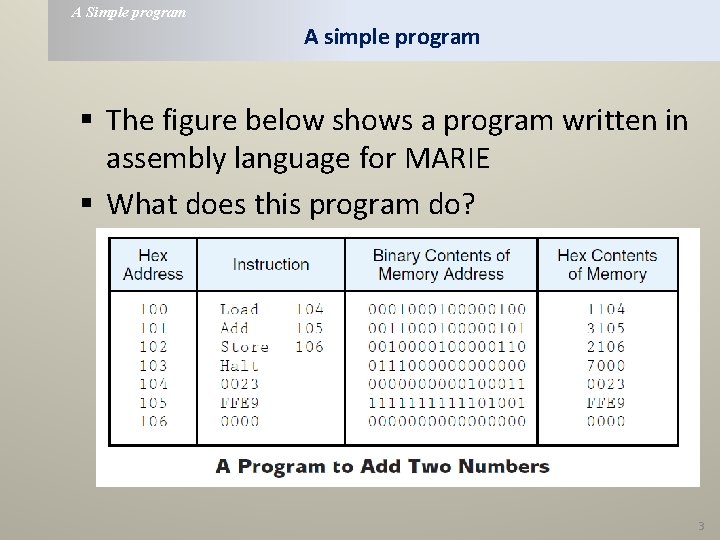
A Simple program A simple program § The figure below shows a program written in assembly language for MARIE § What does this program do? 3
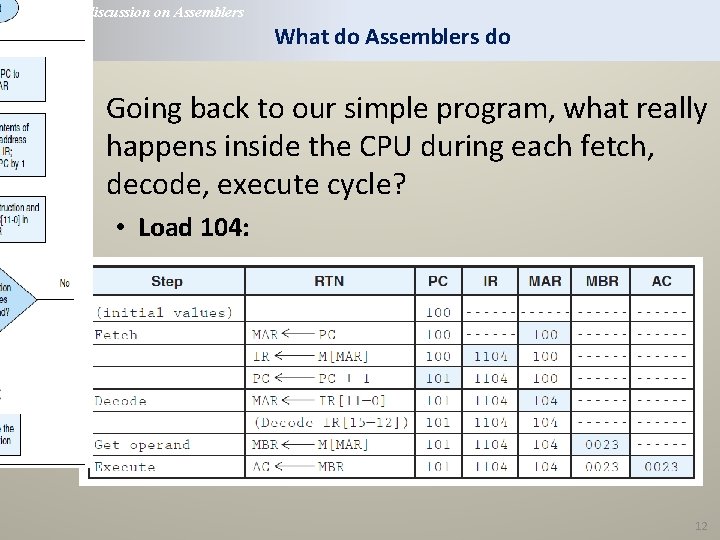
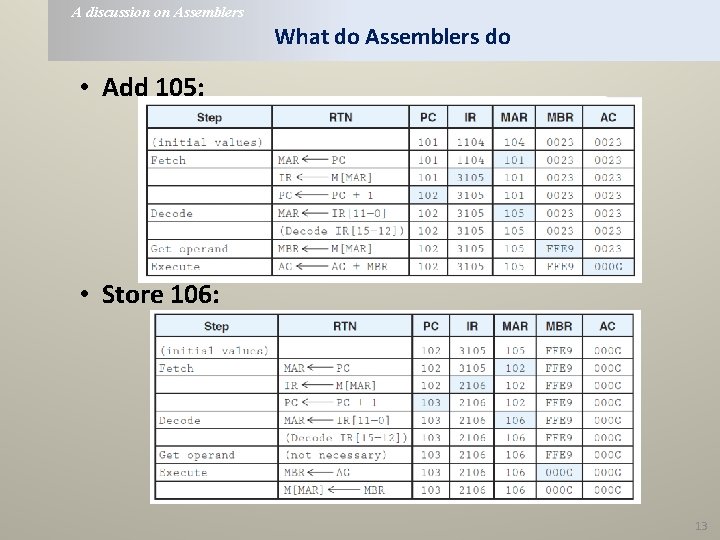
A Simple program A simple program § This program simply adds to numbers and stores the result in the main memory. • It loads the value stored at the location address 10416 into AC (the value is 002316 = 3510), ), (2*16 +3*16 ) or 0000 0010 0011 1 0 =35) • It adds this value to the value stored at the location address 10516 (the value is FFE 916 = (-23)10), (1111 1110 1001)=0000 0001 0110+1 =-23) • Stores the sum into the location address 10616. - So what will be stored in the location address 10616? § Now let us discover what happens during each “Fetch, decode, execute” cycle. 4
Lecture Overview § A simple program § A discussion on assemblers § Extending our ISA 5
A discussion on Assemblers What do Assemblers do § Assembly language can be understood by the programmer but not the computer! § Assembly language must be converted into Machine Codes (binary codes) before being executed or even stored in the main memory. § An Assembler is used to translate assembly language into machine code • It reads a source file (assembly program) and convert it to an object file (Machine code) § Assembler VS Compiler • An assembler translates each mnemonic instruction (written in assembly) to exactly one machine code. • With compilers, this is not usually the case 6
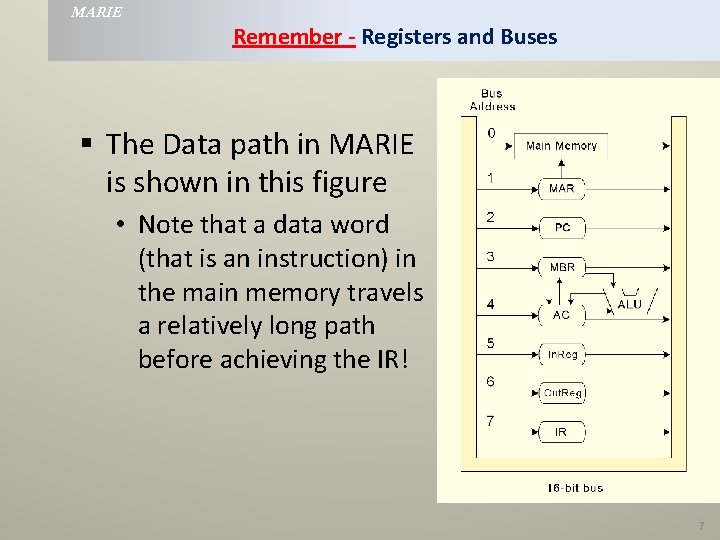
MARIE Remember - Registers and Buses § The Data path in MARIE is shown in this figure • Note that a data word (that is an instruction) in the main memory travels a relatively long path before achieving the IR! 7
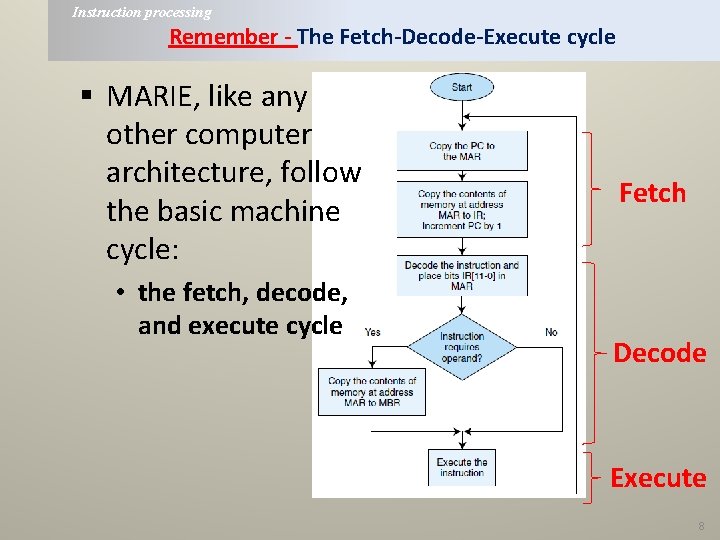
Instruction processing Remember - The Fetch-Decode-Execute cycle § MARIE, like any other computer architecture, follow the basic machine cycle: • the fetch, decode, and execute cycle Fetch Decode Execute 8
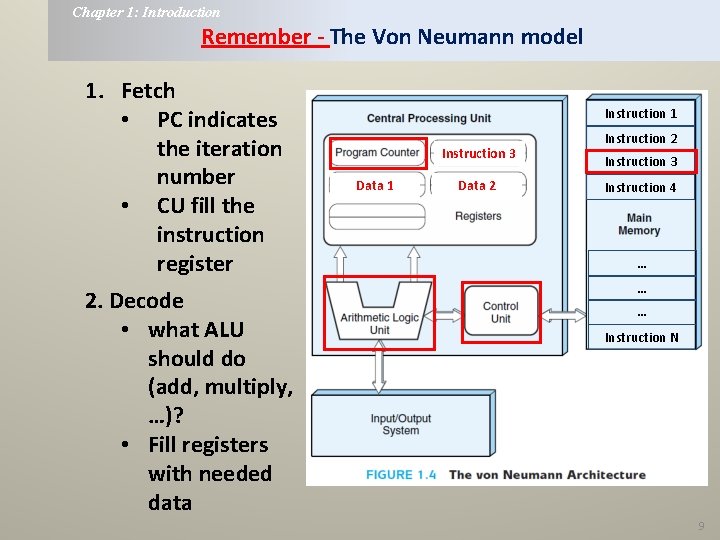
Chapter 1: Introduction Remember - The Von Neumann model 1. Fetch • PC indicates the iteration number • CU fill the instruction register 2. Decode • what ALU should do (add, multiply, …)? • Fill registers with needed data Instruction 1 Instruction 3 Data 1 Data 2 Instruction 3 Instruction 4 … … … Instruction N 9
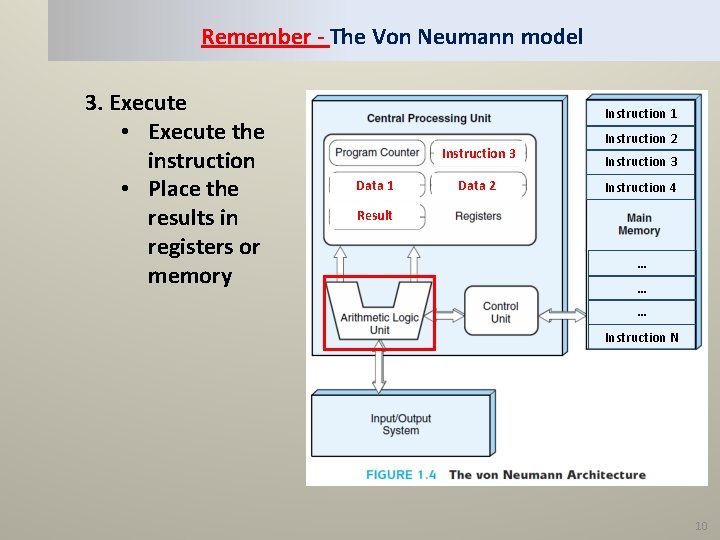
Remember - The Von Neumann model 3. Execute • Execute the instruction • Place the results in registers or memory Instruction 1 Instruction 3 Data 1 Data 2 Instruction 3 Instruction 4 Result … … … Instruction N 10
MARIE The Instruction Set Architecture § The fundamental MARIE instructions are: 11
A discussion on Assemblers What do Assemblers do § Going back to our simple program, what really happens inside the CPU during each fetch, decode, execute cycle? • Load 104: 12
A discussion on Assemblers What do Assemblers do • Add 105: • Store 106: 13
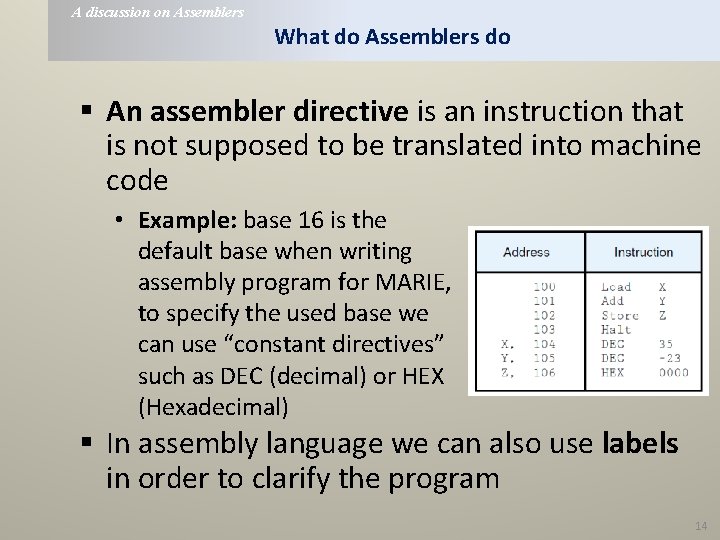
A discussion on Assemblers What do Assemblers do § An assembler directive is an instruction that is not supposed to be translated into machine code • Example: base 16 is the default base when writing assembly program for MARIE, to specify the used base we can use “constant directives” such as DEC (decimal) or HEX (Hexadecimal) § In assembly language we can also use labels in order to clarify the program 14