
Mariculture is a specialized branch of aquaculture involving

Mariculture: is a specialized branch of aquaculture involving the cultivation of marine organisms for food and other products in the open ocean, an enclosed section of the ocean, or in tanks, ponds or raceways which are filled with seawater Most valuable living marine resources: • Demersal fish • Pelagic fish • Crustaceans • Mollusks • Marine mammals
Allow nations to claim jurisdiction over their territorial seas (contiguous sea beds and their waters that extend off shore by 12 nautical miles) Exclusive Economic Zone (EEZ) 1. 200 nautical miles 2. under direct control of the country that owns the nearest land Regulates continental shelf resources: • Fishing • Mineral exploration • Scientific research Due to rapid development of ocean drilling technologies, in 1958 & 1960 Geneva Convention- Law of the Sea--- regulation of continental shelf resources
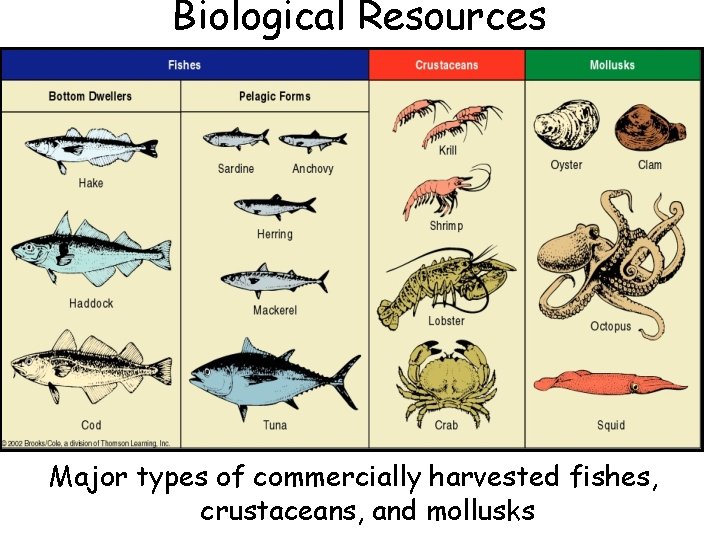
Biological Resources Major types of commercially harvested fishes, crustaceans, and mollusks
IMPORTANCE OF FISH PRODUCTION • Nutritional Benefit of Fish: Fish is a rich source of Protein, Fatty Acids, Essential Vitamins and Minerals, such as Vitamin A, Calcium, Iron, Zinc and Iodine. • Fish is rich in including: omega-3 fatty acid which has many health benefits Ø improved infant cognitive and visual development Ø reduced risk of cardio vascular disease Ø positive clinical outcomes in inflammatory diseases • Fish has great social and economic importance. • Many industries in the world today depend on the various raw materials from fisheries and aquaculture for 1 4 finished products

1. Fish Stocks and Fish Harvests We can group economically important marine organisms in to five major families: Demersal fish. These are bottom-living fish such as cod and haddock. These species tend to concentrate on broad continental shelves, especially of the North Atlantic. Pelagic fishes are species that inhabit the water column, such as herring, mackerel, anchovy, and tuna. The most spectacular fish catches are made of surface-shoaling pelagic species. Demersal fishes and Pelagic fishes combines make up the majority of the fish catch--about 72 million tons per year. Crustaceans. This group consists of bottom-dwelling species (crabs and lobsters) as well as swimming invertebrates (krill, shrimp)Crustacean fisheries are important to many countries and regions. About 4 million tons of this group are harvested each year. Molluscs and Cephalopods. These include various species of squid, cuttlefish, and octopus. More cephalopod stocks are harvested by the Japanese than by any other nation. They also serve as an important source of protein for many Mediterranean and developing countries. About 2. 5 million tons of cephalopods are harvested each year.
Marine mammals. This group has been heavily exploited for oil and meat, although they make a relatively small portion of the global fish catch. Following the commercial extinction of the large baleen whales such as the blue, humpback, and fin, smaller species such as the minke and sei are being taken. Dolphins and porpoises are hunted locally, particularly in some tropical archipelagos. Why concern? • Over 90% of the world's living biomass is contained in the oceans, which cover 71% of the Earth's surface. At present, we harvest about 0. 2% of marine production. (You might think that there is room for growth). • Marine sources provide about 20% of the animal protein eaten by humans. Another 5% is provided indirectly via livestock fed with fish. 60% of fish consumption is by the developing world. • In Asia, about 1 billion people rely on fish as their primary source of protein. • Estimates suggest that seafood production from wild fish stocks will be insufficient to meet growing Nigeria and Global demand for seafood products in the next century.
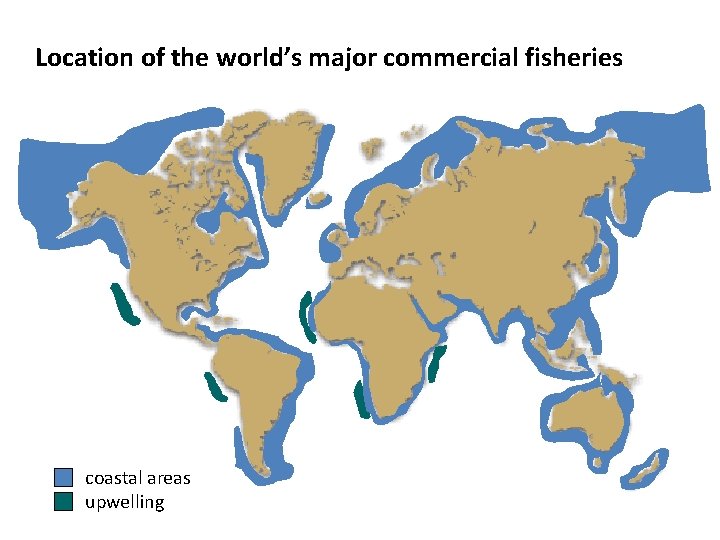
Location of the world’s major commercial fisheries coastal areas upwelling
The Fig above shows the areas of highest phytoplankton production. It is these areas upon which we most rely for our fish. Blooming across large regions, phytoplankton form large fields that sustain the marine food web. A high proportion of these productive zones are found where the ocean is rich in minerals. 99% of the worldwide annual commercial ocean catch comes from coastal waters, within 200 nautical miles of the coastline. These narrow coastal fringes of the world's oceans are at once its most productive and most vulnerable zones.
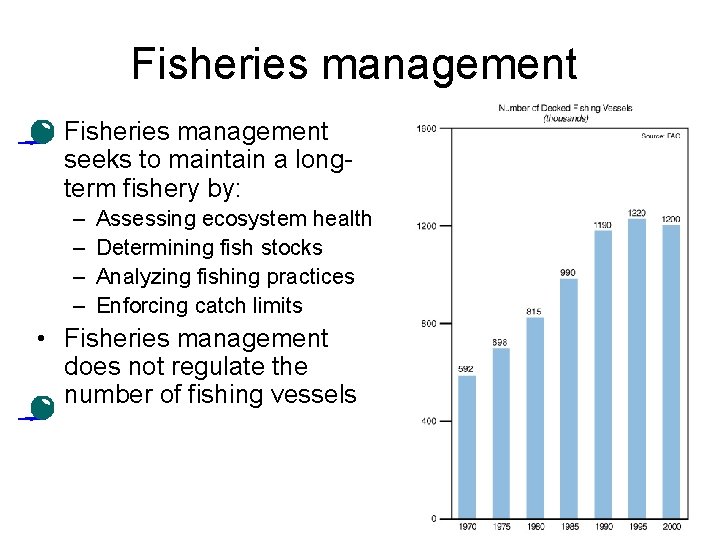
Fisheries management • Fisheries management seeks to maintain a longterm fishery by: – – Assessing ecosystem health Determining fish stocks Analyzing fishing practices Enforcing catch limits • Fisheries management does not regulate the number of fishing vessels
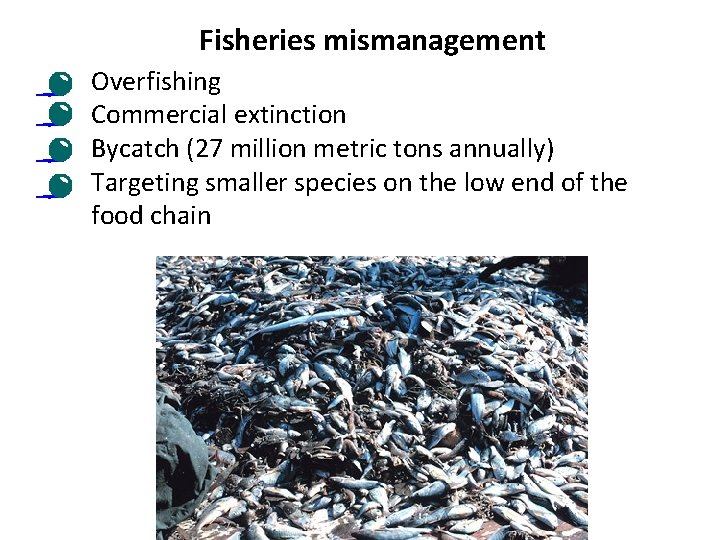
Fisheries mismanagement • • Overfishing Commercial extinction Bycatch (27 million metric tons annually) Targeting smaller species on the low end of the food chain
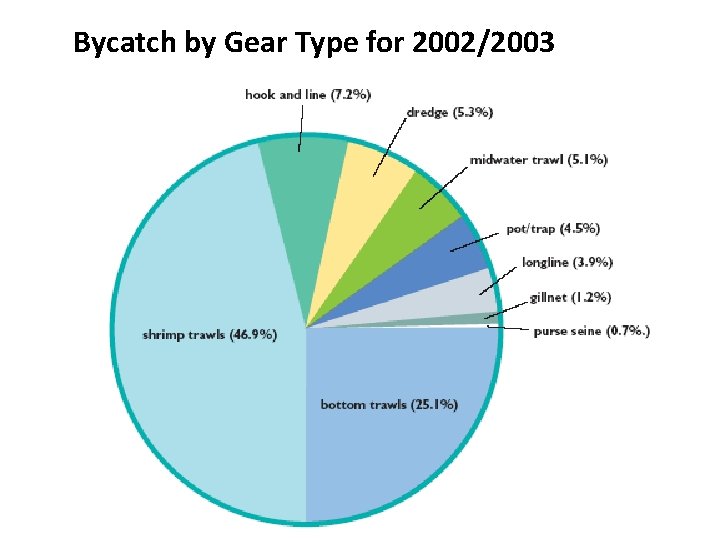
Bycatch by Gear Type for 2002/2003
Principles and Terms First, we need to become familiar with some terms used when discussing fish populations and the fishing industry. • Stock. A stock is the portion of a species or population that is harvestable. • Stock Assessment is the estimation of abundance of a resource, rate at which it is being removed, and reference rates for sustainable yields. • Fishing Mortality Rate is a function of the fishing effort (amount, types of gear, etc. ) • Harvest Rate The harvest rate is the fraction or amount of stock harvested per year. • Production Rate. The production rate is the sum of growth in weight of individual fish, plus the addition of biomass from new recruits, minus loss in biomass to natural mortality. • Production Function shows the relationship between production rate and fishing effort. As effort increases, the biomass drops and the production function typically goes through a fairly stable maximum. To aid in fish management, we can assess stocks by using a combination of three methods: • biological sampling • annual catch statistics • catch per unit effort statistics
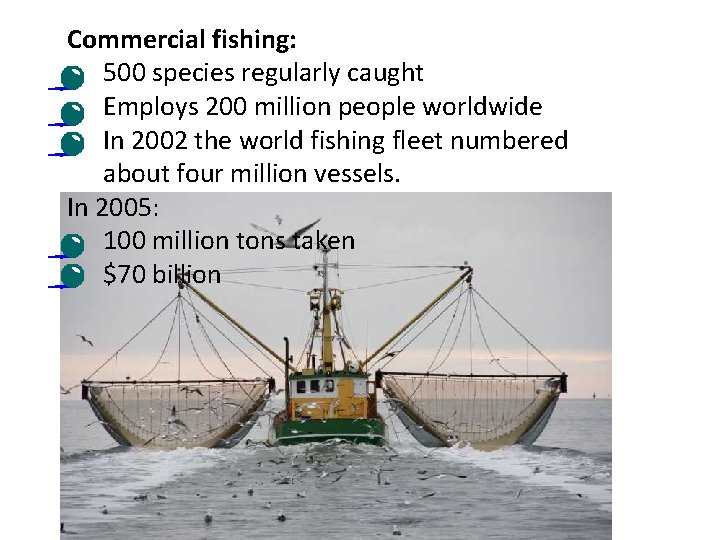
Commercial fishing: • 500 species regularly caught • Employs 200 million people worldwide • In 2002 the world fishing fleet numbered about four million vessels. In 2005: • 100 million tons taken • $70 billion
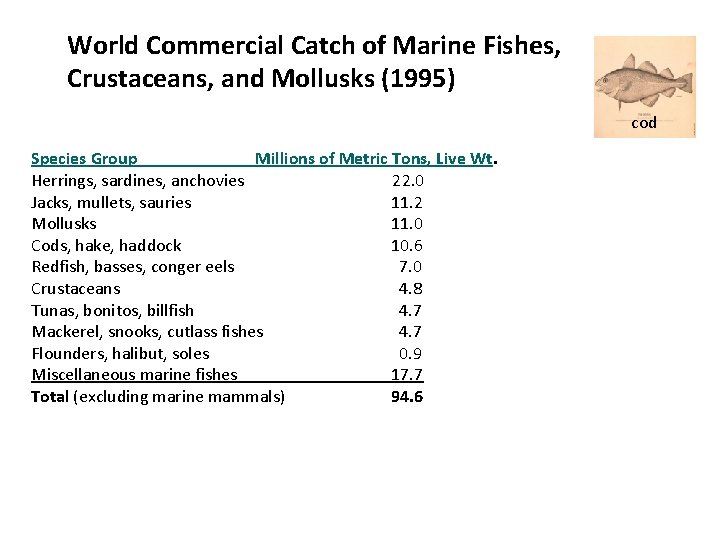
World Commercial Catch of Marine Fishes, Crustaceans, and Mollusks (1995) cod Species Group Millions of Metric Tons, Live Wt. Herrings, sardines, anchovies 22. 0 Jacks, mullets, sauries 11. 2 Mollusks 11. 0 Cods, hake, haddock 10. 6 Redfish, basses, conger eels 7. 0 Crustaceans 4. 8 Tunas, bonitos, billfish 4. 7 Mackerel, snooks, cutlass fishes 4. 7 Flounders, halibut, soles 0. 9 Miscellaneous marine fishes 17. 7 Total (excluding marine mammals) 94. 6
Non-Food Products from the Sea Bioactive Compounds • Algin & Agar: products from seaweed • Whales: Oil for lubrication, in cosmetics, bones for fertilizer • Seals and sea lions: furs A. Bioactive Compounds 1. Anti-viral (e. g. , acyclovir) 2. Anti-tumor (e. g. , bryotstatin from a bryozoan, Didemnin-B from a tunicate) 3. Insecticide (e. g. , Padan from a marine annelid worm) B. Algin & Agar: products from seaweed 1. Algin used to stiffen fabrics, as an emulsifier in salad dressings and paints, in ice cream to prevent formation of large ice crystals 2. Agar and derivatives used extensively in microbiology and molecular biology as a gelling agent C. Whales: Oil for lubrication, in cosmetics, bones for fertilizer D. Seals and sea lions: furs
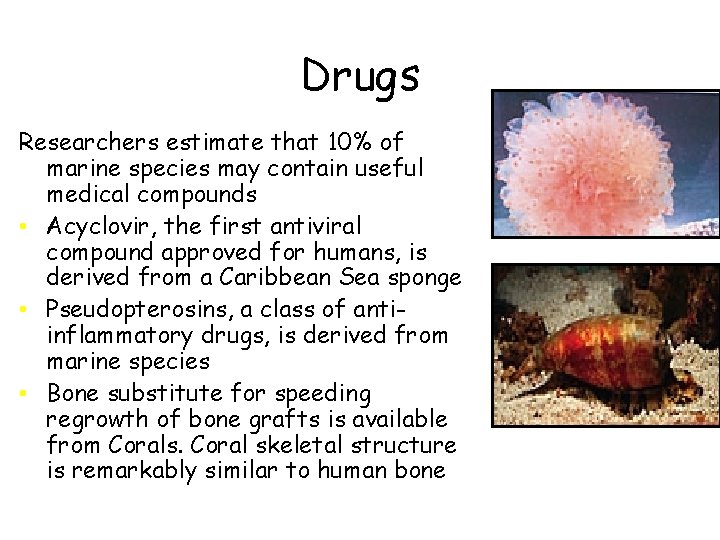
Drugs Researchers estimate that 10% of marine species may contain useful medical compounds • Acyclovir, the first antiviral compound approved for humans, is derived from a Caribbean Sea sponge • Pseudopterosins, a class of antiinflammatory drugs, is derived from marine species • Bone substitute for speeding regrowth of bone grafts is available from Corals. Coral skeletal structure is remarkably similar to human bone
Mariculture: has rapidly expanded over the last two decades due to new technology, improvements in formulated feeds, greater biological understanding of farmed species, increased water quality within closed farm systems, greater demand for seafood products, site expansion and government interest. As a consequence, mariculture has been subject to some controversy regarding its social and environmental impacts. Commonly identified environmental impacts from marine farms are: • Wastes from cage cultures; • Farm escapees and invasives; • Genetic pollution and disease and parasite transfer; • Habitat modification.
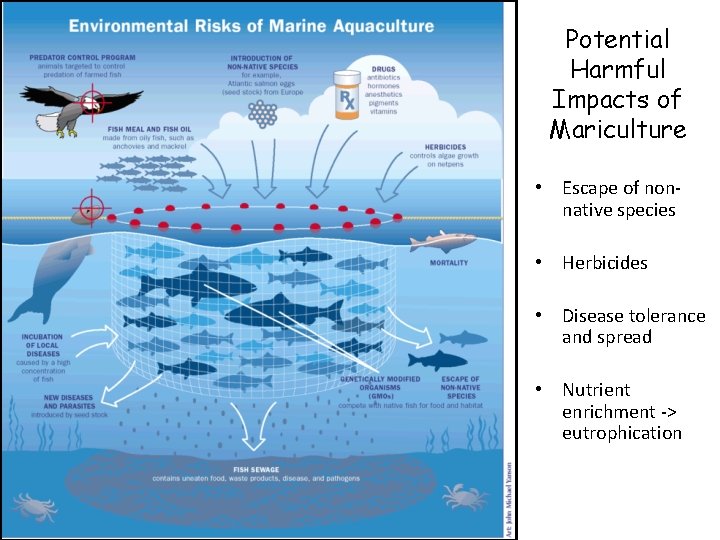
Potential Harmful Impacts of Mariculture • Escape of nonnative species • Herbicides • Disease tolerance and spread • Nutrient enrichment -> eutrophication
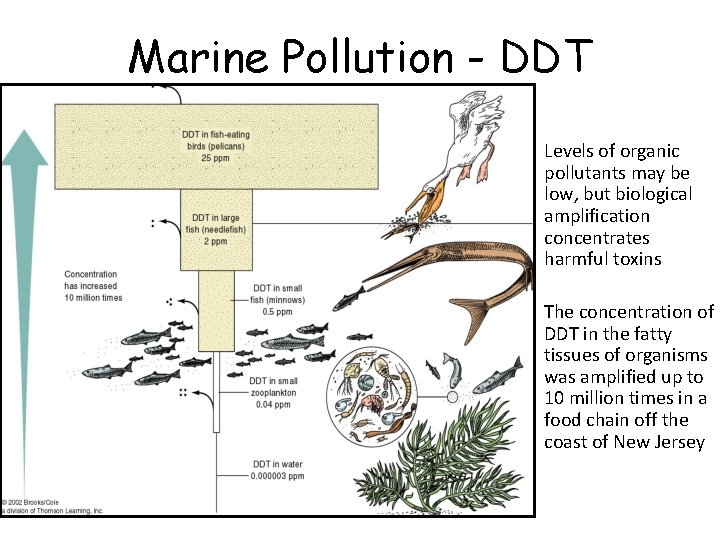
Marine Pollution - DDT • Levels of organic pollutants may be low, but biological amplification concentrates harmful toxins • The concentration of DDT in the fatty tissues of organisms was amplified up to 10 million times in a food chain off the coast of New Jersey
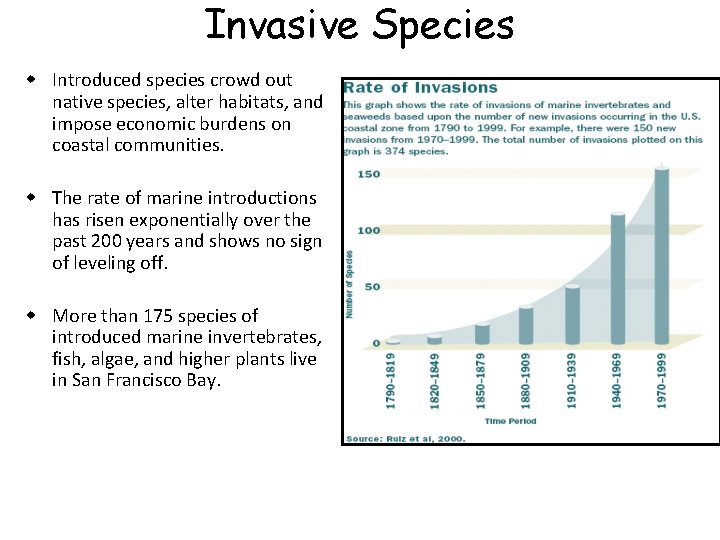
Invasive Species w Introduced species crowd out native species, alter habitats, and impose economic burdens on coastal communities. w The rate of marine introductions has risen exponentially over the past 200 years and shows no sign of leveling off. w More than 175 species of introduced marine invertebrates, fish, algae, and higher plants live in San Francisco Bay.
MARICULTURE which Way Nigeria? (Role for Research Institutes and Universities. ) • Culture of marine species • Not yet popular in Nigeria despite the large expanse of coastal areas. Technology not perfected. - Research and development into the mass culture of the more abundant and diversified marine fish and flora (fisheries) in our coastal waters such as croakers, tuners, sea bass, shrimps, and aquatic weeds. - Virgin area for aquatic research, production and
- Slides: 21