
Maria Estela TeoBalbuena Instructional Media as Teaching Aids
Maria Estela Teo-Balbuena Instructional Media as Teaching Aids
PRINTED MATERIALS GRAPHIC MATERIALS PICTORIAL MEDIA AUDIO MEDIA PROJECTED MEDIA DISPLAY MEDIA COMMUNITY RESOURCES DEMONSTRATIONS DRAMATIZATIONS CONTRIVED EXPERIENCE Maria Estela Teo-Balbuena MOTION MEDIA
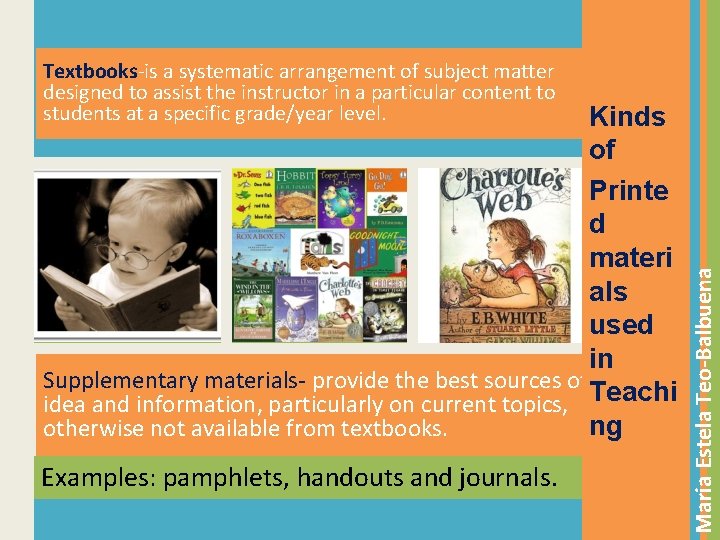
Kinds of Printe d materi als used in Supplementary materials- provide the best sources of idea and information, particularly on current topics, Teachi ng otherwise not available from textbooks. Examples: pamphlets, handouts and journals. Maria Estela Teo-Balbuena Textbooks-is a systematic arrangement of subject matter designed to assist the instructor in a particular content to students at a specific grade/year level.
LIMITATIONS: 1. Printed materials are readily available on a wide variety of topics and in many different formats. 2. Its adaptable in any lighted environment. 3. Its handy and does not require any equipment or electricity. 4. Printed materials, like worksheets, allow learners to practice skills. 5. Its inexpensive to produce or purchase and can be reused. 1. Nonreaders or poor readers may not benefit from the printed materials in as much as these materials are sometimes above the reading level of the learners. 2. Some teachers require students to memorize facts and definitions, thus, these materials are reduced to become mere memorization aids. 3. Other teachers become “bookish”, making the textbooks as subject itself. Maria Estela Teo-Balbuena ADVANTAGES:
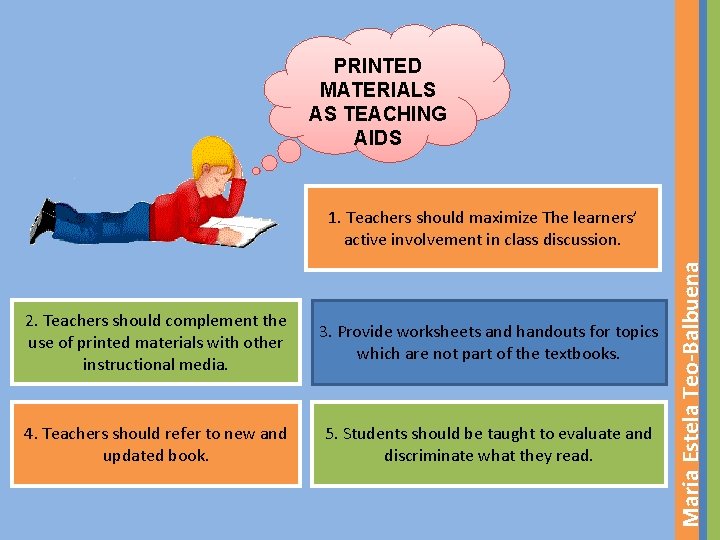
PRINTED MATERIALS AS TEACHING AIDS 2. Teachers should complement the use of printed materials with other instructional media. 3. Provide worksheets and handouts for topics which are not part of the textbooks. 4. Teachers should refer to new and updated book. 5. Students should be taught to evaluate and discriminate what they read. Maria Estela Teo-Balbuena 1. Teachers should maximize The learners’ active involvement in class discussion.
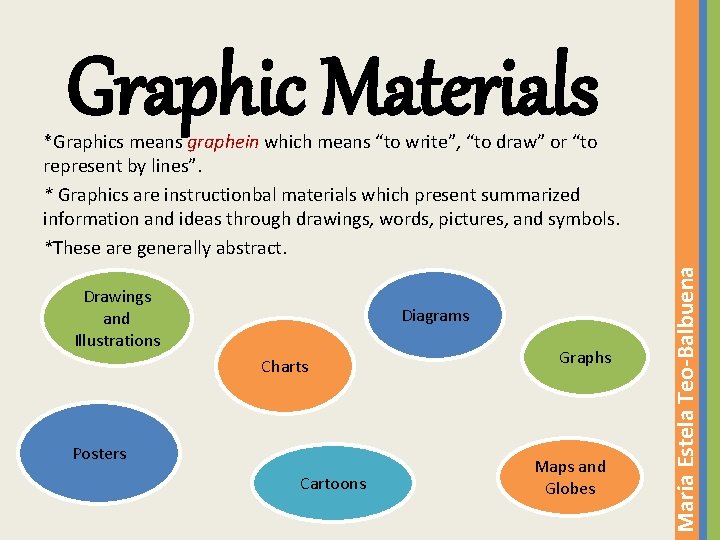
Graphic Materials Drawings and Illustrations Diagrams Charts Posters Cartoons Graphs Maps and Globes Maria Estela Teo-Balbuena *Graphics means graphein which means “to write”, “to draw” or “to represent by lines”. * Graphics are instructionbal materials which present summarized information and ideas through drawings, words, pictures, and symbols. *These are generally abstract.
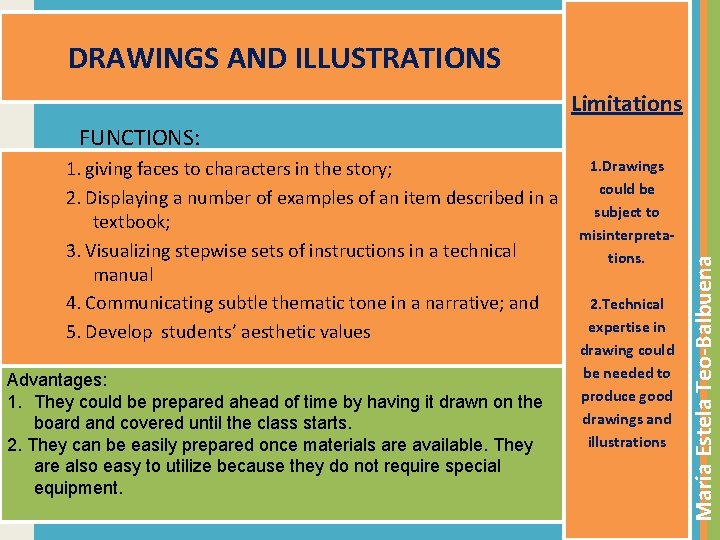
DRAWINGS AND ILLUSTRATIONS Limitations 1. giving faces to characters in the story; 2. Displaying a number of examples of an item described in a textbook; 3. Visualizing stepwise sets of instructions in a technical manual 4. Communicating subtle thematic tone in a narrative; and 5. Develop students’ aesthetic values Advantages: 1. They could be prepared ahead of time by having it drawn on the board and covered until the class starts. 2. They can be easily prepared once materials are available. They are also easy to utilize because they do not require special equipment. 1. Drawings could be subject to misinterpretations. 2. Technical expertise in drawing could be needed to produce good drawings and illustrations Maria Estela Teo-Balbuena FUNCTIONS:
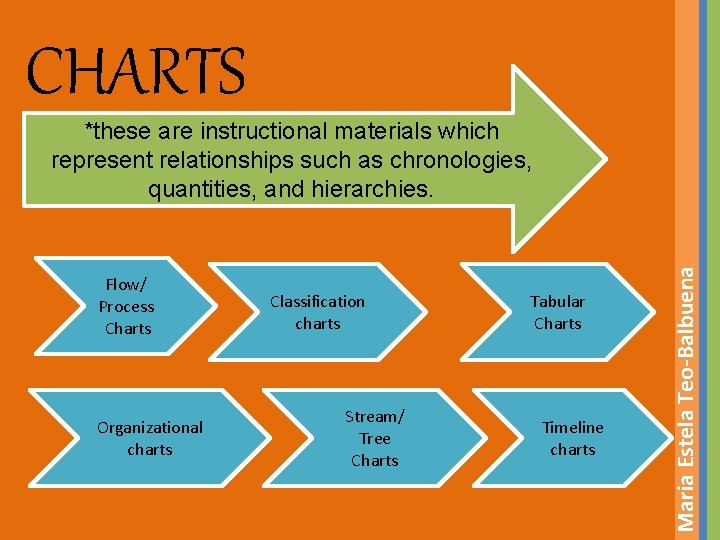
CHARTS Flow/ Process Charts Organizational charts Classification charts Stream/ Tree Charts Tabular Charts Timeline charts Maria Estela Teo-Balbuena *these are instructional materials which represent relationships such as chronologies, quantities, and hierarchies.
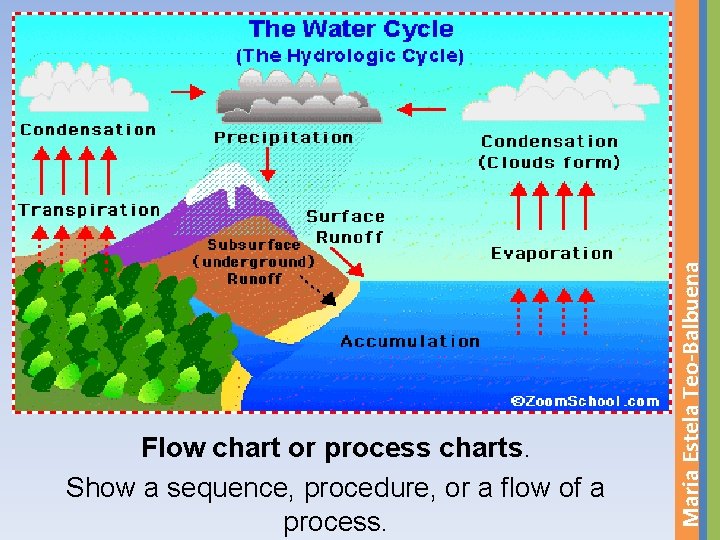
Maria Estela Teo-Balbuena Flow chart or process charts. Show a sequence, procedure, or a flow of a process.
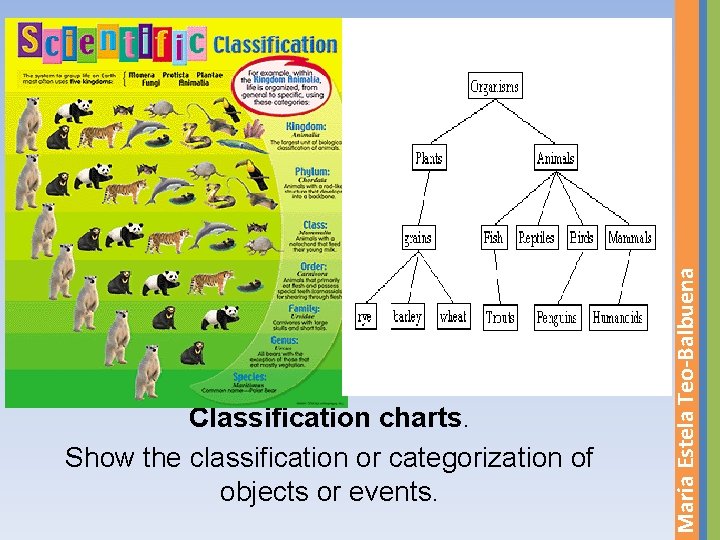
Maria Estela Teo-Balbuena Classification charts. Show the classification or categorization of objects or events.
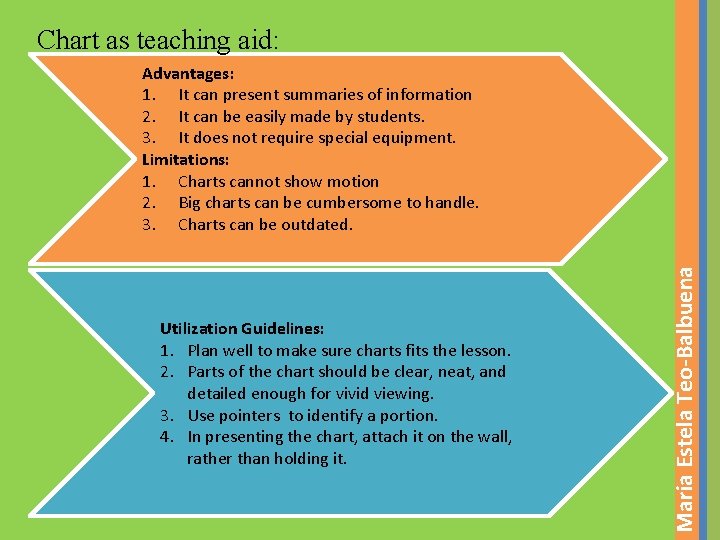
Chart as teaching aid: Utilization Guidelines: 1. Plan well to make sure charts fits the lesson. 2. Parts of the chart should be clear, neat, and detailed enough for vivid viewing. 3. Use pointers to identify a portion. 4. In presenting the chart, attach it on the wall, rather than holding it. Maria Estela Teo-Balbuena Advantages: 1. It can present summaries of information 2. It can be easily made by students. 3. It does not require special equipment. Limitations: 1. Charts cannot show motion 2. Big charts can be cumbersome to handle. 3. Charts can be outdated.
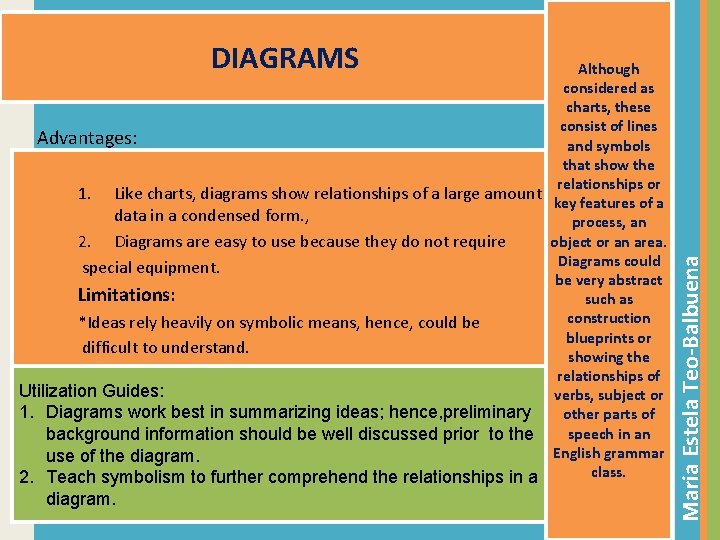
Although considered as charts, these consist of lines Advantages: and symbols that show the relationships or 1. Like charts, diagrams show relationships of a large amount ofkey features of a data in a condensed form. , process, an object or an area. 2. Diagrams are easy to use because they do not require Diagrams could special equipment. be very abstract Limitations: such as construction *Ideas rely heavily on symbolic means, hence, could be blueprints or difficult to understand. showing the relationships of Utilization Guides: verbs, subject or 1. Diagrams work best in summarizing ideas; hence, preliminary other parts of speech in an background information should be well discussed prior to the English grammar use of the diagram. class. 2. Teach symbolism to further comprehend the relationships in a diagram. Maria Estela Teo-Balbuena DIAGRAMS
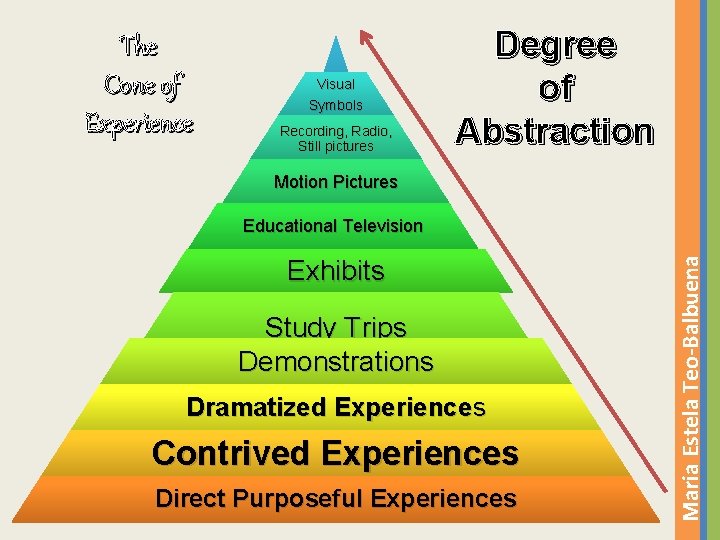
The Cone of Experience Visual Verbal Symbols Recording, Radio, Still pictures Degree of Abstraction Motion Pictures Exhibits Study Trips Demonstrations Dramatized Experiences Contrived Experiences Direct Purposeful Experiences Maria Estela Teo-Balbuena Educational Television
• Directly involving the class in certain activities such as planting, harvesting, praying, and the like is both experiential and participatory. Maria Estela Teo-Balbuena Direct, Purposeful Experiences
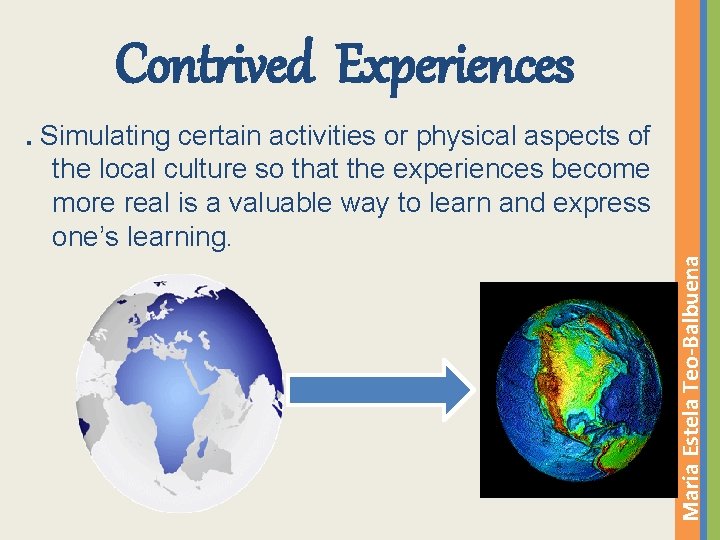
Contrived Experiences Maria Estela Teo-Balbuena . Simulating certain activities or physical aspects of the local culture so that the experiences become more real is a valuable way to learn and express one’s learning.
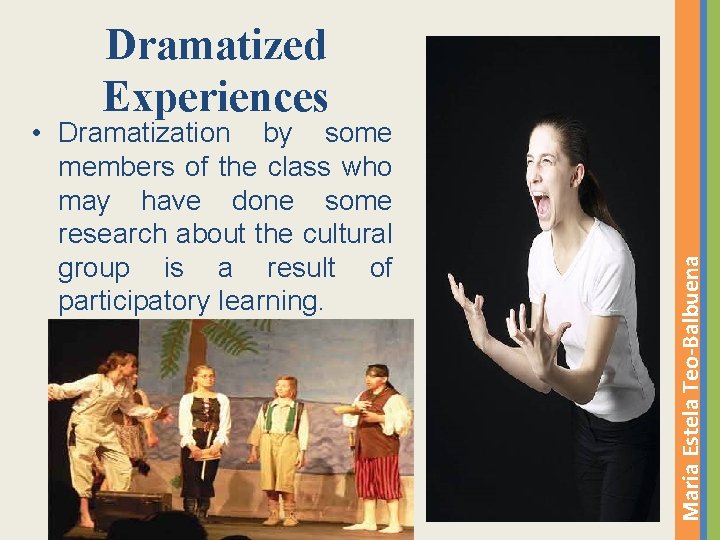
• Dramatization by some members of the class who may have done some research about the cultural group is a result of participatory learning. Maria Estela Teo-Balbuena Dramatized Experiences
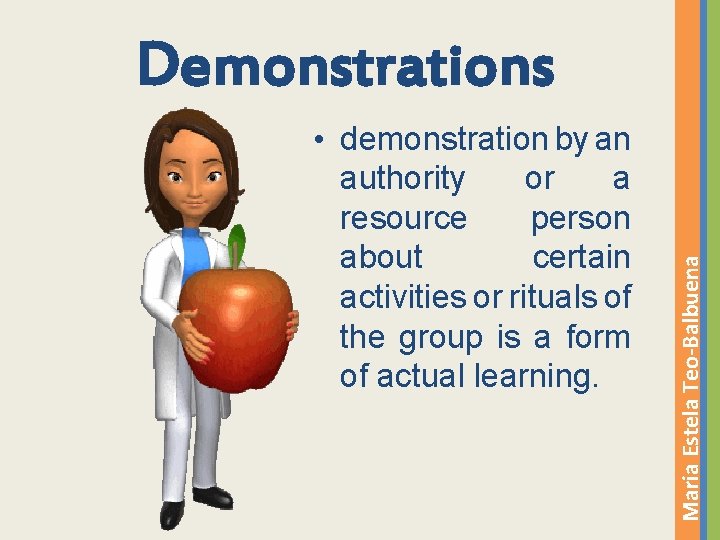
• demonstration by an authority or a resource person about certain activities or rituals of the group is a form of actual learning. Maria Estela Teo-Balbuena Demonstrations
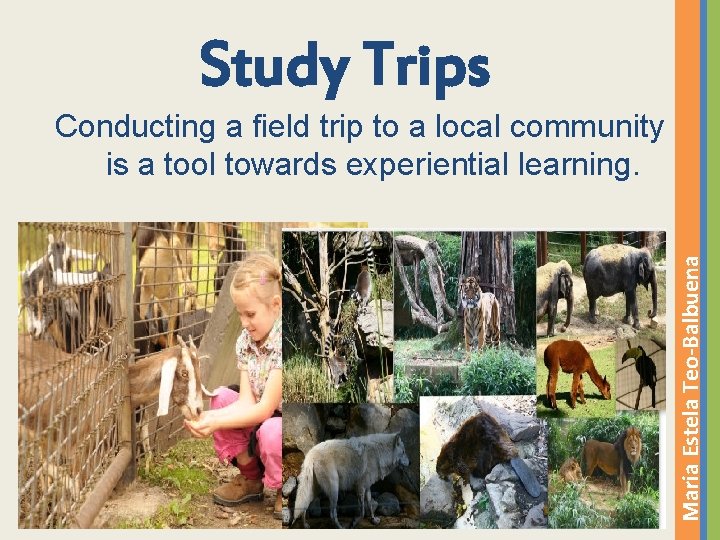
Study Trips Maria Estela Teo-Balbuena Conducting a field trip to a local community is a tool towards experiential learning.
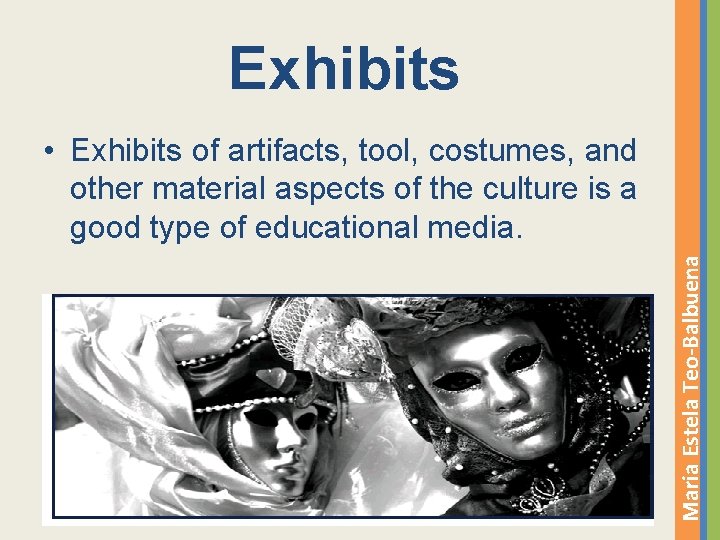
Exhibits Maria Estela Teo-Balbuena • Exhibits of artifacts, tool, costumes, and other material aspects of the culture is a good type of educational media.
Educational Television Maria Estela Teo-Balbuena • Televised lecture or show about the group is an excellent tool to raise awareness and shared understanding.
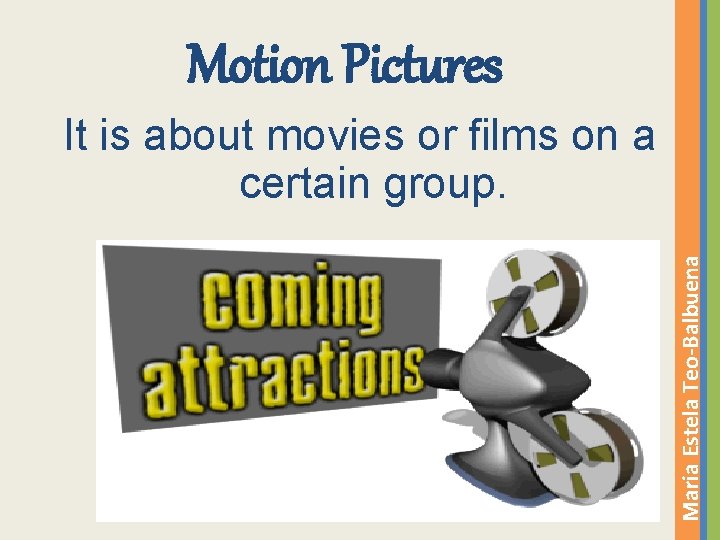
Motion Pictures Maria Estela Teo-Balbuena It is about movies or films on a certain group.
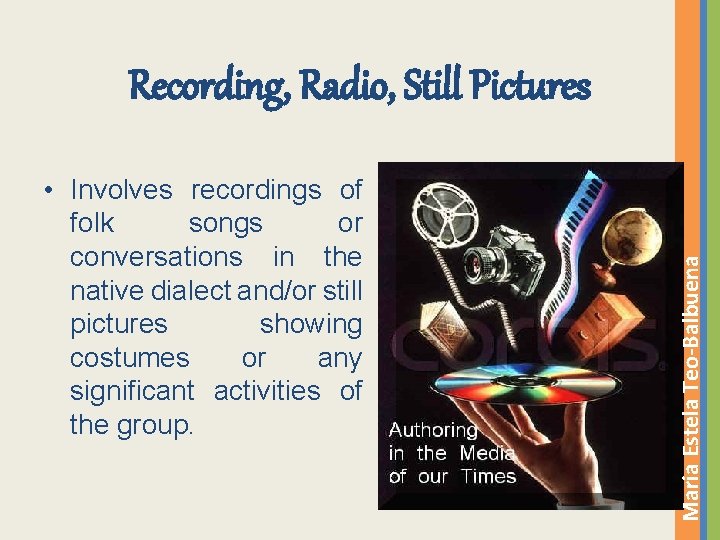
• Involves recordings of folk songs or conversations in the native dialect and/or still pictures showing costumes or any significant activities of the group. Maria Estela Teo-Balbuena Recording, Radio, Still Pictures
Visual Symbols Maria Estela Teo-Balbuena • Contains graphs, cartoons, comic strips, and other visual symbols
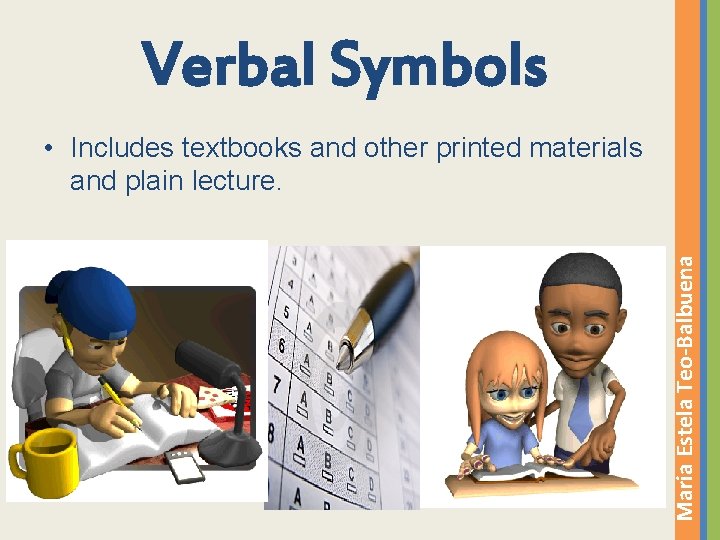
Verbal Symbols Maria Estela Teo-Balbuena • Includes textbooks and other printed materials and plain lecture.
Maria Estela Teo-Balbuena
- Slides: 25