
Margining Requirements for Uncleared Derivatives BCBS 261 BCBS
Margining Requirements for Uncleared Derivatives (BCBS 261, BCBS 317) and ISDA’s Standard Initial Margin Model (SIMM)
Agenda • Background: New Regulation for Margin Requirements • Mechanics of Bilateral Margining • Industry Model for Initial Margin of Uncleared Trades (SIMM) • Practical Examples. • Model Limitations. • Expected Impact of the New Regulation for Uncleared Trades • Implementation challenges 2
Regulatory Requirements for Cleared and Uncleared Trades As a response to the financial crisis, in 2009 the G 20 agreed to measures to reduce counterparty and systemic risk by adopting the following Policy Objectives: • Promoting Central Clearing: • All standardized OTC derivatives contracts should be traded on exchanges or electronic trading platforms by the end of 2012 at the latest, and cleared through CCPs • Non-centrally cleared contracts should be subject to higher capital requirements. • Reduction of Systemic Risk: • Reduce contagion and spillover effects by ensuring that collateral is available to offset the losses caused by the default of a counterparty. • Help market participants better internalise the cost of their risk taking through greater reliance on margins (Variation Margin and Initial Margin). In 2011, the G 20 added margin requirements for uncleared derivatives to the reform program 3
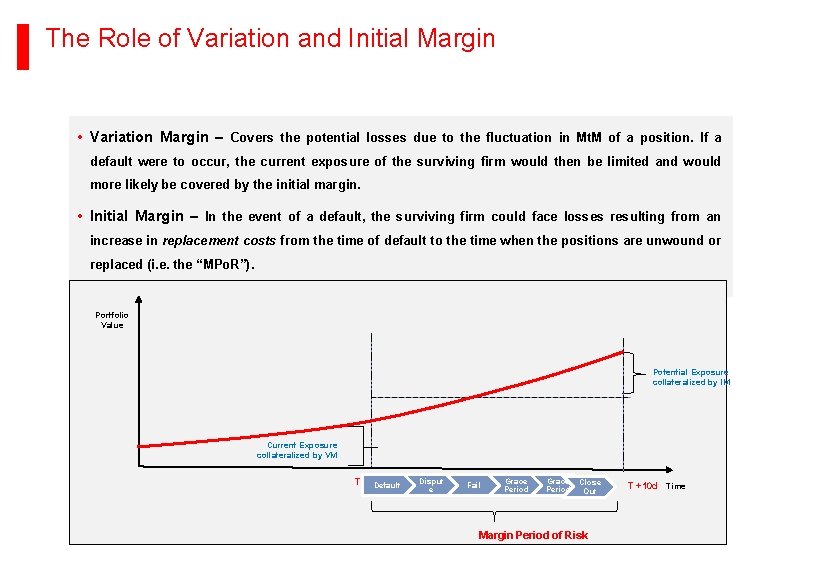
The Role of Variation and Initial Margin • Variation Margin – Covers the potential losses due to the fluctuation in Mt. M of a position. If a default were to occur, the current exposure of the surviving firm would then be limited and would more likely be covered by the initial margin. • Initial Margin – In the event of a default, the surviving firm could face losses resulting from an increase in replacement costs from the time of default to the time when the positions are unwound or replaced (i. e. the “MPo. R”). Portfolio Value Potential Exposure collateralized by IM Current Exposure collateralized by VM T Disput e Default 4 Fail Grace Period Grace Close Period Out Margin Period of Risk T +10 d Time
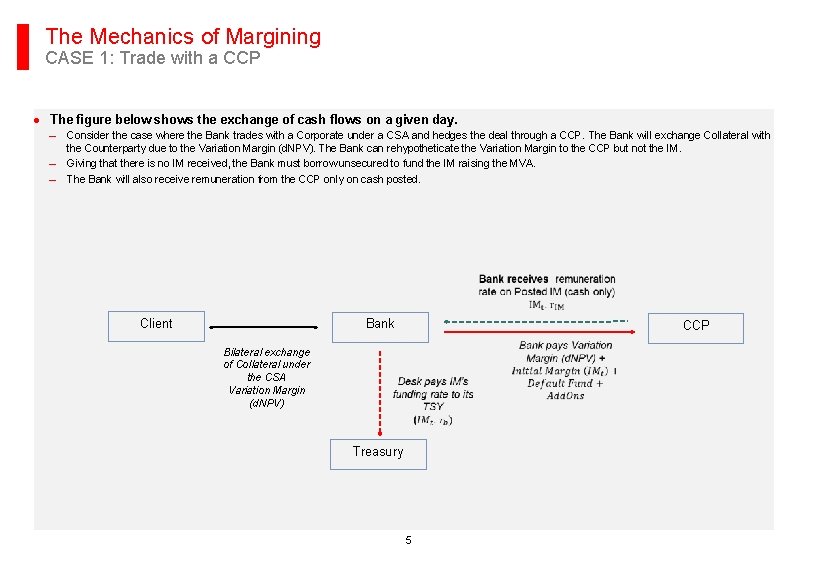
The Mechanics of Margining CASE 1: Trade with a CCP · The figure below shows the exchange of cash flows on a given day. – Consider the case where the Bank trades with a Corporate under a CSA and hedges the deal through a CCP. The Bank will exchange Collateral with the Counterparty due to the Variation Margin (d. NPV). The Bank can rehypotheticate the Variation Margin to the CCP but not the IM. – Giving that there is no IM received, the Bank must borrow unsecured to fund the IM raising the MVA. – The Bank will also receive remuneration from the CCP only on cash posted. Client Bank CCP Bilateral exchange of Collateral under the CSA Variation Margin (d. NPV) Treasury 5
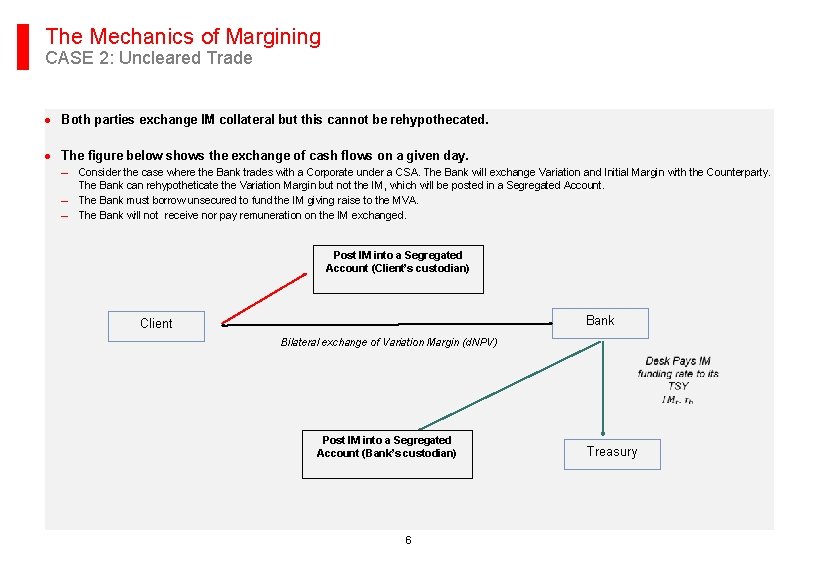
The Mechanics of Margining CASE 2: Uncleared Trade · Both parties exchange IM collateral but this cannot be rehypothecated. · The figure below shows the exchange of cash flows on a given day. – Consider the case where the Bank trades with a Corporate under a CSA. The Bank will exchange Variation and Initial Margin with the Counterparty. The Bank can rehypotheticate the Variation Margin but not the IM, which will be posted in a Segregated Account. – The Bank must borrow unsecured to fund the IM giving raise to the MVA. – The Bank will not receive nor pay remuneration on the IM exchanged. Post IM into a Segregated Account (Client’s custodian) Bank Client Bilateral exchange of Variation Margin (d. NPV) Post IM into a Segregated Account (Bank’s custodian) 6 Treasury
Key Elements of the Margin Requirement Framework • The entities that are affected • The instruments that need to be collateralized • The types of collateral that are permitted • The process of exchanging collateral 7
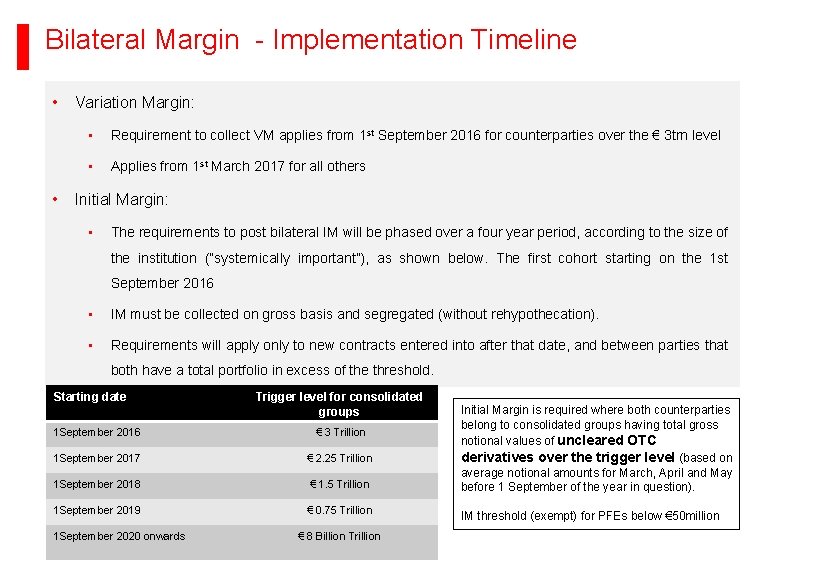
Bilateral Margin - Implementation Timeline • • Variation Margin: • Requirement to collect VM applies from 1 st September 2016 for counterparties over the € 3 trn level • Applies from 1 st March 2017 for all others Initial Margin: • The requirements to post bilateral IM will be phased over a four year period, according to the size of the institution (“systemically important”), as shown below. The first cohort starting on the 1 st September 2016 • IM must be collected on gross basis and segregated (without rehypothecation). • Requirements will apply only to new contracts entered into after that date, and between parties that both have a total portfolio in excess of the threshold. Starting date Trigger level for consolidated groups 1 September 2016 € 3 Trillion 1 September 2017 € 2. 25 Trillion 1 September 2018 € 1. 5 Trillion 1 September 2019 € 0. 75 Trillion 1 September 2020 onwards € 8 Billion Trillion Initial Margin is required where both counterparties belong to consolidated groups having total gross notional values of uncleared OTC derivatives over the trigger level (based on average notional amounts for March, April and May before 1 September of the year in question). IM threshold (exempt) for PFEs below € 50 million 8
Instruments Exempt of Margining Requirements • Some Foreign Exchange Products • Physically settled FX Swaps and Forwards as well as the physically settled FX transactions associated with the exchange of principal for cross-currency Swaps have been exempted from IM requirements, though they are still subject to VM requirements • Liquidity and short maturity of these instruments were considered • Some Equity Products • Physically settled equity options and forwards are exempt, while other types such as equity indices, single stock, basket options etc are in scope. 9
Eligible Collateral • Assets collected as collateral to cover VM and IM requirements must be liquid so that they can be sold reasonably quickly, if needed, and an appropriate haircut must be applied to reflect the potential decline in market value upon liquidation. Subject to these principles, the margining framework provides a broad, non -exhaustive list of eligible collateral, which includes cash, high-quality government and corporate securities, equities included in major stock indexes, and gold. • IM rehypothecation. Under strict conditions that protect the customer’s rights in the collateral, the margining framework allows a one-time reuse of IM collateral, provided that it is segregated from other assets and is intended only for purposes of hedging a dealer’s derivatives position resulting from transactions with customers. There are no restrictions on the reuse of VM, since the exchange of VM essentially represents the settlement of the current profit or loss on derivatives positions between the parties. • Strict conditions render IM rehypothecation largely impractical to implement 10
ISDA’s Model For Initial Margin (1/4) High level overview • As opposed to capital models, BASEL did not propose an IM model but outlined a set of rules that any IM model has to follow: • Single tail 99% confidence 10 -day • 3 -5 year calibration period, equally weighted • Must include a period of stress • The Industry developed a model to calculate the IM posted and received that is being widely adopted by participants. • The model is based on FRTB’s SBA model with enhancements to comply with the regulatory requirements. • Nested covariance model with limited number of parameters • In essence, the model used a Taylor expansion-like formula to calculate the Pn. L combined with an Analytical Va. R approach to cover the losses at the desired confidence level. • Risk weights, correlations and aggregation methodology is given by the model, thus Banks only have to provide their sensitivities (Delta and Vega: Gamma derived from Vega) 11
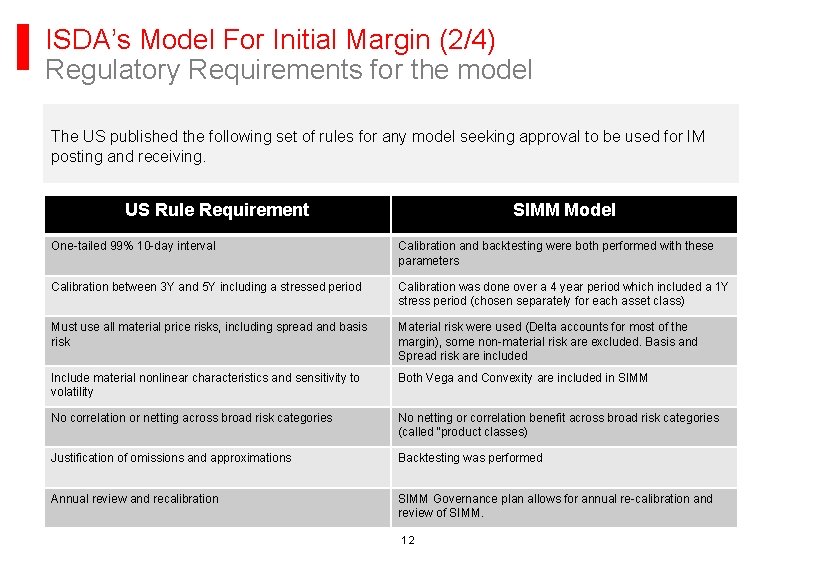
ISDA’s Model For Initial Margin (2/4) Regulatory Requirements for the model The US published the following set of rules for any model seeking approval to be used for IM posting and receiving. US Rule Requirement SIMM Model One-tailed 99% 10 -day interval Calibration and backtesting were both performed with these parameters Calibration between 3 Y and 5 Y including a stressed period Calibration was done over a 4 year period which included a 1 Y stress period (chosen separately for each asset class) Must use all material price risks, including spread and basis risk Material risk were used (Delta accounts for most of the margin), some non-material risk are excluded. Basis and Spread risk are included Include material nonlinear characteristics and sensitivity to volatility Both Vega and Convexity are included in SIMM No correlation or netting across broad risk categories No netting or correlation benefit across broad risk categories (called “product classes) Justification of omissions and approximations Backtesting was performed Annual review and recalibration SIMM Governance plan allows for annual re-calibration and review of SIMM. 12
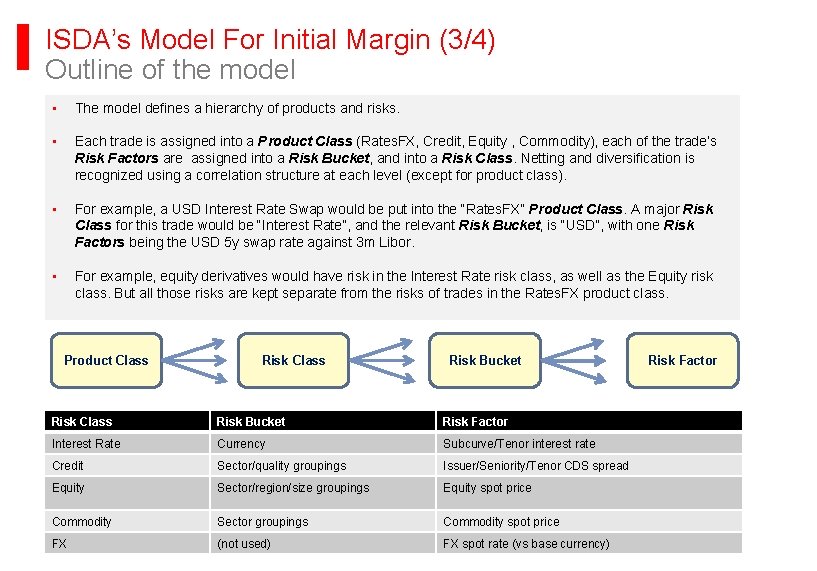
ISDA’s Model For Initial Margin (3/4) Outline of the model • The model defines a hierarchy of products and risks. • Each trade is assigned into a Product Class (Rates. FX, Credit, Equity , Commodity), each of the trade’s Risk Factors are assigned into a Risk Bucket, and into a Risk Class. Netting and diversification is recognized using a correlation structure at each level (except for product class). • For example, a USD Interest Rate Swap would be put into the “Rates. FX” Product Class. A major Risk Class for this trade would be “Interest Rate”, and the relevant Risk Bucket, is “USD”, with one Risk Factors being the USD 5 y swap rate against 3 m Libor. • For example, equity derivatives would have risk in the Interest Rate risk class, as well as the Equity risk class. But all those risks are kept separate from the risks of trades in the Rates. FX product class. Product Class Risk Bucket Risk Factor Interest Rate Currency Subcurve/Tenor interest rate Credit Sector/quality groupings Issuer/Seniority/Tenor CDS spread Equity Sector/region/size groupings Equity spot price Commodity Sector groupings Commodity spot price FX (not used) 13 FX spot rate (vs base currency) Risk Factor
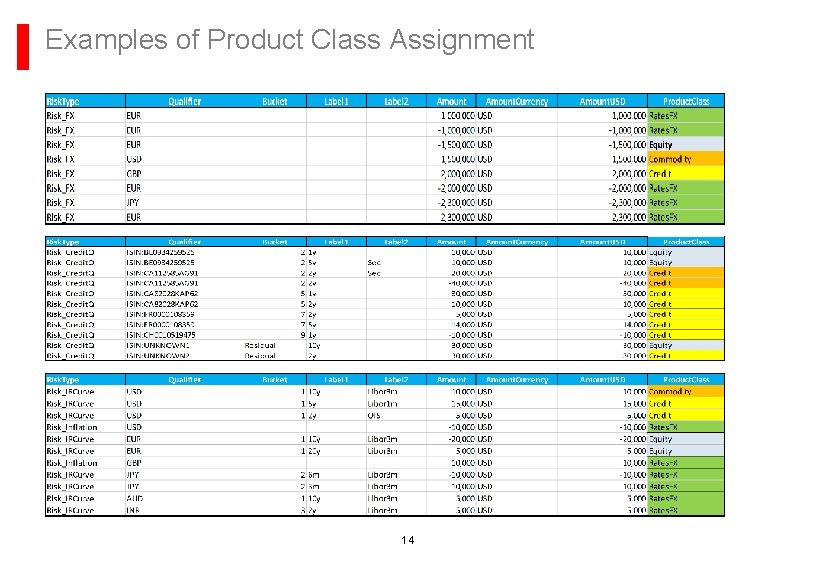
Examples of Product Class Assignment 14
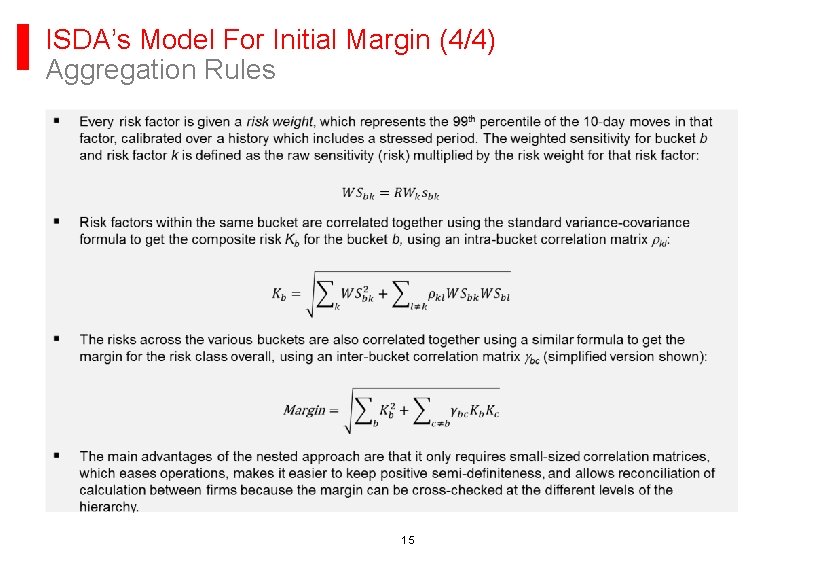
ISDA’s Model For Initial Margin (4/4) Aggregation Rules 15
Potential Implementation Problems Third party logo • Dispute and Resolution - Reconciliation of sensitivities (different curves, different volatility models) - Demand for new D&R resources • Crowdsourcing for the classification of positions – It works when there are many Banks participating on the trading and classification of a position, otherwise, it will be only 2 Banks fighting for the bucket. • IT Development – Specially challenging for small firms. • Calibration of the risk weights and correlations. • Backtesting and exception handling 16
- Slides: 16