
Marginal Loss Factor Forum Friday 13 December 2019

Marginal Loss Factor Forum Friday 13 December 2019 AEMO Offices: Brisbane, Sydney, Melbourne, Adelaide Teleconference: Web. Ex and dial-in (details in agenda)
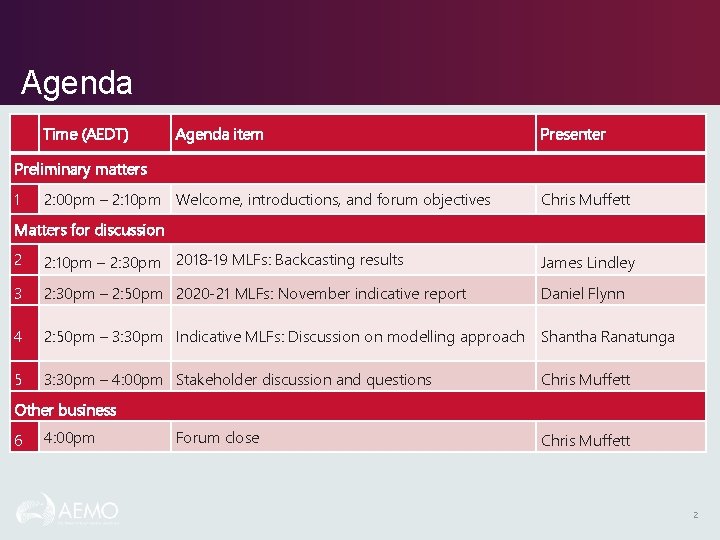
Agenda Time (AEDT) Agenda item Presenter Preliminary matters 1 2: 00 pm – 2: 10 pm Welcome, introductions, and forum objectives Chris Muffett Matters for discussion 2 2: 10 pm – 2: 30 pm 2018 -19 MLFs: Backcasting results James Lindley 3 2: 30 pm – 2: 50 pm 2020 -21 MLFs: November indicative report Daniel Flynn 4 2: 50 pm – 3: 30 pm Indicative MLFs: Discussion on modelling approach Shantha Ranatunga 5 3: 30 pm – 4: 00 pm Stakeholder discussion and questions Chris Muffett Other business 6 4: 00 pm Forum close Chris Muffett 2

Welcome, introductions, and forum objectives Chris Muffett 3
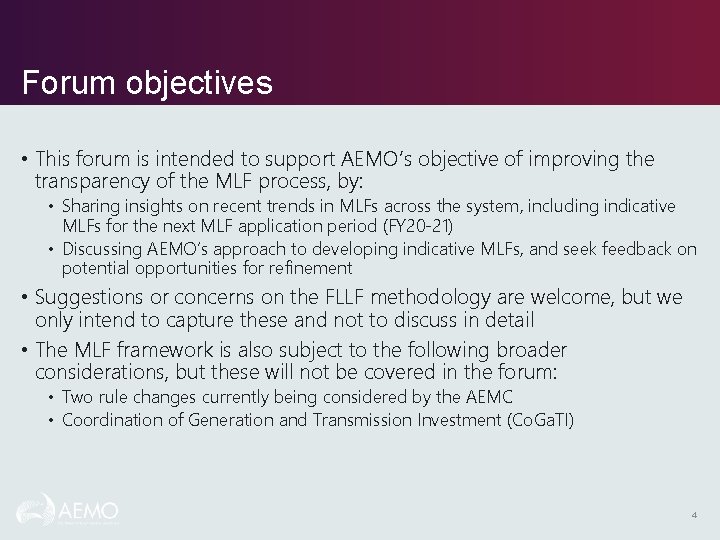
Forum objectives • This forum is intended to support AEMO’s objective of improving the transparency of the MLF process, by: • Sharing insights on recent trends in MLFs across the system, including indicative MLFs for the next MLF application period (FY 20 -21) • Discussing AEMO’s approach to developing indicative MLFs, and seek feedback on potential opportunities for refinement • Suggestions or concerns on the FLLF methodology are welcome, but we only intend to capture these and not to discuss in detail • The MLF framework is also subject to the following broader considerations, but these will not be covered in the forum: • Two rule changes currently being considered by the AEMC • Coordination of Generation and Transmission Investment (Co. Ga. TI) 4
2018 -19 MLFs: Backcasting results James Lindley 5
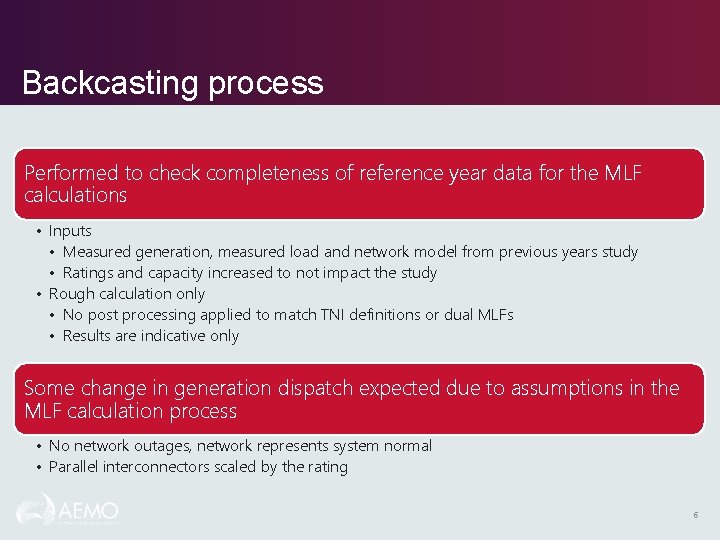
Backcasting process Performed to check completeness of reference year data for the MLF calculations • Inputs • Measured generation, measured load and network model from previous years study • Ratings and capacity increased to not impact the study • Rough calculation only • No post processing applied to match TNI definitions or dual MLFs • Results are indicative only Some change in generation dispatch expected due to assumptions in the MLF calculation process • No network outages, network represents system normal • Parallel interconnectors scaled by the rating 6
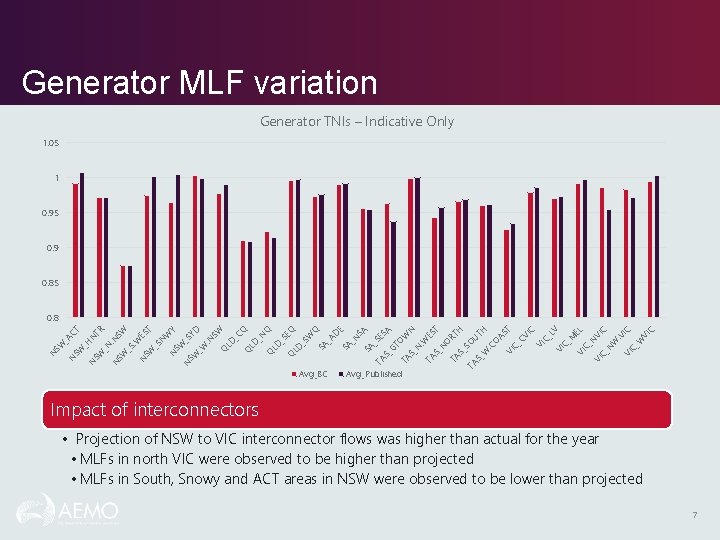
Generator MLF variation Generator TNIs – Indicative Only 1. 05 1 0. 95 0. 9 0. 85 N N SW _A SW CT _H N SW NTR _N. N N SW SW _S. W E N SW ST _S N W N Y SW _S N SW YD _W. N SW Q LD _C Q Q LD _N Q Q LD _S EQ Q LD _S W Q SA _A DE SA _N S SA A _ SE TA SA S_ GT TA OW N S_ N. W TA ES T S_ N O RT TA H S_ S O TA UT S_ H W. C O AS T VI C_ CV IC VI C_ LV VI C_ M EL VI C_ N VI VI C C_ N W. V IC VI C_ W VI C 0. 8 Avg_BC Avg_Published Impact of interconnectors • Projection of NSW to VIC interconnector flows was higher than actual for the year • MLFs in north VIC were observed to be higher than projected • MLFs in South, Snowy and ACT areas in NSW were observed to be lower than projected 7

Load MLF variation Load TNIs – Indicative Only 1. 12 1. 07 1. 02 0. 97 0. 92 0. 87 N N SW _A SW CT _H N SW NTR _N. N N SW SW _S. W N SW EST _S N W N SW Y N SW _SY _W D. N SW Q LD _C Q Q LD _N Q Q LD _S E Q LD Q _S W Q SA _A DE SA _N SA SA _R VR L SA D TA _SE S S_ GT A TA OW N S_ N. W TA ES S_ T N O RT TA H S_ S O TA U S_ W TH. C O A VI ST C_ CV IC VI C_ LV VI C_ M EL VI C_ N VI VI C_ C N W. V IC VI C_ W VI C 0. 82 Avg_BC Avg_Published Impact of interconnectors • Same drivers as generation changes • As a result of over forecast VIC to SA interconnector flows, • MLFs in the Riverland south-east areas in SA were observed to be higher than forecast • Reduction in imports / increase in exports equivalent to localised increase in load and therefore higher MLFs 8
2020 -21 MLFs: November indicative report Daniel Flynn 9
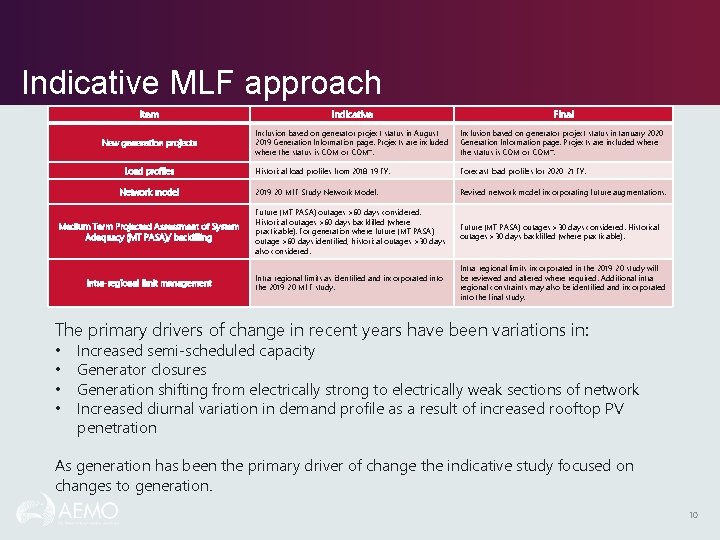
Indicative MLF approach Item Indicative Final New generation projects Inclusion based on generator project status in August 2019 Generation Information page. Projects are included where the status is COM or COM*. Inclusion based on generator project status in January 2020 Generation Information page. Projects are included where the status is COM or COM*. Historical load profiles from 2018 -19 FY. Forecast load profiles for 2020 -21 FY. 2019 -20 MLF Study Network Model. Revised network model incorporating future augmentations. Medium Term Projected Assessment of System Adequacy (MT PASA)/ backfilling Future (MT PASA) outages >60 days considered. Historical outages >60 days backfilled (where practicable). For generation where future (MT PASA) outage >60 days identified, historical outages >30 days also considered. Future (MT PASA) outages >30 days considered. Historical outages >30 days backfilled (where practicable). Intra-regional limit management Intra-regional limits as identified and incorporated into the 2019 -20 MLF study. Intra-regional limits incorporated in the 2019 -20 study will be reviewed and altered where required. Additional intraregional constraints may also be identified and incorporated into the final study. Load profiles Network model The primary drivers of change in recent years have been variations in: • • Increased semi-scheduled capacity Generator closures Generation shifting from electrically strong to electrically weak sections of network Increased diurnal variation in demand profile as a result of increased rooftop PV penetration As generation has been the primary driver of change the indicative study focused on changes to generation. 10
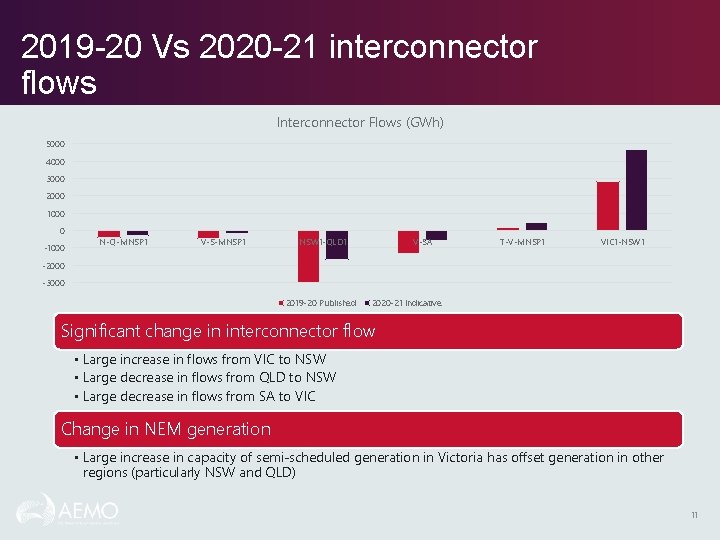
2019 -20 Vs 2020 -21 interconnector flows Interconnector Flows (GWh) 5000 4000 3000 2000 1000 0 -1000 N-Q-MNSP 1 V-S-MNSP 1 NSW 1 -QLD 1 V-SA T-V-MNSP 1 VIC 1 -NSW 1 -2000 -3000 2019 -20 Published 2020 -21 Indicative Significant change in interconnector flow • Large increase in flows from VIC to NSW • Large decrease in flows from QLD to NSW • Large decrease in flows from SA to VIC Change in NEM generation • Large increase in capacity of semi-scheduled generation in Victoria has offset generation in other regions (particularly NSW and QLD) 11
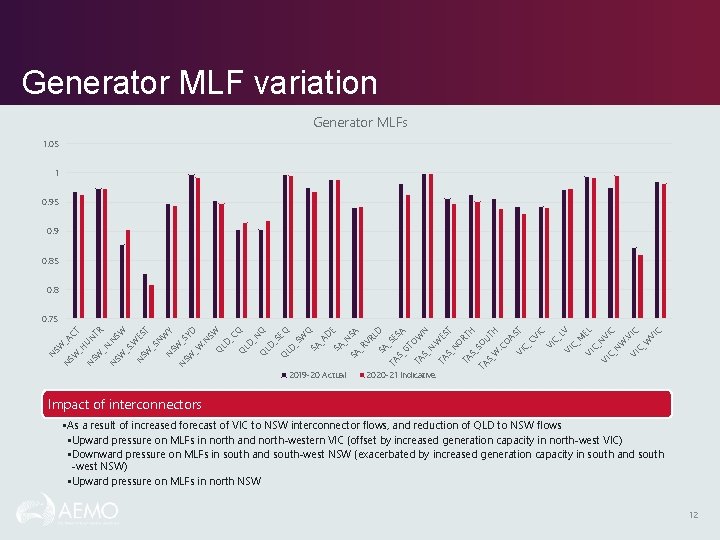
Generator MLF variation Generator MLFs 1. 05 1 0. 95 0. 9 0. 85 0. 8 N N SW _ SW AC _H T U N SW NT R _N. N N SW SW _S. W N SW EST _S N W N SW Y N SW _SY _W D. N SW Q LD _C Q Q LD _N Q Q LD _S E Q LD Q _S W Q SA _A DE SA _N SA SA _R VR L SA D TA _SE S S_ GT A TA OW N S_ N. W TA ES S_ T N O RT TA H S_ S O TA U S_ W TH. C O A VI ST C_ CV IC VI C_ LV VI C_ M EL VI C_ N VI VI C_ C N W. V IC VI C_ W VI C 0. 75 2019 -20 Actual 2020 -21 Indicative Impact of interconnectors • As a result of increased forecast of VIC to NSW interconnector flows, and reduction of QLD to NSW flows • Upward pressure on MLFs in north and north-western VIC (offset by increased generation capacity in north-west VIC) • Downward pressure on MLFs in south and south-west NSW (exacerbated by increased generation capacity in south and south -west NSW) • Upward pressure on MLFs in north NSW 12
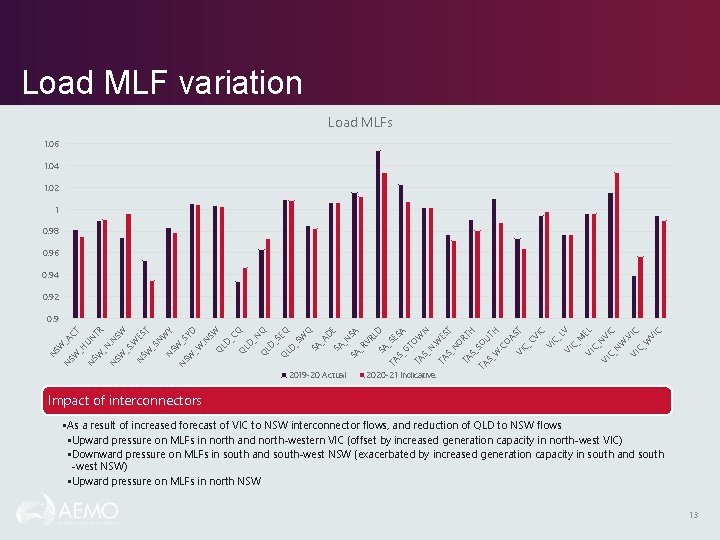
Load MLF variation Load MLFs 1. 06 1. 04 1. 02 1 0. 98 0. 96 0. 94 0. 92 N N SW _ SW AC _H T U N SW NT R _N. N N SW SW _S. W N SW EST _S N W N SW Y N SW _SY _W D. N SW Q LD _C Q Q LD _N Q Q LD _S E Q LD Q _S W Q SA _A DE SA _N SA SA _R VR L SA D TA _SE S S_ GT A TA OW N S_ N. W TA ES S_ T N O RT TA H S_ S O TA U S_ W TH. C O A VI ST C_ CV IC VI C_ LV VI C_ M EL VI C_ N VI VI C_ C N W. V IC VI C_ W VI C 0. 9 2019 -20 Actual 2020 -21 Indicative Impact of interconnectors • As a result of increased forecast of VIC to NSW interconnector flows, and reduction of QLD to NSW flows • Upward pressure on MLFs in north and north-western VIC (offset by increased generation capacity in north-west VIC) • Downward pressure on MLFs in south and south-west NSW (exacerbated by increased generation capacity in south and south -west NSW) • Upward pressure on MLFs in north NSW 13
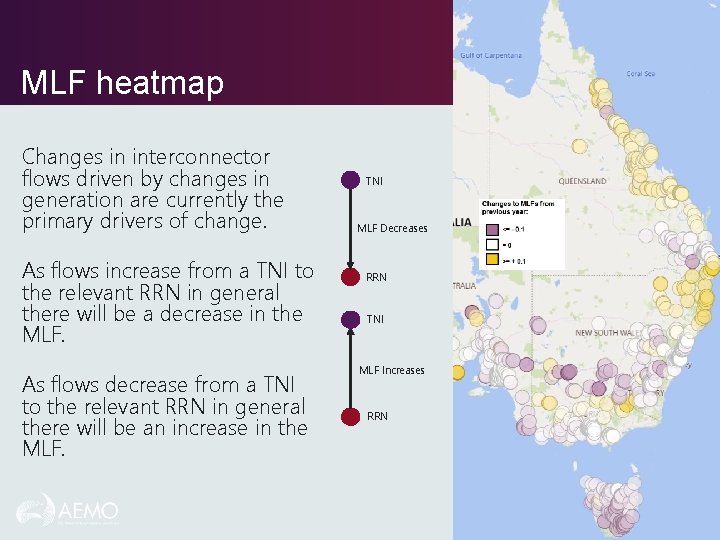
MLF heatmap Changes in interconnector flows driven by changes in generation are currently the primary drivers of change. As flows increase from a TNI to the relevant RRN in general there will be a decrease in the MLF. As flows decrease from a TNI to the relevant RRN in general there will be an increase in the MLF. TNI MLF Decreases RRN TNI MLF Increases RRN

Indicative MLFs: Discussion on modelling approach Shantha Ranatunga 15
Context • In previous years AEMO has requested generator profiles for new generation projects – templates have been provided to assist • For FY 20 -21 AEMO is proposing to develop profiles using a consistent methodology, and provide to proponent for review and feedback: • AEMO will consider adjustments on the basis of feedback provided • Generation profiles should also be consistent with any known electrical power generation limits that are expected to be applied following commissioning, e. g. local limits 16
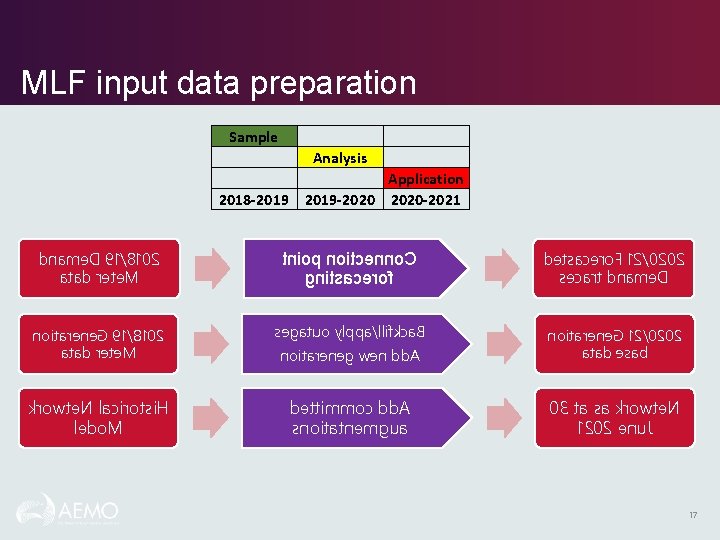
MLF input data preparation Sample 2018 -2019 Analysis Application 2019 -2020 -2021 dname. D 91/8102 atad rete. M tniop noitcenno. C gnitsacerof detsacero. F 12/0202 secart dname. D noitarene. G 91/8102 atad rete. M segatuo ylppa/llifkca. B noitareneg wen dd. A noitarene. G 12/0202 atad esab krowte. N lacirotsi. H ledo. M dettimmoc dd. A snoitatnemgua 03 ta sa krowte. N 1202 enu. J 17
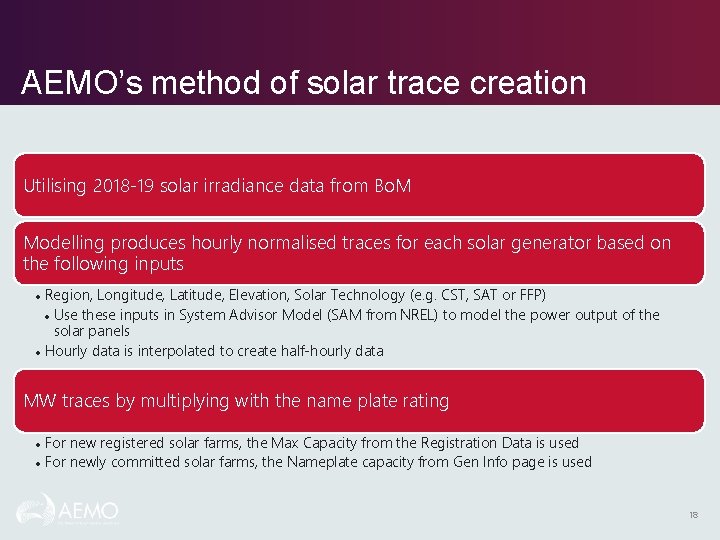
AEMO’s method of solar trace creation Utilising 2018 -19 solar irradiance data from Bo. M Modelling produces hourly normalised traces for each solar generator based on the following inputs Region, Longitude, Latitude, Elevation, Solar Technology (e. g. CST, SAT or FFP) Use these inputs in System Advisor Model (SAM from NREL) to model the power output of the solar panels Hourly data is interpolated to create half-hourly data MW traces by multiplying with the name plate rating For new registered solar farms, the Max Capacity from the Registration Data is used For newly committed solar farms, the Nameplate capacity from Gen Info page is used 18
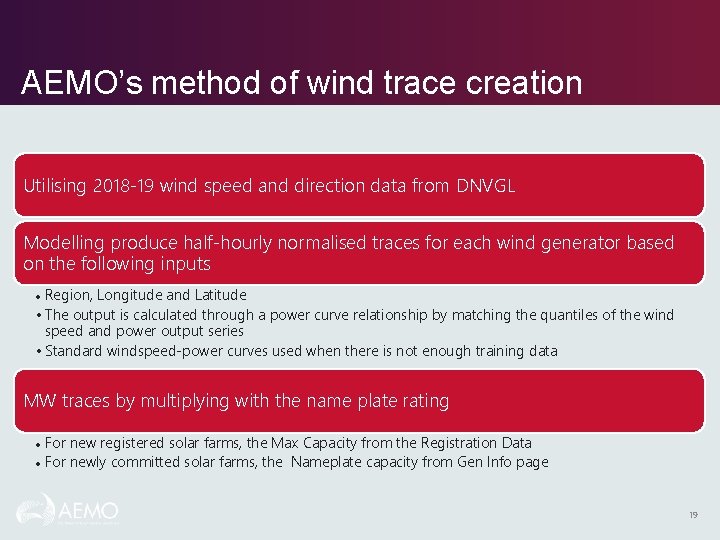
AEMO’s method of wind trace creation Utilising 2018 -19 wind speed and direction data from DNVGL Modelling produce half-hourly normalised traces for each wind generator based on the following inputs Region, Longitude and Latitude • The output is calculated through a power curve relationship by matching the quantiles of the wind speed and power output series • Standard windspeed-power curves used when there is not enough training data MW traces by multiplying with the name plate rating For new registered solar farms, the Max Capacity from the Registration Data For newly committed solar farms, the Nameplate capacity from Gen Info page 19
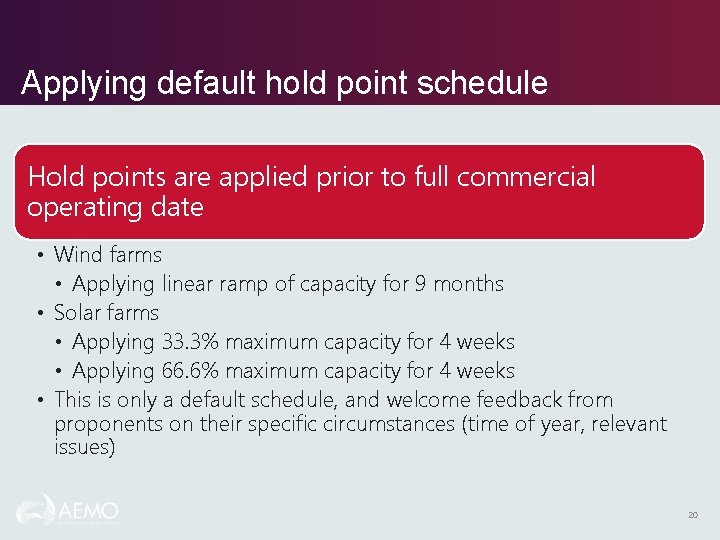
Applying default hold point schedule Hold points are applied prior to full commercial operating date • Wind farms • Applying linear ramp of capacity for 9 months • Solar farms • Applying 33. 3% maximum capacity for 4 weeks • Applying 66. 6% maximum capacity for 4 weeks • This is only a default schedule, and welcome feedback from proponents on their specific circumstances (time of year, relevant issues) 20
Blending with historical data If generator was operational for part of the reference year (2018/19) • Historical metered data for the periods of commercial operation • Forecast trace where either nonoperational or commissioning 21
Intra-regional limit management 1 Limit management • TPRICE has the inbuilt capability to manage interconnectors transfer within limits • Intra-regional flow limits are managed by pre-processing on input generation profiles Sources of information on potential intra-regional issues • AEMO grid modelling team • TNSPs • Planning and modelling studies 22
Intra-regional limit management 2 Using the principles of minimal extrapolation methodology • All relevant generators adjusted by the same ratio • Scaling factors are used to adjust flow through network elements • Eg 2. 5 MW reduction in generation to reduce 1 MW of flow across the monitored line • Can have a different ratios for non-solar periods • Eg For a radial system ratio will be ~1 23
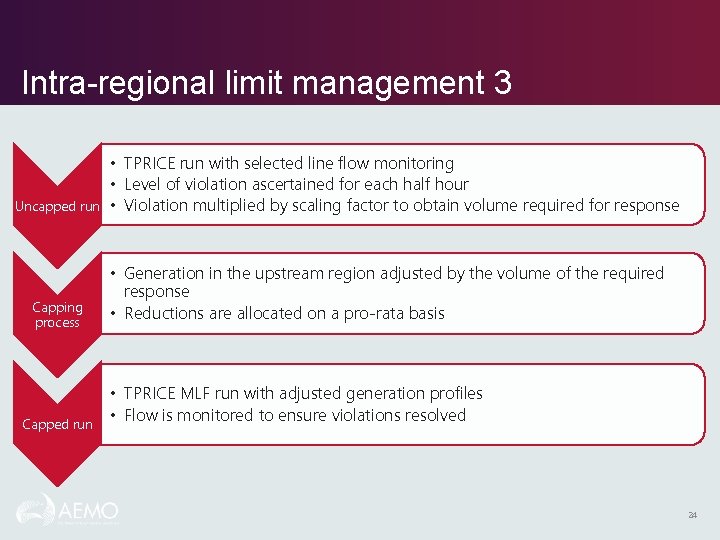
Intra-regional limit management 3 Uncapped run Capping process Capped run • TPRICE run with selected line flow monitoring • Level of violation ascertained for each half hour • Violation multiplied by scaling factor to obtain volume required for response • Generation in the upstream region adjusted by the volume of the required response • Reductions are allocated on a pro-rata basis • TPRICE MLF run with adjusted generation profiles • Flow is monitored to ensure violations resolved 24
Other generation limits AEMO will reflect local limits • Where known, any local limits will be included • If multiple generation projects are expected to be impacted, AEMO will apply the same ratio Review of generation profiles • Proponents should review generation profiles and discuss any potential local limits with AEMO 25

Stakeholder discussion and questions Chris Muffett 26
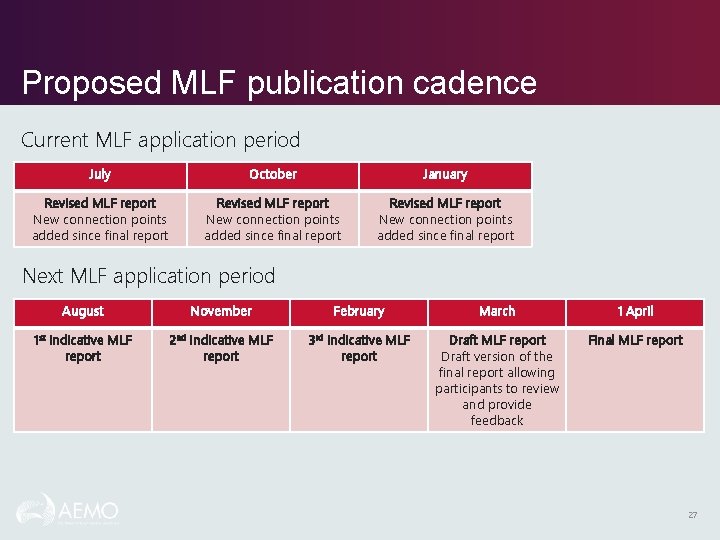
Proposed MLF publication cadence Current MLF application period July October January Revised MLF report New connection points added since final report Next MLF application period August November February March 1 April 1 st Indicative MLF report 2 nd Indicative MLF report 3 rd Indicative MLF report Draft version of the final report allowing participants to review and provide feedback Final MLF report 27
Requested feedback • Feedback is sought from stakeholders on: • Timing and usefulness of indicative publications – November report, and proposed future indicative reports • Modelling approach for generation profiles and network limits • Suggestions/concerns with FLLF methodology to feed into review in 2020 • Feedback can be provided directly to: MLF_feedback@aemo. com. au • Methodology and MLF publications can be found at: https: //www. aemo. com. au/Electricity/National-Electricity-Market-NEM/Security-and -reliability/Loss-factor-and-regional-boundaries 28
Next steps • Input on generation profiles: • AEMO will distribute week commencing 16 December • Feedback requested on concerns/appropriateness by 31 December • Proposing an update of indicative MLFs: • Early February • Intended to be a supplemental update to November report, not a full new report • Draft MLF report will be published by 1 March • Final MLF report published by 1 April • AEMO intends initiating a review of the FLLF methodology: • Preliminary engagement on issues in Q 1 2020 • Rules consultation undertaken in Q 2 2020 29

30
- Slides: 30