
Marginal emissions factors and marginal impact factors a








- Slides: 22
Marginal emissions factors and marginal impact factors: a tool for policy assessment Ines Azevedo Associate Professor Department of Engineering and Public Policy Carnegie Mellon University Co-Director Climate and Energy Decision Making Center 1
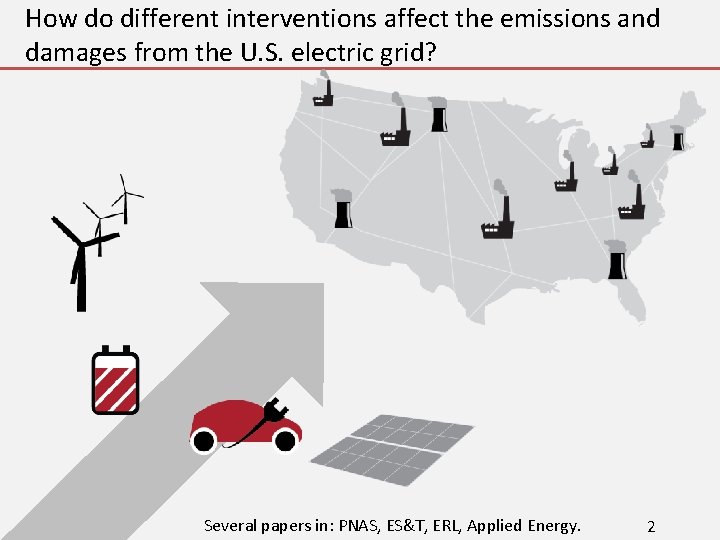
How do different interventions affect the emissions and damages from the U. S. electric grid? Several papers in: PNAS, ES&T, ERL, Applied Energy. 2
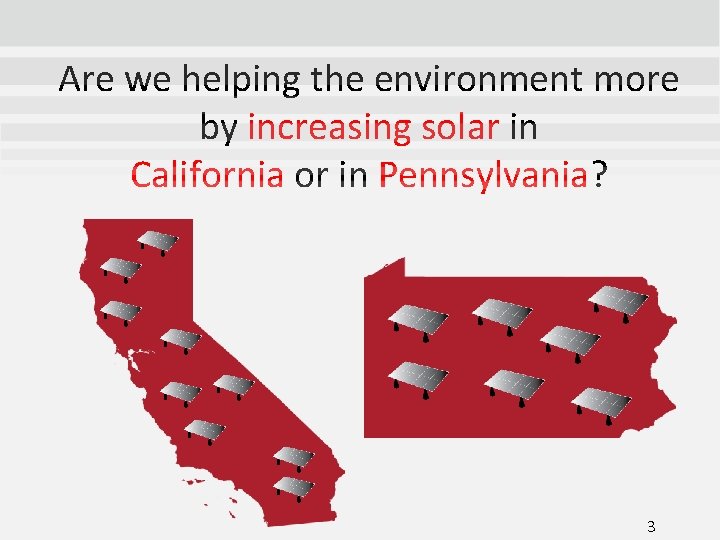
Are we helping the environment more by increasing solar in California or in Pennsylvania? 3
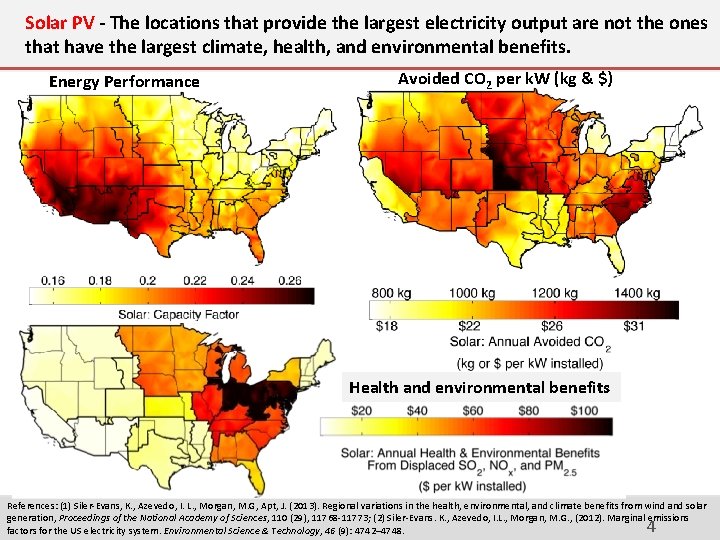
Solar PV - The locations that provide the largest electricity output are not the ones that have the largest climate, health, and environmental benefits. Energy Performance Avoided CO 2 per k. W (kg & $) Health and environmental benefits References: (1) Siler-Evans, K. , Azevedo, I. L. , Morgan, M. G, Apt, J. (2013). Regional variations in the health, environmental, and climate benefits from wind and solar generation, Proceedings of the National Academy of Sciences, 110 (29), 11768 -11773; (2) Siler-Evans. K. , Azevedo, I. L. , Morgan, M. G. , (2012). Marginal emissions factors for the US electricity system. Environmental Science & Technology, 46 (9): 4742– 4748. 4
What are the CO 2 life-cycle emissions from light duty passenger gasoline and plug-in electric vehicles across the U. S. ? (or… Are we helping de-carbonization more if we choose an electric car or an gasoline car? ) 5
g. CO 2 eq mi− 1
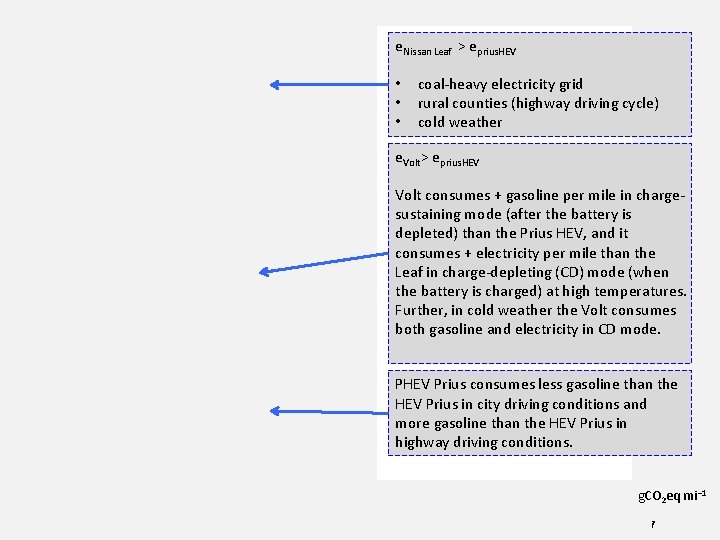
e. Nissan Leaf > eprius. HEV • coal-heavy electricity grid • rural counties (highway driving cycle) • cold weather e. Volt> eprius. HEV Volt consumes + gasoline per mile in chargesustaining mode (after the battery is depleted) than the Prius HEV, and it consumes + electricity per mile than the Leaf in charge-depleting (CD) mode (when the battery is charged) at high temperatures. Further, in cold weather the Volt consumes both gasoline and electricity in CD mode. PHEV Prius consumes less gasoline than the HEV Prius in city driving conditions and more gasoline than the HEV Prius in highway driving conditions. g. CO 2 eq mi− 1 7
g. CO 2 eq mi− 1 8
We have now many pieces using the marginal emissions and damages factors… 1. Gingerich, D. , Sun, X. , Behrer, P. , Azevedo, I. L. , Mauter, M. , (2017). Air emissions implications of expanded wastewater treatment at coal-fired generators. Proceedings of the National Academy of Sciences, published ahead of print February 6, 2017 2. Keen, J. , Apt, L. (2016). Are high penetrations of commercial cogeneration good for society? . Environmental Research Letters 11. 12. 3. Yuksel, T. , Tamayao, M. , Hendrickson, C. , Azevedo, I. L. , Michalek, J. , (2016). Effect of regional grid mix, driving patterns and climate on the comparative carbon footprint of gasoline and plug-in electric vehicles in the United States. Environmental Research Letters, 11. 4. Tamayao, M. , Michalek, J. , Hendrickson, C. , Azevedo I. L. , (2015). Regional variability and uncertainty of electric vehicle life cycle CO 2 emissions across the United States. Environmental Science & Technology, 49 (14). 5. Hittinger, E. , Azevedo, I. L. , (2015). Bulk energy storage increases US electricity system emissions. Environmental Science & Technology, 49 (5). 6. Gilbraith, N. , Azevedo, I. L. , Jaramillo, P. , (2014). Regional energy and GHG savings from building codes across the United States. Environmental Science & Technology, 48 (24). 7. Siler-Evans, K. , Azevedo, I. L. , Morgan, M. G, Apt, J. (2013). Regional variations in the health, environmental, and climate benefits from wind and solar generation. Proceedings of the National Academy of Sciences, 110 (29), 11768 -11773. 8. Siler-Evans, K. , Azevedo, I. L. , Morgan, M. G. , (2012). Marginal emissions factors for the US electricity system. Environmental Science & Technology, 46 (9), 4742– 4748.
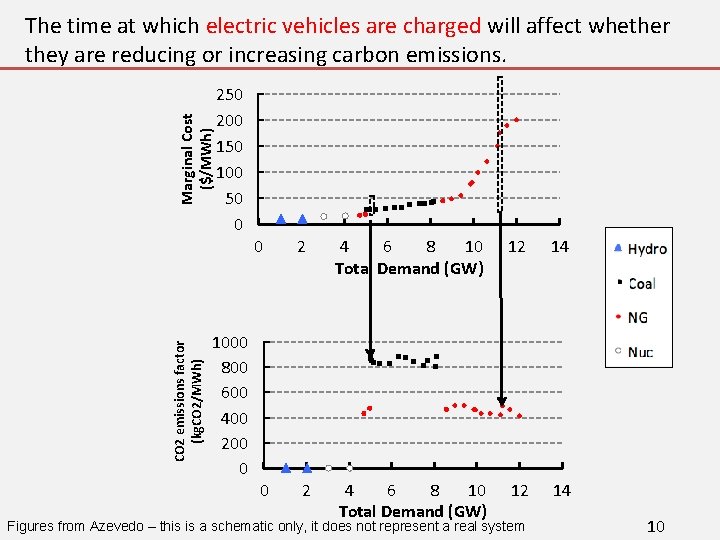
Marginal Cost ($/MWh) CO 2 emissions factor (kg. CO 2/MWh) Total Demand (GW) 1000 800 600 400 200 0 0 2 4 6 8 10 Total Demand (GW) 12 14
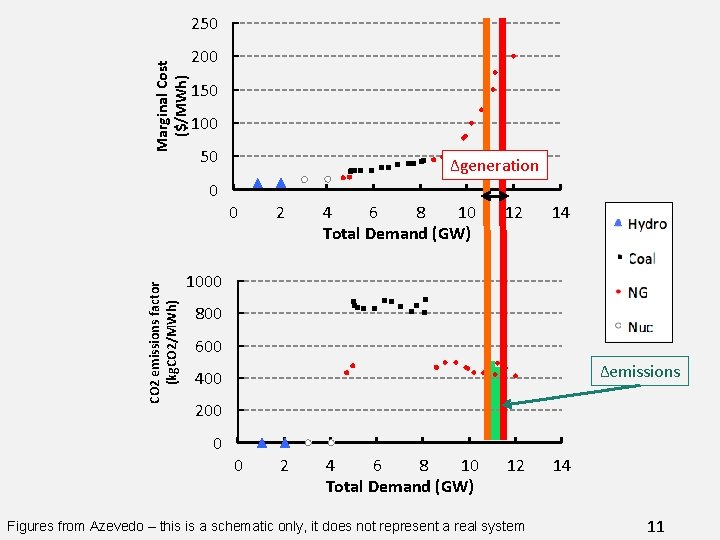
Marginal Cost ($/MWh) CO 2 emissions factor (kg. CO 2/MWh) Total Demand (GW) 1000 800 600 400 200 0 0 2 4 6 8 10 Total Demand (GW) 12 14
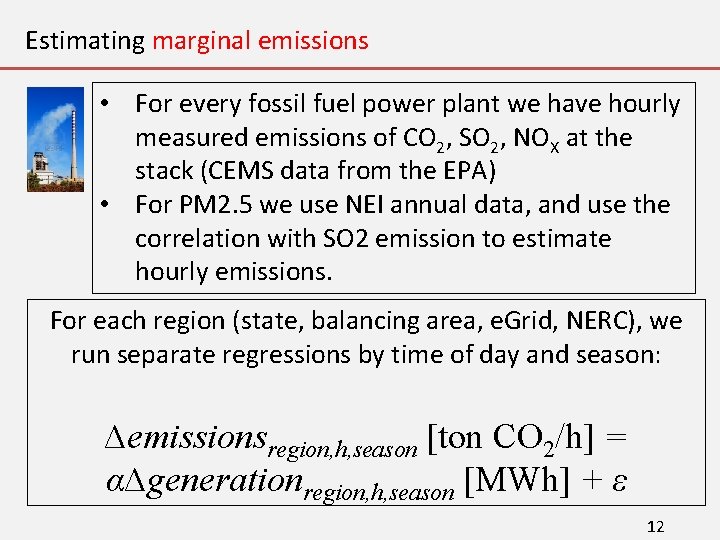
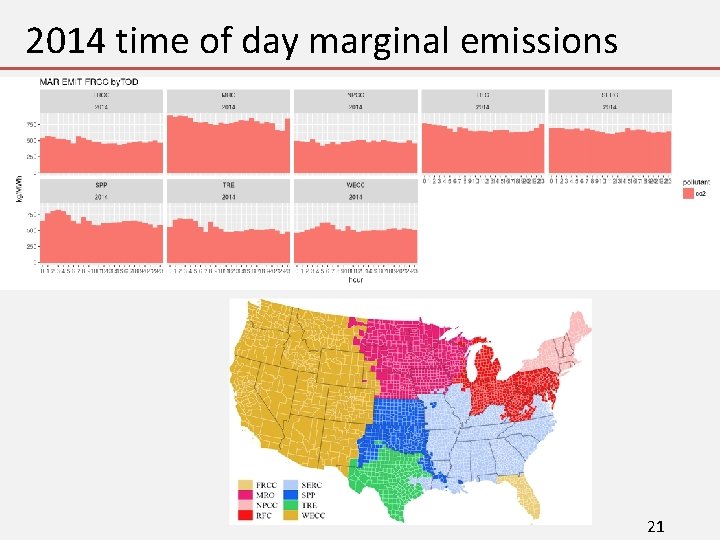
Estimating marginal emissions • For every fossil fuel power plant we have hourly measured emissions of CO 2, SO 2, NOX at the stack (CEMS data from the EPA) • For PM 2. 5 we use NEI annual data, and use the correlation with SO 2 emission to estimate hourly emissions. For each region (state, balancing area, e. Grid, NERC), we run separate regressions by time of day and season: ∆emissionsregion, h, season [ton CO 2/h] = α∆generationregion, h, season [MWh] + ε 12
Estimating marginal damage factors • For every fossil fuel power plant we multiply hourly emissions of CO 2 , SO 2, NOX and PM 2. 5 by the county damages in $/ton in either AP 2 or EASIUR (or the SCC for CO 2) For each region (state, balancing area, e. Grid, NERC), we run separate regressions by time of day and season: ∆damagesregion, h, season [$/h] = α∆generationregion, h, season [MWh] + ε 13
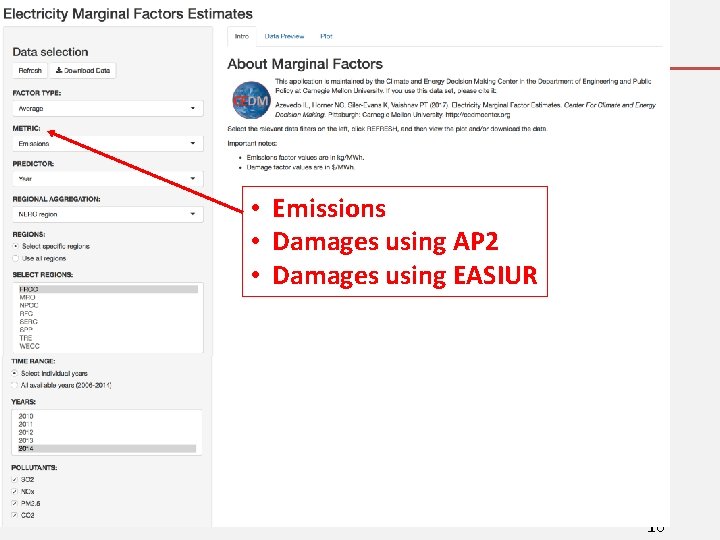
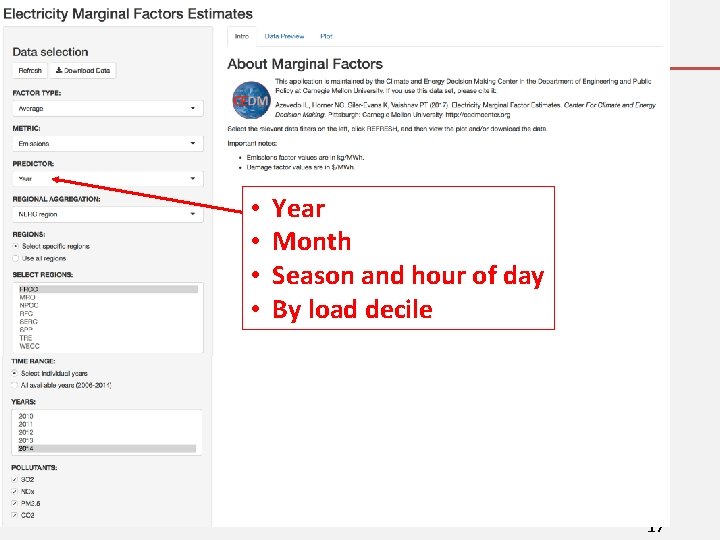
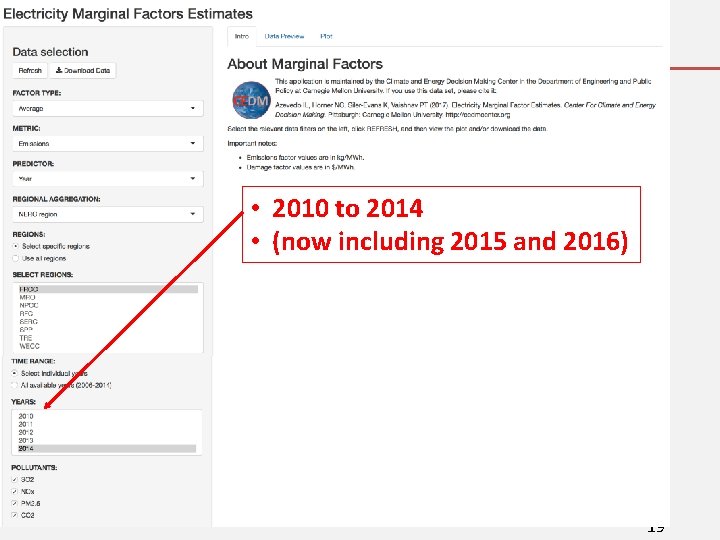
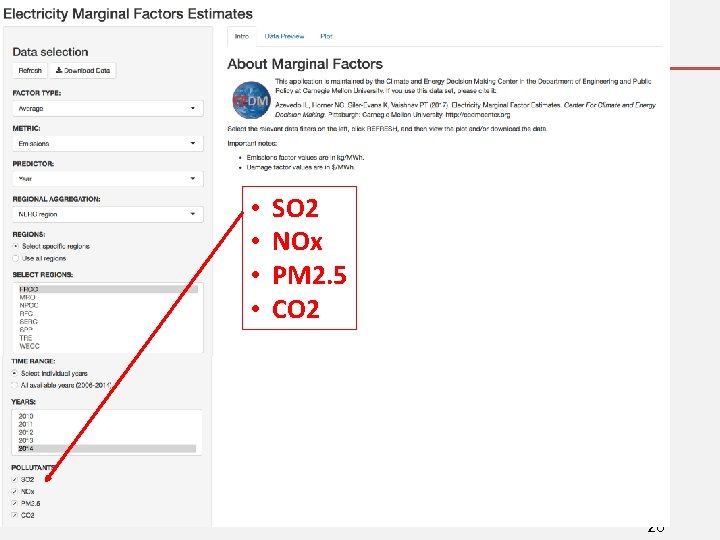
The Marginal Factors tool is now available! We created a user interface with all our estimates being publicly available and downloadable for other modelers to use! https: //cedm. shinyapps. io/Marginal. Factors/ 14
• Average • Marginal 15
• Emissions • Damages using AP 2 • Damages using EASIUR 16
• • Year Month Season and hour of day By load decile 17
• NERC • e. GRID sub-region • State 18
• 2010 to 2014 • (now including 2015 and 2016) 19
• • SO 2 NOx PM 2. 5 CO 2 20
2014 time of day marginal emissions 21
• I already received requests from several groups at LBNL, U. Minnesota, UC San Diego, Stanford U. , etc, to use our estimates in their analysis • Hopefully this tool will help with the wider use by modeler when performing policy evaluations • We will continue to update the estimates, and also include a few other ways to measure marginal emissions 22