
Marginal Cost and Marginal Benefit Identify a finite
Marginal Cost and Marginal Benefit
Identify a finite number of hours available for after-school & identify two activities in which you SHOULD engage during your after-school hours. Economics Warm-Up Using the hours available as the basis for your production possibilities curve, determine the possible trade-offs between two activities and illustrate these on the curve. Identify situations that could cause them to produce at a point inside their Production Possibilities Curve (PPC) What are the dangers of trying to reach a point outside the curve. What are strategies to shift your curve outwards?
Add to your notes… Definition of a PPF Sketch a picture of a PPF and indicate where resources are being used efficiently, inefficiently, or unattain(ably? ) What would it mean if I drew a new PPF line to the right of the original line? Why might this happen? What would it mean if I drew a new PPF to the left of the original line? Why might this happen?
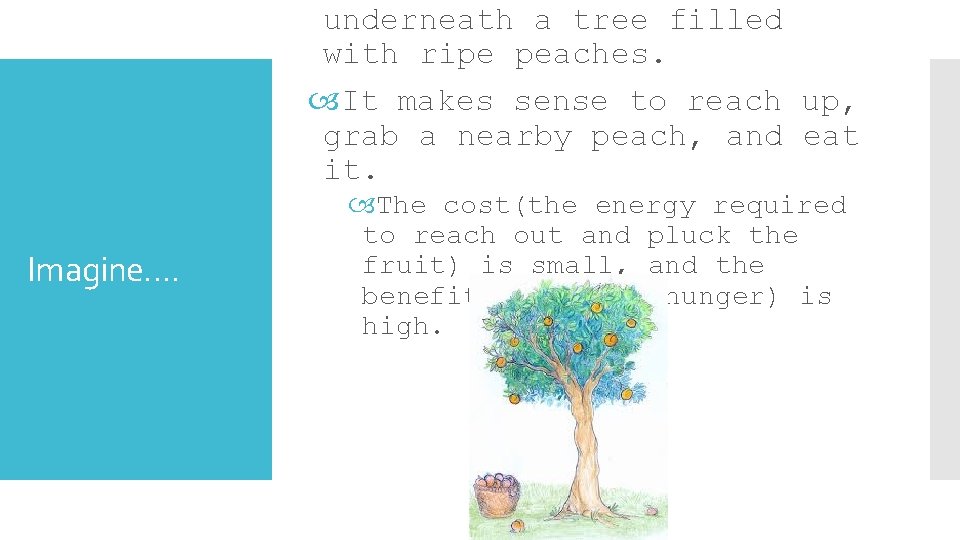
underneath a tree filled with ripe peaches. It makes sense to reach up, grab a nearby peach, and eat it. Imagine…. The cost(the energy required to reach out and pluck the fruit) is small, and the benefit (reducing hunger) is high.
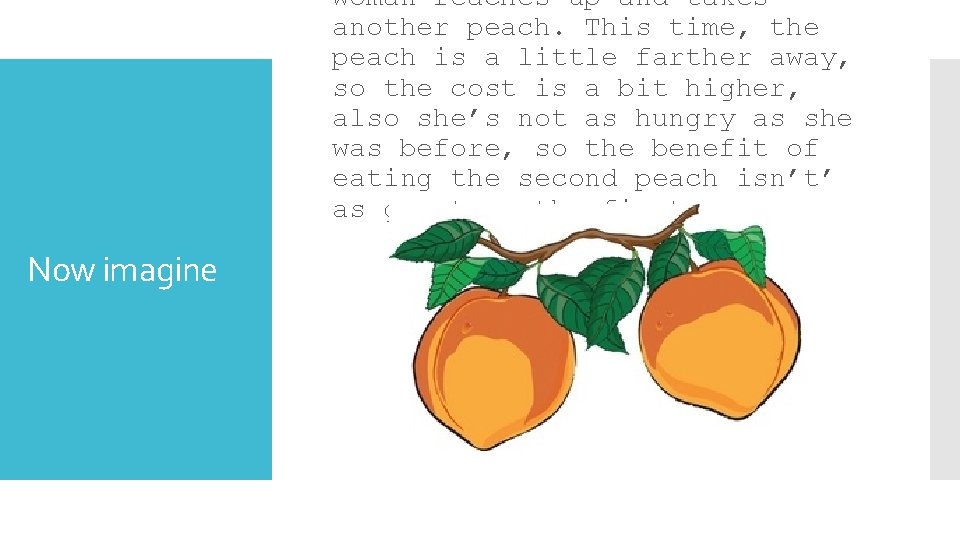
woman reaches up and takes another peach. This time, the peach is a little farther away, so the cost is a bit higher, also she’s not as hungry as she was before, so the benefit of eating the second peach isn’t’ as great as the first. Now imagine
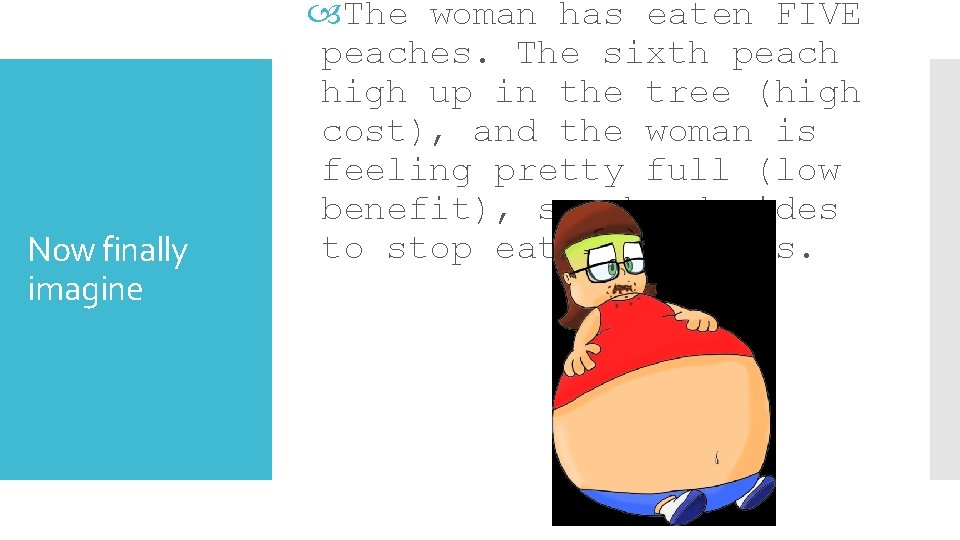
Now finally imagine The woman has eaten FIVE peaches. The sixth peach high up in the tree (high cost), and the woman is feeling pretty full (low benefit), so she decides to stop eating peaches.

Marginal Cost and Marginal Benefit Believe it or not, economists view humans as making rational decisions. It’s not rational to choose an option where the cost exceeds the benefit.

In economics, we are concerned with what happens at “the margin. ” Marginal Cost & Marginal Benefit The “margin” is “small changes” or “additional” amounts”. Rather than thinking in totals, economists look at the “additional” costs or benefits when making a choice.
Marginal Cost & Marginal Benefit It IS rational to select an option where the marginal benefit is equal to marginal cost. For businesses this is said to be their “profit maximizing” point.
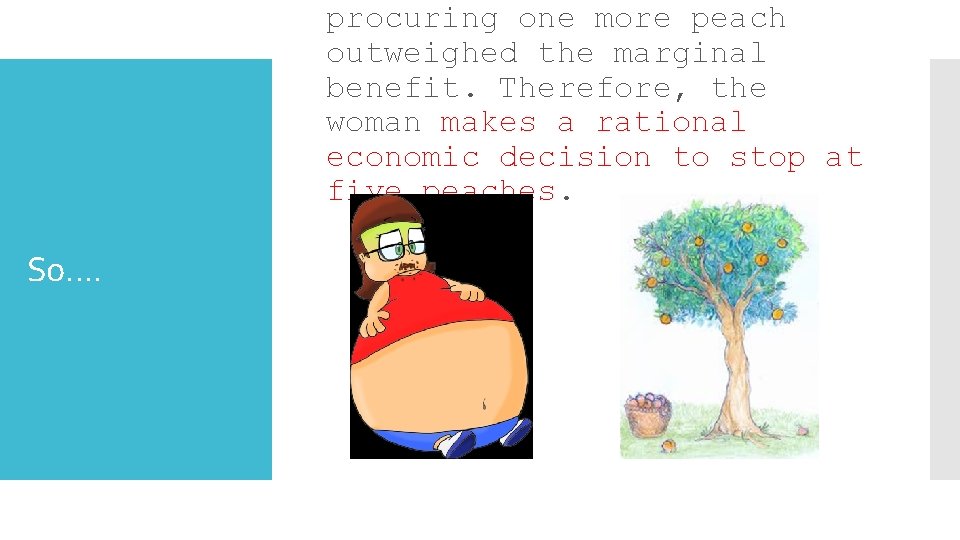
procuring one more peach outweighed the marginal benefit. Therefore, the woman makes a rational economic decision to stop at five peaches. So….
We use marginal analysis every day! My family plans a trip to Disneyland. We can buy a 3 day pass to Disneyland or a 5 day pass. Will the marginal cost of the 5 day pass (whatever the difference in price plus two more nights of hotel and food) be more or less than the marginal benefit (the extra fun of having two more days there)?
We use marginal analysis every day! A parent needs to decide whether to work overtime. Will the marginal benefit (the extra money) be greater than the marginal cost (loss of time at home with the family)?
We use marginal analysis every day! I am going shopping for groceries and I have to decide whether to buy organic or conventional vegetables. Will the marginal cost (how much more the organics cost) be greater than the marginal benefit (healthier food, perhaps, and less impact on the environment)?
TOD Create a scenario (real or fictitious) where marginal analysis is used.
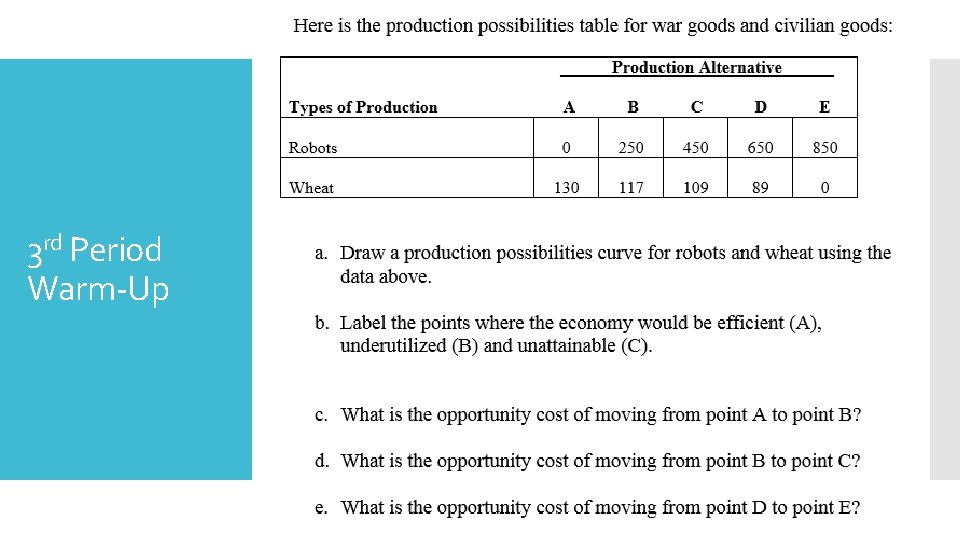
3 rd Period Warm-Up
Economics Warm-Up How do you know when one more is too much?

Two volunteers, please Volunteers
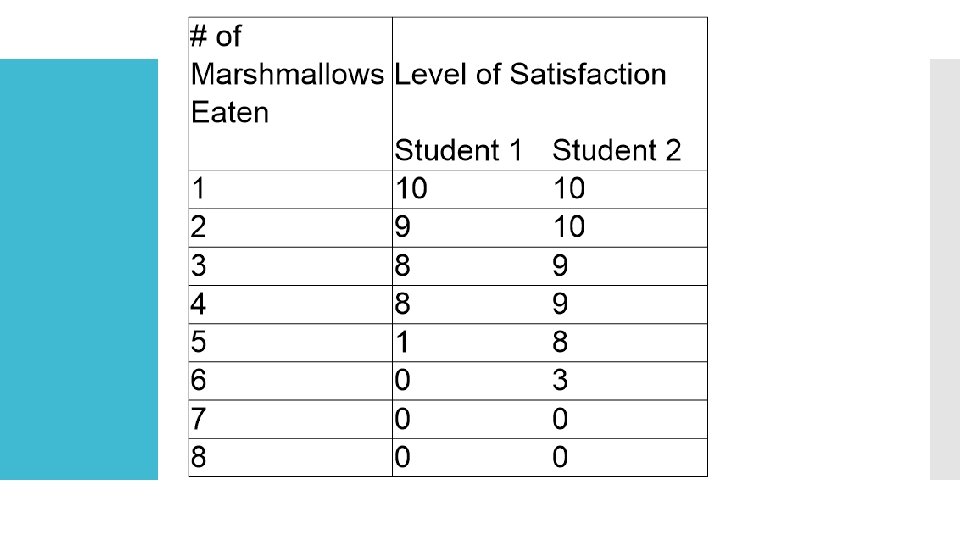

Re-cap Why did each of you stop buying marshmallows? How many more marshmallows will you eat at a price of zero?
Marginal Utility Your decision to purchase additional marshmallows depended on the additional satisfaction, or marginal utility, you expected to gain from each marshmallow.
What happened to each student’s total satisfaction with each marshmallow purchased and eaten? So… Their total satisfaction increased with each one they bought. What happened to the additional satisfaction or marginal utility as more marshmallows were purchased and eaten? At some point, the additional satisfaction began to diminish with each additional marshmallow.
Law of Diminishing Marginal Utility buy, etc) more, the value of satisfaction decreases with each additional unit consumed. Because of this economic law, people stop buying an item when the value of the satisfaction from the next unit of the same item becomes less than the price they must pay
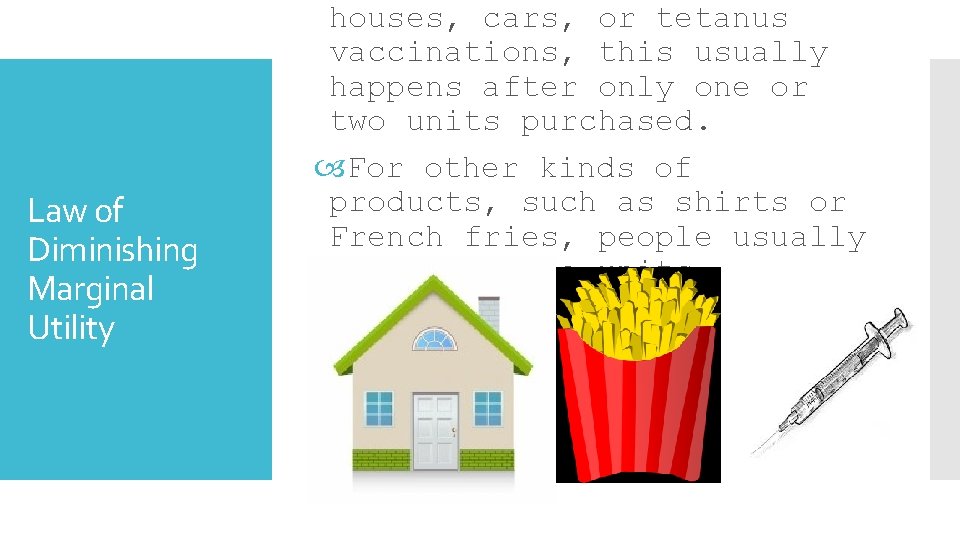
Law of Diminishing Marginal Utility houses, cars, or tetanus vaccinations, this usually happens after only one or two units purchased. For other kinds of products, such as shirts or French fries, people usually buy many more units.
Marginal Analysis Just like consumers deciding whether to buy a few more or a few less units of hundreds of different goods and services, businesses and governments make decisions at the margin, too. Businesses use marginal analysis when making decisions about how much to produce.

More volunteers!
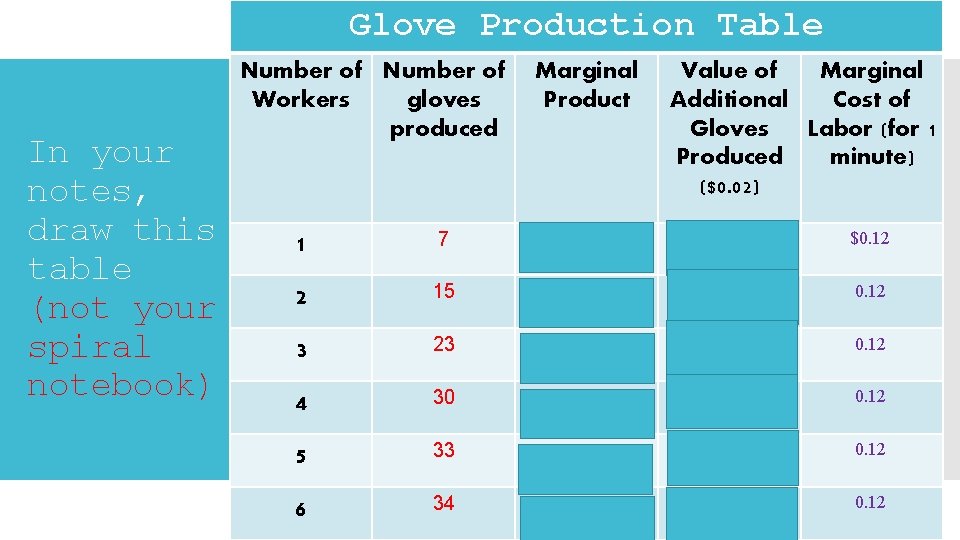
Glove Production Table In your notes, draw this table (not your spiral notebook) Number of Workers gloves produced Marginal Product Value of Marginal Additional Cost of Gloves Labor (for 1 Produced minute) ($0. 02) 1 7 7 $0. 14 $0. 12 2 15 8 0. 16 0. 12 3 23 8 0. 16 0. 12 4 30 7 0. 14 0. 12 5 33 3 0. 06 0. 12 6 34 1 0. 02 0. 12
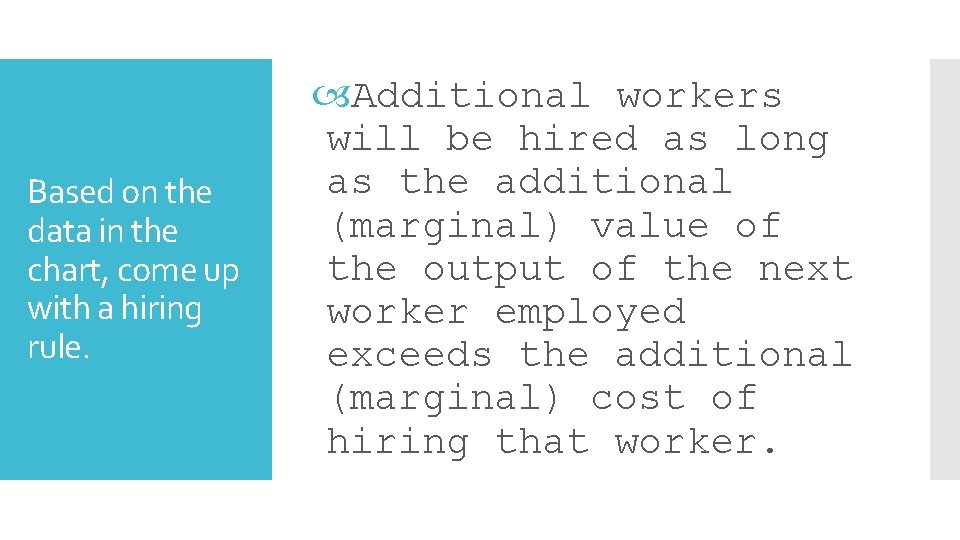
Based on the data in the chart, come up with a hiring rule. Additional workers will be hired as long as the additional (marginal) value of the output of the next worker employed exceeds the additional (marginal) cost of hiring that worker.
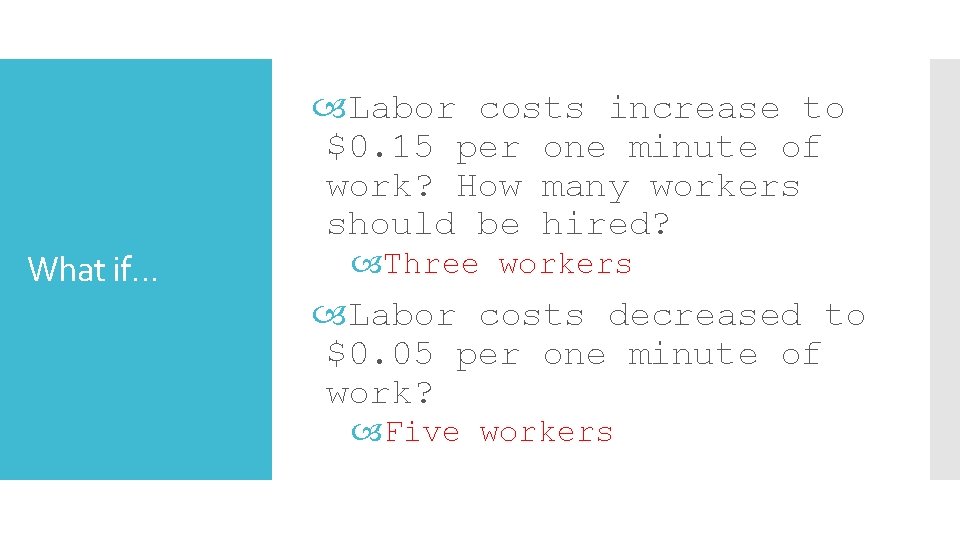
Labor costs increase to $0. 15 per one minute of work? How many workers should be hired? What if… Three workers Labor costs decreased to $0. 05 per one minute of work? Five workers
- Slides: 29