
Margaret Thatcher By Deanna Weiss Chloe Milburn Biography
Margaret Thatcher By: Deanna Weiss & Chloe Milburn
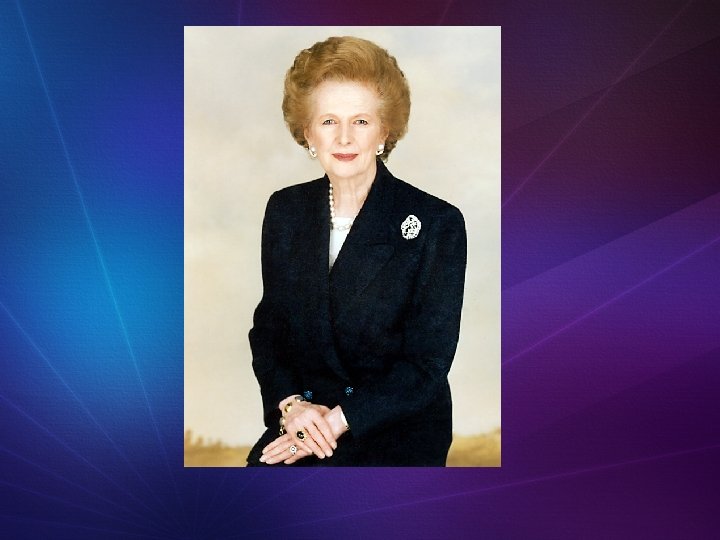
Biography Born in Grantham, Lincolnshire on October 13 th, 1925 Has a science degree from Somerville college, Oxford The first female prime minister of Britain Served for three terms Nicknamed the Iron Lady Famous for saying, “there is no such thing as society”
Member of parliament (1959 -70) Safe seat candidate for Finchley 1966 viewed as a potential shadow cabinet member 1967 US embassy in London chose her to take part in the International Visitor leadership Program
Education Secretary and Cabinet Minister (1970 -74) Appointed to the Cabinet as Secretary of State for Education and Science Attracted attention because of attempts to cut spending Prioritized academic needs in schools
Leader of Opposition (1975 -79) Her support came from the Conservative Committee Became party leader and Leader of Opposition on February 11, 1975 Jan 19 1976 she made a speech in Kensington Town Hall making an attack on the Soviet Union The Soviet Defense Ministry’s newspaper then began to call her the Iron Lady Labour government held off on an election and were mocked for “running scared” The conservatives won the 1979 election with a 44 seat majority and Thatcher became the UK’s first female Prime Minister
Implemented Policies Thatcherism Promotes: Low inflation Free markets Does this through tight control of money supply, privatization, and constraints on the labor movement

What change did she initiate? Margaret Thatcher restored trust in the private sector, reasserted economic principles, changed the role of the state, helped end a totalitarian regime, and stood fast in the wake of societal upheaval that she believed, correctly, was in the best interests of her country. Thanks to her, the Britain today bears little resemblance to Britain of 1979, and other countries, including Canada, which took inspiration from her courage.
What she changed in Britain Raising the tax burden. Denying the advice of many academic economists at the time, she raised the tax burden and decreased public sector budgets. Breaking labor unions. Thatcher broke the power of the labor unions. She stood against the all-powerful National Union of Mineworkers and announced plans to shut down several plants and eliminate thousands of jobs. A violent strike by coal miners erupted. It lasted nearly a year, but ended without settlement — though with Thatcher as the clear victor.
"Popular Capitalism. ” Thatcher pushed hard for bringing "popular capitalism" to Britain, moving major state industries like telephones and gas supply to the private sector. The economy thrived to the point that in 1985, the Treasury announced it would not need deficit spending in the next fiscal budget. What she didn’t change: -did not follow through with her plans to privatize the water industry or the National Health Service, and failed to revamp Social Security. Inflation rose and inflation rates remained high. Among political tensions, she resigned from office in 1990. -she left Britain’s economy different from how she found it

Later Life After Thatcher resigned: Called for NATO to stop the Serbian assault Supported Conservative general election campaign 2002 supported bush to tackle unfinished business of Saddam Hussein 2002 suffered from several small strokes was advised to stop public speaking Final Years Celebrated 80 in 2005 with highly recognized guests such as the Queen, Princess Alexandra, Tom Blair etc. , Had dementia Attended the fifth anniversary memorial for 911 Died April 8, 2013 of a stroke
Question Do you think that because Thatcher is a woman, it is the reason to why the changes she made in society were successful?
Question Even though most of Thatcher's changes were political and economic, do you believe that she made social changes in any way?
- Slides: 13