
March 2013 Madison Grant United School Corporation Evidencebased

March 2013 Madison Grant United School Corporation
Evidence-based research and strategies: Ø Ø Struggling readers vs. good readers Current literacy research Implications for teaching and learning Selected strategies
Di Tri Berrese Read silently Note how you approached the text (Write in the margins!) Discussion at the table about how you approached the text Create a list of all approaches
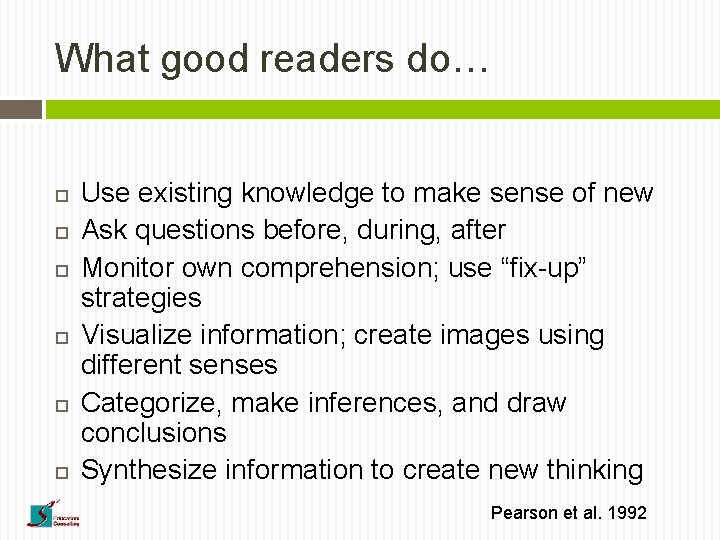
What good readers do… Use existing knowledge to make sense of new Ask questions before, during, after Monitor own comprehension; use “fix-up” strategies Visualize information; create images using different senses Categorize, make inferences, and draw conclusions Synthesize information to create new thinking Pearson et al. 1992
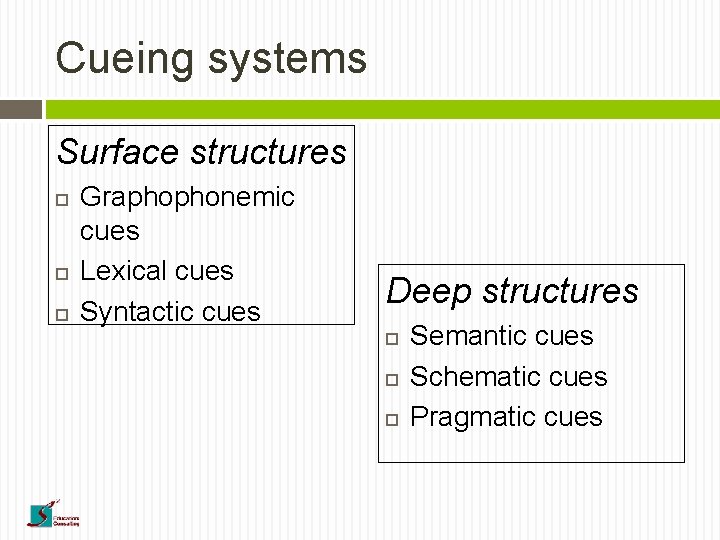
Cueing systems Surface structures Graphophonemic cues Lexical cues Syntactic cues Deep structures Semantic cues Schematic cues Pragmatic cues

Surface structures Graphophonemic cues � relate to letters and sounds, both individually and in combinations; decoding Lexical cues � relate to words, including their instantaneous recognition, but not necessarily the associated meaning Syntactic cues � relate to the form and structure of words and sentences that make up pieces of texts, including whether they “sound right” and are organized cohesively
Deep structures Semantic cues � relate to meaning(s), concepts, and associations of words and longer pieces of text, including understanding subtle definitions and nuances Schematic cues � relate to new information to prior knowledge and/or personal experiences; allow the reader to understand remember what has been read –help to group and organize new information Pragmatic cues � relate to what the reader considers important and what he/she needs to understand for a particular purpose; includes social construction of meaning, in which groups of readers arrive at shared meaning and increasingly abstract interpretations
Scientifically-Based Reading Research (SBRR) ü Impact of effective teaching on reading achievement of students ü Large numbers of students in the study ü Study and control groups ü Stringent peer review process ü Replicated with similar results
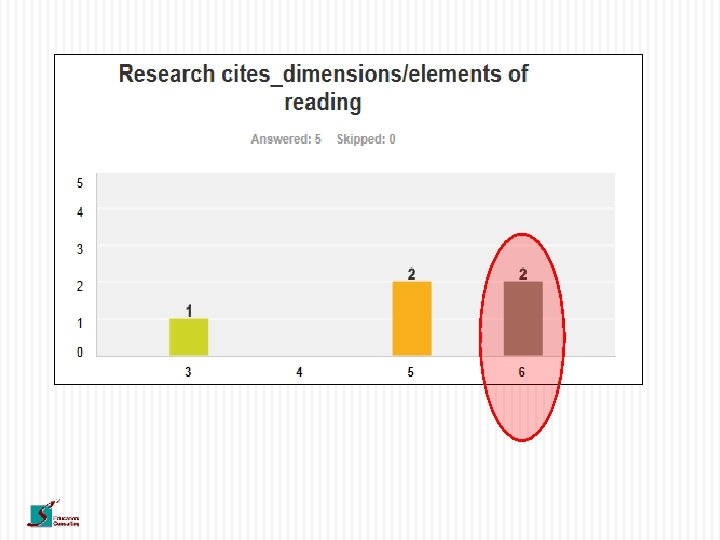
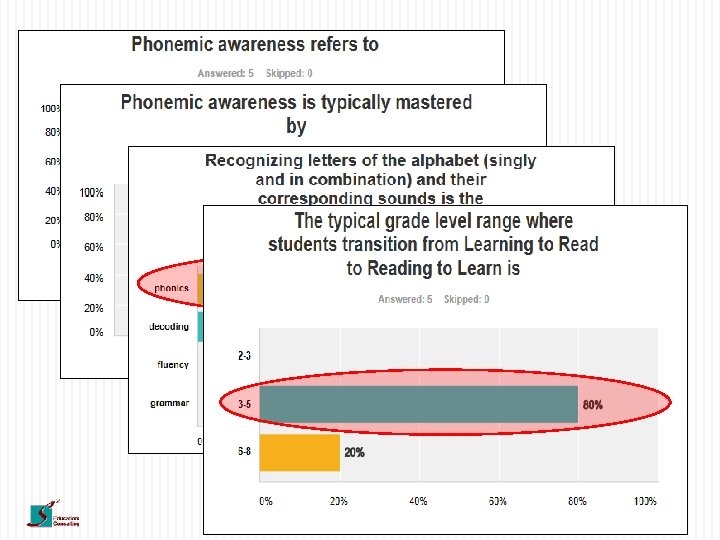
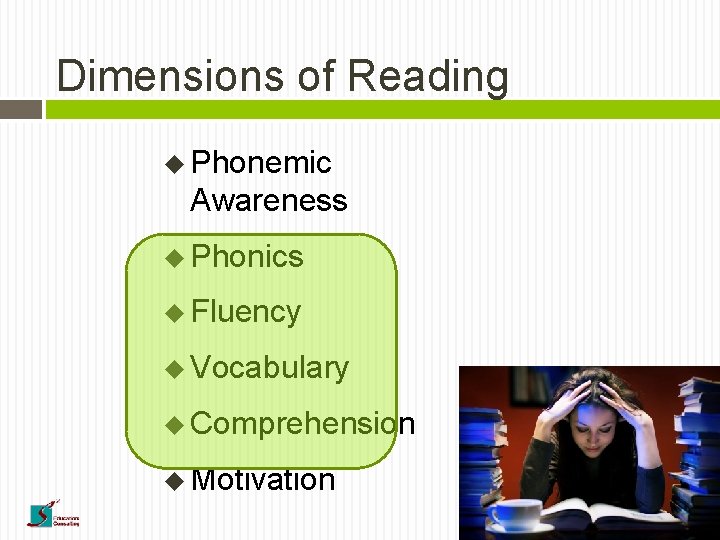
Dimensions of Reading u Phonemic Awareness u Phonics u Fluency u Vocabulary u Comprehension u Motivation
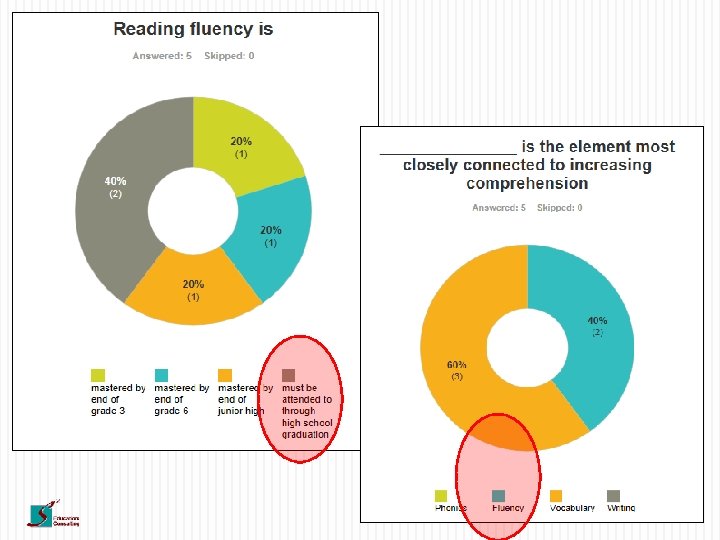
Fluency is important because… Fluent readers are better able to devote attention to comprehension of text. Students who experience reading difficulties are most often not fluent.
Fluency instruction begins when students can read connected text with 90% or better accuracy (usually by the middle of first grade). As text changes in concept and difficulty, fluency must be practiced to support comprehension. If a student misses more than 10% of the words in an unpracticed passage, the material is too difficult to use for fluency instruction/practice.
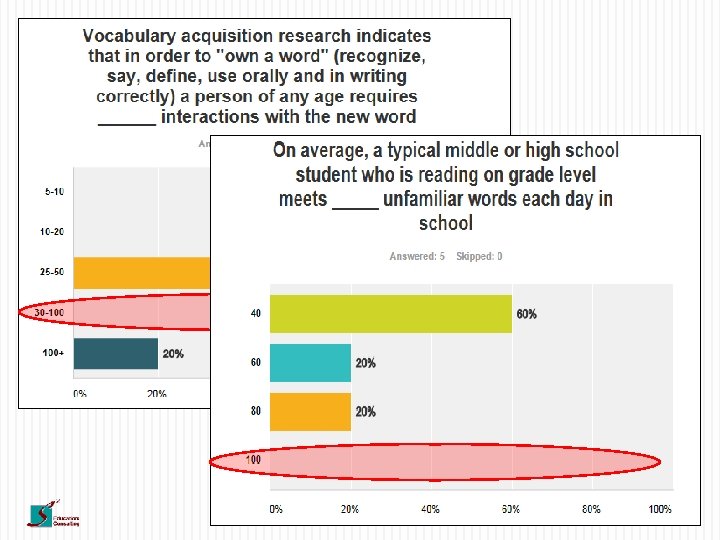
Vocabulary development is important because… A Human Engineering Laboratory Study tested the vocabularies of thousands of people in various careers and age groups, and found that the people drawing the highest salaries scored highest on the vocabulary test. In fact, their results were so consistent that the researchers declared there was only one trait common to all successful people: A superior vocabulary.
Vocab stats 1 st grade – low SES students know about half the number of words as peers 12 th graders near top of class know four times as many words as peers High-knowledge 3 rd graders have vocabularies about equal to lowest performing 12 th graders
Good vocabulary instruction… helps students gain ownership of words; provides multiple exposures; includes both definitional and contextual; information; and tive c e g f f n i e involvesastudents actively. st opy c a Le : y g m e o y t r r f a a r s s st s n o o l i t i g n r i f o e y d r a n o i t c i d
Skills needed for success in tomorrow’s world: Sorting fact from opinion Analyzing in relation to sequence Determining reliability of data sources Projecting possible outcomes/consequences Developing informed decisions based on evidence/data Supporting own opinions and interpretations Learning about new things that do not currently exist
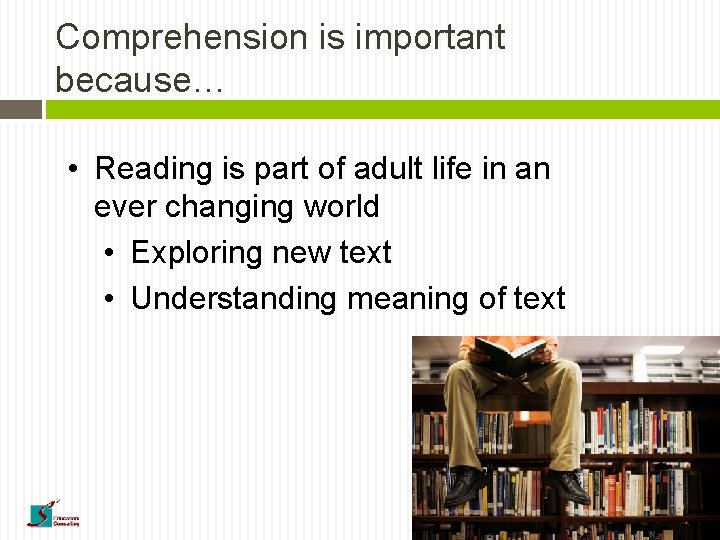
Comprehension is important because… • Reading is part of adult life in an ever changing world • Exploring new text • Understanding meaning of text
Instruction is most effective when it is explicit. delivered through cooperative learning processes. students are taught to use strategies flexibly and in combination.
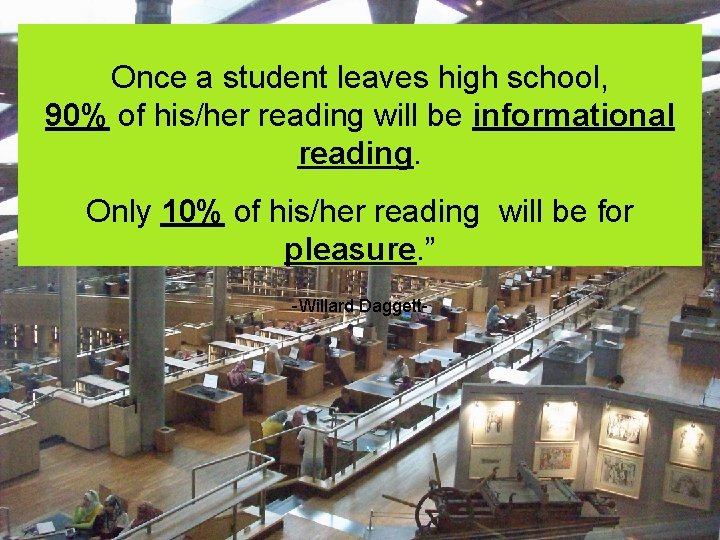
Once a student leaves high school, 90% of his/her reading will be informational reading. Only 10% of his/her reading will be for pleasure. ” -Willard Daggett-
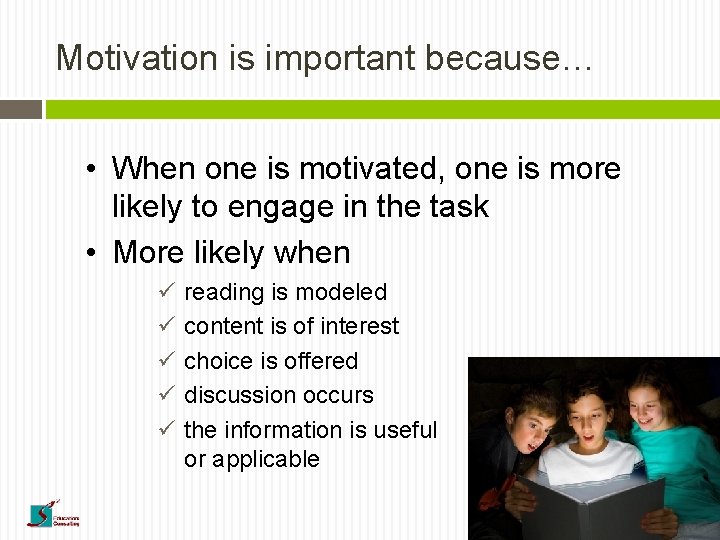
Motivation is important because… • When one is motivated, one is more likely to engage in the task • More likely when ü ü ü reading is modeled content is of interest choice is offered discussion occurs the information is useful or applicable
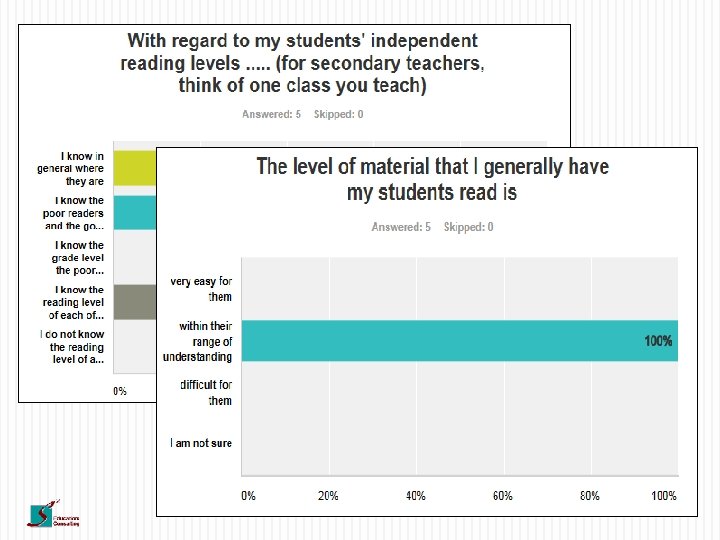
MS & HS Reading Research… continued Little time is devoted to teaching organizational patterns of content text Amount of class time spent reading, discussing, and writing about content is often insufficient for understanding Achievement increases when teachers model reading strategies connected to content area Most textbooks are written two or more grade levels above typical grade level readability
MS & HS SBRR indicates… q q q q q Comprehension instruction Embedding in content Self-directed learning Collaborative learning Strategic tutoring Diversity in text Intensive writing Use of technology Ongoing formative assessment
Direct, explicit comprehension instruction . Describe, model, and give rationale � Summarizing � Identifying text structure � Using visual clues � Connecting to prior knowledge � Using graphic organizers Ensure much practice across wide range of text materials NICHD 2000; Pressley 2000
Effective instructional principles embedded in content Use informational and content text in teaching comprehension strategies Provide reading comprehension instruction within each content area � Organization of unit � Clear explanation of new concepts Model word identification, visual imagery, selfquestioning, paraphrasing Alfassi 2004; Beck etal. 1996; Center for Research on Learning 2001
Motivation and self-directed learning Provide choice in materials � Independent reading time at independent reading level � Student selection of research topics � Student selection of writing topics Student-set literacy goals Teacher feedback on goals and progress Cordova & Lepper; 1996; Reynolds & Symons 2001; Schunk 2003
Text-based collaborative learning Performing reading and writing tasks in with a partner or in a small group Teacher-set study guides, open-ended questions, etc. All learners benefit from cooperative learning (gened, spced, LEP) Across all content areas Improves comprehension and overall achievement Klinger etal. 2004; Langer 2001; NICHD 2000; Guzzetti etal. 1996; Beck eta. 1996
Strategic tutoring Teaching strategies that lead to independent reading Not just support in completing tasks Applied as needed Not necessarily a long-term intervention Elbaum 2000; Gaffney etal. 2002; Hock etal 2001; Staub & Lenz 2000
Diverse texts Access to and experience with a wide variety of texts Access to texts that appeal to student interest Increased numbers of available books Age-appropriate content at a variety of readability levels; for both struggling and advanced readers Campbell etal. 1995; Dreher 2003; Ivey & Broaddus 2001; Guthrie etal. 2000; O’Connor etal, 2002; Schiefele 1999
Intensive writing Must be instructed � Clear objectives and expectations � Connected to real tasks and course content � Supported by high-level peer interactions Integrated as a measure of comprehension � Increases critical thinking � Improves comprehension Tierney & Shanahan 1991; Mc. Crindle & Christensen 1995; Britt & Aglinskas 2002; Hillocks 1984; Matsumura etal 2002; Shananhan 2004
Technology component Leverage instruction by using as a support Use for individual practice (not instruction) Select programs and software wisely Include multimedia text (mixing audio, animation, and text) Mac. Arthur etal. 2001; NICHD 2000; Boin 2004; Kamil etal. 2000; Moreno & Mayer 2002; Brinkerhoff etal. 2001
Ongoing formative assessment Informal Formal Must be linked to clear criteria Must provide feedback to students Measures both curricular goals and response to specific interventions Guides next steps in instruction Boston 2002; William etal. 2004; Fuchs etal; . 1984
Better learning comes from giving the learner better ways to construct meaning.
Constructing Meaning… Read silently Fill in the blanks Check with a partner Agree and make corrections
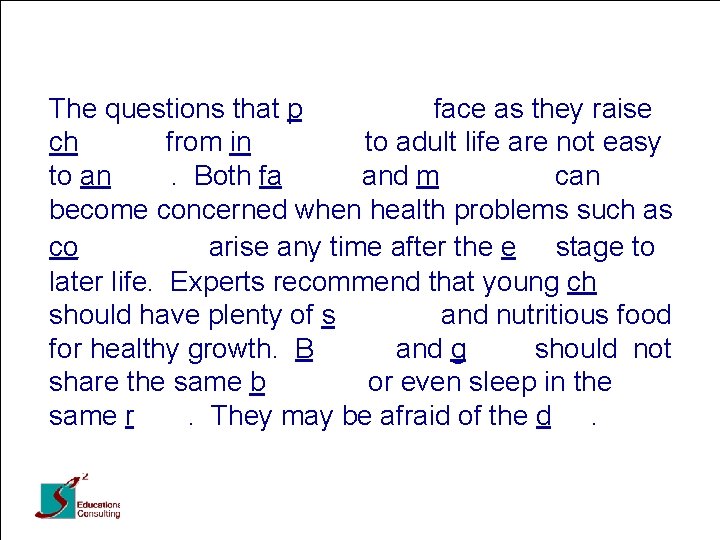
The questions that poultrymen face as they raise chickens from incubation to adult life are not easy to answer. Both farmers and merchants can become concerned when health problems such as coccidiosis arise any time after the egg stage to later life. Experts recommend that young chicks should have plenty of sunshine and nutritious food for healthy growth. Banties and geese should not share the same barnyard or even sleep in the same roost. They may be afraid of the dark.
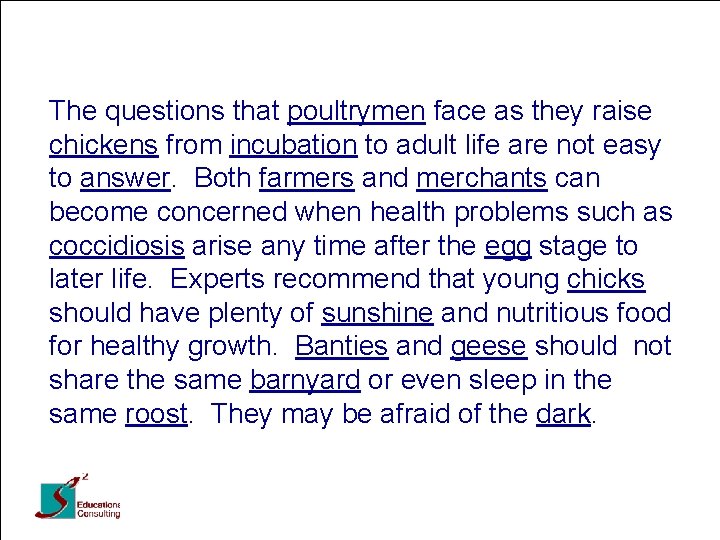
The questions that poultrymen face as they raise chickens from incubation to adult life are not easy to answer. Both farmers and merchants can become concerned when health problems such as coccidiosis arise any time after the egg stage to later life. Experts recommend that young chicks should have plenty of sunshine and nutritious food for healthy growth. Banties and geese should not share the same barnyard or even sleep in the same roost. They may be afraid of the dark.
Teaching reading in the content areas is helping learners to make connections between what they know and “new” information presented in the text. Billmeyer and Barton
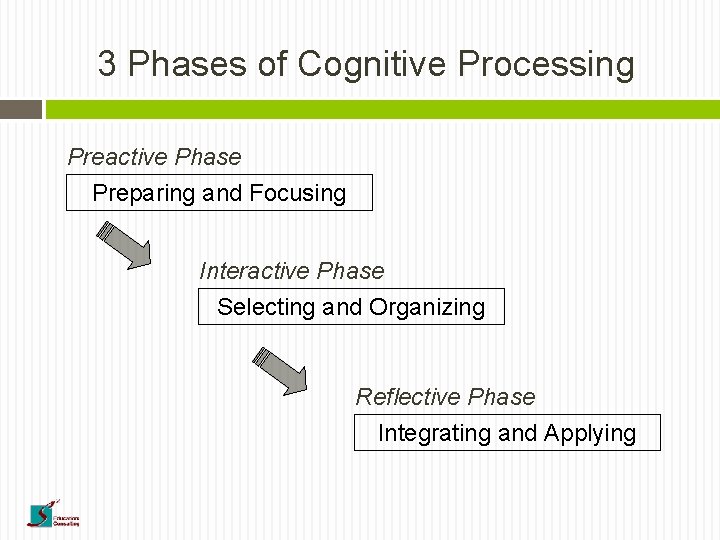
3 Phases of Cognitive Processing Preactive Phase Preparing and Focusing Interactive Phase Selecting and Organizing Reflective Phase Integrating and Applying
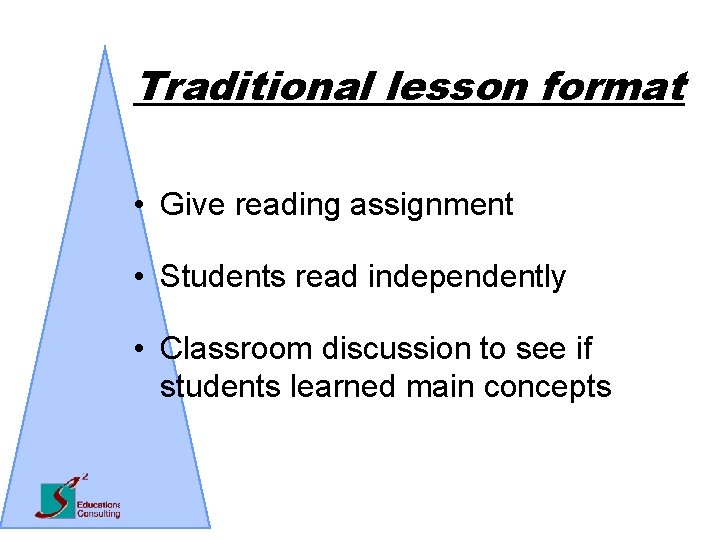
Traditional lesson format • Give reading assignment • Students read independently • Classroom discussion to see if students learned main concepts
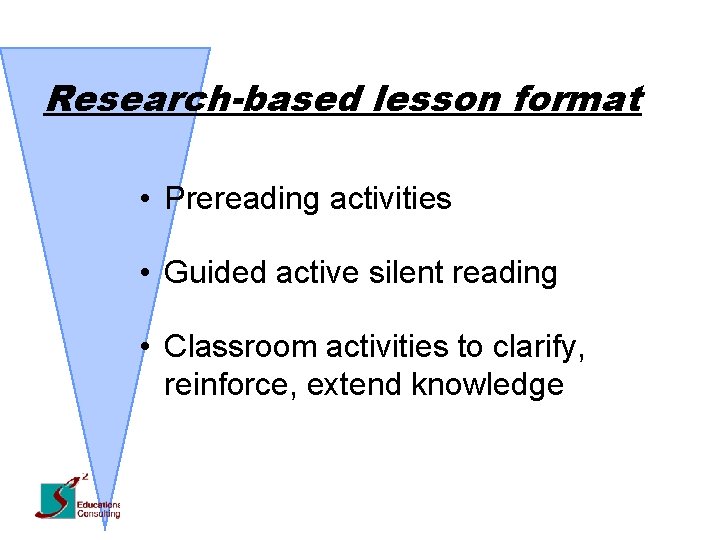
Research-based lesson format • Prereading activities • Guided active silent reading • Classroom activities to clarify, reinforce, extend knowledge
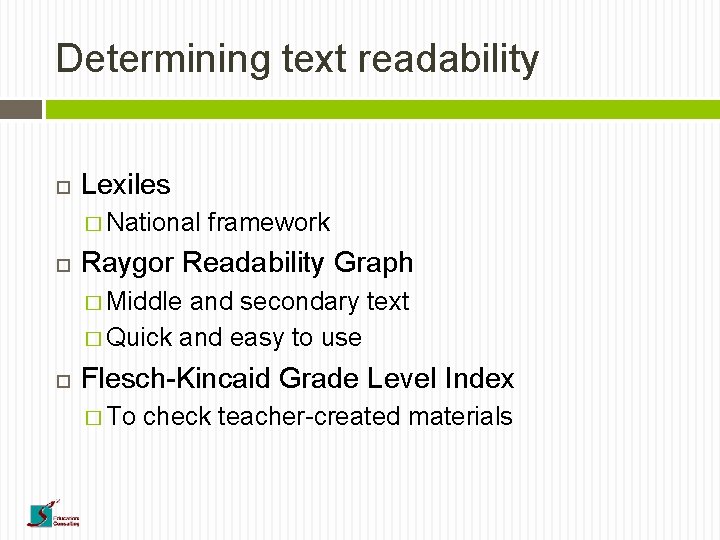
Determining text readability Lexiles � National framework Raygor Readability Graph � Middle and secondary text � Quick and easy to use Flesch-Kincaid Grade Level Index � To check teacher-created materials
Ensuring access to text… Become a passionate reader of what you teach Model how good readers read Create text boxes � Variety of materials related to content and context at differing readability levels Demonstrate access to format Choose, teach, and use appropriate graphic organizers
By three methods we may learn wisdom: First, by reflection, which is noblest; second, by imitation, which is easiest; and third, by experience, which is the bitterest. Confucius, philosopher and teacher (c. 551 -478 BC)
- Slides: 46