
March 2002 Why Worry About Men Addressing mens

© March, 2002
Why Worry About Men? Addressing men’s sexual and reproductive health will help make men become healthier individuals, partners and fathers; improve information, counseling and clinical services for both men and women; and address social concerns such as sexually transmitted diseases and unwanted pregnancy. The Alan Guttmacher Institute (AGI) In Their Own Right, 2002
Report Overview The first national synthesis of men’s sexual, contraceptive, reproductive and parenting experiences Focus on men aged 15 -49 The Alan Guttmacher Institute (AGI) In Their Own Right, 2002
Information Sources National Surveys Current Population Survey National Survey of Families and Households National Survey of Adolescent Males National Survey of Men Other key national surveys Centers for Disease Control and Prevention National Center for Health Statistics Bureau of the Census The Alan Guttmacher Institute (AGI) In Their Own Right, 2002
Men’s Sexual and Reproductive Behavior and Health Needs Vary according to life stage (15 -19, 20 -29, 30 -49) Are influenced by Relationship status Poverty Race and ethnicity School/work status The Alan Guttmacher Institute (AGI) In Their Own Right, 2002
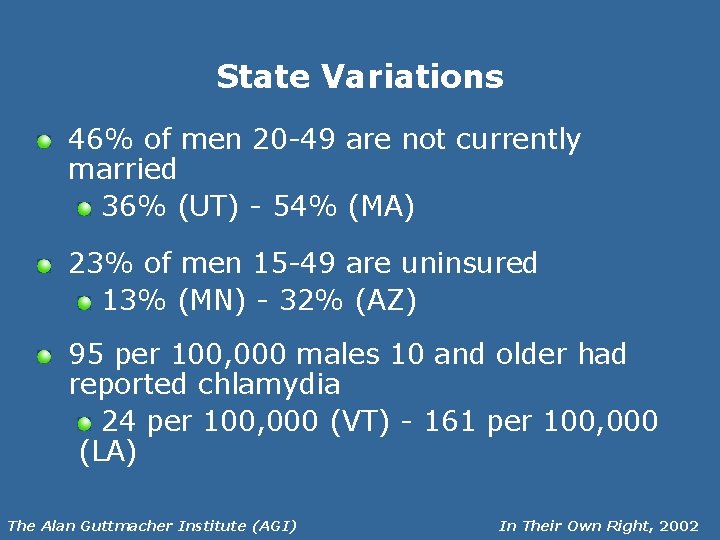
State Variations 46% of men 20 -49 are not currently married 36% (UT) - 54% (MA) 23% of men 15 -49 are uninsured 13% (MN) - 32% (AZ) 95 per 100, 000 males 10 and older had reported chlamydia 24 per 100, 000 (VT) - 161 per 100, 000 (LA) The Alan Guttmacher Institute (AGI) In Their Own Right, 2002
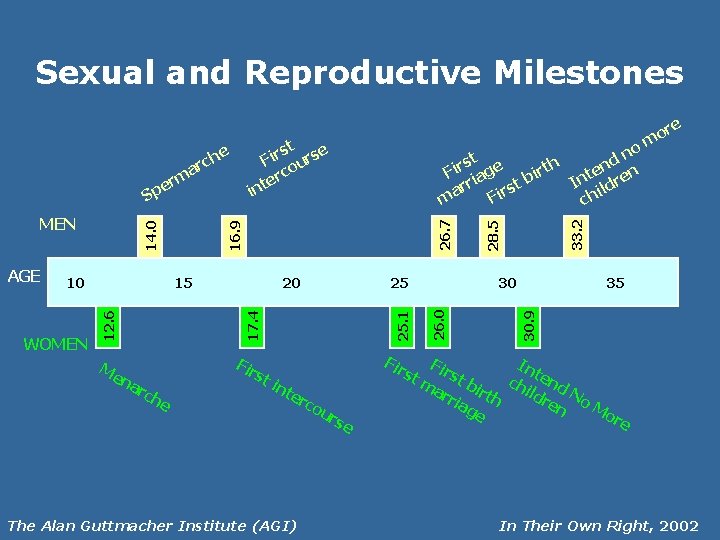
Sexual and Reproductive Milestones e Fir st i na rch e nt er The Alan Guttmacher Institute (AGI) co ur se 33. 2 30 35 30. 9 Me 25 25. 1 20 17. 4 WOMEN 15 28. 5 16. 9 10 12. 6 AGE 14. 0 MEN 26. 7 S no t d s h n Fir iage birt te ren n I ild rr st a r i F m ch 26. 0 ma r pe st e Fir ours c er t in e rch r mo Fir F In st irst t ma bir chi end ldr No rri t en ag h Mo e r e In Their Own Right, 2002
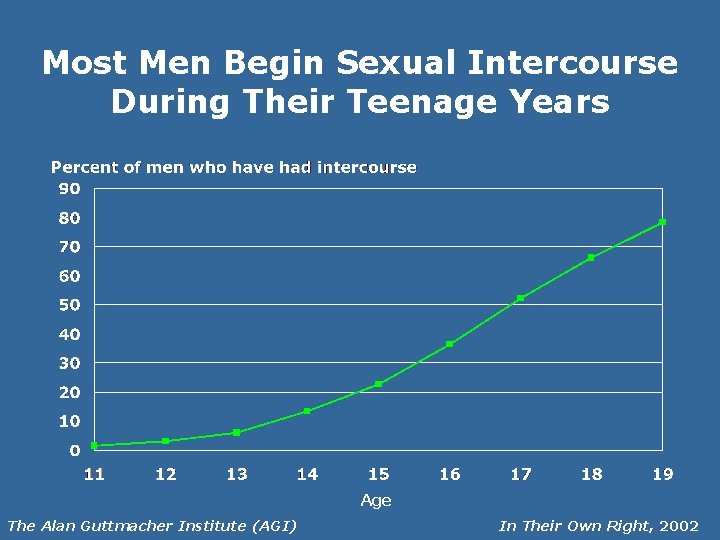
Most Men Begin Sexual Intercourse During Their Teenage Years Age The Alan Guttmacher Institute (AGI) In Their Own Right, 2002
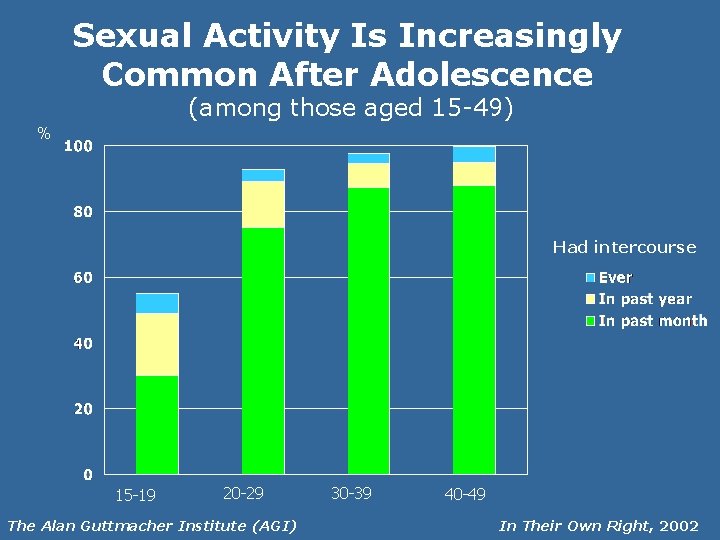
Sexual Activity Is Increasingly Common After Adolescence (among those aged 15 -49) % Had intercourse 15 -19 20 -29 The Alan Guttmacher Institute (AGI) 30 -39 40 -49 In Their Own Right, 2002
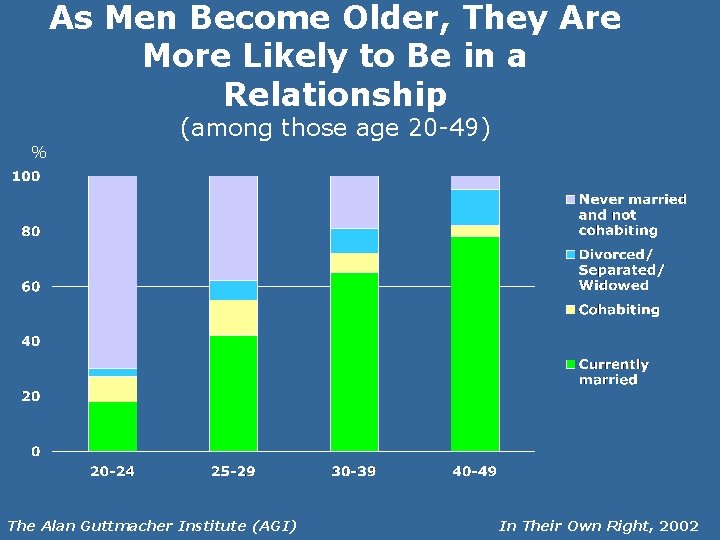
As Men Become Older, They Are More Likely to Be in a Relationship (among those age 20 -49) % The Alan Guttmacher Institute (AGI) In Their Own Right, 2002
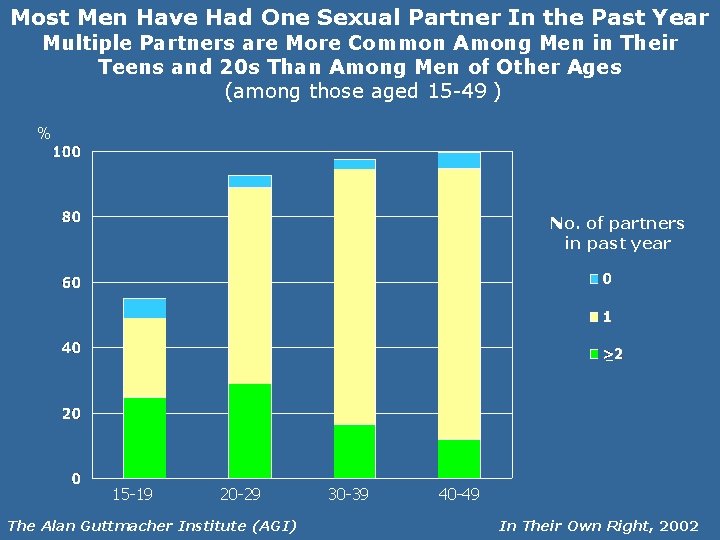
Most Men Have Had One Sexual Partner In the Past Year Multiple Partners are More Common Among Men in Their Teens and 20 s Than Among Men of Other Ages (among those aged 15 -49 ) % No. of partners in past year 15 -19 20 -29 The Alan Guttmacher Institute (AGI) 30 -39 40 -49 In Their Own Right, 2002
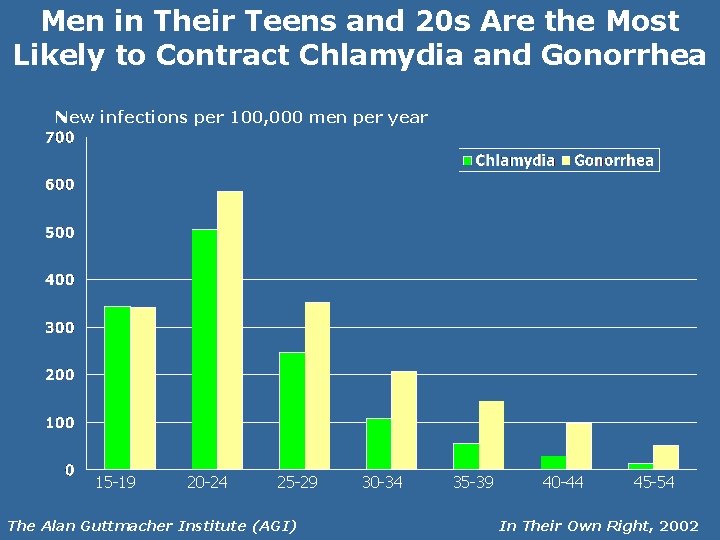
Men in Their Teens and 20 s Are the Most Likely to Contract Chlamydia and Gonorrhea New infections per 100, 000 men per year 15 -19 20 -24 25 -29 The Alan Guttmacher Institute (AGI) 30 -34 35 -39 40 -44 45 -54 In Their Own Right, 2002
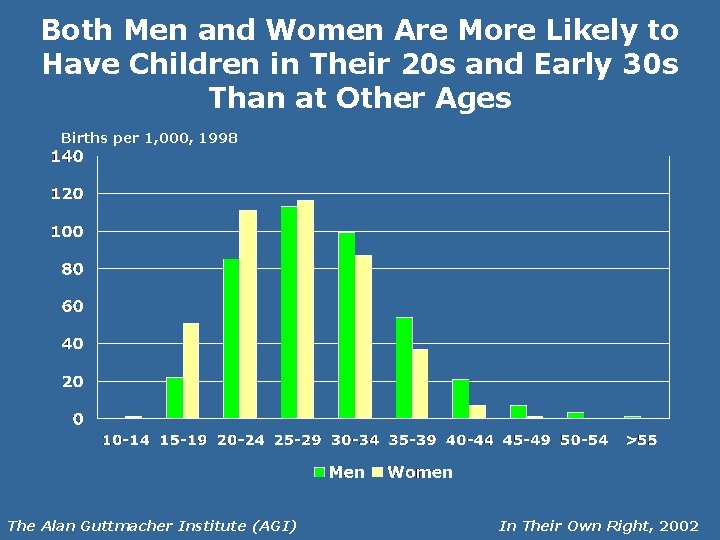
Both Men and Women Are More Likely to Have Children in Their 20 s and Early 30 s Than at Other Ages Births per 1, 000, 1998 The Alan Guttmacher Institute (AGI) In Their Own Right, 2002
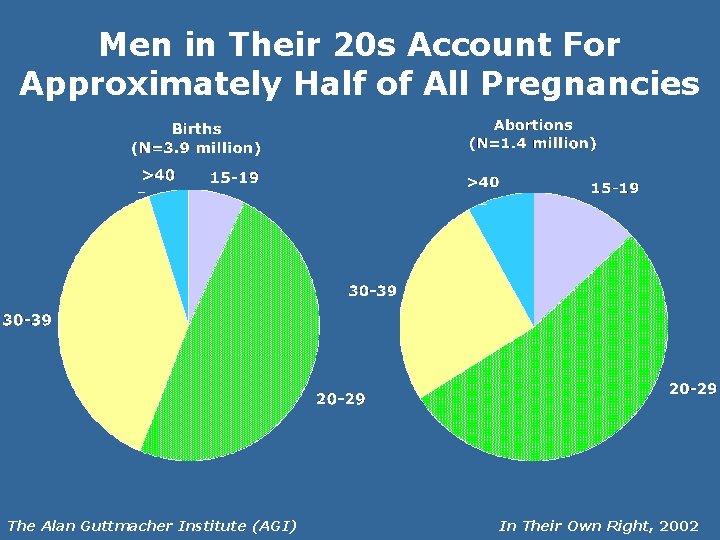
Men in Their 20 s Account For Approximately Half of All Pregnancies The Alan Guttmacher Institute (AGI) In Their Own Right, 2002
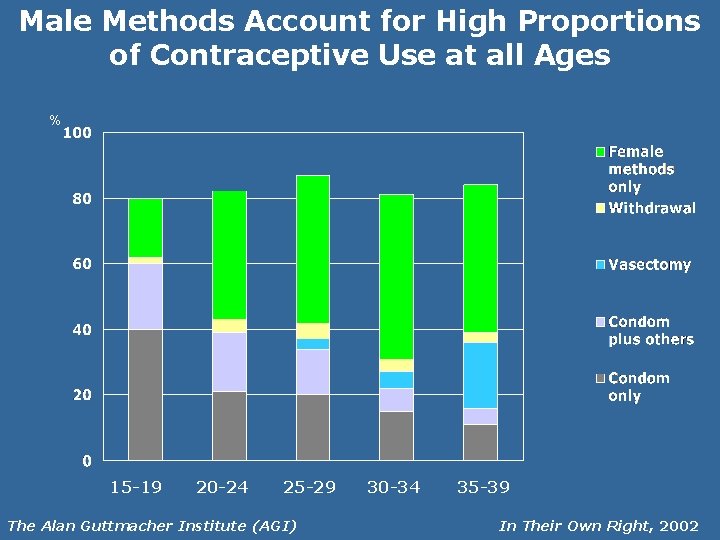
Male Methods Account for High Proportions of Contraceptive Use at all Ages % 15 -19 20 -24 25 -29 The Alan Guttmacher Institute (AGI) 30 -34 35 -39 In Their Own Right, 2002
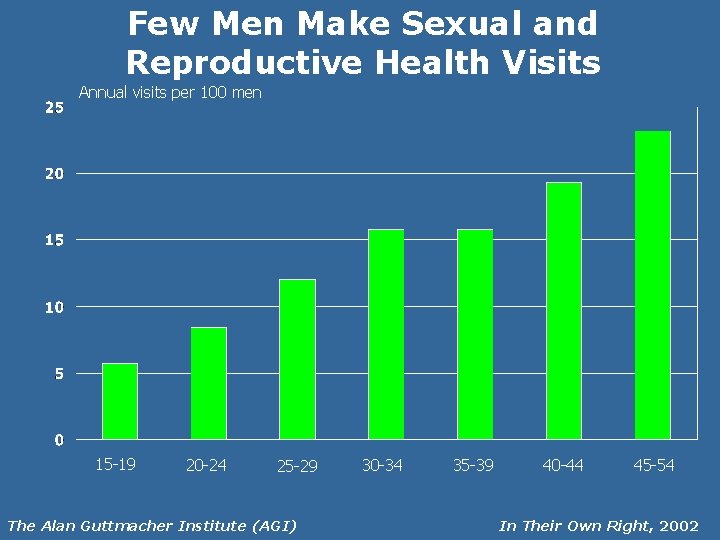
Few Men Make Sexual and Reproductive Health Visits Annual visits per 100 men 15 -19 20 -24 25 -29 The Alan Guttmacher Institute (AGI) 30 -34 35 -39 40 -44 45 -54 In Their Own Right, 2002
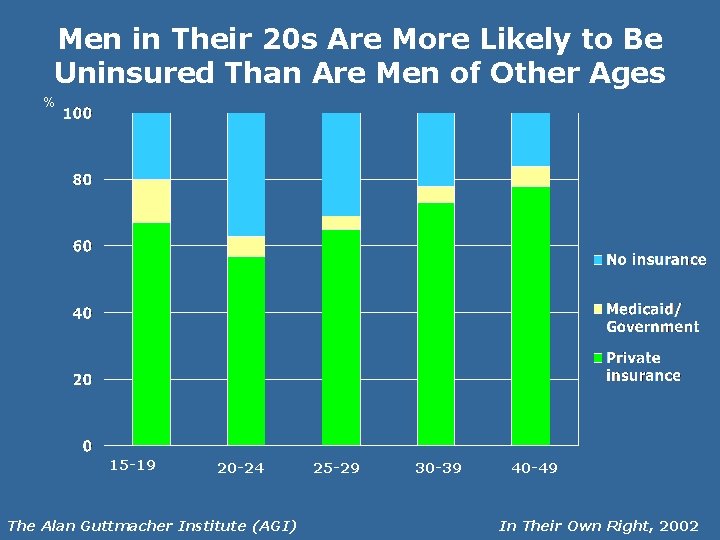
Men in Their 20 s Are More Likely to Be Uninsured Than Are Men of Other Ages % 15 -19 20 -24 The Alan Guttmacher Institute (AGI) 25 -29 30 -39 40 -49 In Their Own Right, 2002
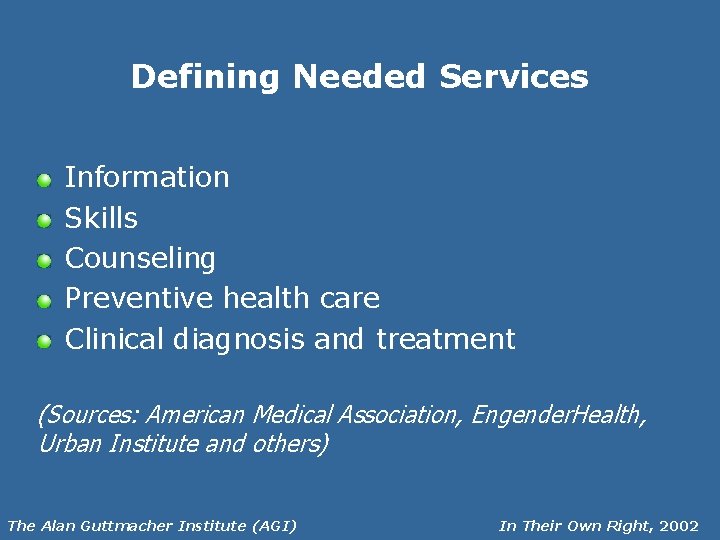
Defining Needed Services Information Skills Counseling Preventive health care Clinical diagnosis and treatment (Sources: American Medical Association, Engender. Health, Urban Institute and others) The Alan Guttmacher Institute (AGI) In Their Own Right, 2002
Information Basic sexuality and reproductive health education Genital health and hygiene Healthy relationships Pregnancy prevention Sexually transmitted diseases, including HIV Fatherhood Where and how to obtain other services The Alan Guttmacher Institute (AGI) In Their Own Right, 2002
Skills Pregnancy and STD prevention and sexual health skills: Risk assessment and avoidance Resisting peer pressure Communicating with partners Using contraceptives properly Fatherhood skills The Alan Guttmacher Institute (AGI) In Their Own Right, 2002
Counseling Self-concept Life events and decision-making Values and motivation The Alan Guttmacher Institute (AGI) In Their Own Right, 2002
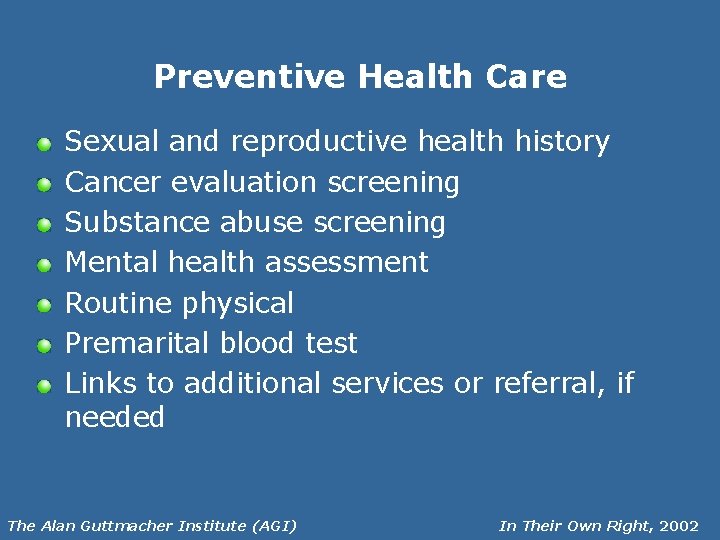
Preventive Health Care Sexual and reproductive health history Cancer evaluation screening Substance abuse screening Mental health assessment Routine physical Premarital blood test Links to additional services or referral, if needed The Alan Guttmacher Institute (AGI) In Their Own Right, 2002
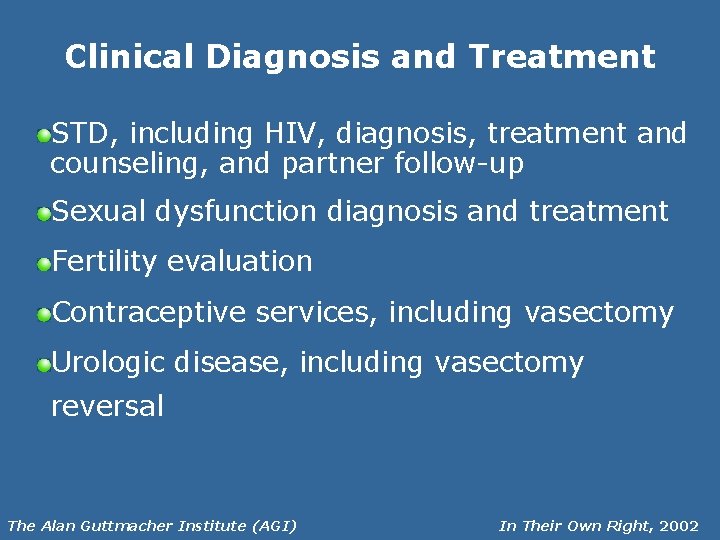
Clinical Diagnosis and Treatment STD, including HIV, diagnosis, treatment and counseling, and partner follow-up Sexual dysfunction diagnosis and treatment Fertility evaluation Contraceptive services, including vasectomy Urologic disease, including vasectomy reversal The Alan Guttmacher Institute (AGI) In Their Own Right, 2002
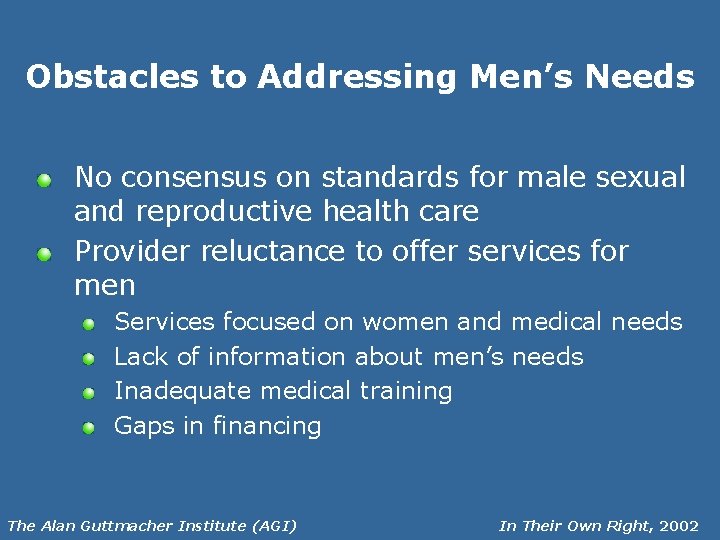
Obstacles to Addressing Men’s Needs No consensus on standards for male sexual and reproductive health care Provider reluctance to offer services for men Services focused on women and medical needs Lack of information about men’s needs Inadequate medical training Gaps in financing The Alan Guttmacher Institute (AGI) In Their Own Right, 2002
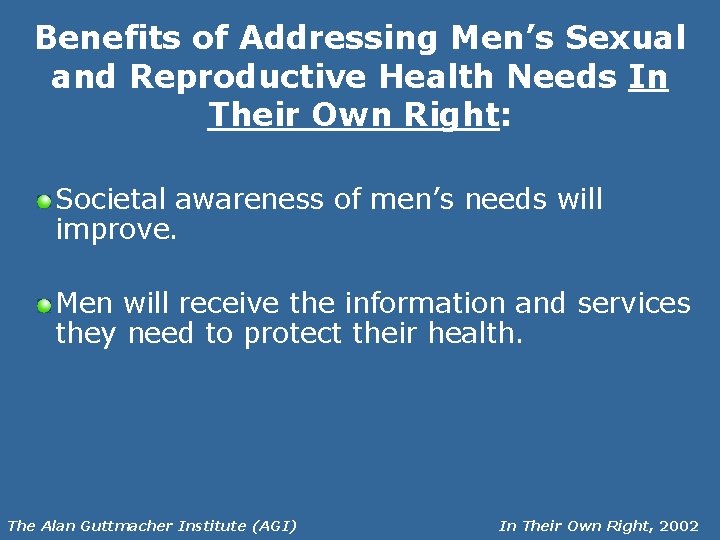
Benefits of Addressing Men’s Sexual and Reproductive Health Needs In Their Own Right: Societal awareness of men’s needs will improve. Men will receive the information and services they need to protect their health. The Alan Guttmacher Institute (AGI) In Their Own Right, 2002
Benefits of Addressing Men’s Sexual and Reproductive Health Needs In Their Own Right: The scope of services available for men and women will expand. Unintended pregnancies and sexually transmitted diseases will be reduced, and healthier pregnancies and better parenting will be promoted. The Alan Guttmacher Institute (AGI) In Their Own Right, 2002
- Slides: 26