
MARC 21 FRBR RDA Objectives Connect MARC fields
MARC 21, FRBR, RDA

Objectives Connect MARC fields and subfields to the appropriate entity and attribute of FRBR ¡ Recognize how RDA uses MARC ¡ 2

What is the difference? ¡ FRBR is a conceptual model l ¡ RDA is a content standard (as is AACR 2) l ¡ What information is recorded and how MARC is a communication format l ¡ How information is described and organized Computer code to consistently handle the data recorded They are not the same thing l Be careful of your vocabulary 3
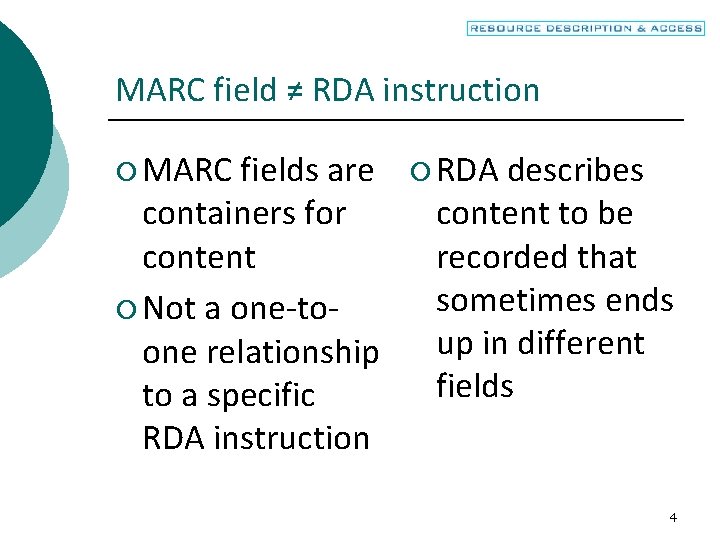
MARC field ≠ RDA instruction ¡ MARC fields are containers for content ¡ Not a one-toone relationship to a specific RDA instruction ¡ RDA describes content to be recorded that sometimes ends up in different fields 4

MARC data ¡ What does the MARC bibliographic record contain? l ¡ A “mashup” of WEMI and sometimes also person/family/corporate body information What does the MARC authority record contain? l Identifying information for the described entity (person, family, corporate body, creator/work/expression), including the “authorized access point” to be used in the MARC environment 5

Change in RDA from AACR 2/MARCthinking ¡ No “main entry” in RDA ¡ No “entry under” a heading in RDA

MARC bibliographic record and FRBR Entities: summary 1 XX = person, family, corporate body, work, expression 130/240 = work, expression 245 -260, 490 = manifestation 300 = expression, manifestation other 3 XX = work, expression, manifestation 5 XX = work, expression, manifestation, item 700 -730 = person, family, corporate body, work, expression 760 -787 = related work, expression, manifestation 8 XX = work, expression, manifestation Slide modified from Judy Kuhagen’s Module A presentation on RDA 7

Example 1 A: Identify the FRBR entity and attribute Creator of Work (relationship) 1 Title of Work 2 Language of Expression 3 4 COIN Title of Manifestation 8

Example 1 B: Identify the FRBR entity and attribute Other title information of Manifestation 1 2 Statement of Responsibility of Manifestation 3 COIN Note of Translation (relationship) Expression 9
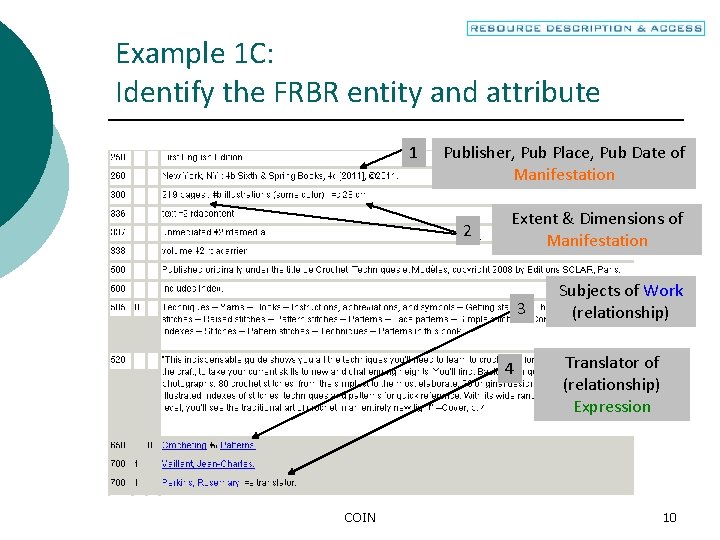
Example 1 C: Identify the FRBR entity and attribute 1 Publisher, Pub Place, Pub Date of Manifestation 2 Extent & Dimensions of Manifestation 3 4 COIN Subjects of Work (relationship) Translator of (relationship) Expression 10

Example 1 D: Identify the FRBR entity and attribute 1 2 COIN Index as Supplementary content Expression Note with Summary of content Expression 11
Conclusions One bib record has attributes from many entities of the FRBR structure ¡ Attribute data (identifying characteristics of the entity) may be in a subfield or a field in a MARC record ¡ 12

What about the 008? ¡ ¡ Attribute information is also recorded in the 008 Repeated information and new information 13
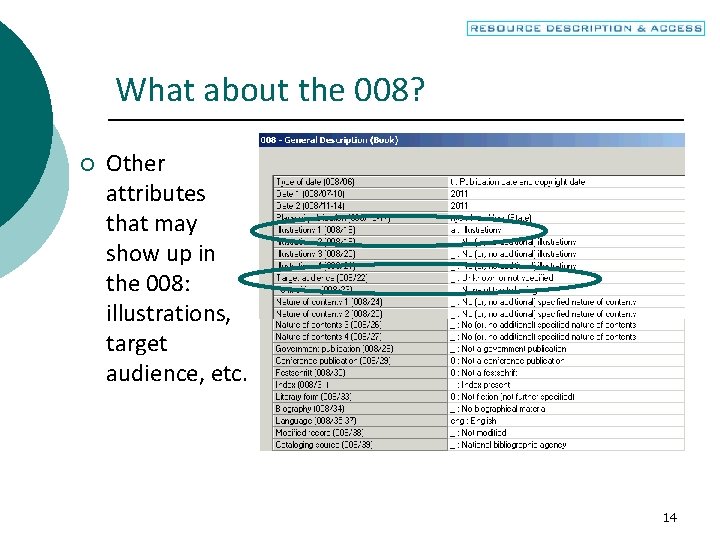
What about the 008? ¡ Other attributes that may show up in the 008: illustrations, target audience, etc. 14
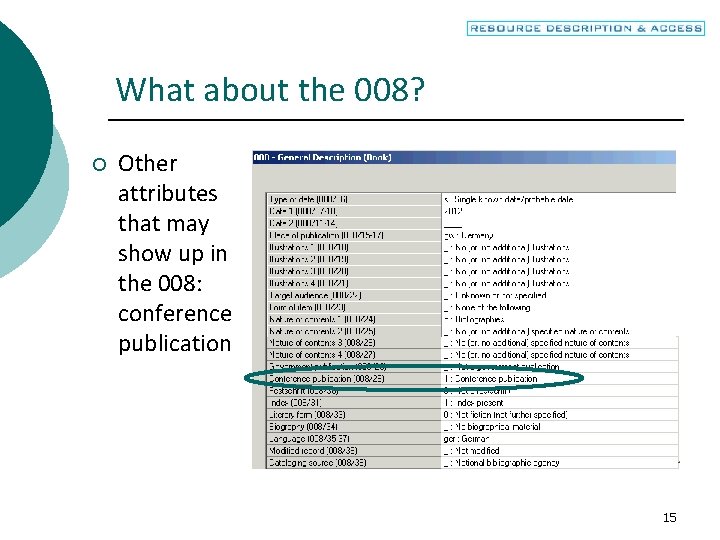
What about the 008? ¡ Other attributes that may show up in the 008: conference publication 15
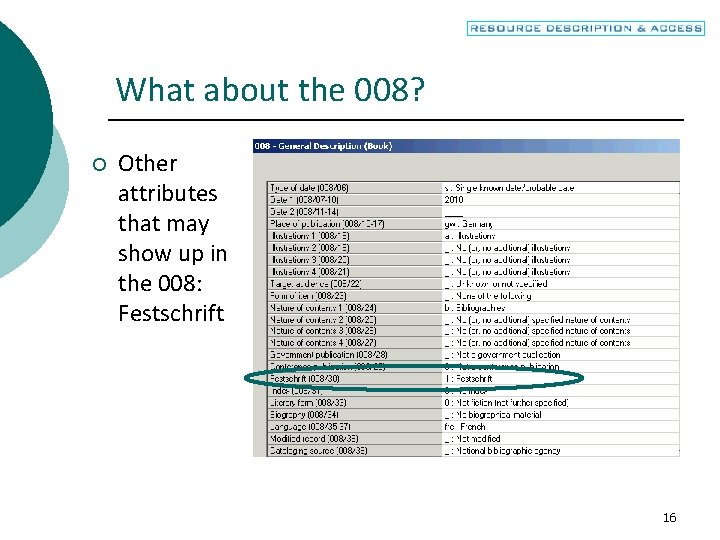
What about the 008? ¡ Other attributes that may show up in the 008: Festschrift 16
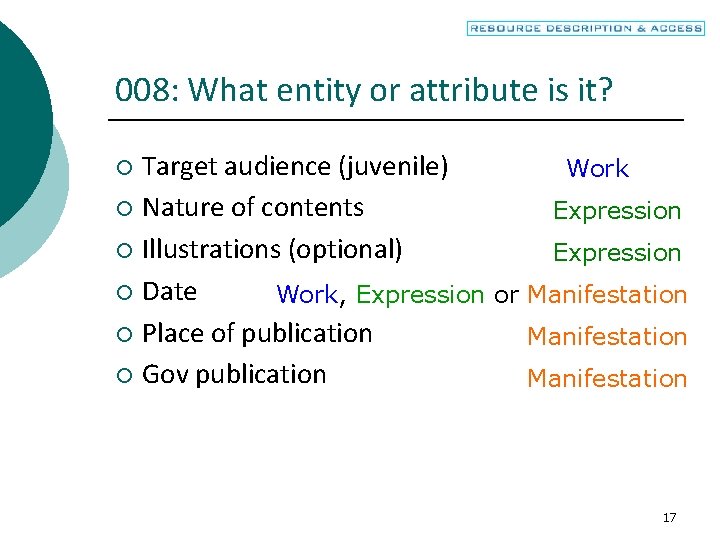
008: What entity or attribute is it? Target audience (juvenile) Work ¡ Nature of contents Expression ¡ Illustrations (optional) Expression ¡ Date Work, Expression or Manifestation ¡ Place of publication Manifestation ¡ Gov publication Manifestation ¡ 17
So, now what? ¡ So, now we will look at specific fields that may offer challenges as we apply RDA 19
Fields with things to note 1 XX, 7 XX fields can use the $e or $i subfield (relationship designators) ¡ 130 for the contained work ¡ -may be seen more, with qualifiers to break title conflicts in some cases -will be seen less for some compilations ¡ 240 may be used in places it wasn’t used before for some compilations 20
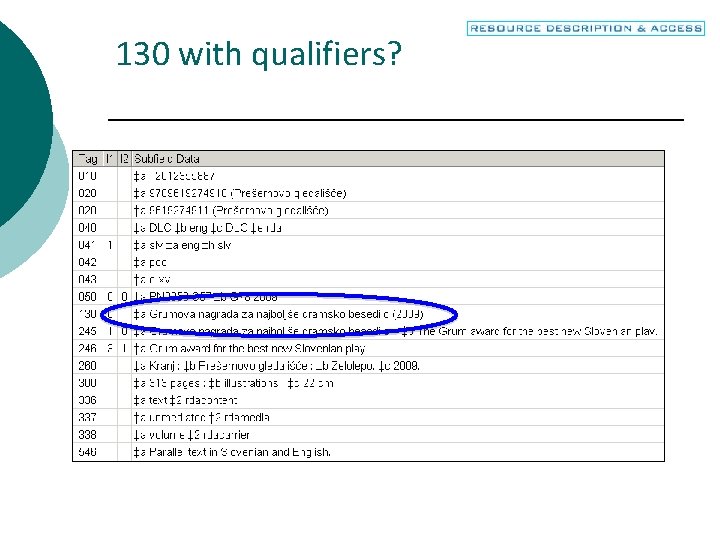
130 with qualifiers?
130 or 240 field New title proper, not revised = new manifestation with 240 for the original work’s “preferred title” (same as AACR 2) ¡ Same title proper , but revised content = new expression: no 240 needed (same as AACR 2) ¡ New title proper, revised content = new expression plus 240 for the original work’s “preferred title” (NOT same as AACR 2) ¡ l 500 &/or 775 option for earlier edition, NOT title or name/title added entry (NOT same as AACR 2) 22
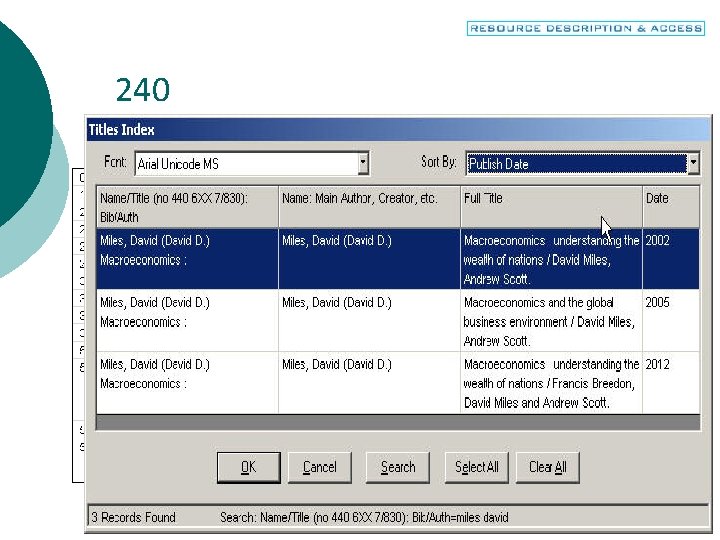
240 23
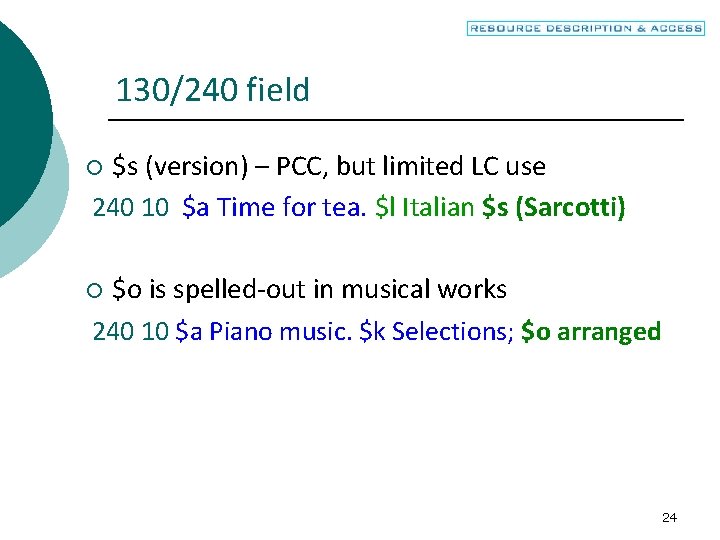
130/240 field $s (version) – PCC, but limited LC use 240 10 $a Time for tea. $l Italian $s (Sarcotti) ¡ $o is spelled-out in musical works 240 10 $a Piano music. $k Selections; $o arranged ¡ 24

Fields with things to note ¡ ¡ 300 l Repetition of the field l $b for illustrative content is now optional except for resources intended for children (Expression attribute) l use of $e (not new, but possibly more frequent) l recording duration for Music (Expression attribute) 5 XX l 500 – more variety of information l 502 – we now use subfields instead of just text l 505 – more frequent usage l 546 – not just for language; non-Roman uses it for script; Music uses this form of musical notation 25
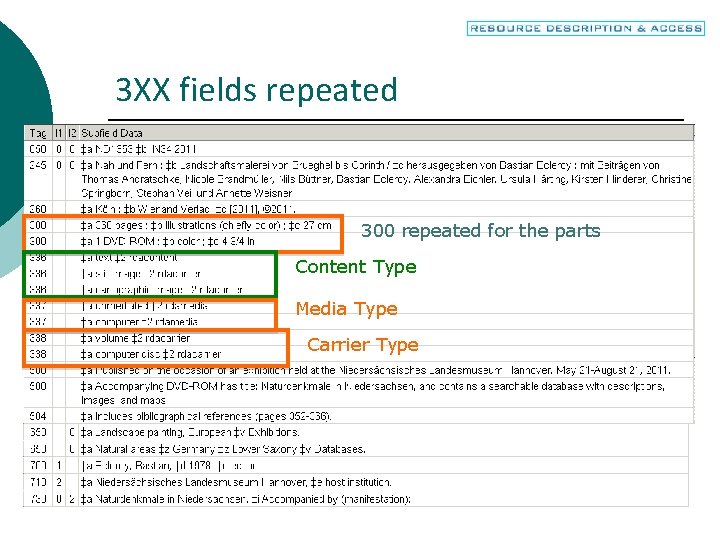
3 XX fields repeated 300 repeated for the parts Content Type Media Type Carrier Type
Fields with things to note ¡ 7 XX is used in many more ways, though many of them are optional l l The use of the $e or $i subfield to describe relationships 700/711/730/740 : not truly different 7 XX name/title entries used more for some compilations Linking fields offer many more options 27
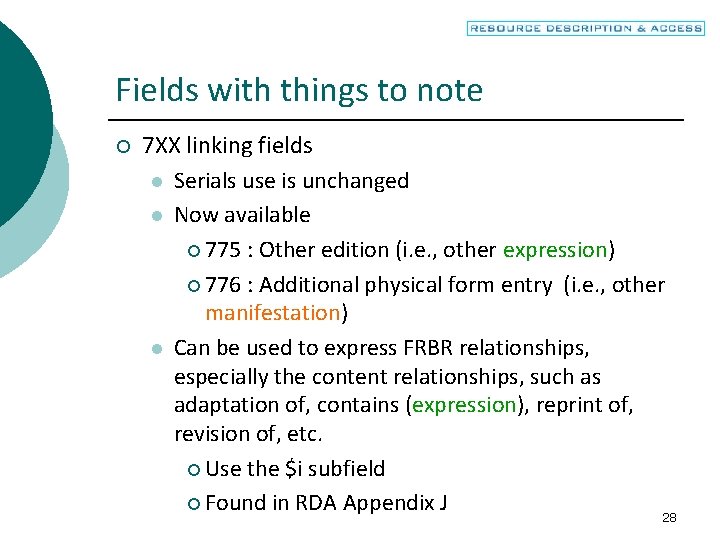
Fields with things to note ¡ 7 XX linking fields l Serials use is unchanged l Now available ¡ 775 : Other edition (i. e. , other expression) ¡ 776 : Additional physical form entry (i. e. , other manifestation) l Can be used to express FRBR relationships, especially the content relationships, such as adaptation of, contains (expression), reprint of, revision of, etc. ¡ Use the $i subfield ¡ Found in RDA Appendix J 28

775 in action

776 in action

New bibliographic fields 336 : (RDA 6. 9) Content type 337 : (RDA 3. 2) Media type 338 : (RDA 3. 3) Carrier type Closed vocabularies (RDA/ONIX Framework) l Repeat the field rather than repeat the $a (term) (LC policy) l $3 (Materials specified) is your judgment l $b (code) is pass-through element l Same information may be found in 300 or 500 with different details l 31
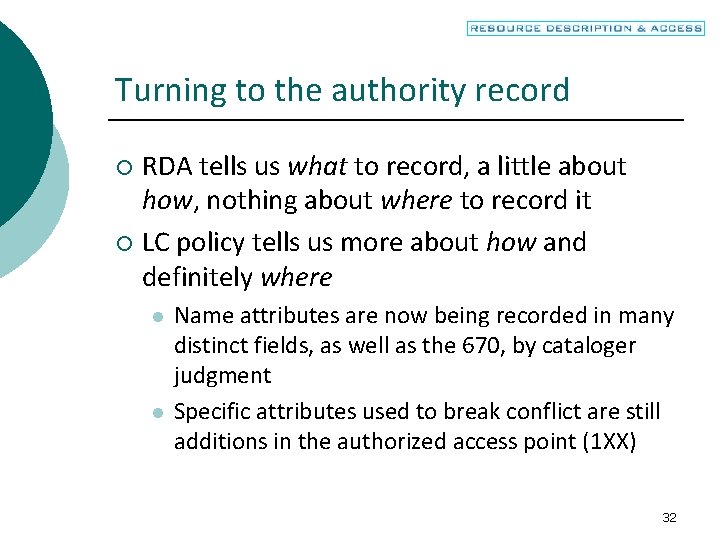
Turning to the authority record RDA tells us what to record, a little about how, nothing about where to record it ¡ LC policy tells us more about how and definitely where ¡ l l Name attributes are now being recorded in many distinct fields, as well as the 670, by cataloger judgment Specific attributes used to break conflict are still additions in the authorized access point (1 XX) 32
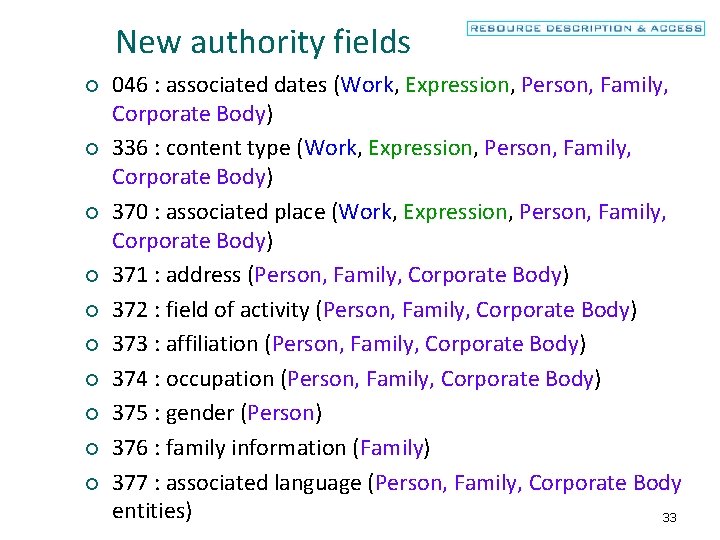
New authority fields ¡ ¡ ¡ ¡ ¡ 046 : associated dates (Work, Expression, Person, Family, Corporate Body) 336 : content type (Work, Expression, Person, Family, Corporate Body) 370 : associated place (Work, Expression, Person, Family, Corporate Body) 371 : address (Person, Family, Corporate Body) 372 : field of activity (Person, Family, Corporate Body) 373 : affiliation (Person, Family, Corporate Body) 374 : occupation (Person, Family, Corporate Body) 375 : gender (Person) 376 : family information (Family) 377 : associated language (Person, Family, Corporate Body entities) 33
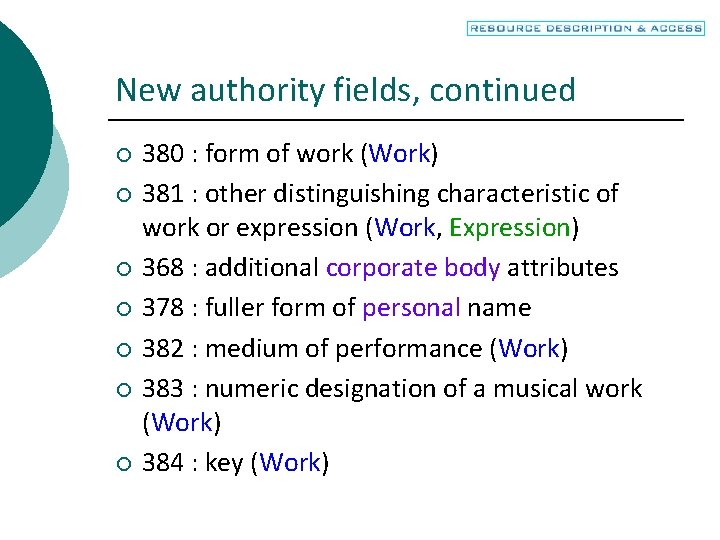
New authority fields, continued ¡ ¡ ¡ ¡ 380 : form of work (Work) 381 : other distinguishing characteristic of work or expression (Work, Expression) 368 : additional corporate body attributes 378 : fuller form of personal name 382 : medium of performance (Work) 383 : numeric designation of a musical work (Work) 384 : key (Work)
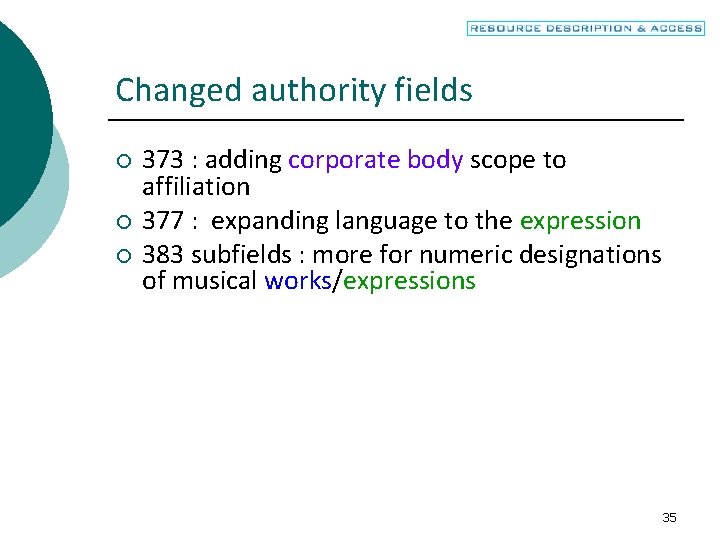
Changed authority fields ¡ ¡ ¡ 373 : adding corporate body scope to affiliation 377 : expanding language to the expression 383 subfields : more for numeric designations of musical works/expressions 35
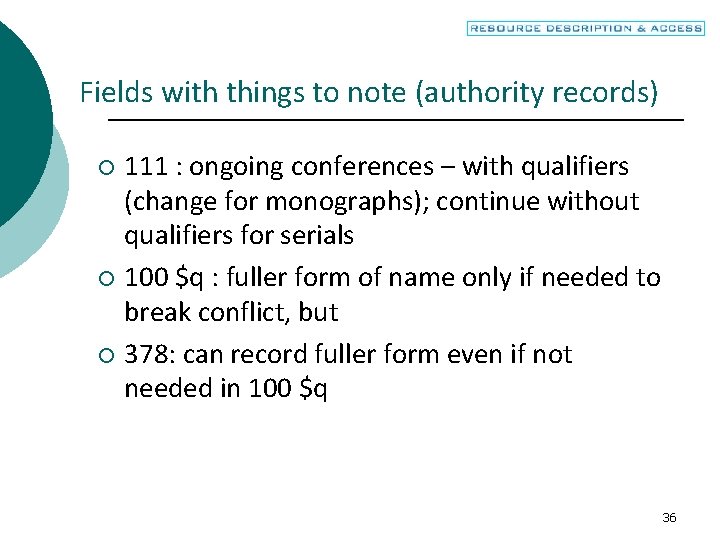
Fields with things to note (authority records) 111 : ongoing conferences – with qualifiers (change for monographs); continue without qualifiers for serials ¡ 100 $q : fuller form of name only if needed to break conflict, but ¡ 378: can record fuller form even if not needed in 100 $q ¡ 36

Relationships Entities and attributes (“elements” in RDA) are found in the bibliographic and authority fields. Where are the relationships? ¡ ¡ Given by the cataloger: 1 XX & 7 XX $e/$i, 7 XX linking fields, 5 XX text notes, 490 Transcribed from the resource: 245 $c Sometimes not specified Examples in authority records: earlier/later, links between persons/corporate bodies, etc. 37
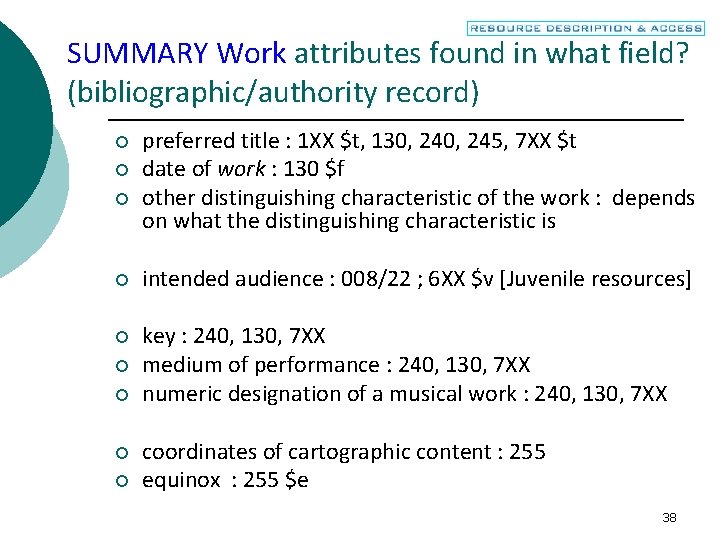
SUMMARY Work attributes found in what field? (bibliographic/authority record) ¡ ¡ ¡ preferred title : 1 XX $t, 130, 245, 7 XX $t date of work : 130 $f other distinguishing characteristic of the work : depends on what the distinguishing characteristic is ¡ intended audience : 008/22 ; 6 XX $v [Juvenile resources] ¡ key : 240, 130, 7 XX medium of performance : 240, 130, 7 XX numeric designation of a musical work : 240, 130, 7 XX ¡ ¡ coordinates of cartographic content : 255 equinox : 255 $e 38
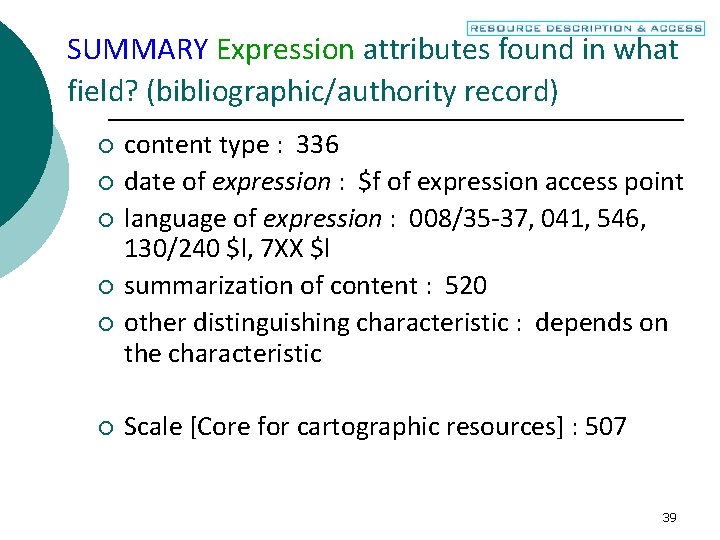
SUMMARY Expression attributes found in what field? (bibliographic/authority record) ¡ ¡ ¡ content type : 336 date of expression : $f of expression access point language of expression : 008/35 -37, 041, 546, 130/240 $l, 7 XX $l summarization of content : 520 other distinguishing characteristic : depends on the characteristic Scale [Core for cartographic resources] : 507 39
SUMMARY Manifestation attributes found in what bibliographic record field? ¡ ¡ ¡ ¡ title proper : 245 $a statement of responsibility for the title proper : 245 $c edition statement : 250 $a place of publication/distribution/manufacture/ production : 264 $a publisher/distributor/manufacturer/producer : 264 $b date of publication/distribution/manufacture/ production : 264 $c series statement : 490 40
SUMMARY Manifestation attributes found in what field? (continued) ¡ ¡ ¡ ¡ ¡ carrier type : 338 media type : 337 extent : 300 $a dimensions : 300 $c identifier for the manifestation : 020, etc. mode of issuance : 362 physical medium : 340 URL : 856 frequency : 310/321 note on changes in carrier characteristics : 500 41
SUMMARY Manifestation attributes found in what field? (continued) ¡ ¡ digital file characteristic : 352 layout of cartographic images : 42
SUMMARY Item attributes found in what bibliographic record or item record field? ¡ restrictions on use : 5 XX ¡ item identifier : barcode in Item record access restrictions on the item : 5 XX ¡ 43
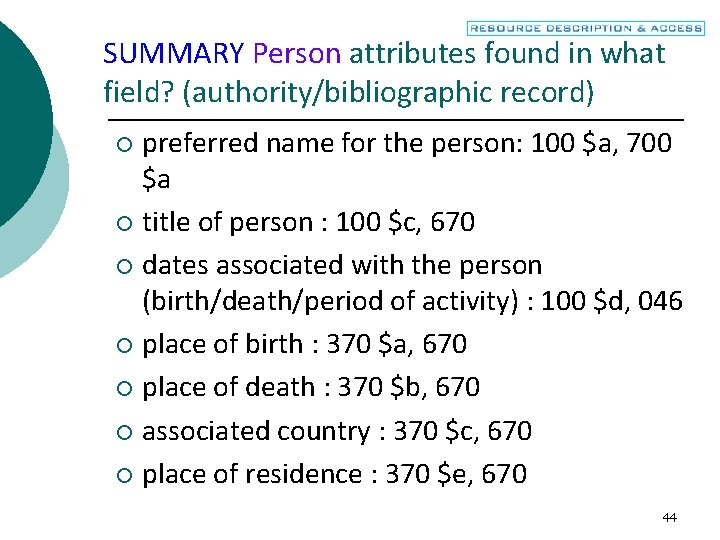
SUMMARY Person attributes found in what field? (authority/bibliographic record) preferred name for the person: 100 $a, 700 $a ¡ title of person : 100 $c, 670 ¡ dates associated with the person (birth/death/period of activity) : 100 $d, 046 ¡ place of birth : 370 $a, 670 ¡ place of death : 370 $b, 670 ¡ associated country : 370 $c, 670 ¡ place of residence : 370 $e, 670 ¡ 44
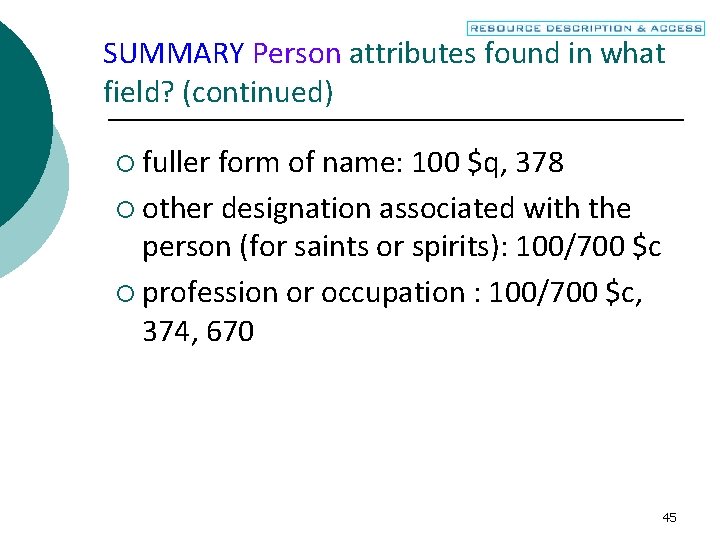
SUMMARY Person attributes found in what field? (continued) ¡ fuller form of name: 100 $q, 378 ¡ other designation associated with the person (for saints or spirits): 100/700 $c ¡ profession or occupation : 100/700 $c, 374, 670 45
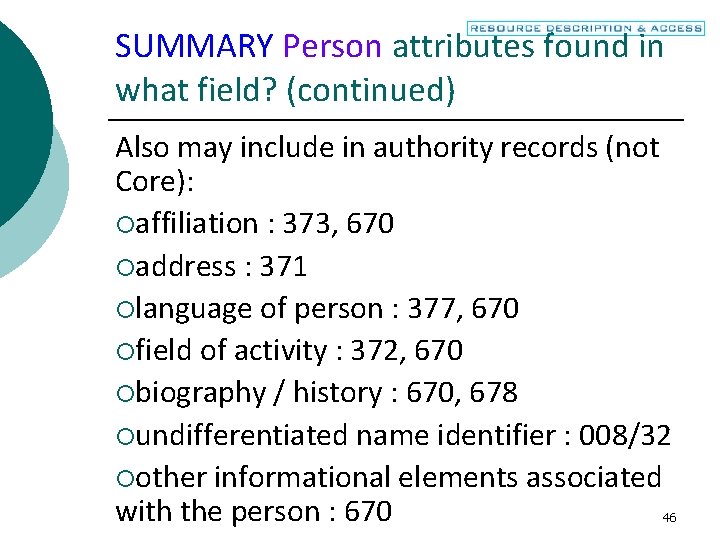
SUMMARY Person attributes found in what field? (continued) Also may include in authority records (not Core): ¡affiliation : 373, 670 ¡address : 371 ¡language of person : 377, 670 ¡field of activity : 372, 670 ¡biography / history : 670, 678 ¡undifferentiated name identifier : 008/32 ¡other informational elements associated with the person : 670 46
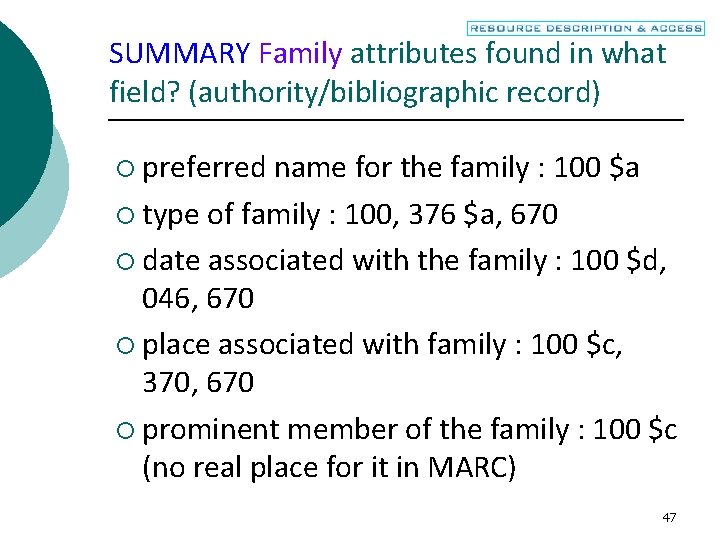
SUMMARY Family attributes found in what field? (authority/bibliographic record) ¡ preferred name for the family : 100 $a ¡ type of family : 100, 376 $a, 670 ¡ date associated with the family : 100 $d, 046, 670 ¡ place associated with family : 100 $c, 370, 670 ¡ prominent member of the family : 100 $c (no real place for it in MARC) 47
SUMMARY Corporate Body attributes found in what field? (authority/bibliographic record) ¡ ¡ ¡ ¡ preferred name of the corporate body: 110 or 111 $a number of a conference, etc. : 111 $n place associated : 110, 111 $c, 370, 670 date associated : 046, 110, 111 $d, 670 associated institution: 111 $670 other designation associated with the corporate body: 368 other information associated with the corporate body : 670 48
Exercises ¡ Look at the handouts, and we’ll work through them to identify the entity and attribute of the different fields 49
- Slides: 48