
Marathi Journalism A detailed study Transformation of Marathi












- Slides: 48
Marathi Journalism A detailed study
Transformation of Marathi papers 1. Viewspaper: Acted as the mouthpiece, was to educate the people (pre-independence). 2. Newspaper: Objectives changed to equality, democracy, development and in the interest of mankind (post-independence). 3. Newspaper as a business proposition: Objective shifted to profits. They aimed at educating the people with a certain political, social and economic inclination.
THE BEGINNINGS • On January 6, 1832, Bal Shastri Jambhekar began Darpan, a Marathi-English fortnightly magazine • By 27 th April 1832 it became an 8 page weekly • It was the first medium of Marathi expression
PRABHAKAR (1841) • On 24 October 1841, Govind Vithal Kunte began Prabhakar • Kunte was the first professional Marathi journalist Prabhakar eulogised Indian art and culture JNYANODAYA (1842) It was started by Christian Missionaries in Western India
JNYAN PRAKASH (1849) • Jnyan Prakash was started on 12 February 1849 in • • • Pune It was edited by Krishnaraj Trimbak Ranade It was a weekly till 1904, when it became a daily It ceased publication in 1951 It was a prestigious journal and supported education and social reform Hari Narayan Apte, a famous Marathi novelist served as its editor Some of its contributors included Mahadev Govind Ranade and Gopal Krishna Gokhale
THE EARLY YEARS • In the early years of Marathi journalism, most periodicals were concerned with spreading education and knowledge • These include • Jaganmitra (from Ratnagiri), • Shubh Suchak (from Satara), • Vartaman Dipika, Vartaman Sangrah
INDUPRAKASH (1862) • In 1862, Induprakash was started in Bombay • It was a • bilingual journal, • edited by M. G. Ranade • It • criticised orthodoxy and • was the mouthpiece of many social reforms
DEENABANDHU (1877) • In 1877, Jyotiba Phule and Krishnarao Bhaskar began Deenabandhu, as part of the Dalit upliftment movement • Deenabandhu was the organ of the Satyashodhak Samaj founded by Phule
KESARI (1881) • On 4 January 1881, Bal Gangadhar Tilak began Kesari, along with Gopal Ganesh Agarkar
SUDHARAK (1887) • In 1887, Agarkar left to start Sudharak (bilingual) along with Gopal Krishna Gokhale • After Agarkar's death in 1895, it ceased publication
VARTAHAR (1889) • In 1889, K. Navalkar started the weekly Vartahar to highlight atrocities committed by Europeans
KARMANUK (1890) • In 1890, Haribhau Apte began Karmanuk as a family entertainment paper • It contained articles on science
BHOOT (1890) • In 1890, Anandrao Ramachandra Dharandhar started Bhoot • Published on every new and full moon day • It was the first Marathi paper to carry cartoons on political and social matters • It was very popular but ceased publication in 1904
KESARI-'Speaking fearlessly and forthrightly' • • Bal Gangadhar Tilak, along with like minded colleagues, started 2 papers i) Kesari - Jan 4, 1881 (Marathi) ii) Mahratta - Jan 2, 1881 (English) Kesari became a symbol of the Freedom Movement. Tilak managed the two newspapers from Kesari Wada, Pune, which now is a museum. Kesari was the principal mouthpiece of the Extremist Nationalistic Politics in the whole country.
Ownership • Started by Tilak, Vishnu Chiplunkar, Vaman Apte, Gopal Agarkar, and others. • Chiplunkar died in 1882. Kesari was then taken over by Tilak and Agarkar. • Dispute between the two led to Agarkar quitting to join Sudharak with Gopal K. Gokhale. • Tilak took charge of Kesari and Mahratta, both.
Objectives of Kesari • Swarajya • Swadeshi • Boycott • National Education • Surajya
Kesari and the Swadeshi Movement in Maharashtra • • Swadeshi Movement: Started as an agitation against Partition of Bengal (1905 by Lord Curzon) and led to complete boycott of British goods. 'Militant Nationalists' led by Tilak, B. C. Pal, L. L. Rai, Aurobindo Ghosh advocated to extend the movement to the rest of India and change it into a full fledged political mass struggle - Kesari acted as an essential weapon.
• Kesari was of the view that the colonial rule changed the economic structure of pre-colonial India after coming of the British Government, the trade declined, industries declined, prosperity put to an end, wealth drained to England (Kesari, 1908) • It explained that Indian trade declined during the colonial period because of the Government policies for the advancement of the British businessmen (1907). In regard to the decline of the Indian Industries, Kesari was of the view that they declined to the encouragement given for the interest of the Lancashire textile industry the Lancashire industries destroyed the employment of Indian weavers. . therefore the first task of the Swadeshi movement is to remove the impact of this industry from India
• • Kesari aimed at encouraging local producers (weavers and other artisans) and development of indigenous industries. Since Tilak was an extremist leader, he used Kesari as a medium to express his views against the Moderate Congress politicians.
Ganpati and Shivaji festival Main aim was to stimulate the spirits of the people by transforming them into public performances as well as help to popularise the Indian National Congress. Introduction of these festivals gave the people a reason to gather and thus the purpose of mass communication, in that time, was served.
Negative effects resulted in Hindu-Muslim conflict. Kesari clarified : the Shivaji festival is not celebrated to alienate or even to irritate you (Muslims). Time is changed and the Mohammedans and the Hindus are in the same boat so far as the political conditions of the people are concerned. Can`t both of us derive inspiration from the life of Shivaji under the circumstances?
National Education • Kesari was of the view that the education which was given in India under colonial rule was to enslave the students` mind. The National Education movement emphasised : i) Indian control over education ii) teaching of the love of motherland, patriotism and national integration. It advocated the growth of Indian languages as a medium of education. Hence, it also came in Gujarati and Hindi for some time. • •
Editorship • Tilak was the editor of Mahratta and Agarkar of Kesari. • In 1887, Agarkar quit, Tilak took charge of Kesari. • By 1891, Tilak became the legal owner of both. • Post Tilak`s demise, N. C. Kelkar became the editor. • The Tilak family carried on the legacy: late Jayantrao Tilak, late Indutai Tilak, Late Gouri Tilak and Deepak Tilak.
New Experiments • Initially, it was a weekly- every Tuesday. • Late N. C. Kelkar made it a bi-weekly - Tue and Fri on 3 rd August, 1929 • On 2 nd Jan, 1951, became a tri-weekly - Tue, Fri, Sun • It became a daily under the editorship of late Jayantrao Tilak
The Heritage • The Kesari-Mahratta Trust has been publishing • • daily Kesari for 130 years now. (completed 130 yrs on Jan 4, 2011) It is regarded as National wealth Kesari started its editions from Solapur, Sangi, Ahmednagar and Chiplun. Also from Junagarh in Gujarati language.
SAKAL (Morning) • Founder: N B Parulekar • Started in 1932 • Nationalistic Ideals • To advance Gandhi movement for independence
Was Ridiculed • Parulekar's Sakal hired reporters, paid stringers in • small towns and covered crucial local topics like fluctuations in the price of mangoes. People used to joke about its [Sakal's] district and taluka correspondents' reports about village fairs, pilgrimages and crops.
The Progress • But Sakal built a place in the hearts of the people of Pune and its neighbourhood - and a circulation • By the early 1960 s, Sakal sold 69, 000 copies a day
• • Though begun as a part of the nationalist cause, it established itself as a successful business by making day-to-day concerns, not just of Pune but its rural neighbourhood, a preoccupation By the 1960 s, Sakal kept full-time correspondents, each with a telephone, in every town in its neighbourhood. It ran training camps for its journalists, promotions and cultural events for its readers and letters to the editor on its front page
Death of Parulekar • • • Parulekar converted Sakal into a private limited company in 1948, with himself, his French wife, their daughter and one or two other shareholders. He died in 1973. Sakal survived the first shocks of the India's revolution in newspaper technology -and carried on for more than 10 years. But he also left a complicated ownership structure: a minority of shares went to his wife and daughter but most went to individual trustees and to a trust.
Dispute over the ownership • The widow and daughter did not appear to get on • well with the trustees and the trust who put their shares on the market at the end of 1984. Pawar family bought them over at the end of 1984 against the will of Parulekar's wife and daughter.
Turning Point • At the same time, the rapid changes overtaking the newspaper industry, and the death of the longserving editor, S G Mungekar in 1985, reinforced the sense that Sakal was at a turning point
Drop in sales • The rival newspapers like, Loksatta and • Maharashtra Times were recording rapid increase in their sales. While sales of Sakal were dropping rapidly
The Dawn • Pawars turned the paper into Public Ltd Co. in 1989 • P G Pawar, a brother of the politician, became managing director • Emphasising marketing, he sent representatives around India to promote the paper and overseas to study marketing techniques.
• • The new owners adopted marketing surveys, new management practices, aggressive selling of advertising and improvement in labour-saving technology Sakal's annual turnover grew by five times in eight years - from Rs 60 million to Rs 300 million.
Growth in Advertisement • India's economic liberalisation' that began in 1991 greatly aided the hunt. • Between 1990 and 1993 Sakal raised its advertising rates three times, but the ads kept flowing in as Sakal told advertisers about the purchasing power of rural Maharashtra, and television manufacturers and financial houses looked for ways to sell products and raise capital.
• According to Indian Readership Survey (IRS) 2012 of Q 1 Sakal was on the top ten Language Dailies with 43, 96, 000
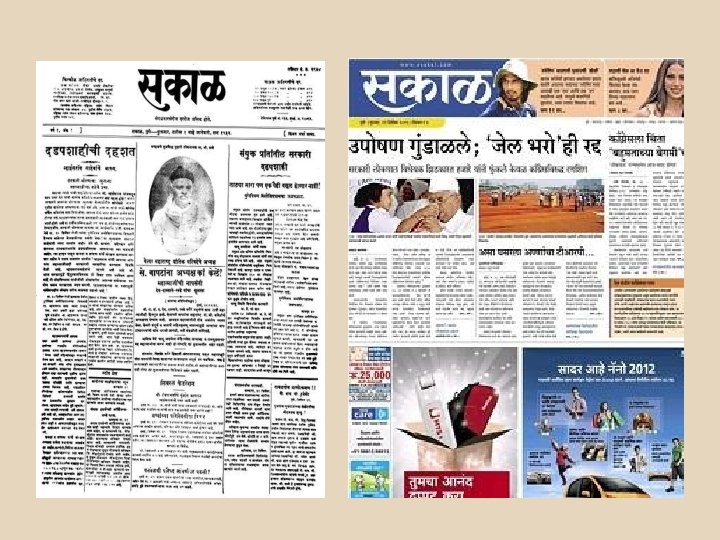
Transition • Sakal started a separate pull out for local content. A • traditional Marathi newspaper, Sakal adopted ‘Today’, an English title of the pullout. In 2006/07, ‘Today’ was launched across all major cities of Maharashtra.
Design It concentrated on multimedia activities and emerged as a Multimedia House. World renowned newspaper designer Mario Garcia (Sr. ) redesigned Sakal newspaper in year 2007 -2008. The new look of Sakal was flashy, energetic and colorful. The masthead of Sakal changed to blue reverse. Garcia Design implemented successfully across the Maharashtra.
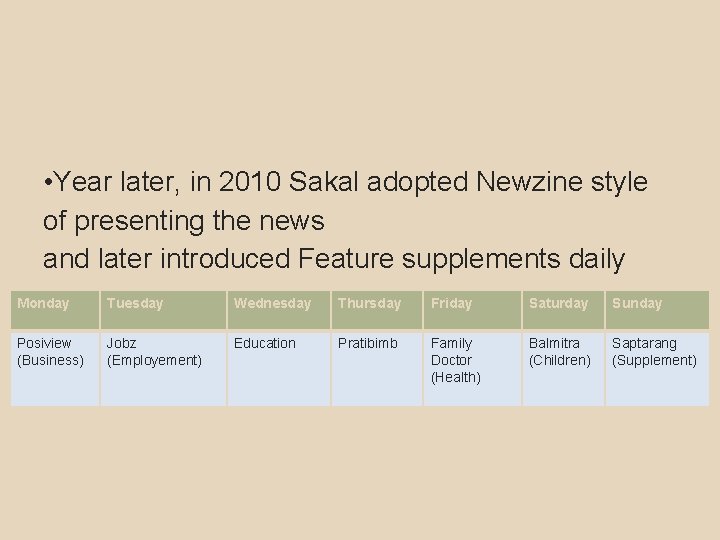
• Year later, in 2010 Sakal adopted Newzine style of presenting the news and later introduced Feature supplements daily Monday Tuesday Wednesday Thursday Friday Saturday Sunday Posiview (Business) Jobz (Employement) Education Pratibimb Family Doctor (Health) Balmitra (Children) Saptarang (Supplement)
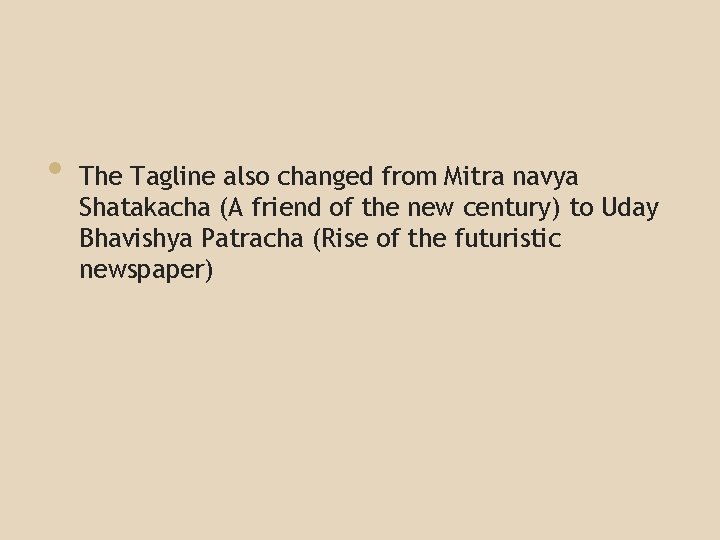
• The Tagline also changed from Mitra navya Shatakacha (A friend of the new century) to Uday Bhavishya Patracha (Rise of the futuristic newspaper)
Adapting to new ways • It started it epaper it also started something called • as epaperfacility for the diasporic audiences in USA, UK and UAE. SAAM TV was founded in 2008 marking it's step towards Television Broadcasting.
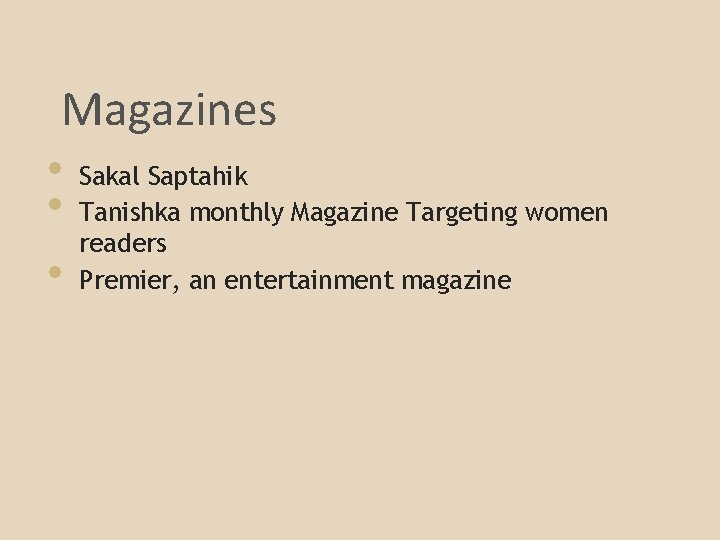
Magazines • Sakal Saptahik • Tanishka monthly Magazine Targeting women readers • Premier, an entertainment magazine
Thank You
References https: //www. google. co. in/#hl=en&sugexp=eqrwrth&gs_nf=1&tok=g. G 28 xr 59 G 0 i Hdob. I 0 SAS_w&cp=9&gs_id=y&xhr=t&q=marathi+journalism+history&pf=p&ou tput=search&sclient=psyab&oq=marathi+j&gs_l=&pbx=1&bav=on. 2, or. r_gc. r_pw. r_cp. r_qf. &fp=a 5 aaa 4 2 b 60 b 99 bf 1&biw=1152&bih=773 http: //shodhganga. inflibnet. ac. in/bitstream/10603/2501/8/08_chapter%204. pdf http: //www. lscac. msu. ac. th/book/480. pdf
https: //www. google. co. in/search? hl=en&sclient=psyab&q=kesari's+130+years+as+a+newspaper&oq=kesari's+130+years+as+a+n ewspaper&gs_l=serp. 3. . . 138. 14176. 2. 14769. 19. 0. 0. 224. 2672. 0 j 18 j 1. 19. 0. eqrwrth. . 0. 0. . . 1. m. Oy. Fs 85 oufc&pbx=1&biw=1152&bih=773&cad=cbv&sei=Ba Er. UIKWNs. SGr. Af. Nzo. CYBw#hl=en&sclient=psyab&q=karmanuk+newspaper&oq=karmanuk+newspaper&gs_l=serp. 3. . . 2586. 1 1307. 0. 12404. 11. 3. 0. 0. 1. 439. 2343. 0 j 7 j 2 j 1 j 1. 11. 0. eqrwrth. . 0. 0. . . 1. RLQJBF 1 A Je. I&pbx=1&bav=on. 2, or. r_gc. r_pw. r_cp. r_qf. &fp=a 5 aaa 42 b 60 b 99 bf 1&biw=115 2&bih=773 http: //shodhganga. inflibnet. ac. in/bitstream/10603/2501/12/12_chapter%208. p df http: //thehoot. org/web/NEWSPAPERS/5845 -1 -1 -37 -true. html
Wikipedia. com Marathi: Big Newspapers are Elephants by Robin Jeffery