
MAPS for the Future An Introduction to Person
- Slides: 19
MAPS for the Future An Introduction to Person. Centered Planning Katie Shepherd, Fall 2009
MAPS: Making Action Plans (a. k. a. Mc. Gill Action Planning System) Reference: O’Brien, J. & Forest, M. , with Snow, J. & Hasbury, D. (1989). Action for Inclusion. Toronto, Canada: Frontier College
Assumptions of MAPS Process is from person centered planning MAPS are guided and/or directed by the person that the MAP is about Self advocacy skills are promoted
MAPS Promote Collaboration MAPS help with the task of developing a plan for the future gathering information creating a vision for the future MAPS help build relationships among team members trust positive interdependence empowerment and accountability MAPS are fun and promote Creativity!
Ground Rules for a MAP The “focus person” has the first opportunity to respond at each step of the MAP, followed by parents and other family members. Afterwards, other team members are free to respond in any order. All team members’ ideas are important and will be written down. You should feel free to ask the recorder to add or change wording, or delete information if you prefer that it not be recorded.
More Ground Rules Feel free to “pass” on a specific question or stop if you begin to feel uncomfortable about the what is being discussed. MAPS are meant to be built on strengths. Try to re-frame potentially negative comments to focus on what is most positive. Wait until the final stages of the MAP to decide which ideas are the best or most important. Some ideas may appear to be in conflict with one another, but this is OK!
Preparing to Complete a MAP Put together a team of people Choose a comfortable time and place You need at least 1 hour to complete a full MAP Identify roles: Facilitator, Recorder, Timekeeper, Summarizer
Preparations, cont’d Bring materials: Flip chart paper, markers, food Maybe: pictures, favorite objects, etc. Introduce team members Introduce purpose, steps and ground rules for a MAP
Five Steps of the MAP History: A short description of the person’s background. Dreams: A list of desired future outcomes for the focus person. Fears: A list of worries or concerns regarding the person’s achievement of their dreams. Who is: A description of the person, including strengths, skills, interests, activities, and friends. Needs: A list of things that need to happen to help make the persons’ dreams for the future come true, and/or to minimize concerns.
Descriptions and Key Questions As you introduce each step of the MAP, provide a brief description of the purpose of the step. The following slides show examples of key questions that may be used to invite answers from the focus person at each step. Variations of these questions may be used with other team members.
History: Key Questions How would you describe your life up to now? You may want to include school and family highlights, important people and events, etc.
Dreams: Key Questions What dreams and hopes do you have for your future? What would you like to accomplish in the coming year? 5 years from now? 10 years from now? What dreams do you have for your: Work? Living situation? Activities in your community? Future education
Fears: Key Questions What do you not want to have happen in your life? What concerns you most about your future? What barriers do you face in making your dream possible?
Who Are You? : Key Questions What words you do you use to describe yourself? What are your strengths, gifts, talents, likes, dislikes, skills, personal qualities, favorite activities and friends? What do people around you need to know in order to support you?
Needs: Key Questions Take a look at the dreams you have identified for yourself and think about who you are. What is needed to make these dreams come true? What would improve your life? What steps can you take to make changes in your life? What can others do to support you in meeting your needs?
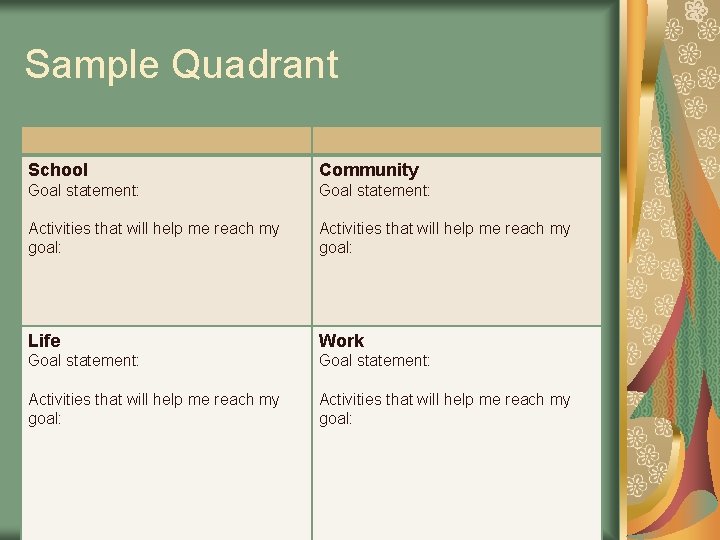
Moving from MAPS to Formal Plans Use information from MAP to identify 4 critical areas to be addressed. These will vary, but common ones are: school, community, family life, and work List each of the 4 areas in a separate box For each area, develop: Goal statements Ideas for activities
Sample Quadrant School Community Goal statement: Activities that will help me reach my goal: Life Work Goal statement: Activities that will help me reach my goal:
Moving to Plans… For each activity, make plans that show the activity will be carried out, who will do it, when it will be done, and how it will be measured. Include this information in the goals, objectives, and/or service plans of the formal plans that you need to make. (ie. IEP, IFSP)
What’s Next? Implement the plan Follow- up and evaluate the plan: Try another MAP!