
MAPS Basic Components Definition n Map a representation
MAPS Basic Components
Definition n Map = a representation of the Earth’s features drawn on a flat surface
Basic Components of a Map 1. TITLE • describes the basics of what the map tells us; usually given in two parts telling where and what • (i. e. Canada: Physical)
Basic Components of a Map 2. DIRECTION ARROW • usually always showing North, therefore E, S, and W are implied. (direction arrows are not in the atlas because North is always up) 3. BORDER • Sets map apart from other information in the text
Basic Components of a Map 4. SCALE • a way to measure distance Types of Scales: a) direct statement written in words (i. e. 1 cm represents 1 km)
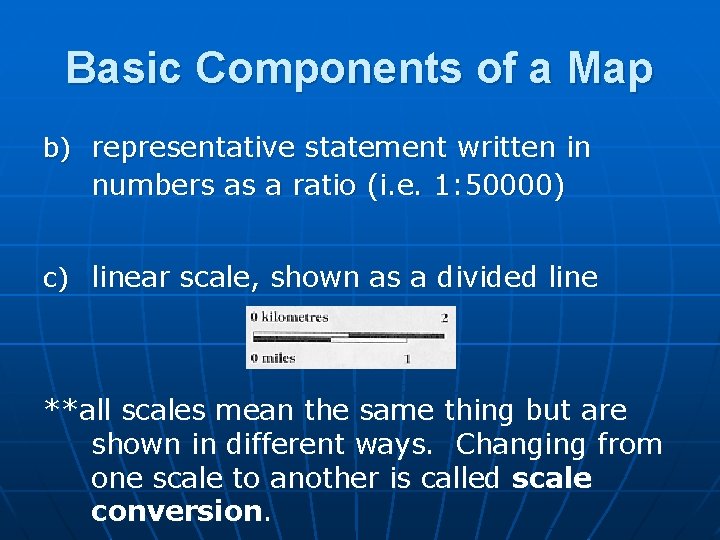
Basic Components of a Map b) representative statement written in numbers as a ratio (i. e. 1: 50000) c) linear scale, shown as a divided line **all scales mean the same thing but are shown in different ways. Changing from one scale to another is called scale conversion.
Basic Components of a Map 5. LEGEND • symbols on the map explained on the side. Types of Symbols: a) point – used to represent small objects (i. e. bridges or buildings).
Basic Components of a Map b) Line – represent features that appear as lines (i. e. roads or railways). c) Area – represent large features by colour and shading (i. e. lakes, mountain ranges, or forests). d) Date of Publication * Text Page 21
MAP RULES
Map Rules 1. All labeling on maps should be 2. 3. 4. done in blue or black ink All maps should include the 5 components All maps need a two-part title (where: what) All maps should be neat, accurate, and legible
Map Rules 5. All labeling should be written straight from left to right (exceptions: rivers, physical features) 6. Colouring: a) Use pencil crayons & make them distinct b) No dark colours c) No similar colours next to each other
Map Rules 7. Colours to keep in mind: a) Blue – water b) Browns and greens – physical maps c) Red – roads and cities d) Light pastel colours – political maps
Types of Maps n n General-purpose maps provide many types of information on one map. Good for broad understanding. (ex. Atlas, road maps) Thematic Maps – show very specific information on a particular topic of theme for a place. (ex. vegetation, see text pg. 23)
Types of Maps n n Topographic Maps – use symbols to show a variety of features. Contour lines show changes in elevation and grid system is used for locating places. (see pg. 24) Digital Map – maps in digital form in computer programs, handheld devices, or on the internet. Users can customize the presentation of the data. http: //maps. google. ca/
- Slides: 14